
Spine Hip Knee Foot Skeletal and muscular considerations

- Slides: 61
Spine, Hip, Knee, & Foot: Skeletal and muscular considerations in movement
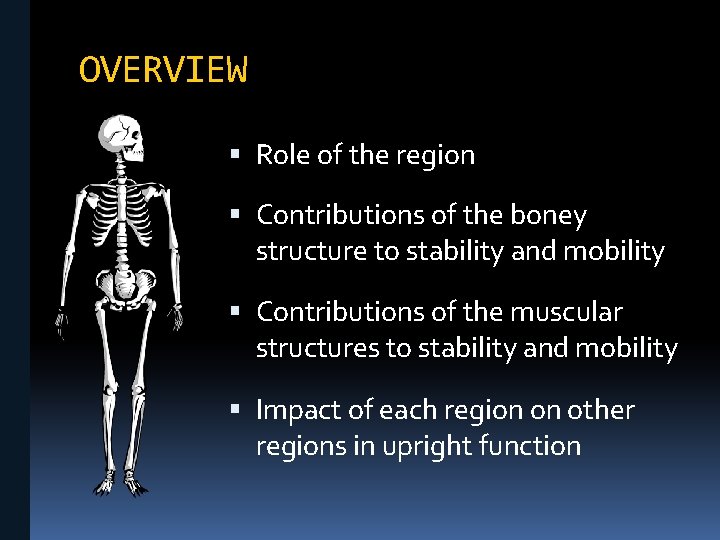
OVERVIEW Role of the region Contributions of the boney structure to stability and mobility Contributions of the muscular structures to stability and mobility Impact of each region on other regions in upright function
Spine & Trunk Skeletal and muscular considerations in movement
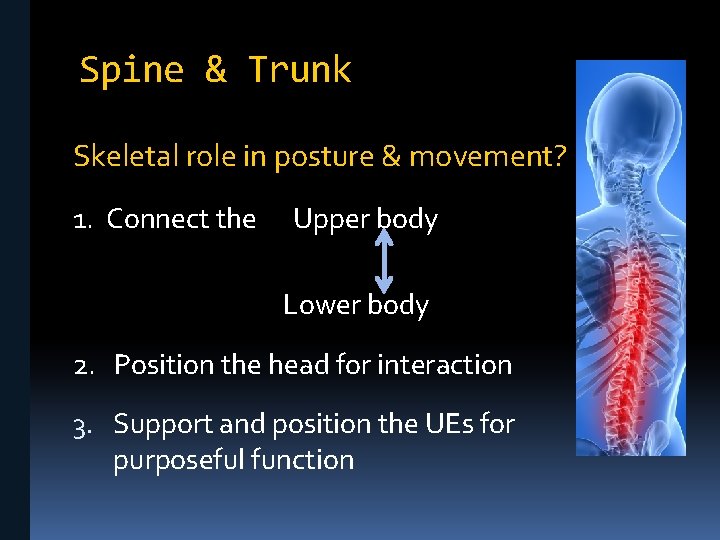
Spine & Trunk Skeletal role in posture & movement? 1. Connect the Upper body Lower body 2. Position the head for interaction 3. Support and position the UEs for purposeful function
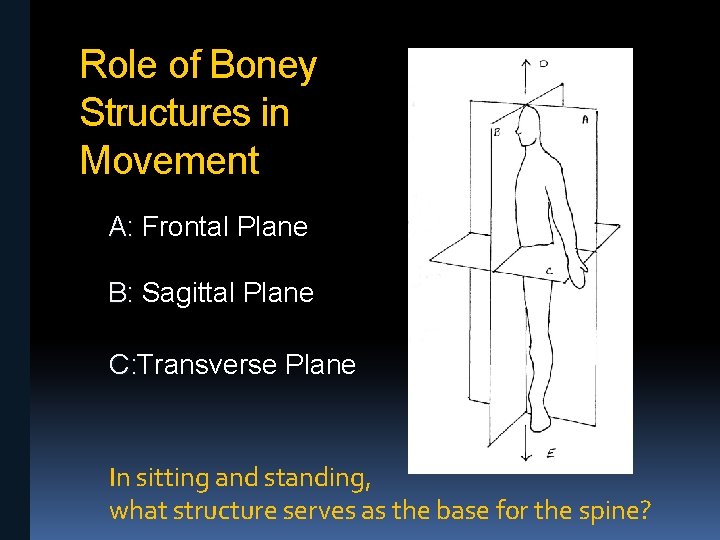
Role of Boney Structures in Movement A: Frontal Plane B: Sagittal Plane C: Transverse Plane C: In sitting and standing, what structure serves as the base for the spine?
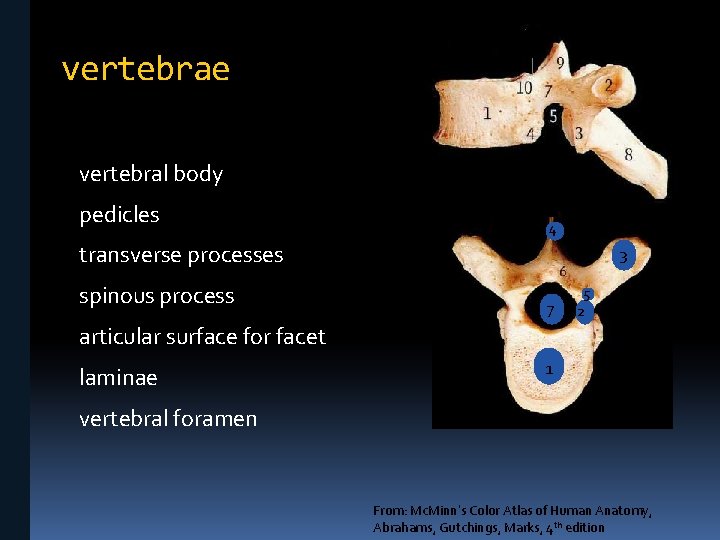
vertebrae vertebral body pedicles 4 transverse processes spinous process 3 7 5 2 articular surface for facet laminae 1 vertebral foramen From: Mc. Minn’s Color Atlas of Human Anatomy, Abrahams, Gutchings, Marks, 4 th edition
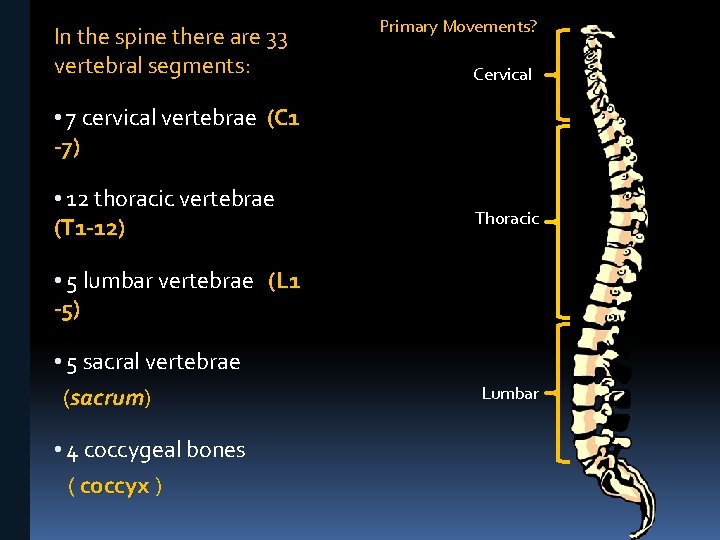
In the spine there are 33 vertebral segments: Primary Movements? Cervical • 7 cervical vertebrae (C 1 -7) -7 • 12 thoracic vertebrae (T 1 -12) T 1 -12 Thoracic • 5 lumbar vertebrae (L 1 -5) -5 • 5 sacral vertebrae (sacrum) sacrum • 4 coccygeal bones ( coccyx ) Lumbar
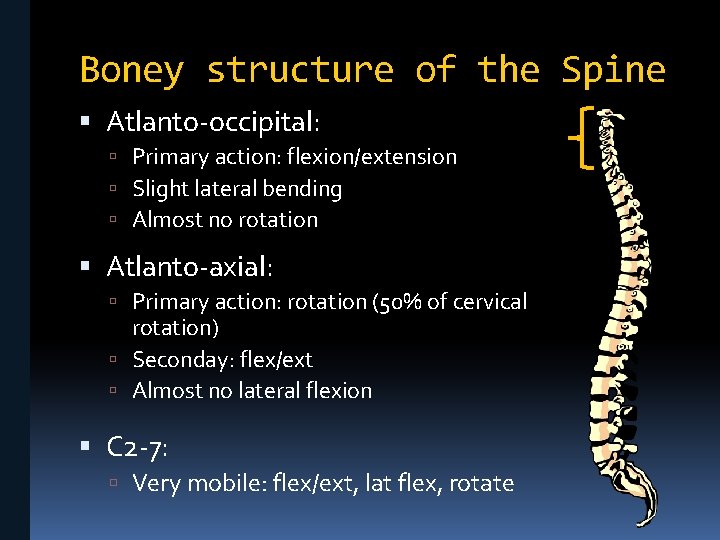
Boney structure of the Spine Atlanto-occipital: Primary action: flexion/extension Slight lateral bending Almost no rotation Atlanto-axial: Primary action: rotation (50% of cervical rotation) Seconday: flex/ext Almost no lateral flexion C 2 -7: Very mobile: flex/ext, lat flex, rotate
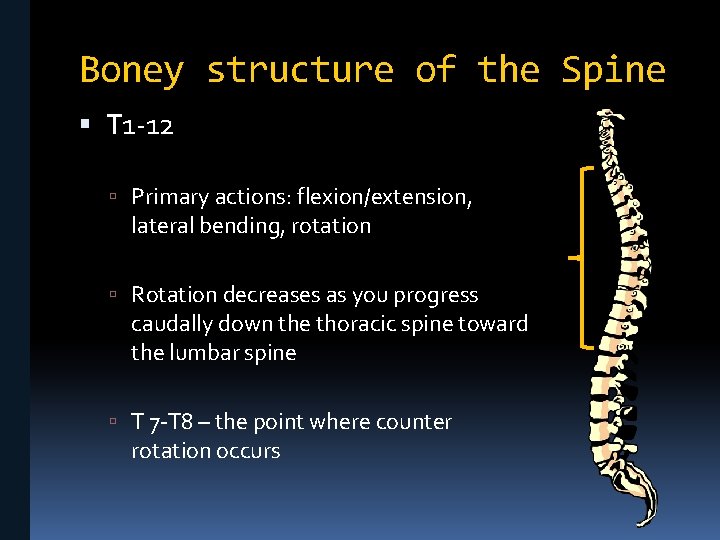
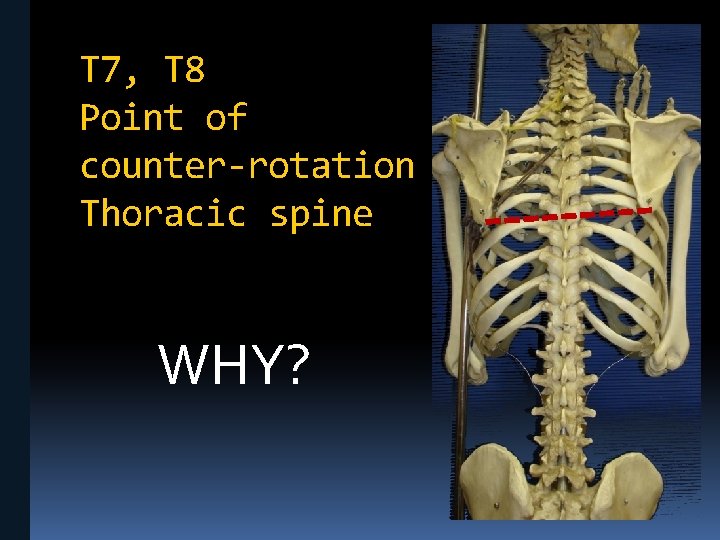
Boney structure of the Spine T 1 -12 Primary actions: flexion/extension, lateral bending, rotation Rotation decreases as you progress caudally down the thoracic spine toward the lumbar spine T 7 -T 8 – the point where counter rotation occurs
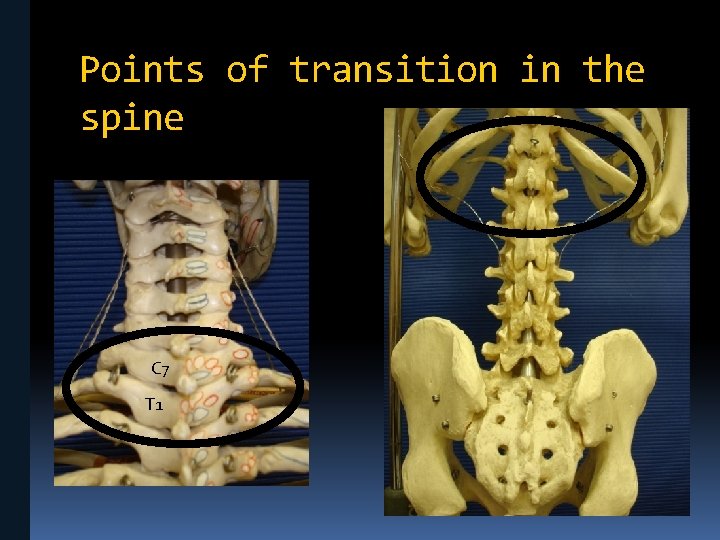
Points of transition in the spine C 7 T 1
T 7, T 8 Point of counter-rotation in the Thoracic spine WHY?
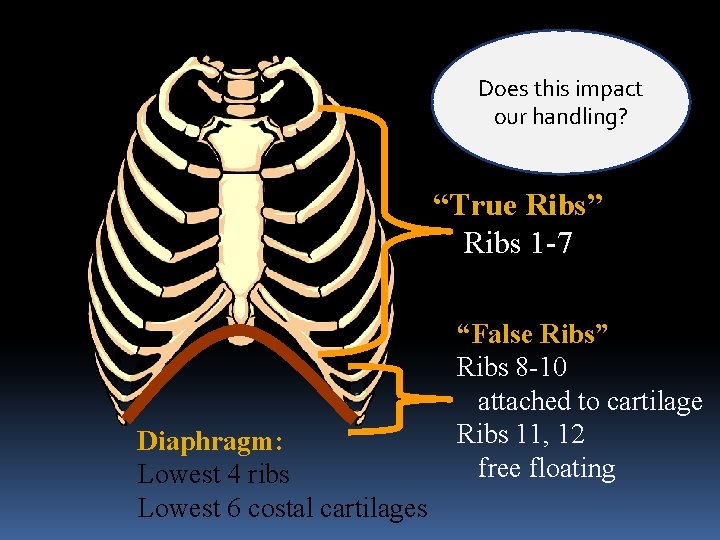
Does this impact our handling? “True Ribs” Ribs 1 -7 Diaphragm: Lowest 4 ribs Lowest 6 costal cartilages “False Ribs” Ribs 8 -10 attached to cartilage Ribs 11, 12 free floating
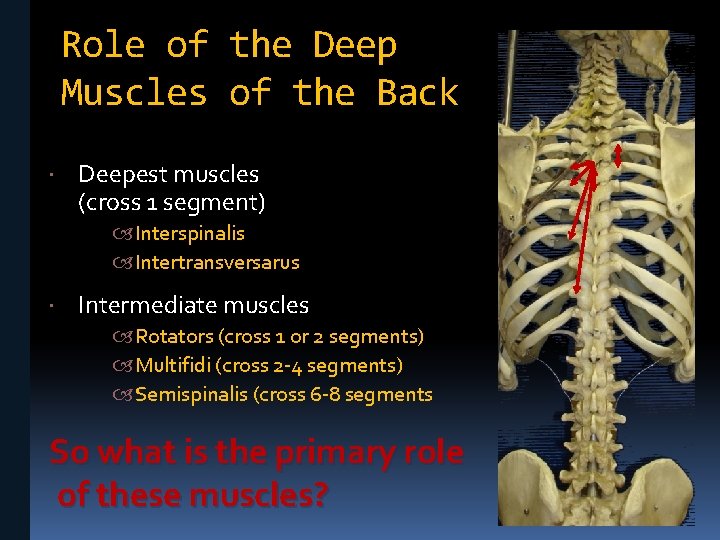
Role of the Deep Muscles of the Back Deepest muscles (cross 1 segment) Interspinalis Intertransversarus Intermediate muscles Rotators (cross 1 or 2 segments) Multifidi (cross 2 -4 segments) Semispinalis (cross 6 -8 segments So what is the primary role of these muscles?
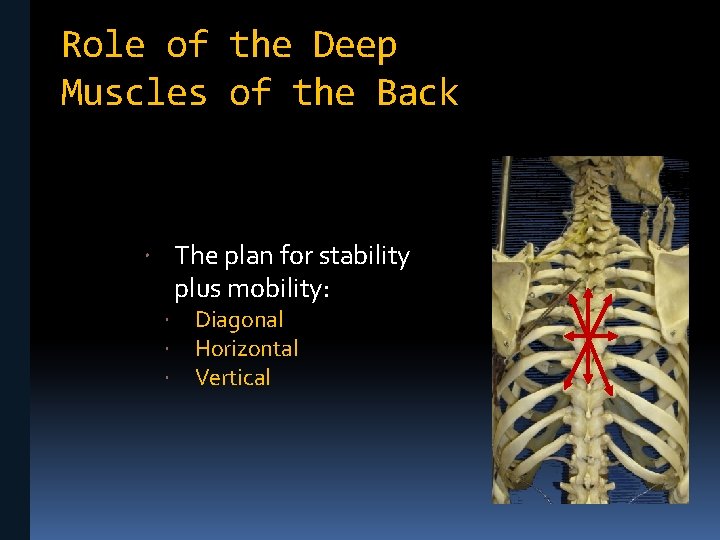
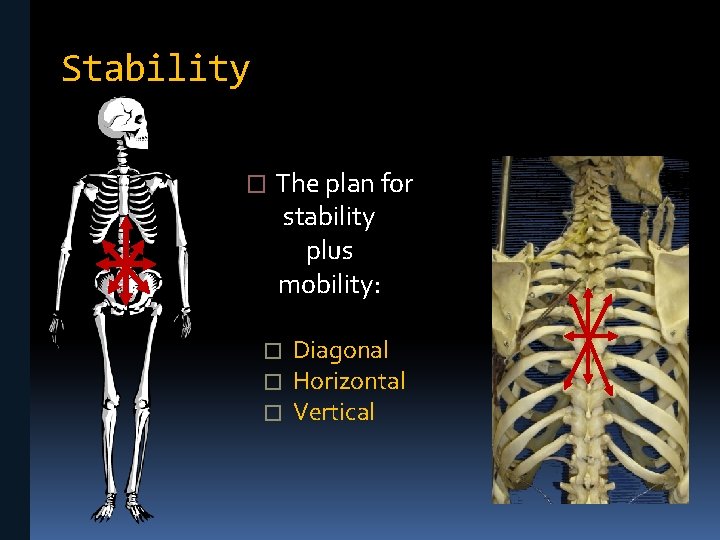
Role of the Deep Muscles of the Back The plan for stability plus mobility: Diagonal Horizontal Vertical
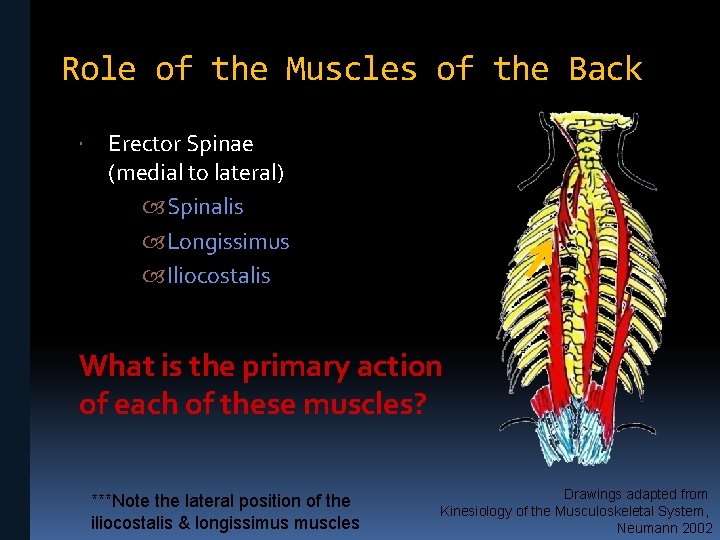
Role of the Muscles of the Back Erector Spinae (medial to lateral) Spinalis Longissimus Iliocostalis What is the primary action of each of these muscles? ***Note the lateral position of the iliocostalis & longissimus muscles Drawings adapted from Kinesiology of the Musculoskeletal System, Neumann 2002
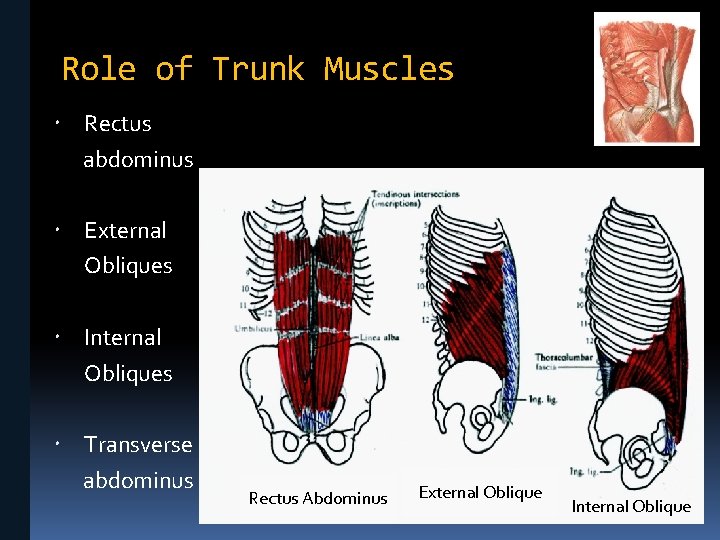
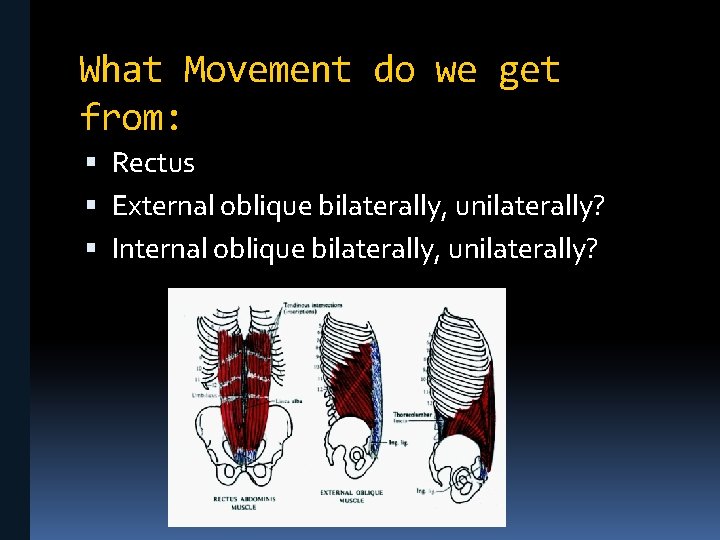
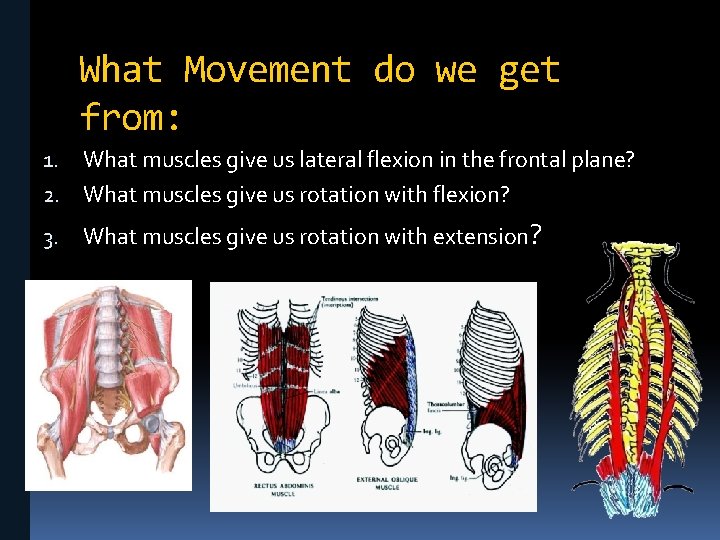
Role of Trunk Muscles Rectus abdominus External Obliques Internal Obliques Transverse abdominus Rectus Abdominus External Oblique Internal Oblique
What Movement do we get from: Rectus External oblique bilaterally, unilaterally? Internal oblique bilaterally, unilaterally?
What Movement do we get from: What muscles give us lateral flexion in the frontal plane? 2. What muscles give us rotation with flexion? 1. 3. What muscles give us rotation with extension?
Stability � The plan for stability plus mobility: � � � Diagonal Horizontal Vertical
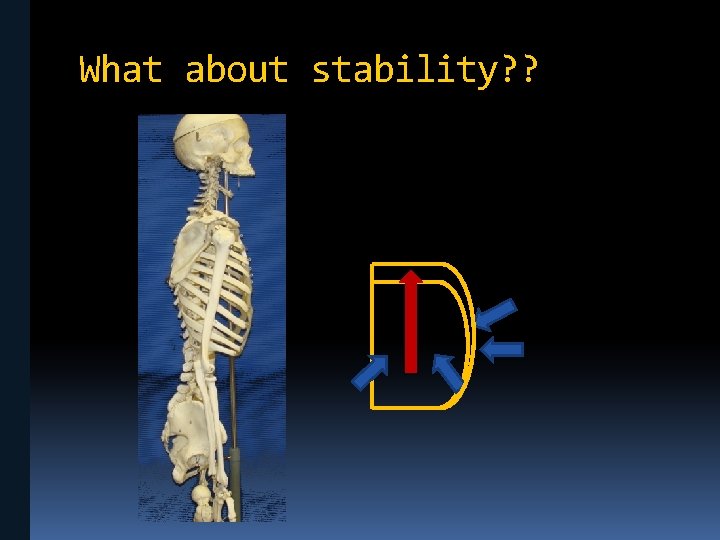
What about stability? ?
Summary: What does this mean to our handling and our facilitations?
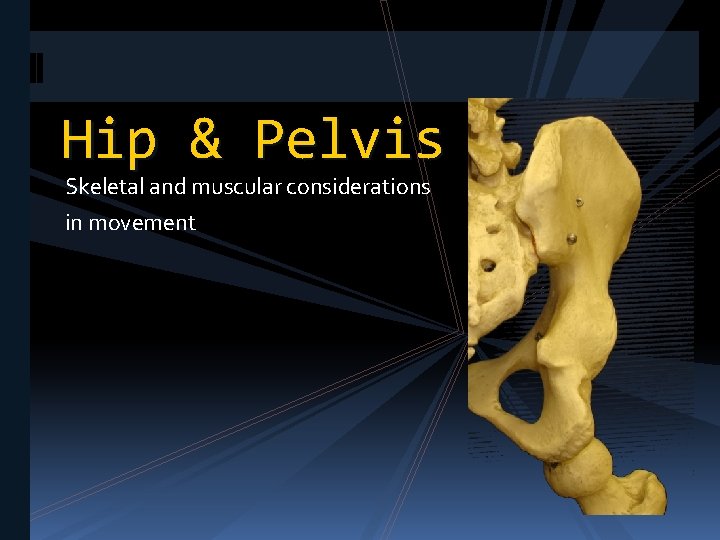
Hip & Pelvis Skeletal and muscular considerations in movement
Hip & Pelvis Skeletal role in posture & movement? 1. Weightbearing 2. Movement of the hip joint allows translation of the trunk unit through space 3. Pelvis is the base for the spine
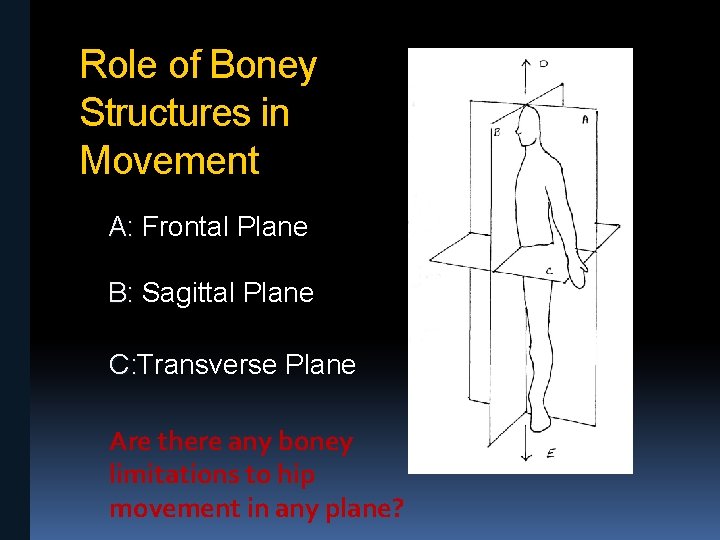
Role of Boney Structures in Movement A: Frontal Plane B: Sagittal Plane C: Transverse Plane C: Are there any boney limitations to hip movement in any plane?
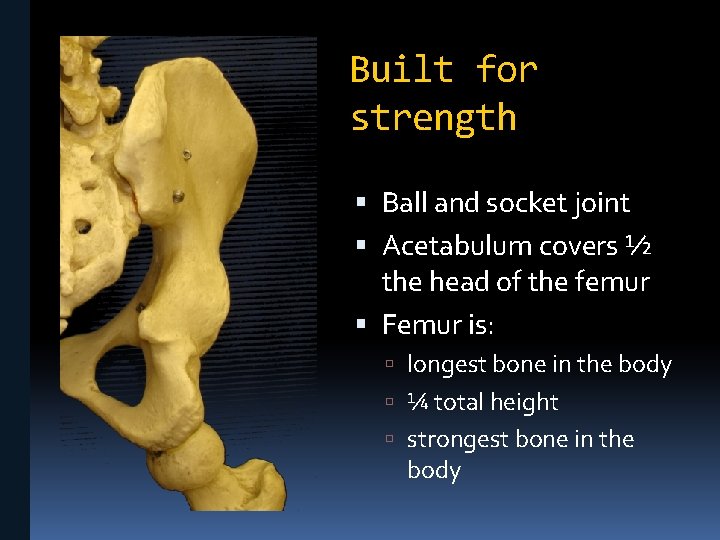
Built for strength Ball and socket joint Acetabulum covers ½ the head of the femur Femur is: longest bone in the body ¼ total height strongest bone in the body
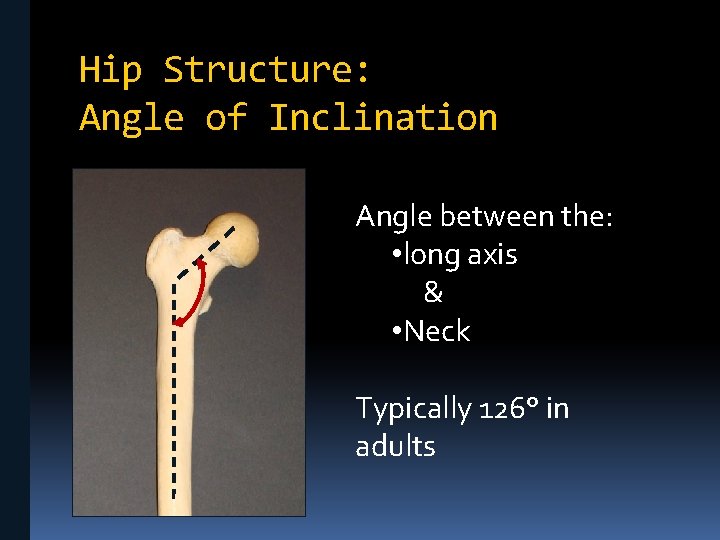
Hip Structure: Angle of Inclination Angle between the: • long axis & • Neck Typically 126° in adults
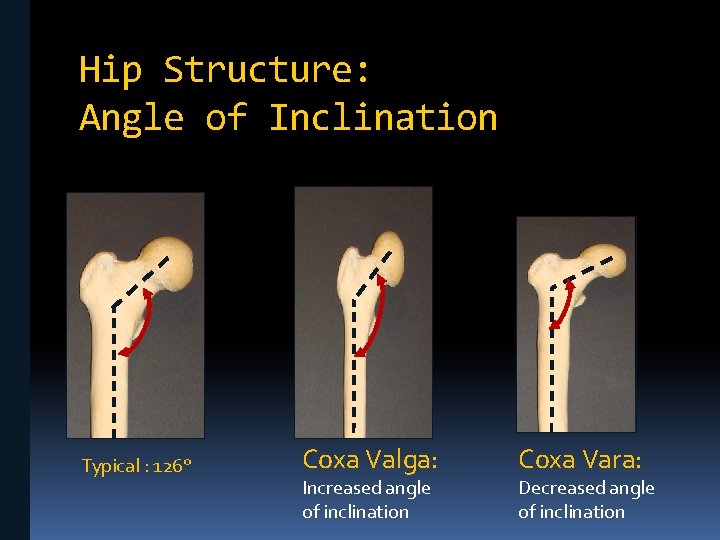
Hip Structure: Angle of Inclination Typical : 126° Coxa Valga: Increased angle of inclination Coxa Vara: Decreased angle of inclination
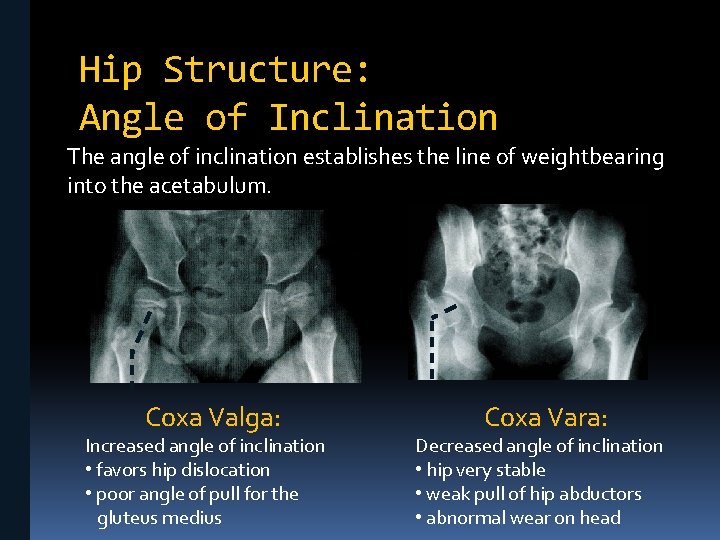
Hip Structure: Angle of Inclination The angle of inclination establishes the line of weightbearing into the acetabulum. Coxa Valga: Increased angle of inclination • favors hip dislocation • poor angle of pull for the gluteus medius Coxa Vara: Decreased angle of inclination • hip very stable • weak pull of hip abductors • abnormal wear on head
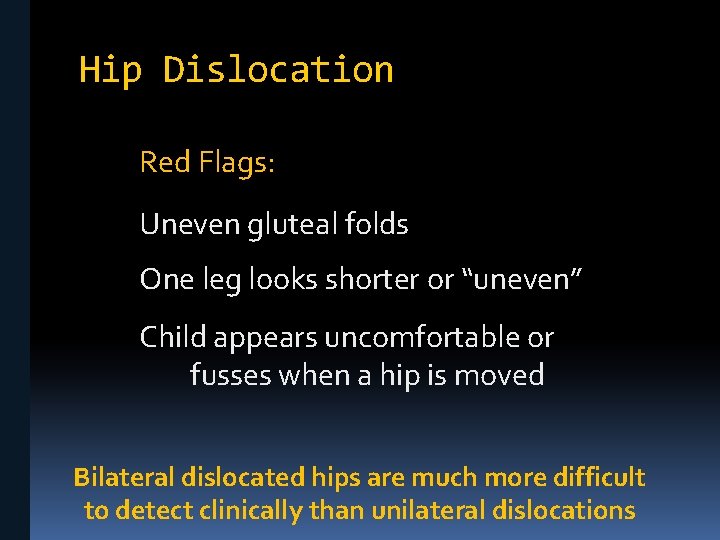
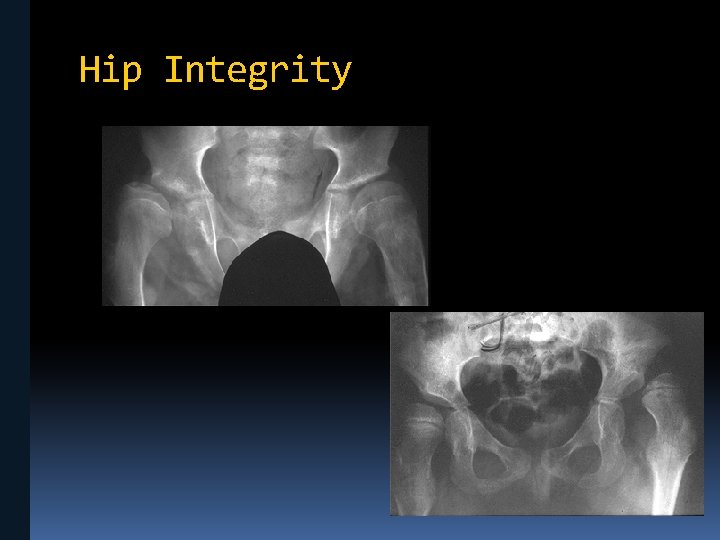
Hip Dislocation Red Flags: Uneven gluteal folds One leg looks shorter or “uneven” Child appears uncomfortable or fusses when a hip is moved Bilateral dislocated hips are much more difficult to detect clinically than unilateral dislocations
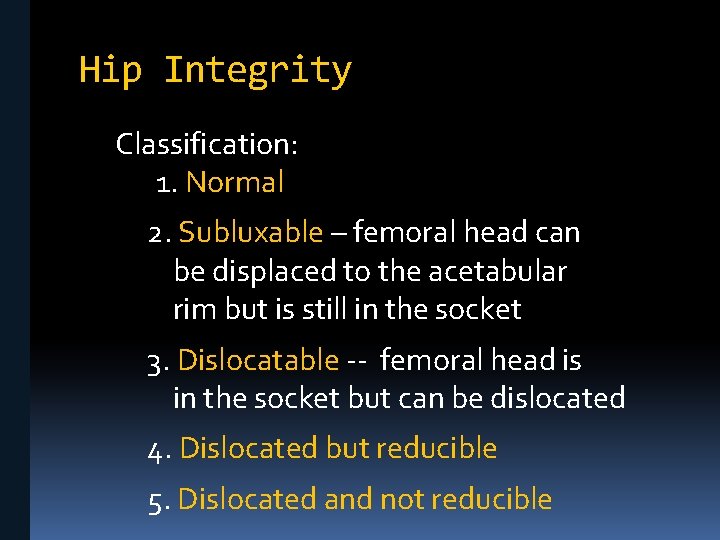
Hip Integrity Classification: 1. Normal 2. Subluxable – femoral head can be displaced to the acetabular rim but is still in the socket 3. Dislocatable -- femoral head is in the socket but can be dislocated 4. Dislocated but reducible 5. Dislocated and not reducible
Hip Integrity
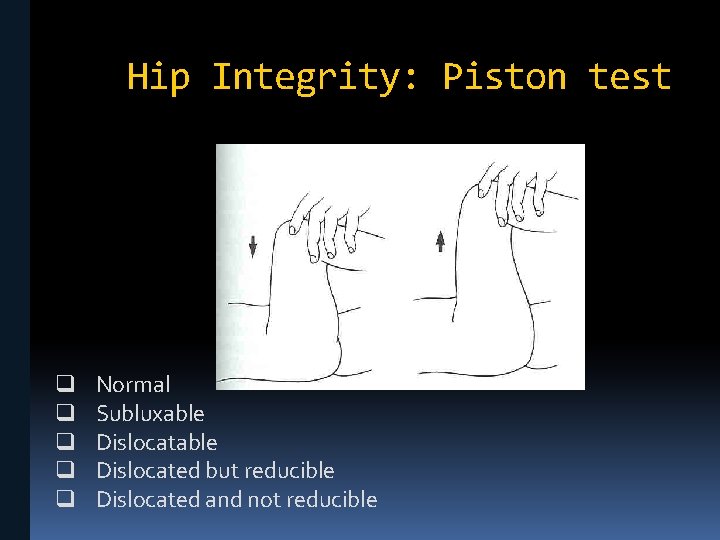
Hip Integrity: Piston test q q q Normal Subluxable Dislocated but reducible Dislocated and not reducible
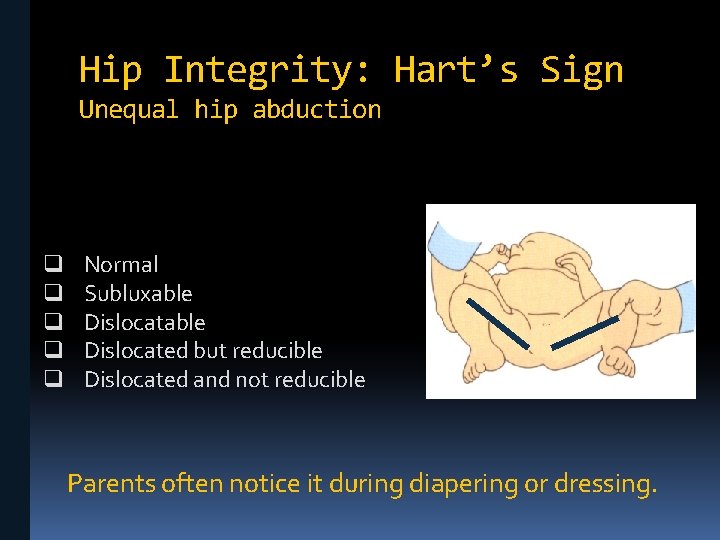
Hip Integrity: Hart’s Sign Unequal hip abduction q q q Normal Subluxable Dislocated but reducible Dislocated and not reducible Parents often notice it during diapering or dressing.
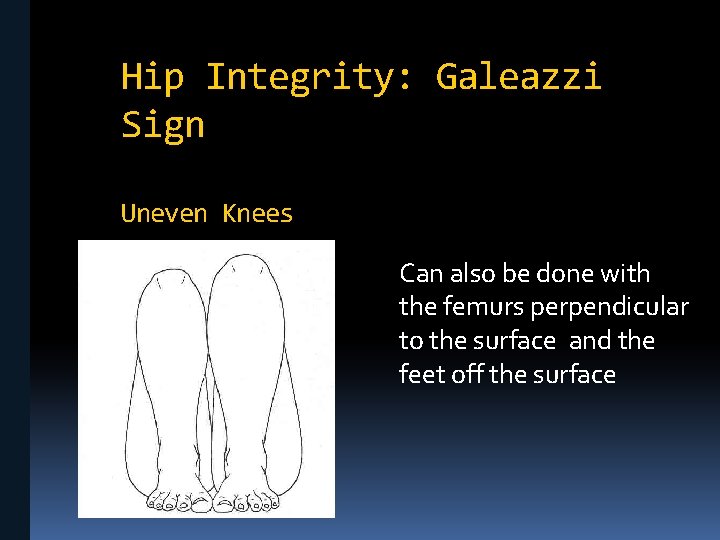
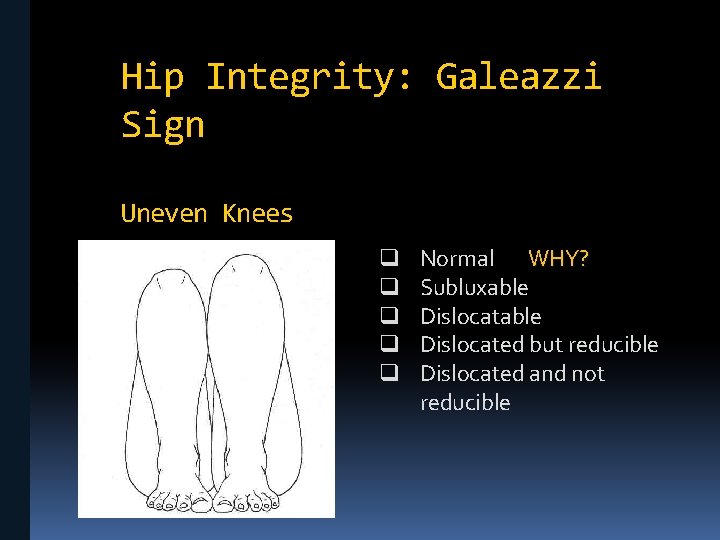
Hip Integrity: Galeazzi Sign Uneven Knees Can also be done with the femurs perpendicular to the surface and the feet off the surface
Hip Integrity: Galeazzi Sign Uneven Knees q q q Normal WHY? Subluxable Dislocated but reducible Dislocated and not reducible
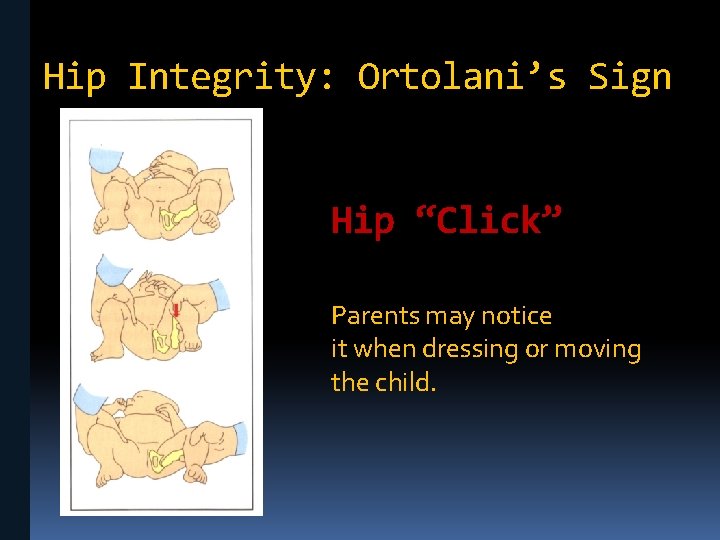
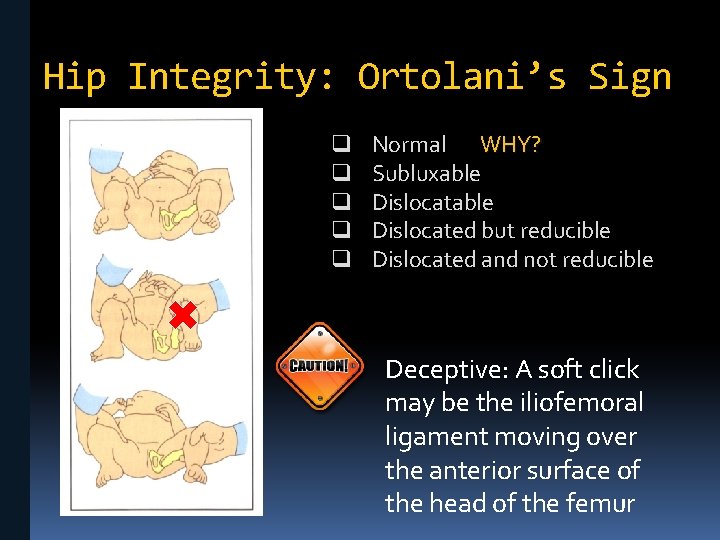
Hip Integrity: Ortolani’s Sign Hip “Click” Parents may notice it when dressing or moving the child.
Hip Integrity: Ortolani’s Sign q q q Normal WHY? Subluxable Dislocated but reducible Dislocated and not reducible Deceptive: A soft click may be the iliofemoral ligament moving over the anterior surface of the head of the femur
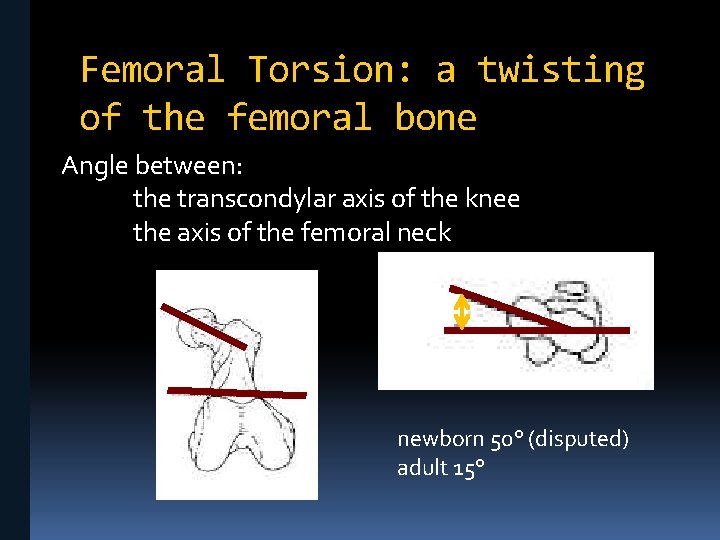
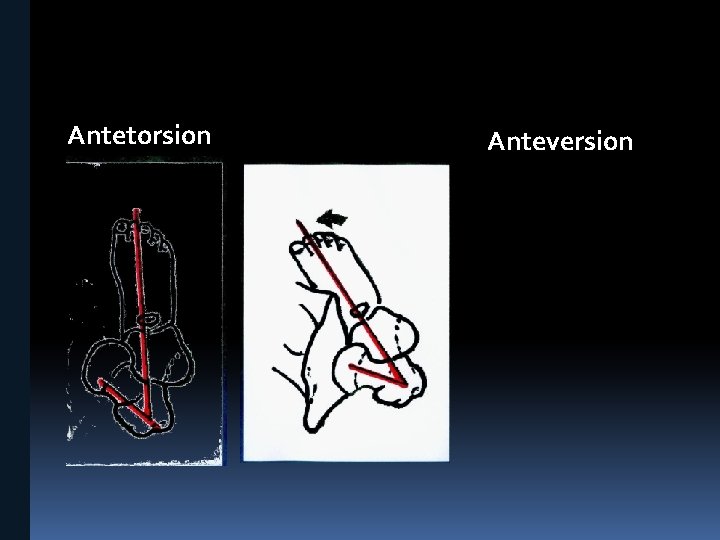
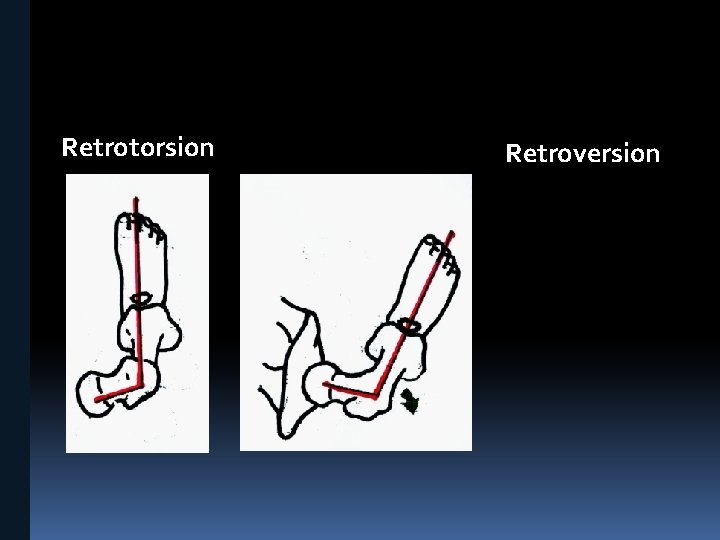
Femoral Torsion: a twisting of the femoral bone Angle between: the transcondylar axis of the knee the axis of the femoral neck newborn 50° (disputed) adult 15°
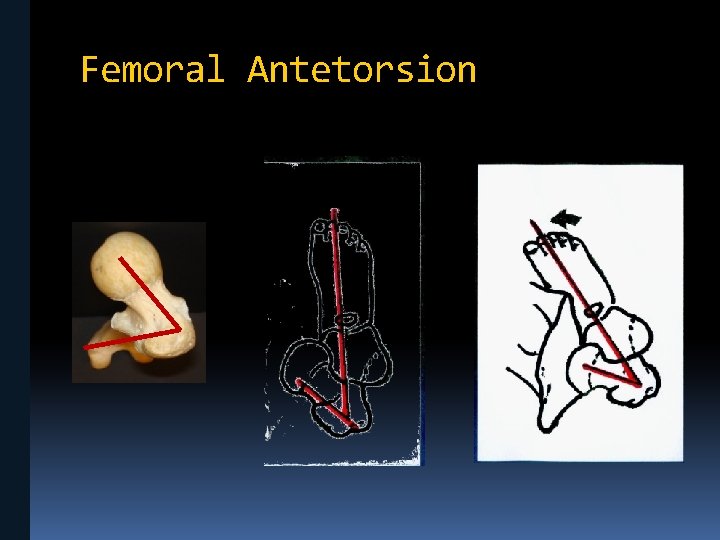
Femoral Antetorsion
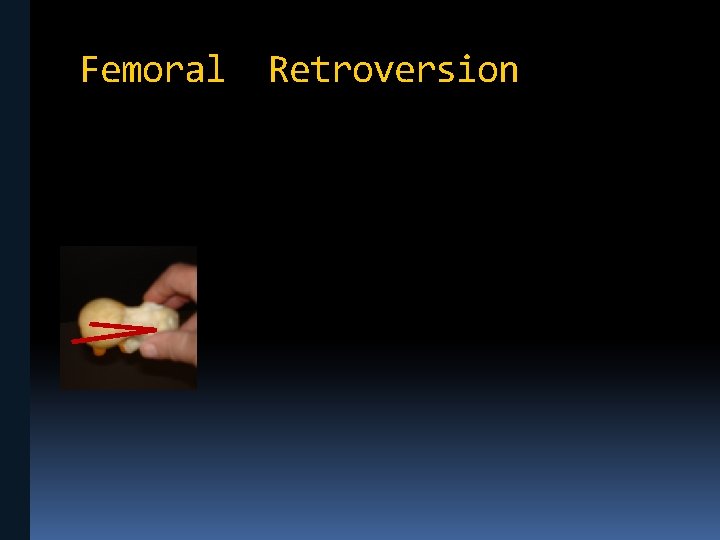
Femoral Retroversion
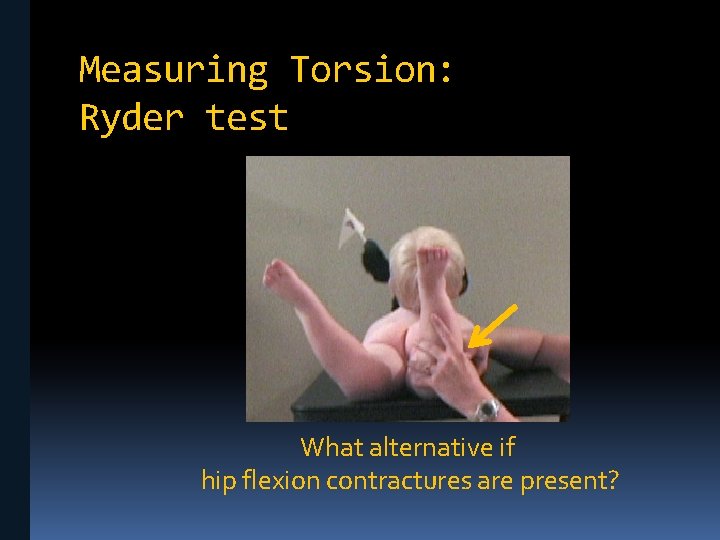
Measuring Torsion: Ryder test What alternative if hip flexion contractures are present?
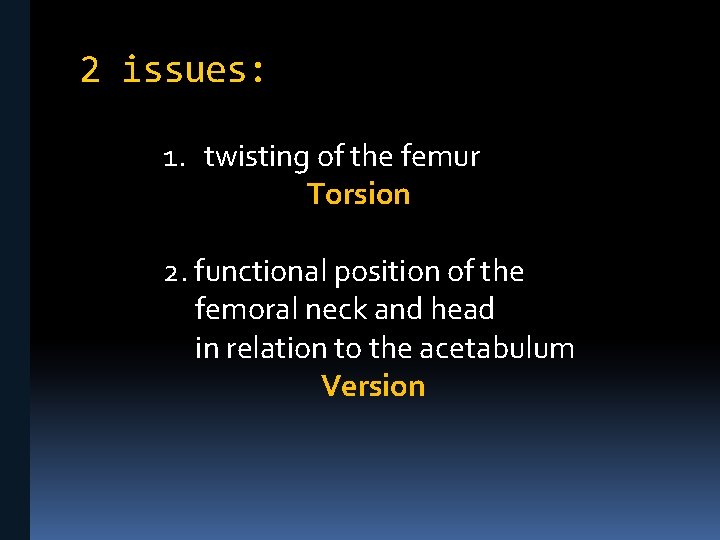
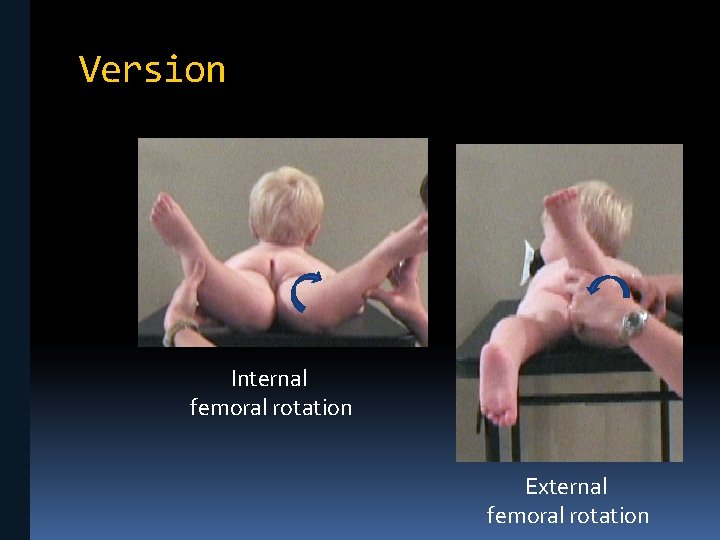
2 issues: 1. twisting of the femur Torsion 2. functional position of the femoral neck and head in relation to the acetabulum Version
Antetorsion Anteversion
Retrotorsion Retroversion
Version Internal femoral rotation External femoral rotation
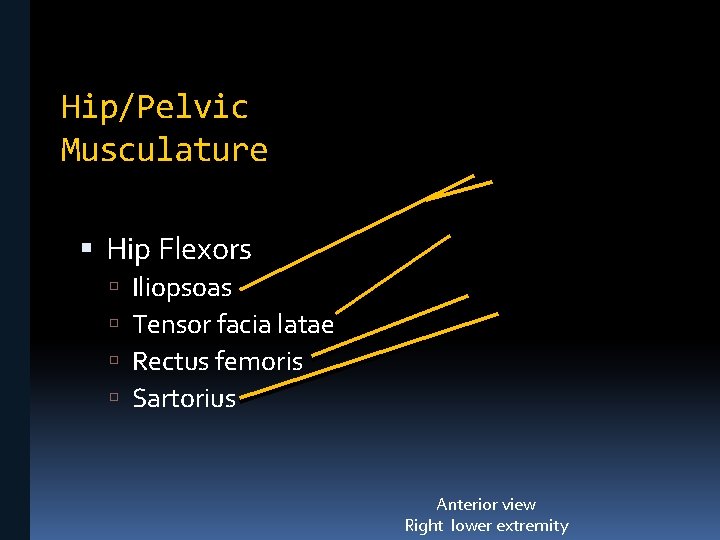
Hip/Pelvic Musculature Hip Flexors Iliopsoas Tensor facia latae Rectus femoris Sartorius Anterior view Right lower extremity
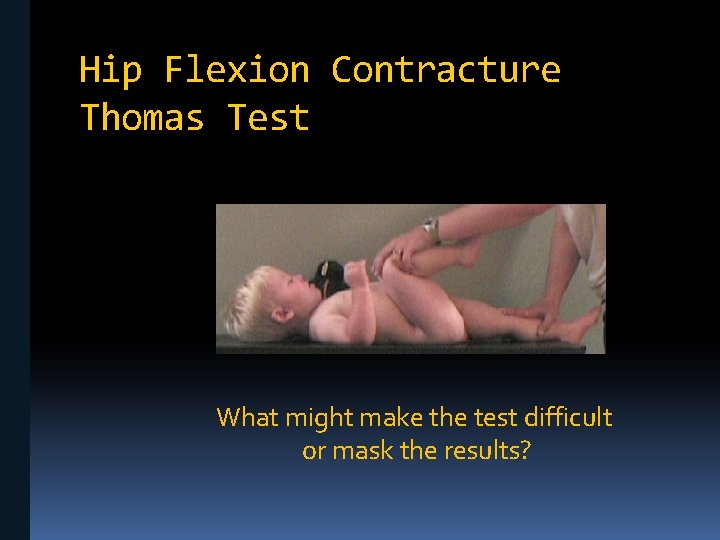
Hip Flexion Contracture Thomas Test What might make the test difficult or mask the results?
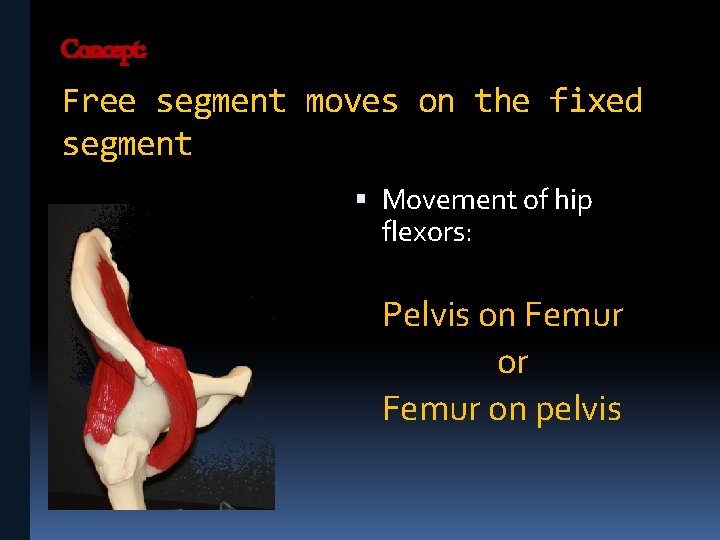
Concept: Free segment moves on the fixed segment Movement of hip flexors: Pelvis on Femur or Femur on pelvis
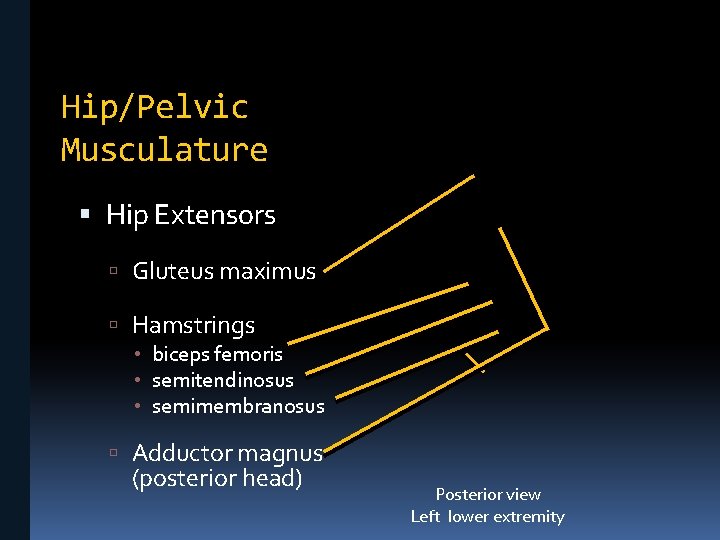
Hip/Pelvic Musculature Hip Extensors Gluteus maximus Hamstrings • biceps femoris • semitendinosus • semimembranosus Adductor magnus (posterior head) Posterior view Left lower extremity
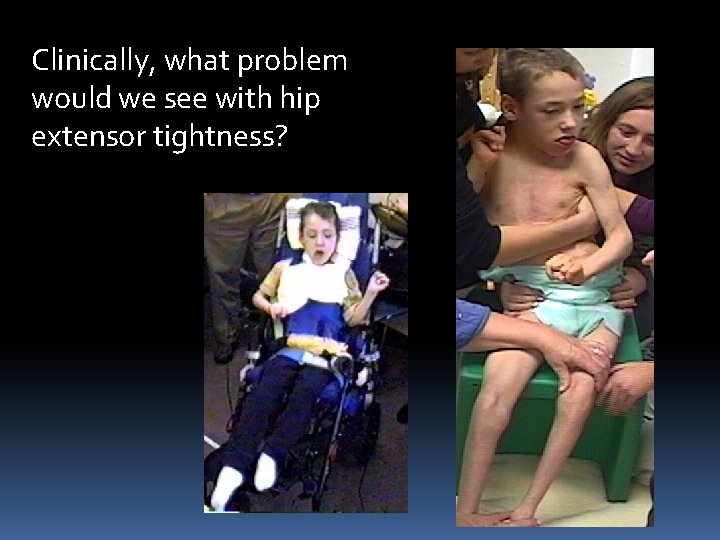
Clinically, what problem would we see with hip extensor tightness?
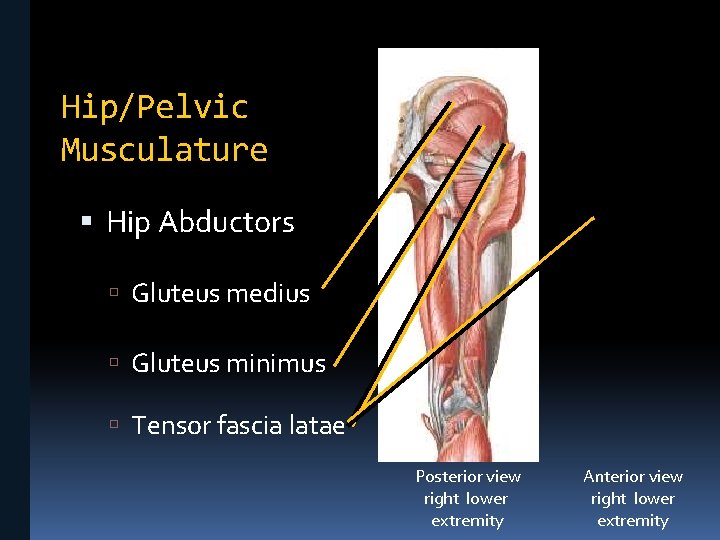
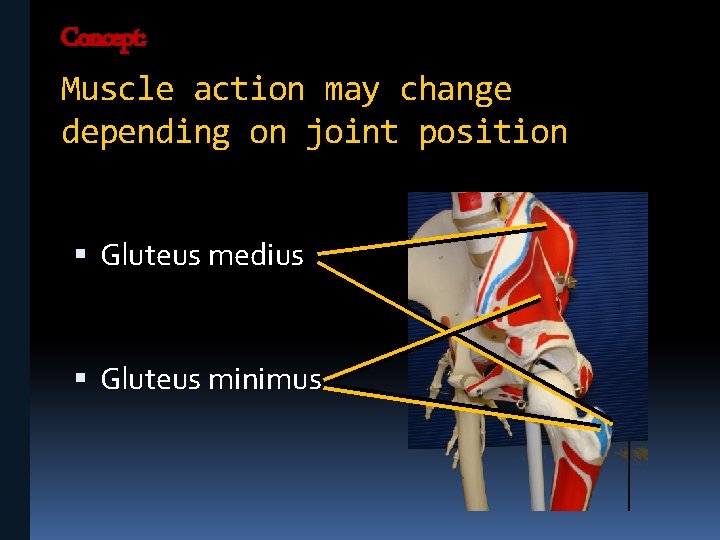
Hip/Pelvic Musculature Hip Abductors Gluteus medius Gluteus minimus Tensor fascia latae Posterior view right lower extremity Anterior view right lower extremity
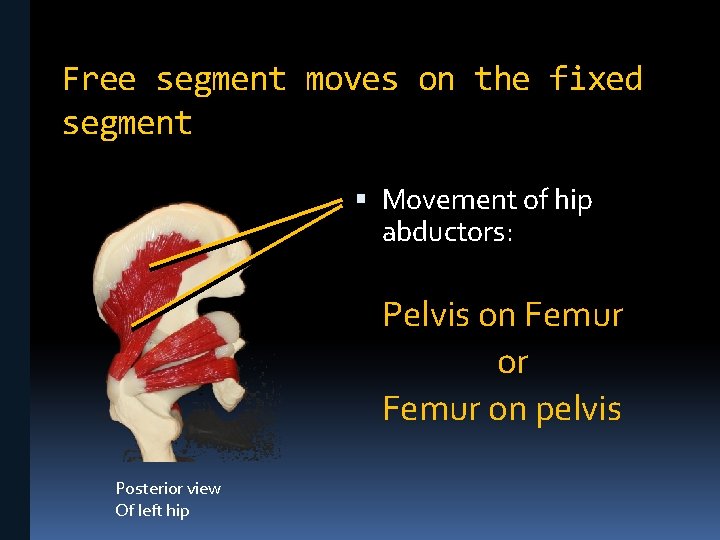
Free segment moves on the fixed segment Movement of hip abductors: Pelvis on Femur or Femur on pelvis Posterior view Of left hip
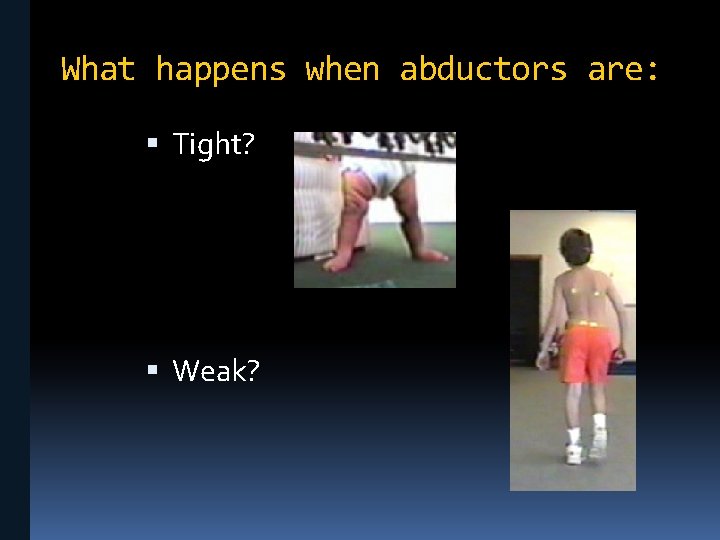
What happens when abductors are: Tight? Weak?
Concept: Muscle action may change depending on joint position Gluteus medius Gluteus minimus
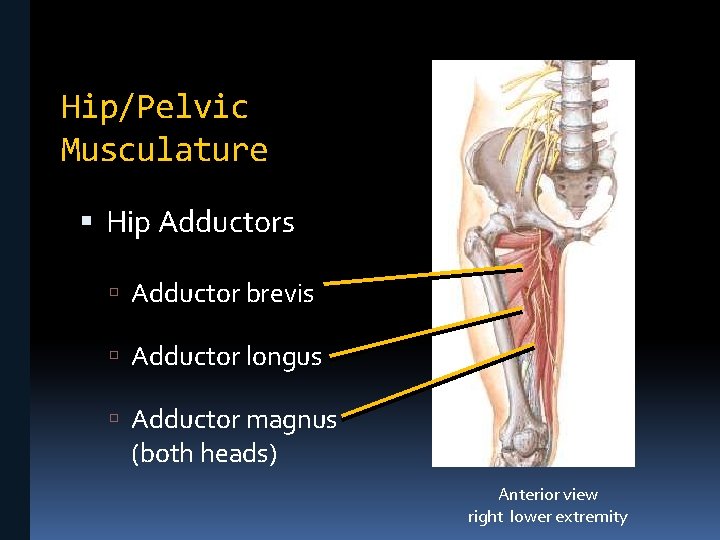
Hip/Pelvic Musculature Hip Adductors Adductor brevis Adductor longus Adductor magnus (both heads) Anterior view right lower extremity
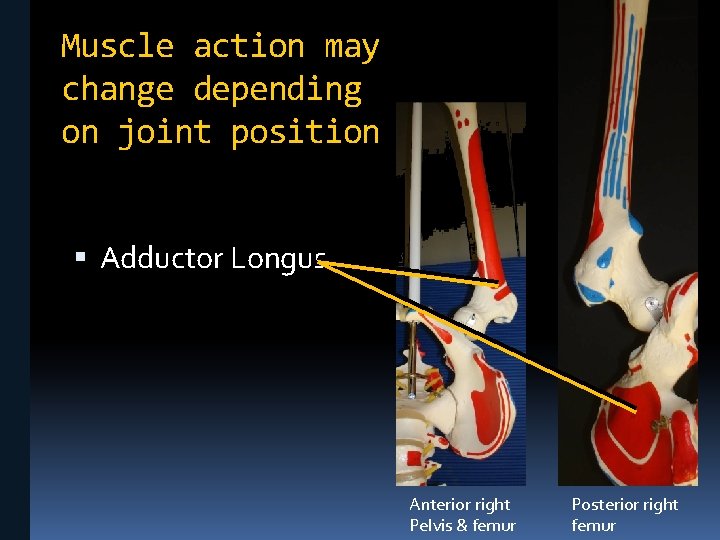
Muscle action may change depending on joint position Adductor Longus Anterior right Pelvis & femur Posterior right femur
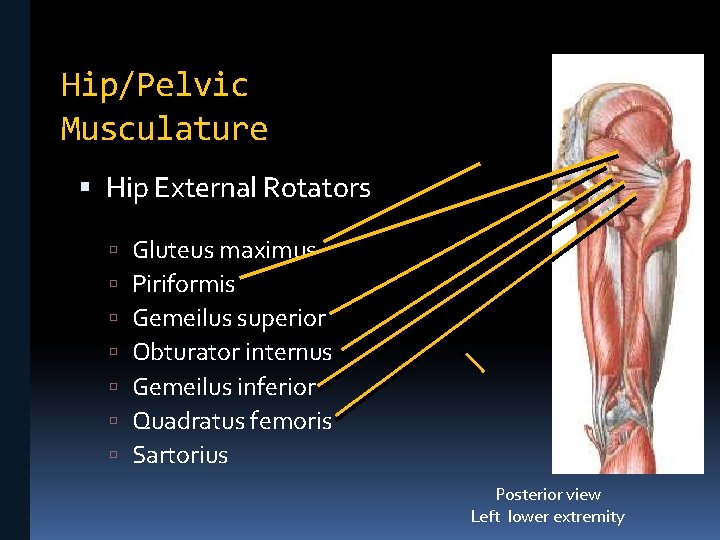
Hip/Pelvic Musculature Hip External Rotators Gluteus maximus Piriformis Gemeilus superior Obturator internus Gemeilus inferior Quadratus femoris Sartorius Posterior view Left lower extremity
Hip/Pelvic Musculature Hip Internal Rotators
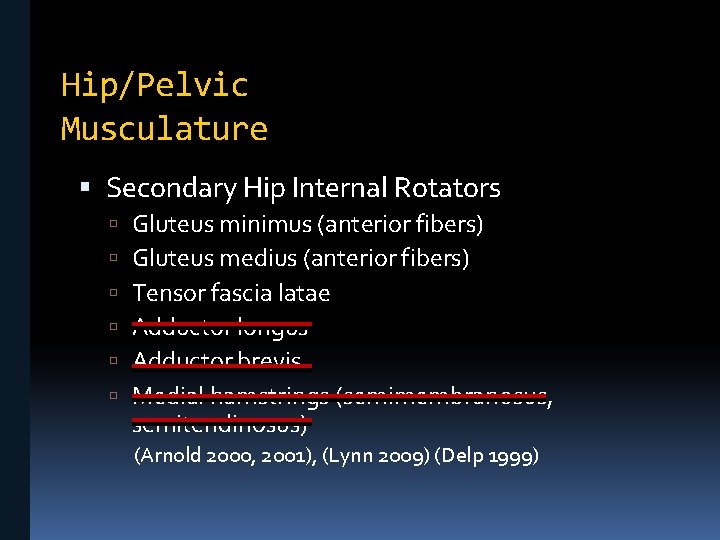
Hip/Pelvic Musculature Secondary Hip Internal Rotators Gluteus minimus (anterior fibers) Gluteus medius (anterior fibers) Tensor fascia latae Adductor longus Adductor brevis Medial hamstrings (semimembranosus, semitendinosus) (Arnold 2000, 2001), (Lynn 2009) (Delp 1999)
Important Points: 1. Facilitate muscles…not bones Stay off the pelvis! 2. Mobile segments move on the fixed segments… 2 sides to every coin. 3. Muscle function can change with joint position…ALIGNMENT IS ESSENTIAL TO FUNCTION!!! 4. Challenge your assumptions!!!!
Surface Anatomy Find: • Spinous Processes: Kyphosis, Lordosis, Scoliosis • C 7 Spinous Process • T 7 –T 8 • Sacrum • ASIS • PSIS • Head of the Trochanter