
Spinal Trauma Samuel Kim M Div September 12
Spinal Trauma Samuel Kim, M. Div. September 12, 2006
Introduction • 40 y. o. male falls off a 12 foot high roof and lands on his back – Not able to feel or move his lower extremities – C-collared, boarded and sent to the nearest trauma center – 10 mg Morphine given en route
Introduction • Initial trauma survey: – Airway: intact – Breathing: clear b/l, equal, no crepitus – Circulation: BP 160/90, 2+ pulses x 4 – Disability: no sensation or motor below umbilicus – Exposure
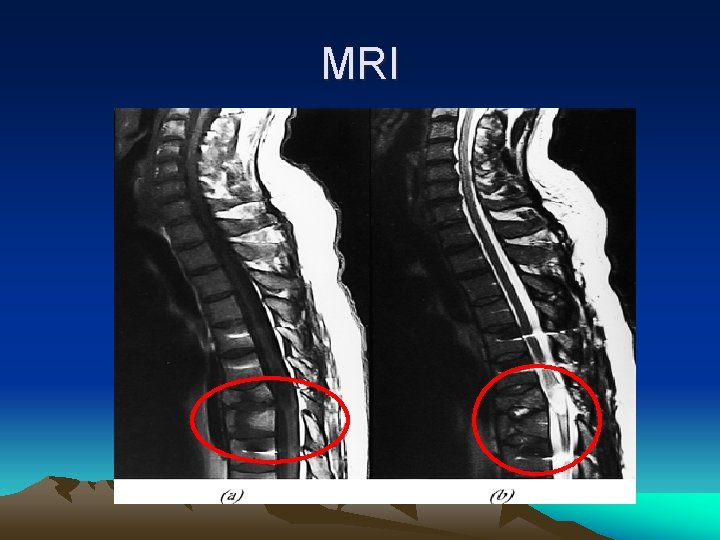
MRI
Introduction • Pt suffered a burst fracture of T 7 and T 8 • No change in condition over next several days • Eventually sent to rehabilitation • Poor prognosis: permanent paraplegia
Statistics • 10, 000 - 20, 000 spinal cord injuries per year • Incidence – ~ 82% occur in men – ~ 61% occur in 16 -30 y. o. • Common causes – – MVC (48%) Falls (21%) Penetrating injuries (15%) Sports injuries (14%)
Statistics • 40% of trauma patients with neuro deficits will have temporary or permanent SCI • Many more vertebral injuries that do not result in cord injury • Most commonly injured vertebrae – C 5 -C 7 – C 1 -C 2 – T 12 -L 2
Statistics • Average cost of caring for permanent paraplegics and quadriplegics – Over five billion dollars per year • Not all are Christopher Reeves • Costs ultimately paid by tax payers
Introduction • As first responders: – Can play a significant role in minimizing secondary spinal cord injuries
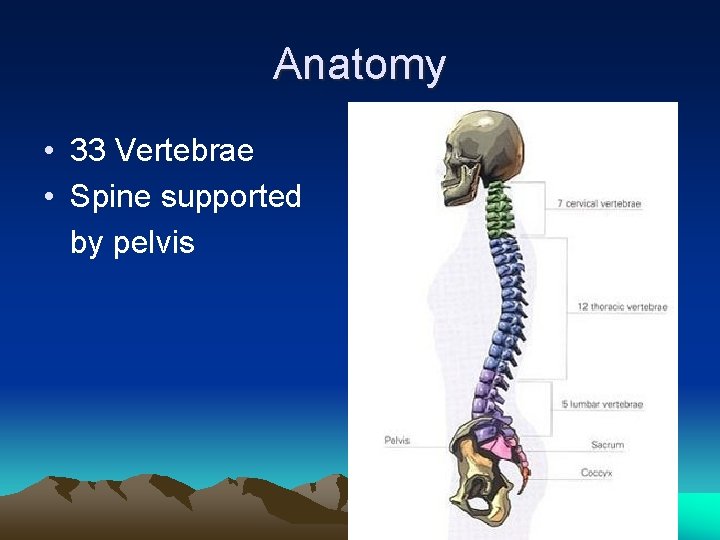
Anatomy • 33 Vertebrae • Spine supported by pelvis
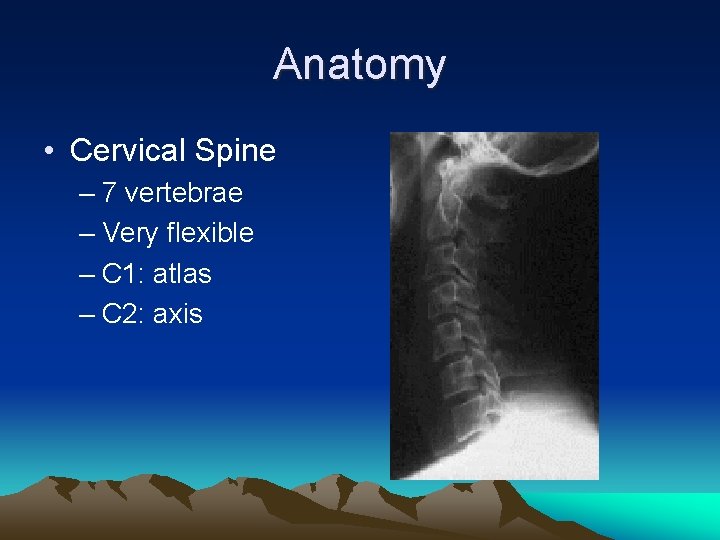
Anatomy • Cervical Spine – 7 vertebrae – Very flexible – C 1: atlas – C 2: axis
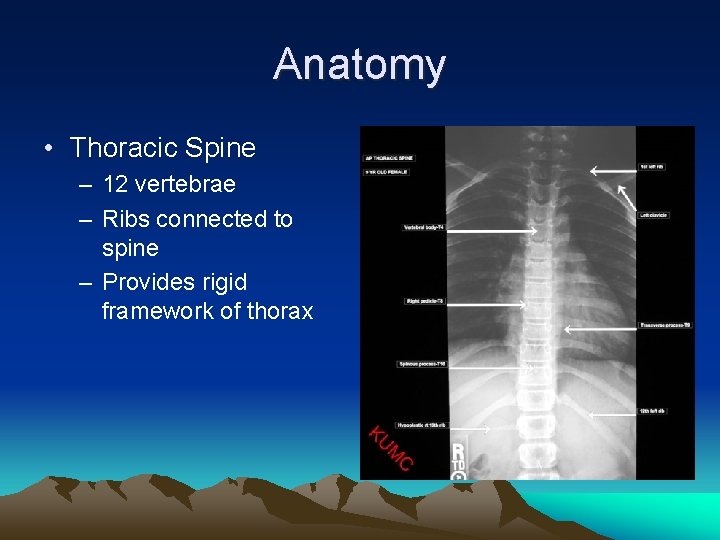
Anatomy • Thoracic Spine – 12 vertebrae – Ribs connected to spine – Provides rigid framework of thorax
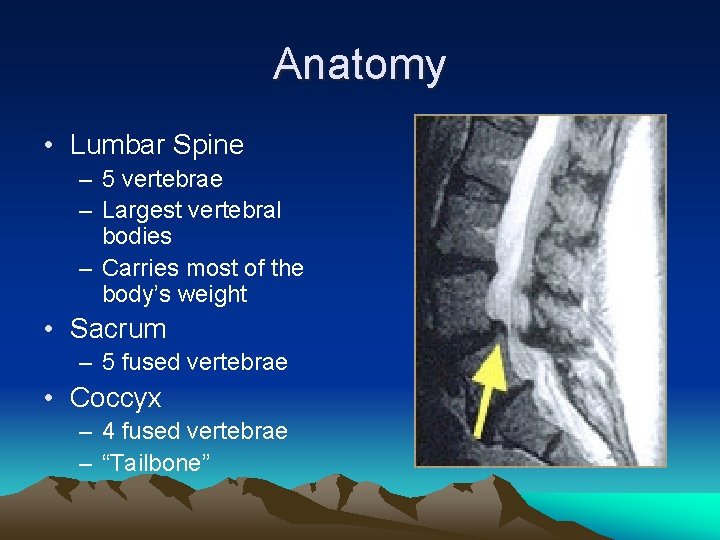
Anatomy • Lumbar Spine – 5 vertebrae – Largest vertebral bodies – Carries most of the body’s weight • Sacrum – 5 fused vertebrae • Coccyx – 4 fused vertebrae – “Tailbone”
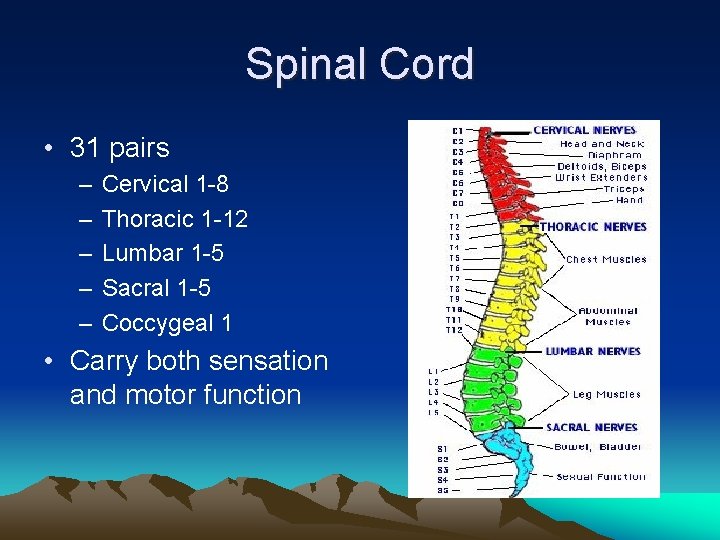
Spinal Cord • 31 pairs – – – Cervical 1 -8 Thoracic 1 -12 Lumbar 1 -5 Sacral 1 -5 Coccygeal 1 • Carry both sensation and motor function
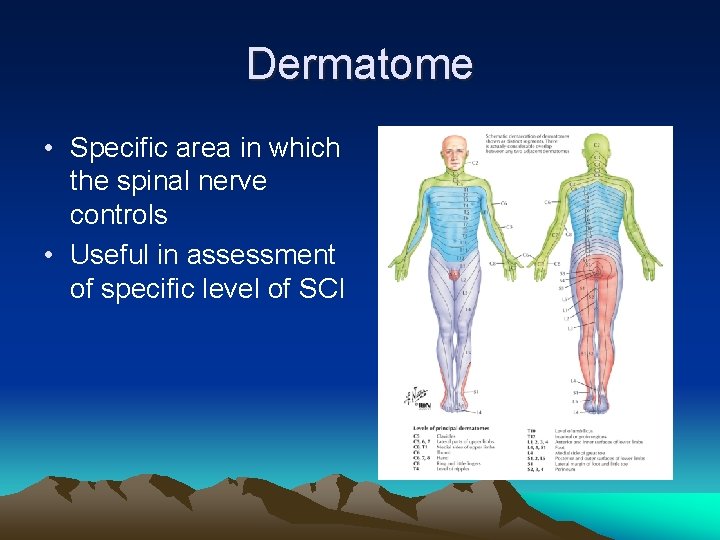
Dermatome • Specific area in which the spinal nerve controls • Useful in assessment of specific level of SCI
Dermatome • C 3, 4 – Motor: shoulder shrug – Sensory: top of shoulder • C 5, 6 – Motor: elbow flexion – Sensory: thumb
Dermatome • C 7 – Motor: elbow, wrist, finger extension – Sensory: middle finger • C 8, T 1 – Motor: finger abduction & adduction – Sensory: little finger • T 4 – Motor/sensory: level of nipple • T 10 – Motor/sensory: level of umbilicus
Dermatome • L 1, 2 – Motor: hip flexion – Sensory: inguinal crease • L 3, 4 – Motor: quadriceps – Sensory: medial thigh, calf • L 5 – Motor: great toe, foot dorsiflexion – Sensory: lateral calf
Dermatome • S 1 – Motor: knee flexion – Sensory: lateral foot • S 4 – Motor: anal sphincter tone – Sensory: perianal
Assessment of Spinal Injury • Consider Mechanism of Injury – High speed MVA – Fall from significant height – Stabbing – Gun shot – Sports injury • Football
Assessment of Spinal Injury • • • Airway Breathing Circulation Disability Exposure
Neurologic Status • Check level of consciousness. – Cooperative? – Intoxicated? – Able to communicate? – Recall the events?
Assessment of Function & Sensation • Palpate over spinous processes • Motor function – Arm and leg movements • Sensation – Position – Pain
Spinal Cord Injuries • Direct traumatic injury – Stab – Gunshot • Excessive Movement – Acceleration – Deformation
Spinal Cord Injuries • Directional Forces – Flexion – Extension – Rotational – Lateral bending – Vertical compression – Distraction

Compression Fracture
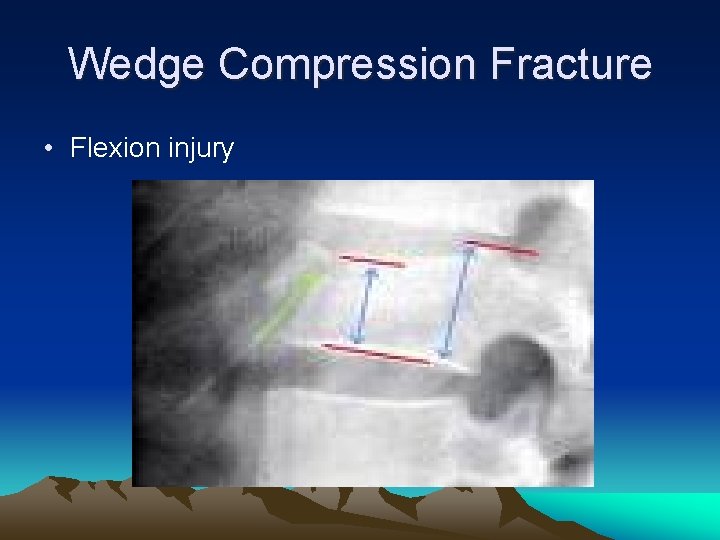
Wedge Compression Fracture • Flexion injury
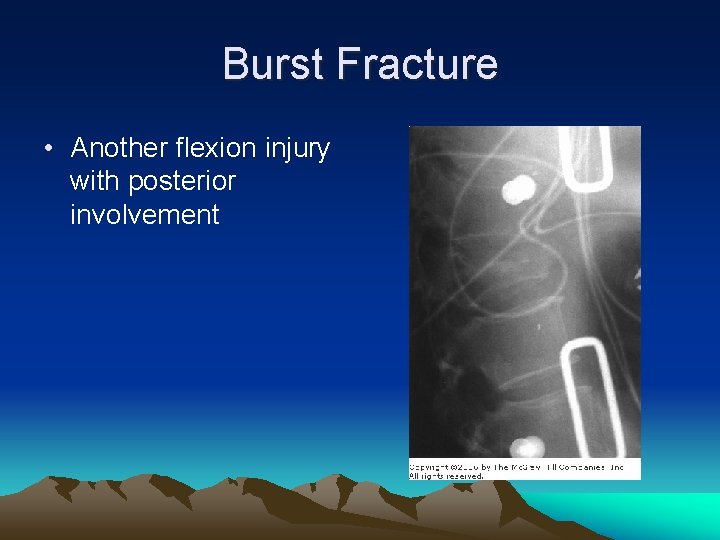
Burst Fracture • Another flexion injury with posterior involvement
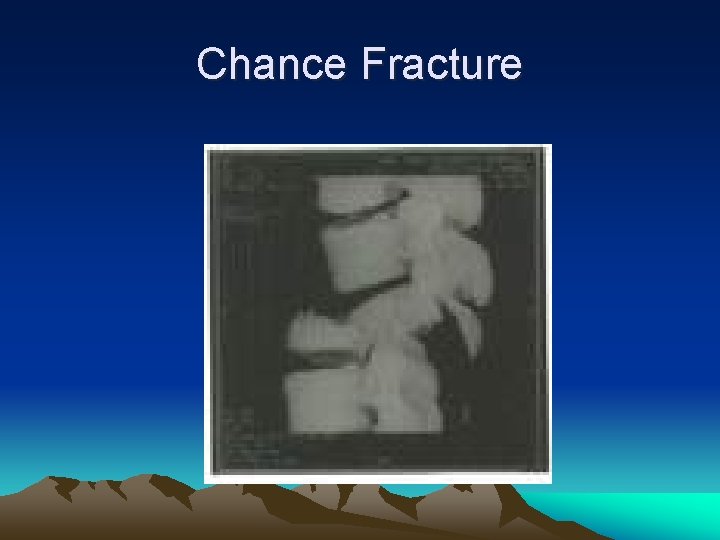
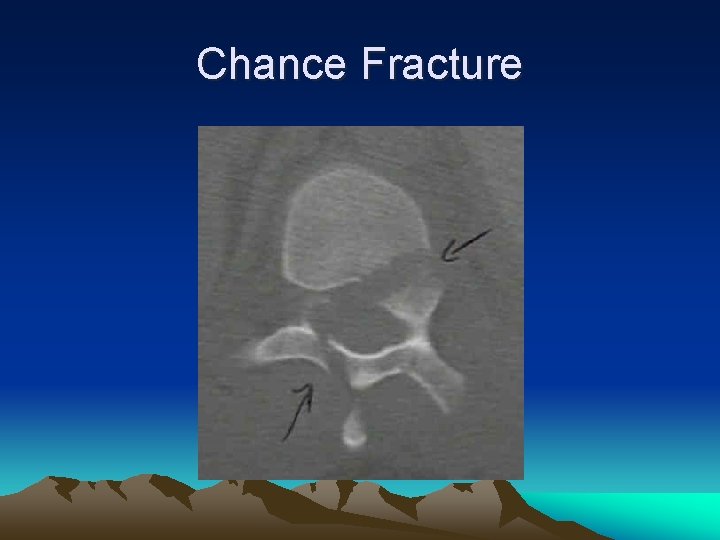
Chance Fracture • Flexion-distraction injury • Typically seatbelt injury in high speed MVA • Involves: – Spinous process – Lamina – Transverse processes – Pedicles – Vertebral body
Chance Fracture
Chance Fracture
Primary Injury • Occurs at the time of injury – May result in • Cord compression • Direct cord injury • Interruption in cord blood supply • Not much can be done
Secondary Injury • Occurs after initial injury – May result from • Dwelling/inflammation • Ischemia • Movement of body fragments • First responders can play a significant role in reducing these injuries!
Cord Transection • Complete – Cord functions below transection are permanently lost – Results in quadriplegia or paraplegia
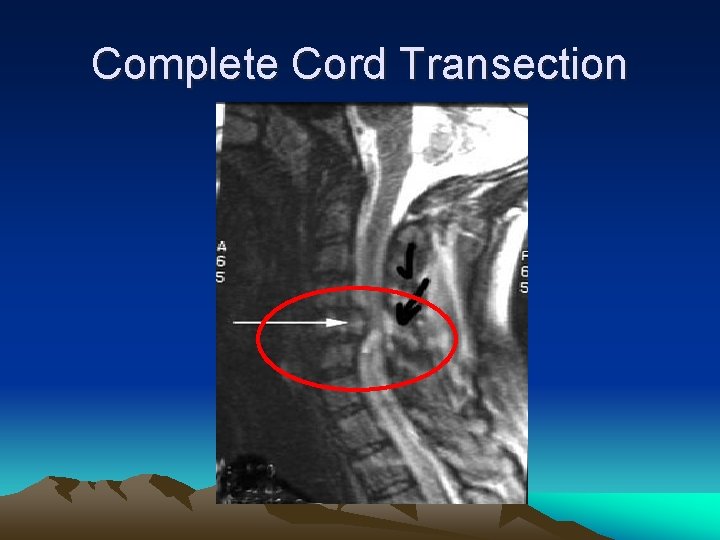
Complete Cord Transection
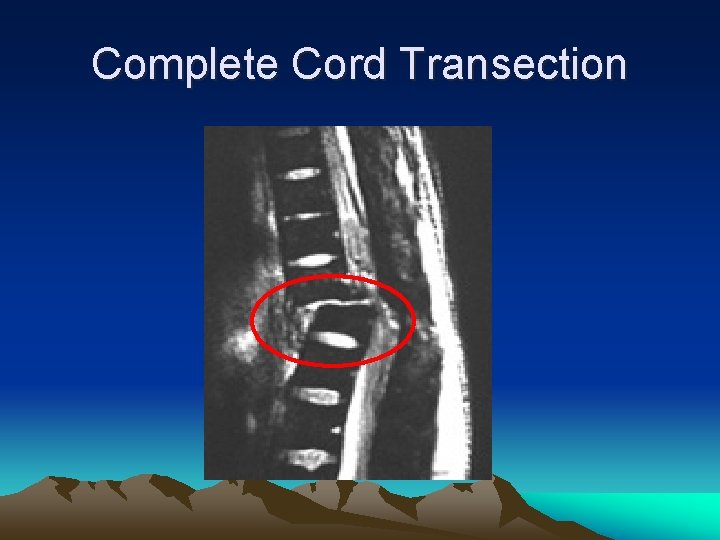
Complete Cord Transection
Cord Transection • Incomplete – Some cord mediated functions remain intact – Potential for recovery of function – Brown-Sequard Syndrome – Anterior Cord Syndrome – Central Cord Syndrome – Posterior Cord Syndrome
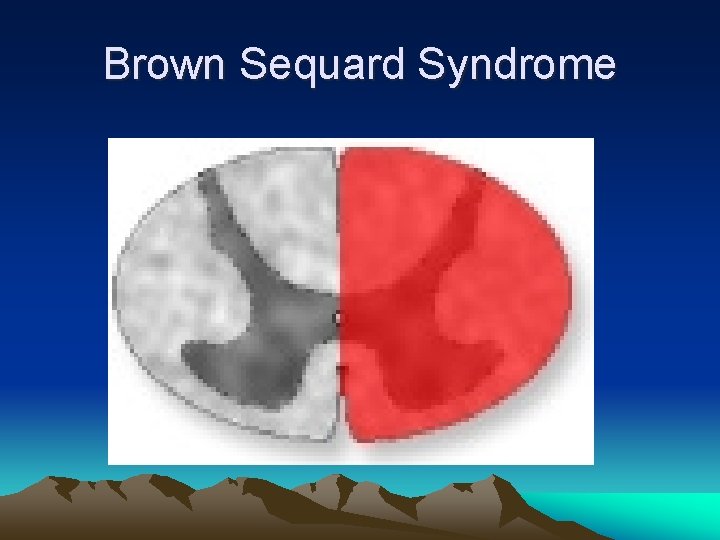
Brown Sequard Syndrome • Injury to one side of the cord • Often due to penetrating injury or vertebral dislocation • Complete damage to all spinal tracts on affected side • Good prognosis for recovery
Brown Sequard Syndrome • Exam Findings – Ipsilateral loss of motor function motion, position, vibration, and light touch – Contralateral loss of sensation to pain and temperature
Brown Sequard Syndrome
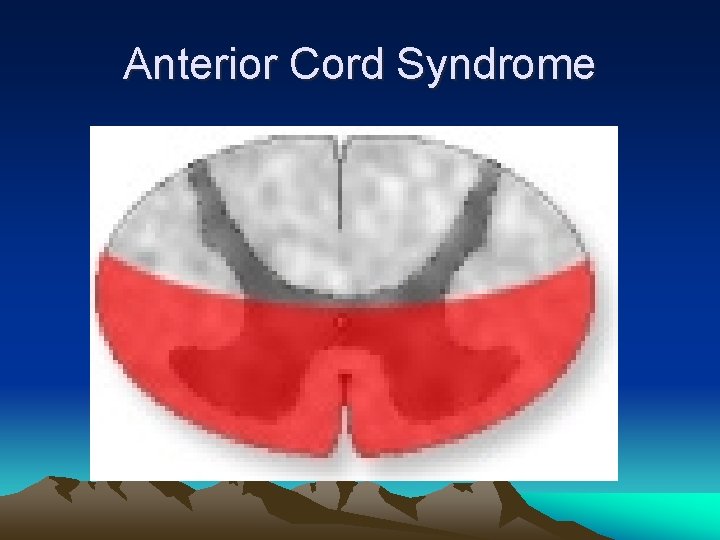
Anterior Cord Syndrome • Exam Findings – Variable loss of motor function and sensitivity to pinprick and temperature – Loss of motor function and sensation to pain, temperature and light touch – Proprioception (position sense) and vibration preserved
Anterior Cord Syndrome
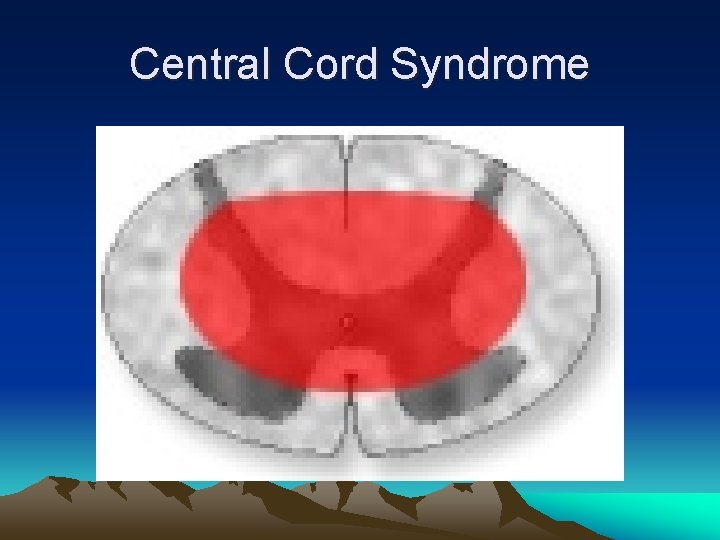
Central Cord Syndrome • Usually occurs with a hyperextension of the cervical region • Weakness or paresthesias in upper extremities but normal strength in lower extremities • Varying degree of bladder dysfunction
Central Cord Syndrome
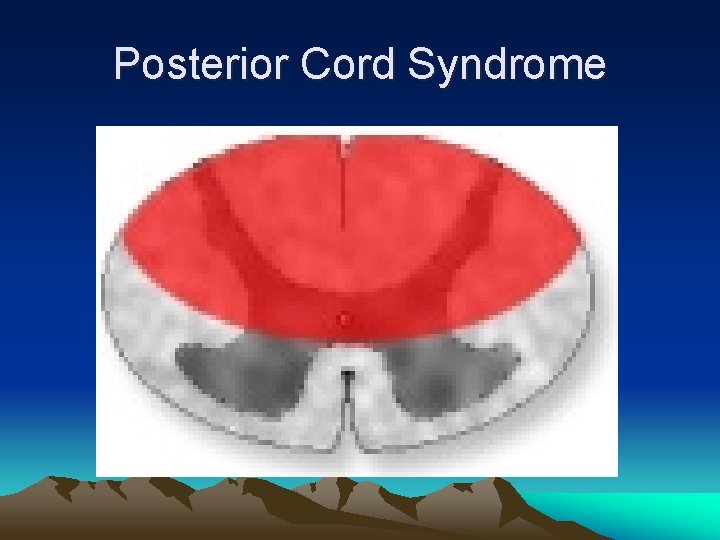
Posterior Cord Syndrome • Good muscle strength • Normal pain and temperature sensation • Difficulty in coordinating limb movements
Posterior Cord Syndrome
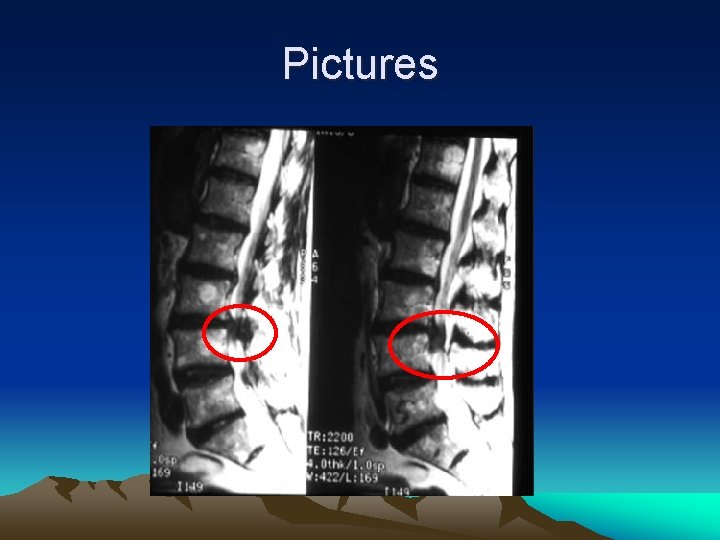
Cauda Equina Syndrome • Injury to nerves within the spinal cord as they exit the lumbar and sacral regions – Usually fractures below L 2 • • Flaccid-type paralysis of lower body Bladder and bowel impairment
Pictures
Neurogenic Shock • From physiologic and anatomic transection or near-transection of the spinal cord • Leads to flaccid paralysis • Hypotension due to vasomotor instability • Patients will be warm • No tachycardia
Spinal Shock • Caused by severe trauma to the spinal cord – Flaccid quadriplegia with areflexia – Need 24 -48 hours before determining longterm prognosis – May spontaneously resolve
Management • Primary Goal – Prevent secondary injury
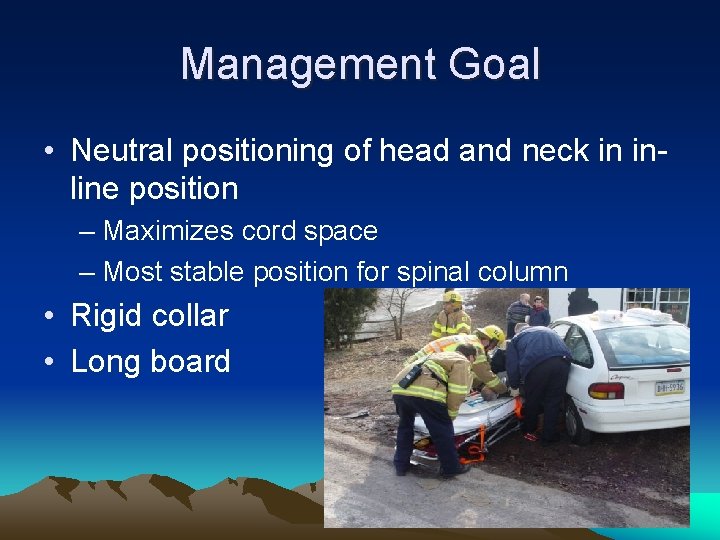
Management Goal • Neutral positioning of head and neck in inline position – Maximizes cord space – Most stable position for spinal column • Rigid collar • Long board
Padding • Maintains anatomical position • Limits movement on board • Fill all the voids – Pillows, blankets, towels
Securing to the Board • Straps or tape – Torso first – Then legs and feet – Head
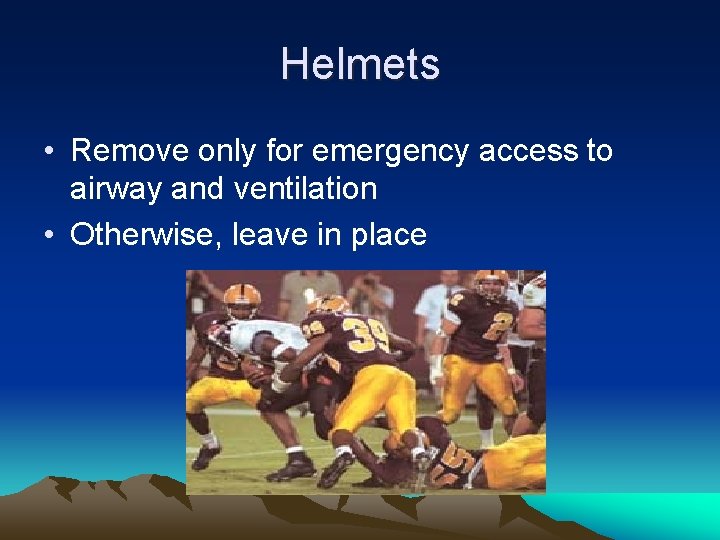
Helmets • Remove only for emergency access to airway and ventilation • Otherwise, leave in place
Conclusion • ABCs • Mechanism of Injury • Prevent Secondary Injuries
- Slides: 56