
Spinal Trauma Kaan Yaltrk M D Outline Incidence
- Slides: 35
Spinal Trauma Kaan Yaltırık, M. D.
Outline • Incidence • Types • Clinical signs • Radiological signs • Spinal shock • Management
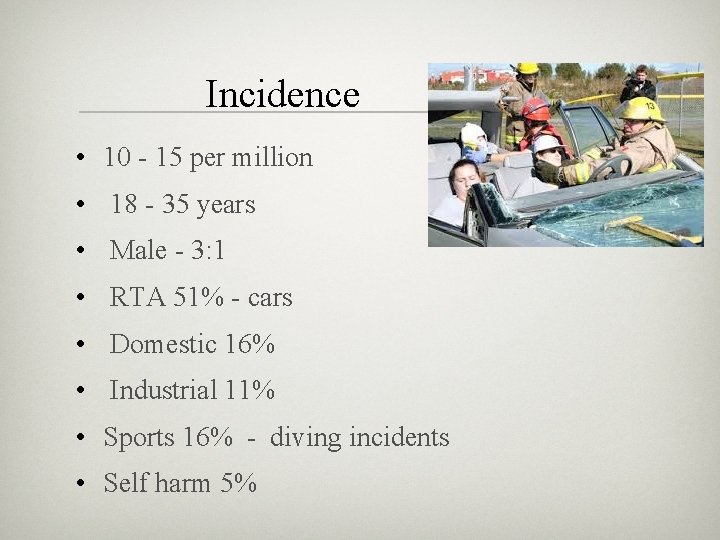
Incidence • 10 - 15 per million • 18 - 35 years • Male - 3: 1 • RTA 51% - cars • Domestic 16% • Industrial 11% • Sports 16% - diving incidents • Self harm 5%
Types • Cervical 40% • Thoracic 10% • Lumbar 3% • Dorso lumbar 35% • Any 14%
Anatomy • Spinal cord ends below lower border of L 1 • Cauda equina is below L 1 • Mid dorsal spinal cord & neural canal space are of same diameter hence prone for complete lesion • Mechanical injury - early ischaemia, cord edema - cord necrosis • Neurological recovery unpredictable in cauda equina ie. peripheral nerves
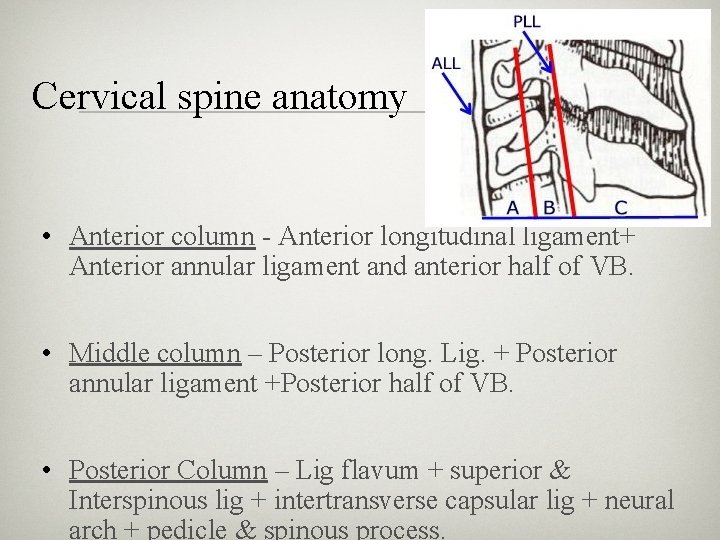
Cervical spine anatomy • Anterior column - Anterior longitudinal ligament+ Anterior annular ligament and anterior half of VB. • Middle column – Posterior long. Lig. + Posterior annular ligament +Posterior half of VB. • Posterior Column – Lig flavum + superior & Interspinous lig + intertransverse capsular lig + neural arch + pedicle & spinous process.
Significance • Unstable if middle column + either Anterior or Posterior column is damaged • Rupture of interspinous ligament is : - associated with avulsion of spinous process - Unstable spine - Further flexion increases neurological injury
Degrees of injury • Complete - flaccid paralysis + total loss of sensory & motor functions • Incomplete - mixed loss - Anterior sc syndrome - Posterior sc syndrome - Central cord syndrome - Brown sequard’s syndrome - Cauda equina syndrome
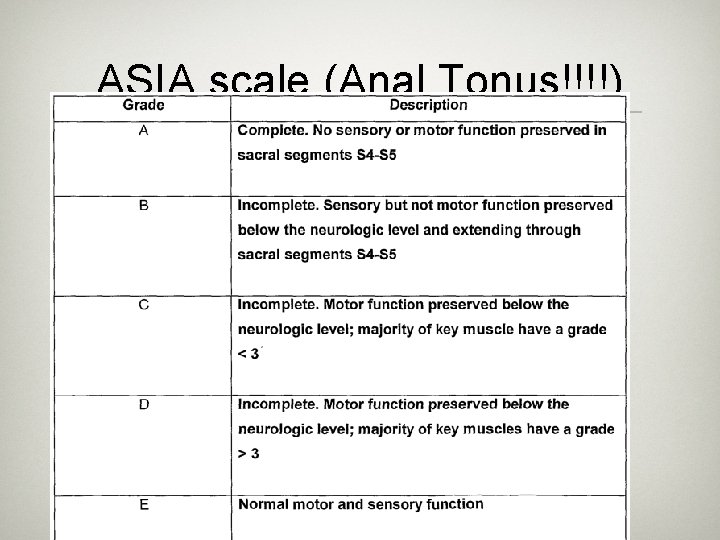
ASIA scale (Anal Tonus!!!!)
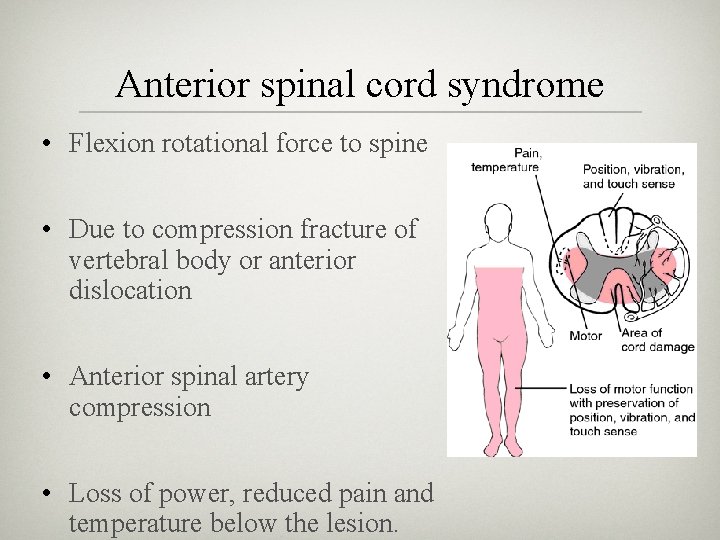
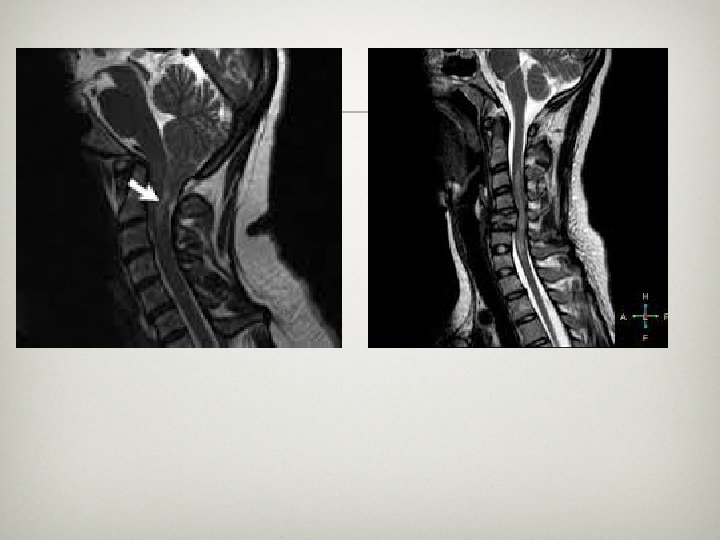
Anterior spinal cord syndrome • Flexion rotational force to spine • Due to compression fracture of vertebral body or anterior dislocation • Anterior spinal artery compression • Loss of power, reduced pain and temperature below the lesion.
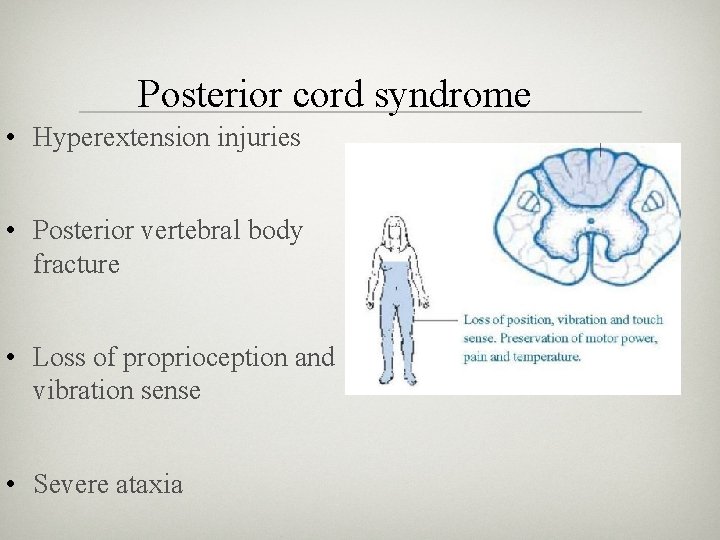
Posterior cord syndrome • Hyperextension injuries • Posterior vertebral body fracture • Loss of proprioception and vibration sense • Severe ataxia
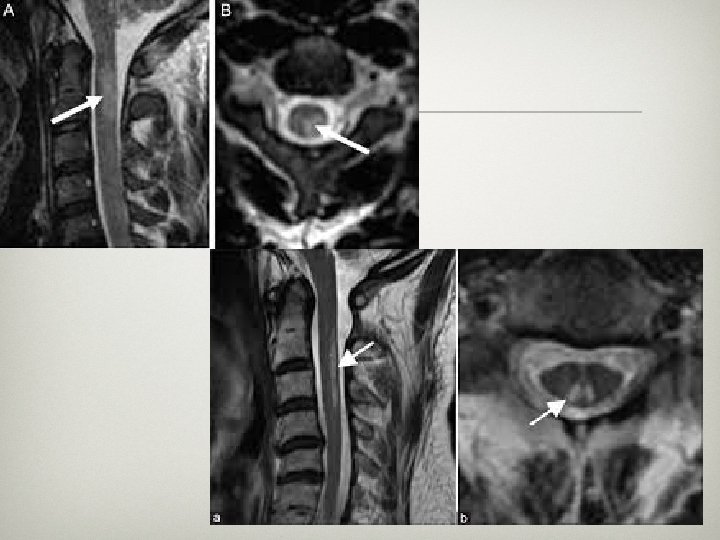
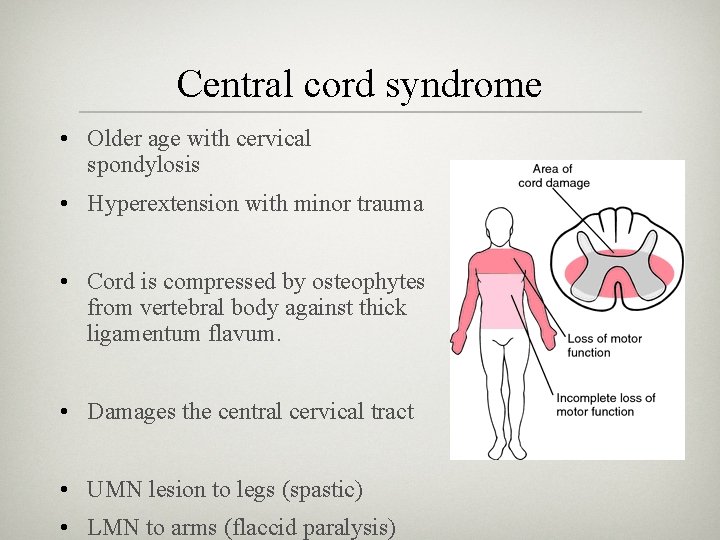
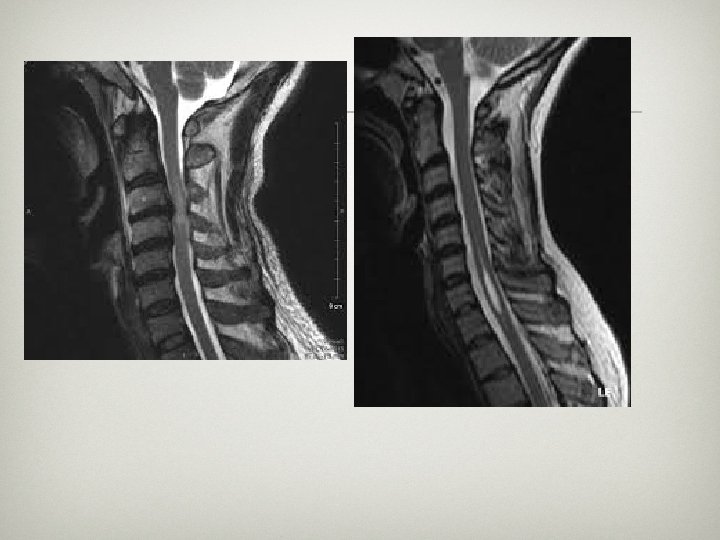
Central cord syndrome • Older age with cervical spondylosis • Hyperextension with minor trauma • Cord is compressed by osteophytes from vertebral body against thick ligamentum flavum. • Damages the central cervical tract • UMN lesion to legs (spastic) • LMN to arms (flaccid paralysis)
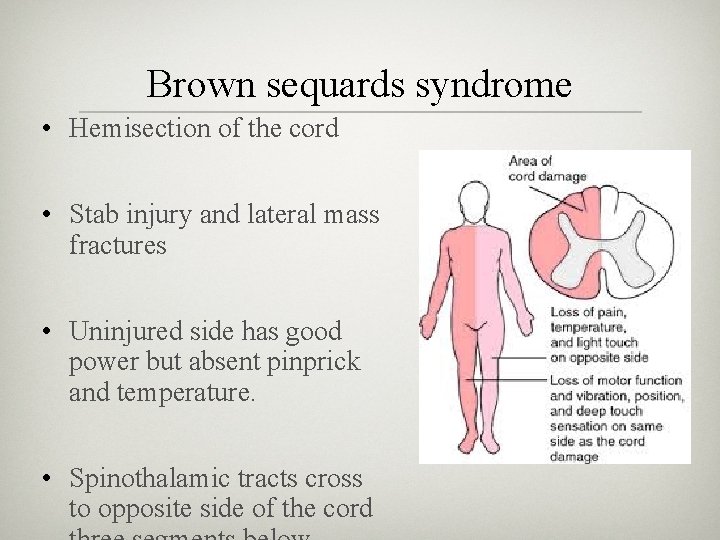
Brown sequards syndrome • Hemisection of the cord • Stab injury and lateral mass fractures • Uninjured side has good power but absent pinprick and temperature. • Spinothalamic tracts cross to opposite side of the cord
Types of bony injury • Flexion • Extension • Flexion with rotation • Compression
Pathophysiology • Primary Neurological damage Direct trauma, haematoma & SCIWORA < 8 yrs old In 4 hrs - Infarction of white matter occurs In 8 hrs - Infarction of grey matter and irreversible paralysis • Secondary damage Hypoxia Hypoperfusion Neurogenic shock Spinal shock
Hypoxia • Lesions above C 5 – damage to diaphragm leads to 20% reduction in vital capacity Rx Phrenic n. pacing • Lesions at D 4 -6 – reduces vital capacity if < 500 ml patient is ventilated • Intercostal nerve paralysis • Atelectasis – poor cough • V/Q mismatch • Reduced compliance of lung – muscle fatigue.
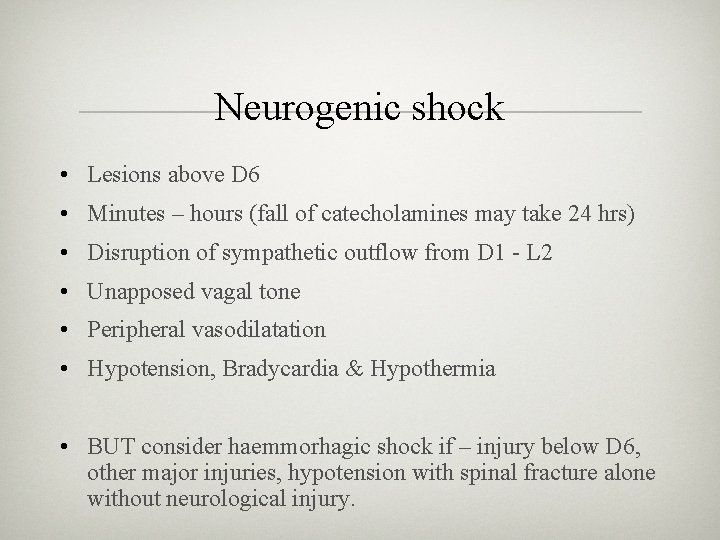
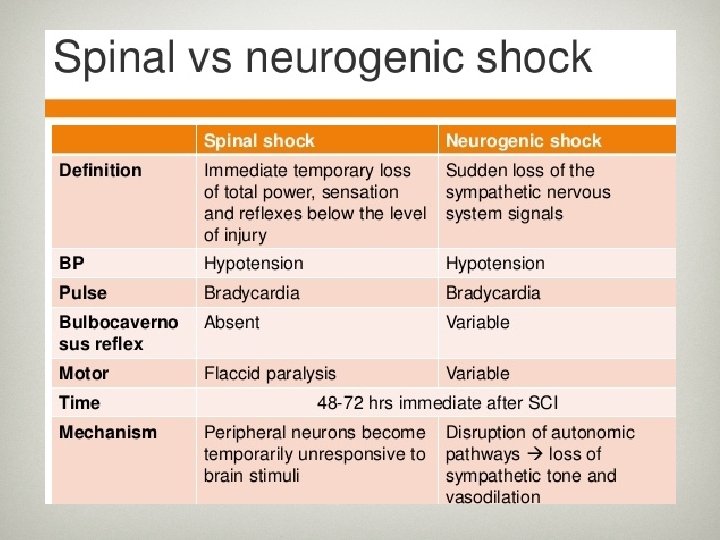
Neurogenic shock • Lesions above D 6 • Minutes – hours (fall of catecholamines may take 24 hrs) • Disruption of sympathetic outflow from D 1 - L 2 • Unapposed vagal tone • Peripheral vasodilatation • Hypotension, Bradycardia & Hypothermia • BUT consider haemmorhagic shock if – injury below D 6, other major injuries, hypotension with spinal fracture alone without neurological injury.
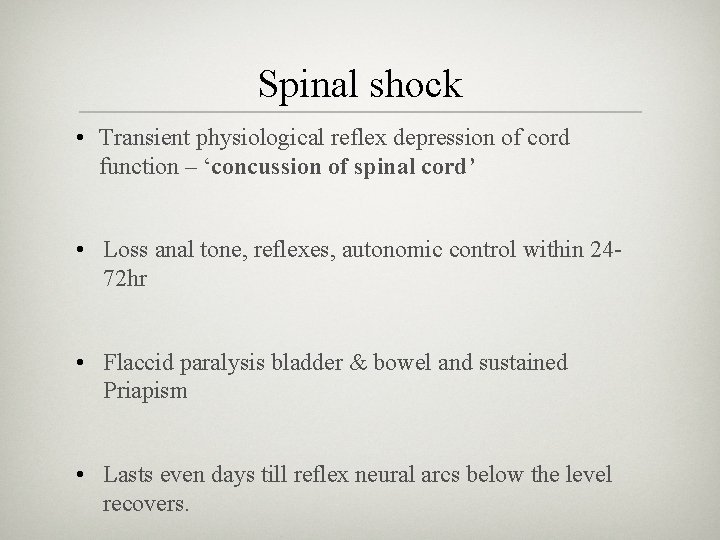
Spinal shock • Transient physiological reflex depression of cord function – ‘concussion of spinal cord’ • Loss anal tone, reflexes, autonomic control within 2472 hr • Flaccid paralysis bladder & bowel and sustained Priapism • Lasts even days till reflex neural arcs below the level recovers.
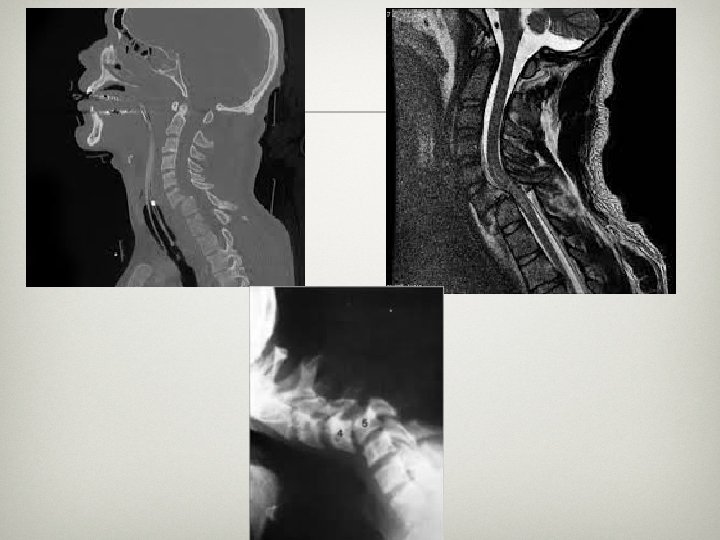
Radiology • Xray • CT • MRI
Assessment & Managemnt • Failure to suspect leads to failure to detect injuries • ABCDE – Logroll and remove the spinal board • Look for markers of spinal injury • Secondary survey • Adequate Xray’s • Emergency treatment • Surgery • Definitive care & rehab.
Clinical features • Pain in the neck or back radiating due to nerve root irritation • Sensory disturbance distal to neurological level • Weakness or flaccid paralysis below the level
Signs in an Unconcious patients • Diaphragmatic breathing • Neurological shock (Low BP & HR) • Spinal shock - Flaccid areflexia • Flexed upper limbs (loss of extensor innervation below C 5) • Responds to pain above the clavicle only • Priapism – may be incomplete.
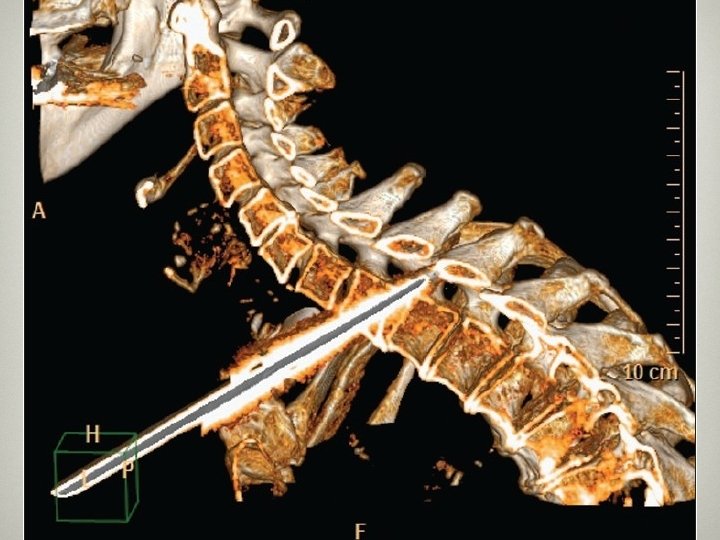
Signs of spinal injury • Forehead wounds – think of hyperextension injury • Localized bruise • Deformities of spine - Gibbus, feel a step & Priapism • Beevors sign – tensing the abdomen umbilicus moves upwards in D 10 lesions
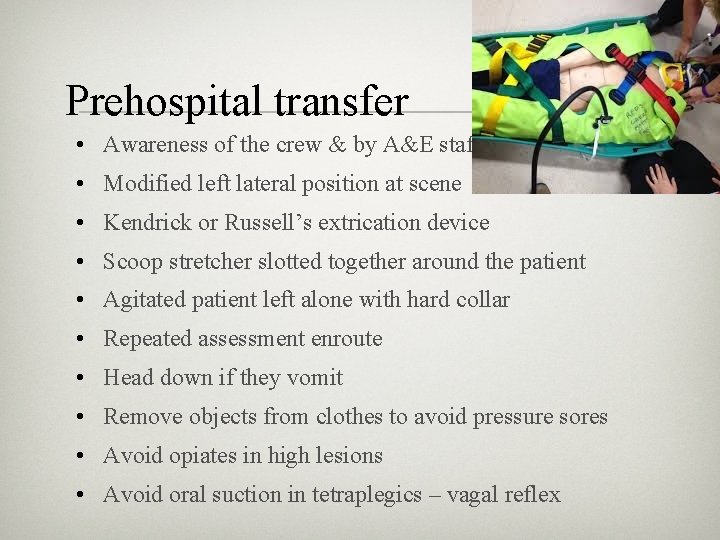
Prehospital transfer • Awareness of the crew & by A&E staff • Modified left lateral position at scene • Kendrick or Russell’s extrication device • Scoop stretcher slotted together around the patient • Agitated patient left alone with hard collar • Repeated assessment enroute • Head down if they vomit • Remove objects from clothes to avoid pressure sores • Avoid opiates in high lesions • Avoid oral suction in tetraplegics – vagal reflex
Care in A&E • Careful manual handling especially if unconcious • Jaw thrust is safer • Correct gross spinal deformities • Call the anaesthetist if diaphragmatic paralysis or RR>35 • Use flexible fibreoptic scopes in unstable fractures • Ryles tube if abdominal distension causes respiratory probl • Cathetrize to avoid overstretching of detrusor • IV fluids – paralytic ileus in first 48 hrs. • Passive movements to rule out fractures • Small iv doses of opiates
Assessment • Document the level of injury • Rule out other injuries – DPL in abdominal injuries as there is paralytic ileus and absent peritioneal irritation. • Associated injuries in dorsal spine fracture are : - Renal injuries - Chest and Sternal injuries - Wide Mediatinum due to fracture haematoma. - Retroperitoneal injuries
Emergency treatment • ABCDE • Keep warm • Treat if BP<80 mm. Hg & HR <50 bpm • Spring loaded gardener wells calipers for traction • H 2 Antagonists & Heparin • Methylprednisolone 30 mg/kg iv bolus over 15 min immediately • 45 minutes after the bolus a 5. 4 mg/kg/h infusion over 23 hrs in first 3 hours after the injury. • 5. 4 mg/kg/hr for 47 hrs if 4 - 8 hrs following the injury.
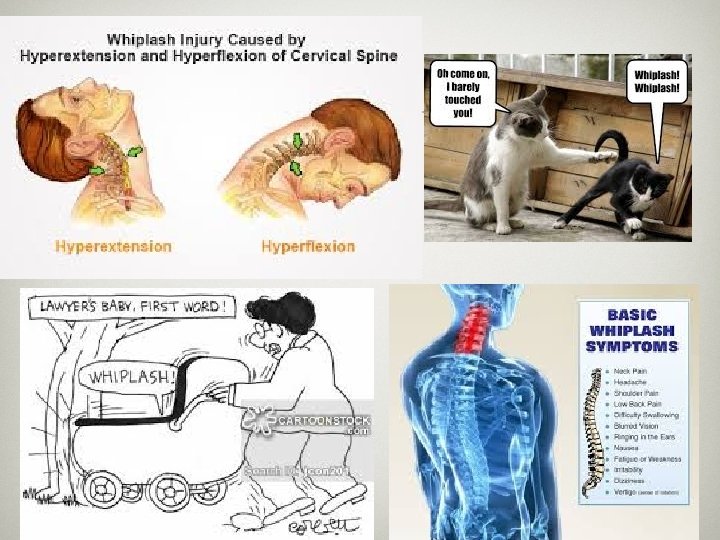
Whiplash injury • Sudden hyperextension and flexion • Increasing neck pain for the first 24 hours • Associated headache, pain radiating to both shoulders and paraesthesia in hands • Reduced lateral flexion • Anterior longitudinal ligaments are torn causes dysphagia • Forward flexion against resistance is painful • 90% are asymptomatic after 2 years • 10% still have pain • Some still claim money hence the need for proper documentations.