
SPINAL MUSCULAR ATROPHY Pathology Treatments Research ABOUT US
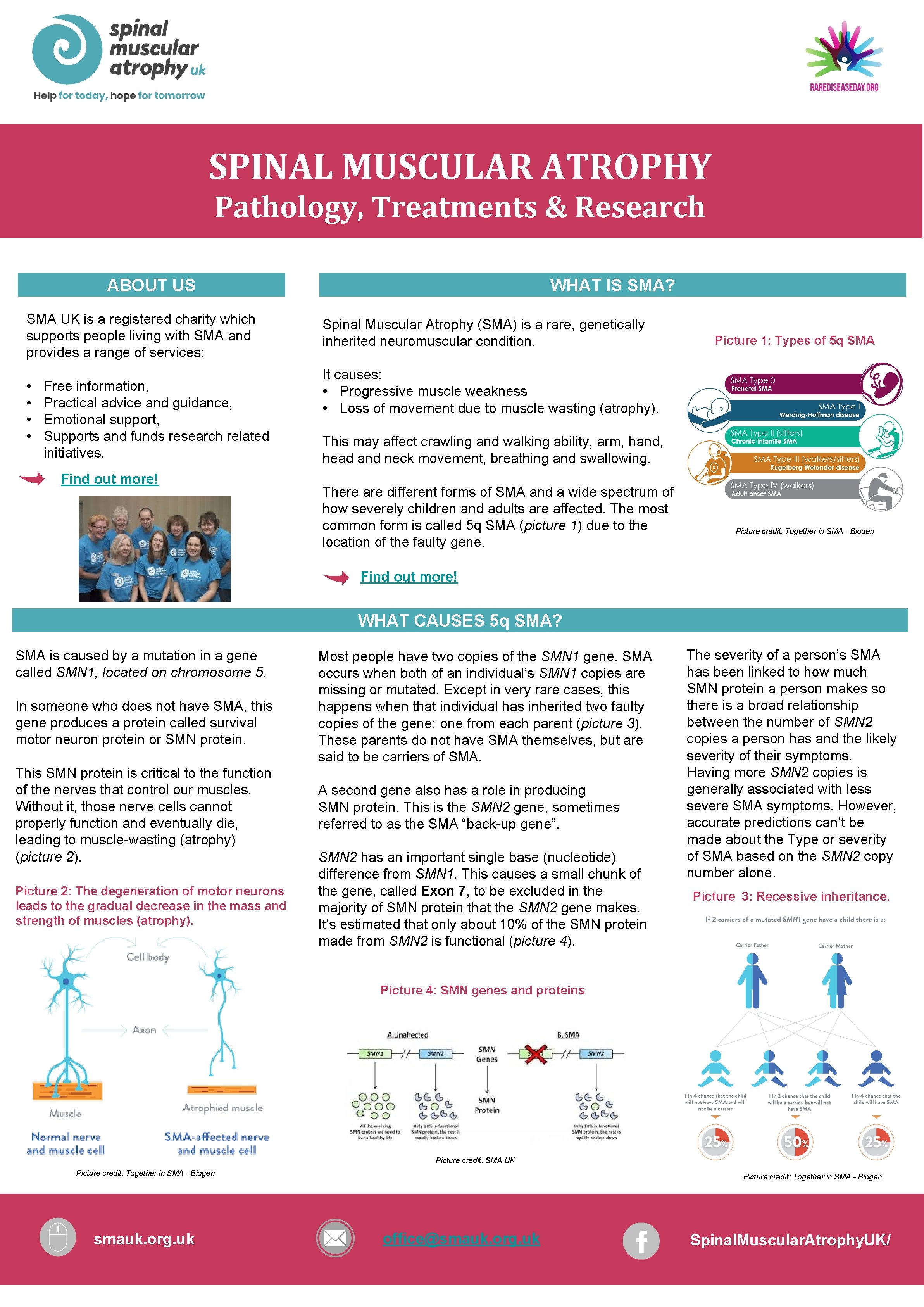
SPINAL MUSCULAR ATROPHY Pathology, Treatments & Research ABOUT US SMA UK is a registered charity which supports people living with SMA and provides a range of services: • • Free information, Practical advice and guidance, Emotional support, Supports and funds research related initiatives. Find out more! WHAT IS SMA? Spinal Muscular Atrophy (SMA) is a rare, genetically inherited neuromuscular condition. Picture 1: Types of 5 q SMA It causes: • Progressive muscle weakness • Loss of movement due to muscle wasting (atrophy). This may affect crawling and walking ability, arm, hand, head and neck movement, breathing and swallowing. There are different forms of SMA and a wide spectrum of how severely children and adults are affected. The most common form is called 5 q SMA (picture 1) due to the location of the faulty gene. Picture credit: Together in SMA - Biogen Find out more! WHAT CAUSES 5 q SMA? SMA is caused by a mutation in a gene called SMN 1, located on chromosome 5. In someone who does not have SMA, this gene produces a protein called survival motor neuron protein or SMN protein. This SMN protein is critical to the function of the nerves that control our muscles. Without it, those nerve cells cannot properly function and eventually die, leading to muscle-wasting (atrophy) (picture 2). Picture 2: The degeneration of motor neurons leads to the gradual decrease in the mass and strength of muscles (atrophy). Most people have two copies of the SMN 1 gene. SMA occurs when both of an individual’s SMN 1 copies are missing or mutated. Except in very rare cases, this happens when that individual has inherited two faulty copies of the gene: one from each parent (picture 3). These parents do not have SMA themselves, but are said to be carriers of SMA. A second gene also has a role in producing SMN protein. This is the SMN 2 gene, sometimes referred to as the SMA “back-up gene”. SMN 2 has an important single base (nucleotide) difference from SMN 1. This causes a small chunk of the gene, called Exon 7, to be excluded in the majority of SMN protein that the SMN 2 gene makes. It’s estimated that only about 10% of the SMN protein made from SMN 2 is functional (picture 4). The severity of a person’s SMA has been linked to how much SMN protein a person makes so there is a broad relationship between the number of SMN 2 copies a person has and the likely severity of their symptoms. Having more SMN 2 copies is generally associated with less severe SMA symptoms. However, accurate predictions can’t be made about the Type or severity of SMA based on the SMN 2 copy number alone. Picture 3: Recessive inheritance. Picture 4: SMN genes and proteins Picture credit: SMA UK Picture credit: Together in SMA - Biogen smauk. org. uk Picture credit: Together in SMA - Biogen office@smauk. org. uk Spinal. Muscular. Atrophy. UK/
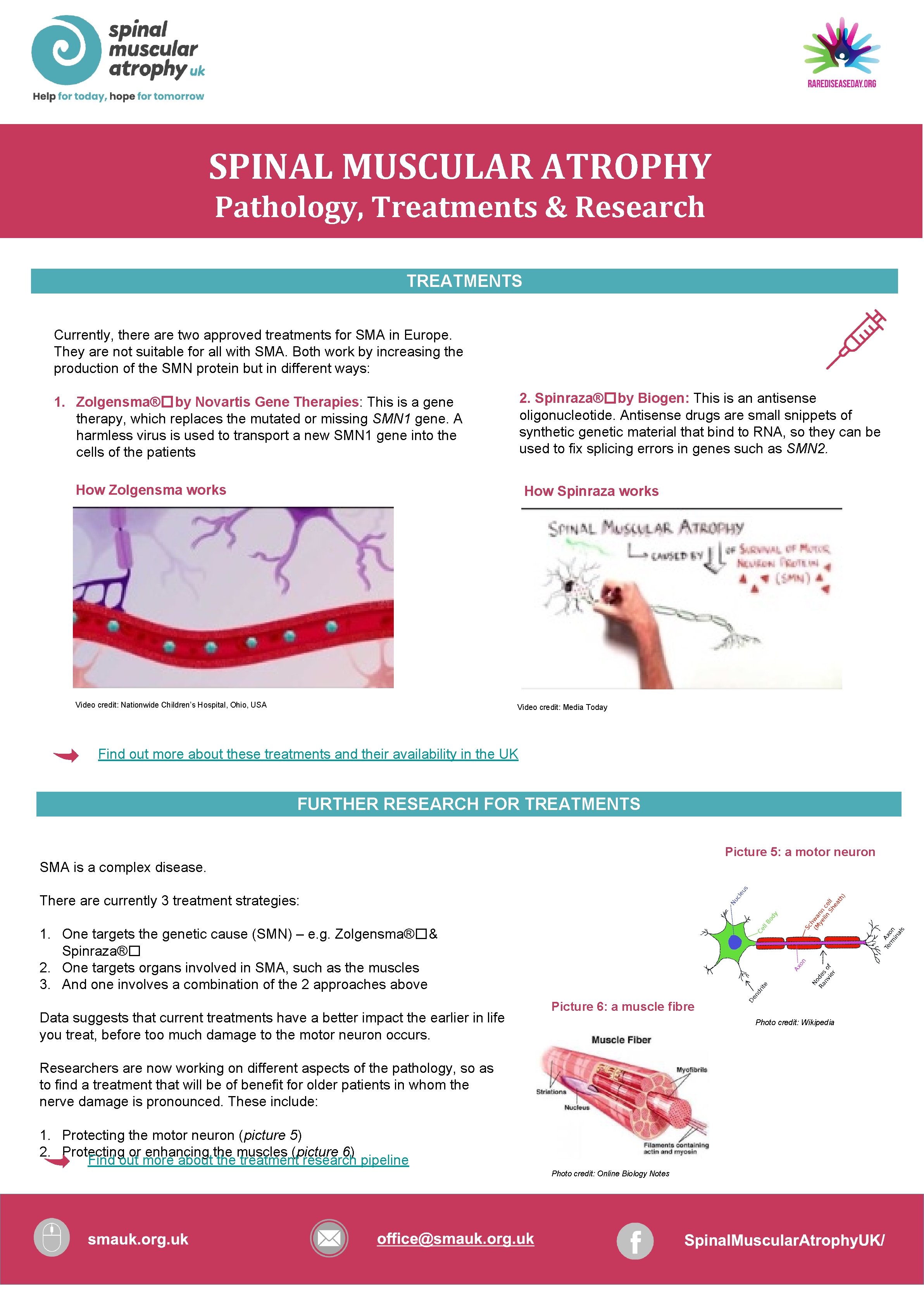
SPINAL MUSCULAR ATROPHY Pathology, Treatments & Research TREATMENTS Currently, there are two approved treatments for SMA in Europe. They are not suitable for all with SMA. Both work by increasing the production of the SMN protein but in different ways: 2. Spinraza®�by Biogen: This is an antisense oligonucleotide. Antisense drugs are small snippets of synthetic genetic material that bind to RNA, so they can be used to fix splicing errors in genes such as SMN 2. 1. Zolgensma®�by Novartis Gene Therapies: This is a gene therapy, which replaces the mutated or missing SMN 1 gene. A harmless virus is used to transport a new SMN 1 gene into the cells of the patients How Zolgensma works How Spinraza works Video credit: Nationwide Children’s Hospital, Ohio, USA Video credit: Media Today Find out more about these treatments and their availability in the UK FURTHER RESEARCH FOR TREATMENTS Picture 5: a motor neuron SMA is a complex disease. There are currently 3 treatment strategies: 1. One targets the genetic cause (SMN) – e. g. Zolgensma®�& Spinraza®� 2. One targets organs involved in SMA, such as the muscles 3. And one involves a combination of the 2 approaches above Data suggests that current treatments have a better impact the earlier in life you treat, before too much damage to the motor neuron occurs. Picture 6: a muscle fibre Photo credit: Wikipedia Researchers are now working on different aspects of the pathology, so as to find a treatment that will be of benefit for older patients in whom the nerve damage is pronounced. These include: 1. Protecting the motor neuron (picture 5) 2. Protecting or enhancing the muscles (picture 6) Find out more about the treatment research pipeline Photo credit: Online Biology Notes
- Slides: 2