
Spinal Growth in Patients with Juvenile Idiopathic Scoliosis
- Slides: 11
Spinal Growth in Patients with Juvenile Idiopathic Scoliosis Treated with Boston Brace 10 th International Congress on Early Onset Scoliosis November 17 & 18, 2016 ∙ Utrecht The Netherlands JL Heemskerk, MD 1; SPJ Wijdicks, MD 2; RM Castelein, MD, Ph. D 2; MC Altena, MD 1; DHR Kempen, MD, Ph. D 1 1 Department of Orthopaedic surgery, OLVG, Amsterdam, the Netherlands 2 Department of Orthopaedic Surgery, University Medical Center Utrecht, the Netherlands.
Disclosure • None of the authors have relevant disclosures related to this research project
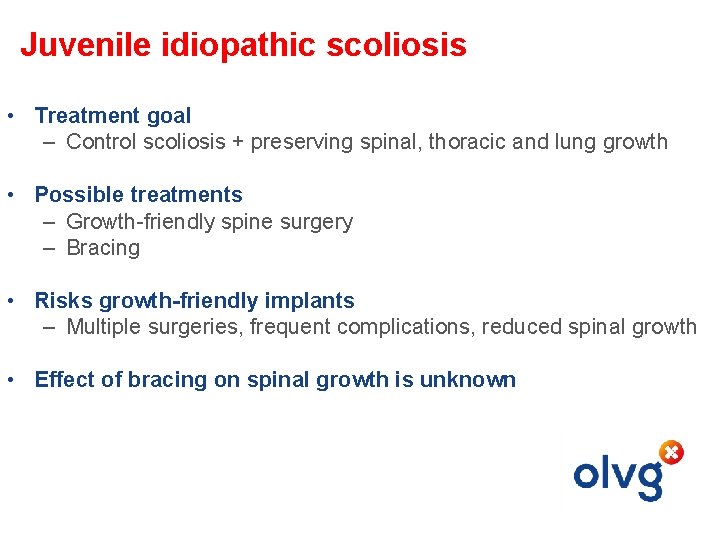
Juvenile idiopathic scoliosis • Treatment goal – Control scoliosis + preserving spinal, thoracic and lung growth • Possible treatments – Growth-friendly spine surgery – Bracing • Risks growth-friendly implants – Multiple surgeries, frequent complications, reduced spinal growth • Effect of bracing on spinal growth is unknown
Aim To describe the longitudinal spinal growth in patients with juvenile idiopathic scoliosis treated with Boston brace
Method selection • Retrospective radiographic analysis • 49 JIS patients treated with Boston brace were included • Three radiographs 1. Before brace treatment 2. After brace treatment 3. At final follow-up
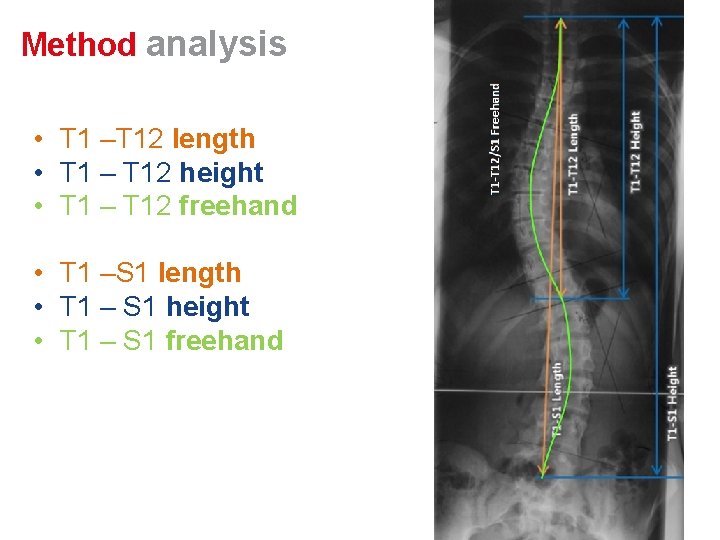
Method analysis • T 1 –T 12 length • T 1 – T 12 height • T 1 – T 12 freehand • T 1 –S 1 length • T 1 – S 1 height • T 1 – S 1 freehand
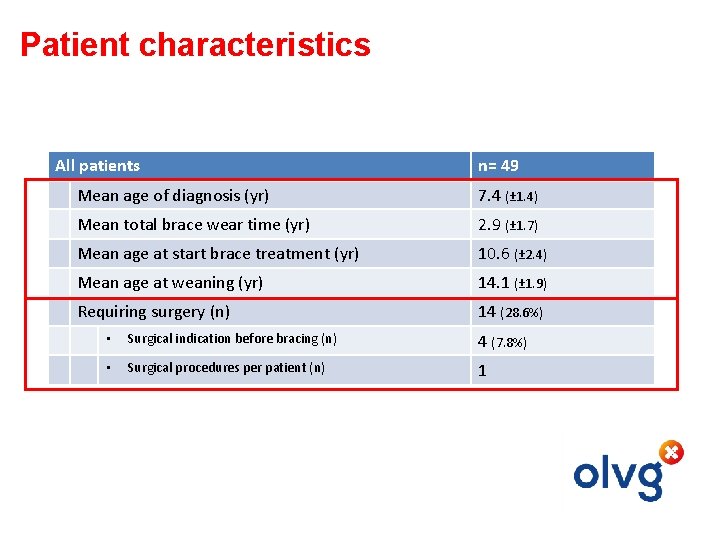
Patient characteristics All patients n= 49 Mean age of diagnosis (yr) 7. 4 (± 1. 4) Mean total brace wear time (yr) 2. 9 (± 1. 7) Mean age at start brace treatment (yr) 10. 6 (± 2. 4) Mean age at weaning (yr) 14. 1 (± 1. 9) Requiring surgery (n) 14 (28. 6%) • Surgical indication before bracing (n) 4 (7. 8%) • Surgical procedures per patient (n) 1
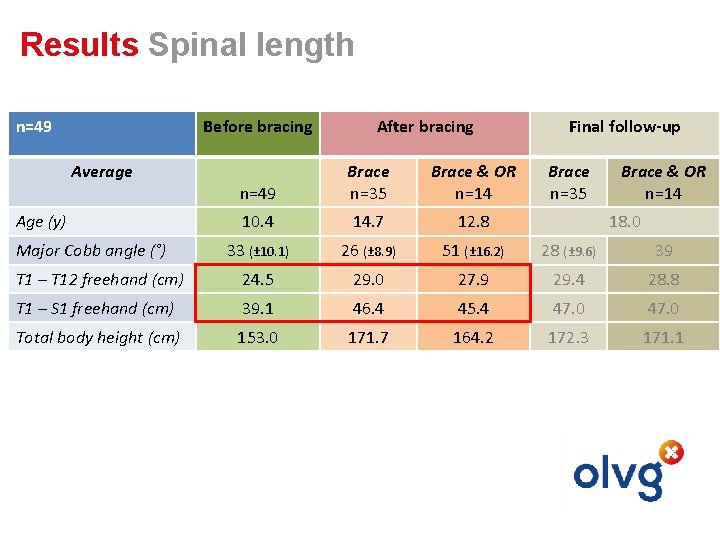
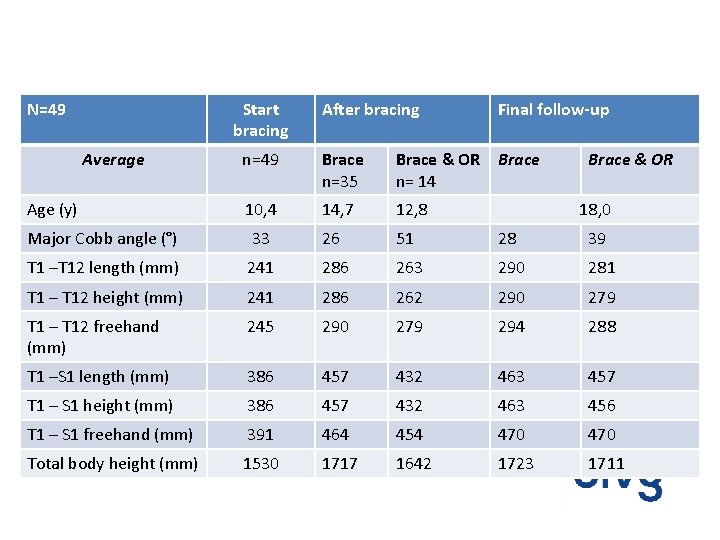
Results Spinal length n=49 Before bracing Average After bracing Final follow-up n=49 Brace n=35 Brace & OR n=14 10. 4 14. 7 12. 8 33 (± 10. 1) 26 (± 8. 9) 51 (± 16. 2) 28 (± 9. 6) 39 T 1 – T 12 freehand (cm) 24. 5 29. 0 27. 9 29. 4 28. 8 T 1 – S 1 freehand (cm) 39. 1 46. 4 45. 4 47. 0 Total body height (cm) 153. 0 171. 7 164. 2 172. 3 171. 1 Age (y) Major Cobb angle (°) Brace n=35 Brace & OR n=14 18. 0
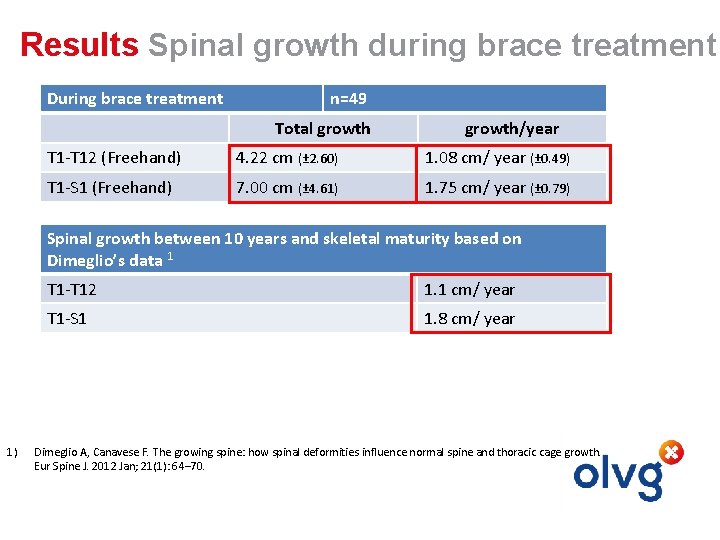
Results Spinal growth during brace treatment During brace treatment n=49 Total growth/year T 1 -T 12 (Freehand) 4. 22 cm (± 2. 60) 1. 08 cm/ year (± 0. 49) T 1 -S 1 (Freehand) 7. 00 cm (± 4. 61) 1. 75 cm/ year (± 0. 79) Spinal growth between 10 years and skeletal maturity based on Dimeglio’s data 1 1) T 1 -T 12 1. 1 cm/ year T 1 -S 1 1. 8 cm/ year Dimeglio A, Canavese F. The growing spine: how spinal deformities influence normal spine and thoracic cage growth. Eur Spine J. 2012 Jan; 21(1): 64– 70.
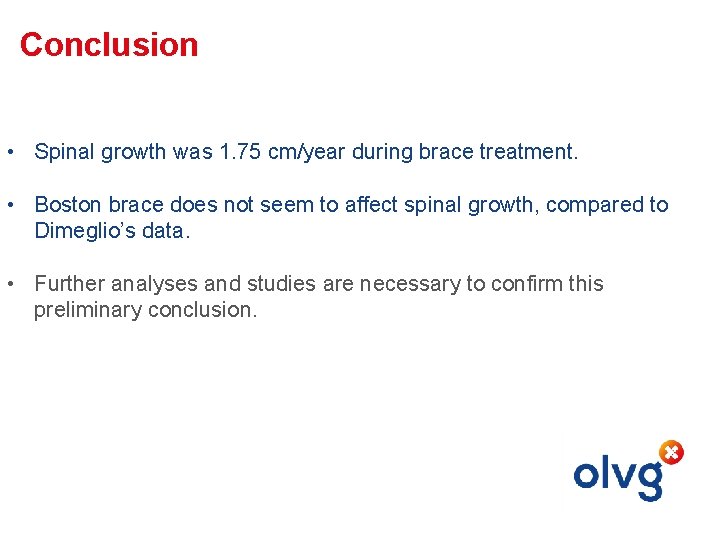
Conclusion • Spinal growth was 1. 75 cm/year during brace treatment. • Boston brace does not seem to affect spinal growth, compared to Dimeglio’s data. • Further analyses and studies are necessary to confirm this preliminary conclusion.
N=49 Start bracing Average Age (y) After bracing Final follow-up n=49 Brace n=35 Brace & OR Brace n= 14 10, 4 14, 7 12, 8 Brace & OR 18, 0 Major Cobb angle (°) 33 26 51 28 39 T 1 –T 12 length (mm) 241 286 263 290 281 T 1 – T 12 height (mm) 241 286 262 290 279 T 1 – T 12 freehand (mm) 245 290 279 294 288 T 1 –S 1 length (mm) 386 457 432 463 457 T 1 – S 1 height (mm) 386 457 432 463 456 T 1 – S 1 freehand (mm) 391 464 454 470 Total body height (mm) 1530 1717 1642 1723 1711