
Spinal Cord Stimulation BE NJ AMIN BONTE MD
Spinal Cord Stimulation BE NJ AMIN BONTE, MD INTERVENTI ONAL PAI N FELLOW HUDSON MED IC AL G ROUP 6/8/ 201 8
Outline • Spinal Cord Stimulator (SCS) • Techniques • Lumbar technique • Cervical technique • Evidence • Traditional SCS • High Frequency SCS (HF-10) • Burst stimulation
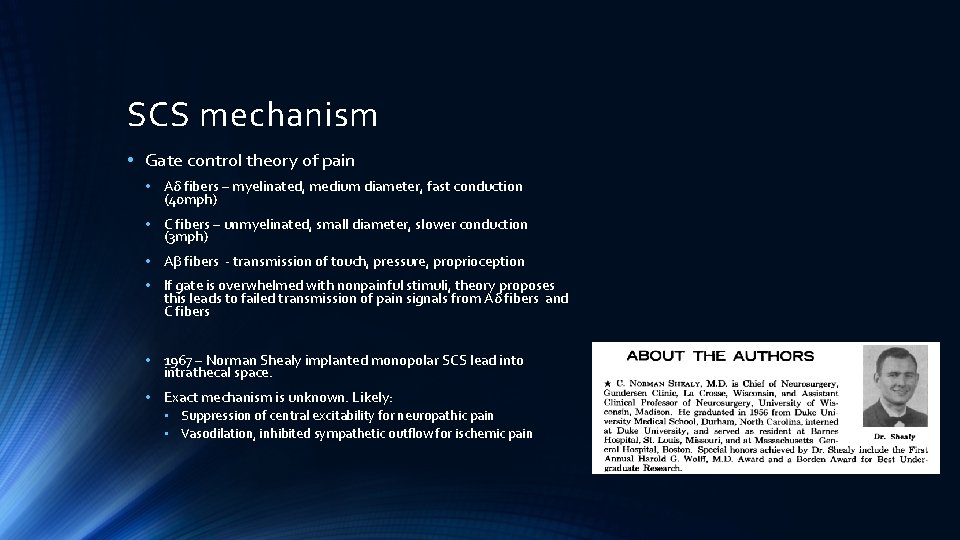
SCS mechanism • Gate control theory of pain • Aδ fibers – myelinated, medium diameter, fast conduction (40 mph) • C fibers – unmyelinated, small diameter, slower conduction (3 mph) • Aβ fibers - transmission of touch, pressure, proprioception • If gate is overwhelmed with nonpainful stimuli, theory proposes this leads to failed transmission of pain signals from Aδ fibers and C fibers • 1967 – Norman Shealy implanted monopolar SCS lead into intrathecal space. • Exact mechanism is unknown. Likely: • Suppression of central excitability for neuropathic pain • Vasodilation, inhibited sympathetic outflow for ischemic pain
Indications for SCS • Failed Back Surgery Syndrome (FBSS) • Chronic radicular pain • Extremity neuropathic pain • CRPS • Axial pain preferably by using burst or HF SCS • Ischemic pain, Raynaud syndrome
Contraindications for SCS • Uncontrolled psychiatric disorders • Unable to stop anticoagulation • Systemic Infection/drug use • Cognitive concerns • Unclear pain generator • Platelets <100 k

SCS electrodes • Percutaneous leads • Flexible, cylindrical, polyurethane. Generally 8 -16 contacts. Circumferential current flow • Paddle leads • Flat, wide, and rectangular • Insulation on one side/unidirectional toward cord with up to 32 lead contacts. • Requires more invasive approach by spine surgeon. • Increased risk of complications, factures, and infections. • Considered with difficult anatomy, undesirable position stimulation or if
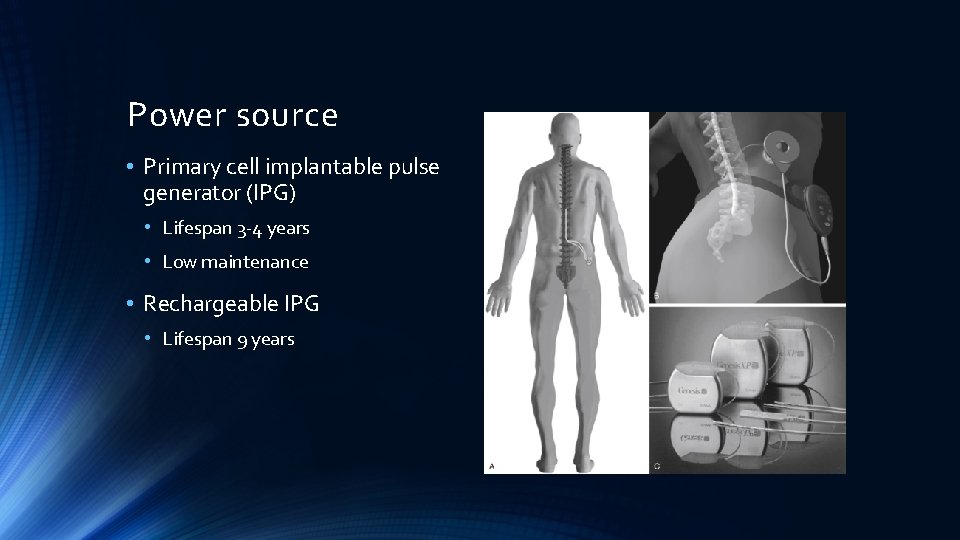
Power source • Primary cell implantable pulse generator (IPG) • Lifespan 3 -4 years • Low maintenance • Rechargeable IPG • Lifespan 9 years
SC S trial procedure • Fluoroscopy guided under sterile conditions • Prophylactic antibiotics are advocated; a cephalosporin such as cefazolin. • If beta-lactam allergy, clindamycin is recommended. • If patient is MRSA positive, vancomycin is recommended
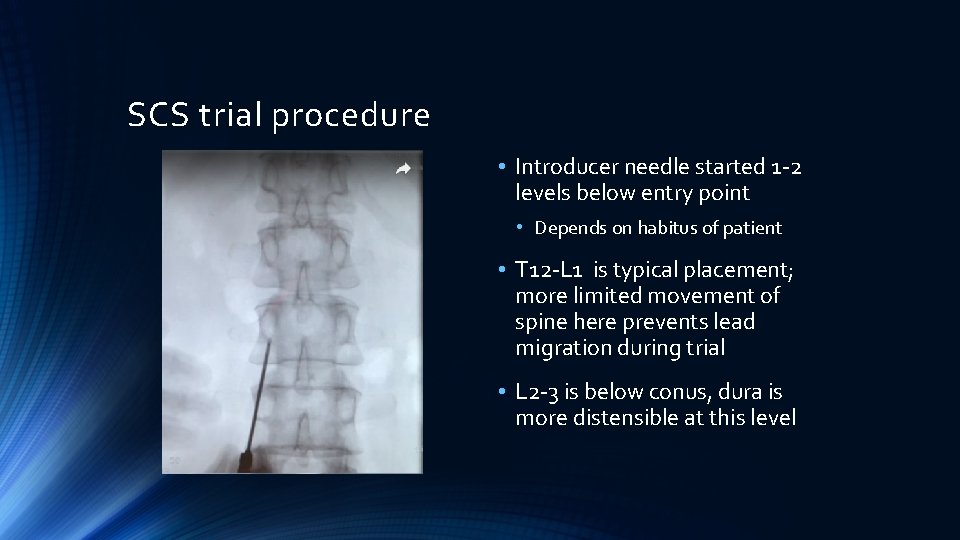
SCS trial procedure • Introducer needle started 1 -2 levels below entry point • Depends on habitus of patient • T 12 -L 1 is typical placement; more limited movement of spine here prevents lead migration during trial • L 2 -3 is below conus, dura is more distensible at this level
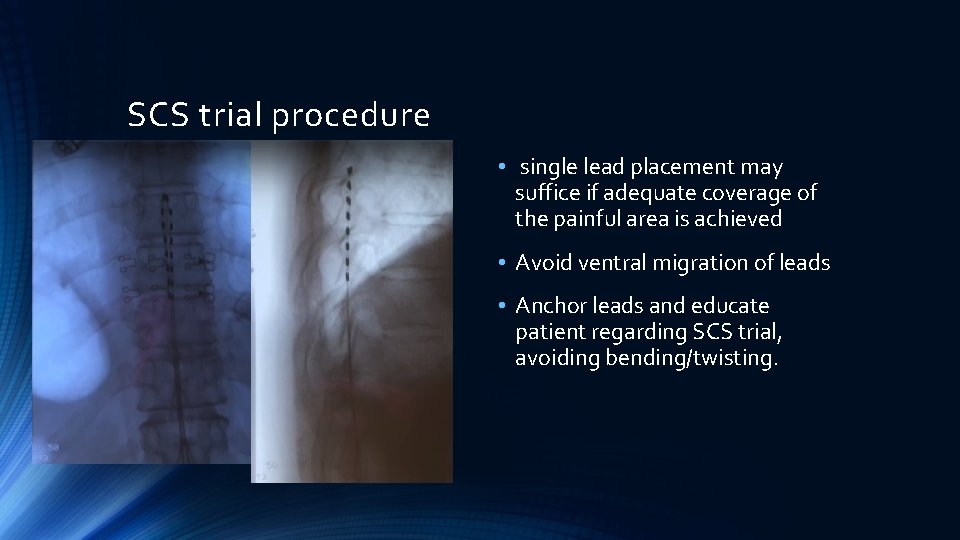
SCS trial procedure • single lead placement may suffice if adequate coverage of the painful area is achieved • Avoid ventral migration of leads • Anchor leads and educate patient regarding SCS trial, avoiding bending/twisting.
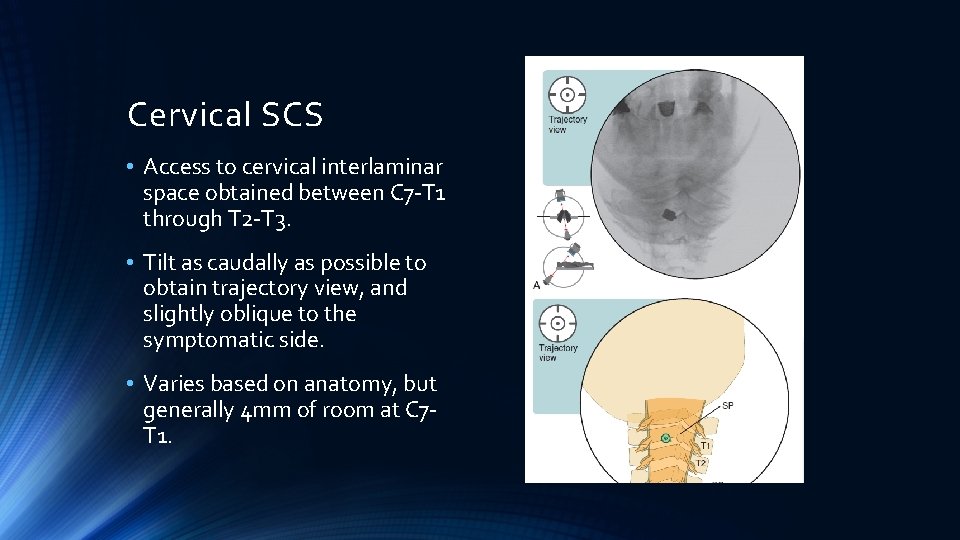
Cervical SCS • Access to cervical interlaminar space obtained between C 7 -T 1 through T 2 -T 3. • Tilt as caudally as possible to obtain trajectory view, and slightly oblique to the symptomatic side. • Varies based on anatomy, but generally 4 mm of room at C 7 T 1.
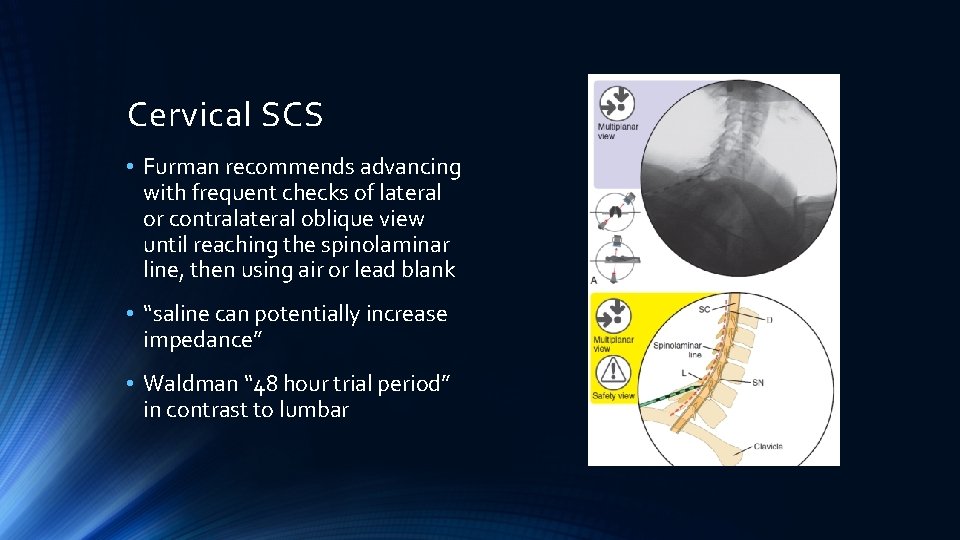
Cervical SCS • Furman recommends advancing with frequent checks of lateral or contralateral oblique view until reaching the spinolaminar line, then using air or lead blank • “saline can potentially increase impedance” • Waldman “ 48 hour trial period” in contrast to lumbar
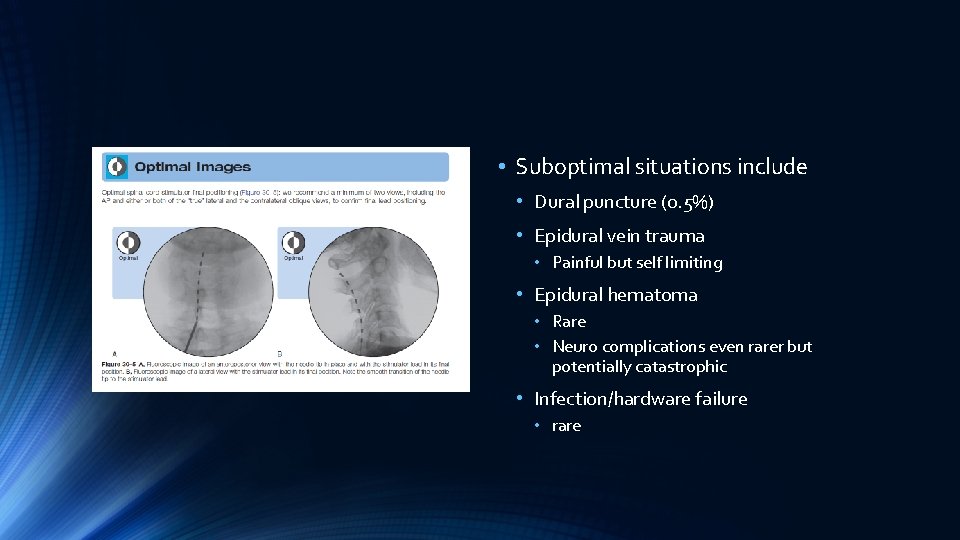
• Suboptimal situations include • Dural puncture (0. 5%) • Epidural vein trauma • Painful but self limiting • Epidural hematoma • Rare • Neuro complications even rarer but potentially catastrophic • Infection/hardware failure • rare
SCS electrode target • Placement of the electrodes for a few important and frequently used targets includes the following: • C 2: lower half of face • C 2 -C 4: neck, shoulder, hand • Mid Cervical spine has high mobility thus position changes can lead to lead migration. • Cervical elad placement in general imvolves placement between T 1 -T 4 and superior advancement. • T 5 -T 6: abdomen • CSF diameter is largest dorsally at T 5 thus stimulation thresholds are higher and postural changes can affect outcome. • T 7 -T 9: back • T 10 -T 10: leg • T 12 -L 1: foot • L 1: pelvis • Leadts directed at conus and cauda equina are more vulnerable to patient movement as there are free floating spinal nerves in this areas.
Programming Parameters • Amplitude • Intensity of each pulse, adjusting voltage or current. • Pulse width • Duration of pulse in microseconds. Usually 100 -400 microseconds. • Rate • Hz – traditional (20 -150) or HF (10 k) • Electrode selection • Which ones are active
Traditional SCS • Therapeutic sensation covers distribution of pain. • Frequencies 50 -150 hz.
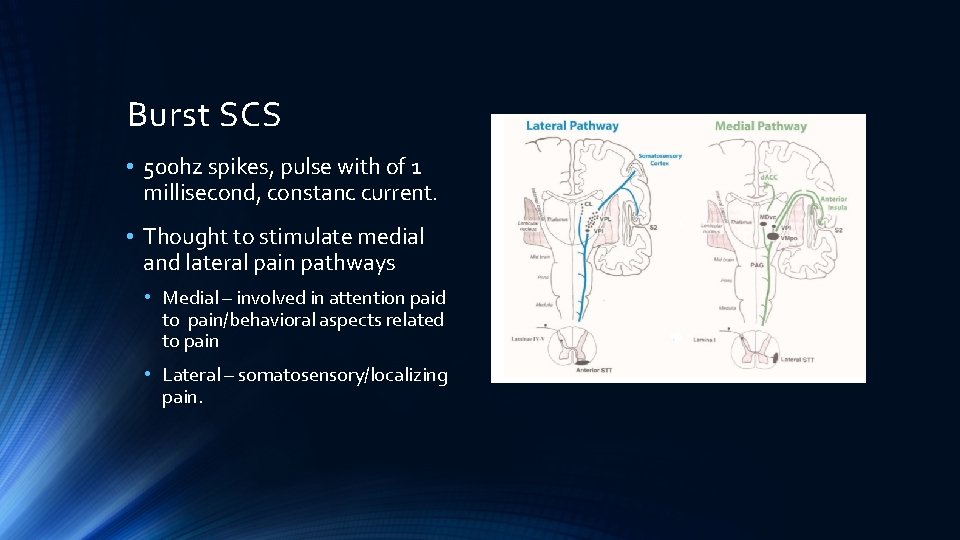
Burst SCS • 500 hz spikes, pulse with of 1 millisecond, constanc current. • Thought to stimulate medial and lateral pain pathways • Medial – involved in attention paid to pain/behavioral aspects related to pain • Lateral – somatosensory/localizing pain.
High Frequency SCS • Paresthesia free • High frequency (10 k Hz), low amplitude, short duration. • Mechanism is not known • Mitigates overall excitability, reduces dorsal horn neuron activity • Does not require paresthesia mapping, more forgiving to lead migration, less vulnerable to body position changes.
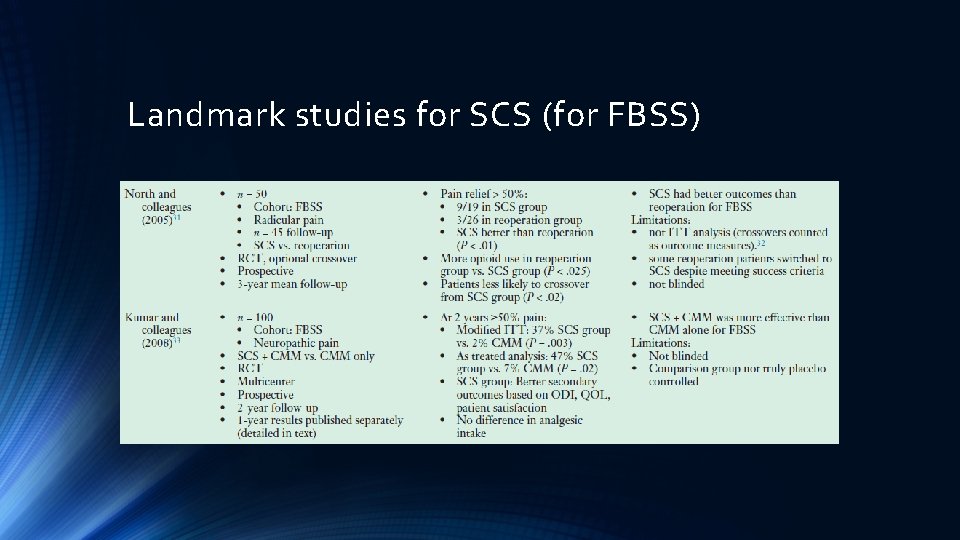
Landmark studies for SCS (for FBSS)
SCS for CRPS • Limited high quality data • Kemler et al • 6 month history of CRPS randomized to SCS + PT vs PT alone • At 2 years – SCS + PT group had reduction in pain and higher satisfaction. • At 5 years – effect diminished over time. Despite the diminishing effectiveness of SCS over time, 95% of patients with an implant would repeat the treatment for the same result.
SCS for Ischemia and Angina • Widely used outside the united states, but now recently starting to be approved by certain insurance plans. • Treatment for vasospasm/raynauds specifically.
Burst SCS evidence • Tends to be limited by duration of follow up. • De. Ridder et al (2013) • Burst SCS is superior to placebo in decreasing axial and limb pain. • Burst SCS superior to tonic SCS in suppressing axial pain (but not limb pain) • 1 w f/u • De V 0 s et al (2014) • Patients who had received tonic SCS for 6 months. 3 subgroups (FBSS good responders to tonic SCS, FBSS poor responders to SCS, and PDN) • All experienced pain relief when switched to burst mode for 2 weeks. • 44% better pain relief in PDN patients, 28% better relief in FBSS. • 2 w f/u
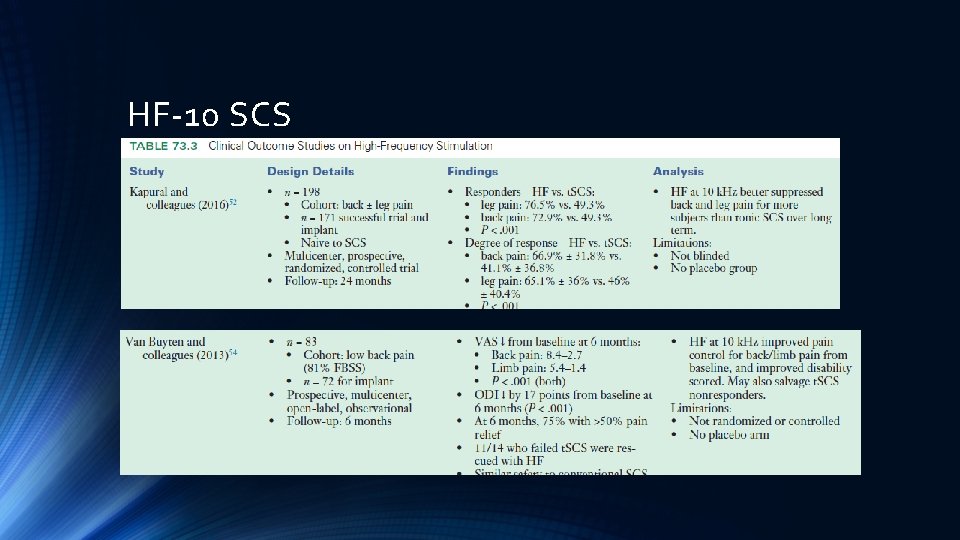
HF-10 SCS
SCS is also more cost effective • Kumar (2002) • 60/104 patients with FBSS implanted with SCS • 5 year follow up: • SCS - $29 k over 5 years • Control - $38 k over 5 years (ER, radiology, physician visits, medications) • Kemler (2002) SCS for CRD • 36/54 patients with CRD implanted with SCS/PT vs PT alone • SCS is $4 k more expensive in first year, but saves $60 k in lifetime analysis. • Projected lifetime analysis , using complication rates of 30% • RSD costs are generally medical care, PT, transport, DME, and medication.
Thank you!
- Slides: 25