
Spinal Cord Location Begins at foramen magnum Ends
Spinal Cord • Location • Begins at foramen magnum • Ends as conus medullaris at L 1 vertebra • Functions • Provides two-way communication • Contains spinal reflex centers Copyright © 2010 Pearson Education, Inc.
Spinal Cord: Protection • Bone, meninges, and CSF • Denticulate ligaments: extensions of pia mater that secure cord to dura mater • Filum terminale: fibrous extension from conus medullaris; anchors the spinal cord to the coccyx Copyright © 2010 Pearson Education, Inc.
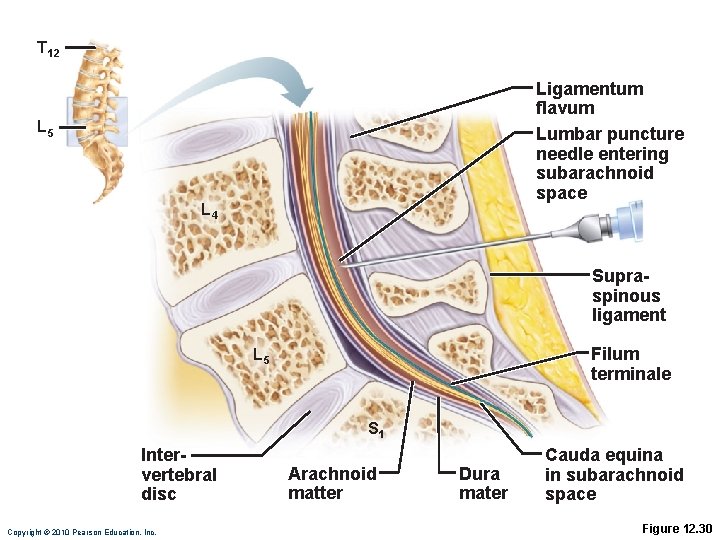
T 12 Ligamentum flavum Lumbar puncture needle entering subarachnoid space L 5 L 4 Supraspinous ligament Filum terminale L 5 S 1 Intervertebral disc Copyright © 2010 Pearson Education, Inc. Arachnoid matter Dura mater Cauda equina in subarachnoid space Figure 12. 30
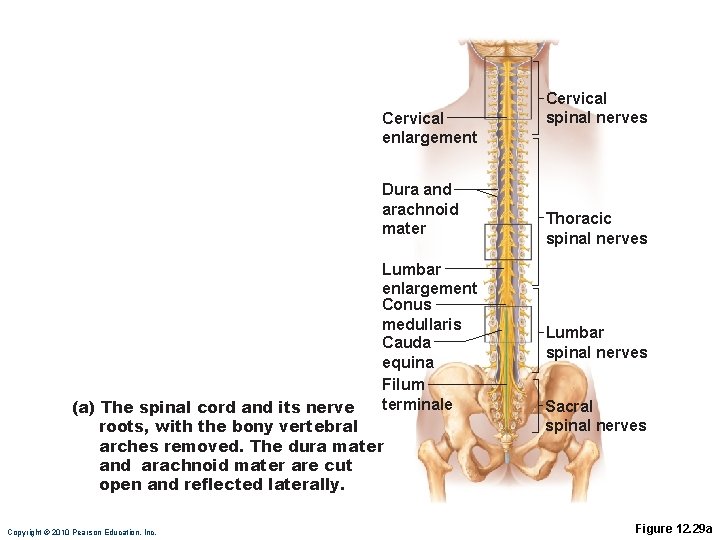
Cervical enlargement Dura and arachnoid mater Lumbar enlargement Conus medullaris Cauda equina Filum terminale (a) The spinal cord and its nerve roots, with the bony vertebral arches removed. The dura mater and arachnoid mater are cut open and reflected laterally. Copyright © 2010 Pearson Education, Inc. Cervical spinal nerves Thoracic spinal nerves Lumbar spinal nerves Sacral spinal nerves Figure 12. 29 a
Spinal Cord • Spinal nerves • 31 pairs • Cervical and lumbar enlargements • Nerves serving upper and lower limbs emerge here • Cauda equina • Collection of nerve roots at inferior end of vertebral canal Copyright © 2010 Pearson Education, Inc.
Cross-Sectional Anatomy • Two lengthwise grooves divide cord into right and left halves • Ventral (anterior) median fissure • Dorsal (posterior) median sulcus • Gray commissure—connects masses of gray matter; encloses central canal Copyright © 2010 Pearson Education, Inc.
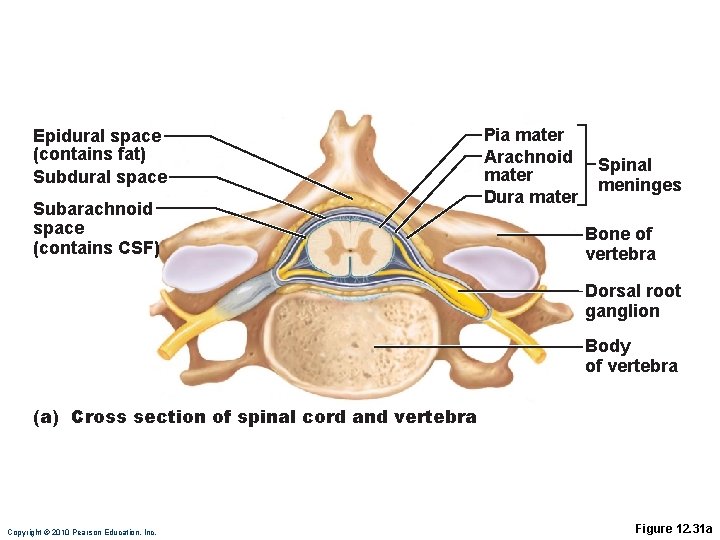
Epidural space (contains fat) Subdural space Subarachnoid space (contains CSF) Pia mater Arachnoid mater Dura mater Spinal meninges Bone of vertebra Dorsal root ganglion Body of vertebra (a) Cross section of spinal cord and vertebra Copyright © 2010 Pearson Education, Inc. Figure 12. 31 a
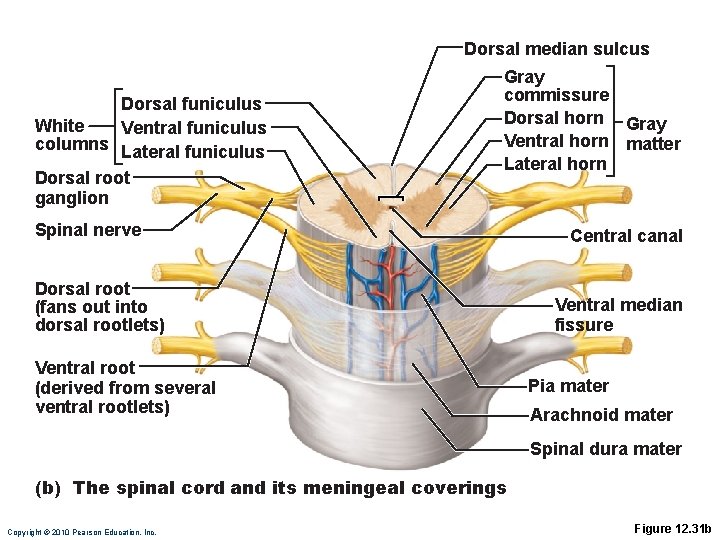
Dorsal median sulcus Dorsal funiculus White Ventral funiculus columns Lateral funiculus Dorsal root ganglion Gray commissure Dorsal horn Gray Ventral horn matter Lateral horn Spinal nerve Dorsal root (fans out into dorsal rootlets) Ventral root (derived from several ventral rootlets) Central canal Ventral median fissure Pia mater Arachnoid mater Spinal dura mater (b) The spinal cord and its meningeal coverings Copyright © 2010 Pearson Education, Inc. Figure 12. 31 b
Gray Matter • Dorsal horns—interneurons that receive somatic and visceral sensory input • Ventral horns—somatic motor neurons whose axons exit the cord via ventral roots • Lateral horns (only in thoracic and lumbar regions) –sympathetic neurons • Dorsal root (spinal) gangia—contain cell bodies of sensory neurons Copyright © 2010 Pearson Education, Inc.
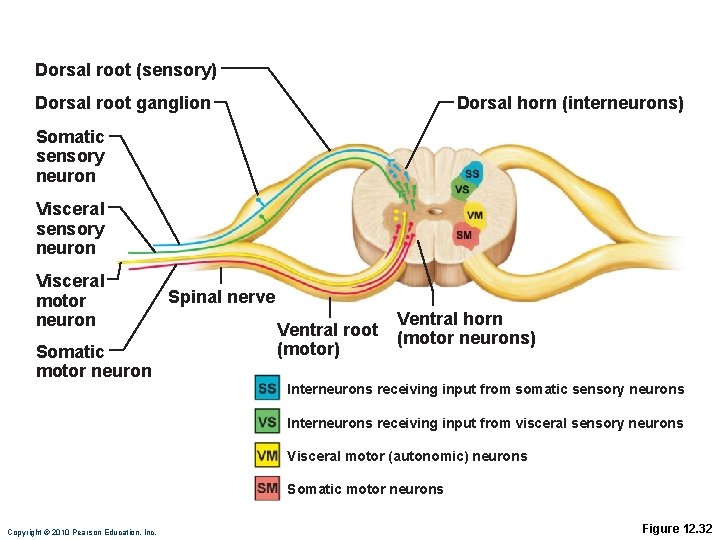
Dorsal root (sensory) Dorsal root ganglion Dorsal horn (interneurons) Somatic sensory neuron Visceral motor neuron Somatic motor neuron Spinal nerve Ventral root (motor) Ventral horn (motor neurons) Interneurons receiving input from somatic sensory neurons Interneurons receiving input from visceral sensory neurons Visceral motor (autonomic) neurons Somatic motor neurons Copyright © 2010 Pearson Education, Inc. Figure 12. 32
White Matter • Consists mostly of ascending (sensory) and descending (motor) tracts • Transverse tracts (commissural fibers) cross from one side to the other • Tracts are located in three white columns (funiculi on each side—dorsal (posterior), lateral, and ventral (anterior) • Each spinal tract is composed of axons with similar functions Copyright © 2010 Pearson Education, Inc.
Pathway Generalizations • Pathways decussate (cross over) • Most consist of two or three neurons (a relay) • Most exhibit somatotopy (precise spatial relationships) • Pathways are paired symmetrically (one on each side of the spinal cord or brain) Copyright © 2010 Pearson Education, Inc.
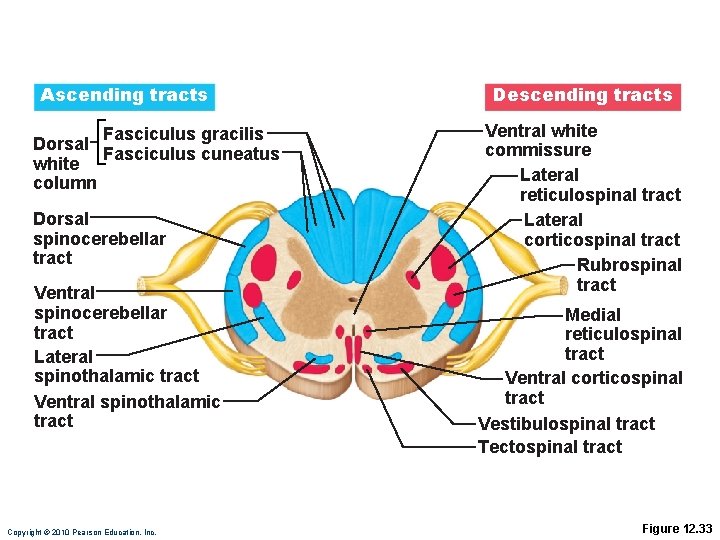
Ascending tracts Fasciculus gracilis Dorsal Fasciculus cuneatus white column Dorsal spinocerebellar tract Ventral spinocerebellar tract Lateral spinothalamic tract Ventral spinothalamic tract Copyright © 2010 Pearson Education, Inc. Descending tracts Ventral white commissure Lateral reticulospinal tract Lateral corticospinal tract Rubrospinal tract Medial reticulospinal tract Ventral corticospinal tract Vestibulospinal tract Tectospinal tract Figure 12. 33
Ascending Pathways • Consist of three neurons • First-order neuron • Conducts impulses from cutaneous receptors and proprioceptors • Branches as it enters spinal cord • Synapses with second-order Copyright © 2010 Pearson Education, Inc.
Ascending Pathways • Second-order neuron • Interneuron • Cell body in dorsal horn of spinal cord • Axons extend to thalamus or cerebellum Copyright © 2010 Pearson Education, Inc.
Ascending Pathways • Third-order neuron • Interneuron • Cell body in thalamus • Axon extends to somatosensory cortex Copyright © 2010 Pearson Education, Inc.
Ascending Pathways • Pathways transmit somatosensory information to sensory cortex via the thalamus • Spinothalamic pathways • Spinocerebellar tracts terminate in the cerebellum Copyright © 2010 Pearson Education, Inc.
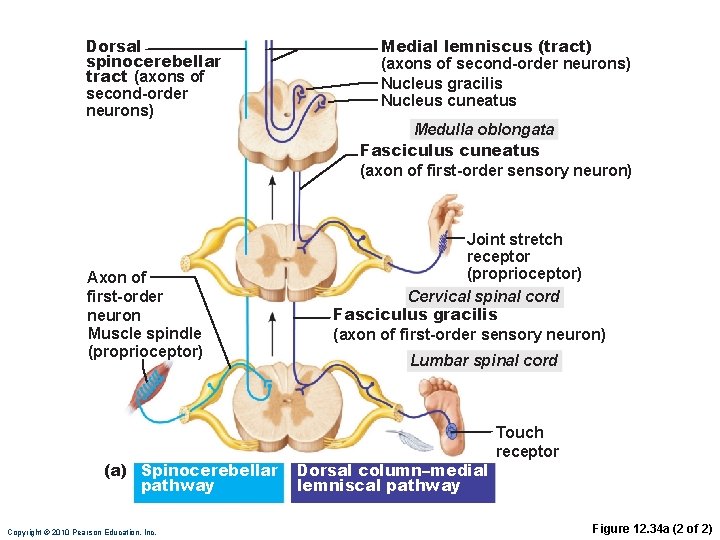
Dorsal spinocerebellar tract (axons of second-order neurons) Medial lemniscus (tract) (axons of second-order neurons) Nucleus gracilis Nucleus cuneatus Medulla oblongata Fasciculus cuneatus (axon of first-order sensory neuron) Axon of first-order neuron Muscle spindle (proprioceptor) (a) Spinocerebellar pathway Copyright © 2010 Pearson Education, Inc. Joint stretch receptor (proprioceptor) Cervical spinal cord Fasciculus gracilis (axon of first-order sensory neuron) Lumbar spinal cord Dorsal column–medial lemniscal pathway Touch receptor Figure 12. 34 a (2 of 2)
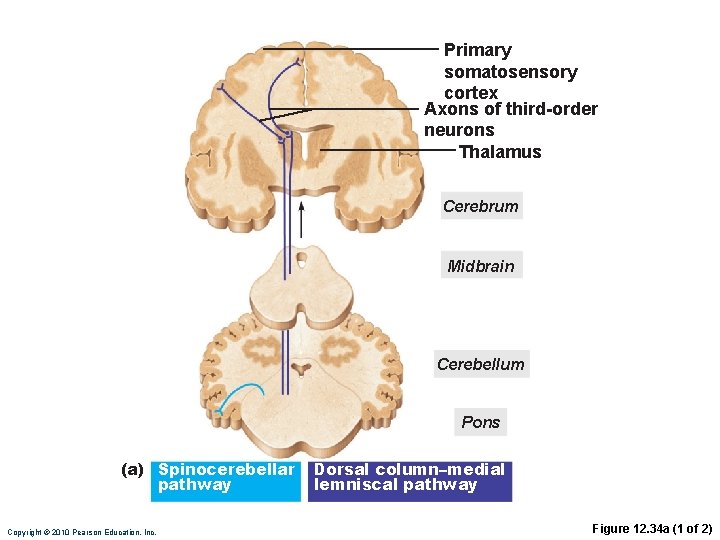
Primary somatosensory cortex Axons of third-order neurons Thalamus Cerebrum Midbrain Cerebellum Pons (a) Spinocerebellar pathway Copyright © 2010 Pearson Education, Inc. Dorsal column–medial lemniscal pathway Figure 12. 34 a (1 of 2)
Descending Pathways and Tracts • Deliver efferent impulses from the brain to the spinal cord • Direct pathways—pyramidal tracts • Indirect pathways—all others Copyright © 2010 Pearson Education, Inc.
Descending Pathways and Tracts • Involve two neurons: 1. Upper motor neurons • Pyramidal cells in primary motor cortex 2. Lower motor neurons • Ventral horn motor neurons • Innervate skeletal muscles Copyright © 2010 Pearson Education, Inc.
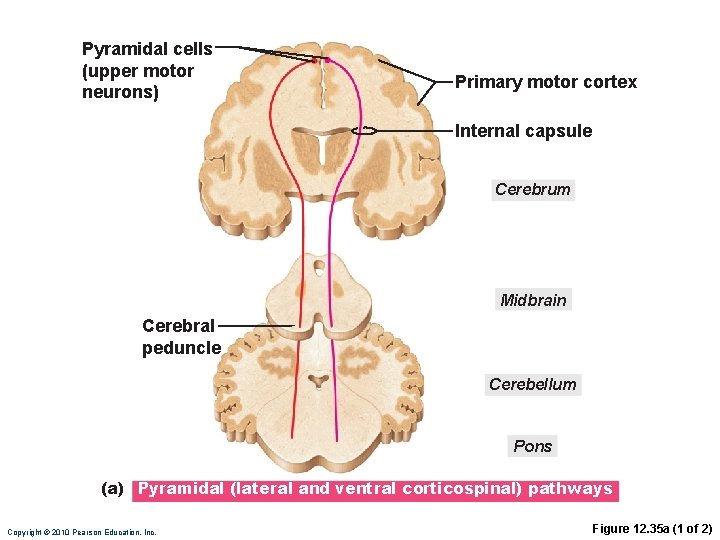
Pyramidal cells (upper motor neurons) Primary motor cortex Internal capsule Cerebrum Midbrain Cerebral peduncle Cerebellum Pons (a) Pyramidal (lateral and ventral corticospinal) pathways Copyright © 2010 Pearson Education, Inc. Figure 12. 35 a (1 of 2)
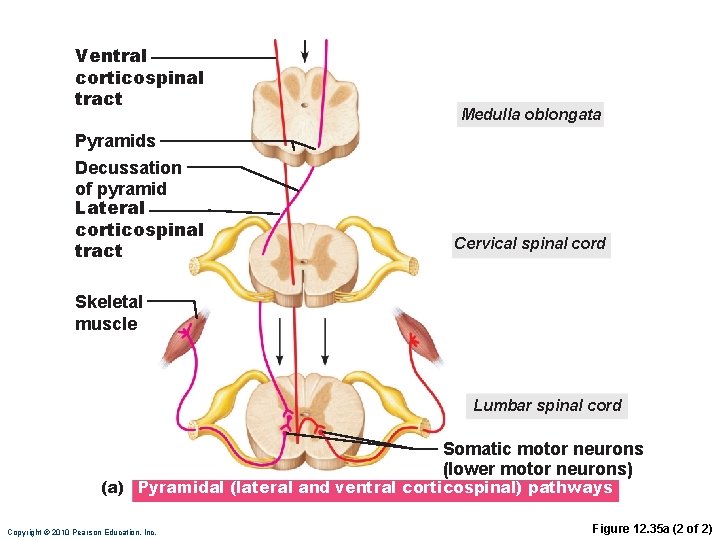
Ventral corticospinal tract Pyramids Decussation of pyramid Lateral corticospinal tract Medulla oblongata Cervical spinal cord Skeletal muscle Lumbar spinal cord Somatic motor neurons (lower motor neurons) (a) Pyramidal (lateral and ventral corticospinal) pathways Copyright © 2010 Pearson Education, Inc. Figure 12. 35 a (2 of 2)
Spinal Cord Trauma • Functional losses • Parasthesias • Sensory loss • Paralysis • Loss of motor function Copyright © 2010 Pearson Education, Inc.
Spinal Cord Trauma • Flaccid paralysis—severe damage to ventral root or ventral horn cells • Impulses do not reach muscles; there is no voluntary or involuntary control of muscles • Muscles atrophy Copyright © 2010 Pearson Education, Inc.
Spinal Cord Trauma • Spastic paralysis—damage to upper motor neurons of the primary motor cortex • Spinal neurons remain intact; muscles are stimulated by reflex activity • No voluntary control of muscles Copyright © 2010 Pearson Education, Inc.
Spinal Cord Trauma • Transection • Cross sectioning of the spinal cord at any level • Results in total motor and sensory loss in regions inferior to the cut • Paraplegia—transection between T 1 and L 1 • Quadriplegia—transection in the cervical region Copyright © 2010 Pearson Education, Inc.
Poliomyelitis • Destruction of ventral horn motor neurons by the poliovirus • Muscles atrophy • Survivors often develop postpolio syndrome many years later, as neurons are lost • Post-Polio Syndrome Fact Sheet • http: //www. ninds. nih. gov/disorders/post_polio/ detail_post_polio. htm Copyright © 2010 Pearson Education, Inc.
Amyotrophic Lateral Sclerosis (ALS) • Lou Gehrig’s disease http: //video. sbrforum. com/video-4844 -lougehrig-speech. html • Involves progressive destruction of ventral horn motor neurons and fibers of the pyramidal tract • Symptoms—loss of the ability to speak, swallow, and breathe • Death typically occurs within five years Copyright © 2010 Pearson Education, Inc.
- Slides: 29