
Spinal cord injury Sherlock bones Med Apps Q
Spinal cord injury Sherlock bones Med Apps Q: A 55 year old male fell from her horse and is now fully tretraplegic. Your first imaging choice is MRI? yes no
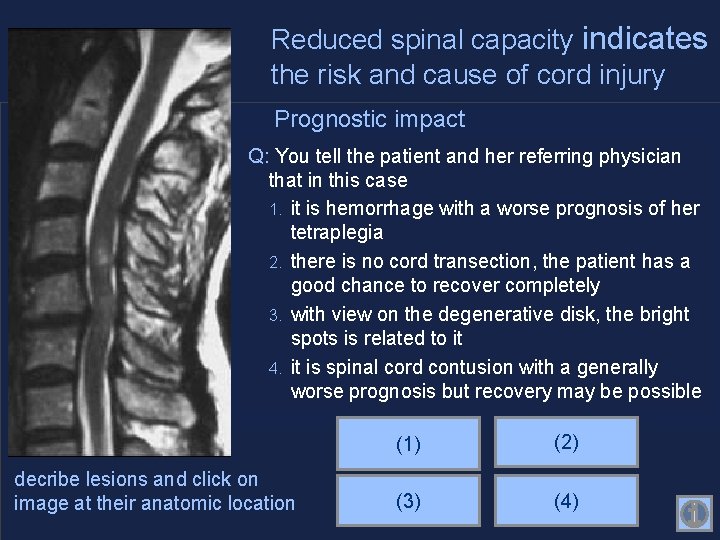
Reduced spinal capacity indicates the risk and cause of cord injury Prognostic impact Q: You tell the patient and her referring physician that in this case 1. it is hemorrhage with a worse prognosis of her tetraplegia 2. there is no cord transection, the patient has a good chance to recover completely 3. with view on the degenerative disk, the bright spots is related to it 4. it is spinal cord contusion with a generally worse prognosis but recovery may be possible decribe lesions and click on image at their anatomic location (1) (2) (3) (4)
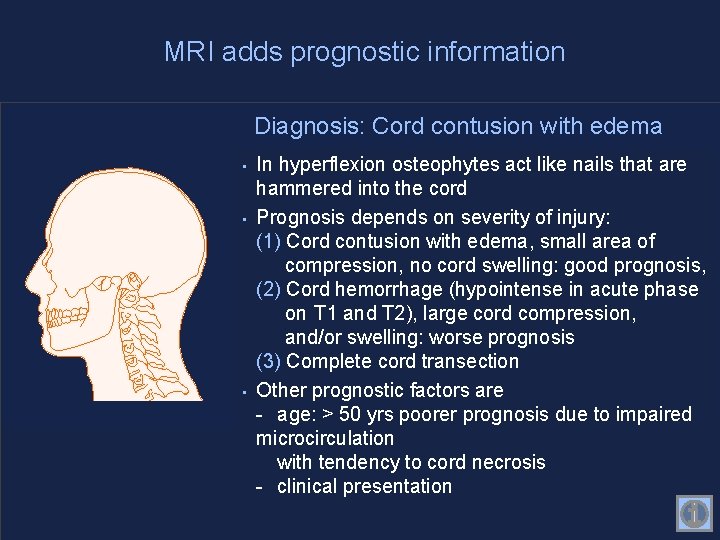
MRI adds prognostic information Diagnosis: Cord contusion with edema • • • In hyperflexion osteophytes act like nails that are hammered into the cord Prognosis depends on severity of injury: (1) Cord contusion with edema, small area of compression, no cord swelling: good prognosis, (2) Cord hemorrhage (hypointense in acute phase on T 1 and T 2), large cord compression, and/or swelling: worse prognosis (3) Complete cord transection Other prognostic factors are - age: > 50 yrs poorer prognosis due to impaired microcirculation with tendency to cord necrosis - clinical presentation

Fortunately, our patient recovered completely after several weeks – and committed during a follow-up visit that he again was riding his horse.
Hyperflexion of cervical spine Summary & Learning Objectives to understand the relationship between the spinal column and the spinal cord in case of injury • Spinal capacity expresses the width of the spinal canal • Spondylosis is an important risk factor for cord injury to estimate the prognosis based on imaging findings in the context with clinical presentation • Three degrees of cord injury: contusional edema, hemorrhage, complete transection References: 1. Fruewald F, Tscholakoff D, Kainberger F. Orientierungshilfe Radiologie, 2011 2. Miyanji F et al. Acute cervical traumatic spinal cord injury. Radiology 2007; 243: 820 back
- Slides: 5