
Spinal Cord Injury Management Outlines Strength training Strength





- Slides: 57
Spinal Cord Injury Management
Outlines �Strength training
Strength training � Strength � Endurance � Power � Motor control � 06 weeks for strengthening � Motor learning � Thousands repetition � Training protocol � Maximum Repetition minimum weight? ? � Maximum weight minimum Repetition? ?
�Two clients came to your department and both want to increase strength of upper limb �One person is Furqan Ahmad �Other person is Arshad Nawaz �What will be your protocol �Will the protocol be same for both or different �Explain with logic
�Two client came to your Gym and both have almost same age, height and weight. �One of them said he wants to increase strength of his limbs while other said I want to increase my endurance of upper limb �So what would be your appropriate protocol for both? ? ?
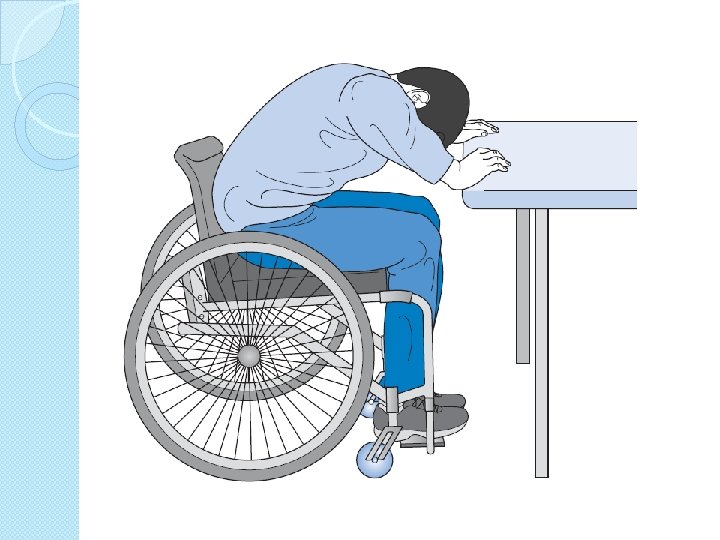
�Strength ◦ Mobility ◦ Independence �Lattismus dorsi and triceps �Normal strength not sufficient to lift
�C 6 partial paralysis of Pect Major �Function of pect major �Help in Rolling �Weak dorsi flexors ? ? �C 5 shoulder flexor strength will improve? ? ? �C 6 ? ? wrist extensors strength will increase
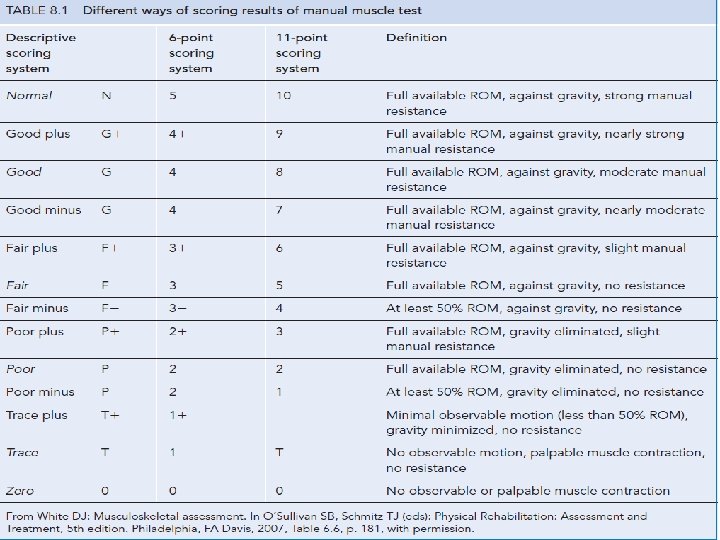
Strength assessment MMT 2. 1 RM 3. Hand held myometer 4. Isokinetic dynamometers 1.
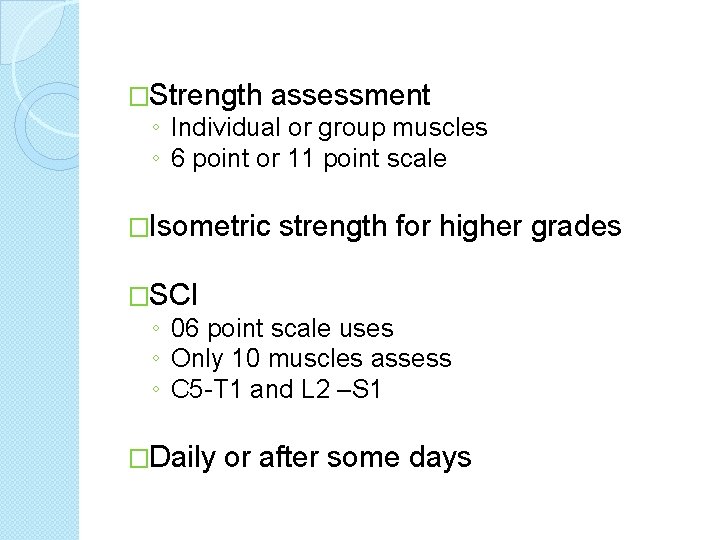
�Strength assessment ◦ Individual or group muscles ◦ 6 point or 11 point scale �Isometric strength for higher grades �SCI ◦ 06 point scale uses ◦ Only 10 muscles assess ◦ C 5 -T 1 and L 2 –S 1 �Daily or after some days
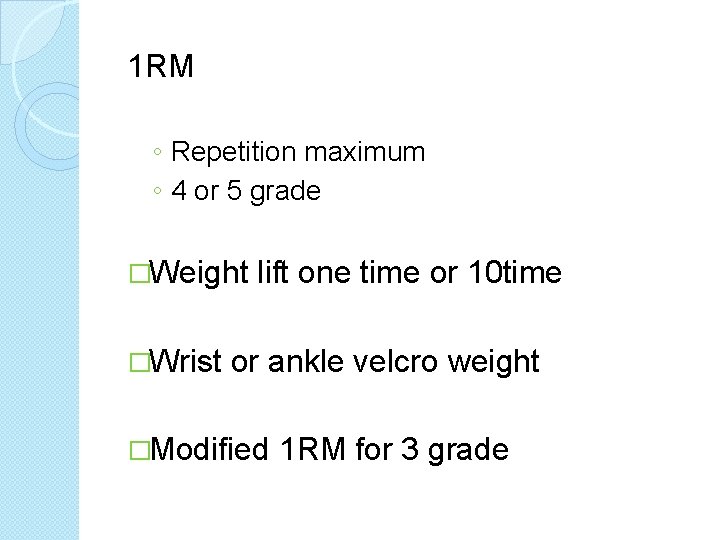
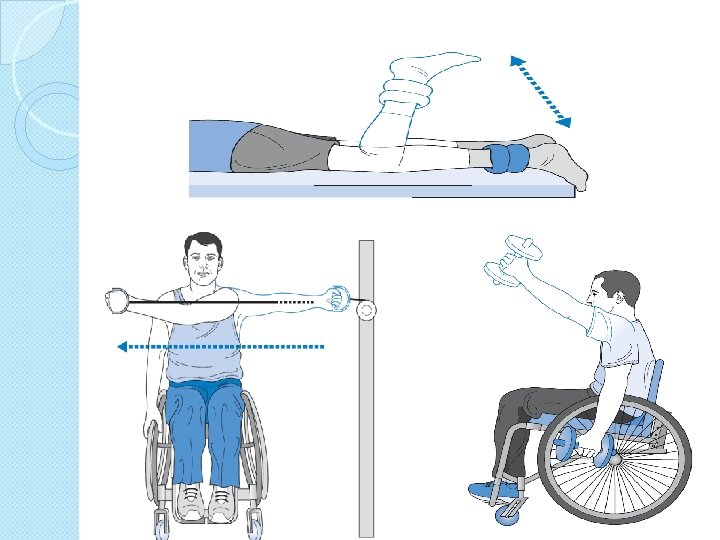
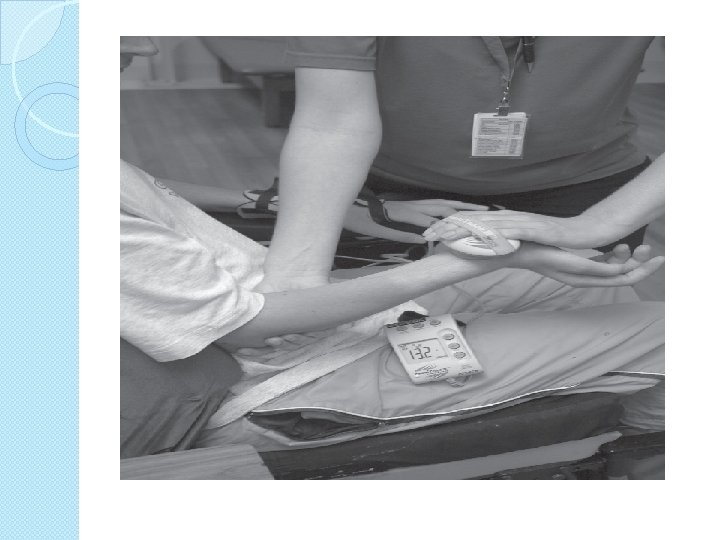
1 RM ◦ Repetition maximum ◦ 4 or 5 grade �Weight �Wrist lift one time or 10 time or ankle velcro weight �Modified 1 RM for 3 grade
How to measure 1 RM �http: //www. exrx. net/Calculators/One. R ep. Max. html �http: //www. exrx. net/index. html
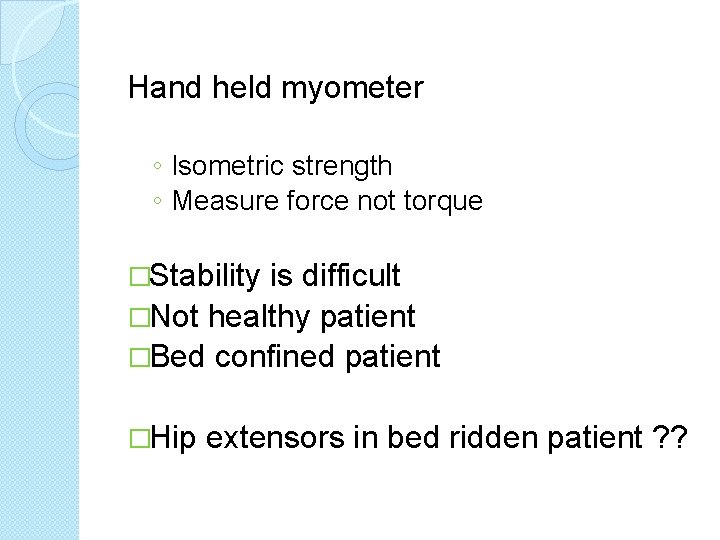
Hand held myometer ◦ Isometric strength ◦ Measure force not torque �Stability is difficult �Not healthy patient �Bed confined patient �Hip extensors in bed ridden patient ? ?
Isokinetic dynamometers �Torque in concentric or eccentric �Same velocity �Not in SCI �Profound weakness and bed ridden
Strength training � Strength increase 2 % per week � Early stages or deconditioned patient increase � Male more strength and female of any age same effect � Cross sectional area, protein content, increase capillary density, hypertrophy � Hyperplasia? � Motor � Short unit synchronization, firing and recruitment term strength training …hypertrophy…. . motor unit synchronization
PRE � Best regimen ◦ 8 -12 RM ◦ 60 -80% of a 1 RM � 1 -3 second rest than second � Two to three per week and third time � 8 -12 times not increase � Longer rest 3 minutes superior seconds to shorter 40 � Eccentric strengthening superior to concentric � Variation in load in session better than fixation
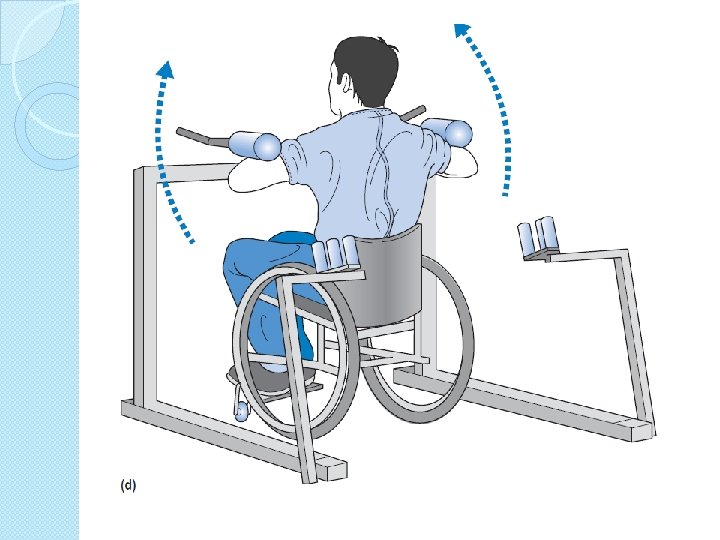
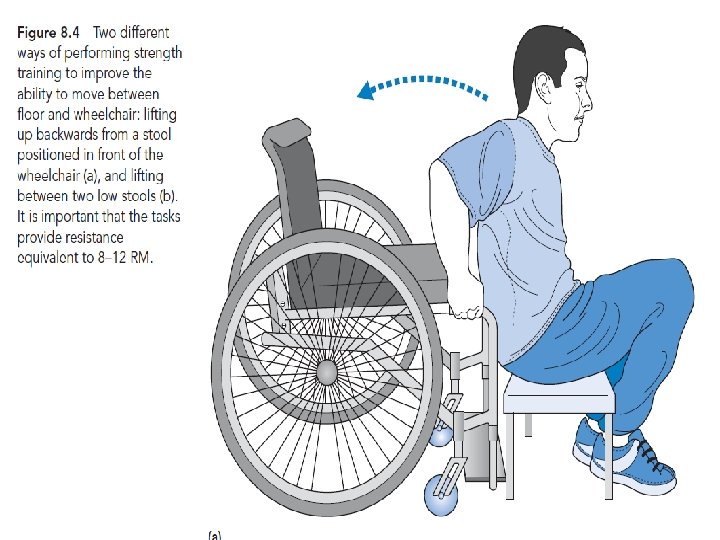
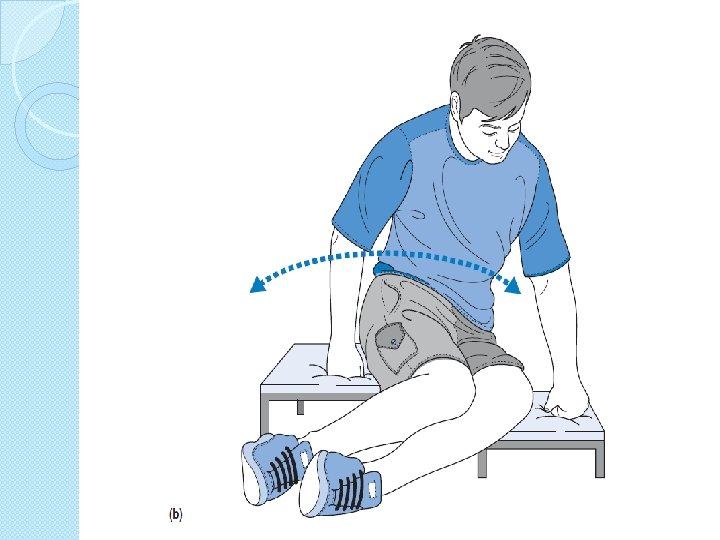
Specificity of training �Co contraction �Position of joint �Type eccentric concentric �Speed �Functional task ◦ Floor and wheel chair ◦ 8 -12 RM isometric
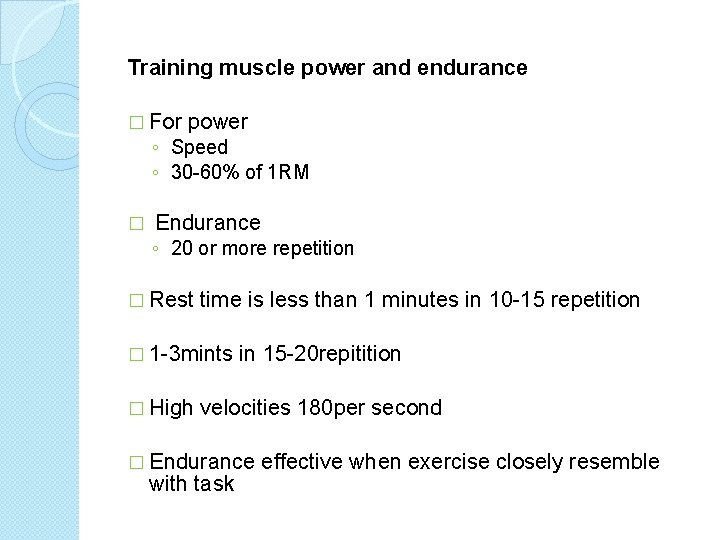
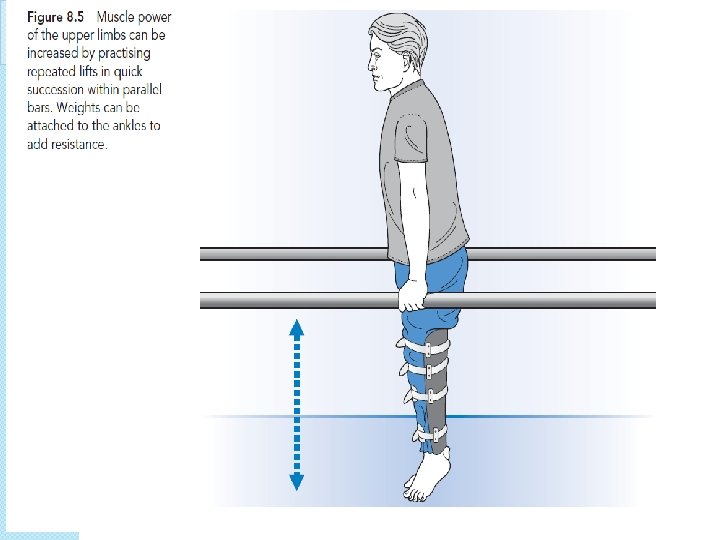
Training muscle power and endurance � For power ◦ Speed ◦ 30 -60% of 1 RM � Endurance ◦ 20 or more repetition � Rest time is less than 1 minutes in 10 -15 repetition � 1 -3 mints � High in 15 -20 repitition velocities 180 per second � Endurance with task effective when exercise closely resemble
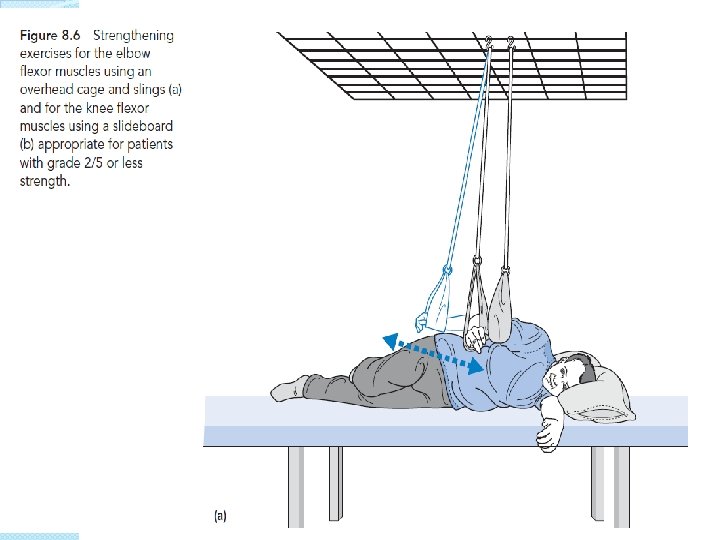
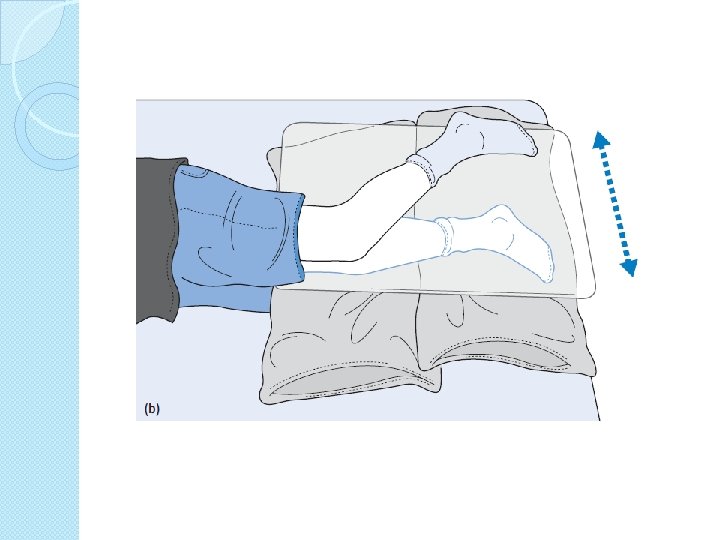
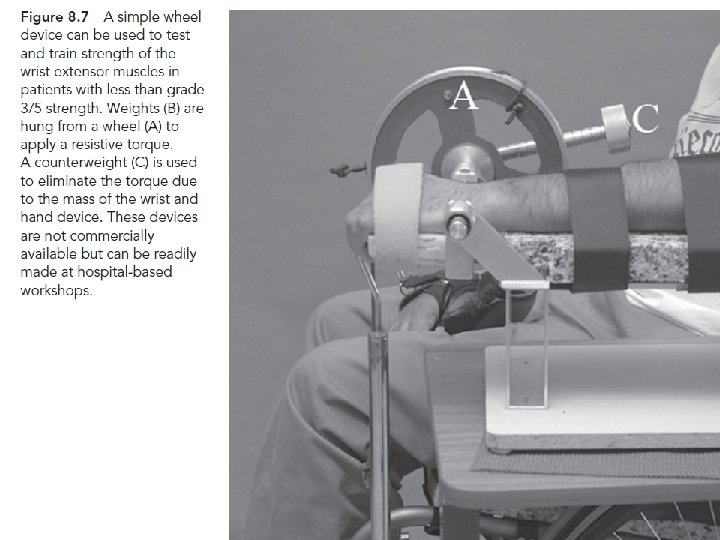
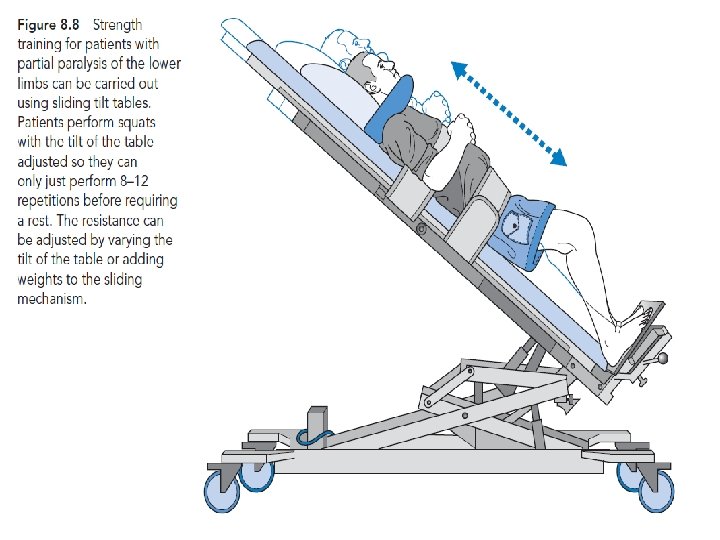
Strength training for paralyzed muscles �Same principal �Biceps in grade 2 �Hamstring � 8 -12 in grade 2 repetition than change grade
�Flicker �EMG movement feed back �Mental practice �Motor imaginary �Repeated cognitive practice without movement
�Electrical stimulation ◦ Crude grip ◦ Increase blood circulation ◦ Gltueal area so pressure sore �No literature
�Resistance training increase spasticity �Bobath believed that resistance exercises reinforced abnormal movement pattern in stroke �In stroke Not in SCI �Modified plan with gradually increasing �Eccentric �Mood, more DOMS QOL, pain, satisfaction �Barriers
Muscle length
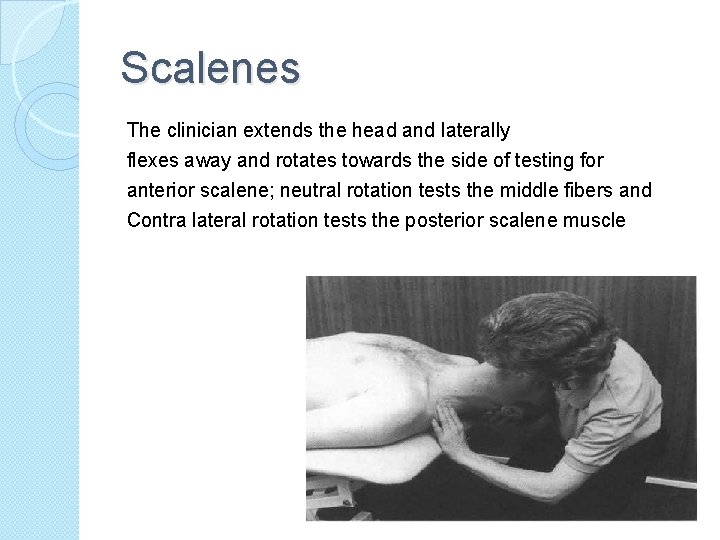
Scalenes The clinician extends the head and laterally flexes away and rotates towards the side of testing for anterior scalene; neutral rotation tests the middle fibers and Contra lateral rotation tests the posterior scalene muscle
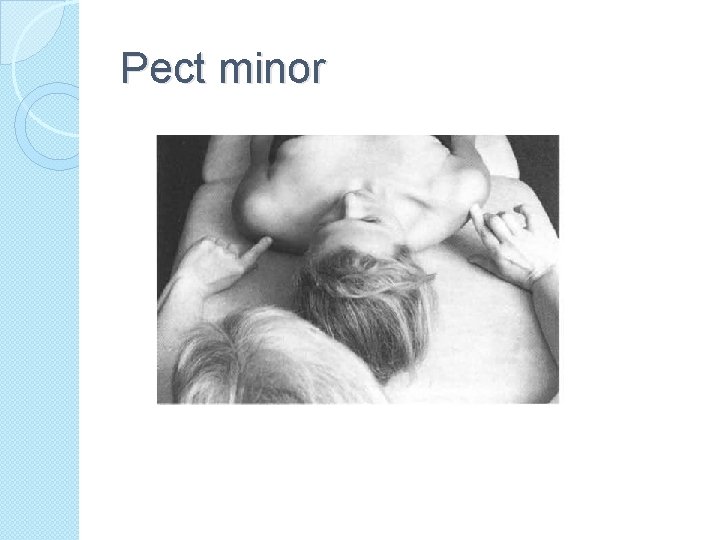
Pect minor
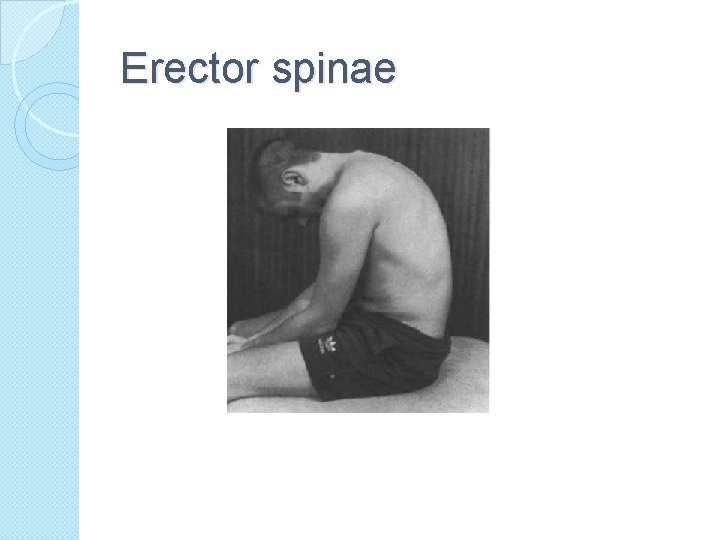
Erector spinae
Test �SCIM �Barthel index �Lawton index
�Assignment �Summary �Feedback �Anything missing ? ? ?
MCQs
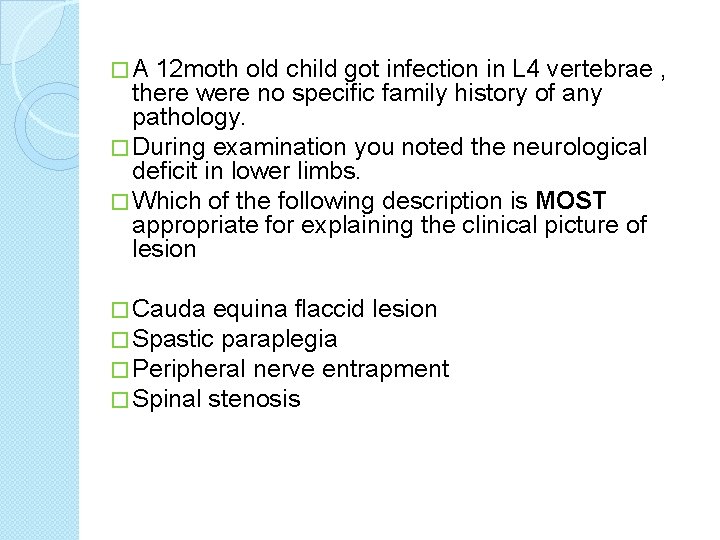
�A 12 moth old child got infection in L 4 vertebrae , there were no specific family history of any pathology. � During examination you noted the neurological deficit in lower limbs. � Which of the following description is MOST appropriate for explaining the clinical picture of lesion � Cauda equina flaccid lesion � Spastic paraplegia � Peripheral nerve entrapment � Spinal stenosis
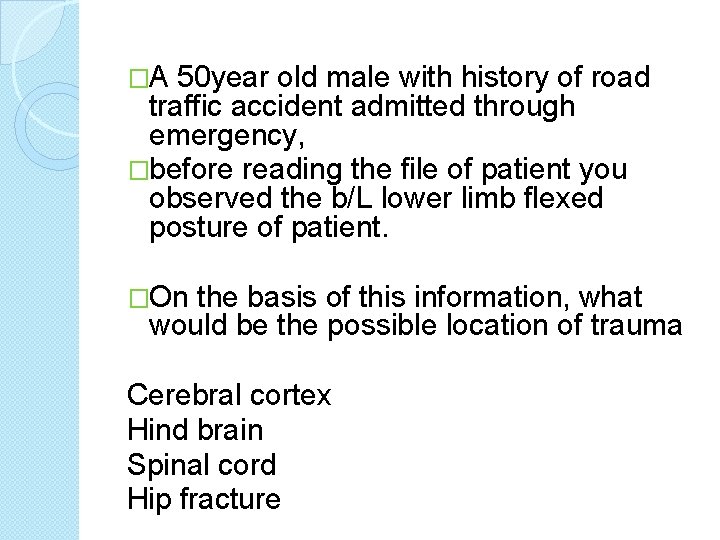
�A 50 year old male with history of road traffic accident admitted through emergency, �before reading the file of patient you observed the b/L lower limb flexed posture of patient. �On the basis of this information, what would be the possible location of trauma Cerebral cortex Hind brain Spinal cord Hip fracture
�A patient comes to the physical therapy department with history of a spinal trauma at the level of T 10 vertebrae , � the symptoms were loss of sensory sensation in right leg , while the motor loss in the left leg. � During neurological examination you observed the positive babinski sign and exaggerated reflexes, � on the basis of above symptoms which type of injury comes in your mind � Right hemi section of spinal cord � Right anterior damage of spinal cord � Left hemi section of spinal cord � Complete damage of spinal cord
�If you are working in spinal cord injury unit, you should know the concept of level of decussating of different ascending and descending tracts of spinal cord. �Which of the following tract is/are decussating at the level of spinal cord segment �Anterior spinothalamic tract �Posterior spinocerebellar tract �Lateral spinocerebellar tract �A & C
�In spinal cord Injury unit , you assess a patient through different movement and sensation , � you observed that the thumb sensation are preserved but the little finger has impaired sensation , what will be the diagnosis �C 6 incomplete �C 6 complete �C 7 incomplete �C 5 incomplete
�If a patient get fractured C 7 spine and all the sensory and motor sensation are absolutely finished. �The C 8 spinal segment is last segment which is preserved and all below segments get damaged , �the patient is declared the spastic paraplegic, in which segment flaccid symptoms will be observed �C 7 �C 8 �T 1 �None of above
�You are treating a patient with T 4 paraplegia who begins to demonstrate signs and symptoms of autonomic dysreflexia. � Which of the following vital signs are the indicators of this �Pulse rate �Respiratory rate �Blood pressure �Body temperature
�In hand function , the power grip of hand mainly on the ……………side and skill activity mainly on the………side �Ulnar , radial �Radial , ulnar �Radial , thumb �Thumb , wrist
�You are about to discharge a patient with a C 7 spinal cord injury. Which of the following would be challenging but obtainable goals for this patient? ◦ Independent w/ all ADLs; may need adaptive aids for bowel care ◦ Independent pressure relief ◦ May have limited walking with bracing ◦ Independent slide board transfer
�A patient of spinal cord injury presents with independent breathing but no other motor activities were possible. �He can operate his motorized wheelchair through breathing and puff , what would be the level of injury �C 3 �C 4 �C 5 �C 6
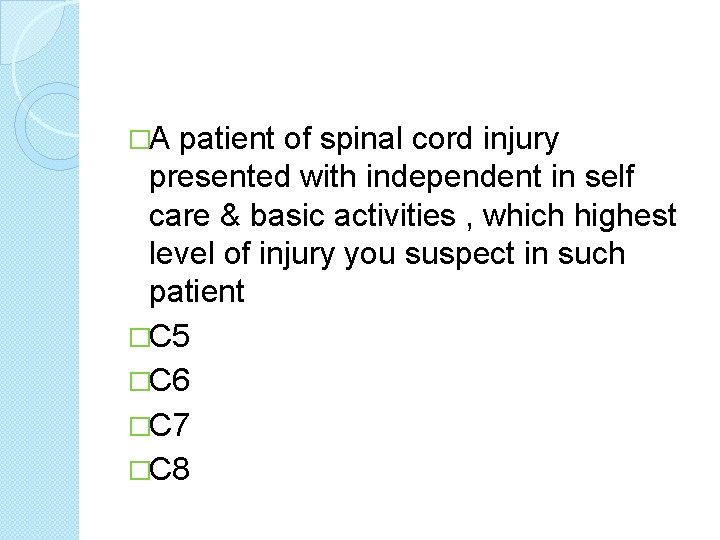
�A patient of spinal cord injury presented with independent in self care & basic activities , which highest level of injury you suspect in such patient �C 5 �C 6 �C 7 �C 8
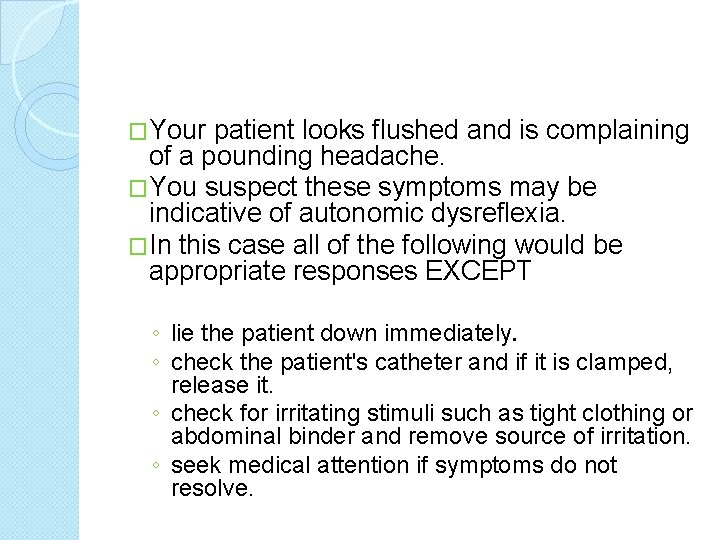
�Your patient looks flushed and is complaining of a pounding headache. �You suspect these symptoms may be indicative of autonomic dysreflexia. �In this case all of the following would be appropriate responses EXCEPT ◦ lie the patient down immediately. ◦ check the patient's catheter and if it is clamped, release it. ◦ check for irritating stimuli such as tight clothing or abdominal binder and remove source of irritation. ◦ seek medical attention if symptoms do not resolve.
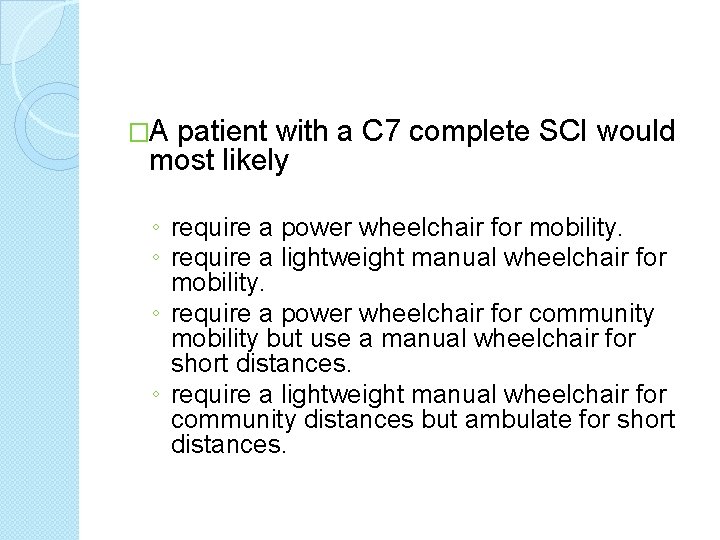
�A patient with a C 7 complete SCI would most likely ◦ require a power wheelchair for mobility. ◦ require a lightweight manual wheelchair for mobility. ◦ require a power wheelchair for community mobility but use a manual wheelchair for short distances. ◦ require a lightweight manual wheelchair for community distances but ambulate for short distances.