
Spinal Cord and Brain Stem Prof K Sivapalan
Spinal Cord and Brain Stem Prof. K. Sivapalan
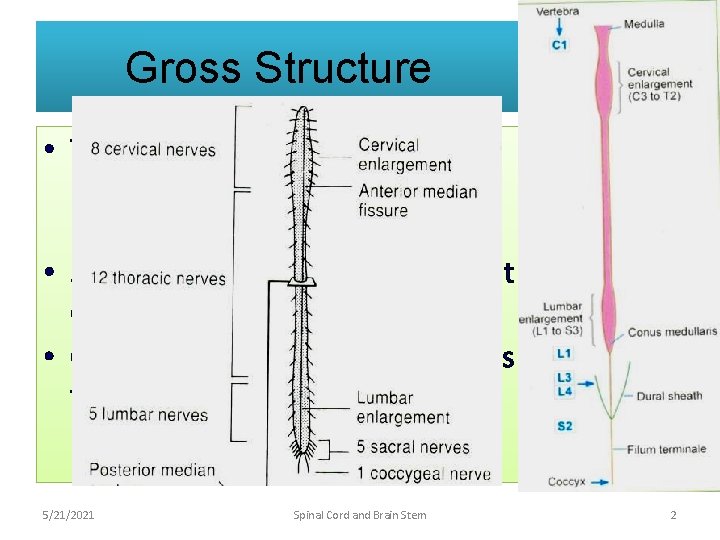
Gross Structure • The upper end continues as the medulla oblongata at the upper border of the C 1 vertebra • 31 pairs of spinal nerves come out of spinal cord. • Cervical and lumbar enlargements to accommodate neurons that innervate the limbs 5/21/2021 Spinal Cord and Brain Stem 2
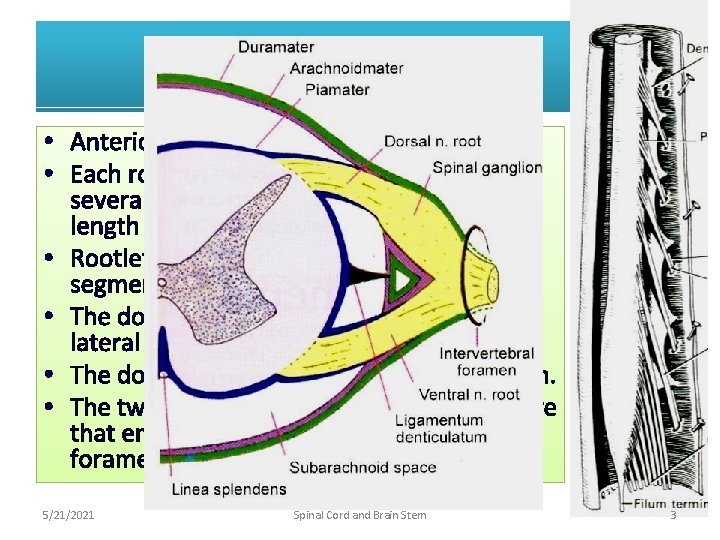
Nerve Roots • Anterior and posterior nerve roots. • Each root is formed by aggregation of several rootlets that arise over a certain length of the cord • Rootlets of one root arise from one spinal segment • The dorsal rootlets arise along the posterolateral salcus • The dorsal root has the dorsal root ganglion. • The two roots meet to form the spinal nerve that emerges through the intervertebral foramen. 5/21/2021 Spinal Cord and Brain Stem 3
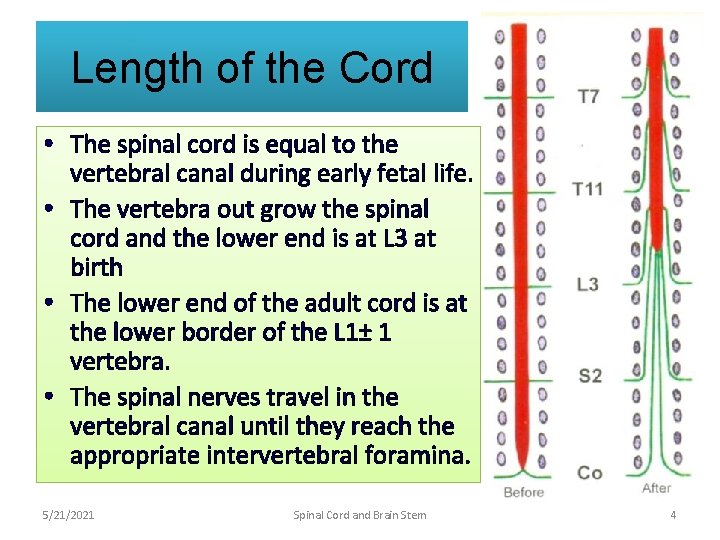
Length of the Cord • The spinal cord is equal to the vertebral canal during early fetal life. • The vertebra out grow the spinal cord and the lower end is at L 3 at birth • The lower end of the adult cord is at the lower border of the L 1± 1 vertebra. • The spinal nerves travel in the vertebral canal until they reach the appropriate intervertebral foramina. 5/21/2021 Spinal Cord and Brain Stem 4

Conus Medullaris • The lower end is called conus medullaris. • It continues as fibrous cord called filum terminale up to the sacrum. • The spinal nerves beyond the end of the spinal cord form the cauda equina 5/21/2021 Spinal Cord and Brain Stem 5
![Structure of the Cord • Butterfly shaped [H shaped] gray matter surrounded by white](http://slidetodoc.com/presentation_image_h2/4168d1d3dd601d55ed1f81d55403b173/image-6.jpg "Structure of the Cord • Butterfly shaped [H shaped] gray matter surrounded by white")
Structure of the Cord • Butterfly shaped [H shaped] gray matter surrounded by white matter. • White matter is in three funiculi [columns] on either side: – Anterior funiculus between anterior median fissure and anterior root – Lateral funiculus between anterior and posterior roots – Posterior funiculus between the posterior root and the posterior median septum 5/21/2021 Spinal Cord and Brain Stem 6
![The Gray Matter • Central gray with a minute central canal • Anterior [motor]](http://slidetodoc.com/presentation_image_h2/4168d1d3dd601d55ed1f81d55403b173/image-7.jpg "The Gray Matter • Central gray with a minute central canal • Anterior [motor]")
The Gray Matter • Central gray with a minute central canal • Anterior [motor] and posterior [sensory] horns on either side • A lateral gray horn [autonomic- dorsal sensory and ventral motor] in the spinal segments from T 1 to L 2 , S 2 -S 4. 5/21/2021 Spinal Cord and Brain Stem 7
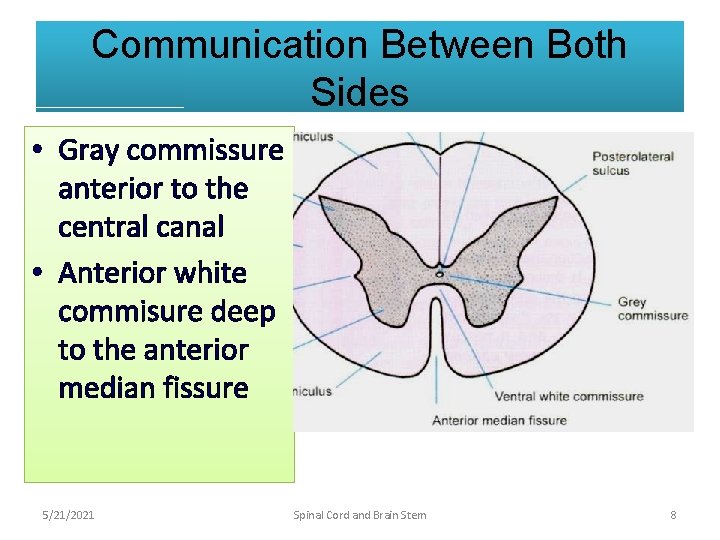
Communication Between Both Sides • Gray commissure anterior to the central canal • Anterior white commisure deep to the anterior median fissure 5/21/2021 Spinal Cord and Brain Stem 8
Brain Stem • The spinal cord continues as the brain stem in the base of the skull. • The arrangement of gray in the centre and white matter around in the spinal cord is disturbed in the brain stem because of the flexures and development. • The ascending, descending and transverse tracts divide the gray into collection of cells called nuclei. • In addition to recognizable nuclei, neurons are disbursed through out the brainstem performing autonomic and other functions. • These neurons are named reticular formation collectively 5/21/2021 Spinal Cord and Brain Stem 9
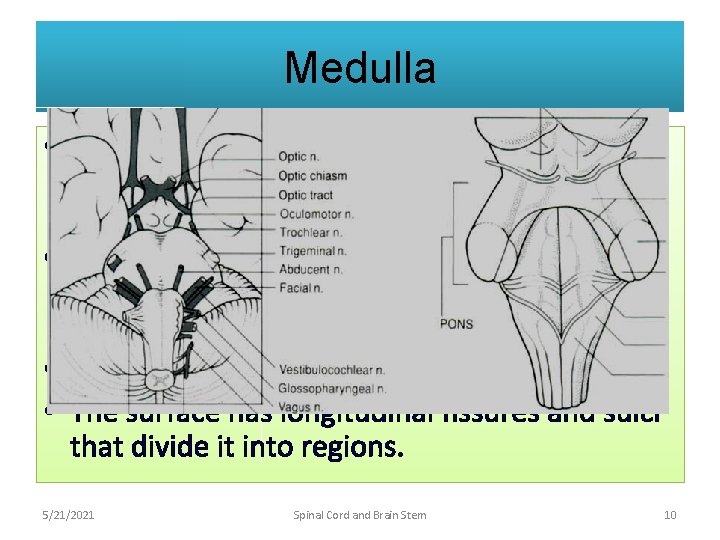
Medulla • Transition of spinal cord to medulla is not abrupt at the upper border of atlas but over a certain distance. • It is narrow [closed- around central canal] below and widens above [open- under fourth ventricle]. • 3 cm long and 2 cm at the upper end • The surface has longitudinal fissures and sulci that divide it into regions. 5/21/2021 Spinal Cord and Brain Stem 10
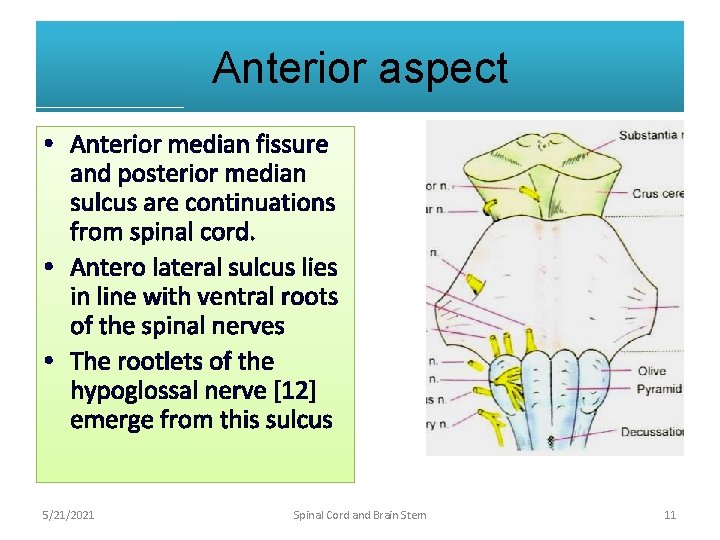
Anterior aspect • Anterior median fissure and posterior median sulcus are continuations from spinal cord. • Antero lateral sulcus lies in line with ventral roots of the spinal nerves • The rootlets of the hypoglossal nerve [12] emerge from this sulcus 5/21/2021 Spinal Cord and Brain Stem 11
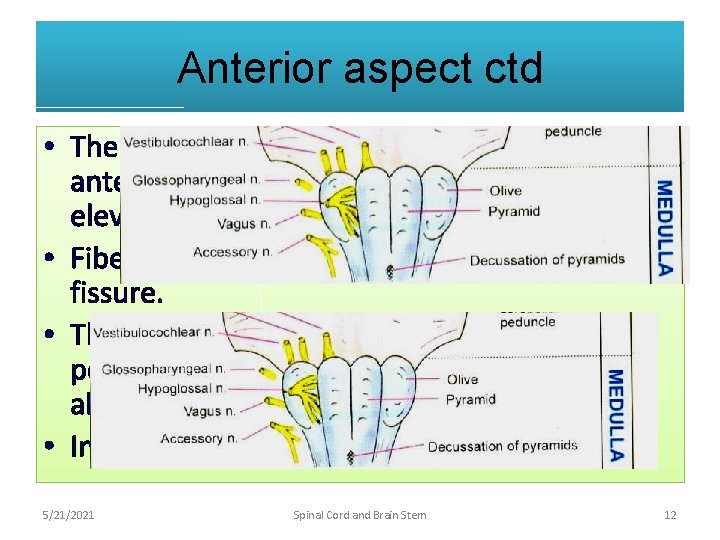
Anterior aspect ctd • The area between anterior median fissure and anterior medial sulcus is occupied by an elevation called the pyramid • Fibers in pyramid decussate obliterating the fissure. • The region between anterolateral and posterolateral sulci has a prominent, oval about 1. 3 cm long swelling named olive • Inferior olivery nucleus lies under this 5/21/2021 Spinal Cord and Brain Stem 12
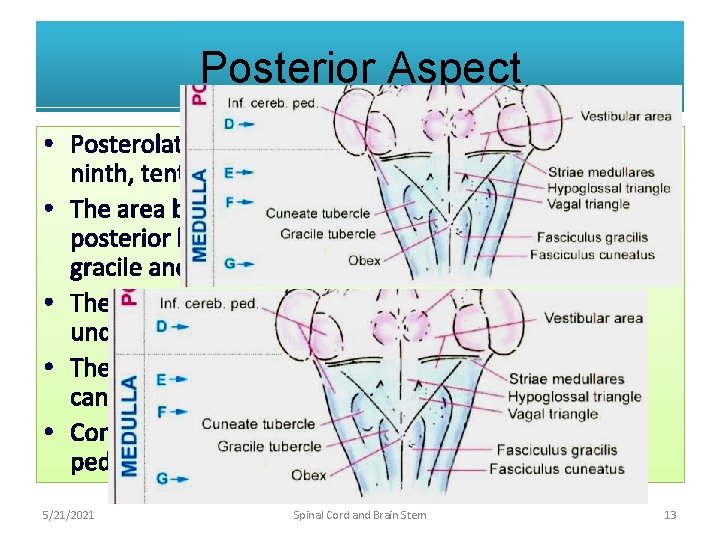
Posterior Aspect • Posterolateral sulcus lies in line with dorsal roots and ninth, tenth and eleventh nerves emerge from this. • The area between the posterior median sulcus and posterior lateral sulcus two rounded elevations called gracile and cuneate tubercles are seen. • They contain nucleus gracilis and nucleus cuneatus under them. • The fourth ventricle continues below as the central canal. • Connects to cerebellum by the inferior cerebellar peduncle. 5/21/2021 Spinal Cord and Brain Stem 13
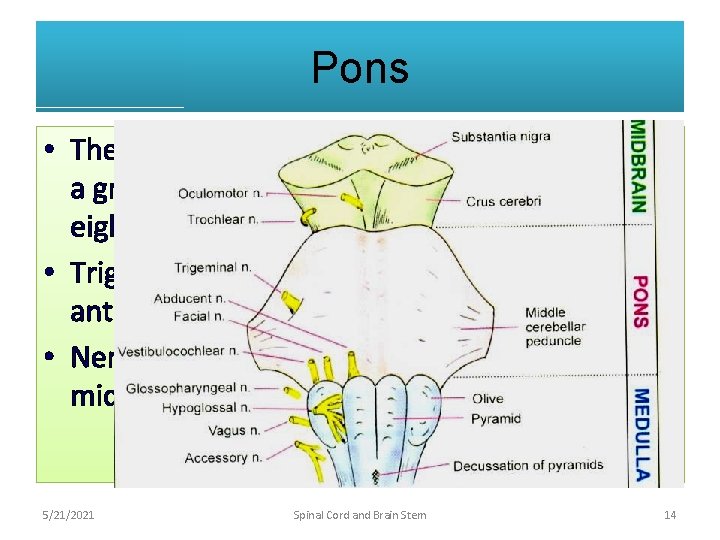
Pons • The junction of pons and medulla is marked by a groove through which sixth, seventh and eighth nerves emerge. • Trigerminal nerve [5] emerges from the anterior surface. • Nerve fibers run transversely and form the middle cerebellar peduncle laterally. 5/21/2021 Spinal Cord and Brain Stem 14
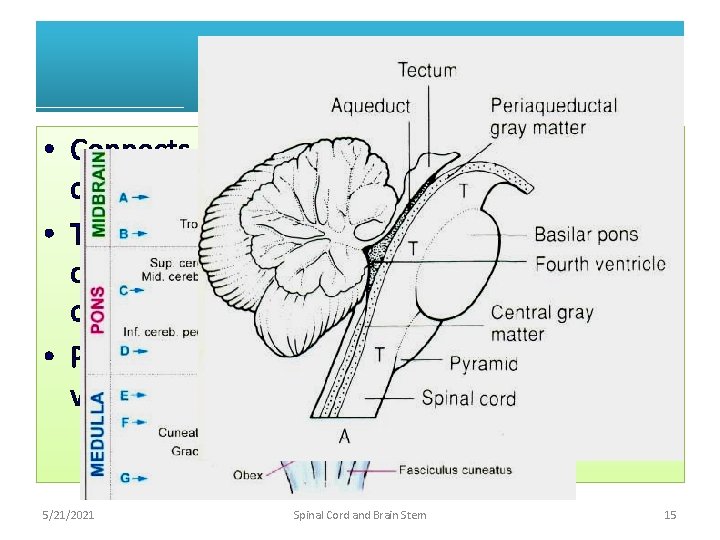
Pons ctd. • Connects to cerebellum by the middle cerebellar peduncle • The lateral aperture of the fourth ventricle lies on either side of the lower pons near the cerebello-pontine angle • Posterior aspect forms the floor of fourth ventricle. 5/21/2021 Spinal Cord and Brain Stem 15
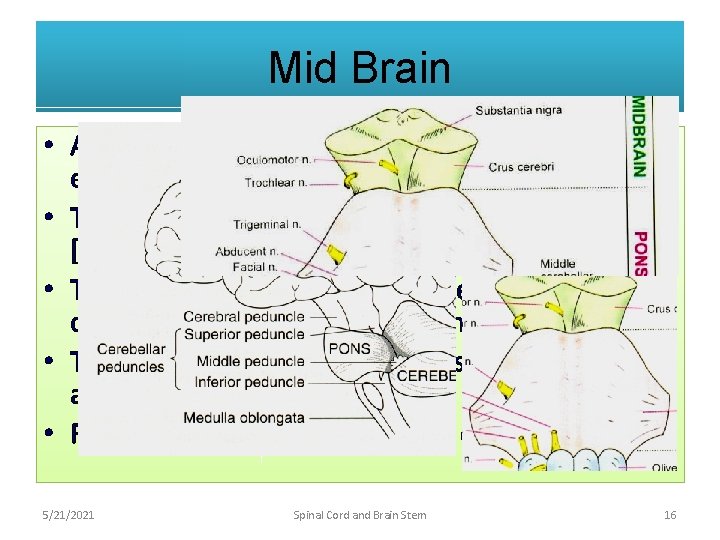
Mid Brain • Anteriorly two large bundles of fibers are seen on either side of the midline. • These are named the crura of the midbrain [cerebral peduncles] • The crura are separated by a deep fissure, diverging to enter the cerebral hemispheres. • The occulomotor nerve emerges from the medial aspect of the crus. • Fourth nerve emerges from the dorsal surface 5/21/2021 Spinal Cord and Brain Stem 16
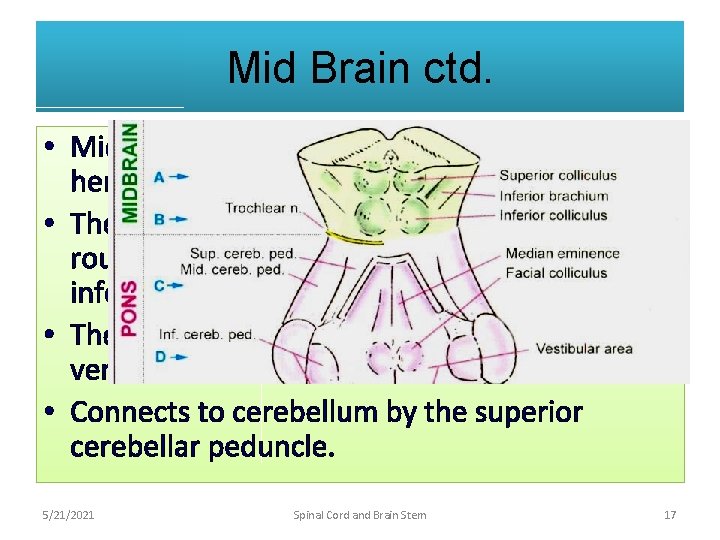
Mid Brain ctd. • Midbrain is continuous with cerebral hemisphers above • The posterior aspect is marked by two pairs of rounded swellings known as superior and inferior colliculi. • The aqueduct continues below as the fourth ventricle • Connects to cerebellum by the superior cerebellar peduncle. 5/21/2021 Spinal Cord and Brain Stem 17
- Slides: 17