
Spinal cord 1 Position of the spinal cord




- Slides: 72
Spinal cord 1
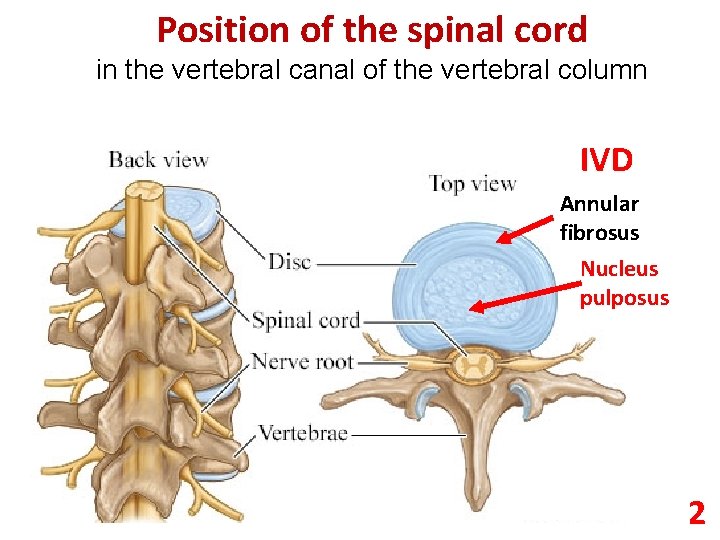
Position of the spinal cord in the vertebral canal of the vertebral column IVD Annular fibrosus Nucleus pulposus 2
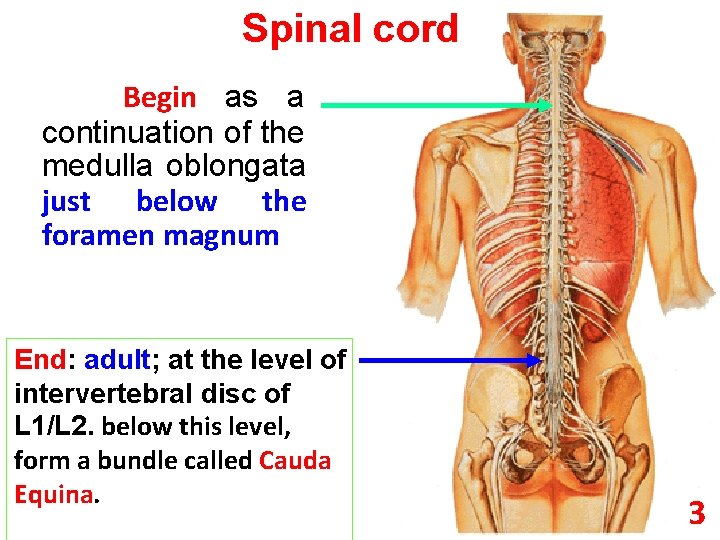
Spinal cord Begin as a continuation of the medulla oblongata just below the foramen magnum End: adult; at the level of intervertebral disc of L 1/L 2. below this level, form a bundle called Cauda Equina. 3
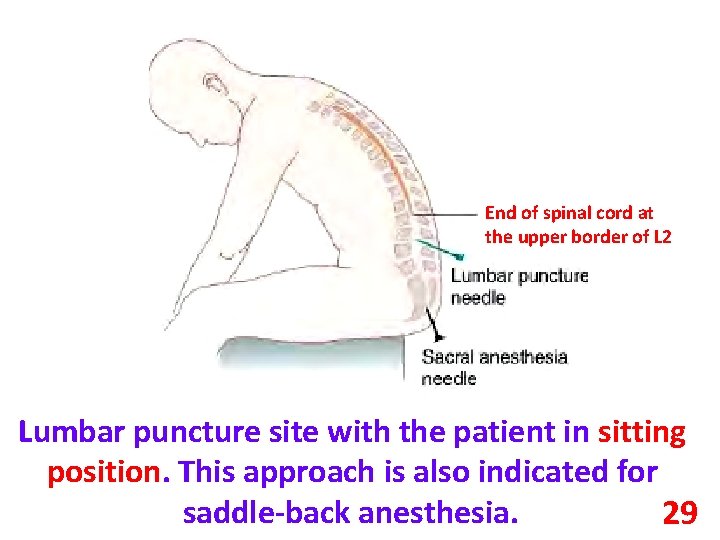
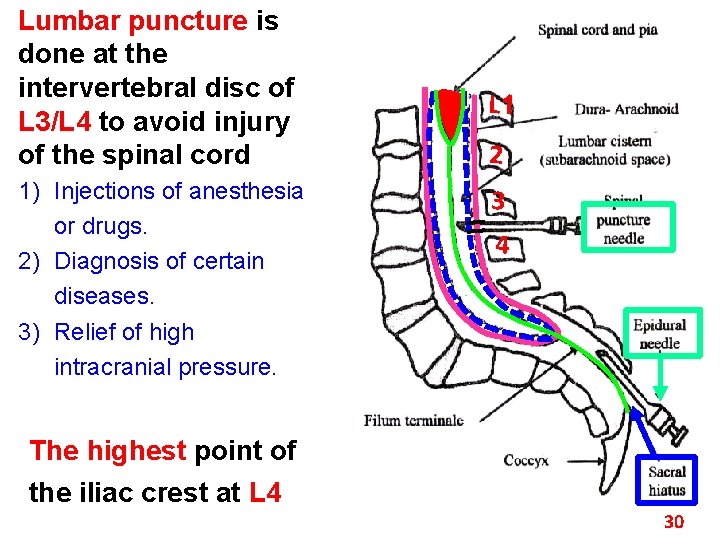
§ Termination of the spinal cord varies with the age: 1 - At the 3 rd month of intrauterine life, tip of coccyx. 2 - At birth, intervertebral disc of L 3/L 4. 3 - Adult; at the level of intervertebral disc of L 1/L 2. • below this level, vertebral canal contains roots of lumbar, sacral, and coccygeal nerves around filum terminale which form a bundle called Cauda Equina (L 2 -C 1) • The difference between the length of the spinal cord and vertebral canal is due to the rapid growth of the vertebral column more than the spinal cord. - At adult, Lumbar puncture is done at the intervertebral disc of L 3/L 4 to avoid injury of the spinal cord. 4
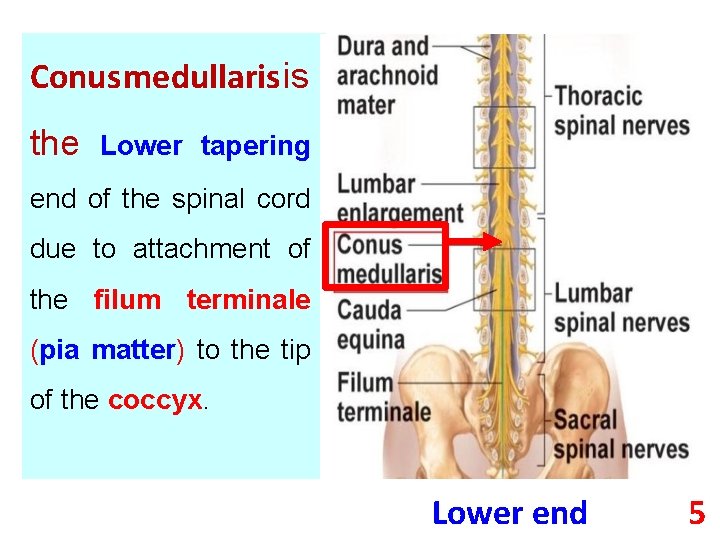
Conus medullaris is the Lower tapering end of the spinal cord due to attachment of the filum terminale (pia matter) to the tip of the coccyx. Lower end 5
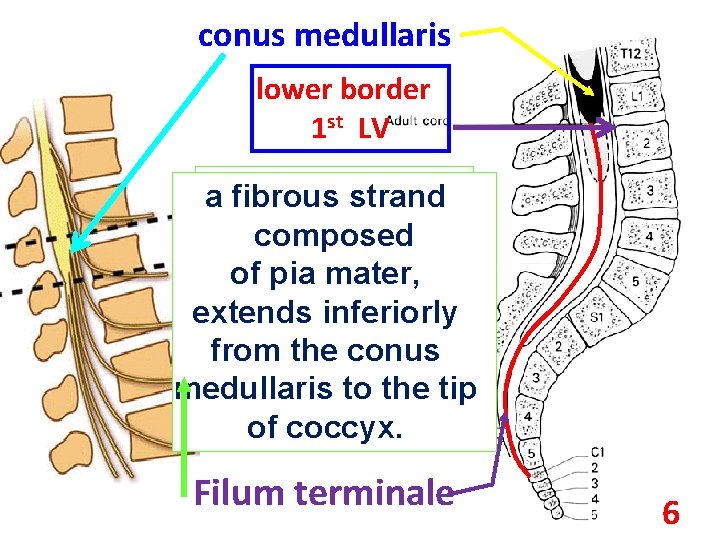
conus medullaris lower border 1 st LV The conus a fibrous strand medullaris is the composed tapering conical of pia mater, distal (inferior) extends inferiorly end ofthe theconus spinal from cord. medullaris to the tip of coccyx. Filum terminale 6
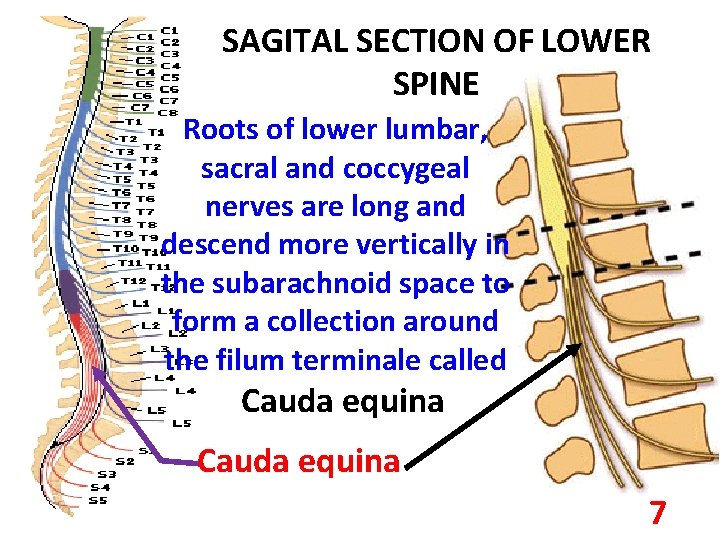
SAGITAL SECTION OF LOWER SPINE Roots of lower lumbar, sacral and coccygeal nerves are long and descend more vertically in the subarachnoid space to form a collection around the filum terminale called Cauda equina 7
The spinal cord 2 enlargements widens laterally Cervical Enlargement C 1 -T 1 Segments gives origin to the cervical and brachial plexuses Lumbar Enlargement L 1 - S 4 Segments gives origin to the lumbar and sacral plexuses 8
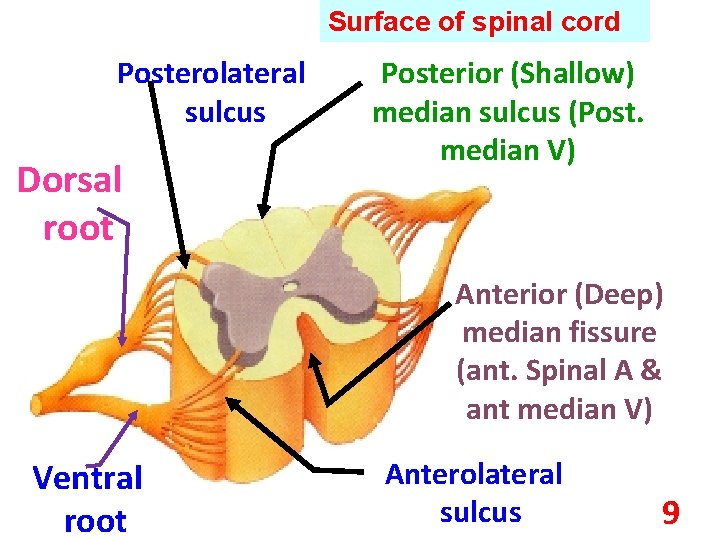
Surface of spinal cord Posterolateral sulcus Dorsal root Posterior (Shallow) median sulcus (Post. median V) Anterior (Deep) median fissure (ant. Spinal A & ant median V) Ventral root Anterolateral sulcus 9
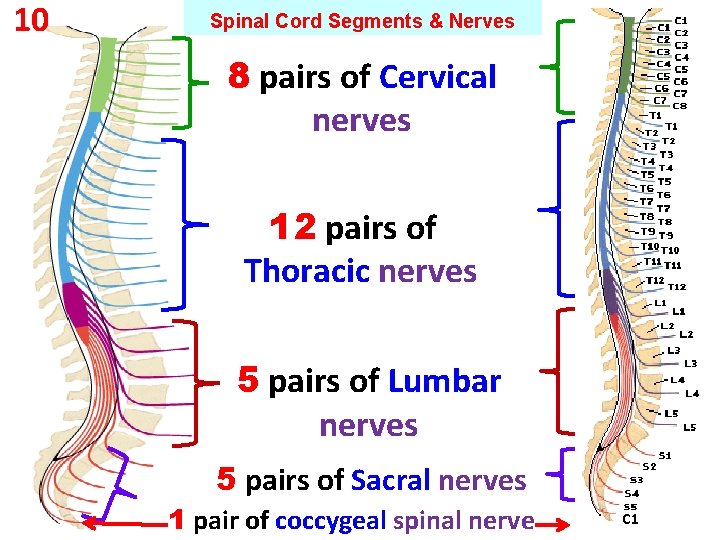
10 Spinal Cord Segments & Nerves 8 pairs of Cervical nerves 12 pairs of Thoracic nerves 5 pairs of Lumbar nerves 5 pairs of Sacral nerves 1 pair of coccygeal spinal nerve C 1
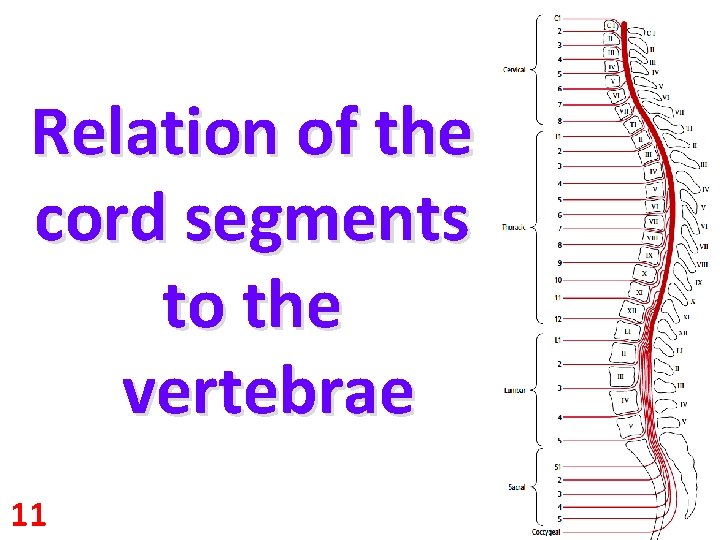
Relation of the cord segments to the vertebrae 11
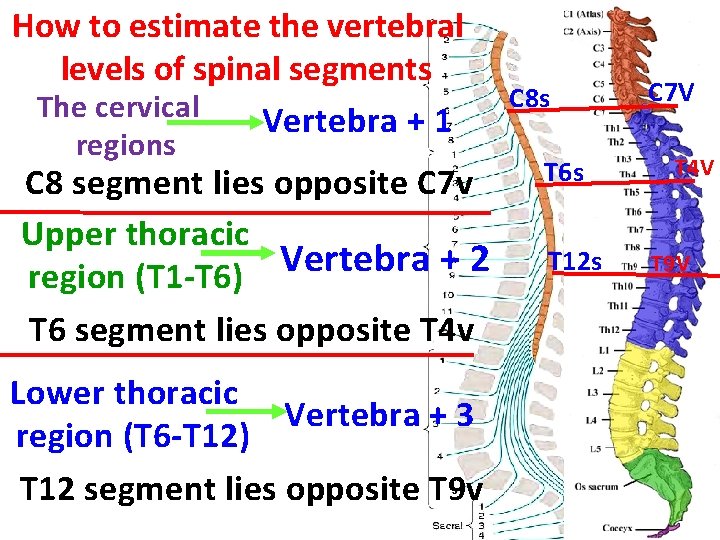
How to estimate the vertebral levels of spinal segments The cervical Vertebra + 1 regions C 8 segment lies opposite C 7 v Upper thoracic Vertebra + 2 region (T 1 -T 6) T 6 segment lies opposite T 4 v Lower thoracic Vertebra + 3 region (T 6 -T 12) T 12 segment lies opposite T 9 v C 8 s T 6 s T 12 s C 7 V T 4 V T 9 V
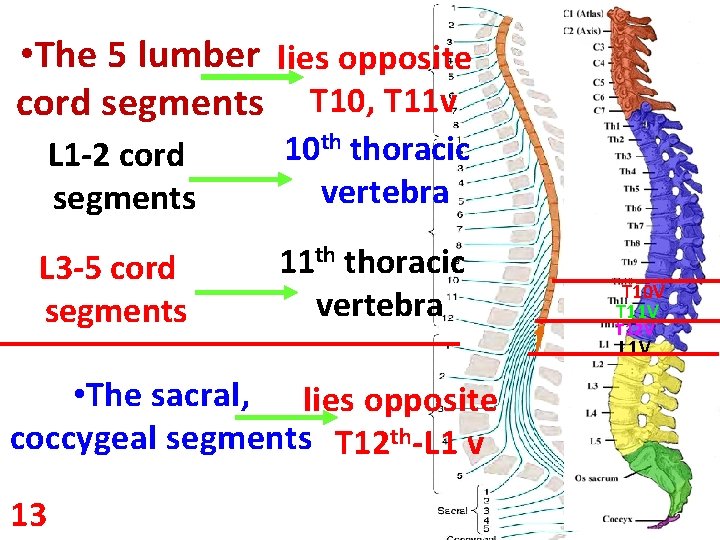
• The 5 lumber lies opposite cord segments T 10, T 11 v L 1 -2 cord segments 10 th thoracic vertebra L 3 -5 cord segments 11 th thoracic vertebra T 10 V T 11 V T 12 V L 1 V • The sacral, lies opposite coccygeal segments T 12 th-L 1 v 13
Spinal Nerves 14
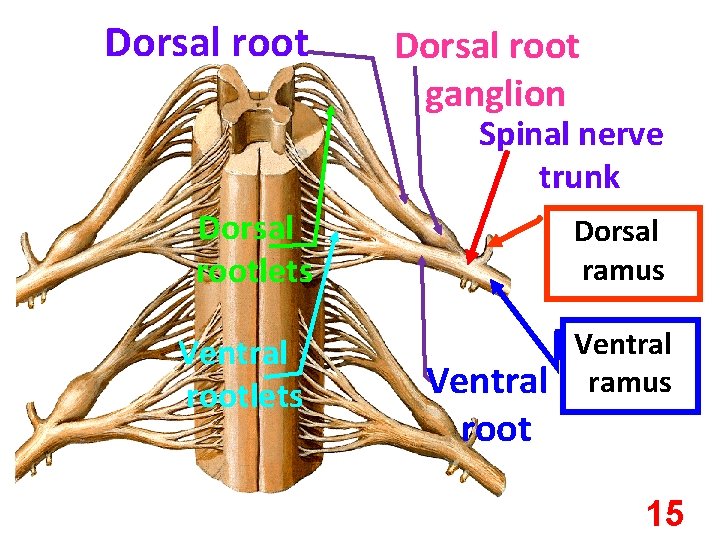
Dorsal root ganglion Spinal nerve trunk Dorsal rootlets Ventral rootlets Dorsal ramus Ventral root Ventral ramus 15
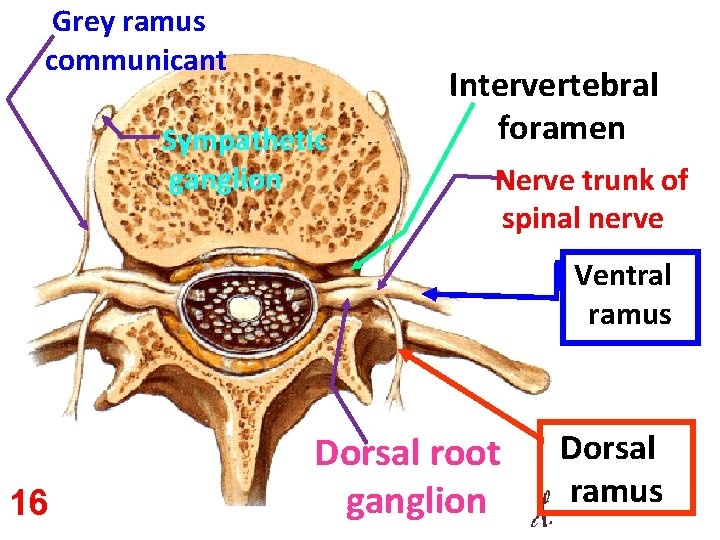
Grey ramus communicant Sympathetic ganglion Intervertebral foramen Nerve trunk of spinal nerve Ventral ramus 16 Dorsal root ganglion Dorsal ramus
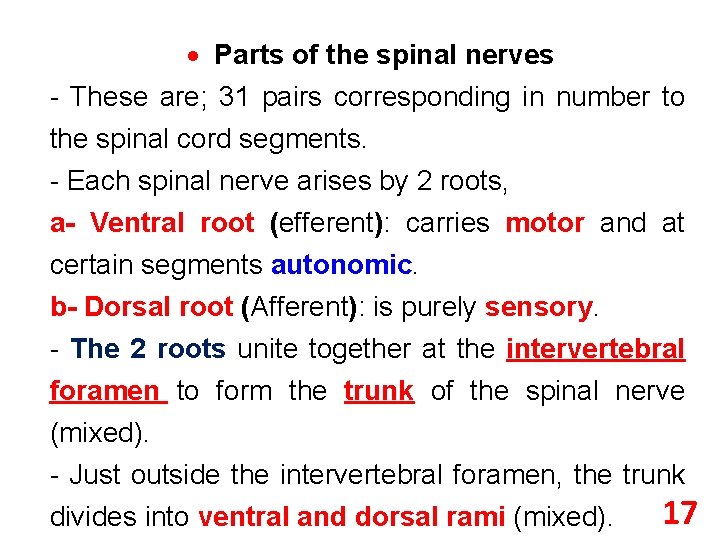
Parts of the spinal nerves - These are; 31 pairs corresponding in number to the spinal cord segments. - Each spinal nerve arises by 2 roots, a- Ventral root (efferent): carries motor and at certain segments autonomic. b- Dorsal root (Afferent): is purely sensory. - The 2 roots unite together at the intervertebral foramen to form the trunk of the spinal nerve (mixed). - Just outside the intervertebral foramen, the trunk 17 divides into ventral and dorsal rami (mixed).
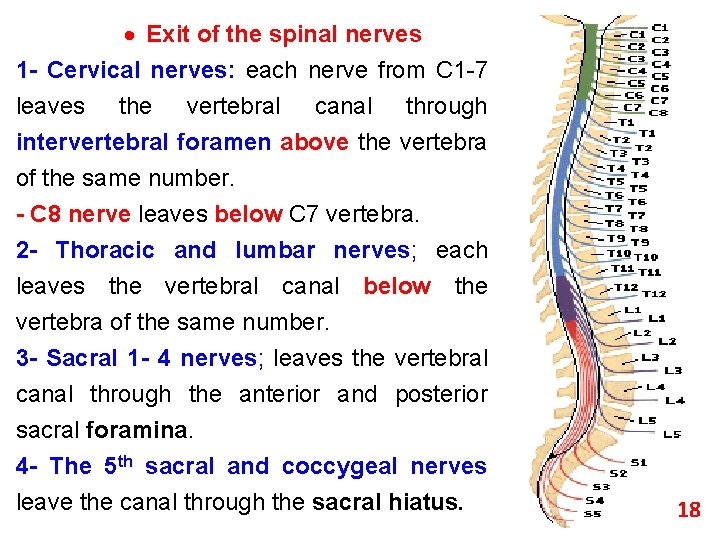
Exit of the spinal nerves 1 - Cervical nerves: each nerve from C 1 -7 leaves the vertebral canal through intervertebral foramen above the vertebra of the same number. - C 8 nerve leaves below C 7 vertebra. 2 - Thoracic and lumbar nerves; each leaves the vertebral canal below the vertebra of the same number. 3 - Sacral 1 - 4 nerves; leaves the vertebral canal through the anterior and posterior sacral foramina. 4 - The 5 th sacral and coccygeal nerves leave the canal through the sacral hiatus. 18
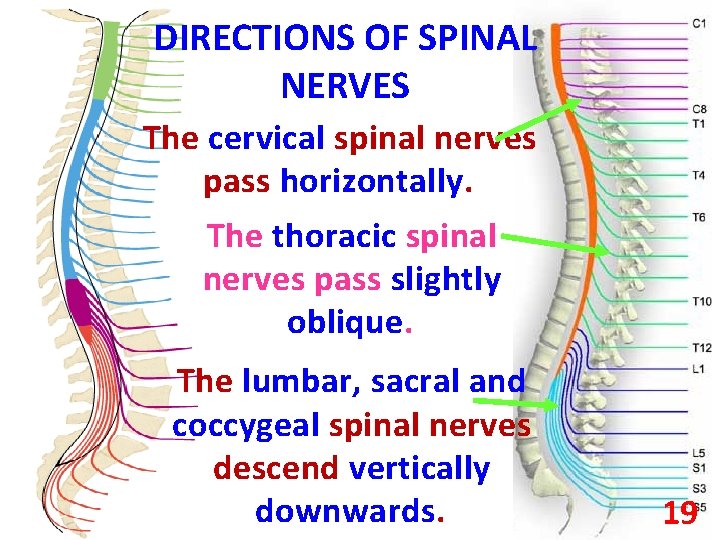
DIRECTIONS OF SPINAL NERVES The cervical spinal nerves pass horizontally. The thoracic spinal nerves pass slightly oblique. The lumbar, sacral and coccygeal spinal nerves descend vertically downwards. 19
Direction of the spinal nerves • The cervical nerves pass horizontally into the vertebral foramen. • The thoracic nerves pass slightly oblique downward. • The lumbar, sacral and coccygeal descend vertical downward in the vertebral canal. • The lower nerve roots are longer and more oblique because the spinal cord is shorter than the vertebral canal. 20
Meninges 21
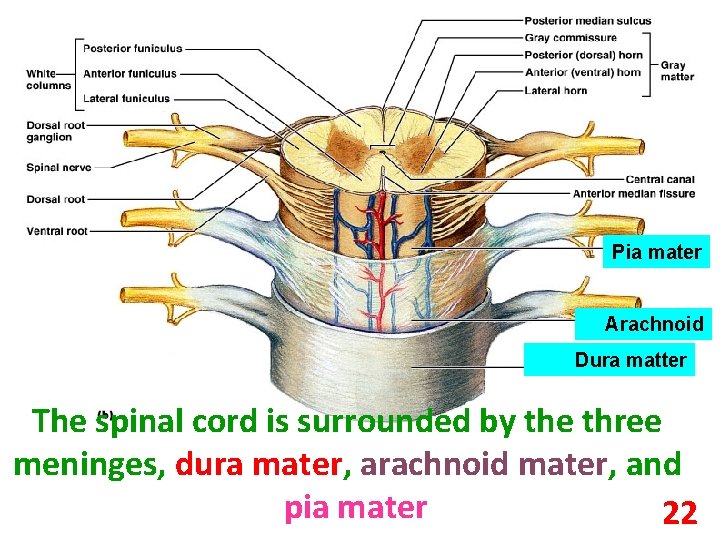
Pia mater Arachnoid Dura matter The spinal cord is surrounded by the three meninges, dura mater, arachnoid mater, and pia mater 22
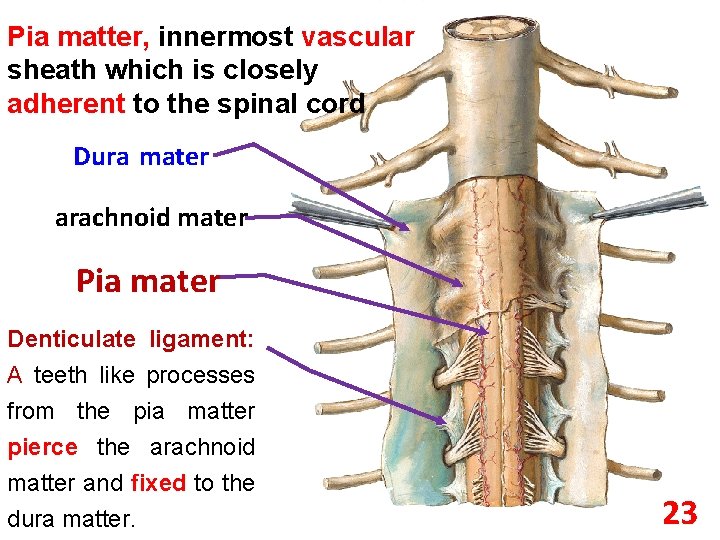
Pia matter, innermost vascular sheath which is closely adherent to the spinal cord Dura mater arachnoid mater Pia mater Denticulate ligament: A teeth like processes from the pia matter pierce the arachnoid matter and fixed to the dura matter. 23
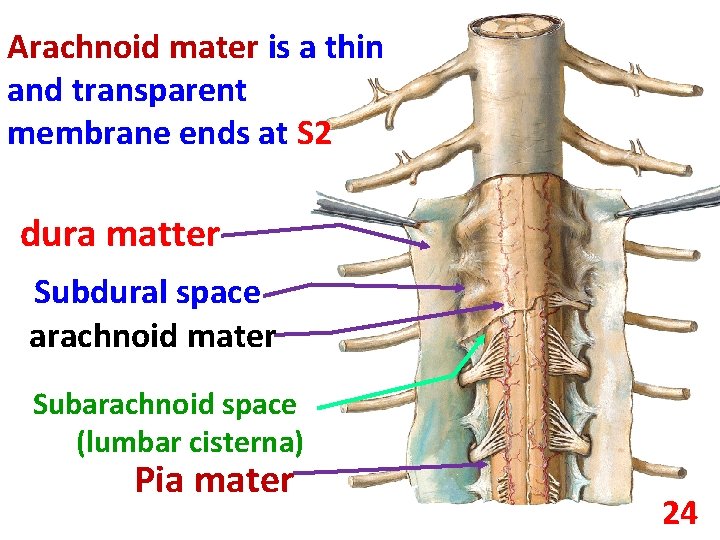
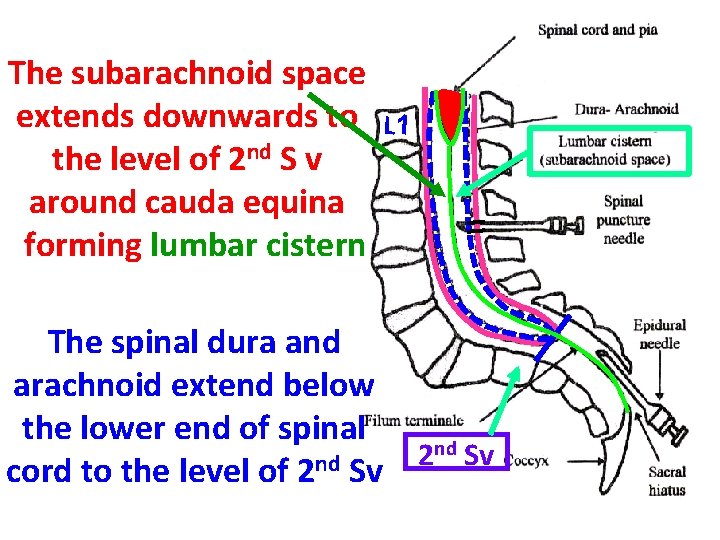
Arachnoid mater is a thin and transparent membrane ends at S 2 dura matter Subdural space arachnoid mater Subarachnoid space (lumbar cisterna) Pia mater 24
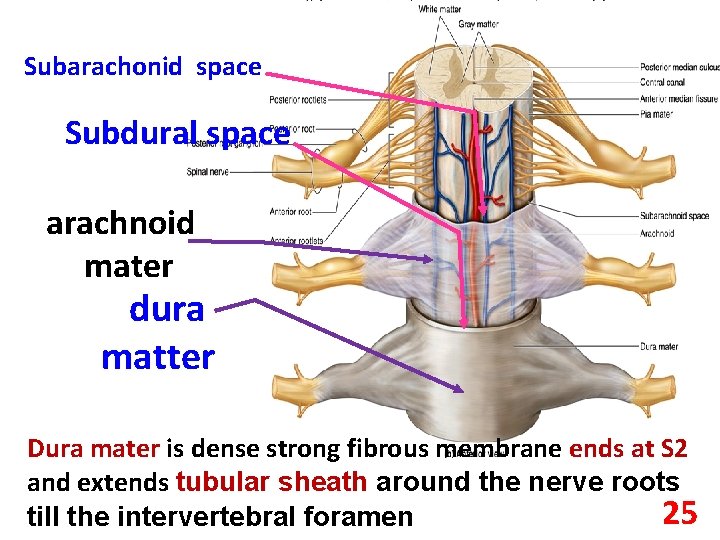
Subarachonid space Subdural space arachnoid mater dura matter Dura mater is dense strong fibrous membrane ends at S 2 and extends tubular sheath around the nerve roots 25 till the intervertebral foramen
Spinal cord Conus medularis lower border 1 st LV Pia mater Dural sheath Subarachonoid space Filum terminale 2 nd sacral vertebra 26
The subarachnoid space extends downwards to the level of 2 nd S v around cauda equina forming lumbar cistern L 1 The spinal dura and arachnoid extend below the lower end of spinal nd Sv 2 cord to the level of 2 nd Sv
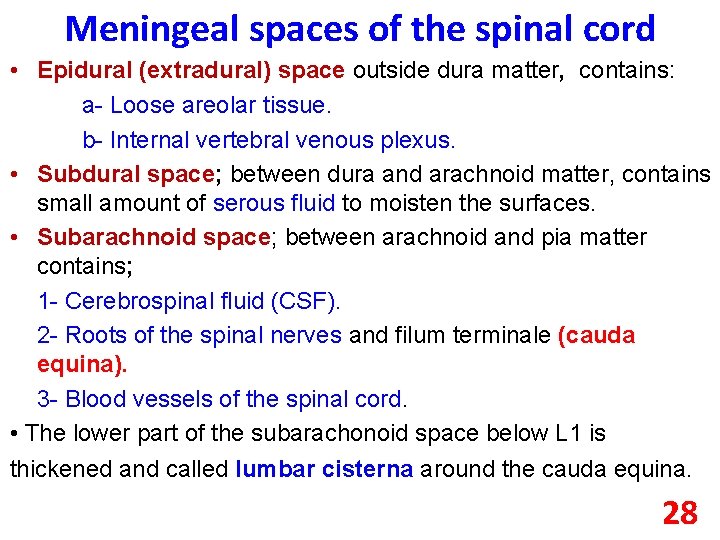
Meningeal spaces of the spinal cord • Epidural (extradural) space outside dura matter, contains: a- Loose areolar tissue. b- Internal vertebral venous plexus. • Subdural space; between dura and arachnoid matter, contains small amount of serous fluid to moisten the surfaces. • Subarachnoid space; between arachnoid and pia matter contains; 1 - Cerebrospinal fluid (CSF). 2 - Roots of the spinal nerves and filum terminale (cauda equina). 3 - Blood vessels of the spinal cord. • The lower part of the subarachonoid space below L 1 is thickened and called lumbar cisterna around the cauda equina. 28
End of spinal cord at the upper border of L 2 Lumbar puncture site with the patient in sitting position. This approach is also indicated for saddle-back anesthesia. 29
Lumbar puncture is done at the intervertebral disc of L 3/L 4 to avoid injury of the spinal cord 1) Injections of anesthesia or drugs. 2) Diagnosis of certain diseases. 3) Relief of high intracranial pressure. L 1 2 3 4 The highest point of the iliac crest at L 4 30
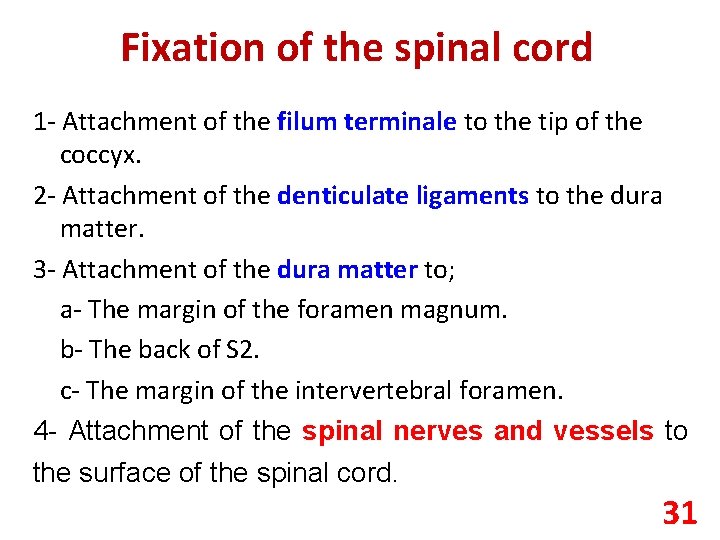
Fixation of the spinal cord 1 - Attachment of the filum terminale to the tip of the coccyx. 2 - Attachment of the denticulate ligaments to the dura matter. 3 - Attachment of the dura matter to; a- The margin of the foramen magnum. b- The back of S 2. c- The margin of the intervertebral foramen. 4 - Attachment of the spinal nerves and vessels to the surface of the spinal cord. 31
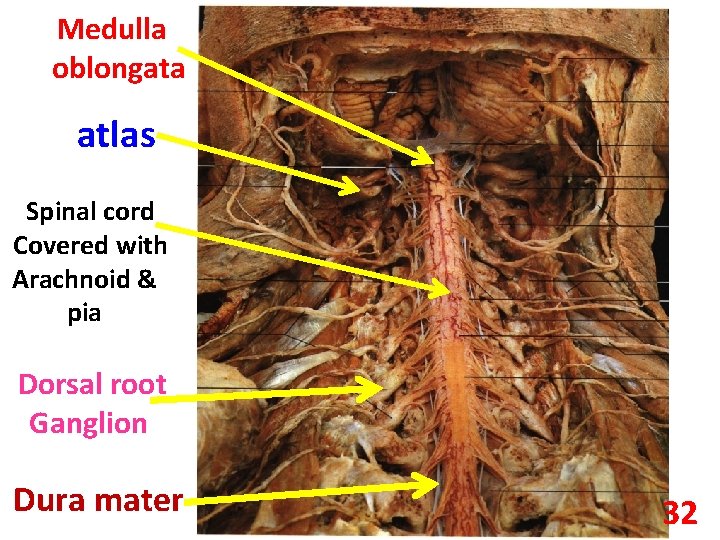
Medulla oblongata atlas Spinal cord Covered with Arachnoid & pia Dorsal root Ganglion Dura mater 32
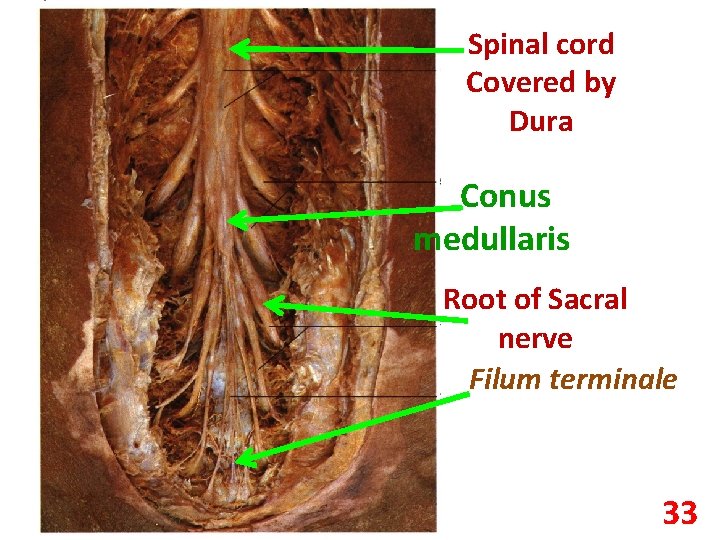
Spinal cord Covered by Dura Conus medullaris Root of Sacral nerve Filum terminale 33
Blood supply
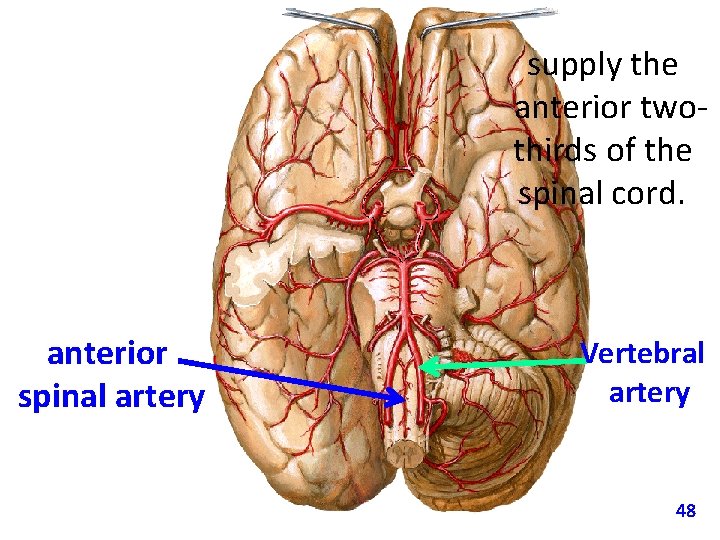
supply the anterior twothirds of the spinal cord. anterior spinal artery Vertebral artery 48
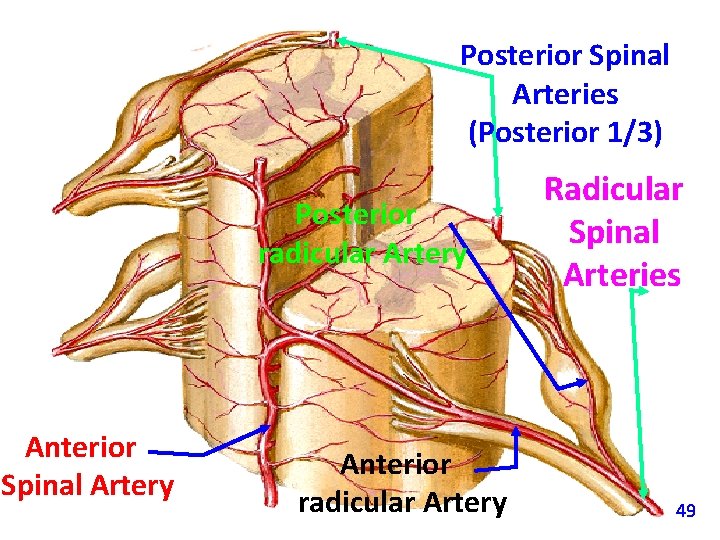
Posterior Spinal Arteries (Posterior 1/3) Posterior radicular Artery Anterior Spinal Artery Anterior radicular Artery Radicular Spinal Arteries 49
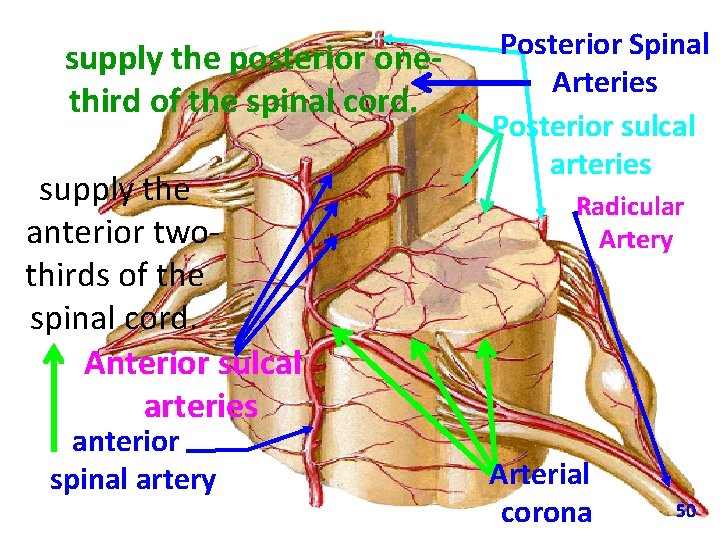
supply the posterior onethird of the spinal cord. supply the anterior twothirds of the spinal cord. Anterior sulcal arteries anterior spinal artery Posterior Spinal Arteries Posterior sulcal arteries Radicular Artery Arterial corona 50
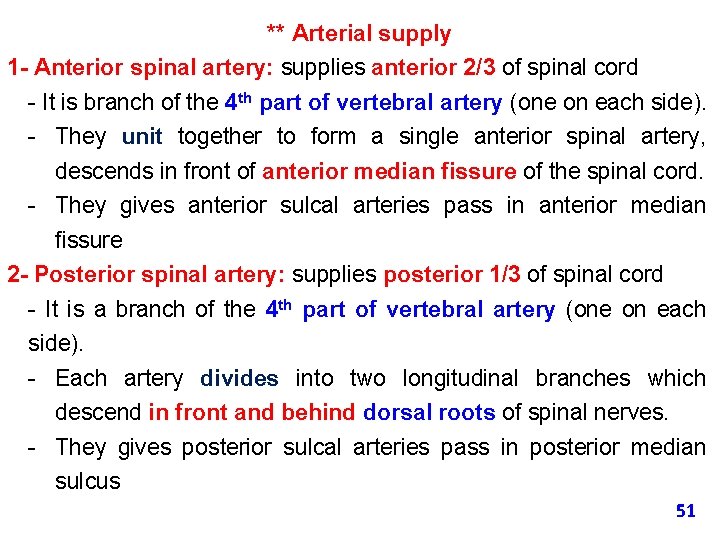
** Arterial supply 1 - Anterior spinal artery: supplies anterior 2/3 of spinal cord - It is branch of the 4 th part of vertebral artery (one on each side). - They unit together to form a single anterior spinal artery, descends in front of anterior median fissure of the spinal cord. - They gives anterior sulcal arteries pass in anterior median fissure 2 - Posterior spinal artery: supplies posterior 1/3 of spinal cord - It is a branch of the 4 th part of vertebral artery (one on each side). - Each artery divides into two longitudinal branches which descend in front and behind dorsal roots of spinal nerves. - They gives posterior sulcal arteries pass in posterior median sulcus 51
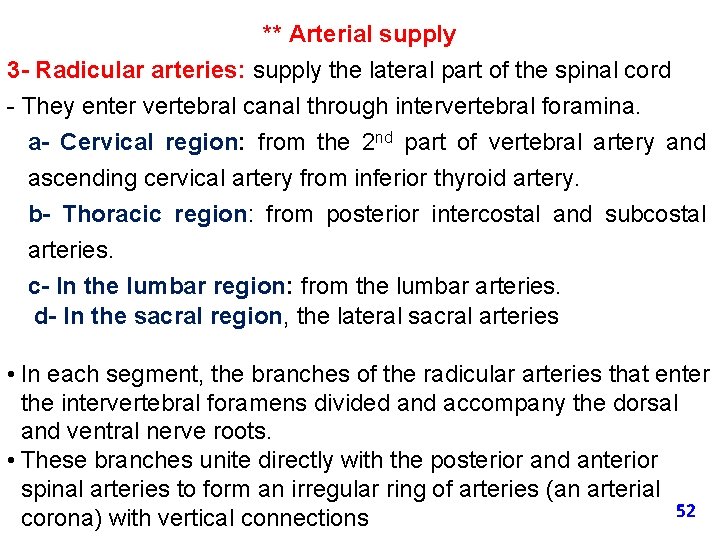
** Arterial supply 3 - Radicular arteries: supply the lateral part of the spinal cord - They enter vertebral canal through intervertebral foramina. a- Cervical region: from the 2 nd part of vertebral artery and ascending cervical artery from inferior thyroid artery. b- Thoracic region: from posterior intercostal and subcostal arteries. c- In the lumbar region: from the lumbar arteries. d- In the sacral region, the lateral sacral arteries • In each segment, the branches of the radicular arteries that enter the intervertebral foramens divided and accompany the dorsal and ventral nerve roots. • These branches unite directly with the posterior and anterior spinal arteries to form an irregular ring of arteries (an arterial 52 corona) with vertical connections
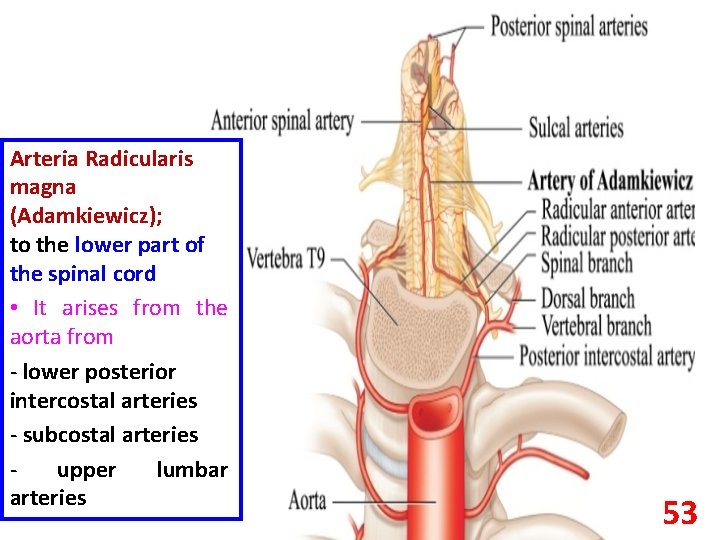
Arteria Radicularis magna (Adamkiewicz); to the lower part of the spinal cord • It arises from the aorta from - lower posterior intercostal arteries - subcostal arteries upper lumbar arteries 53
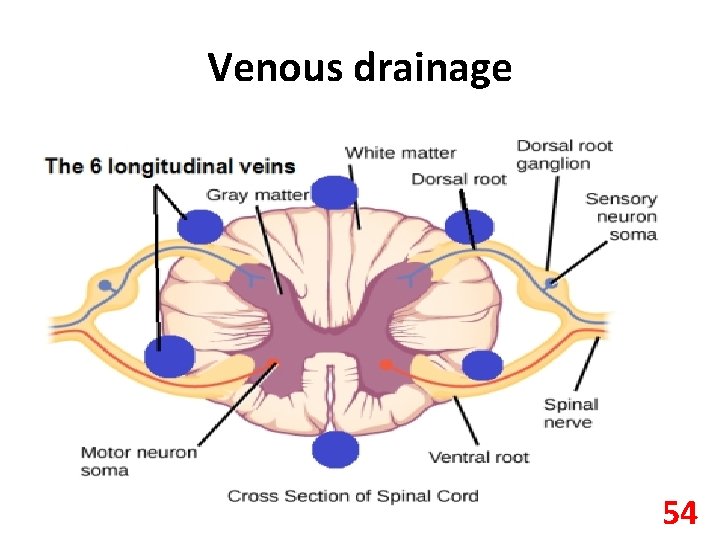
Venous drainage 54
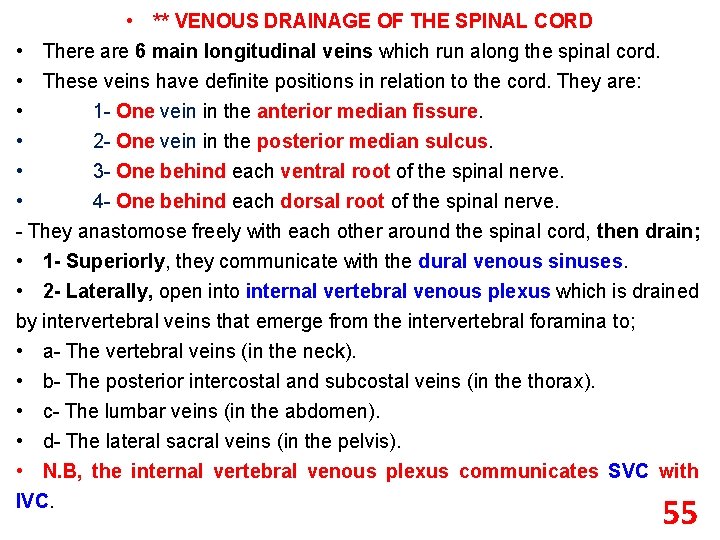
• ** VENOUS DRAINAGE OF THE SPINAL CORD • There are 6 main longitudinal veins which run along the spinal cord. • These veins have definite positions in relation to the cord. They are: • 1 - One vein in the anterior median fissure. • 2 - One vein in the posterior median sulcus. • 3 - One behind each ventral root of the spinal nerve. • 4 - One behind each dorsal root of the spinal nerve. - They anastomose freely with each other around the spinal cord, then drain; • 1 - Superiorly, they communicate with the dural venous sinuses. • 2 - Laterally, open into internal vertebral venous plexus which is drained by intervertebral veins that emerge from the intervertebral foramina to; • a- The vertebral veins (in the neck). • b- The posterior intercostal and subcostal veins (in the thorax). • c- The lumbar veins (in the abdomen). • d- The lateral sacral veins (in the pelvis). • N. B, the internal vertebral venous plexus communicates SVC with IVC. 55
INTERNAL STRUCTURE OF SPINAL CORD
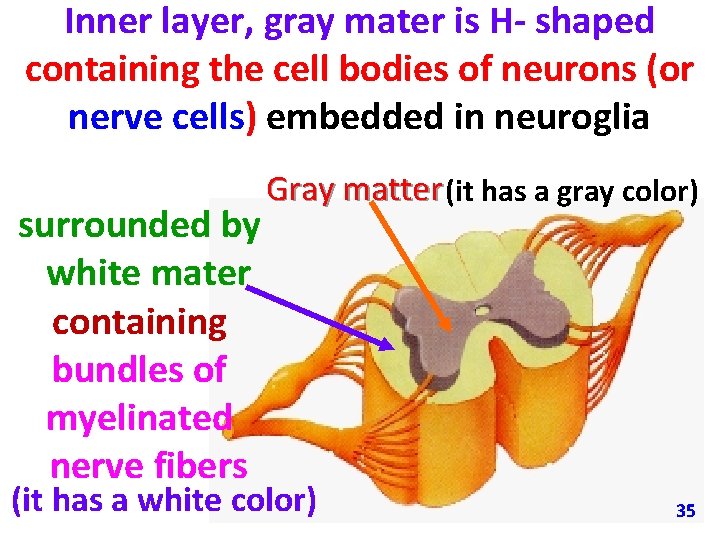
Inner layer, gray mater is H- shaped containing the cell bodies of neurons (or nerve cells) embedded in neuroglia surrounded by white mater containing bundles of myelinated nerve fibers Gray matter (it has a gray color) (it has a white color) 35
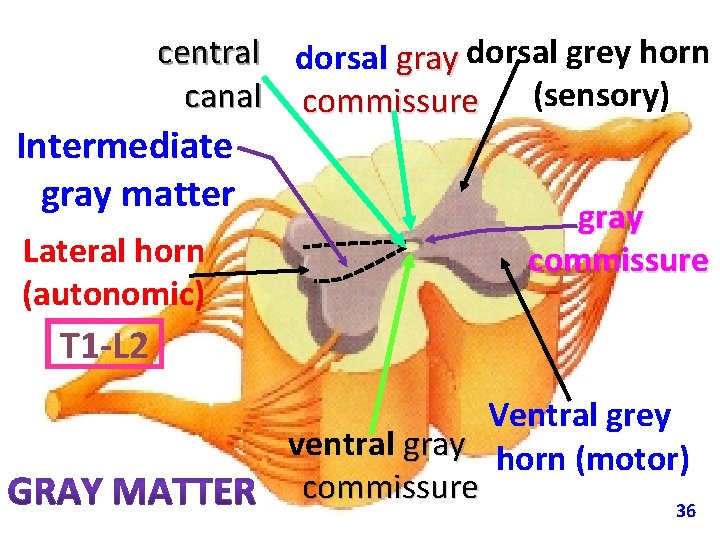
central dorsal gray dorsal grey horn canal commissure (sensory) Intermediate gray matter Lateral horn (autonomic) gray commissure T 1 -L 2 Ventral grey ventral gray horn (motor) commissure 36
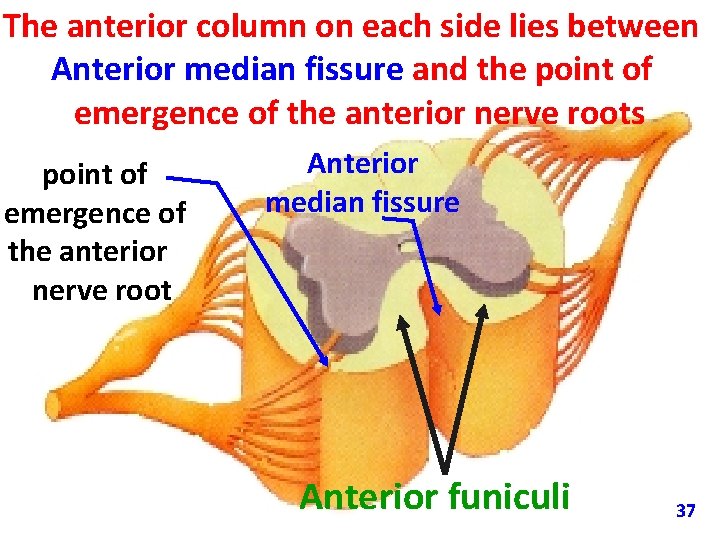
The anterior column on each side lies between Anterior median fissure and the point of emergence of the anterior nerve roots point of emergence of the anterior nerve root Anterior median fissure Anterior funiculi 37
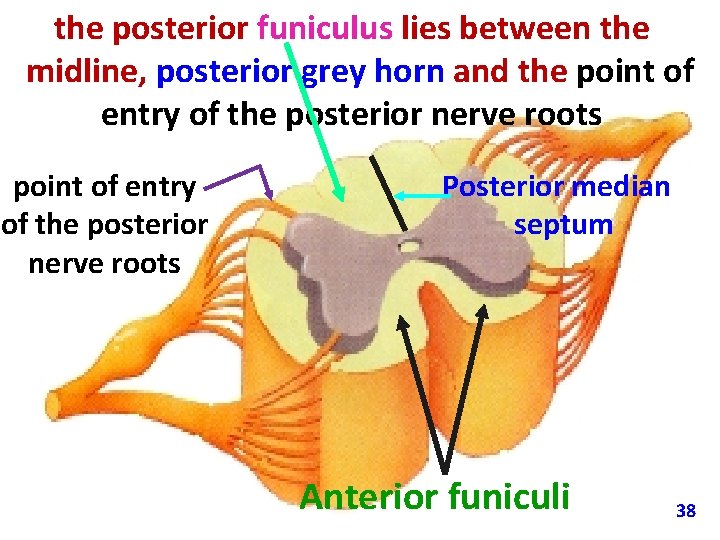
the posterior funiculus lies between the midline, posterior grey horn and the point of entry of the posterior nerve roots Posterior median septum Anterior funiculi 38
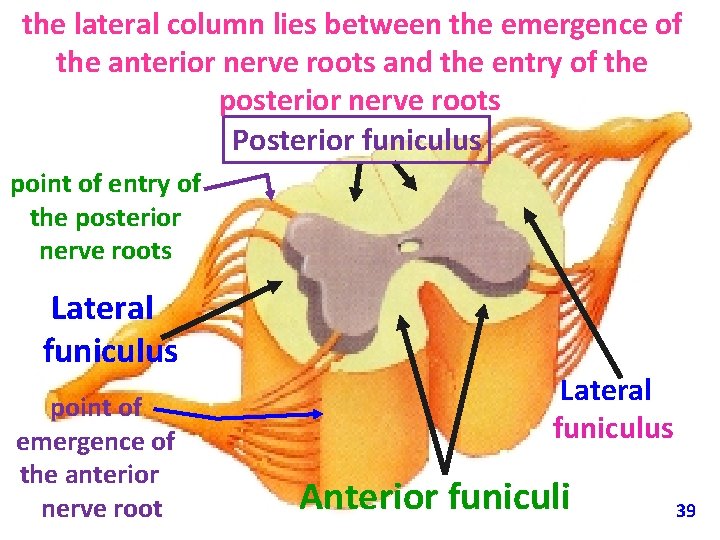
the lateral column lies between the emergence of the anterior nerve roots and the entry of the posterior nerve roots Posterior funiculus point of entry of the posterior nerve roots Lateral funiculus point of emergence of the anterior nerve root Lateral funiculus Anterior funiculi 39
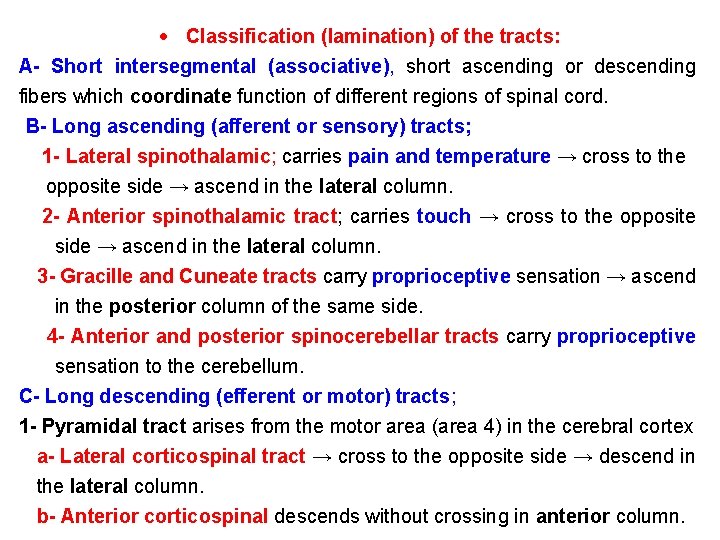
Classification (lamination) of the tracts: A- Short intersegmental (associative), short ascending or descending fibers which coordinate function of different regions of spinal cord. B- Long ascending (afferent or sensory) tracts; 1 - Lateral spinothalamic; carries pain and temperature → cross to the opposite side → ascend in the lateral column. 2 - Anterior spinothalamic tract; carries touch → cross to the opposite side → ascend in the lateral column. 3 - Gracille and Cuneate tracts carry proprioceptive sensation → ascend in the posterior column of the same side. 4 - Anterior and posterior spinocerebellar tracts carry proprioceptive sensation to the cerebellum. C- Long descending (efferent or motor) tracts; 1 - Pyramidal tract arises from the motor area (area 4) in the cerebral cortex a- Lateral corticospinal tract → cross to the opposite side → descend in the lateral column. b- Anterior corticospinal descends without crossing in anterior column.
Nuclear groups in the anterior horns
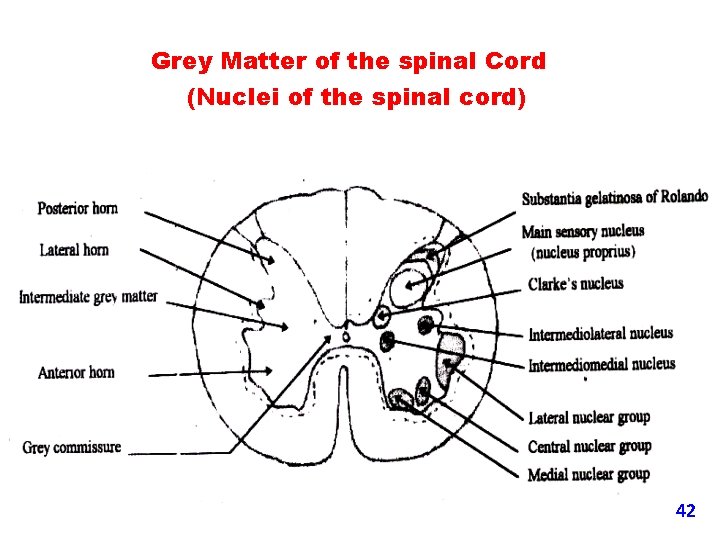
Grey Matter of the spinal Cord (Nuclei of the spinal cord) 42
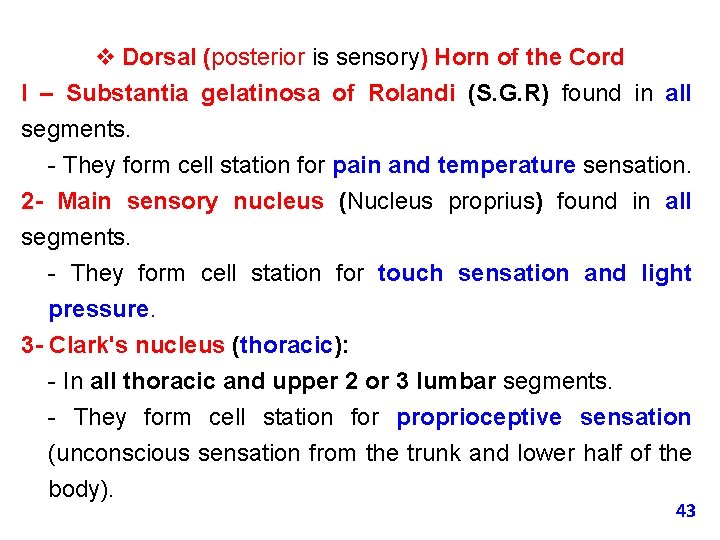
v Dorsal (posterior is sensory) Horn of the Cord I – Substantia gelatinosa of Rolandi (S. G. R) found in all segments. - They form cell station for pain and temperature sensation. 2 - Main sensory nucleus (Nucleus proprius) found in all segments. - They form cell station for touch sensation and light pressure. 3 - Clark's nucleus (thoracic): - In all thoracic and upper 2 or 3 lumbar segments. - They form cell station for proprioceptive sensation (unconscious sensation from the trunk and lower half of the body). 43
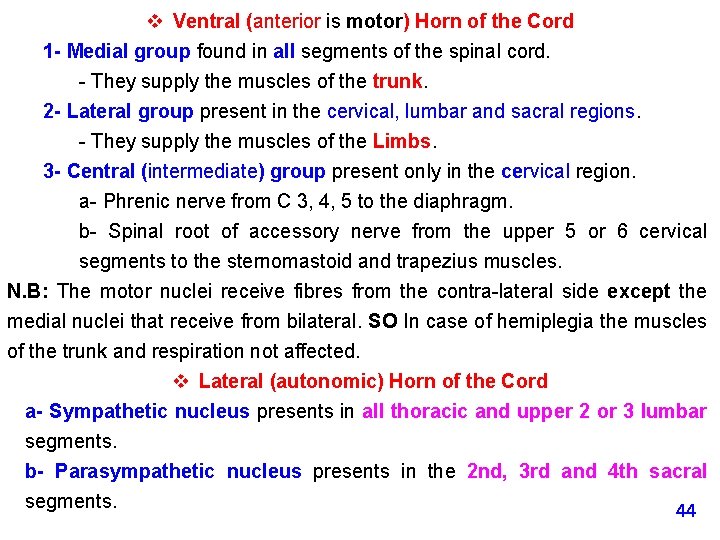
v Ventral (anterior is motor) Horn of the Cord 1 - Medial group found in all segments of the spinal cord. - They supply the muscles of the trunk. 2 - Lateral group present in the cervical, lumbar and sacral regions. - They supply the muscles of the Limbs. 3 - Central (intermediate) group present only in the cervical region. a- Phrenic nerve from C 3, 4, 5 to the diaphragm. b- Spinal root of accessory nerve from the upper 5 or 6 cervical segments to the sternomastoid and trapezius muscles. N. B: The motor nuclei receive fibres from the contra-lateral side except the medial nuclei that receive from bilateral. SO In case of hemiplegia the muscles of the trunk and respiration not affected. v Lateral (autonomic) Horn of the Cord a- Sympathetic nucleus presents in all thoracic and upper 2 or 3 lumbar segments. b- Parasympathetic nucleus presents in the 2 nd, 3 rd and 4 th sacral segments. 44
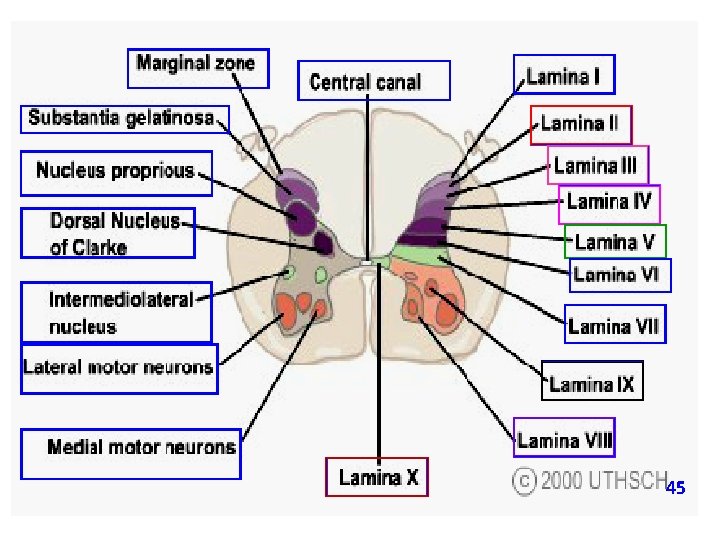
45
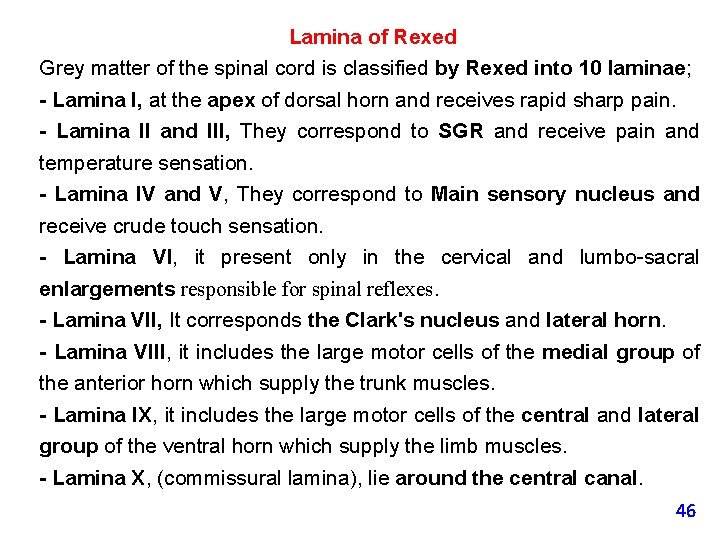
Lamina of Rexed Grey matter of the spinal cord is classified by Rexed into 10 laminae; - Lamina I, at the apex of dorsal horn and receives rapid sharp pain. - Lamina II and III, They correspond to SGR and receive pain and temperature sensation. - Lamina IV and V, They correspond to Main sensory nucleus and receive crude touch sensation. - Lamina VI, it present only in the cervical and lumbo-sacral enlargements responsible for spinal reflexes. - Lamina VII, It corresponds the Clark's nucleus and lateral horn. - Lamina VIII, it includes the large motor cells of the medial group of the anterior horn which supply the trunk muscles. - Lamina IX, it includes the large motor cells of the central and lateral group of the ventral horn which supply the limb muscles. - Lamina X, (commissural lamina), lie around the central canal. 46
Lesion of spinal cord
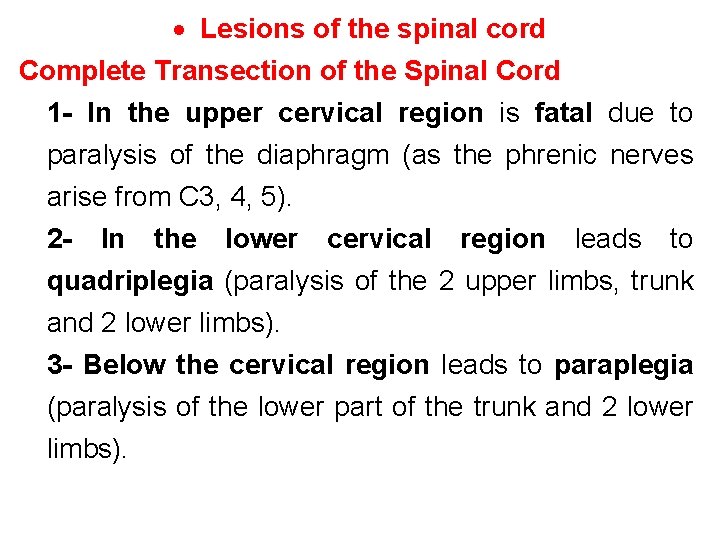
Lesions of the spinal cord Complete Transection of the Spinal Cord 1 - In the upper cervical region is fatal due to paralysis of the diaphragm (as the phrenic nerves arise from C 3, 4, 5). 2 - In the lower cervical region leads to quadriplegia (paralysis of the 2 upper limbs, trunk and 2 lower limbs). 3 - Below the cervical region leads to paraplegia (paralysis of the lower part of the trunk and 2 lower limbs).
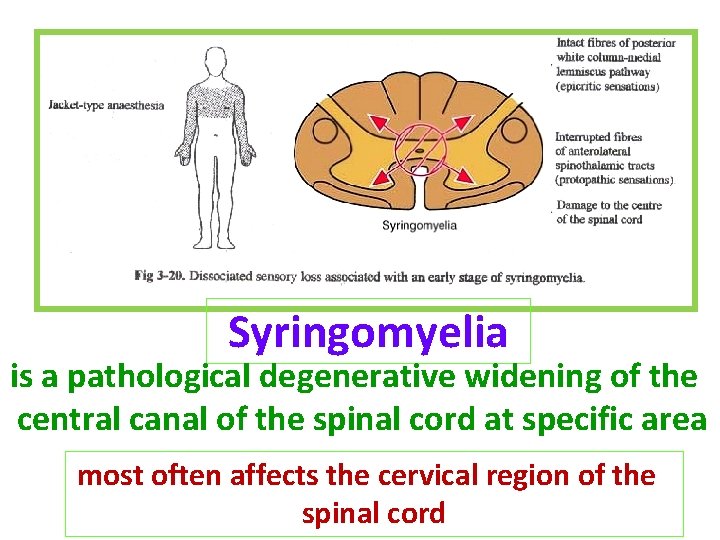
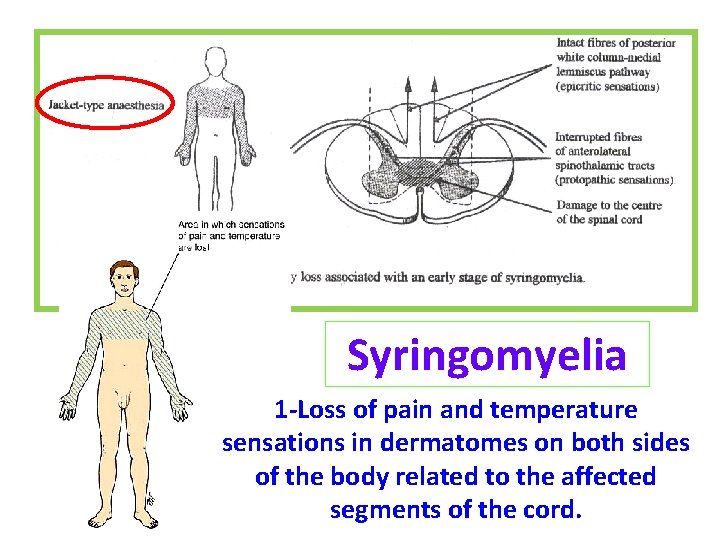
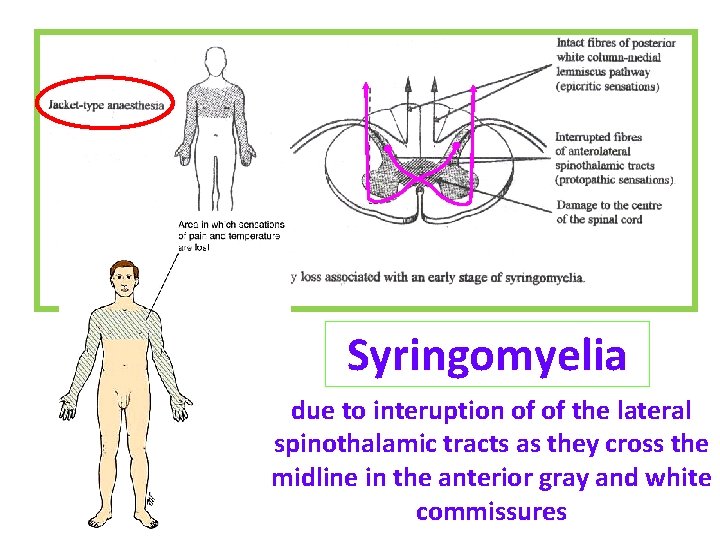
Syringomyelia is a pathological degenerative widening of the central canal of the spinal cord at specific area most often affects the cervical region of the spinal cord
Syringomyelia 1 -Loss of pain and temperature sensations in dermatomes on both sides of the body related to the affected segments of the cord.
Syringomyelia due to interuption of of the lateral spinothalamic tracts as they cross the midline in the anterior gray and white commissures
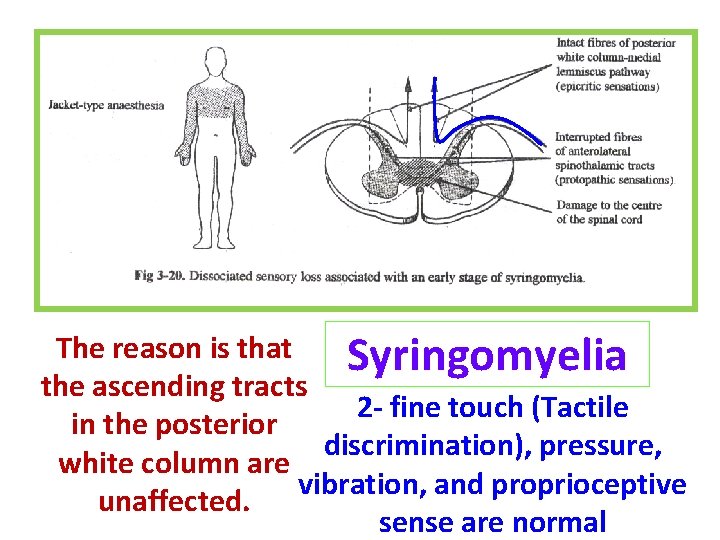
The reason is that Syringomyelia the ascending tracts 2 - fine touch (Tactile in the posterior discrimination), pressure, white column are vibration, and proprioceptive unaffected. sense are normal
** Syringomyelia, There is progressive widening of the central canal of the spinal cord leading to destruction of the lateral spinothalamic tract leading to loss of pain and temperature in the affected segment of both sides. - It is most commonly occurred in the cervical enlargement. ** Babiniski sign, It is a dorsiflexion of the big toe with fanning of the other toes after stroking the planter surface of the outer border of the foot with blunt objects as a key. ** Lesions of the pyramidal tract leading to hemiplegia (UMN lesion) of the opposite side. - This is manifested by paralysis of the lower half of the face, upper and lower limbs on the opposite side. N. B; The upper half of the face is normal because the upper half of the facial nucleus receives corticonuclear fibers from both aides.
Brown-Séquard Syndrome
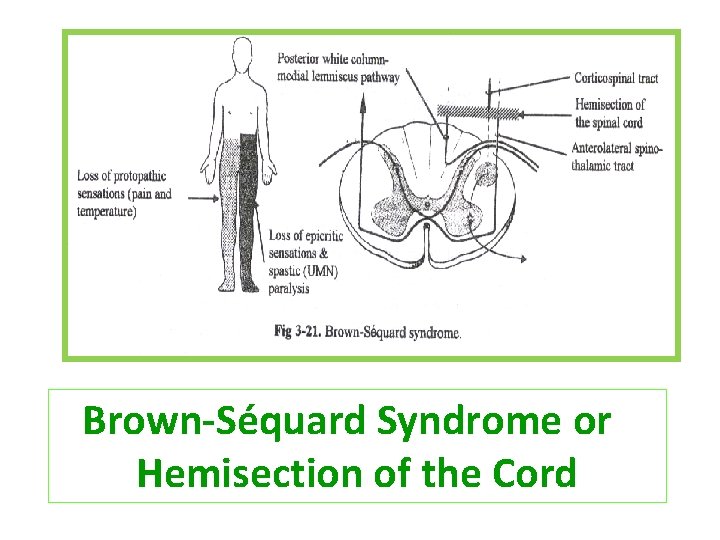
Brown-Séquard Syndrome or Hemisection of the Cord
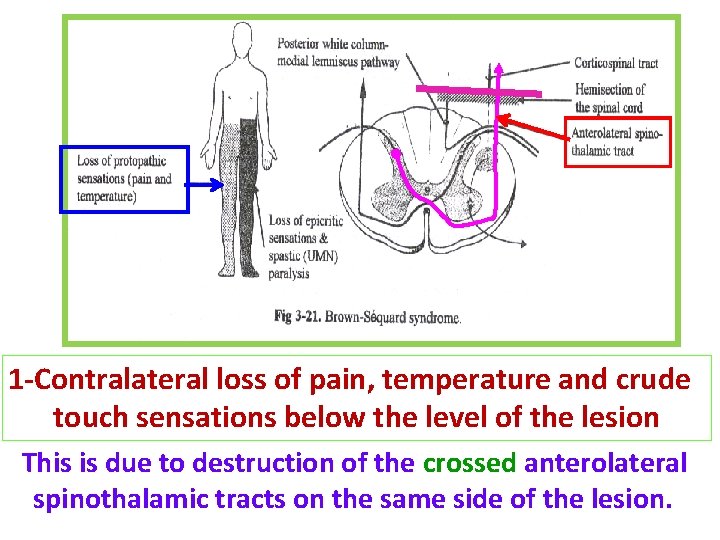
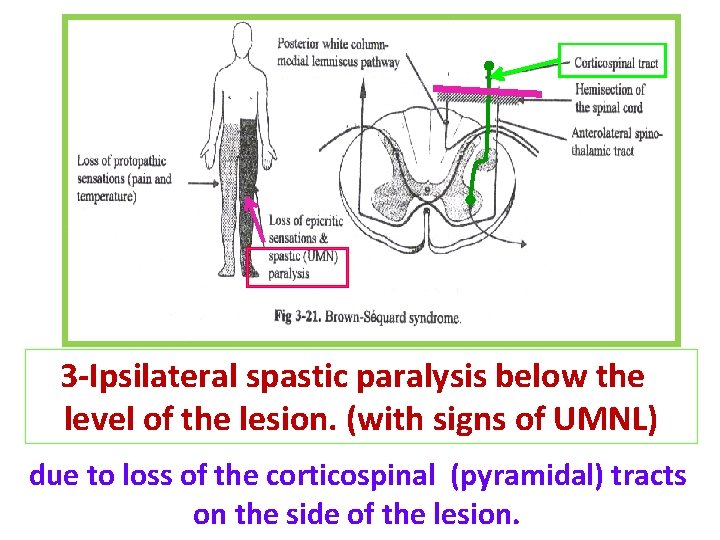
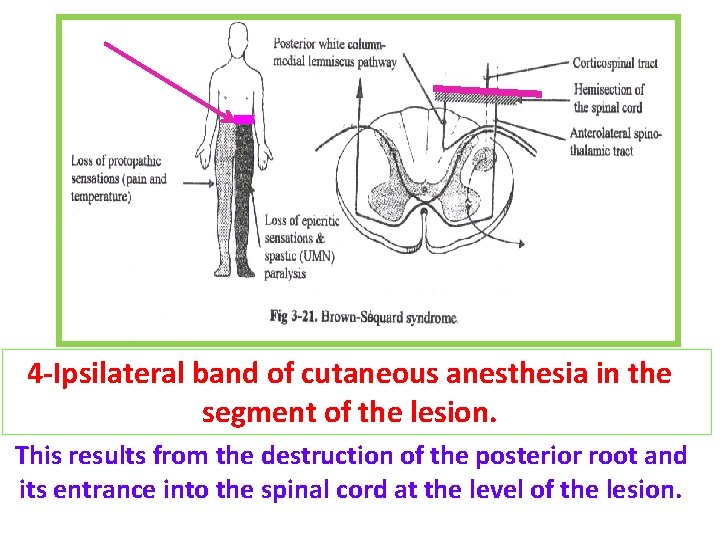
1 -Contralateral loss of pain, temperature and crude touch sensations below the level of the lesion This is due to destruction of the crossed anterolateral spinothalamic tracts on the same side of the lesion.
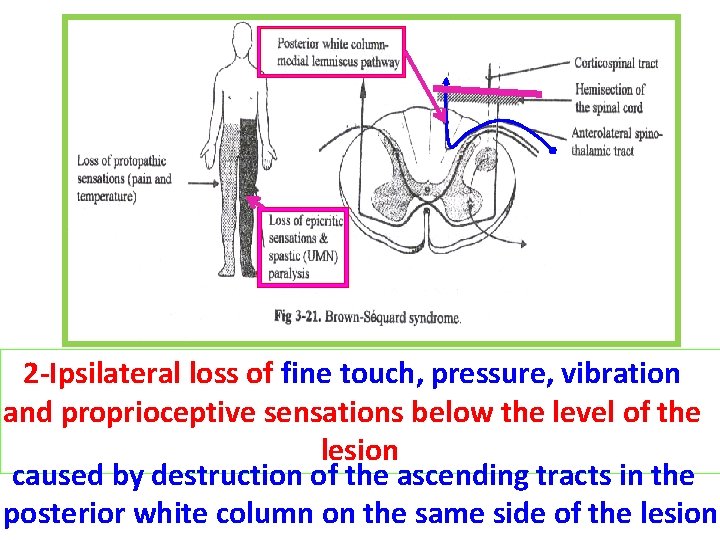
2 -Ipsilateral loss of fine touch, pressure, vibration and proprioceptive sensations below the level of the lesion caused by destruction of the ascending tracts in the posterior white column on the same side of the lesion
3 -Ipsilateral spastic paralysis below the level of the lesion. (with signs of UMNL) due to loss of the corticospinal (pyramidal) tracts on the side of the lesion.
4 -Ipsilateral band of cutaneous anesthesia in the segment of the lesion. This results from the destruction of the posterior root and its entrance into the spinal cord at the level of the lesion.
Hemisection of spinal cord (Brown-Sequard Syndrome) a- Changes at the level of the lesion 1 - Lower motor neuron paralysis due to Injury of AHC and ventral root of the spinal nerve. 2 - Loss of all sensations due to Injury of the posterior horn and dorsal root of the spinal nerve. b- Changes below the level of the lesion 1 - On the same side, a- Upper motor neuron paralysis due to injury of the crossed pyramidal tract b- Loss of prorioceptive sensations due to Injury of the Gracille and Cuneate tracts. 2 - On the opposite side, a- Loss of pain and temperature sensations due to Injury of the lateral spinothalamic tract b- Loss of touch sensation due to Injury of the anterior spinothalamic tract.
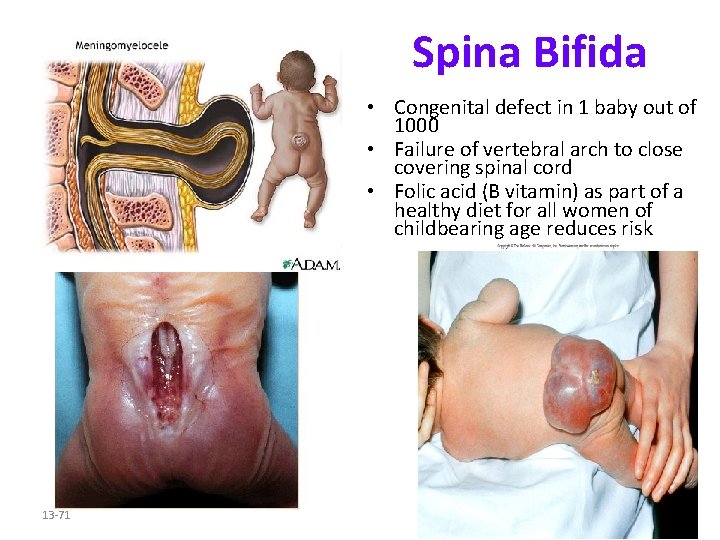
Spina Bifida • Congenital defect in 1 baby out of 1000 • Failure of vertebral arch to close covering spinal cord • Folic acid (B vitamin) as part of a healthy diet for all women of childbearing age reduces risk 13 -71
Th ank Qu you est ion s I/Azzam - 2004