
Spinach Spinach Botanical Name Origin Family Chromosome no
Spinach
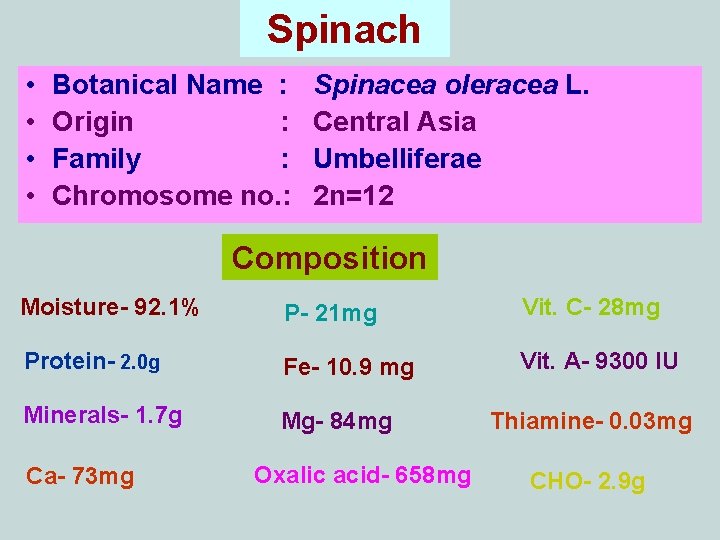
Spinach • • Botanical Name : Origin : Family : Chromosome no. : Spinacea oleracea L. Central Asia Umbelliferae 2 n=12 Composition Moisture- 92. 1% P- 21 mg Vit. C- 28 mg Protein- 2. 0 g Fe- 10. 9 mg Vit. A- 9300 IU Minerals- 1. 7 g Mg- 84 mg Ca- 73 mg Oxalic acid- 658 mg Thiamine- 0. 03 mg CHO- 2. 9 g
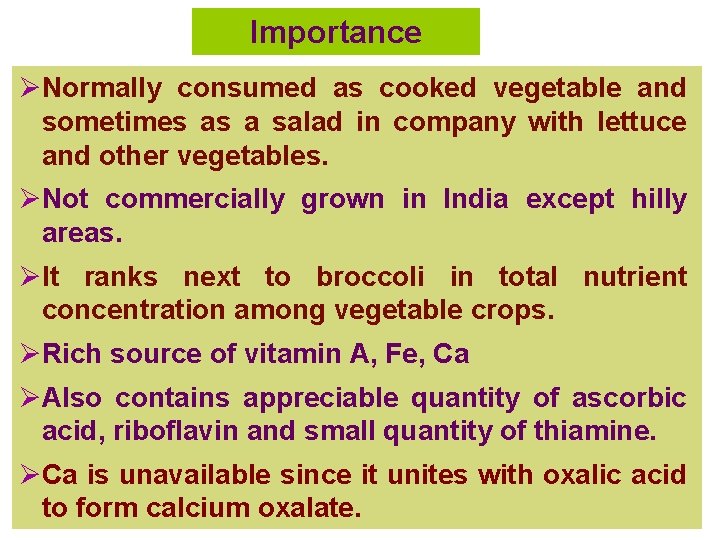
Importance ØNormally consumed as cooked vegetable and sometimes as a salad in company with lettuce and other vegetables. ØNot commercially grown in India except hilly areas. ØIt ranks next to broccoli in total nutrient concentration among vegetable crops. ØRich source of vitamin A, Fe, Ca ØAlso contains appreciable quantity of ascorbic acid, riboflavin and small quantity of thiamine. ØCa is unavailable since it unites with oxalic acid to form calcium oxalate.
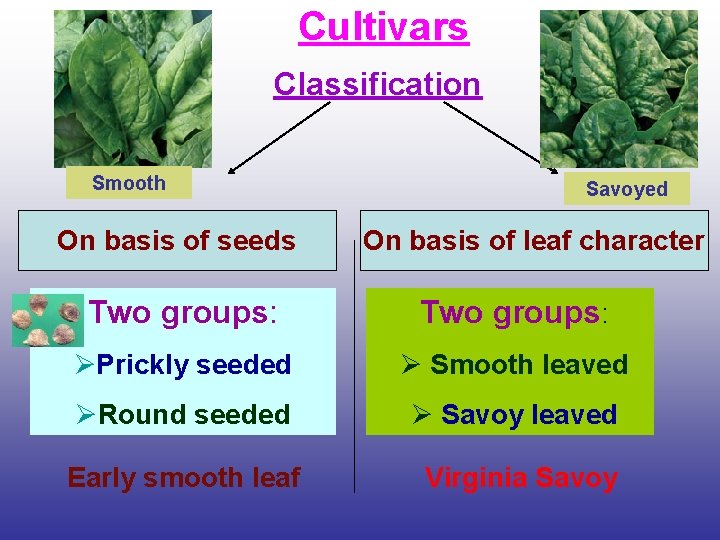
Cultivars Classification Smooth On basis of seeds Savoyed On basis of leaf character Two groups: ØPrickly seeded Ø Smooth leaved ØRound seeded Ø Savoy leaved Early smooth leaf Virginia Savoy
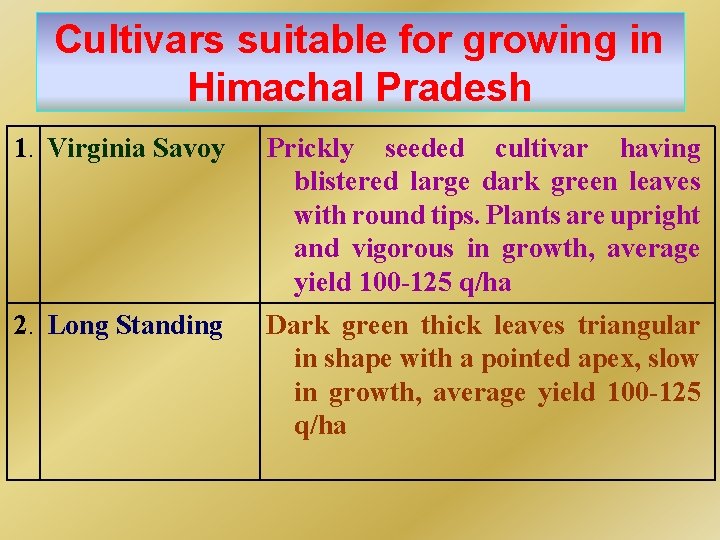
Cultivars suitable for growing in Himachal Pradesh 1. Virginia Savoy Prickly seeded cultivar having blistered large dark green leaves with round tips. Plants are upright and vigorous in growth, average yield 100 -125 q/ha 2. Long Standing Dark green thick leaves triangular in shape with a pointed apex, slow in growth, average yield 100 -125 q/ha
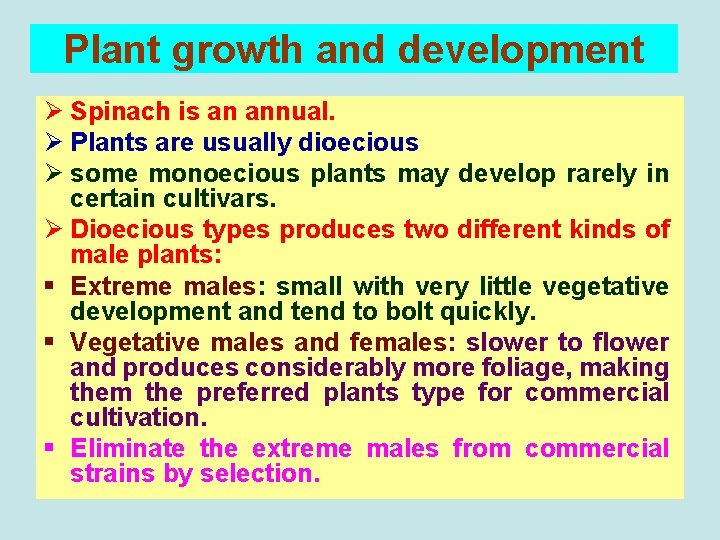
Plant growth and development Ø Spinach is an annual. Ø Plants are usually dioecious Ø some monoecious plants may develop rarely in certain cultivars. Ø Dioecious types produces two different kinds of male plants: § Extreme males: small with very little vegetative development and tend to bolt quickly. § Vegetative males and females: slower to flower and produces considerably more foliage, making them the preferred plants type for commercial cultivation. § Eliminate the extreme males from commercial strains by selection.
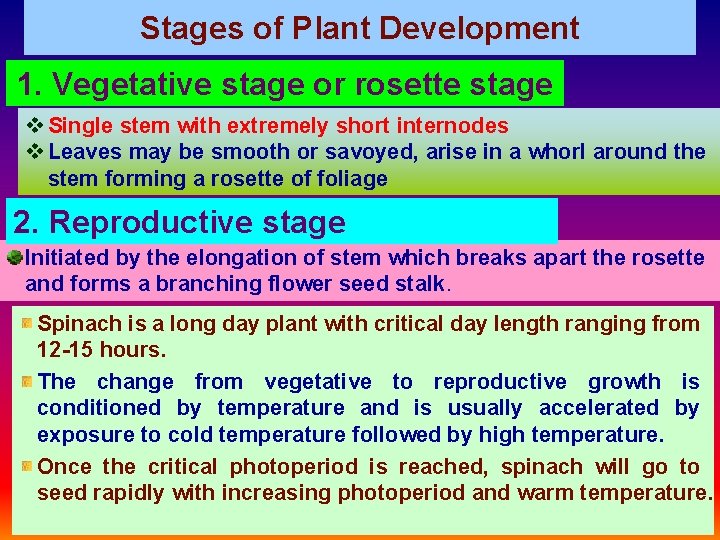
Stages of Plant Development 1. Vegetative stage or rosette stage v Single stem with extremely short internodes v Leaves may be smooth or savoyed, arise in a whorl around the stem forming a rosette of foliage 2. Reproductive stage Initiated by the elongation of stem which breaks apart the rosette and forms a branching flower seed stalk. Spinach is a long day plant with critical day length ranging from 12 -15 hours. The change from vegetative to reproductive growth is conditioned by temperature and is usually accelerated by exposure to cold temperature followed by high temperature. Once the critical photoperiod is reached, spinach will go to seed rapidly with increasing photoperiod and warm temperature.
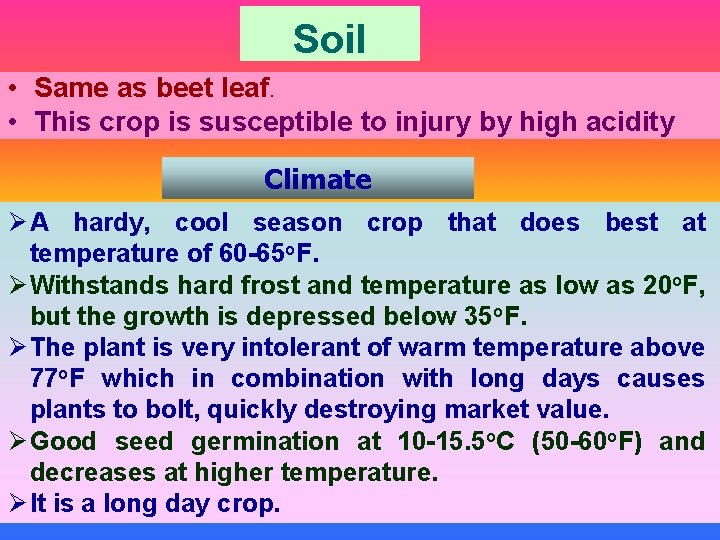
Soil • Same as beet leaf. • This crop is susceptible to injury by high acidity Climate Ø A hardy, cool season crop that does best at temperature of 60 -65 o. F. Ø Withstands hard frost and temperature as low as 20 o. F, but the growth is depressed below 35 o. F. Ø The plant is very intolerant of warm temperature above 77 o. F which in combination with long days causes plants to bolt, quickly destroying market value. Ø Good seed germination at 10 -15. 5 o. C (50 -60 o. F) and decreases at higher temperature. Ø It is a long day crop.

AGRONOMIC PRACTICES
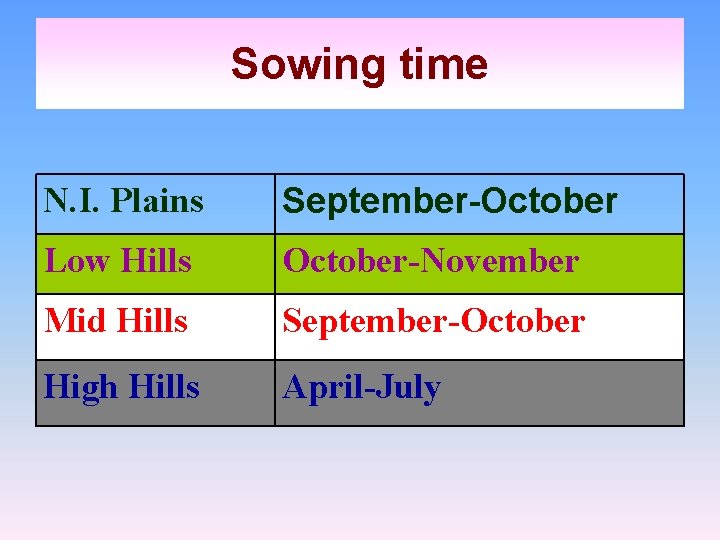
Sowing time N. I. Plains September-October Low Hills October-November Mid Hills September-October High Hills April-July
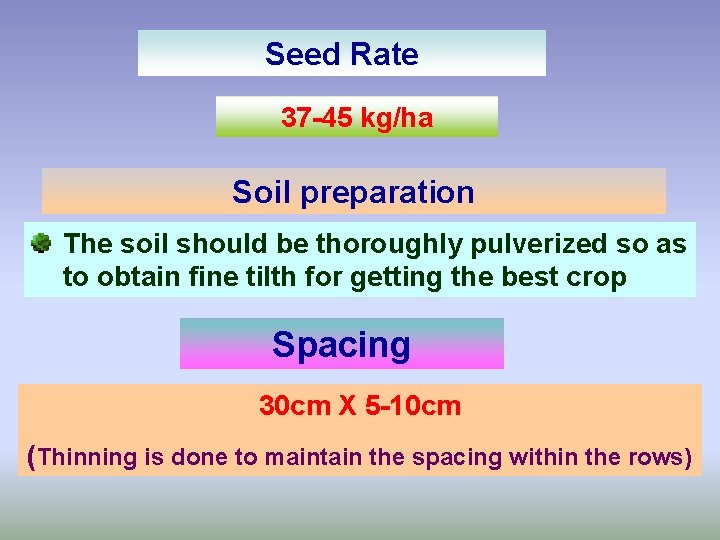
Seed Rate 37 -45 kg/ha Soil preparation The soil should be thoroughly pulverized so as to obtain fine tilth for getting the best crop Spacing 30 cm X 5 -10 cm (Thinning is done to maintain the spacing within the rows)
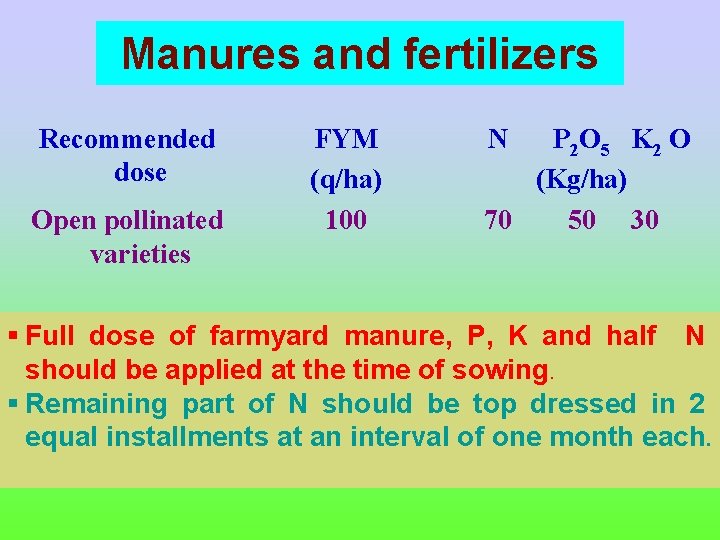
Manures and fertilizers Recommended dose Open pollinated varieties FYM (q/ha) 100 N P 2 O 5 K 2 O (Kg/ha) 70 50 30 § Full dose of farmyard manure, P, K and half N should be applied at the time of sowing. § Remaining part of N should be top dressed in 2 equal installments at an interval of one month each.
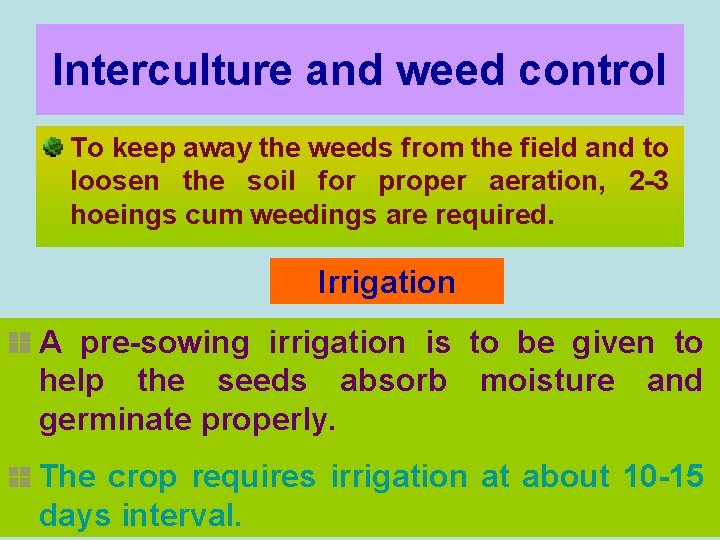
Interculture and weed control To keep away the weeds from the field and to loosen the soil for proper aeration, 2 -3 hoeings cum weedings are required. Irrigation A pre-sowing irrigation is to be given to help the seeds absorb moisture and germinate properly. The crop requires irrigation at about 10 -15 days interval.
Harvesting • The crop will be ready for harvest about 4 weeks after sowing. • It gives about 3 -4 cuttings in the season. • Harvesting by hand gave higher yield than mowing. • A plant with seed stalk is considered unmarketable. Yield 100 q/ha
Diseases • • Damping off Leaf spot: spray 0. 2% Blitox at 15 days interval White rust: Downy mildew: 0. 2% Dithane-M-45 Insects 1. Aphids: Spray oxy demeton methyl@ 0. 025% or malathion@0. 05% 2. Catterpiller: Spray malathion@0. 05% or deltamethrin@0. 0028% or cypermethrin@0. 0075%
- Slides: 15