
Spin of the proton and orbital motion of
Spin of the proton and orbital motion of quarks Petr Závada Inst. of Physics, Prague Workshop on Nucleon Form Factors Frascati, 12 -14 October, 2005
Introduction o o Presented results are based on the covariant QPM, in which quarks are considered as quasifree fermions on mass shell. Intrinsic quark motion, reflecting orbital momenta, is consistently taken into account. [for details see P. Z. Phys. Rev. D 65, 054040(2002) and D 67, 014019(2003)]. Recently, this model was generalized to include the transversity distribution [A. Efremov, O. Teryaev and P. Z. , Phys. Rev. D 70, 054018(2004)]. In this talk the obtained spin functions will be discussed: Sum rules for g 1, g 2. Calculation of the spin functions, comparison with experimental data, discussion on Γ 1.
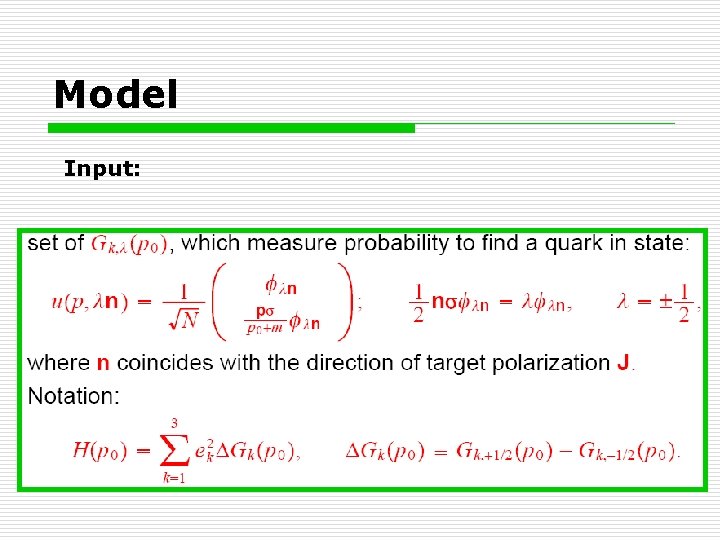
Model Input:
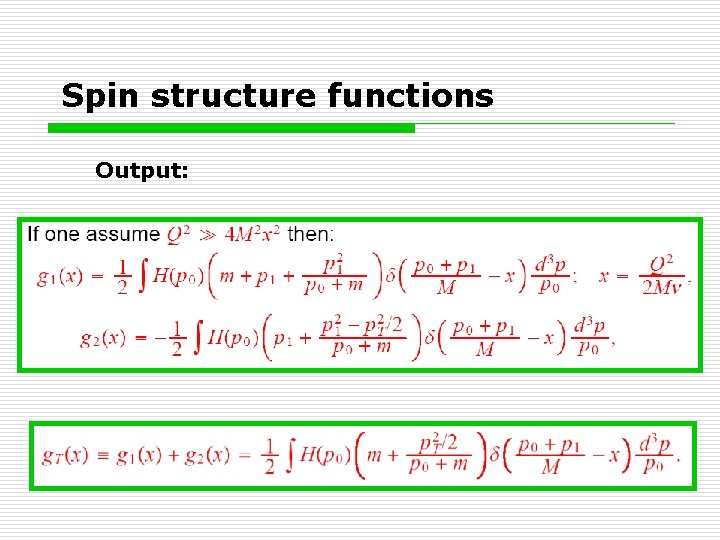
Spin structure functions Output:
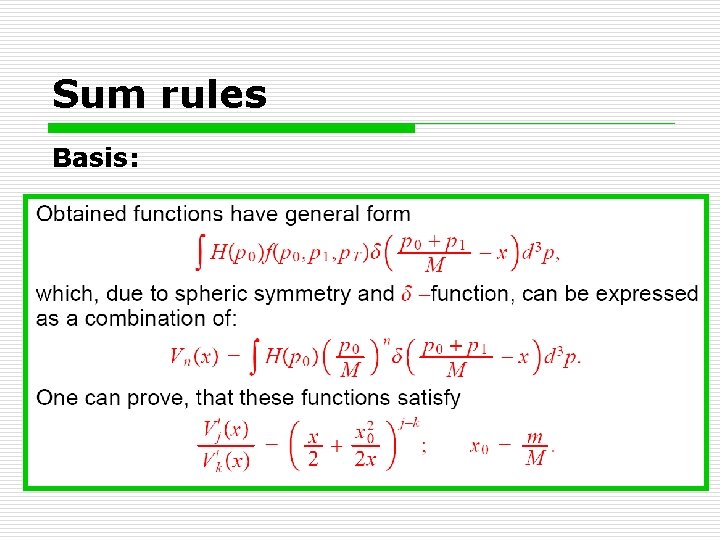
Sum rules Basis:
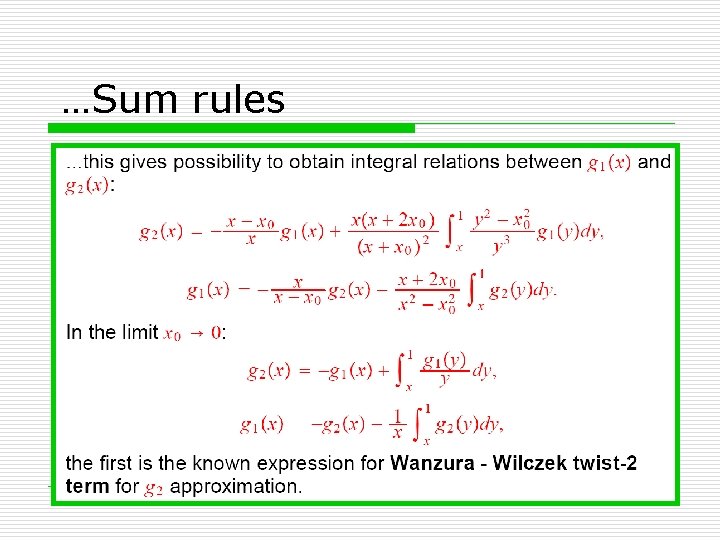
…Sum rules
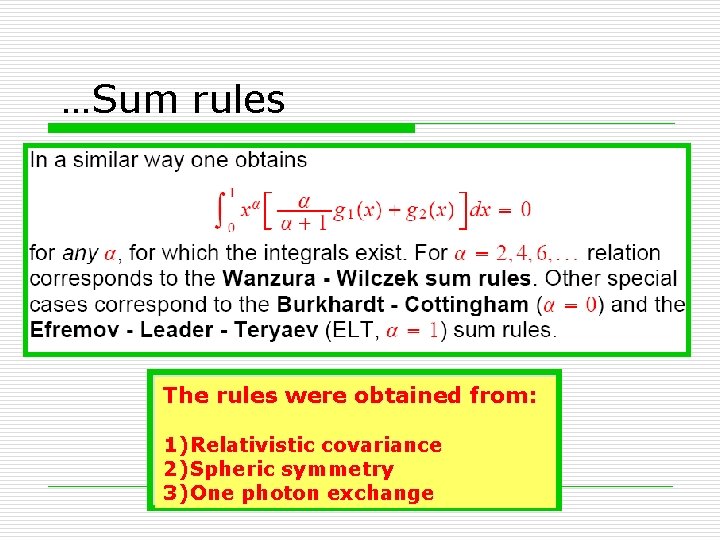
…Sum rules The rules were obtained from: 1) Relativistic covariance 2) Spheric symmetry 3) One photon exchange
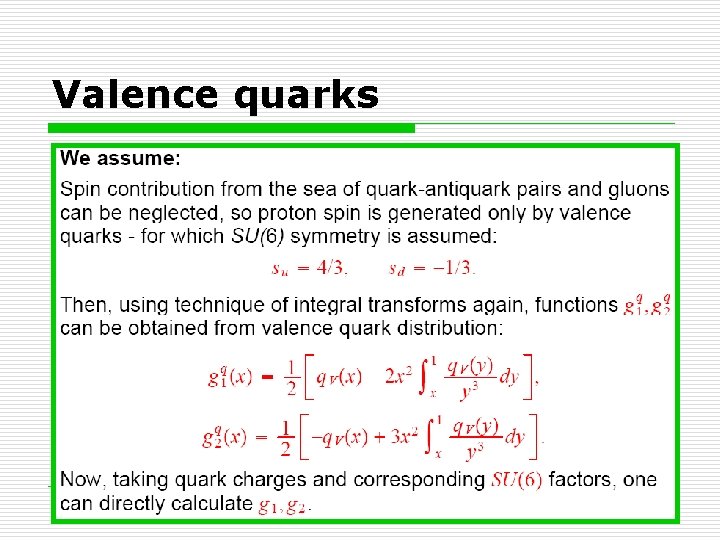
Valence quarks
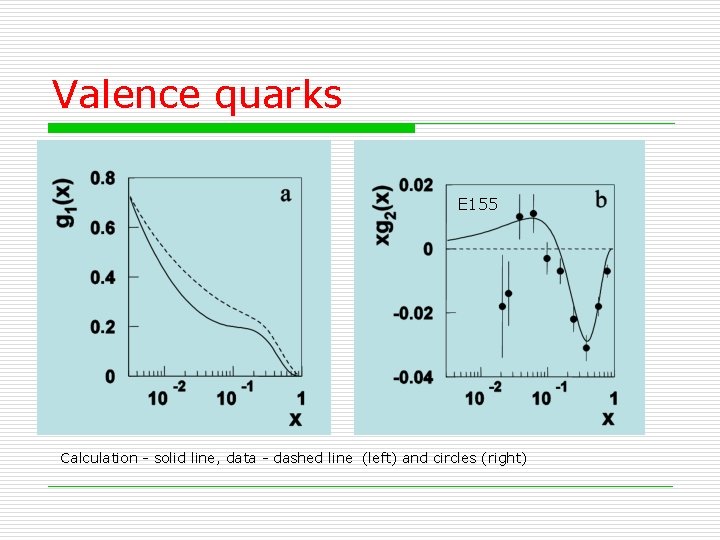
Valence quarks E 155 Calculation - solid line, data - dashed line (left) and circles (right)
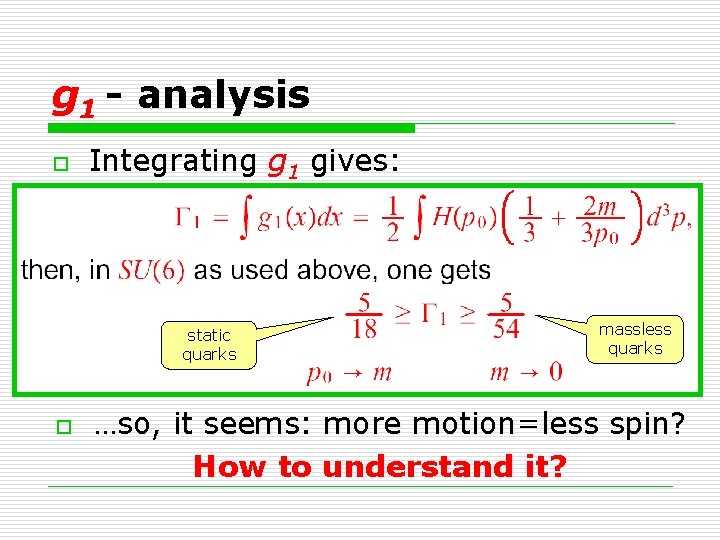
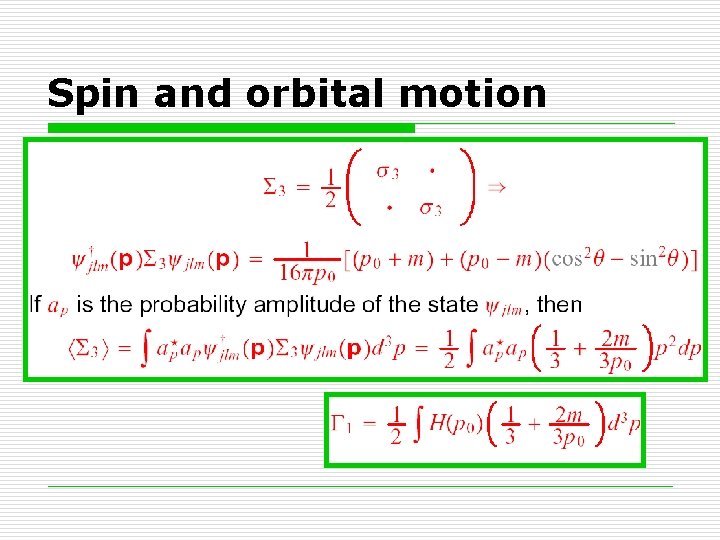
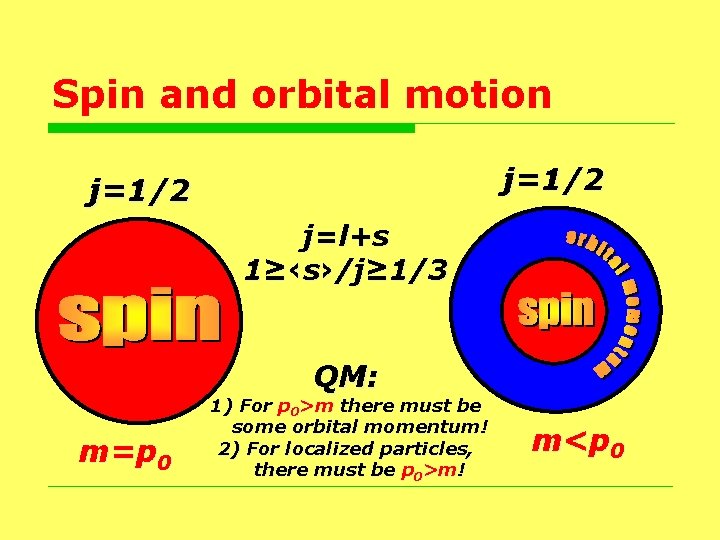
g 1 - analysis o Integrating g 1 gives: static quarks o massless quarks …so, it seems: more motion=less spin? How to understand it?
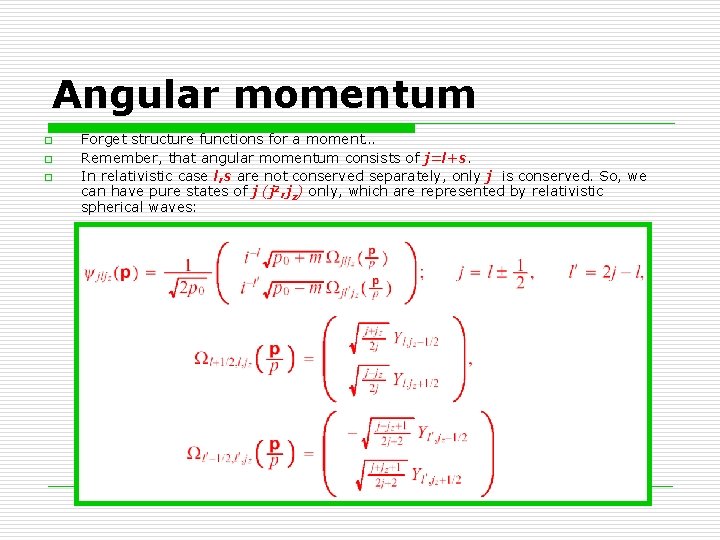
Angular momentum o o o Forget structure functions for a moment… Remember, that angular momentum consists of j=l+s. In relativistic case l, s are not conserved separately, only j is conserved. So, we can have pure states of j (j 2, jz) only, which are represented by relativistic spherical waves:
j=1/2
Spin and orbital motion
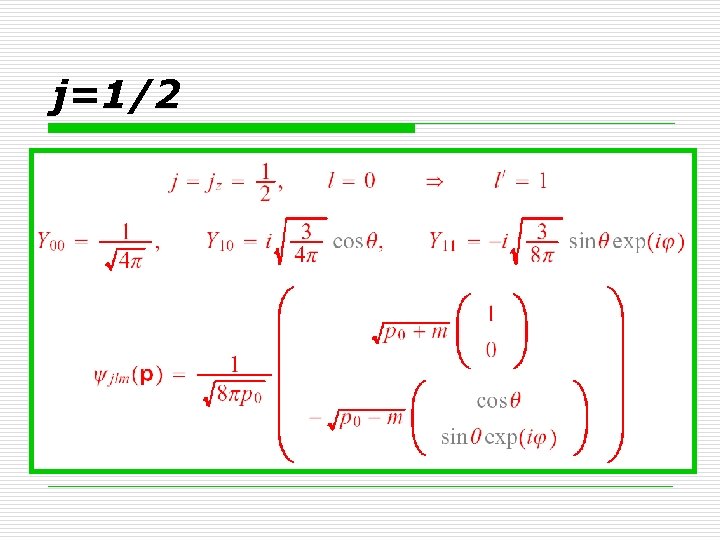
Spin and orbital motion j=1/2 j=l+s 1≥‹s›/j≥ 1/3 QM: m=p 0 1) For p 0>m there must be some orbital momentum! 2) For localized particles, there must be p 0>m! m<p 0
Recent experimental data: o Contribution of sea quarks is compatible with zero: HERMES Phys. Rev. Lett. 92, 012005 (2004); Phys. Rev. D 71, 012003 (2005). o Contribution of gluons is compatible with zero, but with rather big errors: HERMES, SMC, COMPASS Phys. Rev. Lett. 84, 2584 (2000); Phys. Rev. D 70, 012002 (2004); hep-ex/0501056
Support for dominant role of the orbital momentum: o Models, e. g. : o Casu, Sehgal, Phys. Rev. D 58, 2644 (1996). Wakamatsu, Watabe, Phys. Rev. D 62, 054009 (2000). o Jefferson Lab Hall A Collaboration o Experimental analysis suggests significant presence of the orbital momentum: Phys. Rev. Lett. 92, 012004 (2004); Phys. Rev. C 70, 065207 (2004).
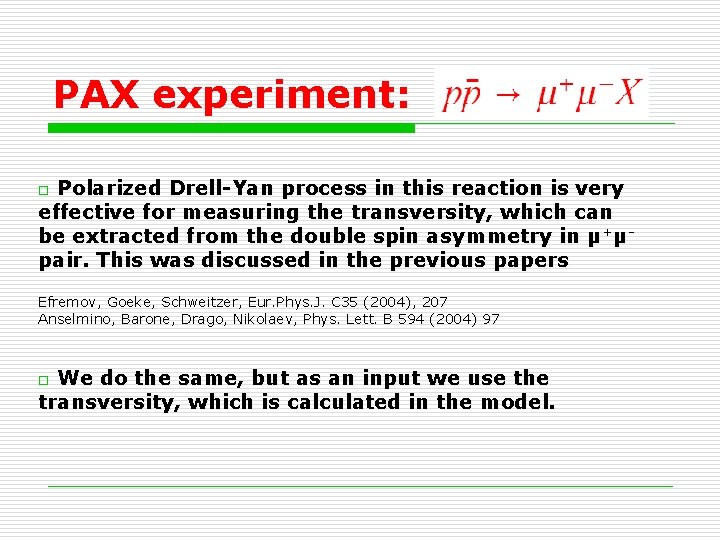
PAX experiment: Polarized Drell-Yan process in this reaction is very effective for measuring the transversity, which can be extracted from the double spin asymmetry in μ+μpair. This was discussed in the previous papers o Efremov, Goeke, Schweitzer, Eur. Phys. J. C 35 (2004), 207 Anselmino, Barone, Drago, Nikolaev, Phys. Lett. B 594 (2004) 97 We do the same, but as an input we use the transversity, which is calculated in the model. o
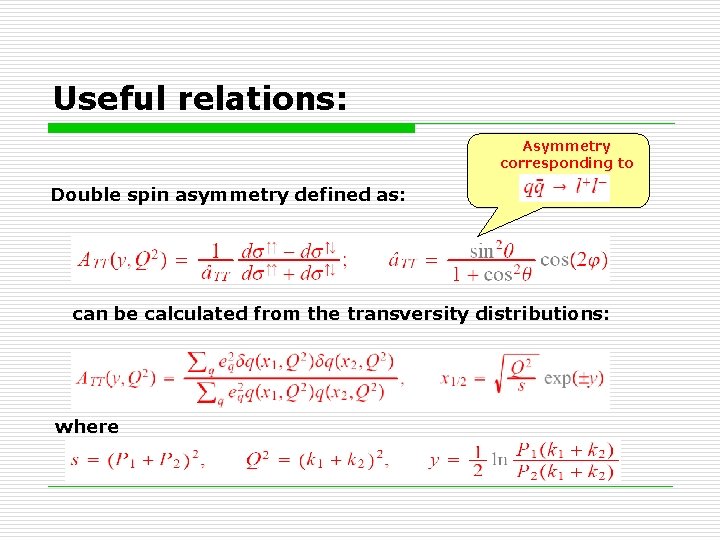
Useful relations: Asymmetry corresponding to Double spin asymmetry defined as: can be calculated from the transversity distributions: where
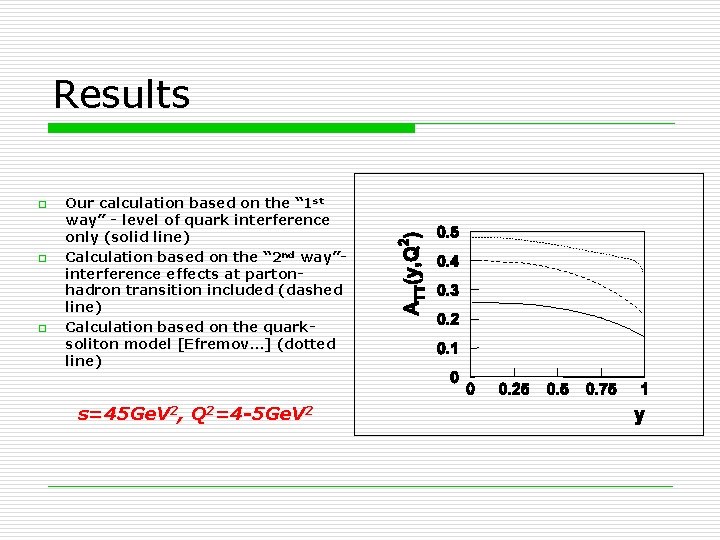
Results o o o Our calculation based on the “ 1 st way” - level of quark interference only (solid line) Calculation based on the “ 2 nd way”interference effects at partonhadron transition included (dashed line) Calculation based on the quarksoliton model [Efremov…] (dotted line) s=45 Ge. V 2, Q 2=4 -5 Ge. V 2
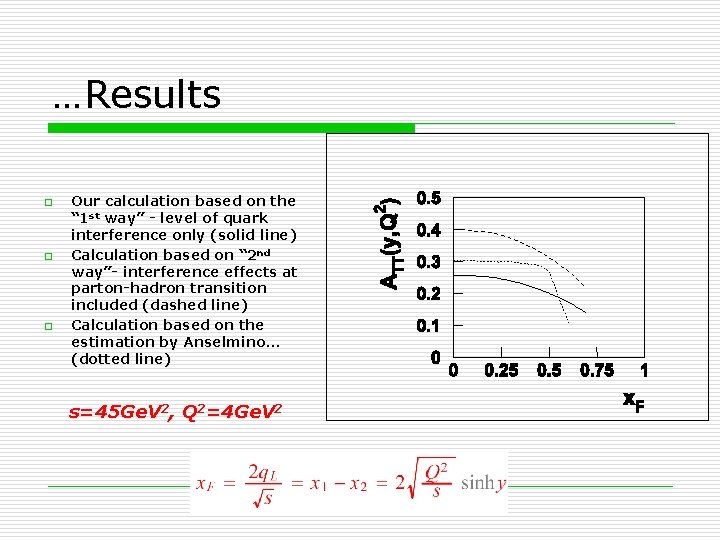
…Results o o o Our calculation based on the “ 1 st way” - level of quark interference only (solid line) Calculation based on “ 2 nd way”- interference effects at parton-hadron transition included (dashed line) Calculation based on the estimation by Anselmino… (dotted line) s=45 Ge. V 2, Q 2=4 Ge. V 2
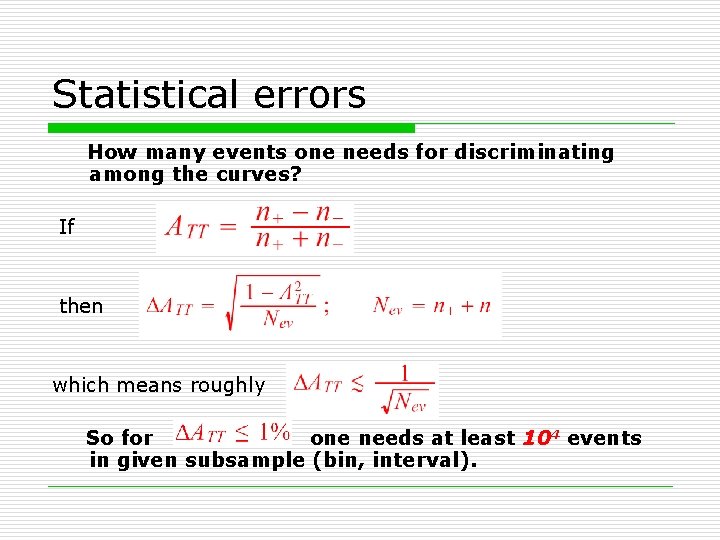
Statistical errors How many events one needs for discriminating among the curves? If then which means roughly So for one needs at least 104 events in given subsample (bin, interval).
Summary o o Covariant version of QPM involving intrinsic (orbital) motion was studied. Model reproduces the well known sum rules for g 1, g 2 : WW, ELT, BC. Spin function g 1 depend on intrinsic orbital motion rather significantly, this motion generates orbital angular momentum, which can represent as much as 2/3 j. Calculated g 1, g 2 from qval are well compatible with the experimental data.
- Slides: 22