
Spin effects in MC generators Aram Kotzinian JINR
- Slides: 29
Spin effects in MC generators Aram Kotzinian JINR, Dubna and Torino University & INFN On leave in absence from Yer. Ph. I, Armenia Dubna, SPIN-05 The spin and azimuthal asymmetries in the current and target fragmentation regions The flavor separation of the quark helicity distributions Conclusions Dubna, September, 2005 Aram Kotzinian 1
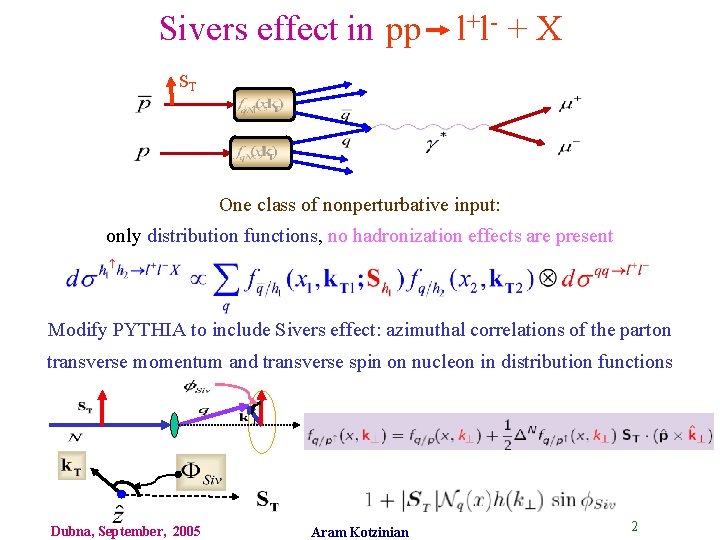
Sivers effect in pp l+l- + X ST One class of nonperturbative input: only distribution functions, no hadronization effects are present Modify PYTHIA to include Sivers effect: azimuthal correlations of the parton transverse momentum and transverse spin on nucleon in distribution functions Dubna, September, 2005 Aram Kotzinian 2
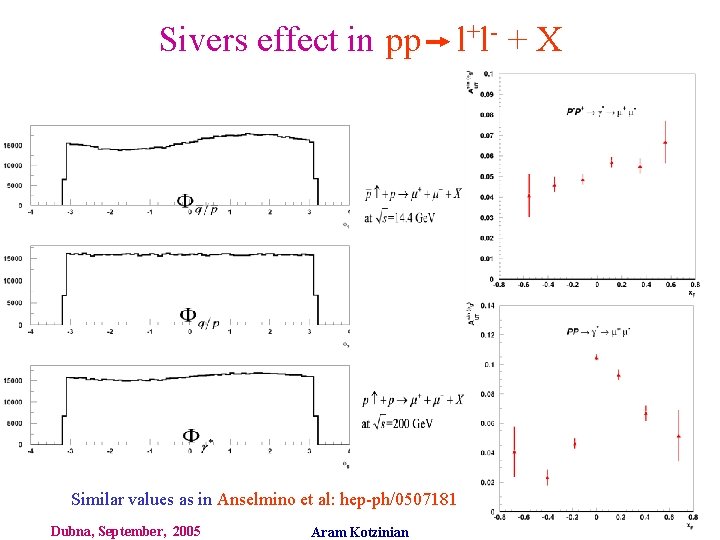
Sivers effect in pp l+l- + X Similar values as in Anselmino et al: hep-ph/0507181 Dubna, September, 2005 Aram Kotzinian 3
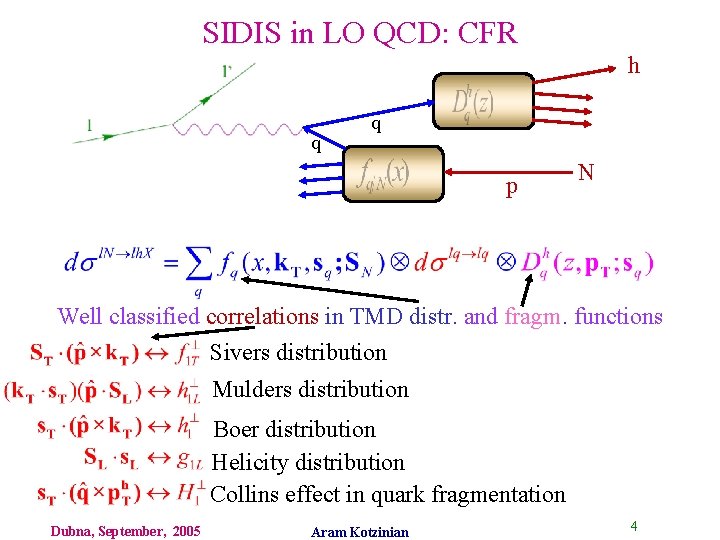
SIDIS in LO QCD: CFR h q q p N Well classified correlations in TMD distr. and fragm. functions Sivers distribution Mulders distribution Boer distribution Helicity distribution Collins effect in quark fragmentation Dubna, September, 2005 Aram Kotzinian 4
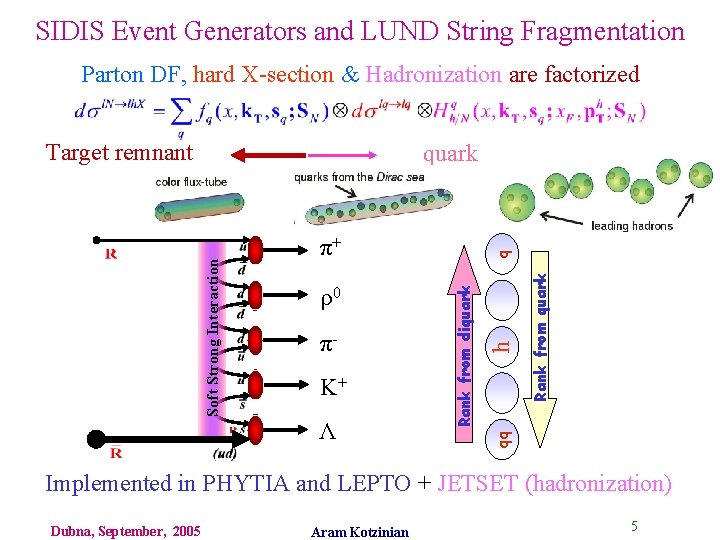
SIDIS Event Generators and LUND String Fragmentation Parton DF, hard X-section & Hadronization are factorized Target remnant Λ Rank from quark K+ h π- qq ρ0 q π+ Rank from diquark Soft Strong Interaction quark Implemented in PHYTIA and LEPTO + JETSET (hadronization) Dubna, September, 2005 Aram Kotzinian 5
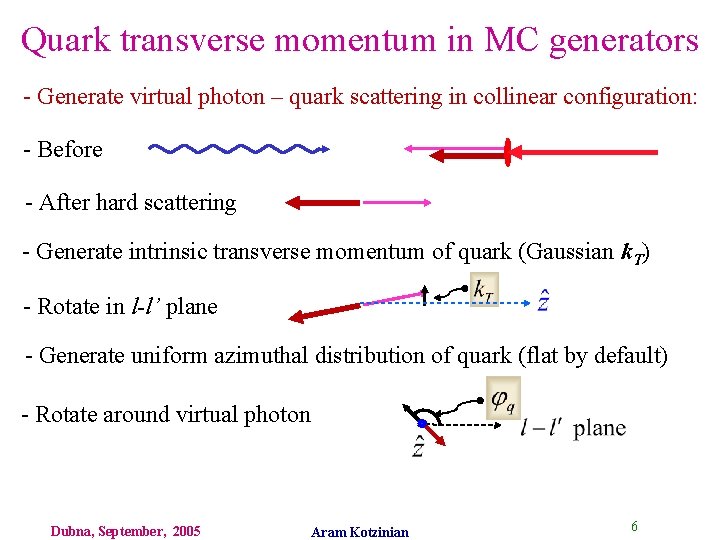
Quark transverse momentum in MC generators - Generate virtual photon – quark scattering in collinear configuration: - Before - After hard scattering - Generate intrinsic transverse momentum of quark (Gaussian k. T) - Rotate in l-l’ plane - Generate uniform azimuthal distribution of quark (flat by default) - Rotate around virtual photon Dubna, September, 2005 Aram Kotzinian 6
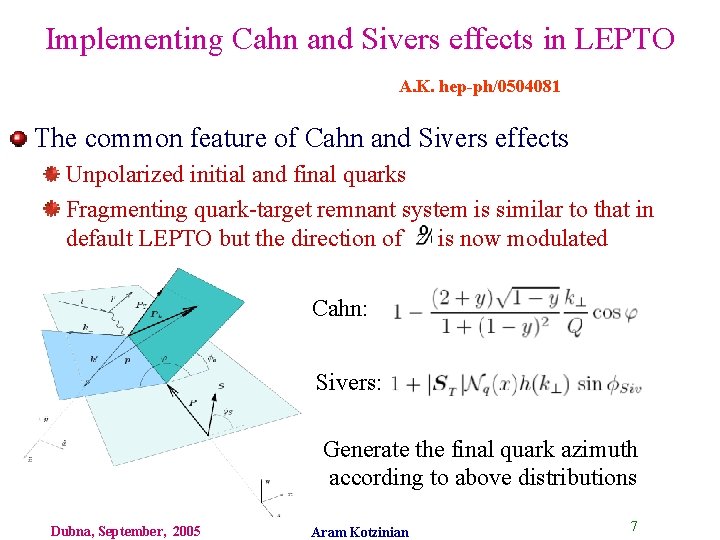
Implementing Cahn and Sivers effects in LEPTO A. K. hep-ph/0504081 The common feature of Cahn and Sivers effects Unpolarized initial and final quarks Fragmenting quark-target remnant system is similar to that in default LEPTO but the direction of is now modulated Cahn: Sivers: Generate the final quark azimuth according to above distributions Dubna, September, 2005 Aram Kotzinian 7
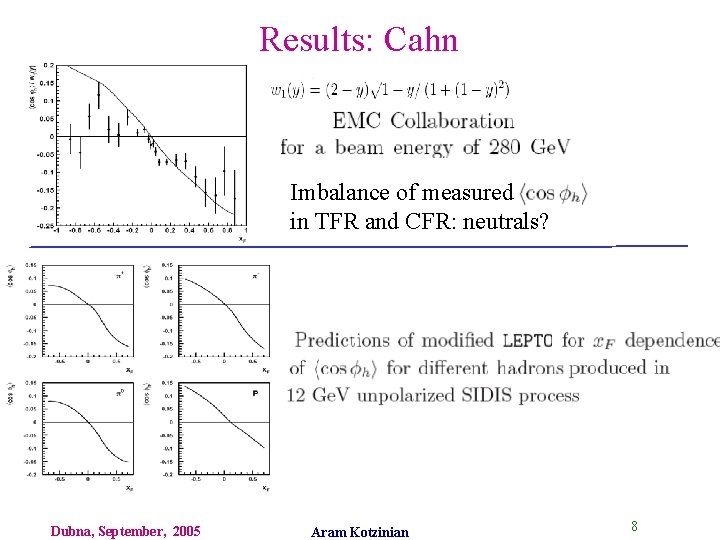
Results: Cahn Imbalance of measured in TFR and CFR: neutrals? Dubna, September, 2005 Aram Kotzinian 8
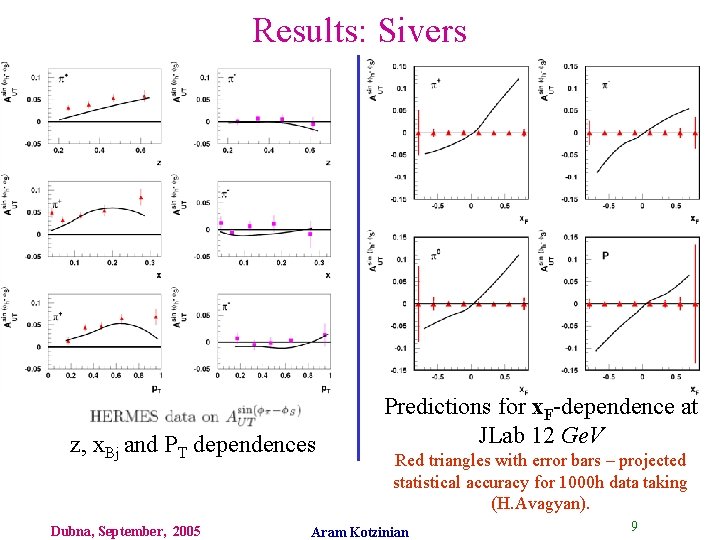
Results: Sivers z, x. Bj and PT dependences Dubna, September, 2005 Predictions for x. F-dependence at JLab 12 Ge. V Red triangles with error bars – projected statistical accuracy for 1000 h data taking (H. Avagyan). Aram Kotzinian 9
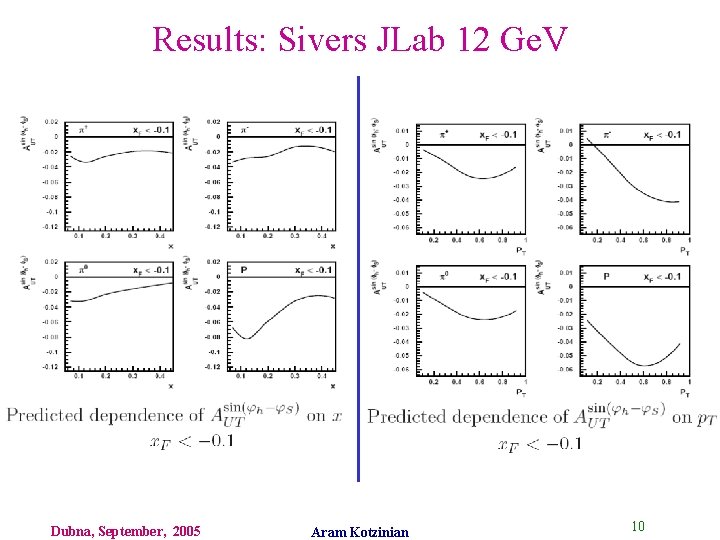
Results: Sivers JLab 12 Ge. V Dubna, September, 2005 Aram Kotzinian 10
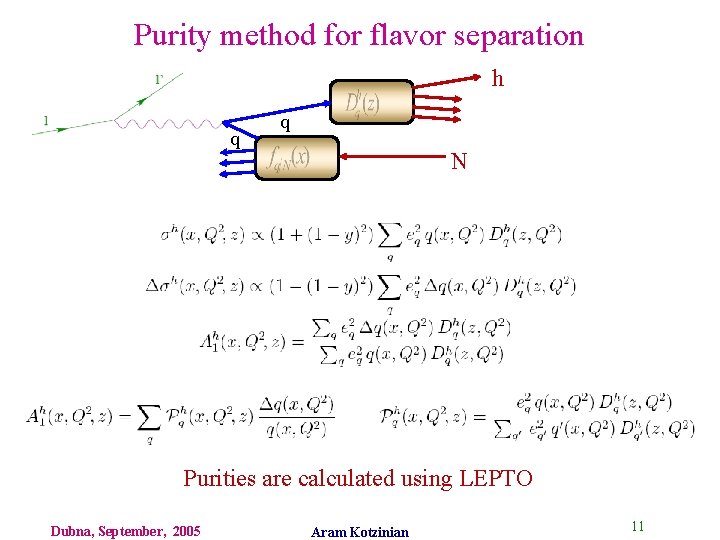
Purity method for flavor separation h q q N Purities are calculated using LEPTO Dubna, September, 2005 Aram Kotzinian 11
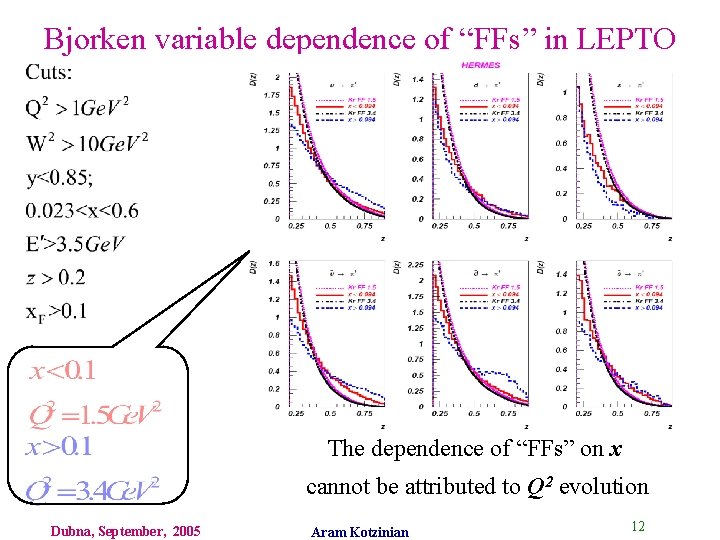
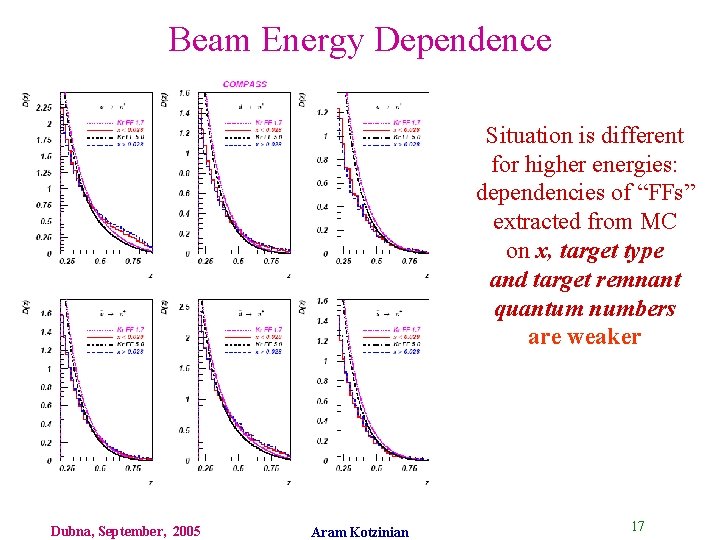
Bjorken variable dependence of “FFs” in LEPTO The dependence of “FFs” on x cannot be attributed to Q 2 evolution Dubna, September, 2005 Aram Kotzinian 12
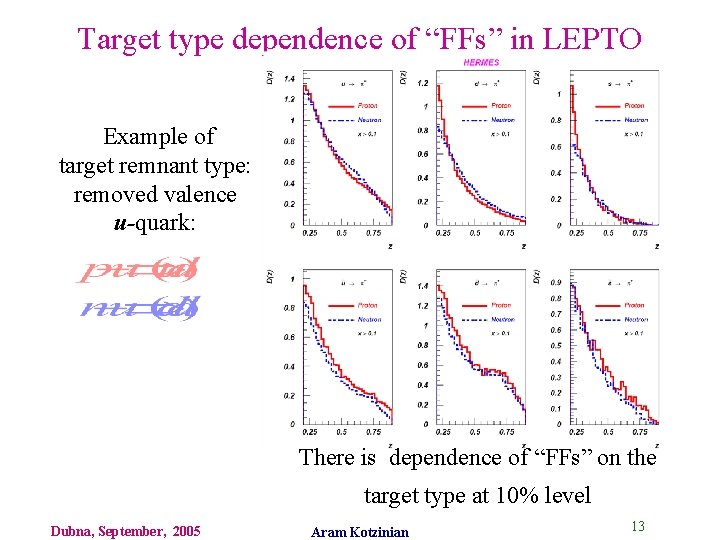
Target type dependence of “FFs” in LEPTO Example of target remnant type: removed valence u-quark: There is dependence of “FFs” on the target type at 10% level Dubna, September, 2005 Aram Kotzinian 13
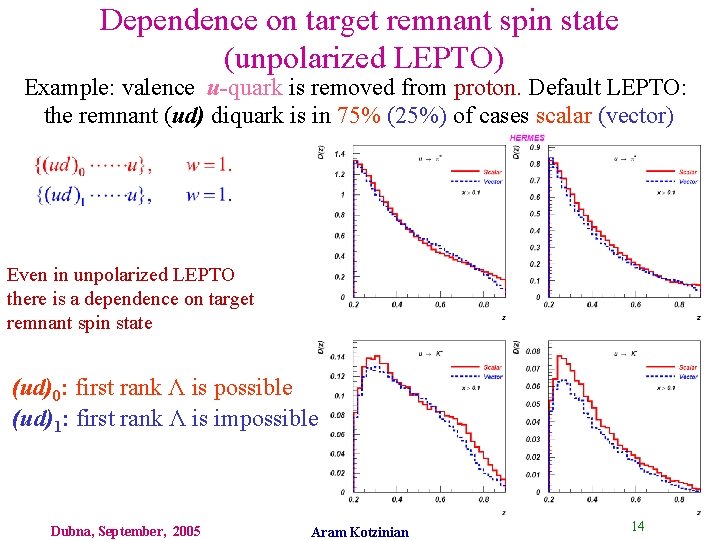
Dependence on target remnant spin state (unpolarized LEPTO) Example: valence u-quark is removed from proton. Default LEPTO: the remnant (ud) diquark is in 75% (25%) of cases scalar (vector) Even in unpolarized LEPTO there is a dependence on target remnant spin state (ud)0: first rank Λ is possible (ud)1: first rank Λ is impossible Dubna, September, 2005 Aram Kotzinian 14
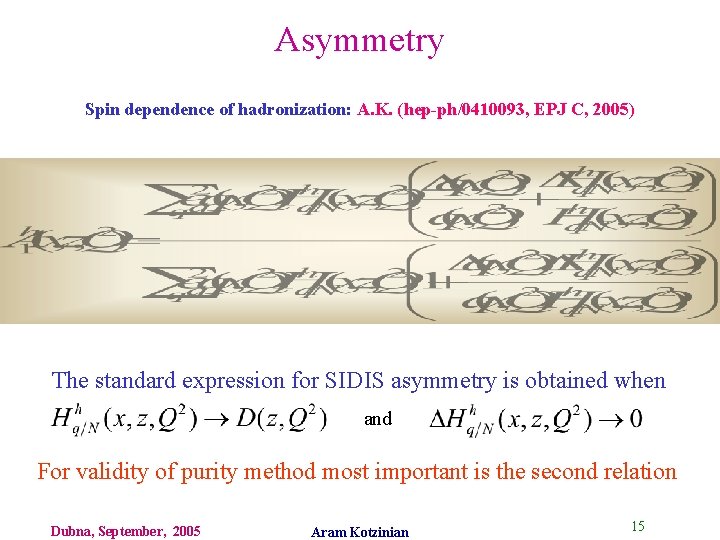
Asymmetry Spin dependence of hadronization: A. K. (hep-ph/0410093, EPJ C, 2005) The standard expression for SIDIS asymmetry is obtained when and For validity of purity method most important is the second relation Dubna, September, 2005 Aram Kotzinian 15
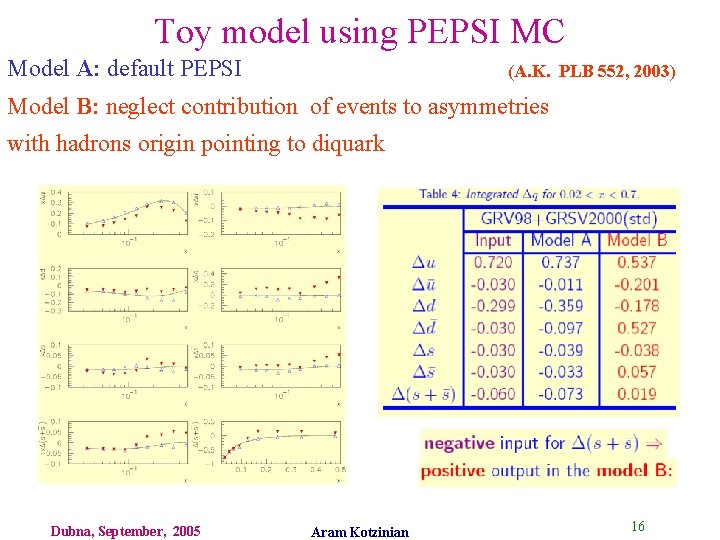
Toy model using PEPSI MC Model A: default PEPSI (A. K. PLB 552, 2003) Model B: neglect contribution of events to asymmetries with hadrons origin pointing to diquark Dubna, September, 2005 Aram Kotzinian 16
Beam Energy Dependence Situation is different for higher energies: dependencies of “FFs” extracted from MC on x, target type and target remnant quantum numbers are weaker Dubna, September, 2005 Aram Kotzinian 17
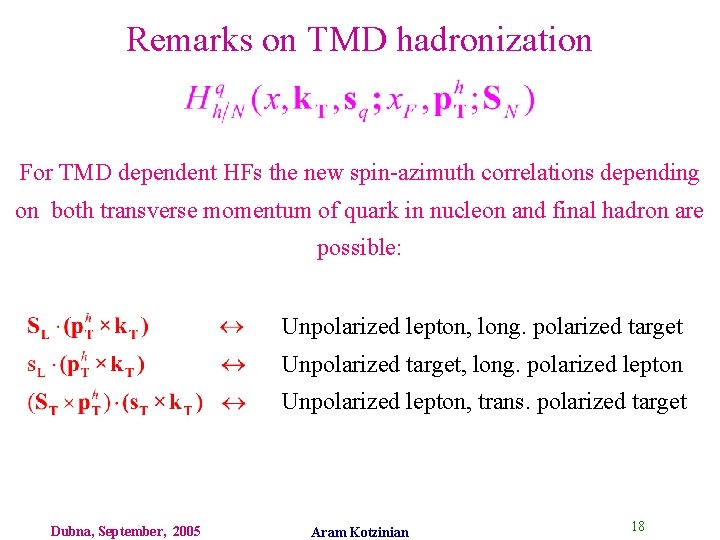
Remarks on TMD hadronization For TMD dependent HFs the new spin-azimuth correlations depending on both transverse momentum of quark in nucleon and final hadron are possible: Unpolarized lepton, long. polarized target Unpolarized target, long. polarized lepton Unpolarized lepton, trans. polarized target Dubna, September, 2005 Aram Kotzinian 18
Conclusions (flavor separation) The new concept of (polarized) hadronization is introduced and studied using LEPTO event generator The hadronization in LEPTO is more general than simple LO x-z factorized picture with independent fragmentation, for example, it describes well TFR. One can try to modify PEPSI MC event generator by including polarization in hadronization. The purity method have to be modified to take into account the polarized HFs. Within this new approach one can include all hadrons (CFR+TFR) for flavor separation analysis. More studies on the accuracy of different methods of the polarized parton DF extraction using SIDIS asymmetries are needed. Alternative measurements are highly desirable SIDIS at different beam energies: COMPASS, JLab, EIC W production in polarized p+p collisions (Anti)neutrino DIS on polarized targets (Neutrino Factory) Dubna, September, 2005 Aram Kotzinian 19
Conclusions (azimuthal asymmetries) Both Cahn and Sivers effects are implemented in LEPTO. Possible effects of polarized hadronization were neglected. Existing data in CFR are well described by modified LEPTO The measured Cahn effect in the TFR is not well described It is important to perform new measurements of both Cahn and Sivers effects in the TFR (JLab, HERMES, Electron Ion Colliders) This will help better understand hadronization mechanism Do the neutral hadrons compensate Cahn effect in CFR? Is there Sivers effect in TFR compensating asymmetry in CFR? Access to TFR opens a new field both for theoretical and experimental investigations Dubna, September, 2005 Aram Kotzinian 20
additional slides Dubna, September, 2005 Aram Kotzinian 21
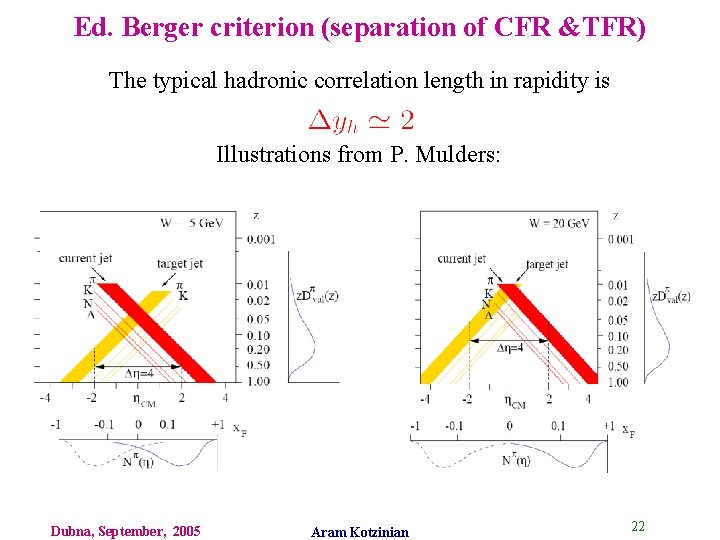
Ed. Berger criterion (separation of CFR &TFR) The typical hadronic correlation length in rapidity is Illustrations from P. Mulders: Dubna, September, 2005 Aram Kotzinian 22
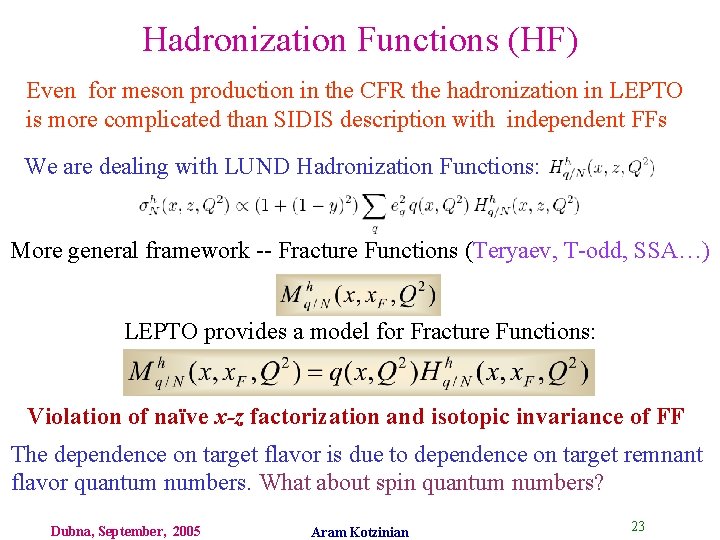
Hadronization Functions (HF) Even for meson production in the CFR the hadronization in LEPTO is more complicated than SIDIS description with independent FFs We are dealing with LUND Hadronization Functions: More general framework -- Fracture Functions (Teryaev, T-odd, SSA…) LEPTO provides a model for Fracture Functions: Violation of naïve x-z factorization and isotopic invariance of FF The dependence on target flavor is due to dependence on target remnant flavor quantum numbers. What about spin quantum numbers? Dubna, September, 2005 Aram Kotzinian 23
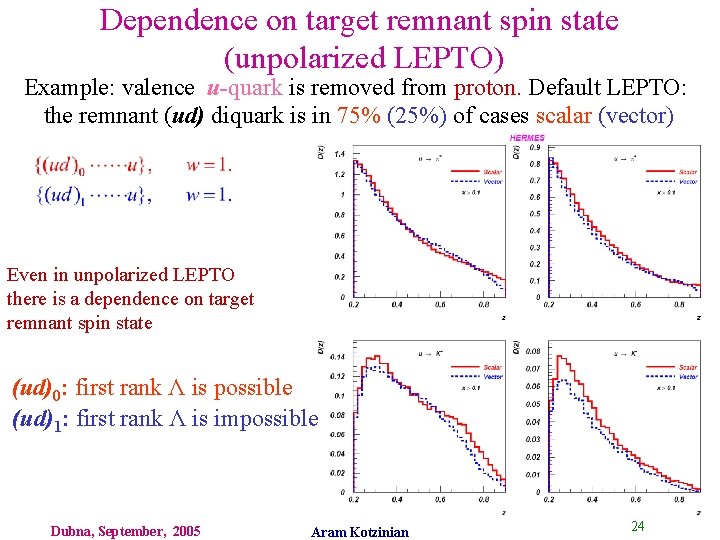
Dependence on target remnant spin state (unpolarized LEPTO) Example: valence u-quark is removed from proton. Default LEPTO: the remnant (ud) diquark is in 75% (25%) of cases scalar (vector) Even in unpolarized LEPTO there is a dependence on target remnant spin state (ud)0: first rank Λ is possible (ud)1: first rank Λ is impossible Dubna, September, 2005 Aram Kotzinian 24
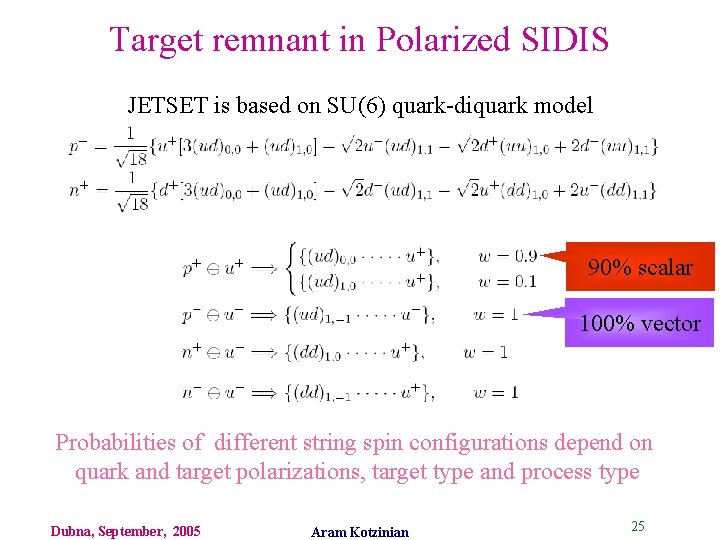
Target remnant in Polarized SIDIS JETSET is based on SU(6) quark-diquark model 90% scalar 100% vector Probabilities of different string spin configurations depend on quark and target polarizations, target type and process type Dubna, September, 2005 Aram Kotzinian 25
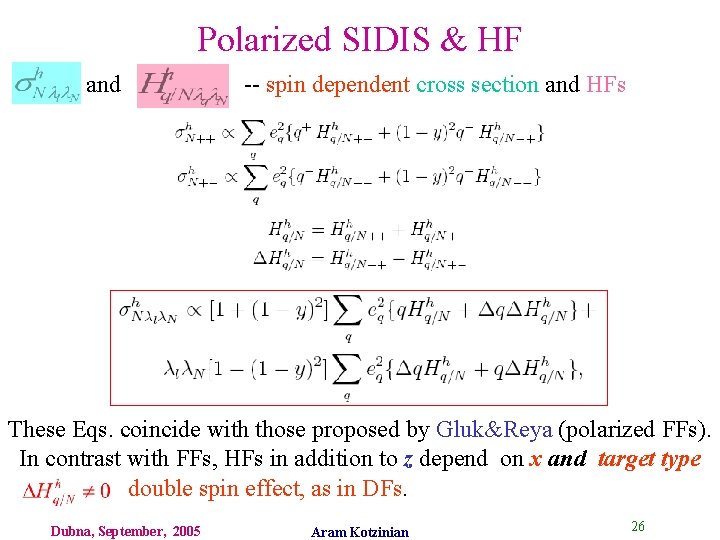
Polarized SIDIS & HF and -- spin dependent cross section and HFs These Eqs. coincide with those proposed by Gluk&Reya (polarized FFs). In contrast with FFs, HFs in addition to z depend on x and target type double spin effect, as in DFs. Dubna, September, 2005 Aram Kotzinian 26
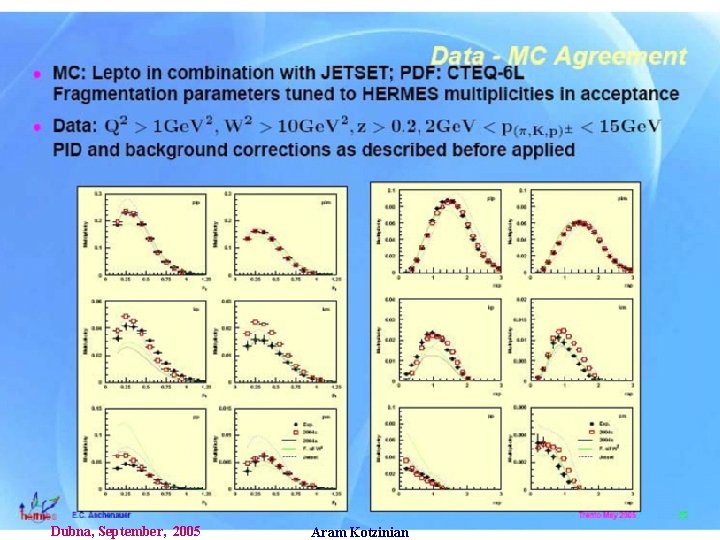
Dubna, September, 2005 Aram Kotzinian 27
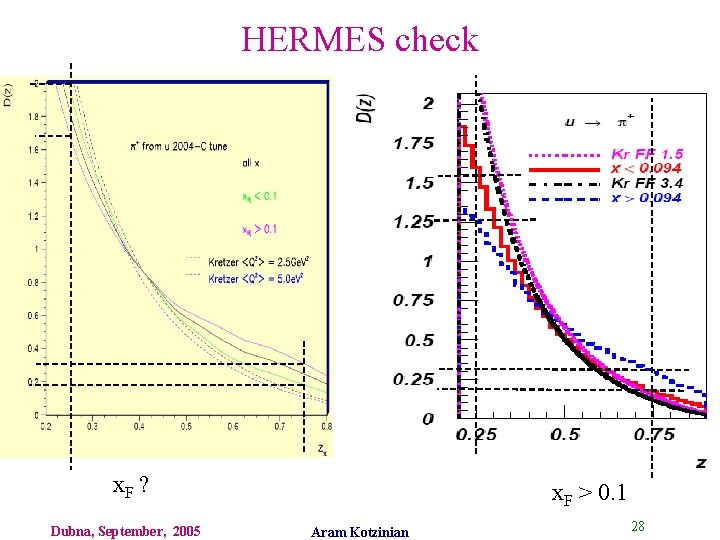
HERMES check x. F ? Dubna, September, 2005 x. F > 0. 1 Aram Kotzinian 28
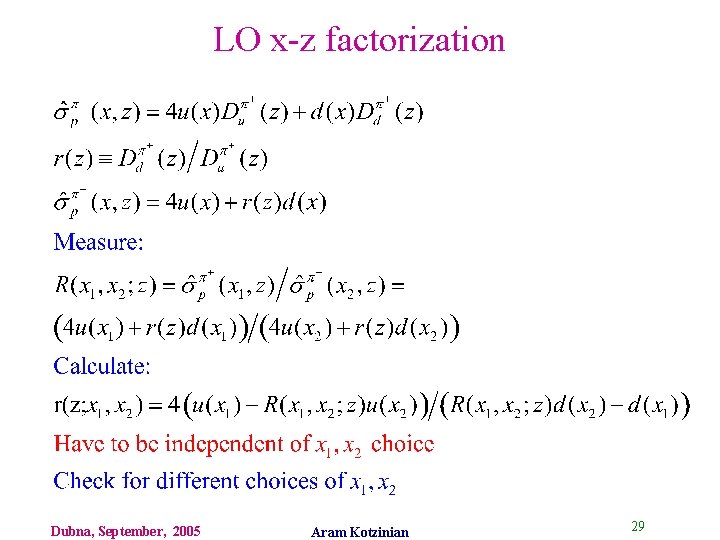
LO x-z factorization Dubna, September, 2005 Aram Kotzinian 29