
SPHINCS JeanPhilippe Aumasson Daniel J Bernstein Christoph Dobraunig
+ SPHINCS Jean-Philippe Aumasson, Daniel J. Bernstein, Christoph Dobraunig, Maria Eichlseder, Scott Fluhrer, Stefan-Lukas Gazdag, Andreas Hülsing, Panos Kampanakis, Stefan Kölbl, Tanja Lange, Martin M. Lauridsen, Florian Mendel, Ruben Niederhagen, Christian Rechberger, Joost Rijneveld, Peter Schwabe
Hash-based signatures Boring crypto: • Dates back to beginning of public key cryptography • No fancy new mathematical assumption: Only requires a secure hash function („minimal security assumptions“) • Stateful schemes already in standardization 23. 08. 2019 https: //sphincs. org/ 2
SPHINCS Joint work with Daniel J. Bernstein, Daira Hopwood, Tanja Lange, Ruben Niederhagen, Louiza Papachristodoulou, Michael Schneider, Peter Schwabe, and Zooko Wilcox-O’Hearn
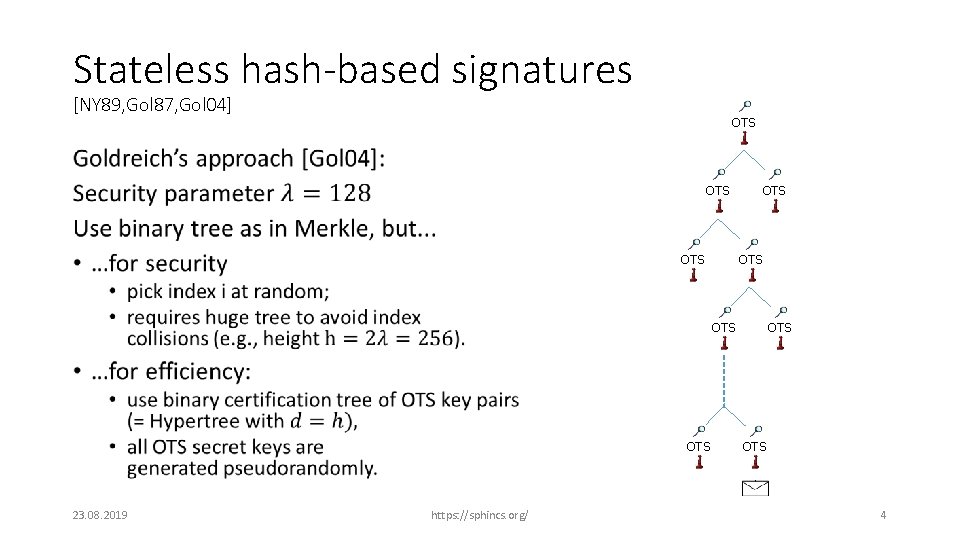
Stateless hash-based signatures [NY 89, Gol 87, Gol 04] OTS • OTS OTS OTS 23. 08. 2019 https: //sphincs. org/ OTS 4
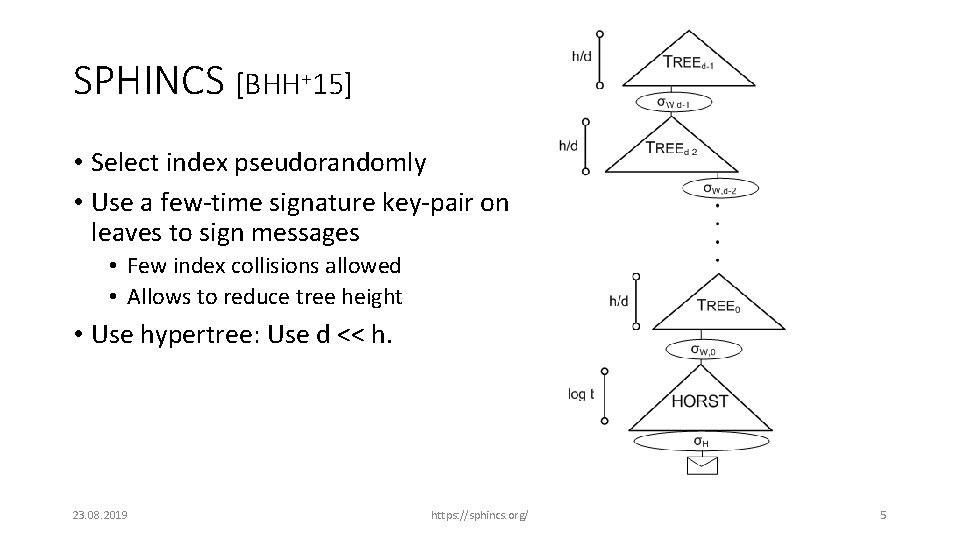
SPHINCS [BHH+15] • Select index pseudorandomly • Use a few-time signature key-pair on leaves to sign messages • Few index collisions allowed • Allows to reduce tree height • Use hypertree: Use d << h. 23. 08. 2019 https: //sphincs. org/ 5
+ SPHINCS in 1 st Round Joint work with Daniel J. Bernstein, Christoph Dobraunig, Maria Eichlseder, Scott Fluhrer, Stefan-Lukas Gazdag, Panos Kampanakis, Stefan Kölbl, Tanja Lange, Martin M. Lauridsen, Florian Mendel, Ruben Niederhagen, Christian Rechberger, Joost Rijneveld, Peter Schwabe
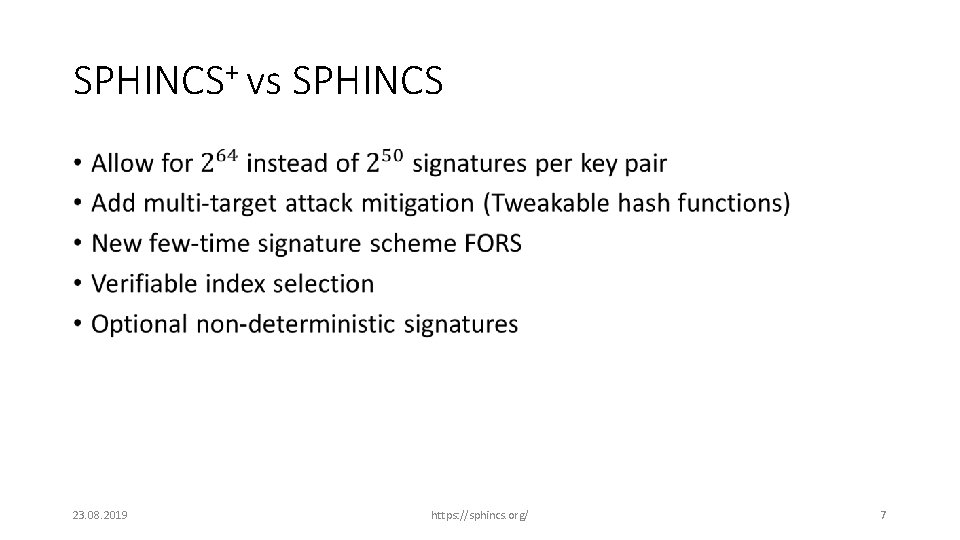
SPHINCS+ vs SPHINCS • 23. 08. 2019 https: //sphincs. org/ 7
+ SPHINCS in 2 nd Round Joint work with Jean-Philippe Aumasson, Daniel J. Bernstein, Christoph Dobraunig, Maria Eichlseder, Scott Fluhrer, Stefan-Lukas Gazdag, Panos Kampanakis, Stefan Kölbl, Tanja Lange, Martin M. Lauridsen, Florian Mendel, Ruben Niederhagen, Christian Rechberger, Joost Rijneveld, Peter Schwabe 23. 08. 2019 https: //sphincs. org/ 8
2 nd Round changes • One new team member: 1/2 Gravity-SPHINCS (J. -P. Aumasson) • “Simple”-instantiations (of tweakable hash functions) • Performance optimization for SHA-256 instantiations • Fixed tight security reduction 23. 08. 2019 https: //sphincs. org/ 9
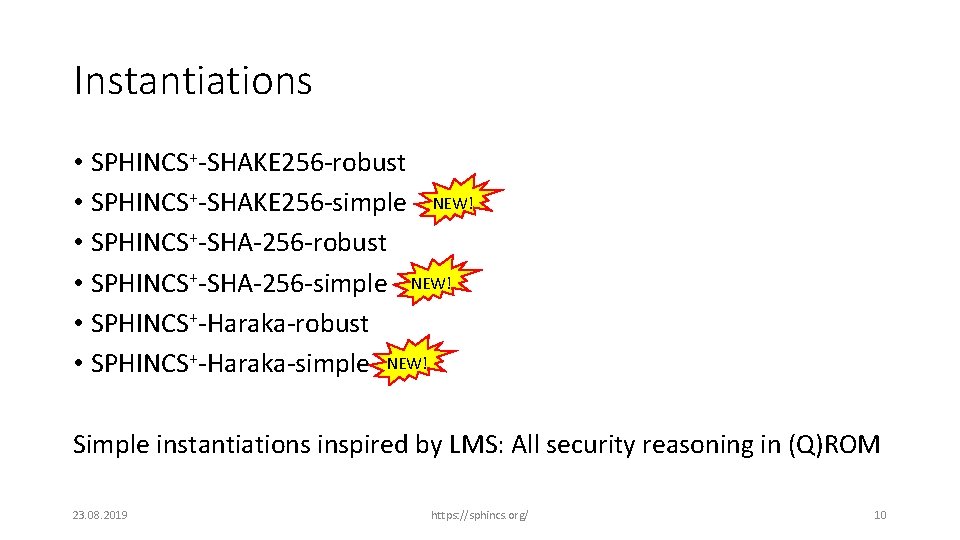
Instantiations • SPHINCS+-SHAKE 256 -robust • SPHINCS+-SHAKE 256 -simple NEW! • SPHINCS+-SHA-256 -robust • SPHINCS+-SHA-256 -simple NEW! • SPHINCS+-Haraka-robust • SPHINCS+-Haraka-simple NEW! Simple instantiations inspired by LMS: All security reasoning in (Q)ROM 23. 08. 2019 https: //sphincs. org/ 10
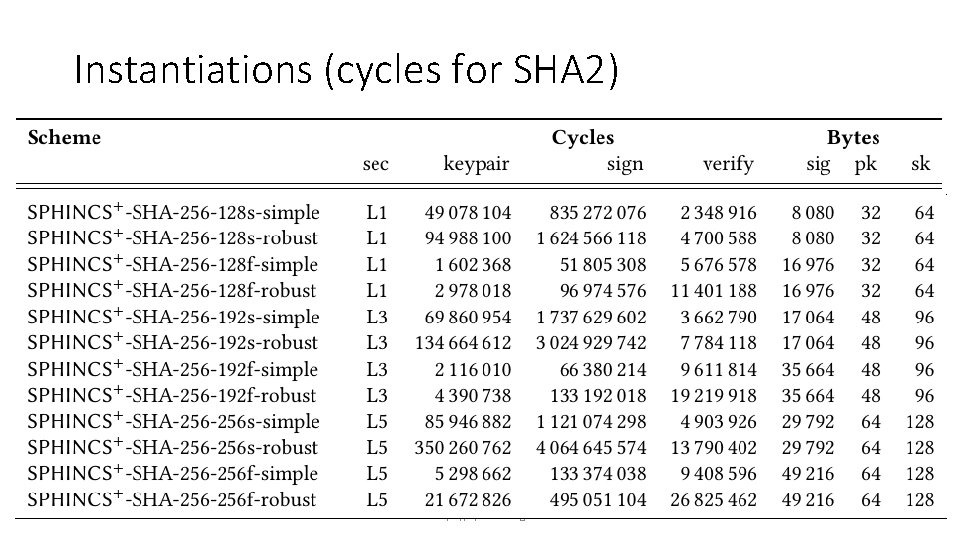
Instantiations (cycles for SHA 2) 23. 08. 2019 https: //sphincs. org/ 11
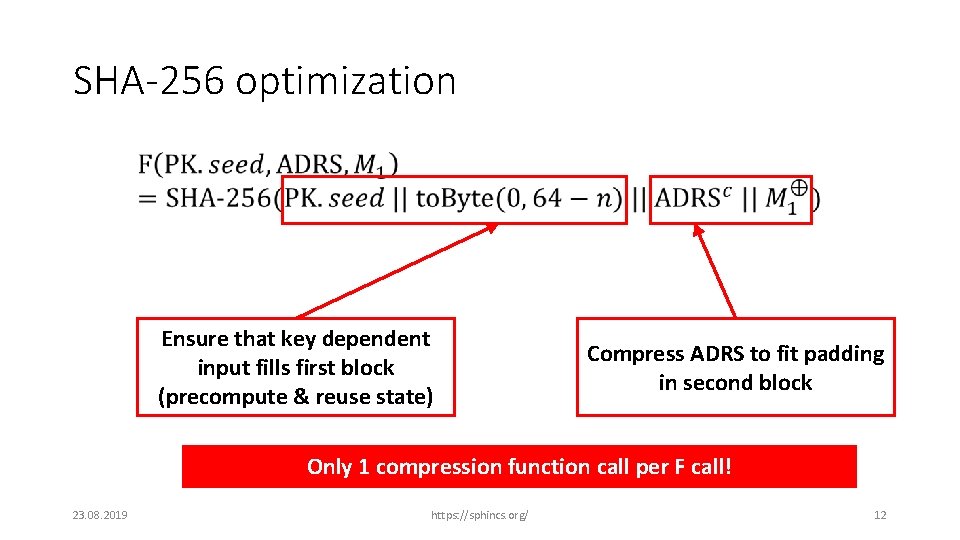
SHA-256 optimization • Ensure that key dependent input fills first block (precompute & reuse state) Compress ADRS to fit padding in second block Only 1 compression function call per F call! 23. 08. 2019 https: //sphincs. org/ 12
23. 08. 2019 https: //sphincs. org/ 13
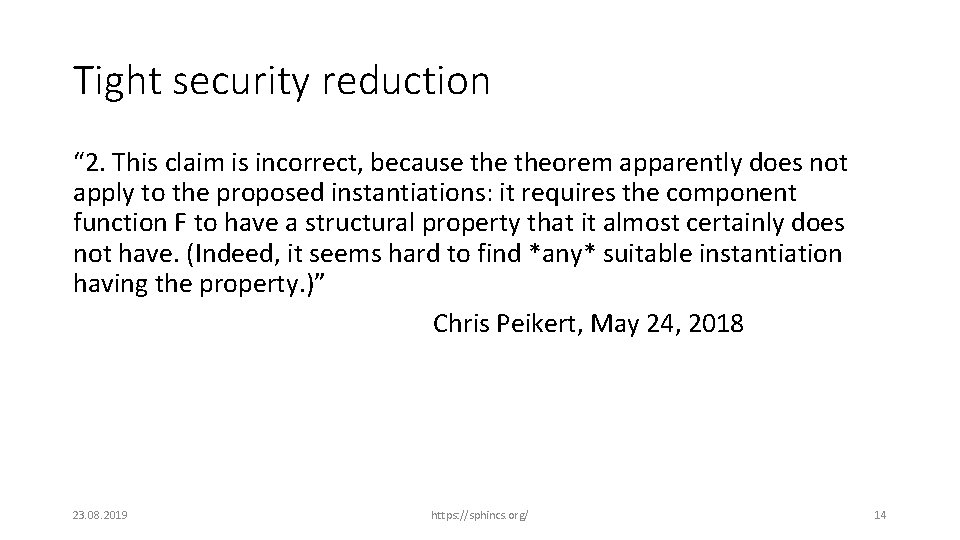
Tight security reduction “ 2. This claim is incorrect, because theorem apparently does not apply to the proposed instantiations: it requires the component function F to have a structural property that it almost certainly does not have. (Indeed, it seems hard to find *any* suitable instantiation having the property. )” Chris Peikert, May 24, 2018 23. 08. 2019 https: //sphincs. org/ 14
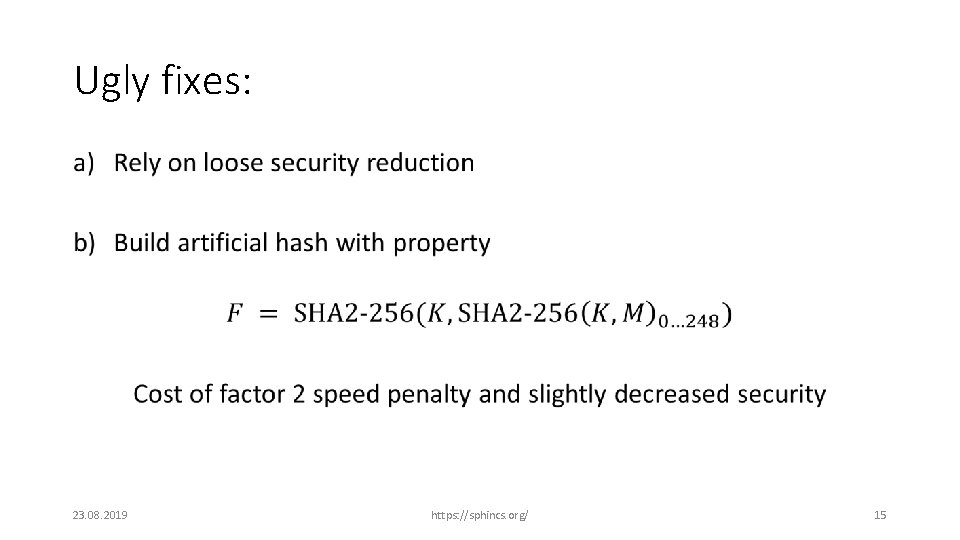
Ugly fixes: • 23. 08. 2019 https: //sphincs. org/ 15
More elegant fix Replace statistical property by new computational assumption: Decisional second-preimage resistance (DSPR) [BH 19] Intuition: Given domain element it is hard to decide if second-preimage exists (with probability better than guessing) 23. 08. 2019 https: //sphincs. org/ 16
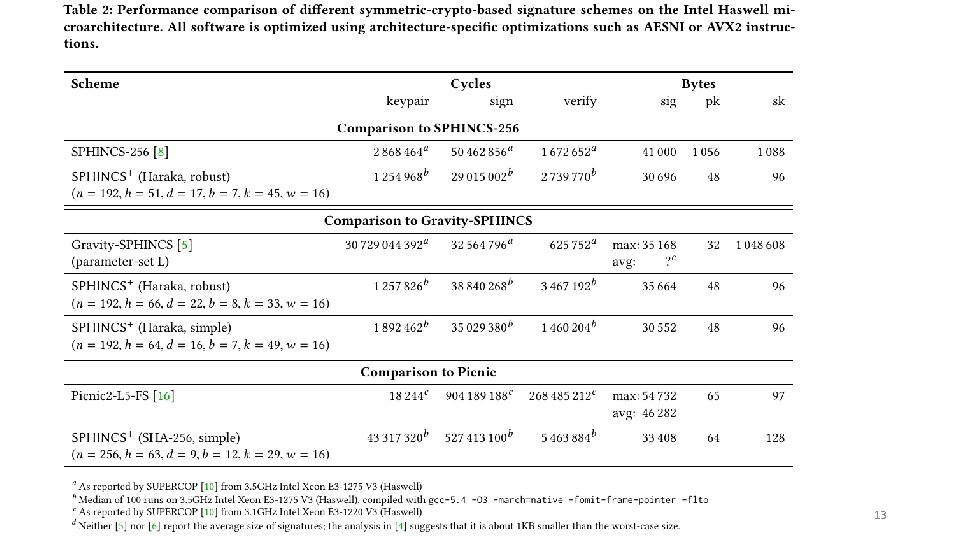
Conclusion • SPHINCS+ beats performance of other symmetric crypto based signatures for comparable parameters. • Possible synergies with standardizing stateful hash-based signatures • New simple instantiations integrate well with an LMS-like stateful scheme. • Re-established tight security proof. • The most conservative submission in the competition. 23. 08. 2019 https: //sphincs. org/ 17
Thank you! Questions? 23. 08. 2019 https: //sphincs. org/ PAGE 18
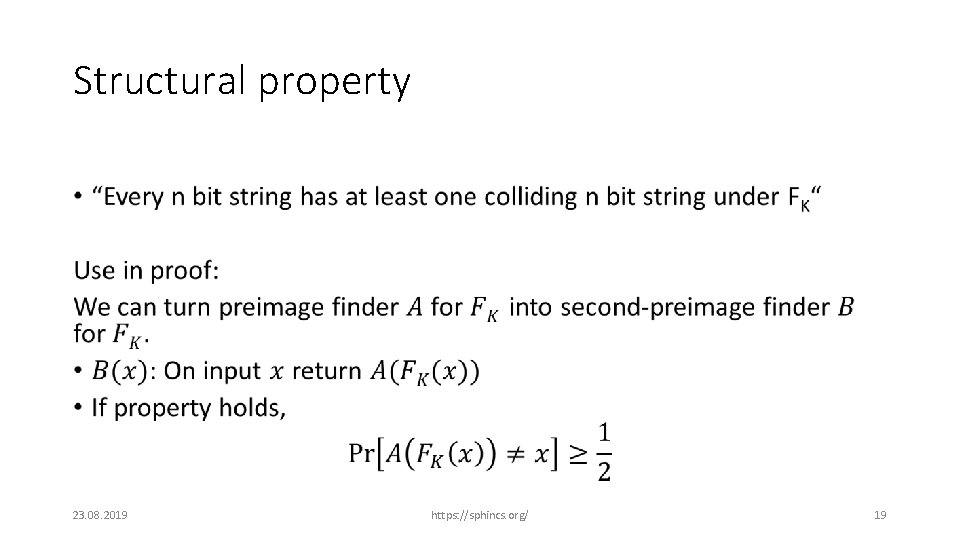
Structural property • 23. 08. 2019 https: //sphincs. org/ 19
- Slides: 19