
SPHERESX a Proposed Inspection Laboratory Outside ISS Alvar

SPHERES-X: a Proposed Inspection Laboratory Outside ISS Alvar Saenz-Otero NASA In Space Inspection Workshop 2014/July/15 -16 JSC, Houston
SPHERES Outline • Quick look back at current SPHERES – Operations – Design philosophy • Motivation for autonomous robotic satellites • SPHERES-X Requirements – Combine motivation and design philosophy • Preliminary design concepts • Preliminary mission concept 2
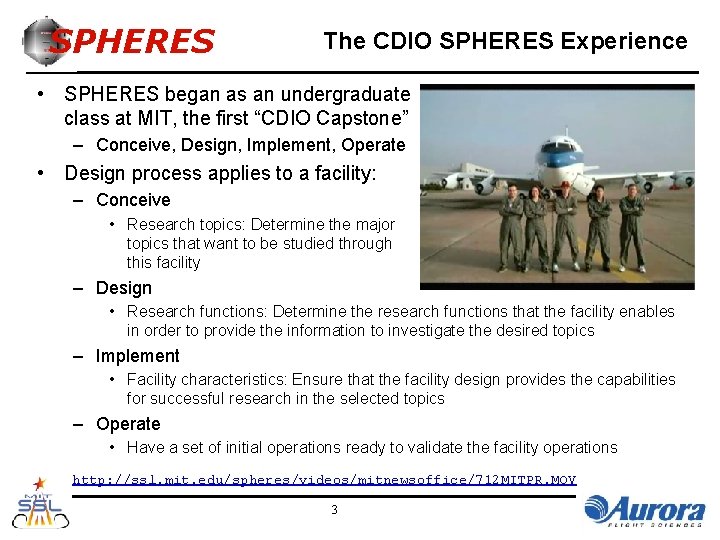
SPHERES The CDIO SPHERES Experience • SPHERES began as an undergraduate class at MIT, the first “CDIO Capstone” – Conceive, Design, Implement, Operate • Design process applies to a facility: – Conceive • Research topics: Determine the major topics that want to be studied through this facility – Design • Research functions: Determine the research functions that the facility enables in order to provide the information to investigate the desired topics – Implement • Facility characteristics: Ensure that the facility design provides the capabilities for successful research in the selected topics – Operate • Have a set of initial operations ready to validate the facility operations http: //ssl. mit. edu/spheres/videos/mitnewsoffice/712 MITPR. MOV 3
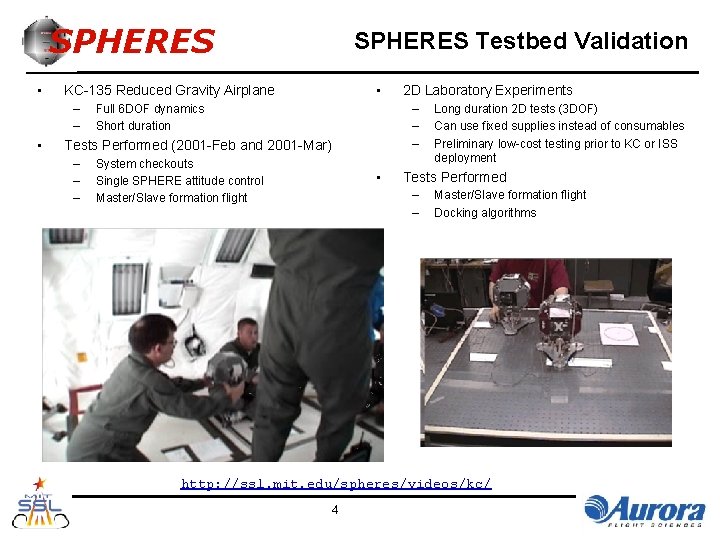
SPHERES • • KC-135 Reduced Gravity Airplane – – • SPHERES Testbed Validation – – – Full 6 DOF dynamics Short duration Tests Performed (2001 -Feb and 2001 -Mar) – – – 2 D Laboratory Experiments System checkouts Single SPHERE attitude control Master/Slave formation flight • Long duration 2 D tests (3 DOF) Can use fixed supplies instead of consumables Preliminary low-cost testing prior to KC or ISS deployment Tests Performed – – Master/Slave formation flight Docking algorithms http: //ssl. mit. edu/spheres/videos/kc/ 4
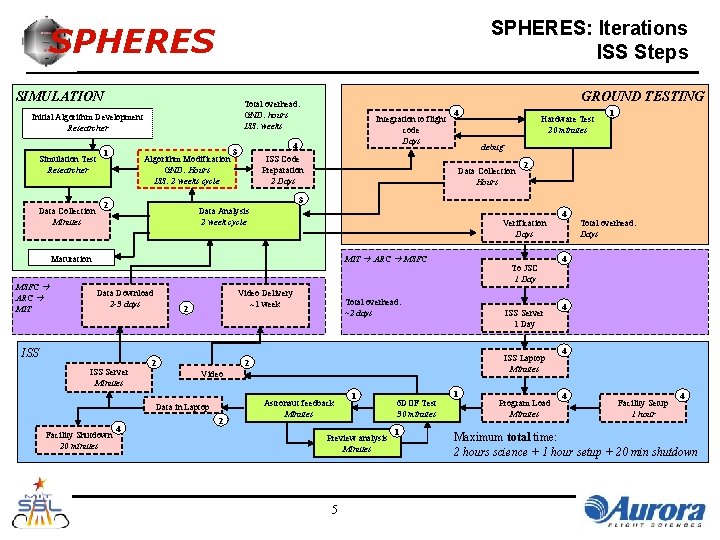
SPHERES: Iterations ISS Steps SPHERES SIMULATION Initial Algorithm Development Researcher Simulation Test Researcher Data Collection Minutes 1 GROUND TESTING Total overhead: GND: hours ISS: weeks Algorithm Modification GND: Hours ISS: 2 weeks cycle Integration to flight code Days 4 3 ISS Code Preparation 2 Days 1 debug 2 3 2 Data Analysis 2 week cycle Verification Days MIT ARC MSFC Data Download 2 -3 days ISS Server Minutes Video Delivery ~1 week 2 2 4 To JSC 1 Day Total overhead: ~2 days ISS Server 1 Day ISS Laptop Minutes 2 Video Data in Laptop Facility Shutdown 20 minutes Hardware Test 20 minutes Data Collection Hours Maturation MSFC ARC MIT 4 2 Astronaut feedback Minutes 1 Preview analysis Minutes 5 6 DOF Test 30 minutes 1 1 Program Load Minutes 4 Total overhead: Days 4 4 Facility Setup 1 hour 4 Maximum total time: 2 hours science + 1 hour setup + 20 min shutdown
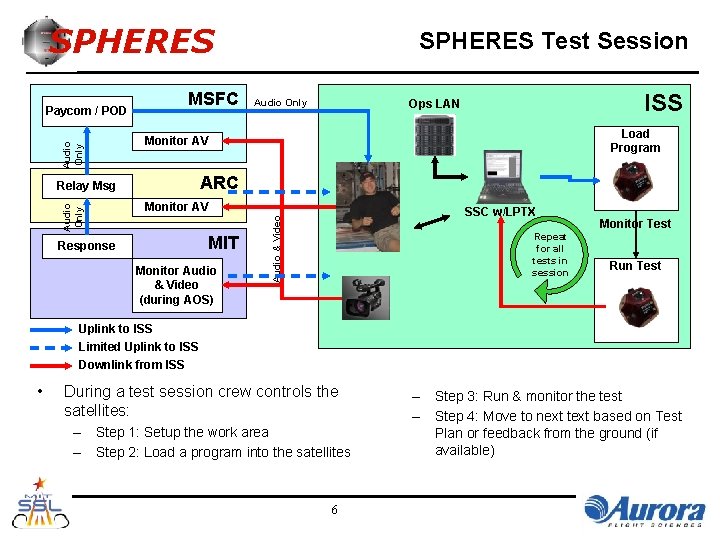
SPHERES MSFC Load Program Monitor AV ARC Relay Msg Audio Only ISS Ops LAN Audio Only Monitor AV MIT Response Monitor Audio & Video (during AOS) SSC w/LPTX Audio & Video Audio Only Paycom / POD SPHERES Test Session Repeat for all tests in session Monitor Test Run Test Uplink to ISS Limited Uplink to ISS Downlink from ISS • During a test session crew controls the satellites: – Step 1: Setup the work area – Step 2: Load a program into the satellites 6 – Step 3: Run & monitor the test – Step 4: Move to next text based on Test Plan or feedback from the ground (if available)
SPHERES • Design Philosophy The following seven principles capture the underlying and long enduring fundamentals that are always (or almost always) valid for space technology maturation laboratories: – Principle of Iterative Research • A laboratory allows investigators to conduct multiple cycles of the iterative research process in a timely fashion – Principle of Enabling a Field of Study • A laboratory provides the facilities to study a substantial number of the research areas which comprise a field of study – Principle of Optimized Utilization • A well-designed laboratory considers all the resources available and optimizes their use with respect to the research needs – Principle of Focused Modularity • A modular facility identifies those aspects of specific experiments that are generic in nature and allows the use of these generic components to facilitate as yet unforeseen experiments. Such a facility is not designed to support an unlimited range of research, but is designed to meet the needs of a specific research area – Principle of Remote Operation & Usability • A remotely operated laboratory, such as one which operates aboard the ISS, must consider the fact that remote operators perform the everyday experiments while research scientists, who do not have direct access to the hardware, are examining data and creating hypotheses and experiments for use with the facility – Principle of Incremental Technology Maturation • A successful ISS laboratory for technology maturation allows technology maturation to transition smoothly between 1 -g development and the microgravity operational environment in terms of cost, complexity, and risk – Principle of Requirements Balance • The requirements of a laboratory are balanced such that one requirement does not drive the design in a way that it hinders the ability to succeed on other requirements; further, the hard requirements drive the majority of the design, while soft requirements enhance the design only when possible http: //ssl. mit. edu/files/website/theses/Ph. D-2005 -Saenz-Otero. Alvar. pdf 7
SPHERES • SPHERES-X Motivation Autonomous inspection of vehicles in space – Enable near-field situational awareness for both manned and unmanned vehicles – Demonstrate (TRL 7+) rendezvous to both known and unknown objects and collect inspection (visual and other sensors) data – Reduce need for crew EVA, especially during inter-planetary travel (high radiation environments) – Identification (mass properties) of unknown bodies, such as tumbling asteroids • Space Debris Mitigation – Demonstrate (to at least TRL 7) mechanism to capture space debris in a full, but controlled, space environment • Sample return missions – Demonstrate (TRL 7+) capture mechanism for sample “shot” from other bodies (e. g. Mars Sample Return) • Continue “Distributed Satellite Systems” Research – Fractionated spacecraft demonstrations – Large space telescopes in GEO and beyond – Enable in-space assembly of large space vehicles (e. g. interplanetary or telescopes) 8
SPHERES • Requirements Allow iterative research – REQ: scientists must be able to test their algorithms and/or hardware multiple times – REQ: flexible science development time • Enable a field of study – Find common areas for Inspection & Servicing, Debris Mitigation, Sample Return, DSS (Fractionated Spacecraft, In-Space Robotic Assembly) – REQ: enable proximity operations – REQ: docking mechanism • Optimize Utilization of ISS Resources – REQ: use ISS power & communications as much as possible – REQ: use crew inside ISS to mitigate risks and enable a risk-tolerant environment • Modularity – REQ: create the basic satellites as generic satellite buses – REQ: ensure at least one “expansion port” is available to scientists • Remote Operations – REQ: provide sufficient data to allow scientist to be virtually present – REQ: crew is both a local and remote operator • Incremental Technology Maturation – REQ: allow scientists to concentrate on their specific technology (control cost & complexity) – REQ: a science failure should not mean mission failure (control risk) 9
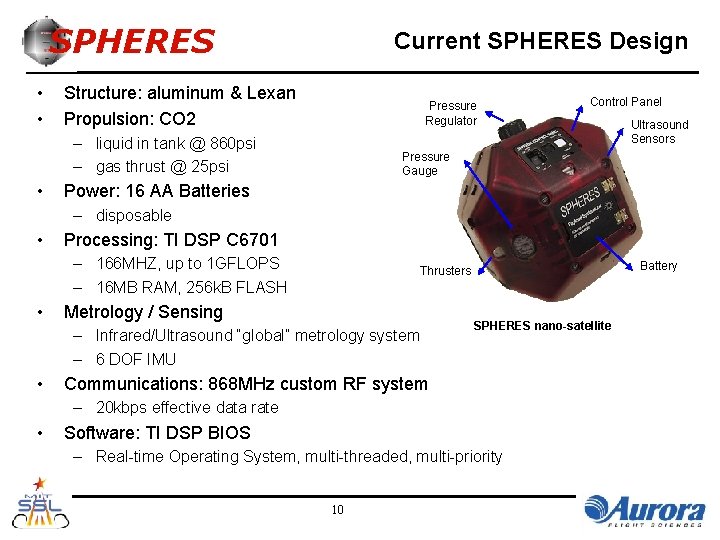
SPHERES • • Current SPHERES Design Structure: aluminum & Lexan Propulsion: CO 2 Pressure Regulator – liquid in tank @ 860 psi – gas thrust @ 25 psi • Control Panel Ultrasound Sensors Pressure Gauge Power: 16 AA Batteries – disposable • Processing: TI DSP C 6701 – 166 MHZ, up to 1 GFLOPS – 16 MB RAM, 256 k. B FLASH • Metrology / Sensing – Infrared/Ultrasound “global” metrology system – 6 DOF IMU • Battery Thrusters SPHERES nano-satellite Communications: 868 MHz custom RF system – 20 kbps effective data rate • Software: TI DSP BIOS – Real-time Operating System, multi-threaded, multi-priority 10
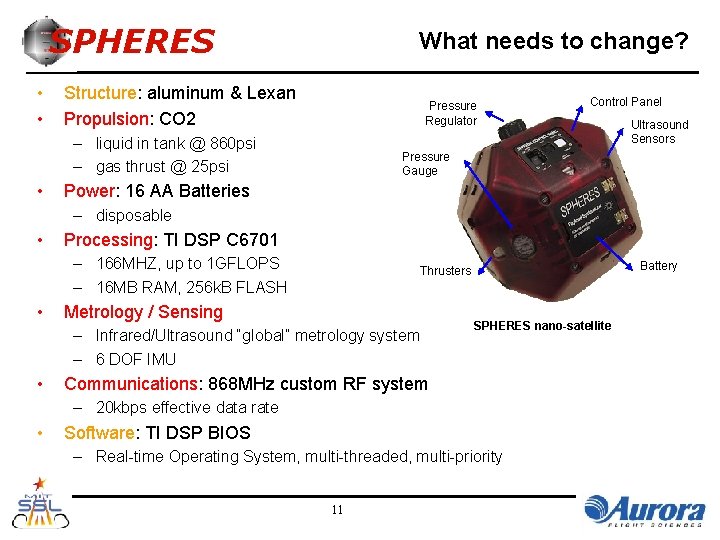
SPHERES • • What needs to change? Structure: aluminum & Lexan Propulsion: CO 2 Pressure Regulator – liquid in tank @ 860 psi – gas thrust @ 25 psi • Control Panel Ultrasound Sensors Pressure Gauge Power: 16 AA Batteries – disposable • Processing: TI DSP C 6701 – 166 MHZ, up to 1 GFLOPS – 16 MB RAM, 256 k. B FLASH • Metrology / Sensing – Infrared/Ultrasound “global” metrology system – 6 DOF IMU • Battery Thrusters SPHERES nano-satellite Communications: 868 MHz custom RF system – 20 kbps effective data rate • Software: TI DSP BIOS – Real-time Operating System, multi-threaded, multi-priority 11
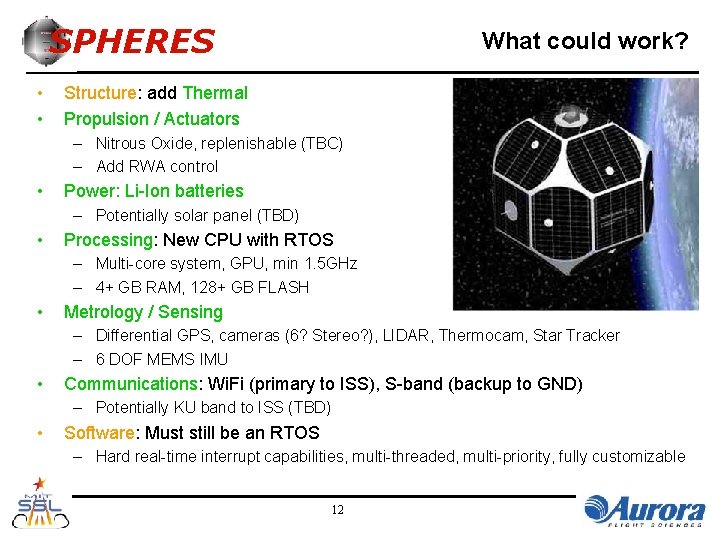
SPHERES • • What could work? Structure: add Thermal Propulsion / Actuators – Nitrous Oxide, replenishable (TBC) – Add RWA control • Power: Li-Ion batteries – Potentially solar panel (TBD) • Processing: New CPU with RTOS – Multi-core system, GPU, min 1. 5 GHz – 4+ GB RAM, 128+ GB FLASH • Metrology / Sensing – Differential GPS, cameras (6? Stereo? ), LIDAR, Thermocam, Star Tracker – 6 DOF MEMS IMU • Communications: Wi. Fi (primary to ISS), S-band (backup to GND) – Potentially KU band to ISS (TBD) • Software: Must still be an RTOS – Hard real-time interrupt capabilities, multi-threaded, multi-priority, fully customizable 12
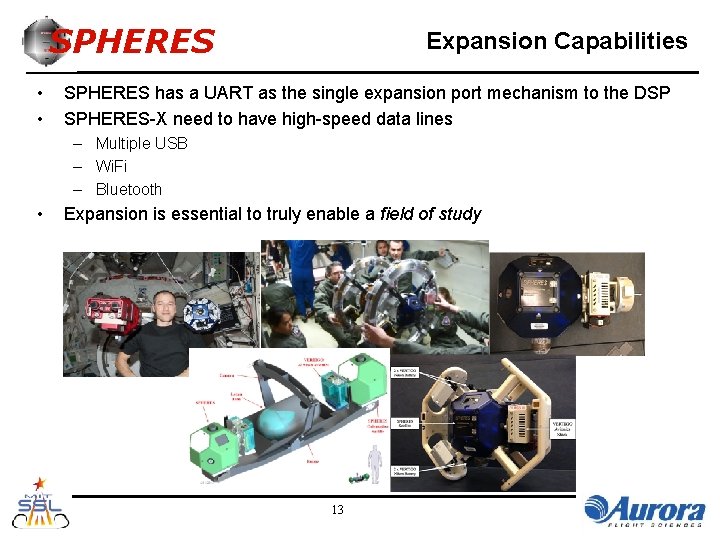
SPHERES • • Expansion Capabilities SPHERES has a UART as the single expansion port mechanism to the DSP SPHERES-X need to have high-speed data lines – Multiple USB – Wi. Fi – Bluetooth • Expansion is essential to truly enable a field of study 13
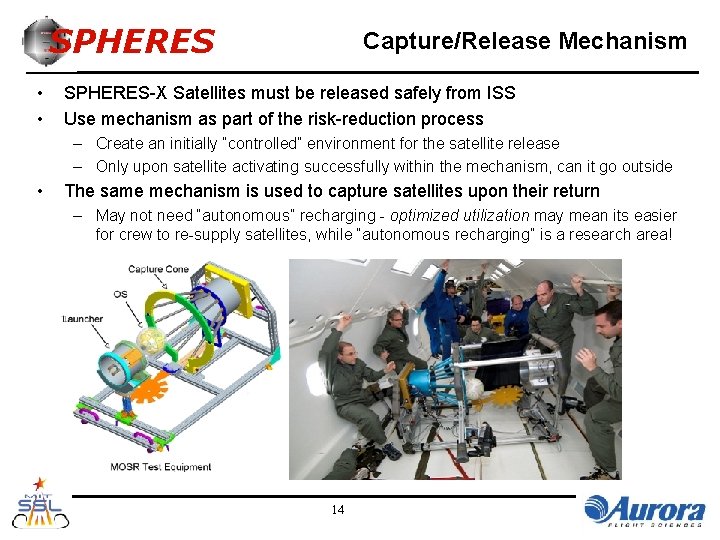
SPHERES • • Capture/Release Mechanism SPHERES-X Satellites must be released safely from ISS Use mechanism as part of the risk-reduction process – Create an initially “controlled” environment for the satellite release – Only upon satellite activating successfully within the mechanism, can it go outside • The same mechanism is used to capture satellites upon their return – May not need “autonomous” recharging - optimized utilization may mean its easier for crew to re-supply satellites, while “autonomous recharging” is a research area! 14
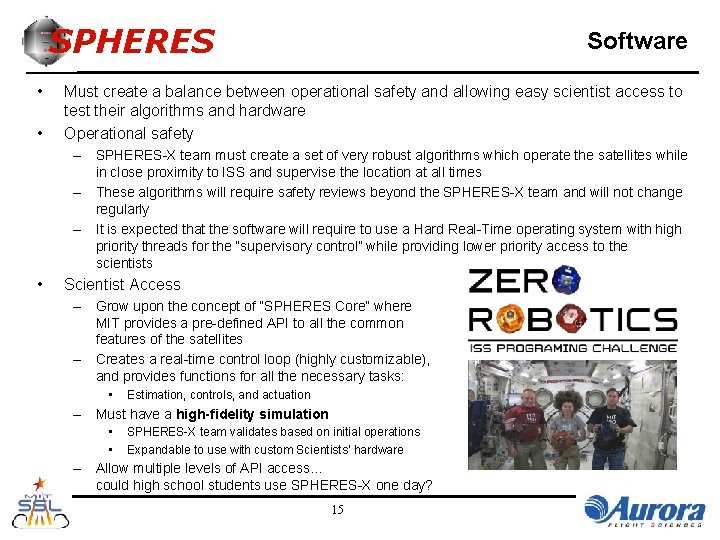
SPHERES • • Software Must create a balance between operational safety and allowing easy scientist access to test their algorithms and hardware Operational safety – SPHERES-X team must create a set of very robust algorithms which operate the satellites while in close proximity to ISS and supervise the location at all times – These algorithms will require safety reviews beyond the SPHERES-X team and will not change regularly – It is expected that the software will require to use a Hard Real-Time operating system with high priority threads for the “supervisory control” while providing lower priority access to the scientists • Scientist Access – Grow upon the concept of “SPHERES Core” where MIT provides a pre-defined API to all the common features of the satellites – Creates a real-time control loop (highly customizable), and provides functions for all the necessary tasks: • Estimation, controls, and actuation – Must have a high-fidelity simulation • • SPHERES-X team validates based on initial operations Expandable to use with custom Scientists’ hardware – Allow multiple levels of API access… could high school students use SPHERES-X one day? 15
SPHERES Mission Concept (1) • Multiple phases with increasing complexity risk • Phase A - Ground Testing – Flat floor facilities at MIT SSL – Reduced Gravity Flights for validation of 6 DOF sensing & actuation • Phase B - Intra-Vehicular Activity (IVA) – Operate SPHERES-X along-side SPHERES to validate general operation of the bus • Tests actuators (propulsion & RWA), relative sensors (visual, LIDAR, etc), communications (Wi. Fi), power (batteries), processing avionics, and software • Does not test external sensors such as GPS / Star Tracker, thermal, and ground comm – Extensive test of “core” supervisory algorithm which controls satellite during deployment and proximity with ISS – Conduct initial tests of science algorithms inside ISS – REQ: satellite must be operational IVA – Note: once the facility is fully operational, IVA will be repeated every time before new algorithms are tested outside 16
SPHERES • Mission Concept (2) Phase C - Captive Extra-Vehicular Activity (e. VA) – Single satellite operated within the deploy/capture mechanism – Demonstrate ability to determine satellite state (sensing/estimation) and precision control (actuation) within a limited volume – Potentially open deploy mechanism and use ISS robotic arm to move satellite, still captured, further out • Only to test sensing/estimation, no actuation – This phase is limited to validation of the “core” algorithms for control – Repeat phase for up to three satellites • Phase D - Extra-Vehicular Activity - single use – Upon successful deployment in Phase C, up to three satellites will be deployed to an orbit beyond their capability to return to ISS (safety distance TBD by ISS team) – An initial set of scientific tests will be conducted with only the base hardware – Objective is to demonstrate full control of the satellites, including supervisory control operation, while conducting limited science – REQ: must be cost-effective to make the first set of satellites disposable 17
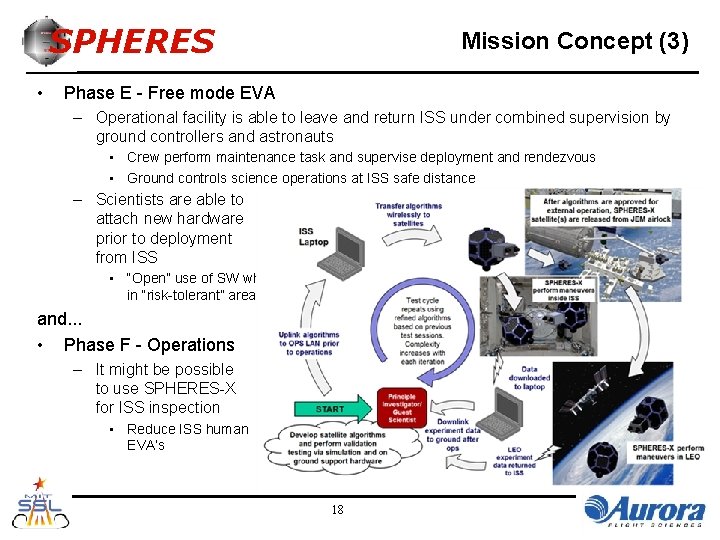
SPHERES • Mission Concept (3) Phase E - Free mode EVA – Operational facility is able to leave and return ISS under combined supervision by ground controllers and astronauts • Crew perform maintenance task and supervise deployment and rendezvous • Ground controls science operations at ISS safe distance – Scientists are able to attach new hardware prior to deployment from ISS • “Open” use of SW when in “risk-tolerant” area and. . . • Phase F - Operations – It might be possible to use SPHERES-X for ISS inspection • Reduce ISS human EVA’s 18
SPHERES Thank you! Questions?
- Slides: 19