
Spheres of Influence Relationship Diagrams and your service

- Slides: 14
Spheres of Influence / Relationship Diagrams and your service
Stakeholder analysis • Are all stakeholders created equal? • How do you know who to consider? • Why bother? "Individuals and organisations who are actively involved in the project, or whose interests may be positively or negatively affected as a result of project execution or successful project completion”. Cleland, David I. (ed), Field Guide to Project Management, John Wiley and Sons, 1998
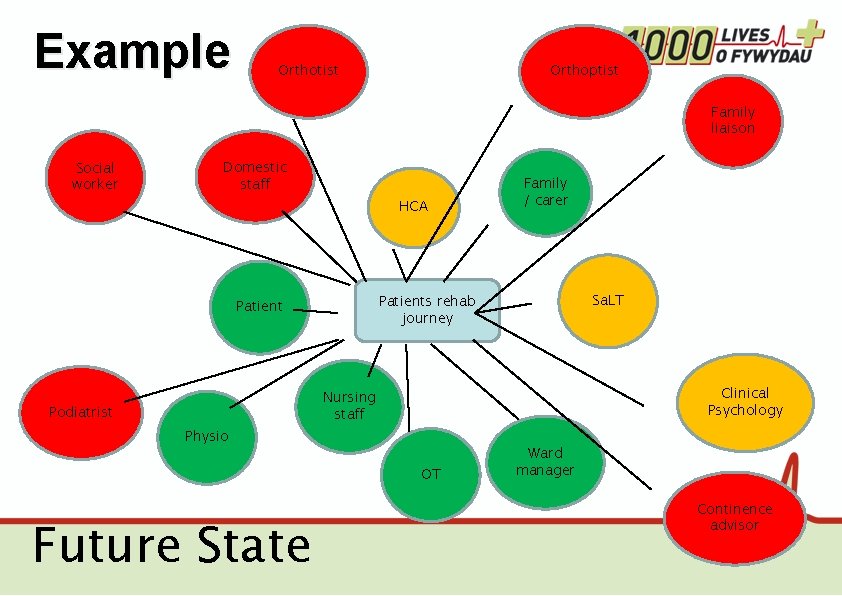
Spheres of Influence To fully understand the impact of influence and relationships on an outcome it can be useful to create a map clearly defining the Spheres of Influence. Step 1 – Make a list of all the stakeholders that interact with your patient throughout their rehab journey- who can influence whether they achieve optimal functional recovery or not? Identify the current state of the communication relationship with the identified individuals/groups- how well informed and engaged are they in planning and delivery of rehabilitation?
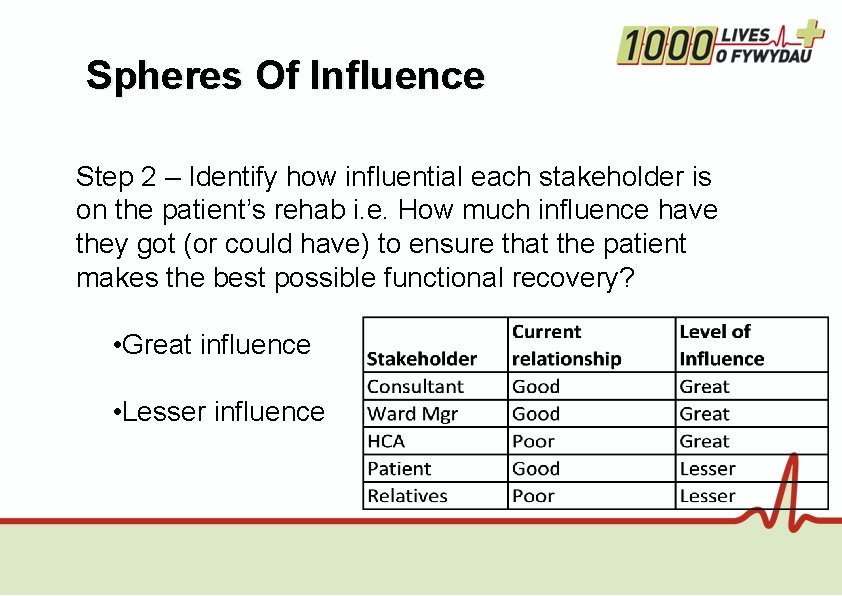
Spheres Of Influence Step 2 – Identify how influential each stakeholder is on the patient’s rehab i. e. How much influence have they got (or could have) to ensure that the patient makes the best possible functional recovery? • Great influence • Lesser influence
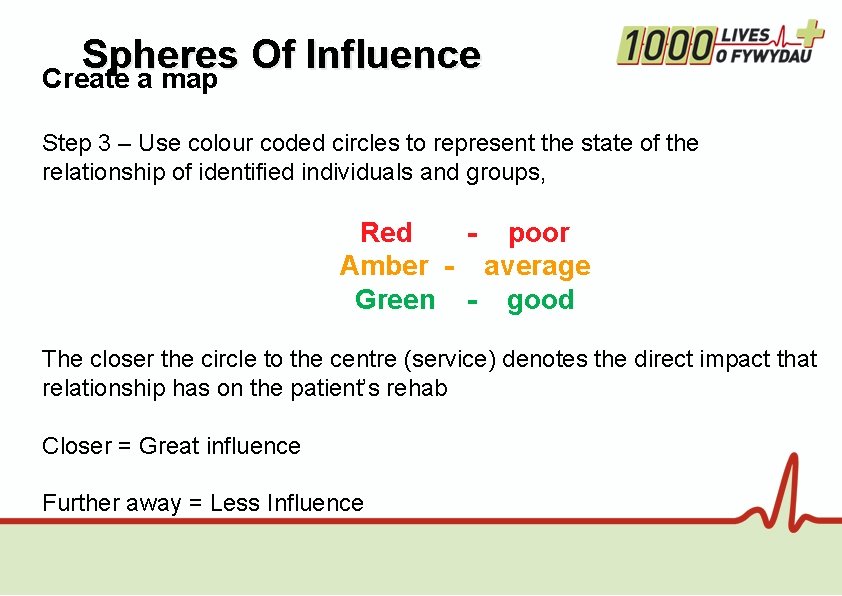
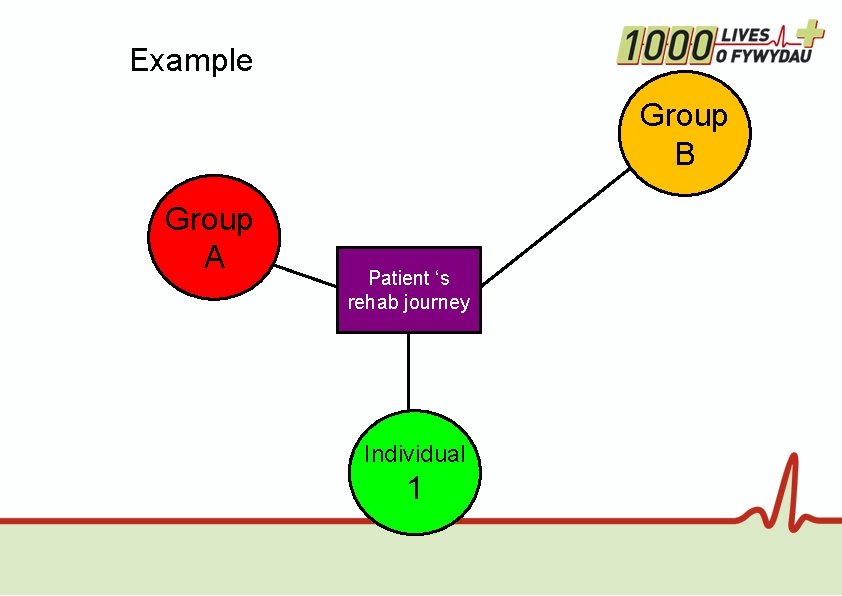
Spheres Of Influence Create a map Step 3 – Use colour coded circles to represent the state of the relationship of identified individuals and groups, Red - poor Amber - average Green - good The closer the circle to the centre (service) denotes the direct impact that relationship has on the patient’s rehab Closer = Great influence Further away = Less Influence
Example Group B Group A Patient ‘s rehab journey Individual 1
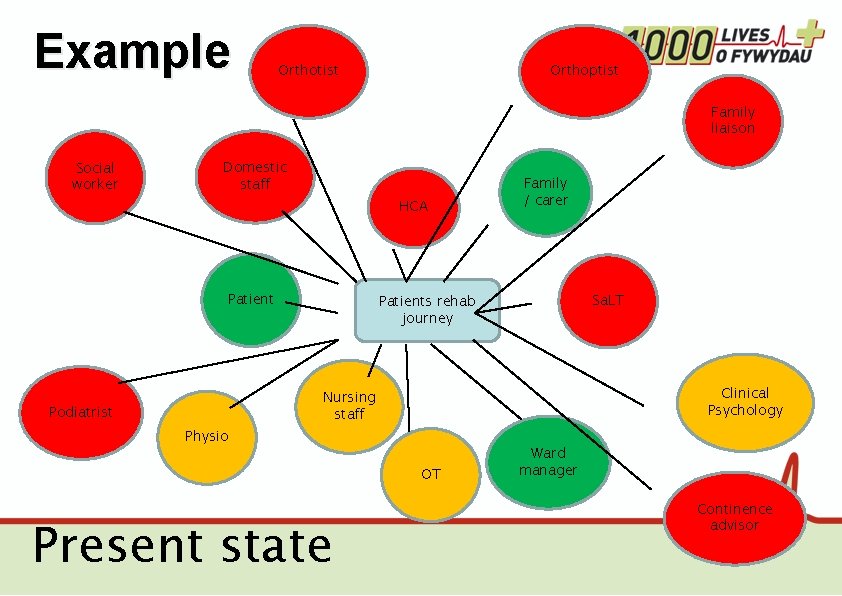
Spheres Of Influence Step 4 – Create two maps, the present state in relation to your service and what you need the future state to be to ensure improvement.
Example Orthotist Orthoptist Family liaison Social worker Domestic staff HCA Patient Family / carer Sa. LT Patients rehab journey Clinical Psychology Nursing staff Podiatrist Physio OT Present state Ward manager Continence advisor
Example Orthotist Orthoptist Family liaison Social worker Domestic staff HCA Family / carer Sa. LT Patients rehab journey Patient Clinical Psychology Nursing staff Podiatrist Physio OT Future State Ward manager Continence advisor
How to deal with each
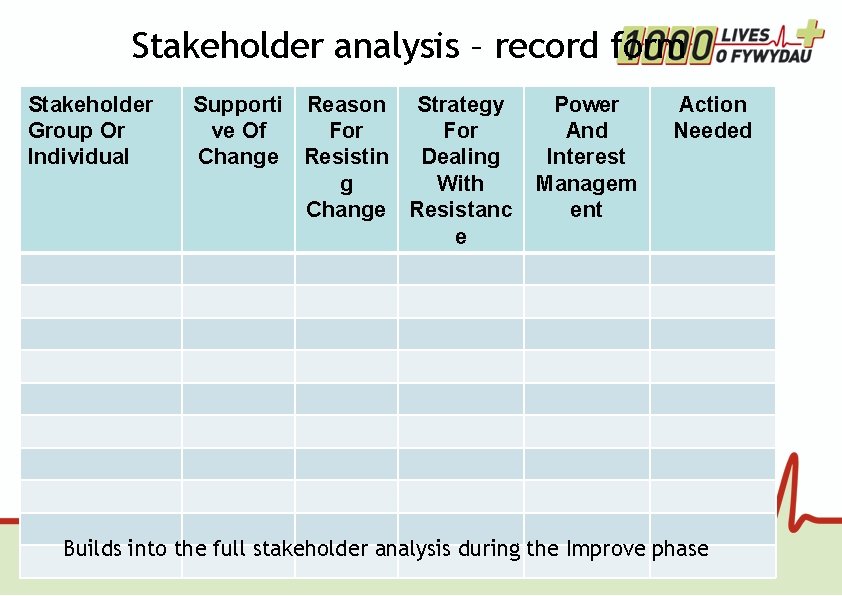
Stakeholder analysis – record form Stakeholder Group Or Individual Supporti Reason Strategy ve Of For Change Resistin Dealing g With Change Resistanc e Power And Interest Managem ent Action Needed Builds into the full stakeholder analysis during the Improve phase
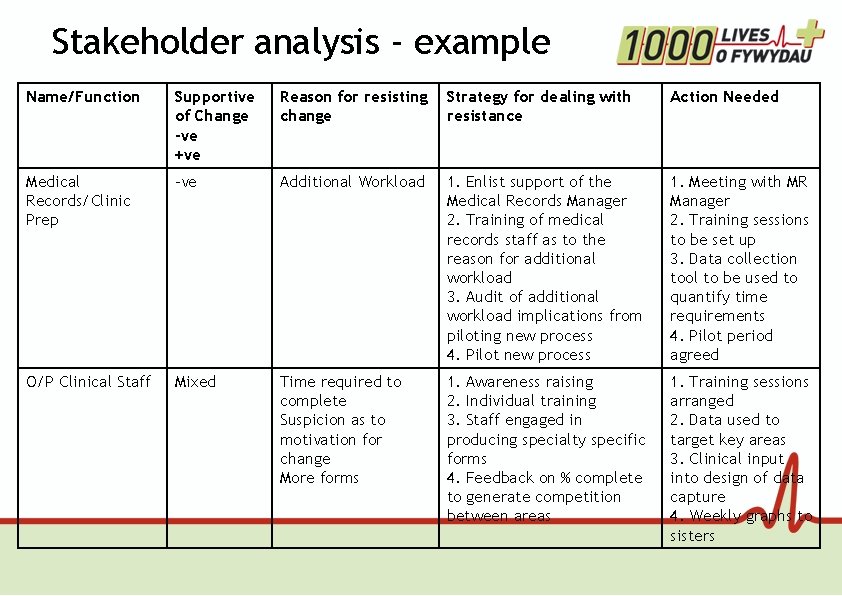
Stakeholder analysis - example Name/Function Supportive of Change -ve +ve Reason for resisting change Strategy for dealing with resistance Action Needed Medical Records/Clinic Prep -ve Additional Workload 1. Enlist support of the Medical Records Manager 2. Training of medical records staff as to the reason for additional workload 3. Audit of additional workload implications from piloting new process 4. Pilot new process 1. Meeting with MR Manager 2. Training sessions to be set up 3. Data collection tool to be used to quantify time requirements 4. Pilot period agreed O/P Clinical Staff Mixed Time required to complete Suspicion as to motivation for change More forms 1. Awareness raising 2. Individual training 3. Staff engaged in producing specialty specific forms 4. Feedback on % complete to generate competition between areas 1. Training sessions arranged 2. Data used to target key areas 3. Clinical input into design of data capture 4. Weekly graphs to sisters
Stakeholder analysis – power & interest High Satisfy Manage Satisfy the opinion leaders by communicating what’s happening Key stakeholders should be fully engaged through full communication & consultation Monitor Inform Patients often fall into this category. Take steps increase their interest e. g. active consultation groups The 6 Cs Power This group can be given limited priority if resources are stretched Low Interest High Ø Commissioners Ø Customers Ø Collaborators Ø Contributors Ø Channels Ø Commentators
Any questions?