
SPF Development in Illinois Yanfeng Ouyang Department of





- Slides: 19
SPF Development in Illinois Yanfeng Ouyang Department of Civil & Environmental Engineering University of Illinois at Urbana-Champaign July 29 and 30, 2009
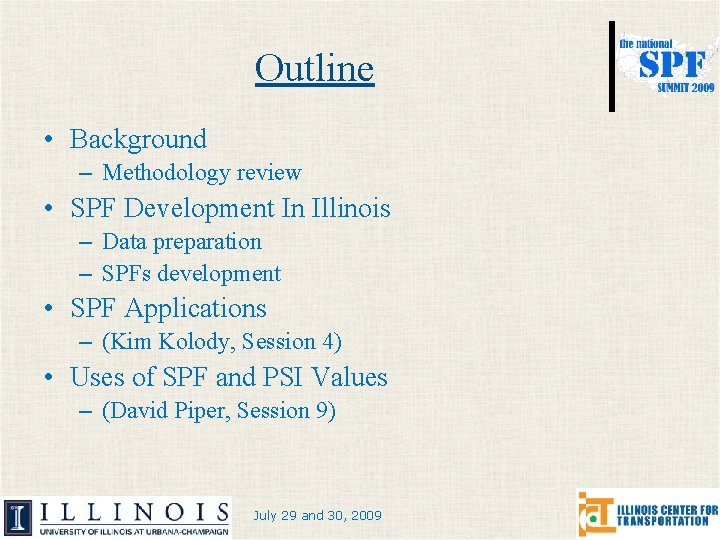
Outline • Background – Methodology review • SPF Development In Illinois – Data preparation – SPFs development • SPF Applications – (Kim Kolody, Session 4) • Uses of SPF and PSI Values – (David Piper, Session 9) July 29 and 30, 2009
Background • Safety performance functions (SPFs) – Descriptive statistical relationships between crash counts and contributing factors (e. g. , traffic volume) Crash # SPF g r utin e h Ot ntrib co ctors fa expected crash # AADT • Developing SPFs helps – identify high-potential candidate locations for safety improvement July 29 andof 30, various 2009 – prepare for implementation safety tools
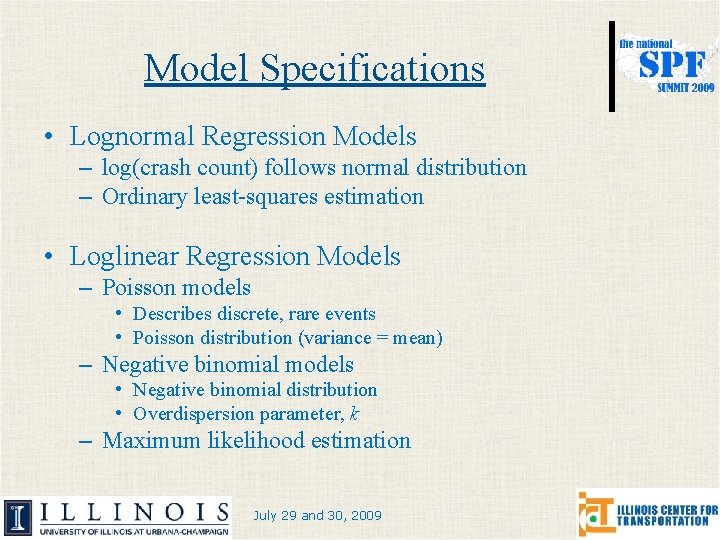
Model Specifications • Lognormal Regression Models – log(crash count) follows normal distribution – Ordinary least-squares estimation • Loglinear Regression Models – Poisson models • Describes discrete, rare events • Poisson distribution (variance = mean) – Negative binomial models • Negative binomial distribution • Overdispersion parameter, k – Maximum likelihood estimation July 29 and 30, 2009
Explanatory Variables • Quantitative – Values that represent a condition, characteristic, or quantity – Can be directly entered into SPF – E. g. , AADT, lane width, # lanes, etc. • Categorical – Non-numerical variables to describe a situation – Use binary ‘dummies’, or define “peer groups” – E. g. , median type, shoulder type, terrain type, etc. July 29 and 30, 2009
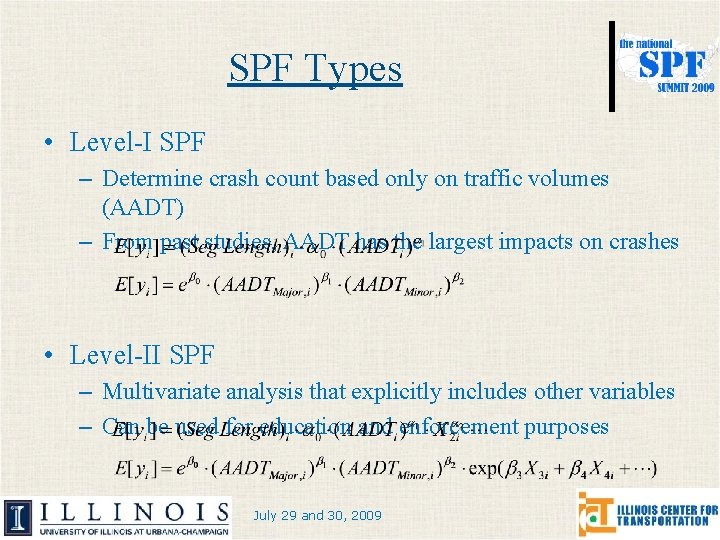
SPF Types • Level-I SPF – Determine crash count based only on traffic volumes (AADT) – From past studies, AADT has the largest impacts on crashes • Level-II SPF – Multivariate analysis that explicitly includes other variables – Can be used for education and enforcement purposes July 29 and 30, 2009
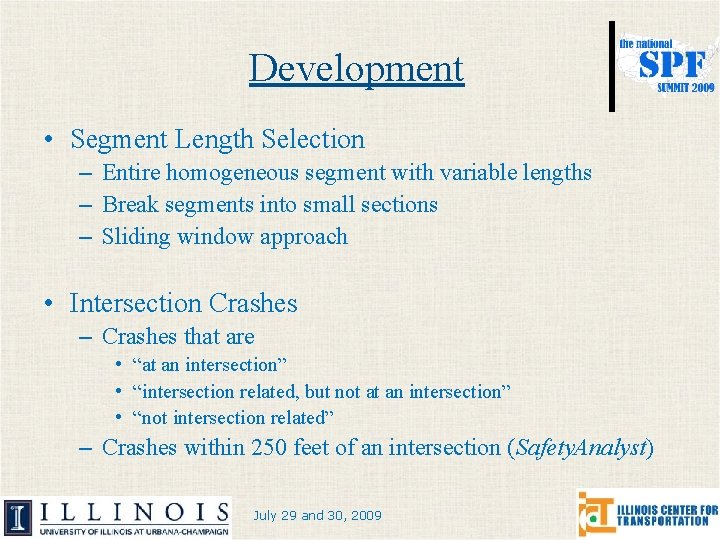
Development • Segment Length Selection – Entire homogeneous segment with variable lengths – Break segments into small sections – Sliding window approach • Intersection Crashes – Crashes that are • “at an intersection” • “intersection related, but not at an intersection” • “not intersection related” – Crashes within 250 feet of an intersection (Safety. Analyst) July 29 and 30, 2009
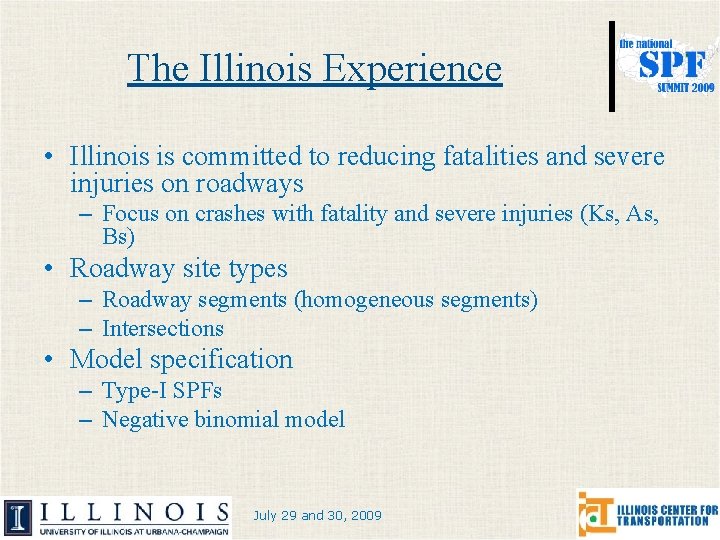
The Illinois Experience • Illinois is committed to reducing fatalities and severe injuries on roadways – Focus on crashes with fatality and severe injuries (Ks, As, Bs) • Roadway site types – Roadway segments (homogeneous segments) – Intersections • Model specification – Type-I SPFs – Negative binomial model July 29 and 30, 2009
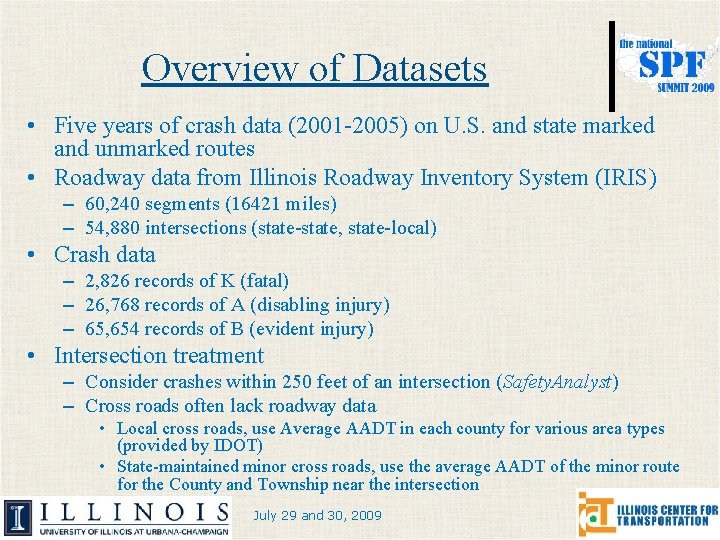
Overview of Datasets • Five years of crash data (2001 -2005) on U. S. and state marked and unmarked routes • Roadway data from Illinois Roadway Inventory System (IRIS) – 60, 240 segments (16421 miles) – 54, 880 intersections (state-state, state-local) • Crash data – 2, 826 records of K (fatal) – 26, 768 records of A (disabling injury) – 65, 654 records of B (evident injury) • Intersection treatment – Consider crashes within 250 feet of an intersection (Safety. Analyst) – Cross roads often lack roadway data • Local cross roads, use Average AADT in each county for various area types (provided by IDOT) • State-maintained minor cross roads, use the average AADT of the minor route for the County and Township near the intersection July 29 and 30, 2009
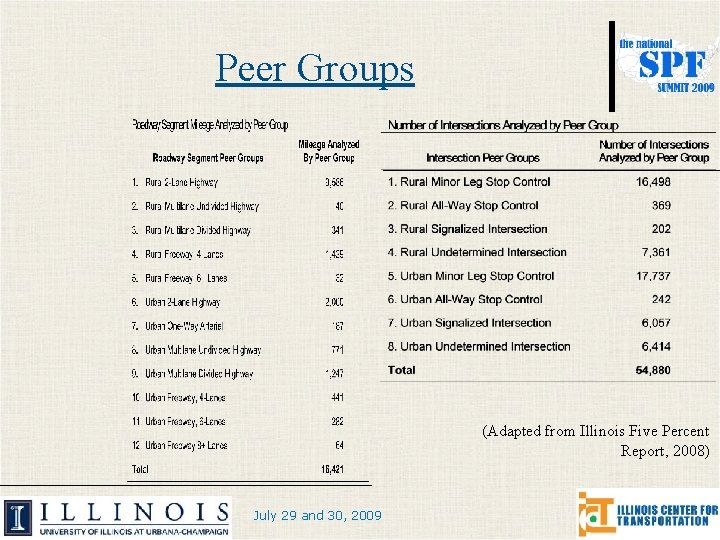
Peer Groups (Adapted from Illinois Five Percent Report, 2008) July 29 and 30, 2009
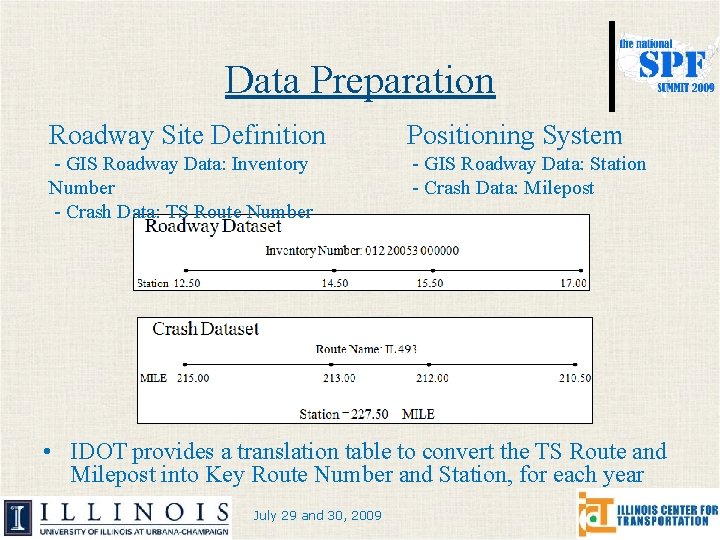
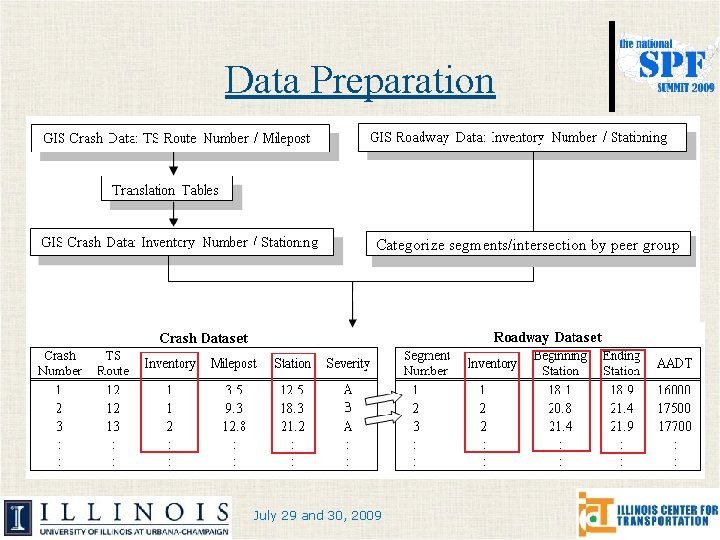
Data Preparation Roadway Site Definition Positioning System - GIS Roadway Data: Inventory Number - Crash Data: TS Route Number - GIS Roadway Data: Station - Crash Data: Milepost • IDOT provides a translation table to convert the TS Route and Milepost into Key Route Number and Station, for each year July 29 and 30, 2009
Data Preparation Categorize segments/intersection by peer group July 29 and 30, 2009
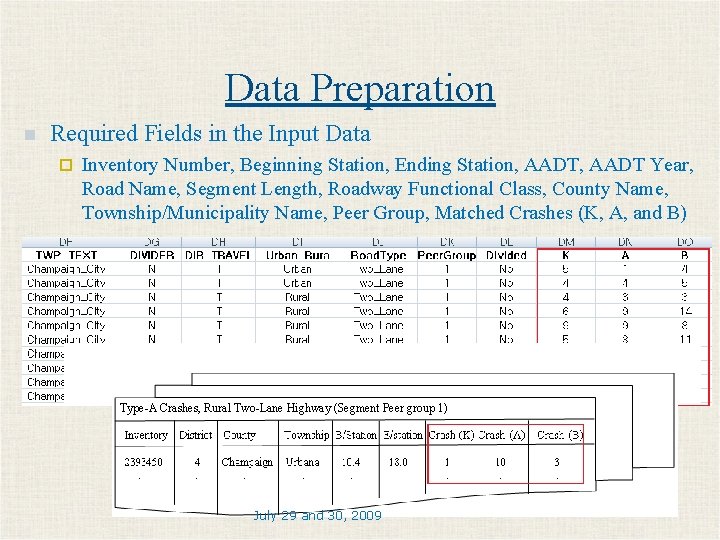
Data Preparation n Required Fields in the Input Data ¨ Inventory Number, Beginning Station, Ending Station, AADT Year, Road Name, Segment Length, Roadway Functional Class, County Name, Township/Municipality Name, Peer Group, Matched Crashes (K, A, and B) Type-A Crashes, Rural Two-Lane Highway (Segment Peer group 1) July 29 and 30, 2009
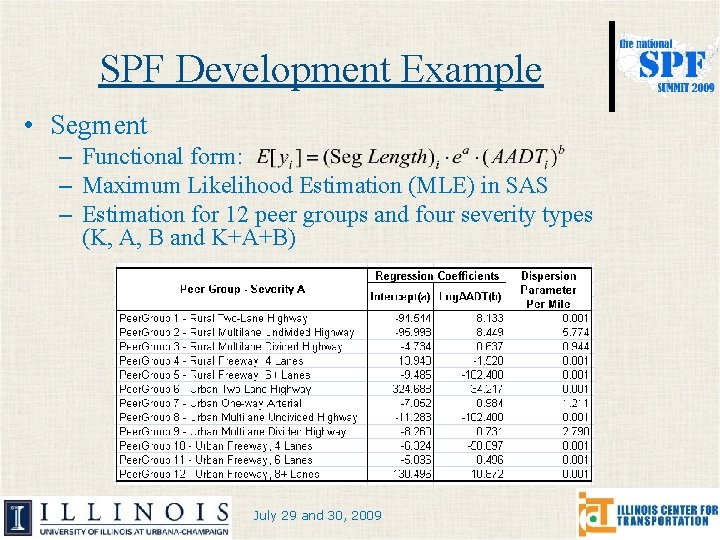
SPF Development Example • Segment – Functional form: – Maximum Likelihood Estimation (MLE) in SAS – Estimation for 12 peer groups and four severity types (K, A, B and K+A+B) July 29 and 30, 2009
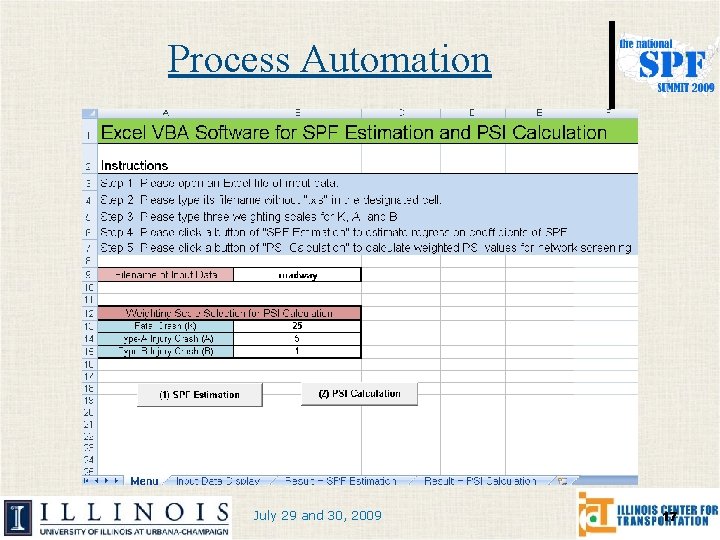
PSI Calculation • Weighted PSI (Potential for Safety Improvements) – PSI – how much a site’s safety performance exceeds the expectation – Empirical Bayesian (EB) Method: Find a weighted average of the predicted and observed numbers of crashes – Default values of weights: Fatal-K (25), Injury-A (5), and Injury-B (1) July 29 and 30, 2009
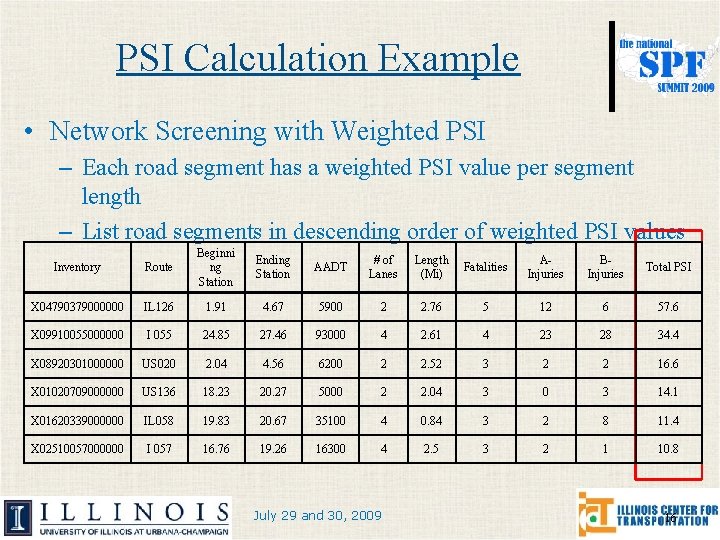
PSI Calculation Example • Network Screening with Weighted PSI – Each road segment has a weighted PSI value per segment length – List road segments in descending order of weighted PSI values Inventory Route Beginni ng Station Ending Station AADT # of Lanes Length (Mi) Fatalities AInjuries BInjuries Total PSI X 04790379000000 IL 126 1. 91 4. 67 5900 2 2. 76 5 12 6 57. 6 X 09910055000000 I 055 24. 85 27. 46 93000 4 2. 61 4 23 28 34. 4 X 08920301000000 US 020 2. 04 4. 56 6200 2 2. 52 3 2 2 16. 6 X 01020709000000 US 136 18. 23 20. 27 5000 2 2. 04 3 0 3 14. 1 X 01620339000000 IL 058 19. 83 20. 67 35100 4 0. 84 3 2 8 11. 4 X 02510057000000 I 057 16. 76 19. 26 16300 4 2. 5 3 2 1 10. 8 July 29 and 30, 2009 16
Process Automation July 29 and 30, 2009 17
Other Related Work • Multivariate SPF development • Implementation the SPFs in local safety tools • Utilization and applications of SPFs – (Kim Kolody, Session 4) – (David Piper, Session 9) July 29 and 30, 2009
Thank you! yfouyang@illinois. edu 217 -333 -9858 July 29 and 30, 2009