
Spent coffee grains biochar activation and its effects
Spent coffee grains biochar activation and its effects on the characteristics of the final products to be used as sorbents or catalysts support Nikolaos Mourgkogiannis, Ioannis Nikolopoulos, Eleana Kordouli, Christos Kordulis, Alexis Lycourghiotis, Hrissi K. Karapanagioti * Department of Chemistry, University of Patras, 26504, Patras, Greece * Corresponding author: E-mail: karapanagioti@upatras. gr, Tel +30 2610996728 The problem Climate change effects are visible in various sectors of human life such as agriculture, industry and health. Therefore, it is necessary to search and implement green and sustainable technologies in order to reduce or eliminate the effects of this change. Over the last years, in the context of aforementioned goal, the idea of a circular economy has been adopted. Based on this, waste biomass materials have been used for production of biochars obtained with environmentally friendly processes such as pyrolysis. The present study aims to characterize the physicochemical properties of biochars obtained from spent coffee grounds for the determination of their characteristics related with catalytic and sorptive functionalities. 1/5 Objectives Biochar Pyrolysis
Spent coffee grains biochar activation and its effects on the characteristics of the final products to be used as sorbents or catalysts support Nikolaos Mourgkogiannis, Ioannis Nikolopoulos, Eleana Kordouli, Christos Kordulis, Alexis Lycourghiotis, Hrissi K. Karapanagioti * Department of Chemistry, University of Patras, 26504, Patras, Greece * Corresponding author: E-mail: karapanagioti@upatras. gr, Tel +30 2610996728 Samples and Methods Coffee is considered the most widely spread beverage and annually, approximately, 11 million tons produced all around the world. Spent coffee grounds are considered a valuable, rich source of bioactive compounds and a useful resource material for a variety of other applications. Raw spent coffee residue (Raw-SCG), biochar from spent coffee residue (SCG) and the activated SCG biochar with distilled H 2 O (W-SCG), H 2 SO 4 (SCG-S), H 3 PO 4 (SCG-P), and Na. OH (SCG-ALK) were fully characterized for their surface area, ash, surface topography, surface elemental analysis, surface functional groups and suspension p. H. SCG-P SCG-ALK W-SCG SCG-S 2/5 FTIR analysis Surface area and porocity Ash Content Suspension p. H SEM/EDS
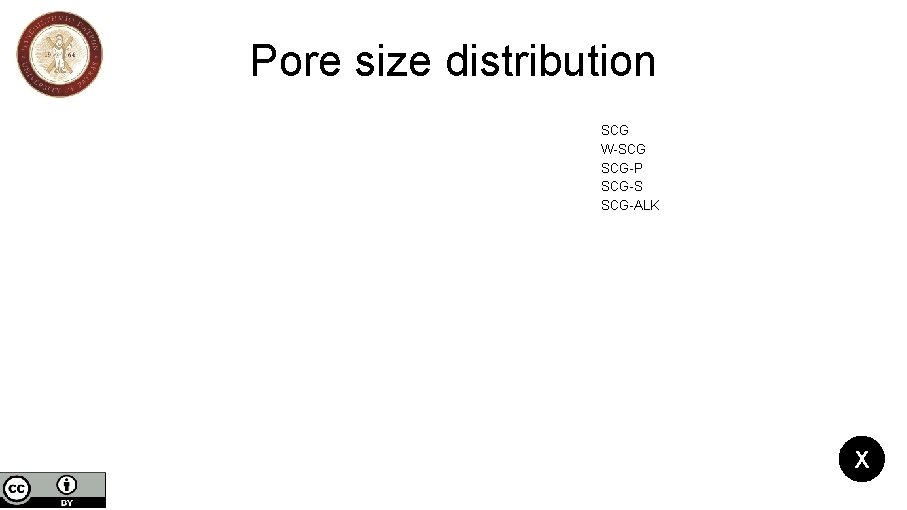
Spent coffee grains biochar activation and its effects on the characteristics of the final products to be used as sorbents or catalysts support Nikolaos Mourgkogiannis, Ioannis Nikolopoulos, Eleana Kordouli, Christos Kordulis, Alexis Lycourghiotis, Hrissi K. Karapanagioti * Department of Chemistry, University of Patras, 26504, Patras, Greece *Corresponding author: E-mail: karapanagioti@upatras. gr, Tel +30 2610996728 Results SCGs produced at 850 o. C have high specific surface and micropore area and at the same time, low external surface area. The t-plot for the SCG disclose that the activation with H 3 PO 4 leads to high specific surface (921 m 2/g) and micropore (626 m 2/g) area compared to other SCG samples. Simultaneously, the activation of SCG increases the pore size of biochar and the highest pore size was observed for the SCG–ALK (37 Å) compared to activated SCG-S (34 Å) and SCG-P (34 Å). The Raw. SCG has slightly acidic nature (p. H 5. 5) than the biochar SCG (p. H 10. 6) which has the highest alkaline nature. For the activated SCG biochars, SCG-S (p. H 4. 6) is more acidic than SCG-P (p. H 5. 2). Furthermore, W-SCG biochar (p. H 9. 1) is more alkaline than SCG-ALK (p. H 8. 8). 3/5 Suspension p. H Surface area and porosity Ash Content Pore size distribution
Spent coffee grains biochar activation and its effects on the characteristics of the final products to be used as sorbents or catalysts support Nikolaos Mourgkogiannis, Ioannis Nikolopoulos, Eleana Kordouli, Christos Kordulis, Alexis Lycourghiotis, Hrissi K. Karapanagioti * Department of Chemistry, University of Patras, 26504, Patras, Greece *Corresponding author: E-mail: karapanagioti@upatras. gr, Tel +30 2610996728 Results The samples present a peak at 1050 cm-1 that corresponds to (C-O) bond a weak peak at 3450 cm-1 that reveals O-H groups. For the Raw-SCG a carboxyl stretching mode (C=O) demonstrate a weak peak at 1740 cm-1; the sharp peaks at 2830 and 2950 cm-1 are related to aliphatic C-H 2 bending. The presence of a shallow peak at 2450 cm-1 corresponds to CO 2 bond for the SCG and W-SCG. It is very important to mention that the peaks of W-SCG and SCG-ALK are similar. 4/5 FTIR SEM Elemental Analysis
Spent coffee grains biochar activation and its effects on the characteristics of the final products to be used as sorbents or catalysts support Nikolaos Mourgkogiannis, Ioannis Nikolopoulos, Eleana Kordouli, Christos Kordulis, Alexis Lycourghiotis, Hrissi K. Karapanagioti * Department of Chemistry, University of Patras, 26504, Patras, Greece *Corresponding author: E-mail: karapanagioti@upatras. gr, Tel +30 2610996728 Conclusions Biochar activation with distilled water (W-SCG), and Na. OH solution (SCG-ALK) led to a significant increase of specific surface area by ~ 100 m 2 /g due to the increase of micropore area. Further increase in the specific surface area occurred for the activated biochar SCG-P and SCG-S with H 2 SO 4 and H 3 PO 4 solution, respectively. For the five biochar samples, the characterization results indicated that the W-SCG and SCG-P are more favourable to be tested for their sorption capacity and catalytic activity in future studies due to their environmental and costeffective activation. Conclusions 5/5 Acknowlegment
Objectives The present study aims to: Ø Investigate biochars development and properties at high pyrolysis temperature. Ø Develop new effective sorbents with desired physicochemical characteristics for their potential use in wastewater treatment. Ø Characterize raw and produced materials: a) b) c) d) the surface area and the porosity of SCG. the suspension p. H and ash content of SCG. the functional groups observed on the surface of SCG. the SEM micrographs of raw SCG, biochar and activated SCG. X

Biochar • Biochar is a rich in carbon by-product produced from agro-industrial wastes when biomass is heated under various pyrolytic conditions. • Raw spent coffee grains obtained from coffee shop located in the University of Patras Campus were used for the production of biochar SCG. • Biochar SCG activated with distilled H 2 O (WSCG), H 2 SO 4 (SCG-S), H 3 PO 4 (SCG-P), and Na. OH (SCG-ALK). X
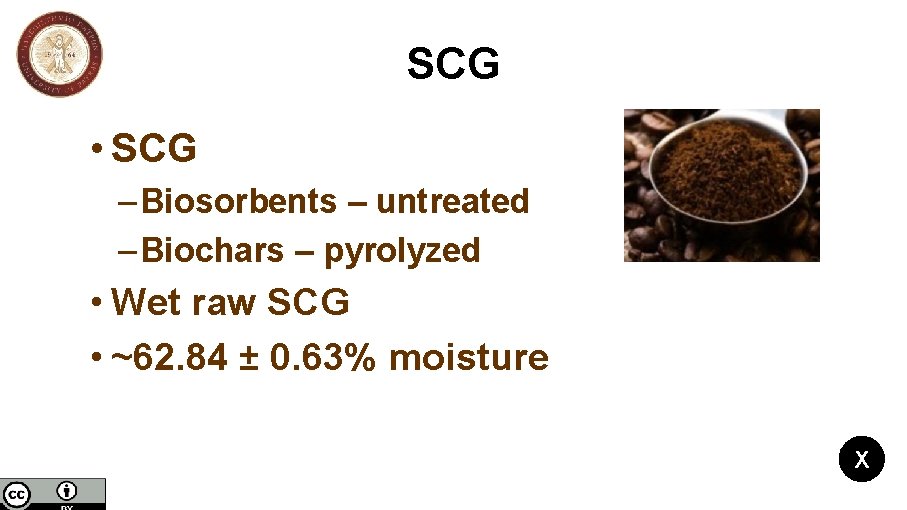
SCG • SCG – Biosorbents – untreated – Biochars – pyrolyzed • Wet raw SCG • ~62. 84 ± 0. 63% moisture X
W-SCG • Flushing with distilled water (3 D) • at 70 o. C • Into Vacuum Flask • p. H neutral • Washed biochar heated over night at 110 o. C X
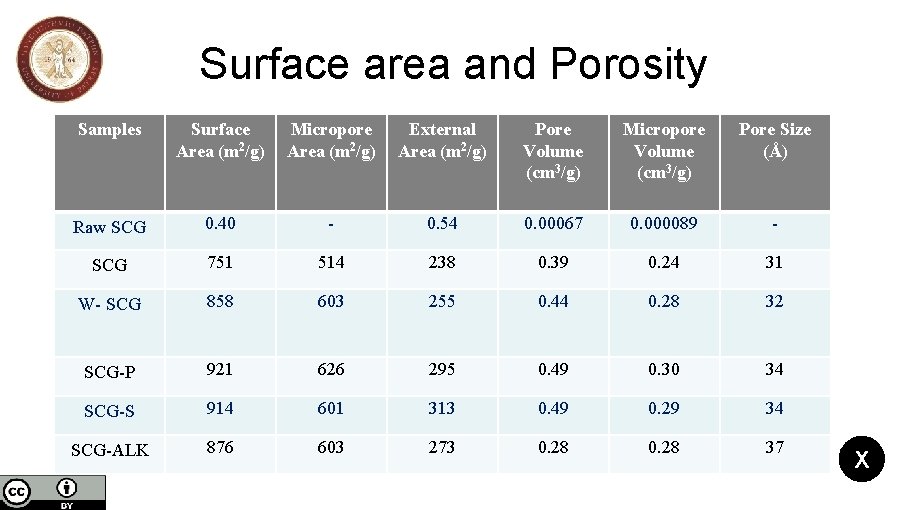
Surface area and Porosity Samples Surface Area (m 2/g) Micropore Area (m 2/g) External Area (m 2/g) Pore Volume (cm 3/g) Micropore Volume (cm 3/g) Pore Size (Å) Raw SCG 0. 40 - 0. 54 0. 00067 0. 000089 - SCG 751 514 238 0. 39 0. 24 31 W- SCG 858 603 255 0. 44 0. 28 32 SCG-P 921 626 295 0. 49 0. 30 34 SCG-S 914 601 313 0. 49 0. 29 34 SCG-ALK 876 603 273 0. 28 37 X
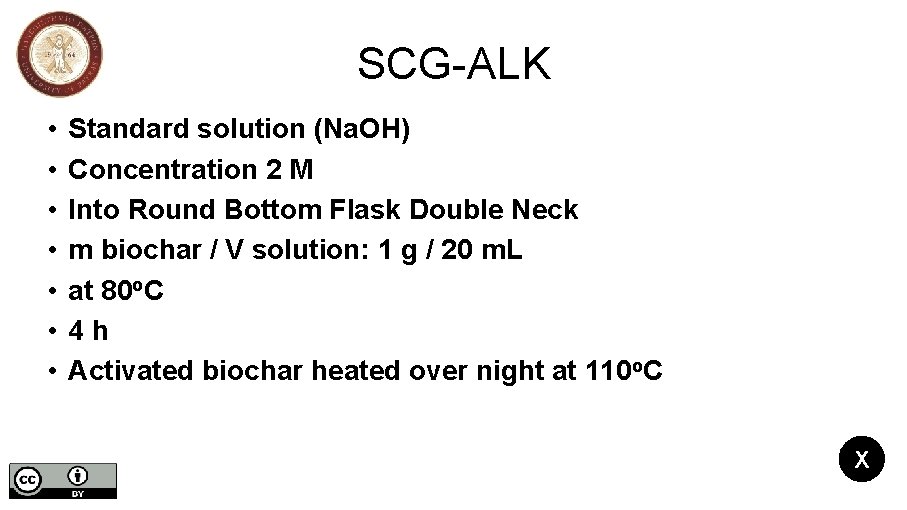
SCG-ALK • • Standard solution (Na. OH) Concentration 2 M Into Round Bottom Flask Double Neck m biochar / V solution: 1 g / 20 m. L at 80 o. C 4 h Activated biochar heated over night at 110 o. C X
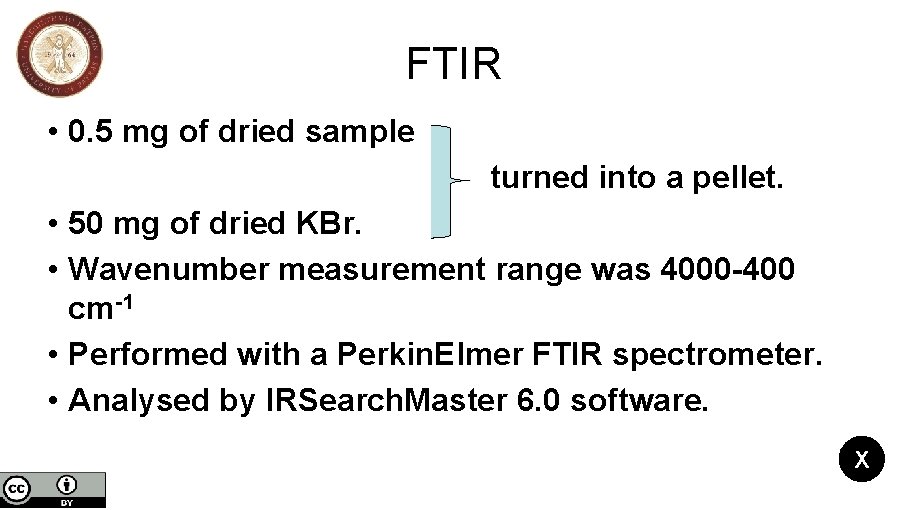
FTIR • 0. 5 mg of dried sample turned into a pellet. • 50 mg of dried KBr. • Wavenumber measurement range was 4000 -400 cm-1 • Performed with a Perkin. Elmer FTIR spectrometer. • Analysed by IRSearch. Master 6. 0 software. X
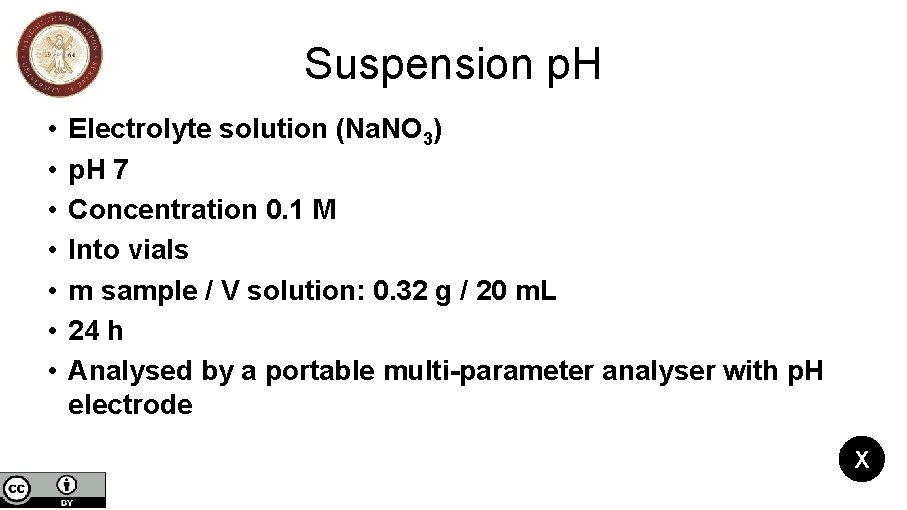
Suspension p. H • • Electrolyte solution (Na. NO 3) p. H 7 Concentration 0. 1 M Into vials m sample / V solution: 0. 32 g / 20 m. L 24 h Analysed by a portable multi-parameter analyser with p. H electrode X
Ash Content • Materials were placed in a Memmet oven at 50 ± 5 o. C for several hours to remove the moisture. • 1 g of drying raw SCG was heated at 750 o. C for the determination of the ash content. • 1 g of biochar SCG was heated at 750 o. C for the determination of the ash content. X
Surface area and porosity • Raw SCG was degassed at 60 o. C under mild nitrogen flow for 1 h. • Biochar SCG was degassed at 300 o. C under mild nitrogen flow for 1 h. • Performed by gas (N 2) adsorption−desorption with the Micromeritics Tri. Star 3000 Analyzer system using the Brunauer, Emmett, and Teller (BET) equation. • Analysed by Micromeritics Tri. Star 3000 software. X
Pore size distribution SCG W-SCG SCG-P SCG-S SCG-ALK X
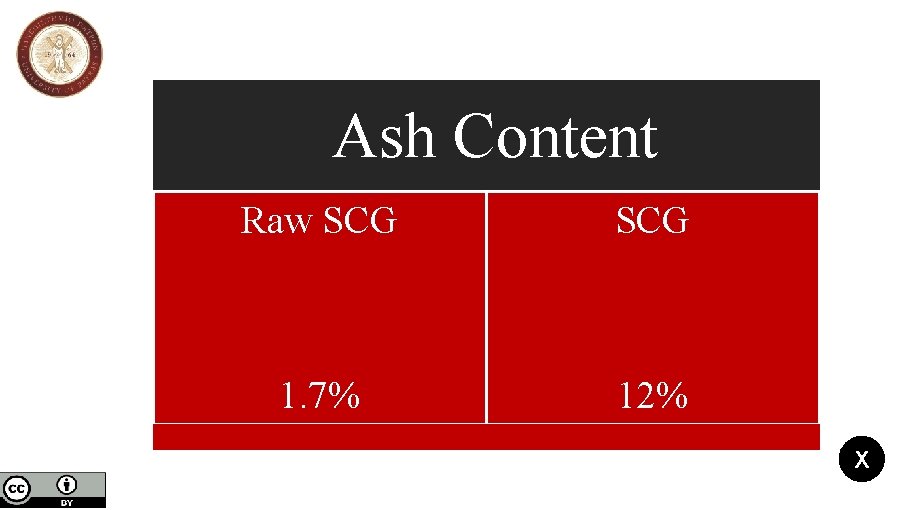
Ash Content Raw SCG 1. 7% 12% X
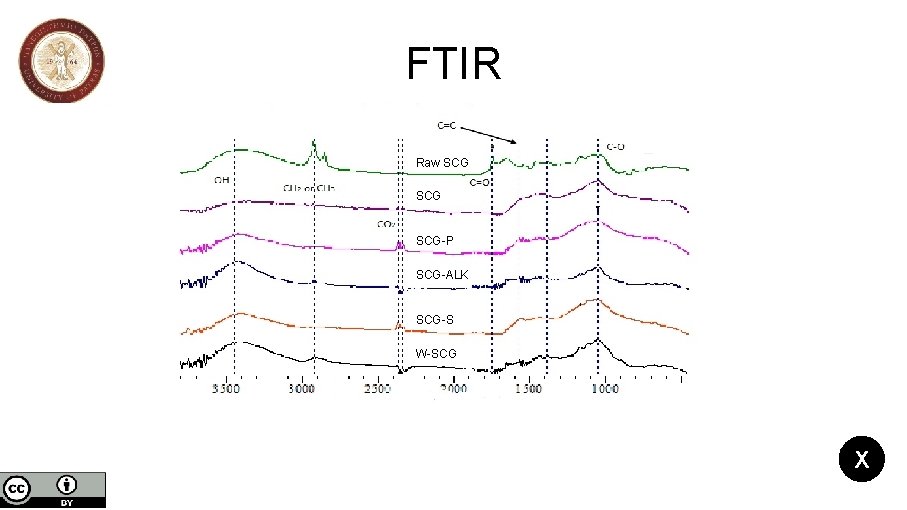
FTIR Raw SCG SCG-P SCG-ALK SCG-S W-SCG X
SCG-P • • Model solution (H 3 PO 4) Concentration 2 M Into Round Bottom Flask Double Neck m biochar / V solution: 1 g / 20 m. L at 80 o. C 4 h Activated biochar heated over night at 110 o. C X
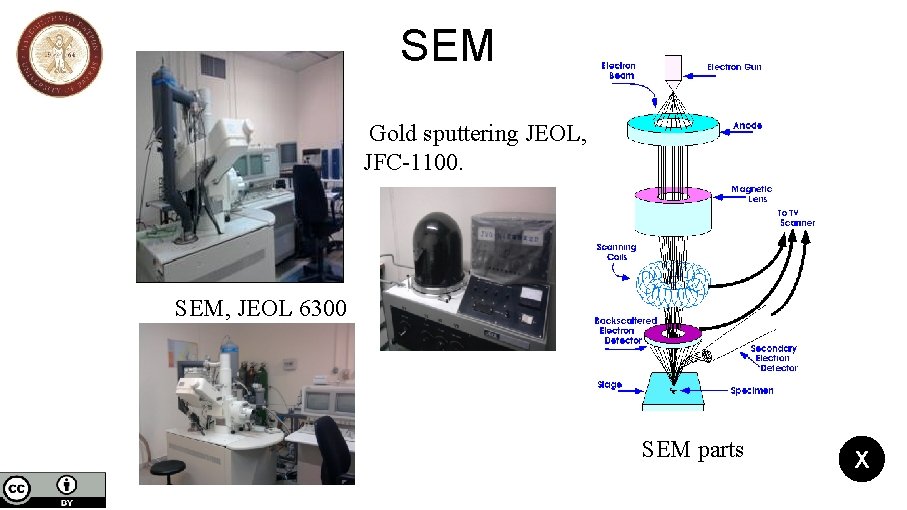
SEM Gold sputtering JEOL, JFC-1100. SEM, JEOL 6300 SEM parts X
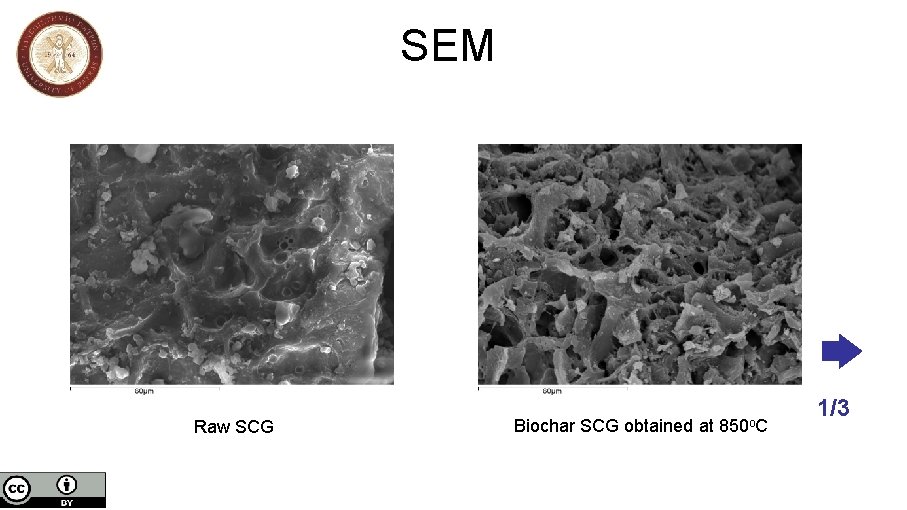
SEM Raw SCG Biochar SCG obtained at 850 o. C 1/3
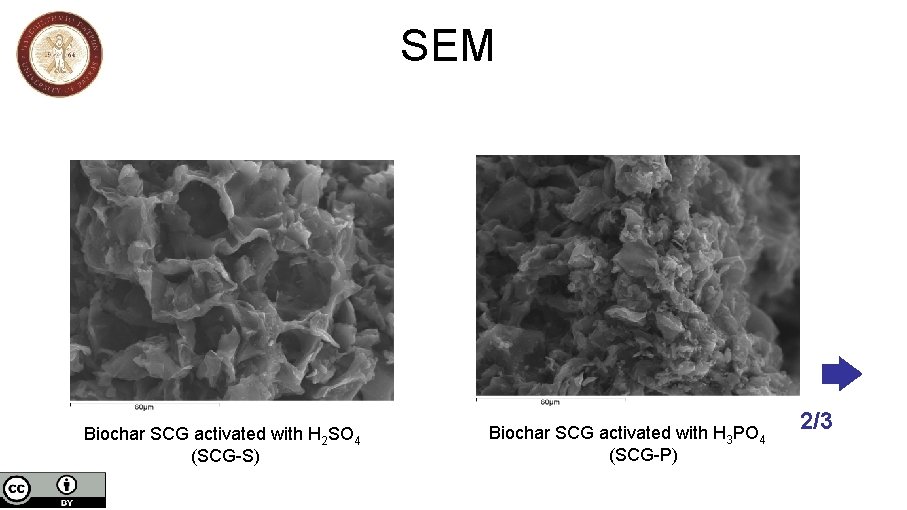
SEM Biochar SCG activated with H 2 SO 4 (SCG-S) Biochar SCG activated with H 3 PO 4 (SCG-P) 2/3
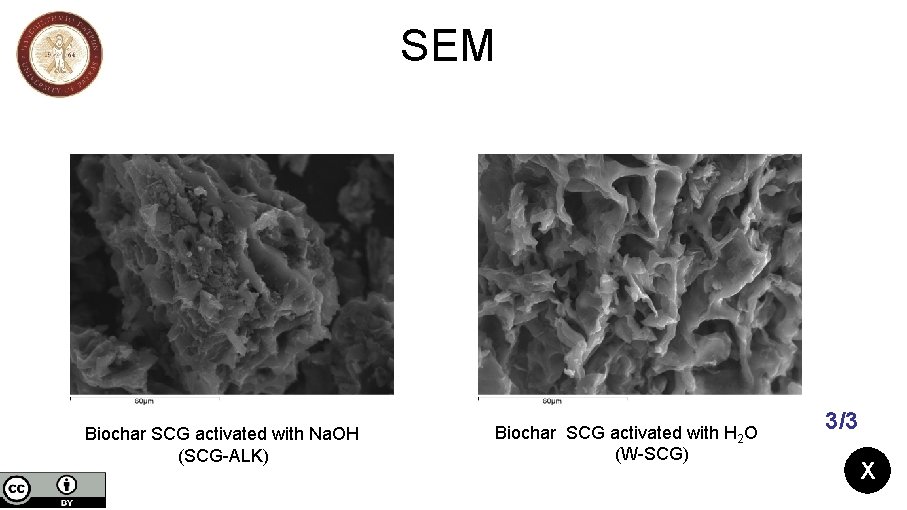
SEM Biochar SCG activated with Na. OH (SCG-ALK) Biochar SCG activated with H 2 O (W-SCG) 3/3 X
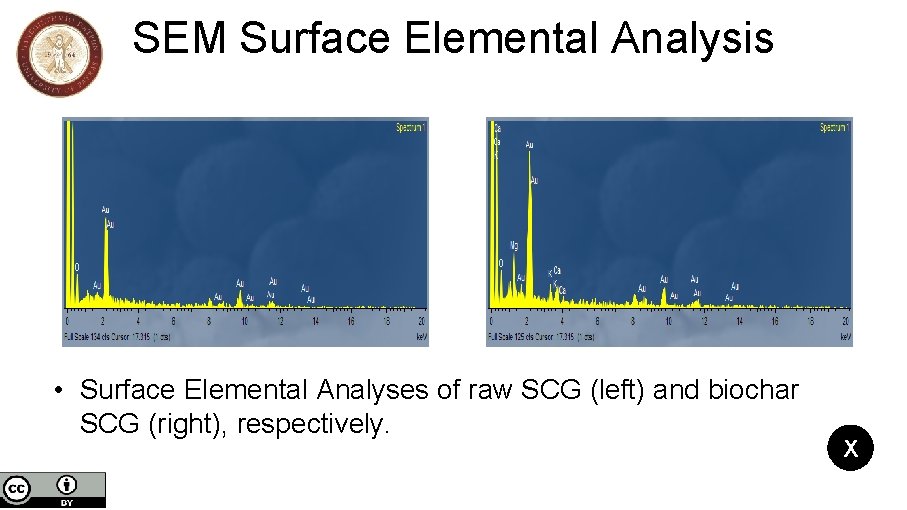
SEM Surface Elemental Analysis • Surface Elemental Analyses of raw SCG (left) and biochar SCG (right), respectively. X
SCG-S • • Model solution (H 2 SO 4) Concentration 2 M Into Round Bottom Flask Double Neck m biochar / V solution: 1 g / 20 m. L at 80 o. C 4 h Activated biochar heated over night at 110 o. C X
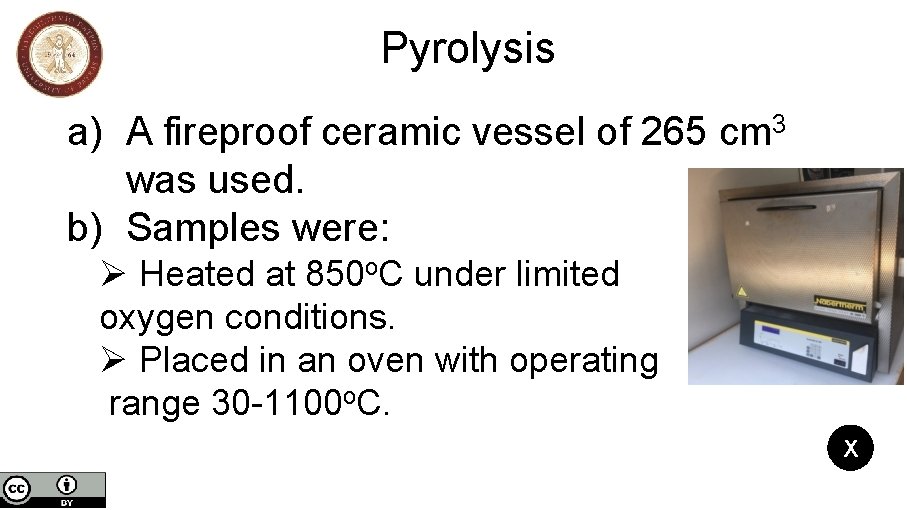
Pyrolysis a) A fireproof ceramic vessel of 265 cm 3 was used. b) Samples were: Ø Heated at 850 o. C under limited oxygen conditions. Ø Placed in an oven with operating range 30 -1100 o. C. X
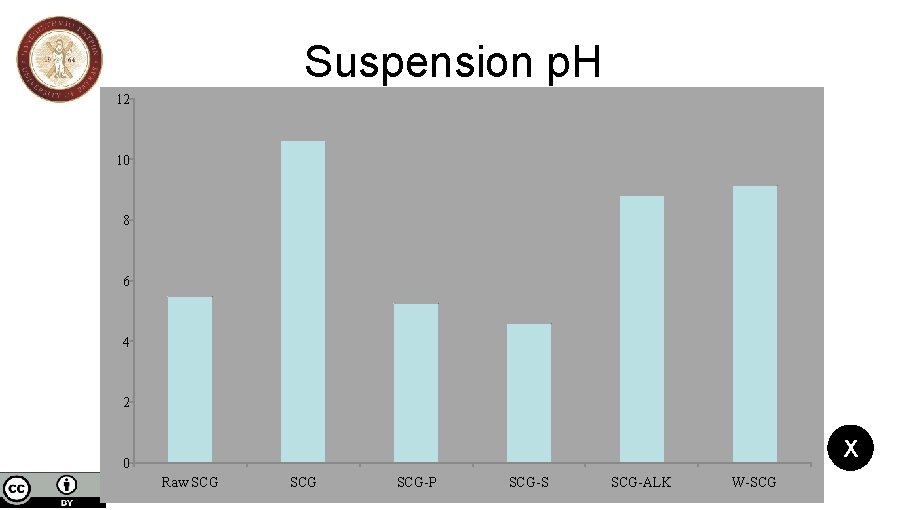
Suspension p. H 12 10 8 6 4 2 X 0 Raw SCG SCG-P SCG-S SCG-ALK W-SCG
Conclusions • Biochars SCG are mainly microporous materials with high specific surface area; 63% of the pore volume of the resulted biochar was due to micropores. • The activation of biochars with warm distilled H 2 O and aqueous acidic or alkaline solutions, led to a significant increase of specific surface area. • Micrographs of materials showed obvious differences in morphology between raw SCG and biochar SCG. Many pores (macropores) were formed on the surface of biochar. • The activated SCG-P shows an increase of micropore area compared to SCG-S, SCG -ALK, W-SCG. • Biochars SCG obtained at 850 o. C are alkaline in nature. • A few peaks occurred at SCG and activated biochar FTIR spectra compared to the raw SCG FTIR spectrum. • The FTIR spectra for SCG-ALK and W-SCG were similar. 1/2
General Conclusions • Among the various types of pyrolized and activated samples (biochars) obtained from raw spent coffee grains, statistically there was no significant difference on their physicochemical properties. • The results of the present study can be used by industries who deal with these byproducts. The new materials can be used as sorbents for water purification by the same industries. • For the five biochar samples, the characterization results indicated that the W-SCG and SCG-P is more favourable to be tested for their sorption capacity and catalytic activities in future studies due to their environmentally friendly and cost-effective activation. X 2/2
Acknowlegment We acknowledge support of this work by the project “Research Infrastructure on Food Bioprocessing Development and Innovation Exploitation – Food Innovation RI” (MIS 5027222), which is implemented under the Action “Reinforcement of the Research and Innovation Infrastructure”, funded by the Operational Programme "Competitiveness, Entrepreneurship and Innovation" (NSRF 2014 -2020) and cofinanced by Greece and the European Union (European Regional Development Fund). X
- Slides: 30