
Spelling Scheme of Work Year 4 190619 Spelling
- Slides: 3
Spelling Scheme of Work Year 4 19/06/19
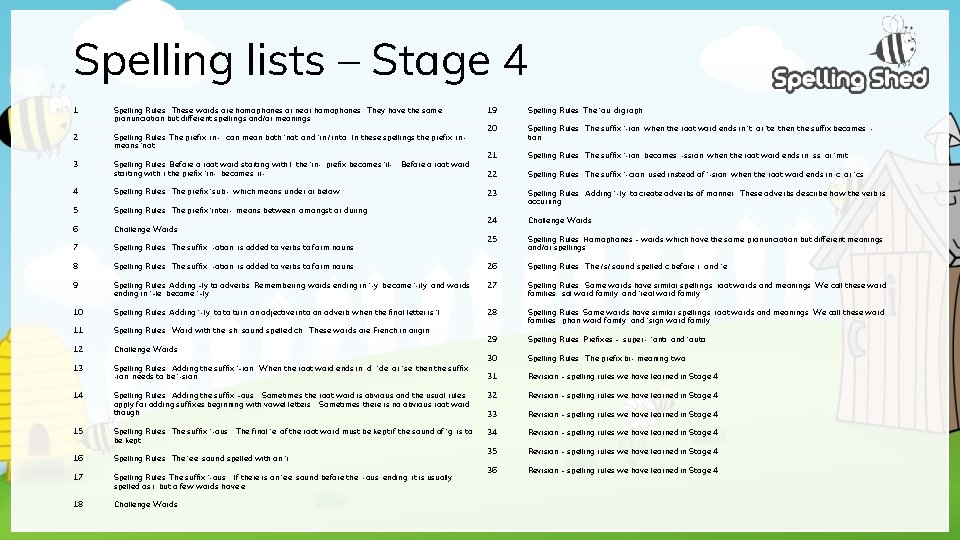
Spelling lists – Stage 4 19. Spelling Rules: The ‘au’ digraph 20. Spelling Rules: The suffix ‘-ion’ when the root word ends in ‘t’ or ‘te’ then the suffix becomes ’tion. ’ 21. Spelling Rules: The suffix ‘-ion’ becomes ’-ssion’ when the root word ends in ’ss’ or ‘mit. ’ 22. Spelling Rules: The suffix ‘-cian’ used instead of ‘-sion’ when the root word ends in ’c’ or ‘cs’ 23. Spelling Rules: Adding ‘-ly’ to create adverbs of manner. These adverbs describe how the verb is occurring. 24. Challenge Words 25. Spelling Rules: Homophones – words which have the same pronunciation but different meanings and/or spellings. Spelling Rules: The suffix ’-ation’ is added to verbs to form nouns. 26. Spelling Rules: The /s/ sound spelled c before ’i’ and ‘e’. 9. Spelling Rules: Adding –ly to adverbs. Remembering words ending in ‘-y’ become ‘-ily’ and words ending in ‘–le’ become ‘–ly. ’ 27. Spelling Rules: Some words have similar spellings, root words and meanings. We call these word families. ’sol word family’ and ‘real word family’ 10. Spelling Rules: Adding ‘-ly’ to to turn an adjective into an adverb when the final letter is ‘l. ’ 28. 11. Spelling Rules: Word with the ’sh’ sound spelled ch. These words are French in origin. Spelling Rules: Some words have similar spellings, root words and meanings. We call these word families. ’phon word family’ and ‘sign word family’ 12. Challenge Words 29. Spelling Rules: Prefixes – ’super-’ ‘anti’ and ‘auto. ’ 13. Spelling Rules: Adding the suffix ‘–ion. ’ When the root word ends in ’d, ’ ‘de’ or ‘se’ then the suffix ’ -ion’ needs to be ‘-sion. ’ 30. Spelling Rules: The prefix bi- meaning two. 31. Revision – spelling rules we have learned in Stage 4. 14. Spelling Rules: Adding the suffix –ous. ’ Sometimes the root word is obvious and the usual rules apply for adding suffixes beginning with vowel letters. Sometimes there is no obvious root word though. 32. Revision – spelling rules we have learned in Stage 4. 33. Revision – spelling rules we have learned in Stage 4. 15. Spelling Rules: The suffix ‘-ous. ’ The final ‘e’ of the root word must be kept if the sound of ‘g’ is to be kept. 34. Revision – spelling rules we have learned in Stage 4. 16. Spelling Rules: The ‘ee’ sound spelled with an ‘i. ’ 35. Revision – spelling rules we have learned in Stage 4. 17. Spelling Rules: The suffix ‘-ous. ’ If there is an ‘ee’ sound before the ’-ous’ ending, it is usually spelled as i, but a few words have e. 36. Revision – spelling rules we have learned in Stage 4. 18. Challenge Words 1. Spelling Rules: These words are homophones or near homophones. They have the same pronunciation but different spellings and/or meanings. 2. Spelling Rules: The prefix ’in-’ can mean both ‘not’ and ‘in’/’into. ’ In these spellings the prefix ’in-’ means ‘not. ’ 3. Spelling Rules: Before a root word starting with l, the ‘in-’ prefix becomes ‘il-’. Before a root word starting with r the prefix ‘in-’ becomes ’ir-’ 4. Spelling Rules: The prefix ‘sub-’ which means under or below. 5. Spelling Rules: The prefix ‘inter-’ means between, amongst or during. 6. Challenge Words 7. Spelling Rules: The suffix ’-ation’ is added to verbs to form nouns. 8.