
Spelling Phonics and Word Recognition Overview What are




- Slides: 57
Spelling Phonics and Word Recognition
Overview • What are phonics, word study, and word recognition? • How do spelling and word recognition knowledge typically develop? • What are some instructional techniques for teaching word study? • What does research say about effective phonics instruction?
Key Terminology
Phonics The study of the relationships between letters (graphemes) and the sounds (phonemes) they represent; instruction that teaches sound-symbol correspondence.
Word Recognition The process of determining the pronunciation and some degree of meaning of a word in written form.
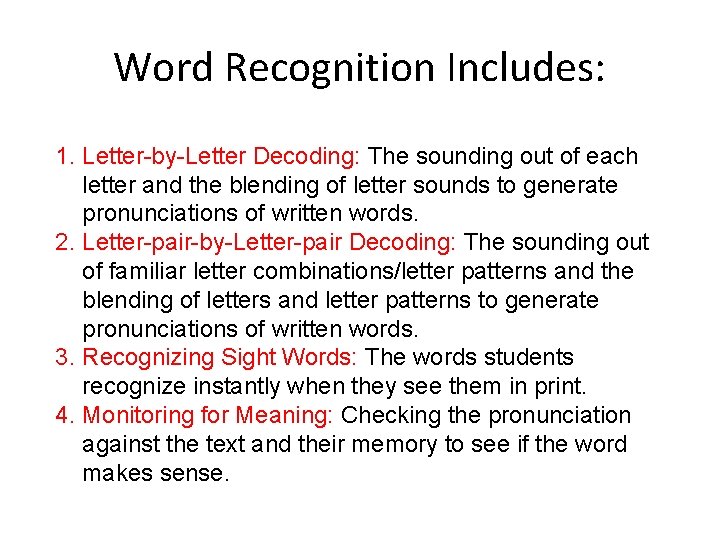
Word Recognition Includes: 1. Letter-by-Letter Decoding: The sounding out of each letter and the blending of letter sounds to generate pronunciations of written words. 2. Letter-pair-by-Letter-pair Decoding: The sounding out of familiar letter combinations/letter patterns and the blending of letters and letter patterns to generate pronunciations of written words. 3. Recognizing Sight Words: The words students recognize instantly when they see them in print. 4. Monitoring for Meaning: Checking the pronunciation against the text and their memory to see if the word makes sense.
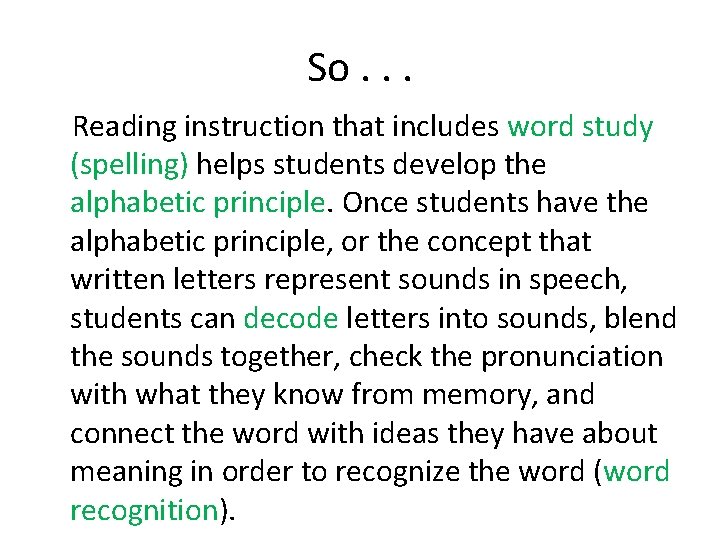
So. . . Reading instruction that includes word study (spelling) helps students develop the alphabetic principle. Once students have the alphabetic principle, or the concept that written letters represent sounds in speech, students can decode letters into sounds, blend the sounds together, check the pronunciation with what they know from memory, and connect the word with ideas they have about meaning in order to recognize the word (word recognition).
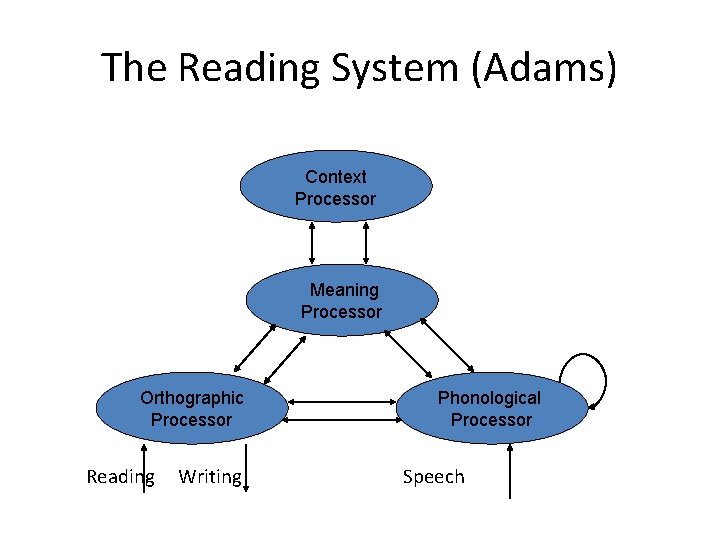
The Reading System (Adams) Context Processor Meaning Processor Orthographic Processor Reading Writing Phonological Processor Speech
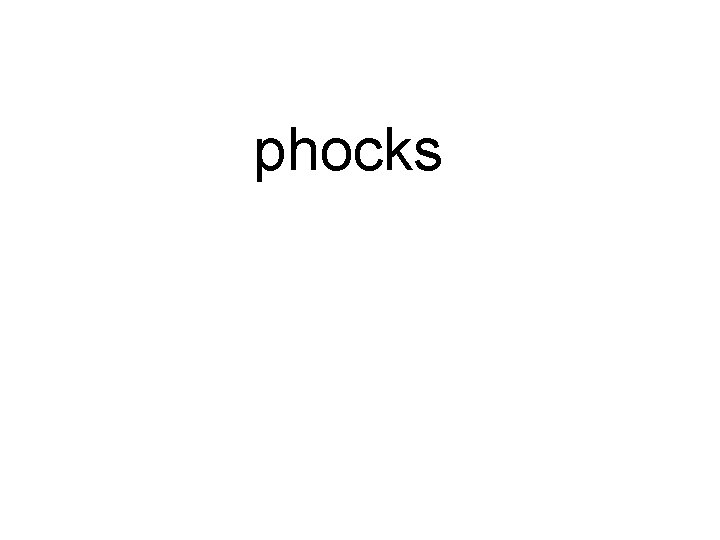
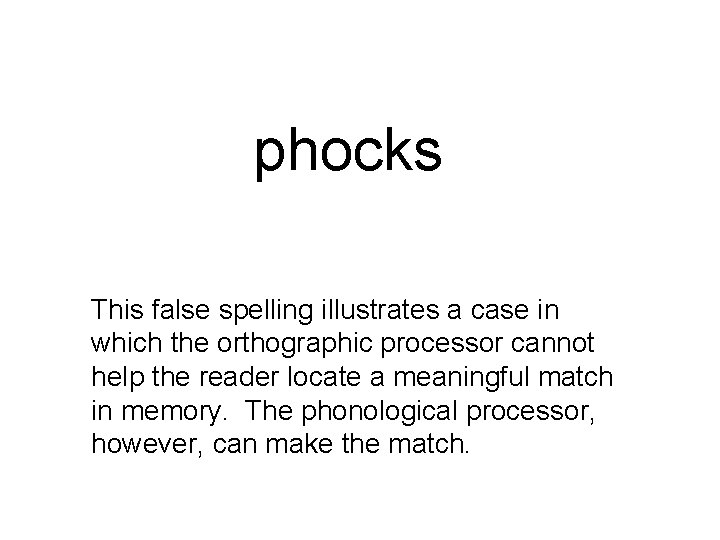
phocks
phocks This false spelling illustrates a case in which the orthographic processor cannot help the reader locate a meaningful match in memory. The phonological processor, however, can make the match.
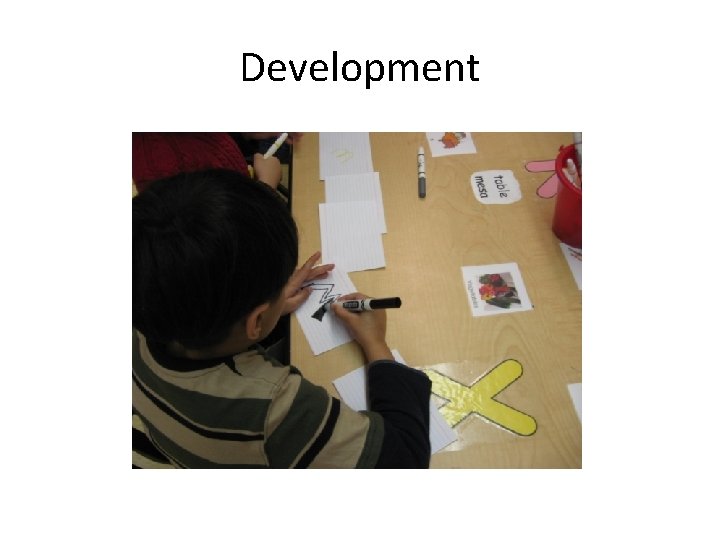
Development
Phases of Word Learning Ehri, 1997 1. Prealphabetic phase: Use environmental or visual cues not related to processing letter-sound relationships. 2. Partial alphabetic phase: Look only at initial letters 3. Full alphabetic phase: Process each letter and sound in sequence 4. Consolidated alphabetic phase: Process patterns rather than sound-by-sound decoding
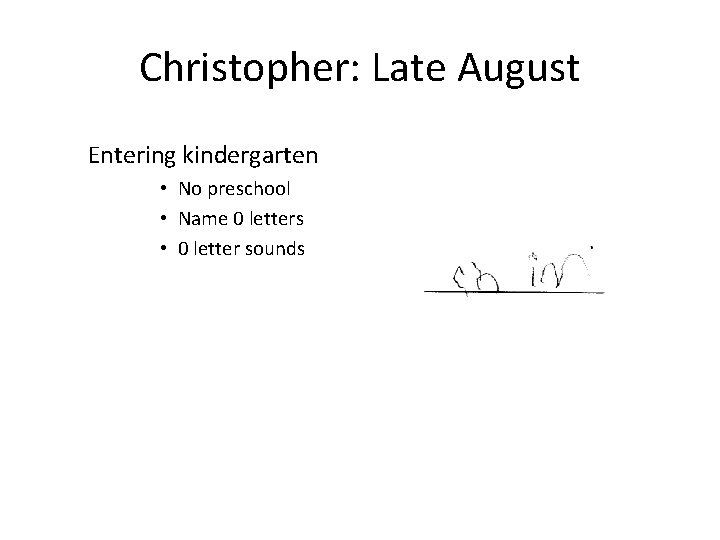
Christopher: Late August Entering kindergarten • No preschool • Name 0 letters • 0 letter sounds
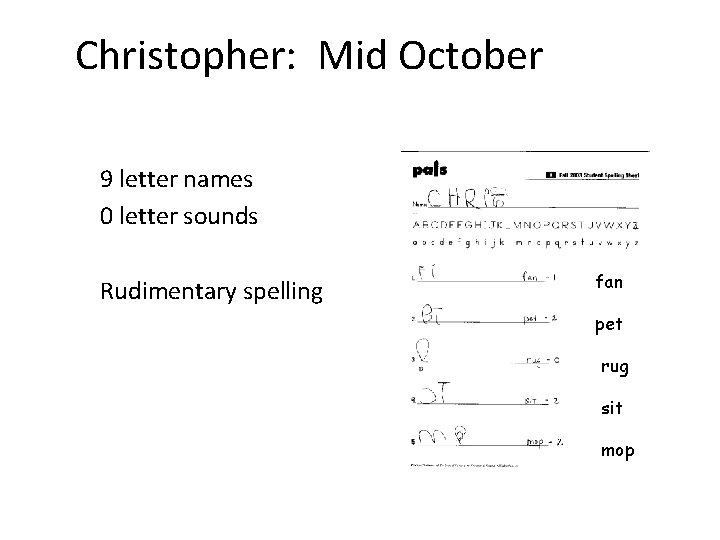
Christopher: Mid October 9 letter names 0 letter sounds Rudimentary spelling fan pet rug sit mop
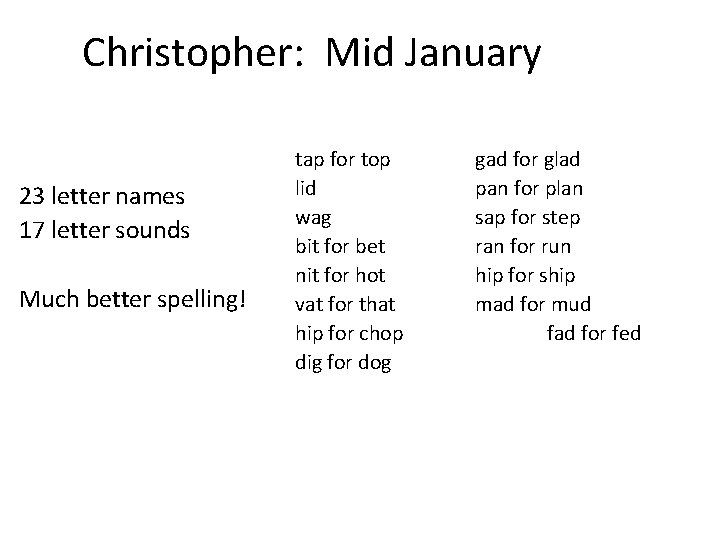
Christopher: Mid January 23 letter names 17 letter sounds Much better spelling! tap for top lid wag bit for bet nit for hot vat for that hip for chop dig for dog gad for glad pan for plan sap for step ran for run hip for ship mad for mud fad for fed
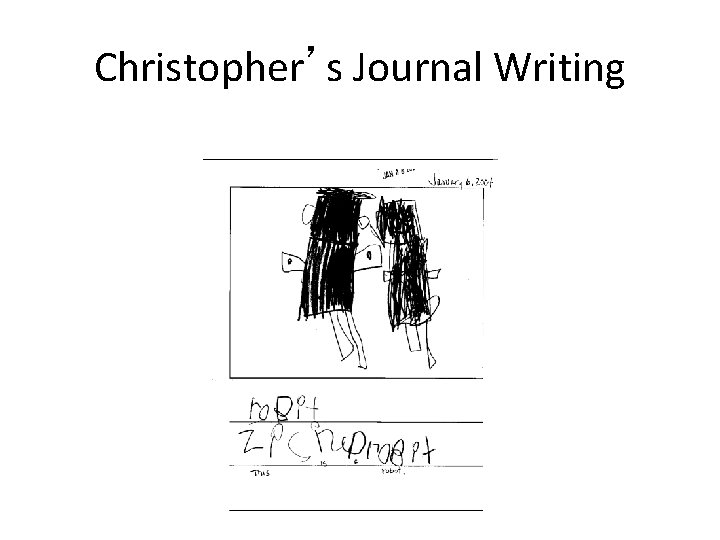
Christopher’s Journal Writing
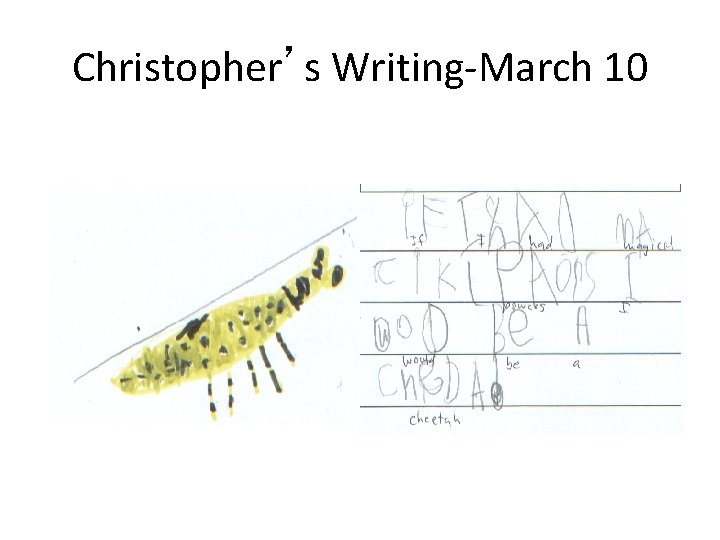
Christopher’s Writing-March 10
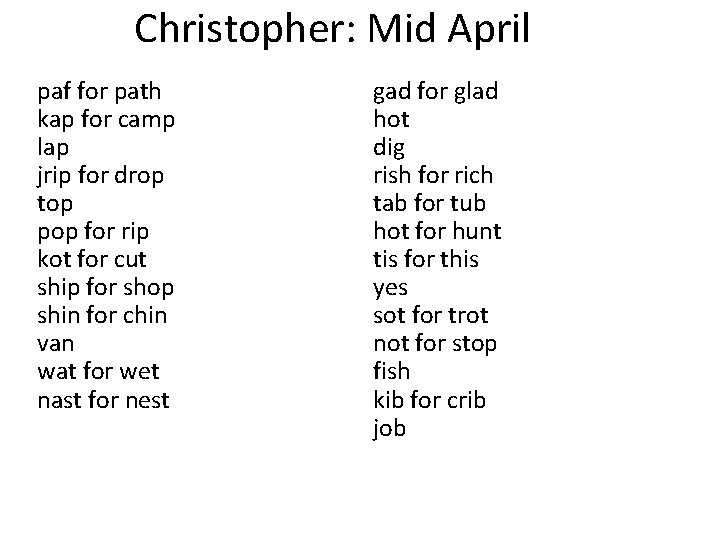
Christopher: Mid April paf for path kap for camp lap jrip for drop top pop for rip kot for cut ship for shop shin for chin van wat for wet nast for nest gad for glad hot dig rish for rich tab for tub hot for hunt tis for this yes sot for trot not for stop fish kib for crib job
WHAT WORDY STUDY CONCEPTS DO TEACHERS NEED TO TEACH READERS?
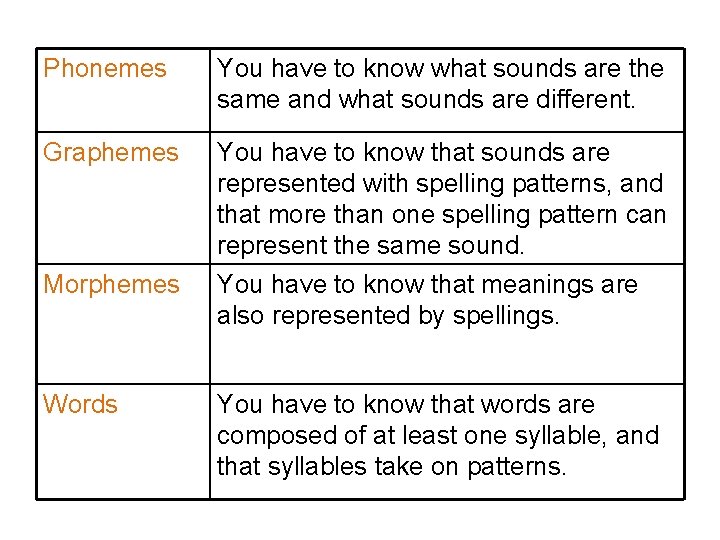
Phonemes You have to know what sounds are the same and what sounds are different. Graphemes You have to know that sounds are represented with spelling patterns, and that more than one spelling pattern can represent the same sound. You have to know that meanings are also represented by spellings. Morphemes Words You have to know that words are composed of at least one syllable, and that syllables take on patterns.
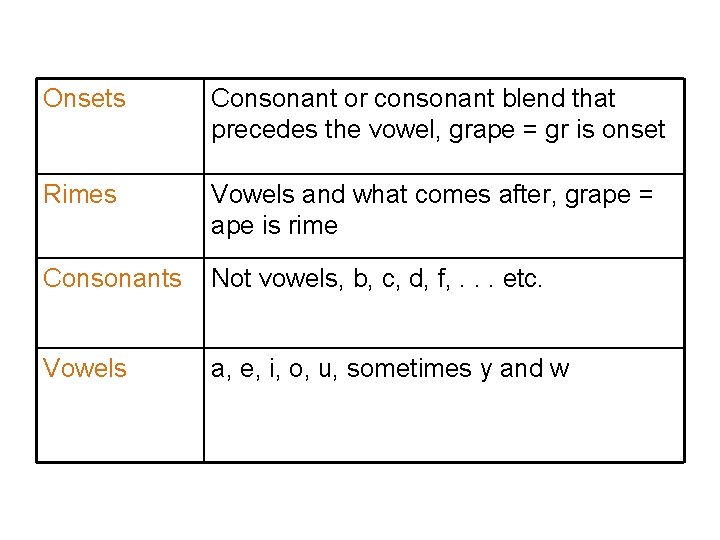
Onsets Consonant or consonant blend that precedes the vowel, grape = gr is onset Rimes Vowels and what comes after, grape = ape is rime Consonants Not vowels, b, c, d, f, . . . etc. Vowels a, e, i, o, u, sometimes y and w
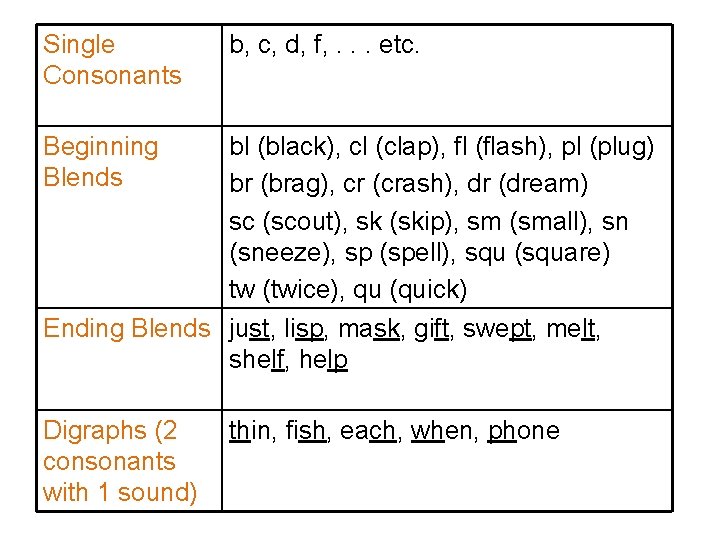
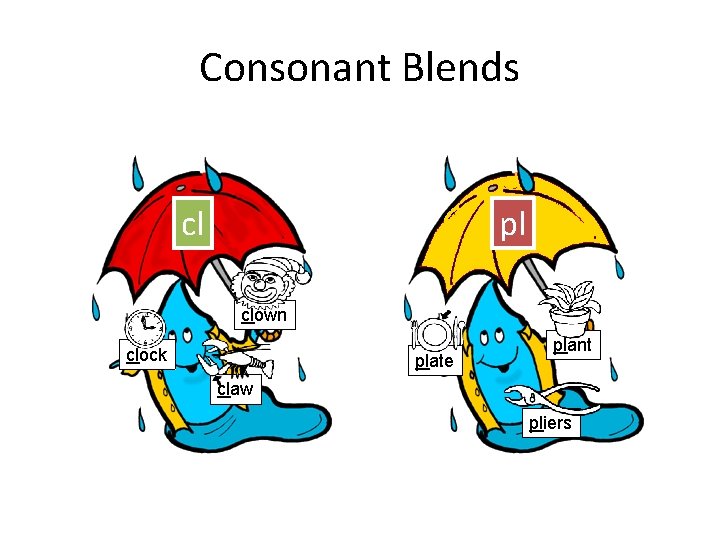
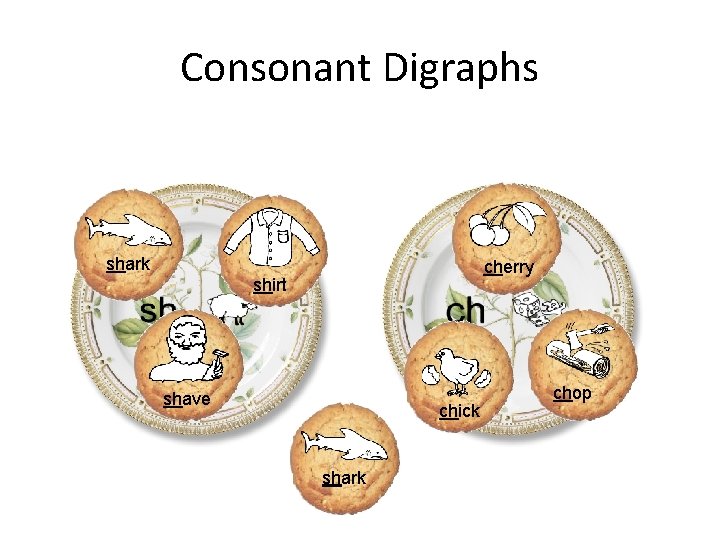
Single Consonants b, c, d, f, . . . etc. Beginning Blends bl (black), cl (clap), fl (flash), pl (plug) br (brag), cr (crash), dr (dream) sc (scout), sk (skip), sm (small), sn (sneeze), sp (spell), squ (square) tw (twice), qu (quick) Ending Blends just, lisp, mask, gift, swept, melt, shelf, help Digraphs (2 consonants with 1 sound) thin, fish, each, when, phone
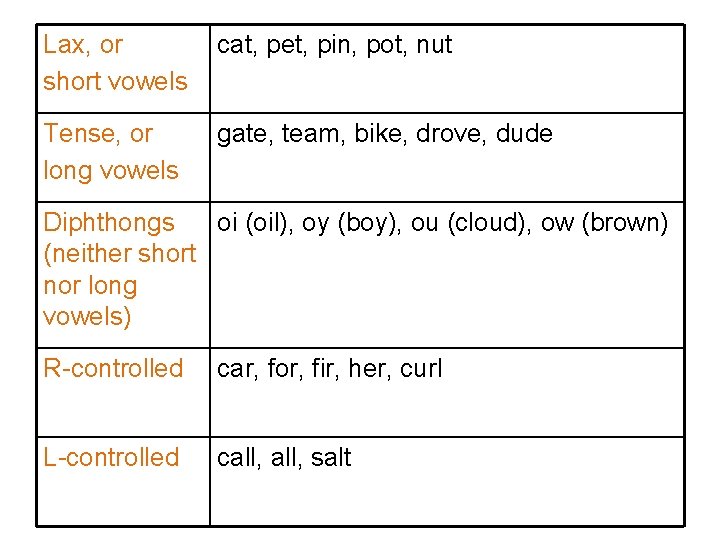
Lax, or short vowels cat, pet, pin, pot, nut Tense, or long vowels gate, team, bike, drove, dude Diphthongs oi (oil), oy (boy), ou (cloud), ow (brown) (neither short nor long vowels) R-controlled car, for, fir, her, curl L-controlled call, salt
Reading is Easier than Spelling There are many ways that one phoneme can be represented (spelled) by different graphemes. Let’s take a look. . .
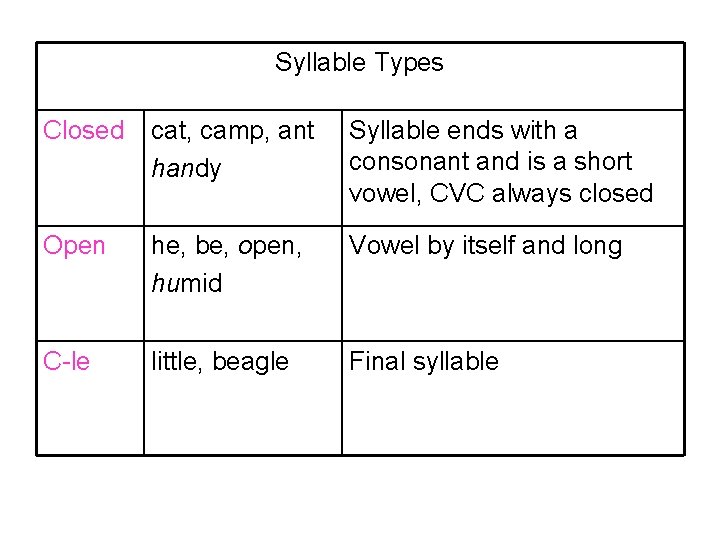
Syllable Types Closed cat, camp, ant handy Syllable ends with a consonant and is a short vowel, CVC always closed Open he, be, open, humid Vowel by itself and long C-le little, beagle Final syllable
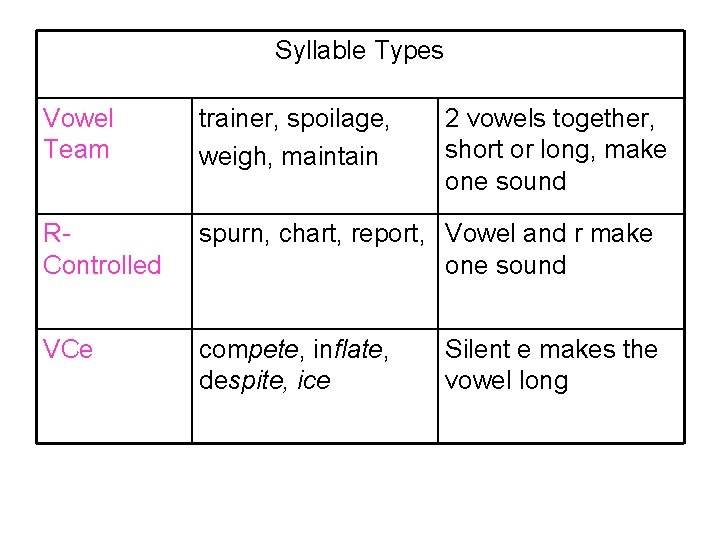
Syllable Types Vowel Team trainer, spoilage, weigh, maintain 2 vowels together, short or long, make one sound RControlled spurn, chart, report, Vowel and r make one sound VCe compete, inflate, despite, ice Silent e makes the vowel long
Let’s Practice—
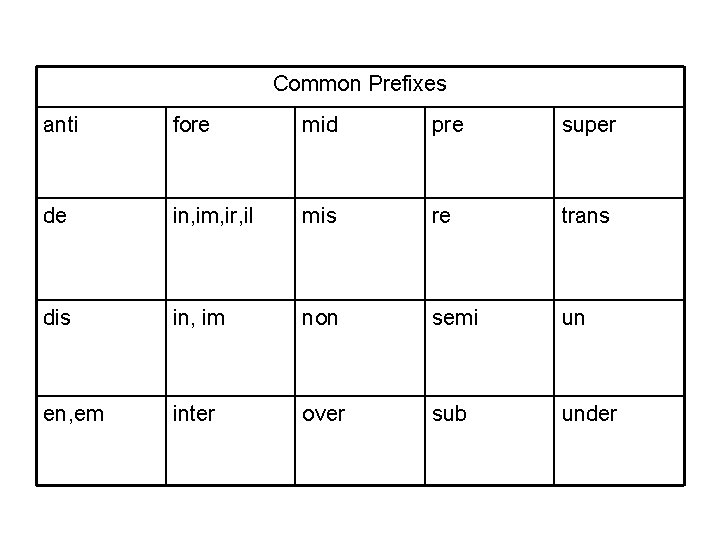
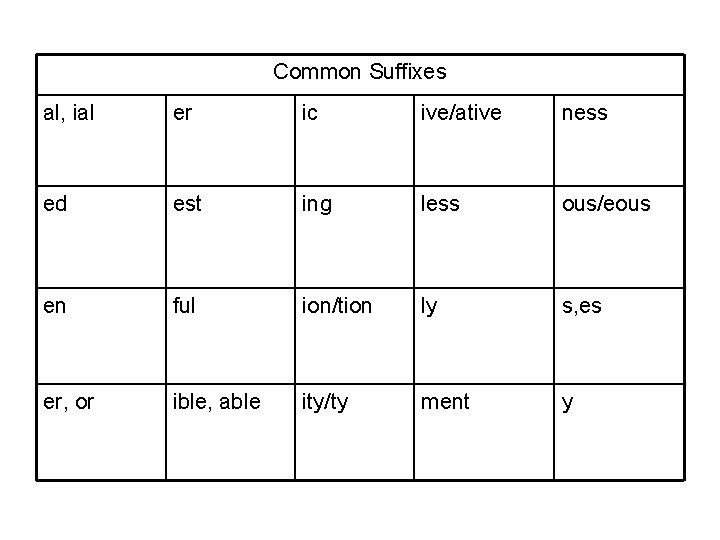
And how about meaning? How are phonemes, graphemes, and syllables combined in words to represent meaning?
Common Prefixes anti fore mid pre super de in, im, ir, il mis re trans dis in, im non semi un en, em inter over sub under
Common Suffixes al, ial er ic ive/ative ness ed est ing less ous/eous en ful ion/tion ly s, es er, or ible, able ity/ty ment y
Principles of Word Study Instruction Good word study instruction should develop the alphabetic principle. Good word study instruction should develop phonemic awareness. Good word study instruction should provide a thorough grounding in the letters. Good wordy study instruction should not teach rules, need not use worksheets, should not dominate instruction, and does not have to be boring.
Good word study instruction provides sufficient practice in reading words, both in isolation and in stories, and in writing words, both from dictation and using invented spelling. Good word study instruction leads to automatic word recognition. Good word study instruction is one part of a reading program. Stahl, S. A. , Duffy-Hester, A. M. , & Stahl, K. A. D. (1998). Everything you wanted to know about phonics (but were afraid to ask). Reading Research Quarterly, 338 -355.
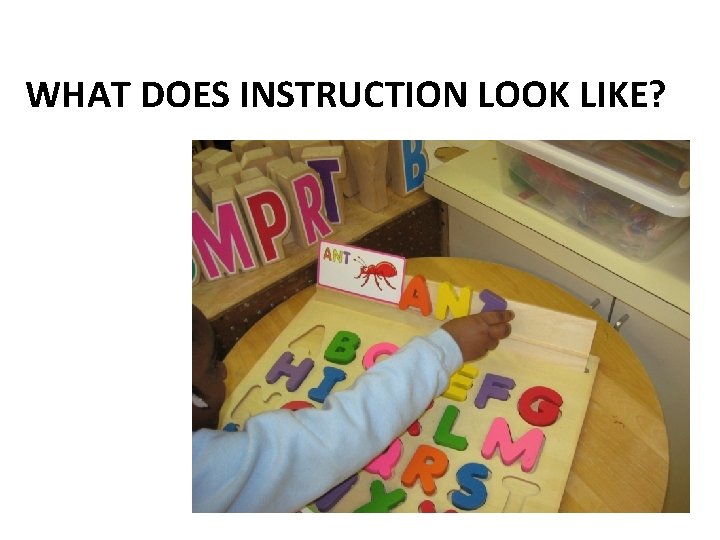
WHAT DOES INSTRUCTION LOOK LIKE?
How should that initial knowledge of word learning be developed? Research studies: 1. Teach the most useful letters and letter patterns early (Fry, 2004) 2. Use groupings and differentiated, data-based instruction to teach decoding (Williams & Hufnagel, 2005) 3. Increase decoding skills by teaching decoding systematically and explicitly (White, 2005) 4. Practice phonics concepts while reading actual texts (Hiebert and Martin, 2002; Menon and Hiebert, 2005; Cunningham, Spadorcia, Erickson, Koppenhaver, Sturm, & Yoder, 2005)
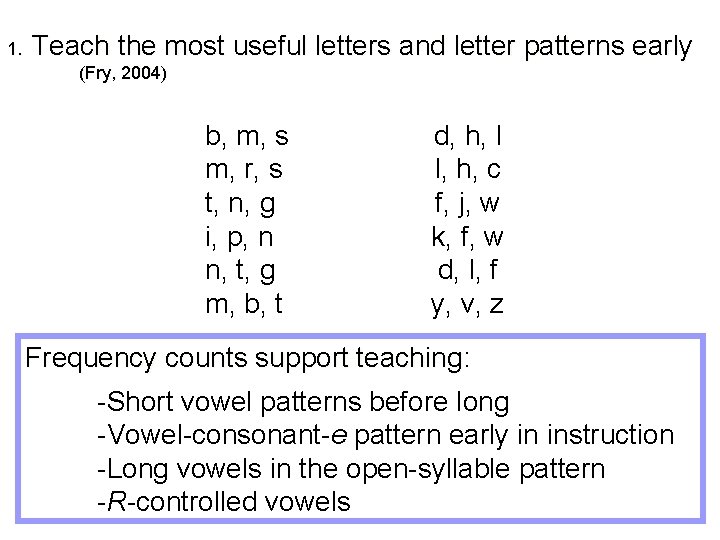
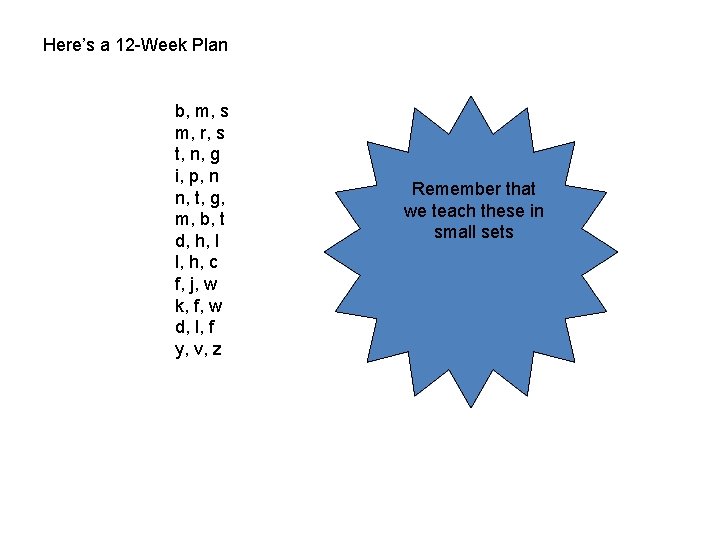
1. Teach the most useful letters and letter patterns early (Fry, 2004) b, m, s m, r, s t, n, g i, p, n n, t, g m, b, t d, h, l l, h, c f, j, w k, f, w d, l, f y, v, z Frequency counts support teaching: teaching -Short vowel patterns before long -Vowel-consonant-e pattern early in instruction -Long vowels in the open-syllable pattern -R-controlled vowels
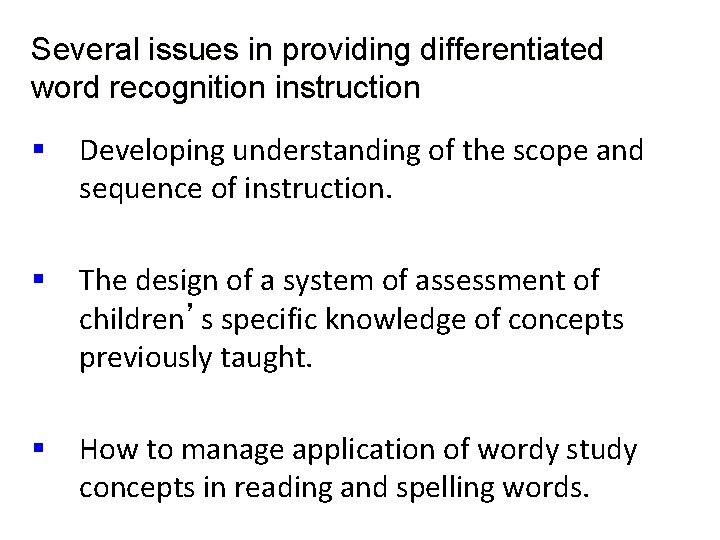
Several issues in providing differentiated word recognition instruction § Developing understanding of the scope and sequence of instruction. § The design of a system of assessment of children’s specific knowledge of concepts previously taught. § How to manage application of wordy study concepts in reading and spelling words.
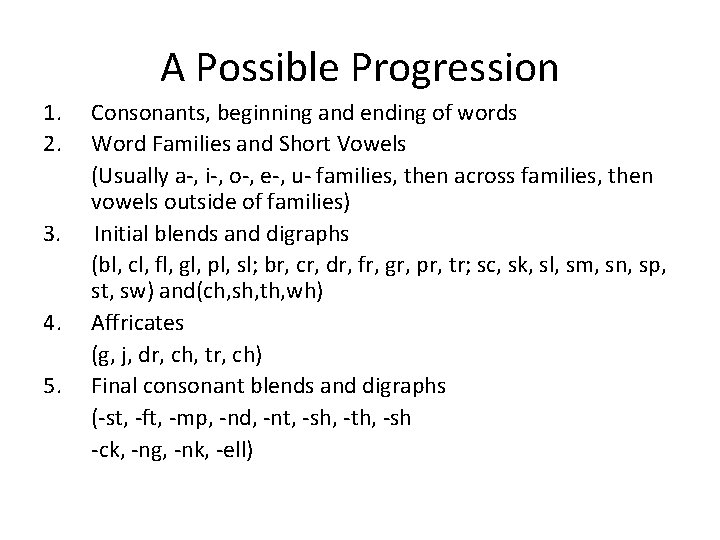
A Possible Progression 1. 2. 3. 4. 5. Consonants, beginning and ending of words Word Families and Short Vowels (Usually a-, i-, o-, e-, u- families, then across families, then vowels outside of families) Initial blends and digraphs (bl, cl, fl, gl, pl, sl; br, cr, dr, fr, gr, pr, tr; sc, sk, sl, sm, sn, sp, st, sw) and(ch, sh, th, wh) Affricates (g, j, dr, ch, tr, ch) Final consonant blends and digraphs (-st, -ft, -mp, -nd, -nt, -sh, -th, -sh -ck, -ng, -nk, -ell)
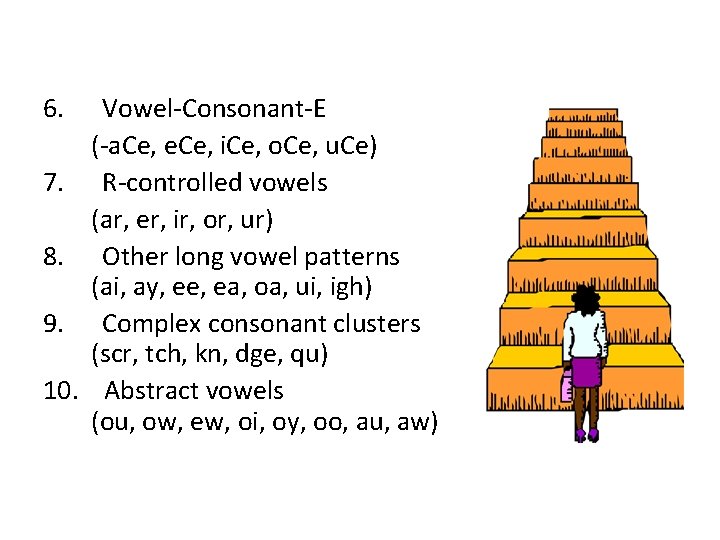
6. 7. 8. 9. 10. Vowel-Consonant-E (-a. Ce, e. Ce, i. Ce, o. Ce, u. Ce) R-controlled vowels (ar, er, ir, or, ur) Other long vowel patterns (ai, ay, ee, ea, oa, ui, igh) Complex consonant clusters (scr, tch, kn, dge, qu) Abstract vowels (ou, ow, ew, oi, oy, oo, au, aw)
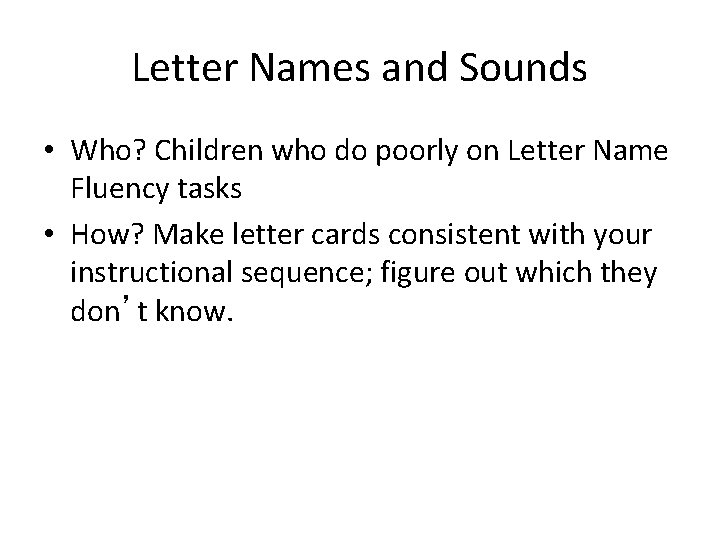
Letter Names and Sounds • Who? Children who do poorly on Letter Name Fluency tasks • How? Make letter cards consistent with your instructional sequence; figure out which they don’t know.
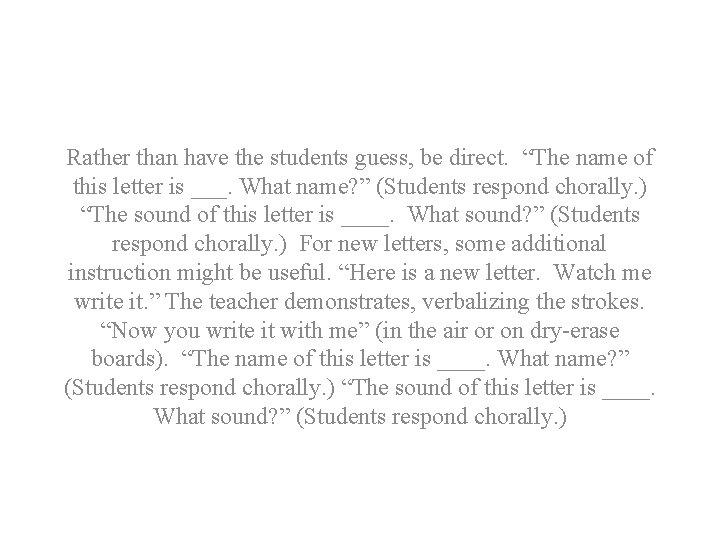
Rather than have the students guess, be direct. “The name of this letter is ___. What name? ” (Students respond chorally. ) “The sound of this letter is ____. What sound? ” (Students respond chorally. ) For new letters, some additional instruction might be useful. “Here is a new letter. Watch me write it. ” The teacher demonstrates, verbalizing the strokes. “Now you write it with me” (in the air or on dry-erase boards). “The name of this letter is ____. What name? ” (Students respond chorally. ) “The sound of this letter is ____. What sound? ” (Students respond chorally. )
Here’s a 12 -Week Plan b, m, s m, r, s t, n, g i, p, n n, t, g, m, b, t d, h, l l, h, c f, j, w k, f, w d, l, f y, v, z Remember that we teach these in small sets
Teaching Sounding and Blending • Who? Children who know their letter names and sounds but do poorly on word reading • How? Make word cards that review and extend the patterns that have been taught in phonics instruction.
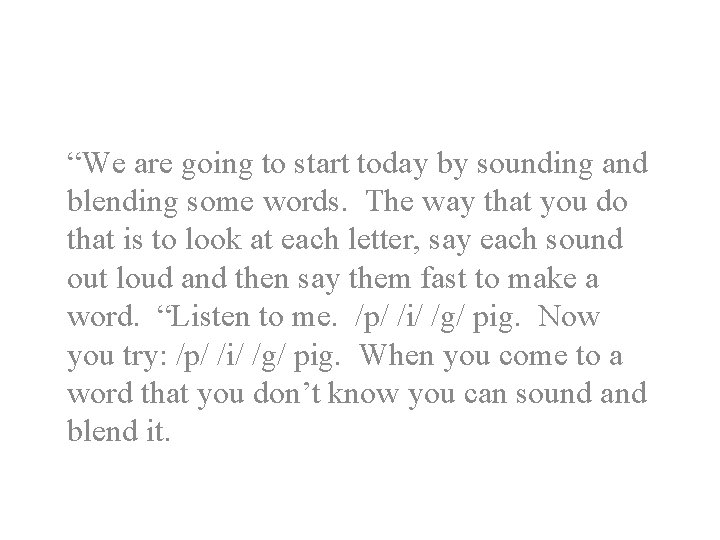
“We are going to start today by sounding and blending some words. The way that you do that is to look at each letter, say each sound out loud and then say them fast to make a word. “Listen to me. /p/ /i/ /g/ pig. Now you try: /p/ /i/ /g/ pig. When you come to a word that you don’t know you can sound and blend it.
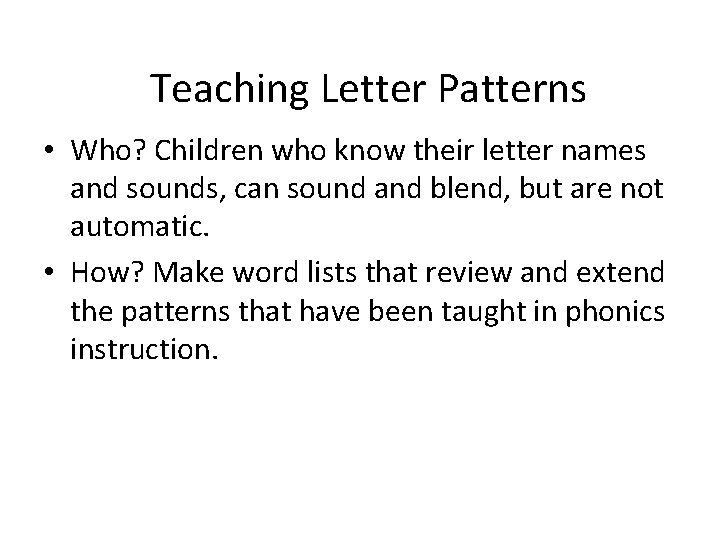
Teaching Letter Patterns • Who? Children who know their letter names and sounds, can sound and blend, but are not automatic. • How? Make word lists that review and extend the patterns that have been taught in phonics instruction.
“Today we will work on reading and spelling three vowel patterns. The /at/ pattern is the sound at the end of the word cat. It is spelled a-t. The /et/ pattern is the sound at the end of the word pet. It is spelled e-t. The /it/ pattern is the sound at the end of the word sit. It is spelled i-t. ” “First I want you to listen to words and tell me whether they sound like cat, pet, or sit. ” At this point, pronounce five or six words to represent each pattern, and ask the children to group words with like sounds together. Next, highlight the spelling patterns again. “Let’s look at the spellings for all of the words that sound like cat. Notice that words with the /at/ sound have the a-t pattern. You can use that pattern when you read or spell a-t words. ”
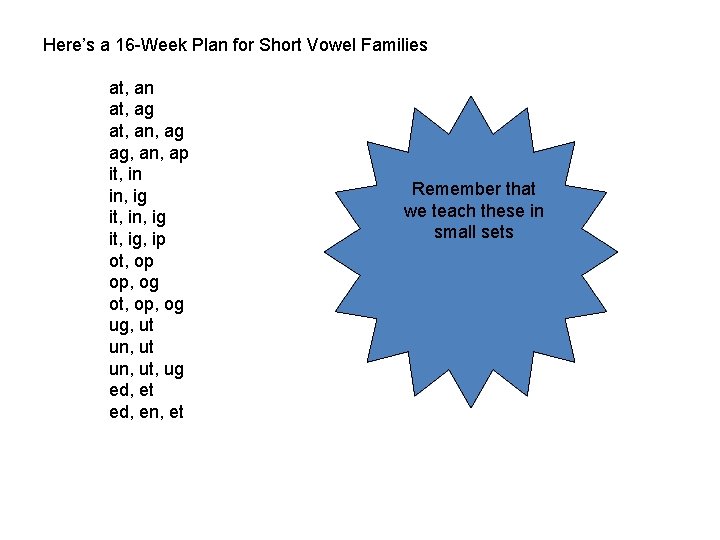
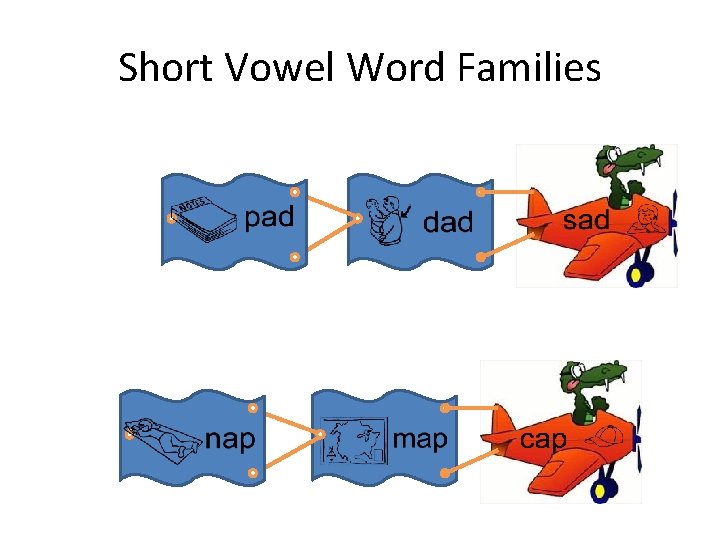
Here’s a 16 -Week Plan for Short Vowel Families at, an at, ag at, an, ag ag, an, ap it, in in, ig it, ig, ip ot, op op, og ot, op, og ug, ut un, ut, ug ed, et ed, en, et Remember that we teach these in small sets
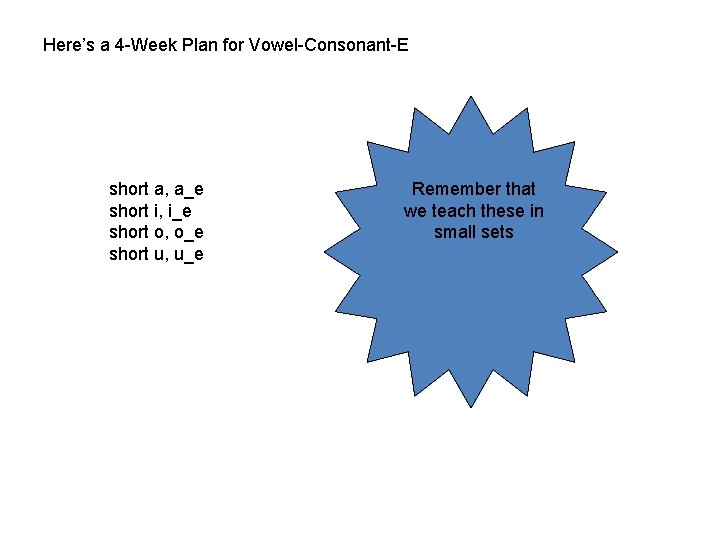
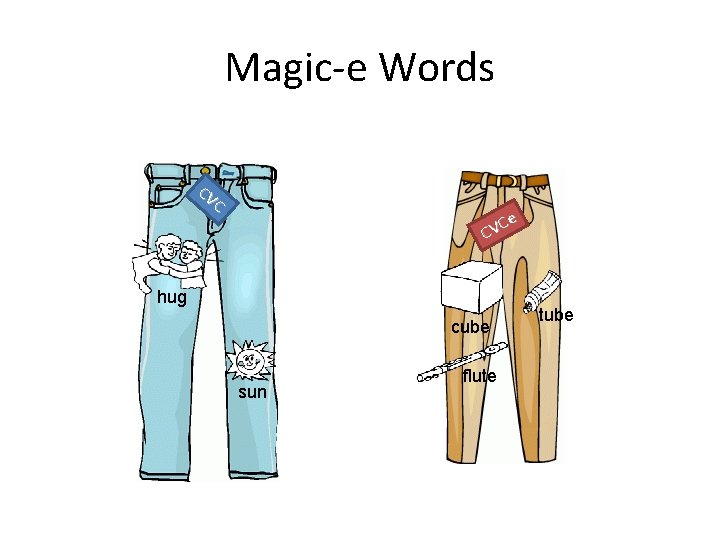
Here’s a 4 -Week Plan for Vowel-Consonant-E short a, a_e short i, i_e short o, o_e short u, u_e Remember that we teach these in small sets
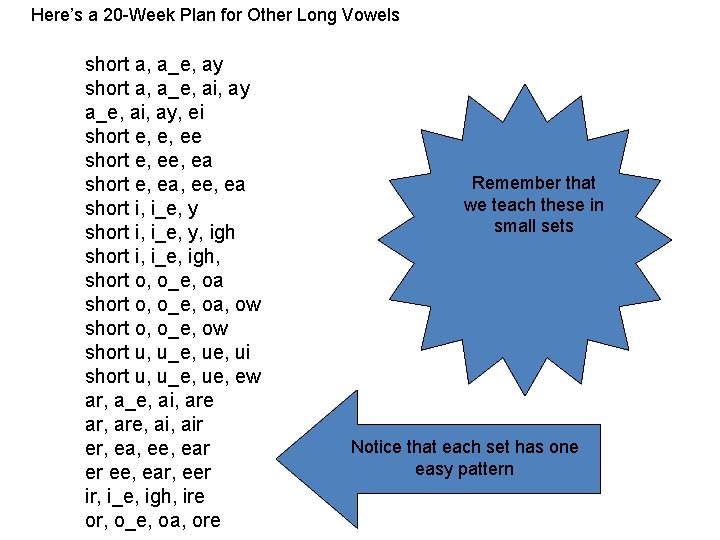
Here’s a 20 -Week Plan for Other Long Vowels short a, a_e, ay short a, a_e, ai, ay, ei short e, e, ee short e, ea, ee, ea short i, i_e, y, igh short i, i_e, igh, short o, o_e, oa, ow short o, o_e, ow short u, u_e, ui short u, u_e, ue, ew ar, a_e, ai, are ar, are, air er, ea, ee, ear er ee, ear, eer ir, i_e, igh, ire or, o_e, oa, ore Remember that we teach these in small sets Notice that each set has one easy pattern
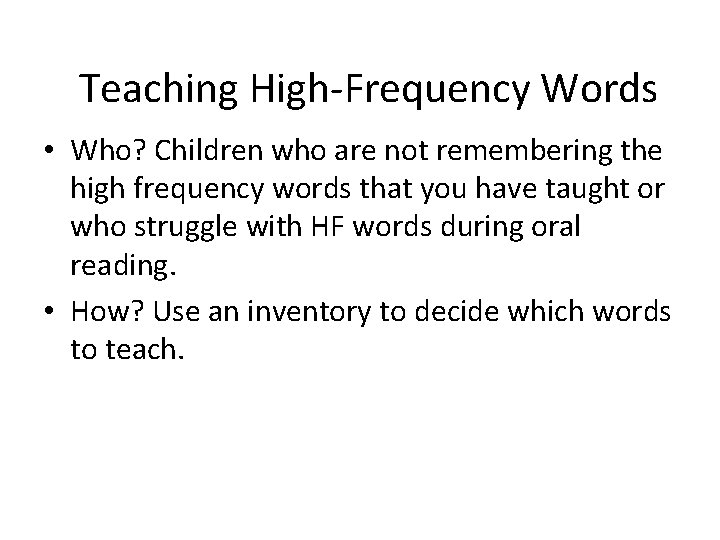
Teaching High-Frequency Words • Who? Children who are not remembering the high frequency words that you have taught or who struggle with HF words during oral reading. • How? Use an inventory to decide which words to teach.
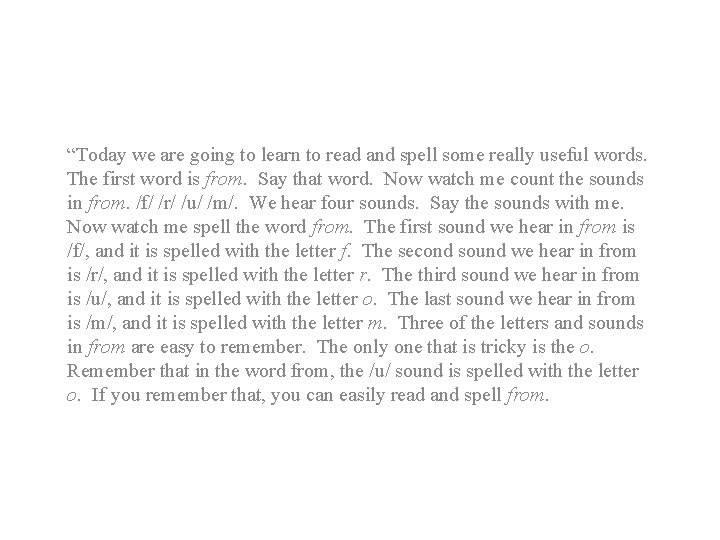
“Today we are going to learn to read and spell some really useful words. The first word is from. Say that word. Now watch me count the sounds in from. /f/ /r/ /u/ /m/. We hear four sounds. Say the sounds with me. Now watch me spell the word from. The first sound we hear in from is /f/, and it is spelled with the letter f. The second sound we hear in from is /r/, and it is spelled with the letter r. The third sound we hear in from is /u/, and it is spelled with the letter o. The last sound we hear in from is /m/, and it is spelled with the letter m. Three of the letters and sounds in from are easy to remember. The only one that is tricky is the o. Remember that in the word from, the /u/ sound is spelled with the letter o. If you remember that, you can easily read and spell from.
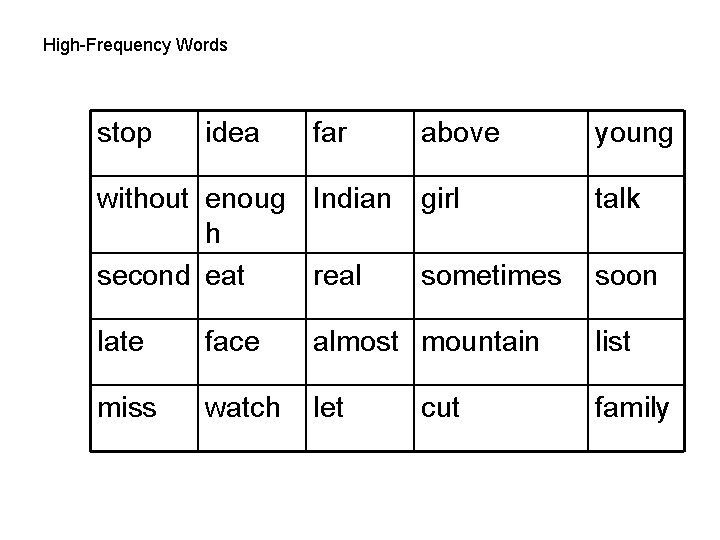
High-Frequency Words stop idea far without enoug Indian h second eat real above young girl talk sometimes soon late face almost mountain list miss watch let family cut
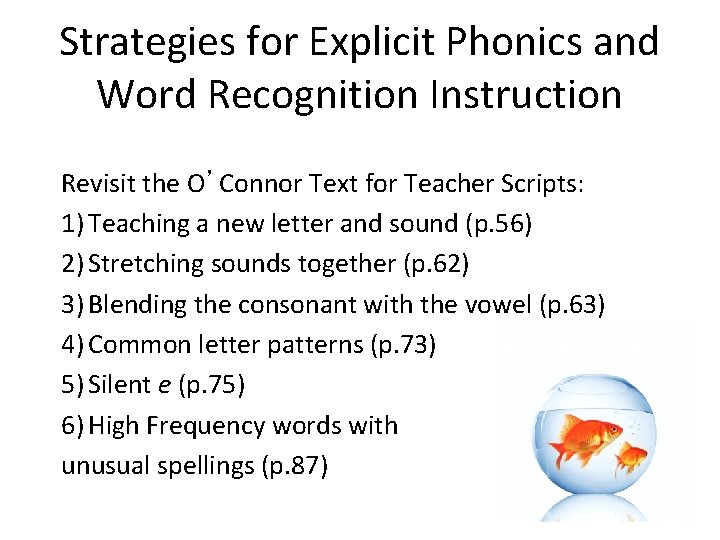
Strategies for Explicit Phonics and Word Recognition Instruction Revisit the O’Connor Text for Teacher Scripts: 1) Teaching a new letter and sound (p. 56) 2) Stretching sounds together (p. 62) 3) Blending the consonant with the vowel (p. 63) 4) Common letter patterns (p. 73) 5) Silent e (p. 75) 6) High Frequency words with unusual spellings (p. 87)
Short Vowel Word Families
Consonant Blends cl pl clown clock plate plant claw pliers
Consonant Digraphs shark cherry shirt shave chick shark cherry chick chop shave shirt chop
Magic-e Words CV C Ce CV hug cube sun flute tube
On-line resources to help you implement your phonics curriculum CIERA series Every child a reader http: //www. ciera. org/library/products/ecr/index. html PALS website http: //pals. virginia. edu/Instructional-Resources/ Florida Center for Reading Research http: //fcrr. org Georgia Reading First Professional Development Webpage http: //www. georgiasouthern. edu/~mmckenna/garf. html