
Speed and Velocity pg 5 in NB Objectives
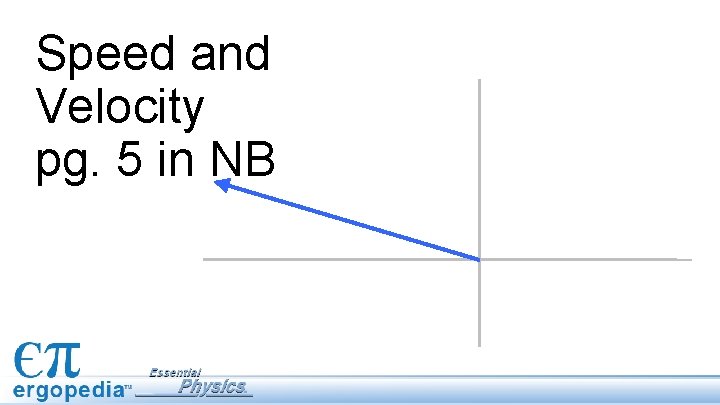
Speed and Velocity pg. 5 in NB
Objectives • Describe one dimensional motion using equations for speed and velocity. • Analyze one dimensional motion using equations for speed and velocity. • Define and identify positive and negative velocities. Terms • Speed • Velocity
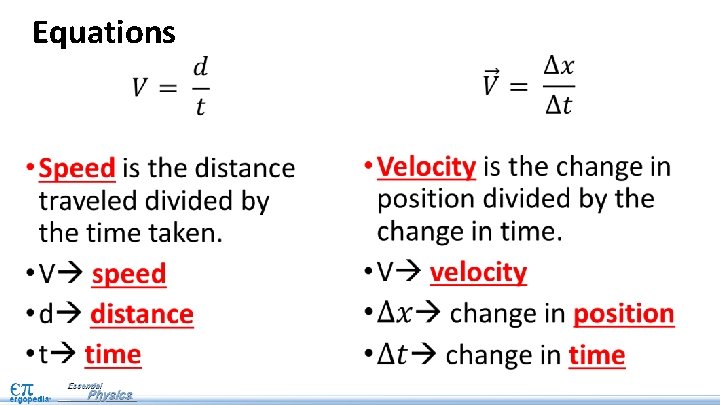
Equations • •
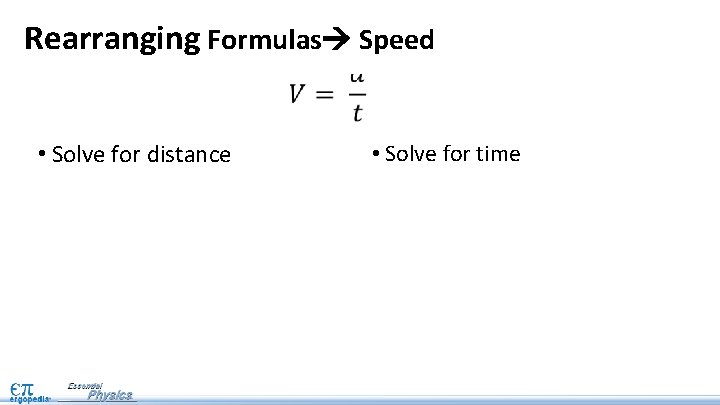
Rearranging Formulas Speed • Solve for distance • Solve for time
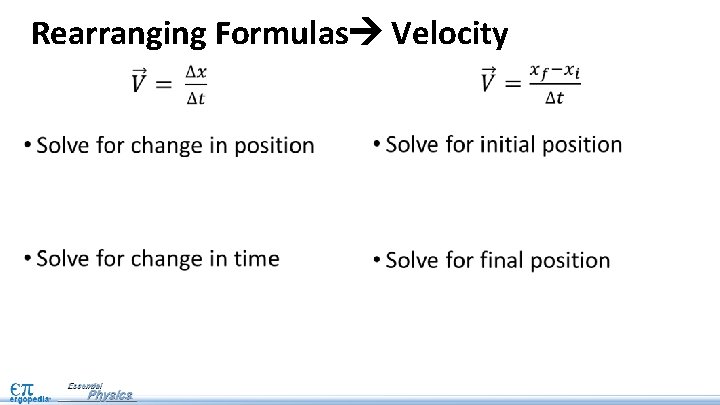
Rearranging Formulas Velocity • •
Speed vs. Velocity • Are speed & velocity just two different words for the same thing? • In everyday life you probably use these words interchangeably. • In Physics class, speed and velocity are related, but NOT exactly the same.
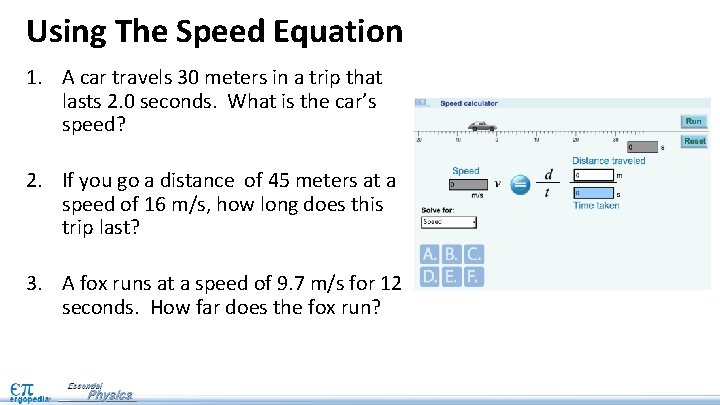
Using The Speed Equation 1. A car travels 30 meters in a trip that lasts 2. 0 seconds. What is the car’s speed? 2. If you go a distance of 45 meters at a speed of 16 m/s, how long does this trip last? 3. A fox runs at a speed of 9. 7 m/s for 12 seconds. How far does the fox run?
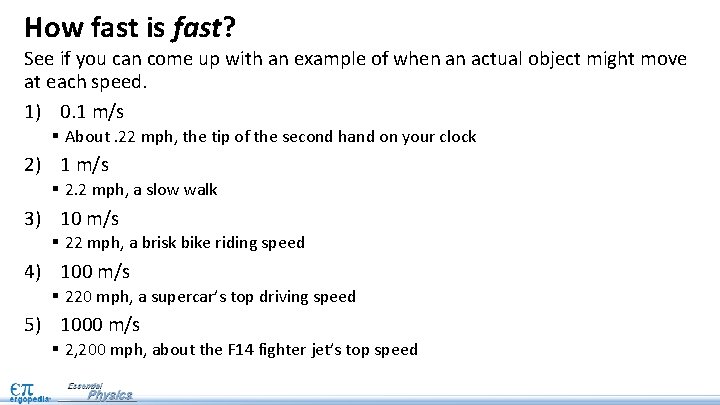
How fast is fast? See if you can come up with an example of when an actual object might move at each speed. 1) 0. 1 m/s § About. 22 mph, the tip of the second hand on your clock 2) 1 m/s § 2. 2 mph, a slow walk 3) 10 m/s § 22 mph, a brisk bike riding speed 4) 100 m/s § 220 mph, a supercar’s top driving speed 5) 1000 m/s § 2, 200 mph, about the F 14 fighter jet’s top speed
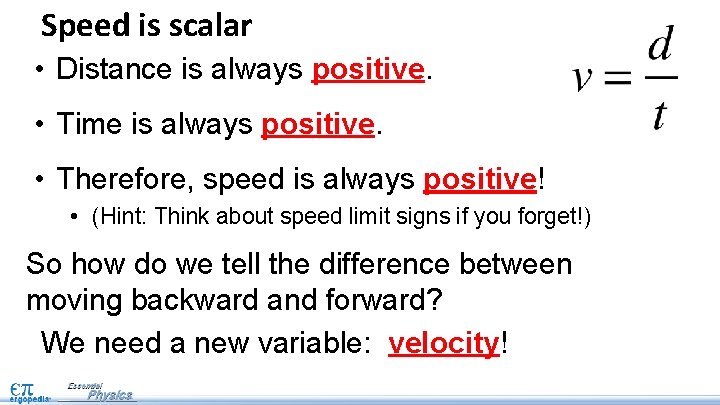
Speed is scalar • Distance is always positive. • Time is always positive. • Therefore, speed is always positive! • (Hint: Think about speed limit signs if you forget!) So how do we tell the difference between moving backward and forward? We need a new variable: velocity!
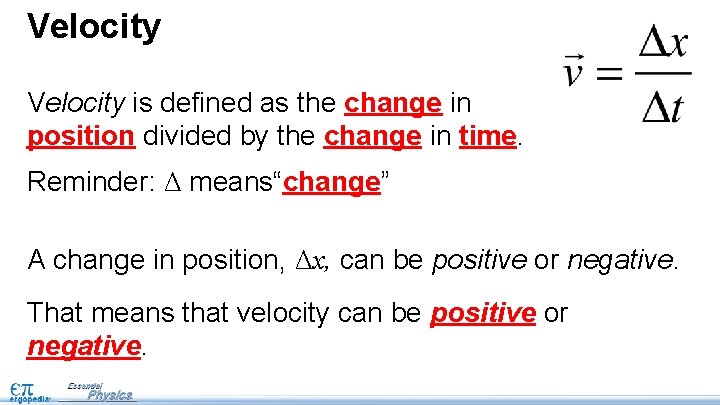
Velocity is defined as the change in position divided by the change in time. Reminder: Δ means“change” A change in position, Δx, can be positive or negative. That means that velocity can be positive or negative.
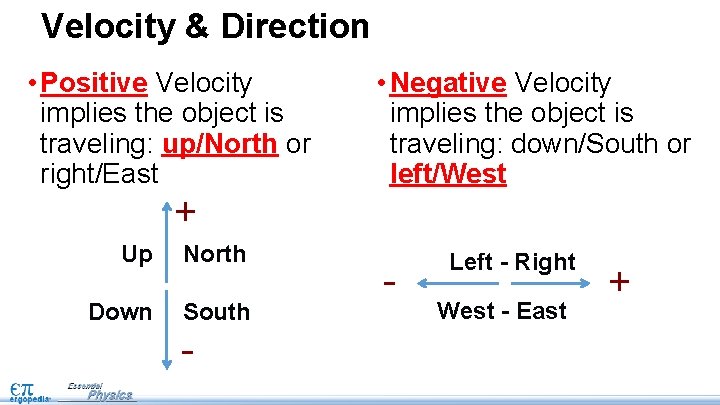
Velocity & Direction • Positive Velocity implies the object is traveling: up/North or right/East • Negative Velocity implies the object is traveling: down/South or left/West + Up North Down South - - Left - Right West - East +
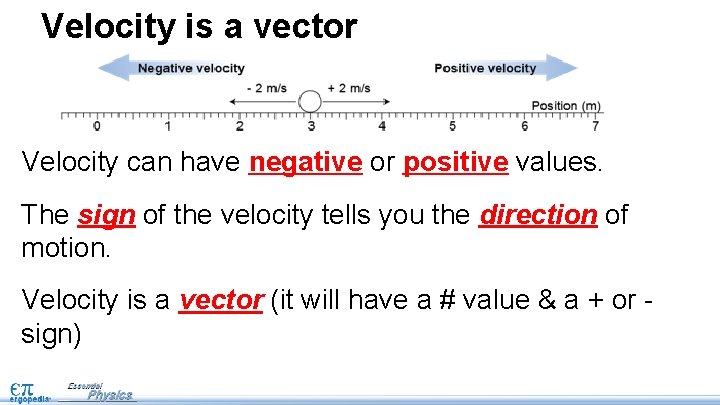
Velocity is a vector Velocity can have negative or positive values. The sign of the velocity tells you the direction of motion. Velocity is a vector (it will have a # value & a + or sign)
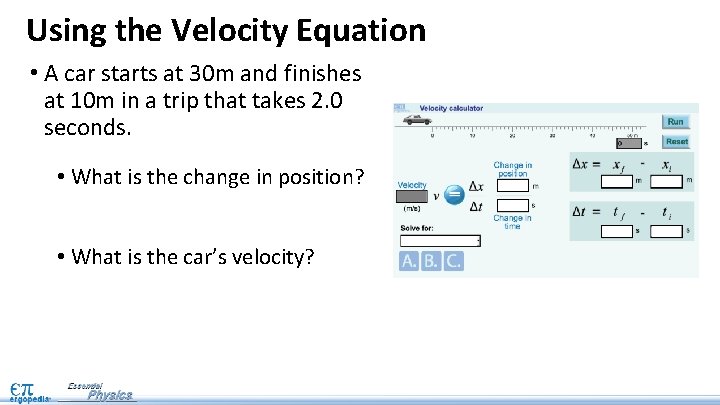
Using the Velocity Equation • A car starts at 30 m and finishes at 10 m in a trip that takes 2. 0 seconds. • What is the change in position? • What is the car’s velocity?
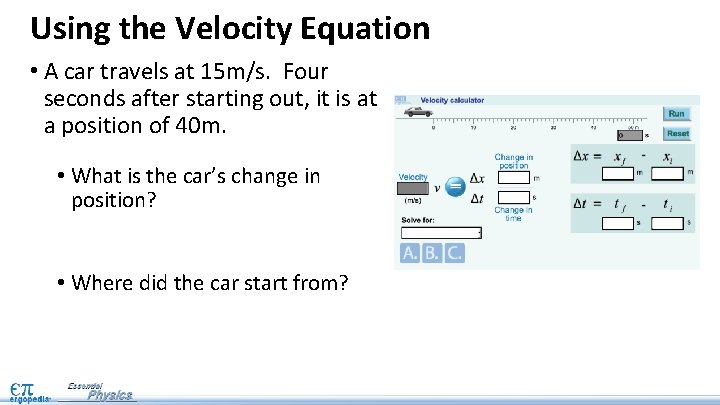
Using the Velocity Equation • A car travels at 15 m/s. Four seconds after starting out, it is at a position of 40 m. • What is the car’s change in position? • Where did the car start from?

Finding Change in Position •
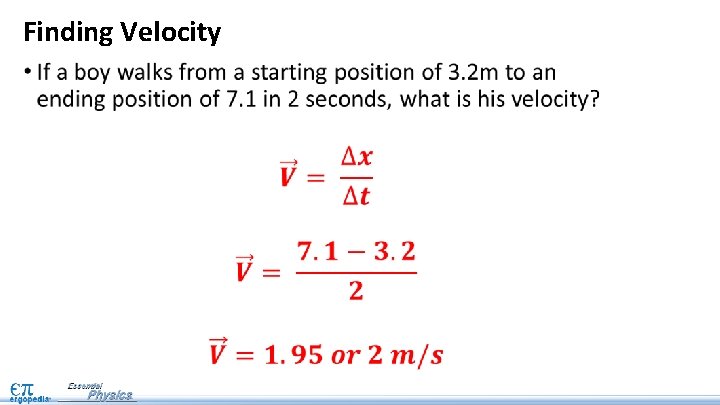
Finding Velocity •
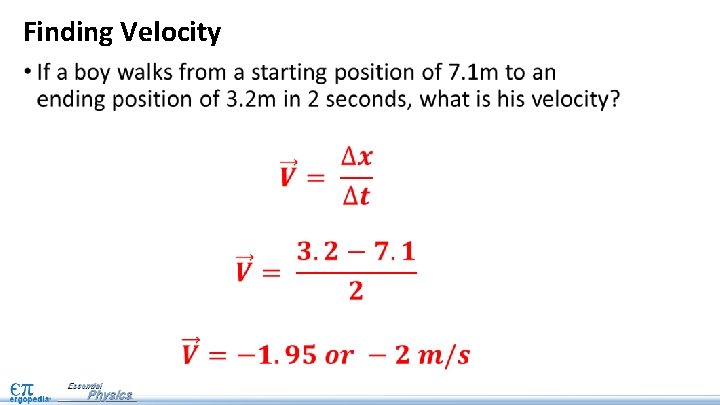
Finding Velocity •
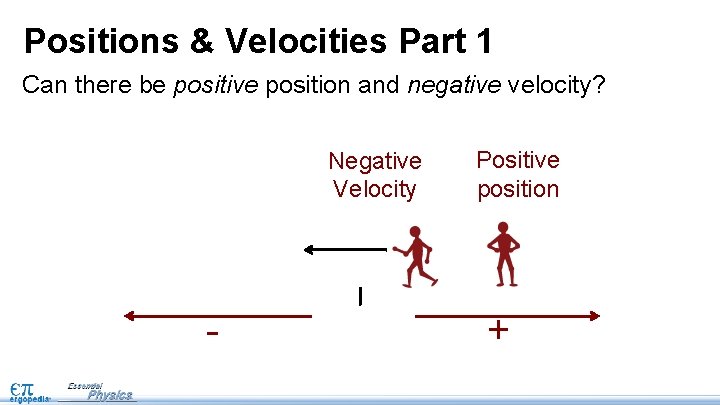
Positions & Velocities Part 1 Can there be positive position and negative velocity? Negative Velocity velocity - 0 Positive position +
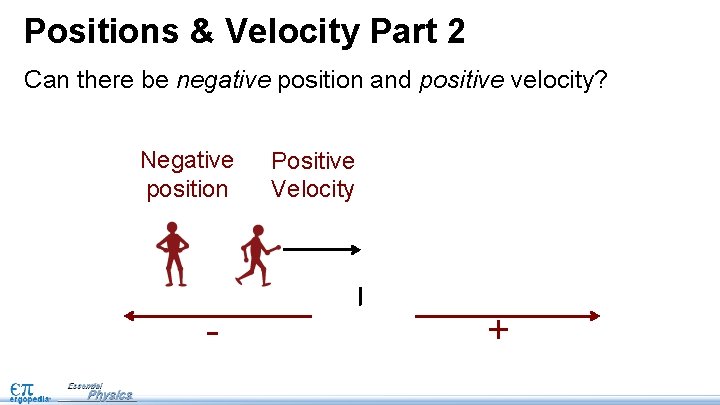
Positions & Velocity Part 2 Can there be negative position and positive velocity? Negative position - Positive Velocity velocity 0 +
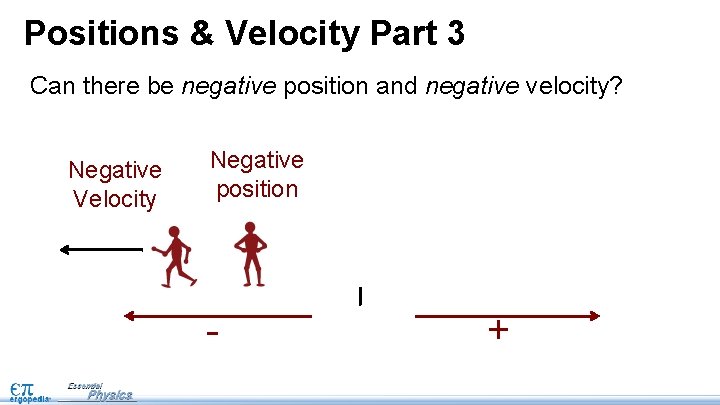
Positions & Velocity Part 3 Can there be negative position and negative velocity? Negative Velocity velocity Negative position - 0 +
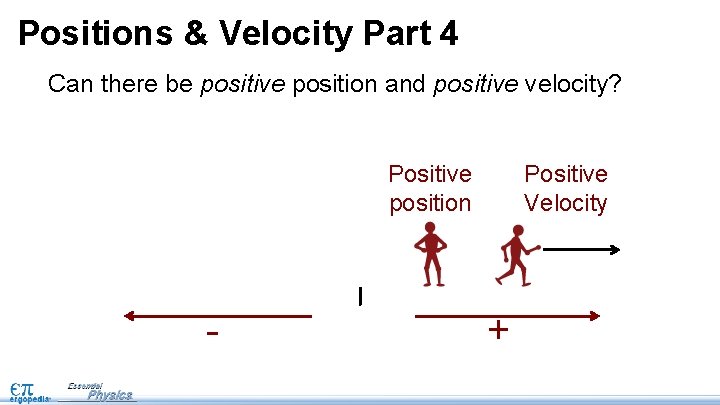
Positions & Velocity Part 4 Can there be positive position and positive velocity? Positive position - 0 Positive Velocity velocity +
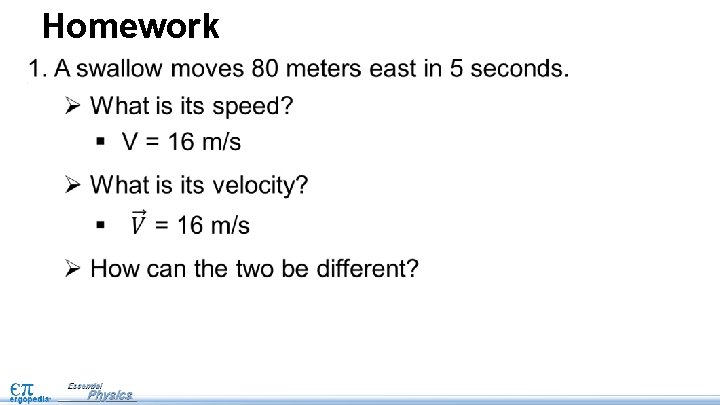
Homework
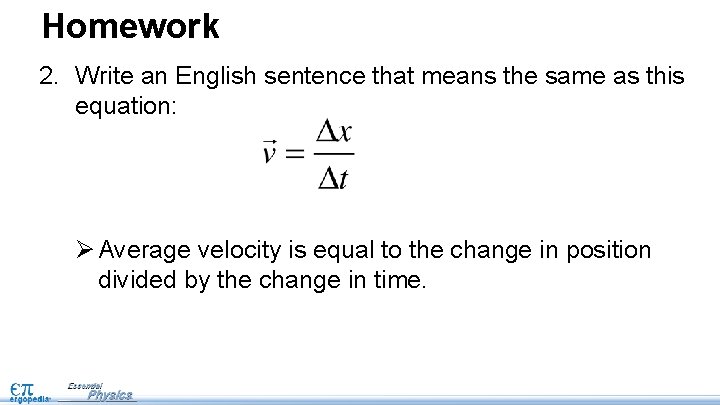
Homework 2. Write an English sentence that means the same as this equation: Ø Average velocity is equal to the change in position divided by the change in time.
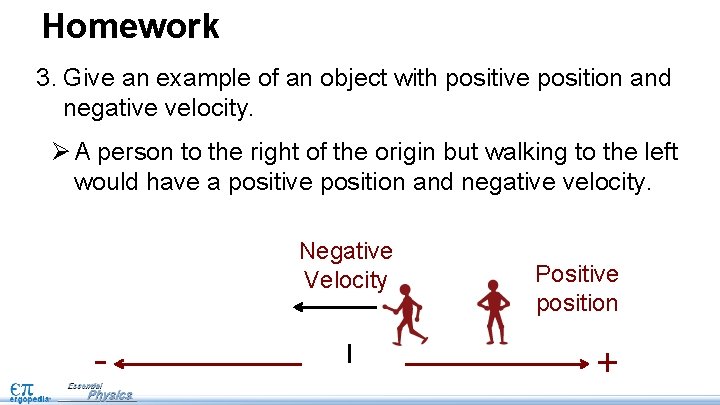
Homework 3. Give an example of an object with positive position and negative velocity. Ø A person to the right of the origin but walking to the left would have a positive position and negative velocity. Negative velocity Velocity - 0 Positive position +
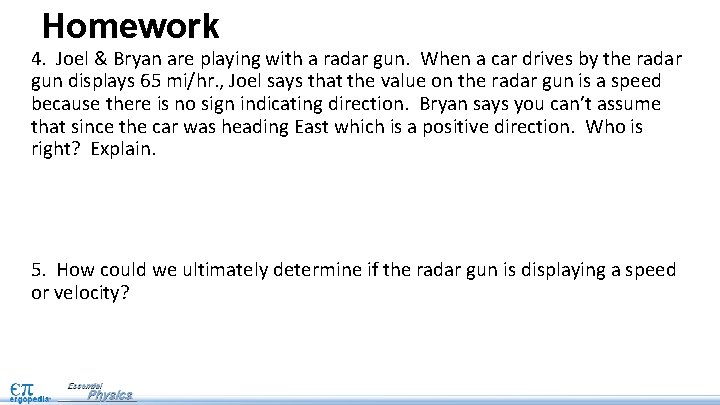
Homework 4. Joel & Bryan are playing with a radar gun. When a car drives by the radar gun displays 65 mi/hr. , Joel says that the value on the radar gun is a speed because there is no sign indicating direction. Bryan says you can’t assume that since the car was heading East which is a positive direction. Who is right? Explain. 5. How could we ultimately determine if the radar gun is displaying a speed or velocity?
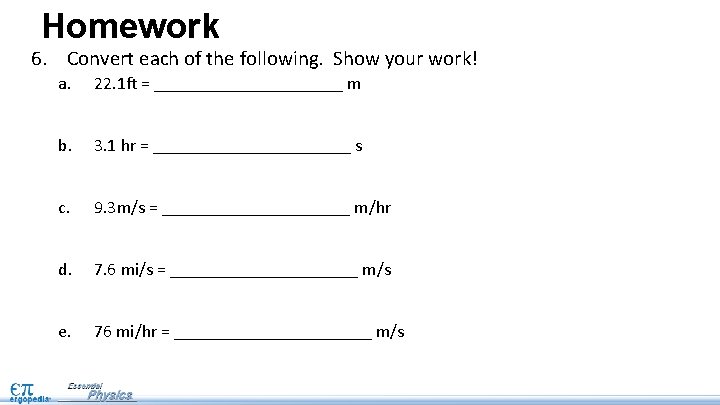
Homework 6. Convert each of the following. Show your work! a. 22. 1 ft = ___________ m b. 3. 1 hr = ___________ s c. 9. 3 m/s = ___________ m/hr d. 7. 6 mi/s = ___________ m/s e. 76 mi/hr = ___________ m/s
- Slides: 26