
Speech Unit Vocabulary Definition of Validate 1 Stamp
Speech Unit
Vocabulary: Definition of Validate 1. Stamp a parking ticket so the customer doesn’t have to pay for parking 2. Affirm or prove the value of something.
Part 1: Lance Miller “The Ultimate Question” https: //www. youtube. com/watch? v=yqdipkq 9 Tm. A
How to create a spell-binding story…lessons from Lance Miller’s speech “The Ultimate Question” (Kariah): Your opening should create curiosity and questions in your audience’s mind • “What’s he talking about? ” • The Ultimate Question… Introduce your problem or conflict early in the speech • Lance introduces his problem: his life was “going nowhere” • The audience wonders how it will end
How to create a spell-binding story…lessons from Lance Miller’s speech “The Ultimate Question”: Introduce a “catalyst for change” Øa guru (wise person)who says something deep and inspiring OR Øa hero that impacts the main character to change • the receptionist in Lance’s speech • The speaker should not be the hero
How to create a spell-binding story…lessons from Lance Miller’s speech “The Ultimate Question”: v“Get the audience members to laugh and learn at the same time” v. Use stories from your everyday life; they don’t have to be dramatic v. Ask yourself, “What lessons can I learn from this story? ”
How to create a spell-binding story…lessons from Lance Miller’s speech “The Ultimate Question”: • Give your audience the resolution: • When Lance validates others, his life gets better • Show the change in character: • Lance before the catalyst for change • Lance after the catalyst for change
How to create a spell-binding story…lessons from Lance Miller’s speech “The Ultimate Question”: Repeat the catch phrase often & keep it short • Martin Luther King: “I have a dream” • Barack Obama speech in 2008: “Yes, we can!” • Lance Miller: “Chi Chink”
How to create a spell-binding story…lessons from Lance Miller’s speech “The Ultimate Question”: End with audience participation Ending should be memorable!
Part 2: Ian Humphrey “It’s Not About the Knockdown”
How to create a spell-binding story…lessons from Ian Humphrey’s speech “It’s Not About the Knockdown”: • Begin with a BOOM! • Start off in the middle of the action • Use a metaphor • Boxing = Life • Helps make abstract concepts easier to understand • Good memory tool
Part 3: Advice from Akash Karia, author of Storytelling Techniques for Electrifying Presentations
Advice from Akash Karia, author of Storytelling Techniques for Electrifying Presentations If you’re having a hard time planning your speech: • Look for stories from your everyday life • Your story can be very simple…but it must be included to support your takeaway message • Which experience have you gone through that has taught you about life?
Advice from Akash Karia You don’t have to make people cry • Maybe you will make people laugh • Maybe you will make people think BUT • You must create some kind of emotional change in your audience
Advice from Akash Karia Make your story come alive • Give specific details • Use beautiful and clear description to paint a picture for your audience • Describe your characters enough so the audience can picture them
Assignment: Creating Your Own Speech
Planning your speech • Brainstorm ideas • Forward: Start with a personal experience determine the life lesson • Backward: Start with the life lesson determine the personal experience you will share • Use the chart provided to plan the essential parts of your speech
Writing your speech • Work on one main idea at a time (check this before continuing) • Write down exactly what you’re going to say…as if you are actually talking to your audience. • Helpful tips for writing Oral Language: ØSay it out loud before you write it down ØMake sure the sentences are “speaking length” (conversational style) ØUse words that your audience will understand easily
Writing your speech • Make sure you link one idea to the next • Spend a lot of time working on your opening and closing: these will be the main parts your audience remembers.
Format for Your Speech Script • Set your document up with MLA format • Headings • Title • Body of Script • NO indentations • 1. 15 spacing between each line • Double spacing between each new idea
Checking Your Speech 1. Read through your speech to make sure you have all the required elements. 2. Read through your speech to check that your ideas are all linked well. 3. Read through your speech to check for sentence structure, language use, and tone. 4. Read through your speech to check for timing: decide if you need to cut something out or add something in.
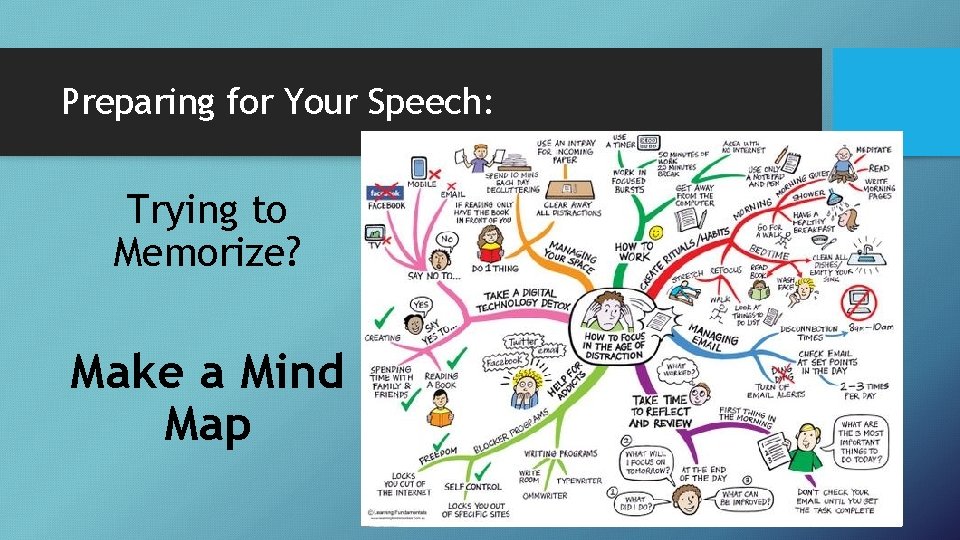
Preparing for Your Speech: Trying to Memorize? Make a Mind Map
Sources Anderson, Chris. “TED’s secret to great public speaking. ” Youtube, April 19, 2016. Accessed on 22 October 2017. Feloni, Richard. “ 7 Presentation tips from the 2015 world champion of public speaking. ” Business Insider. Sep 2, 2015. www. businessinsider. com. Accessed on 29 October 2017. Karia, Akash. Public Speaking Storytelling Techniques for Electrifying Presentations. Akesh Karia, 2015. Miller, Fred E. “Personal Branding: Mind Map Infograph. ” http: //mastermindmapper. com/. Accessed on 2 November 2017
- Slides: 23