
Speech Therapy for students with Clefting Loretta Dunkmann
- Slides: 33
Speech Therapy for students with Clefting Loretta Dunkmann, MS, CFY-SLP
Anatomy and Physiology Clefting is not about what happens; it is about what does not happen.
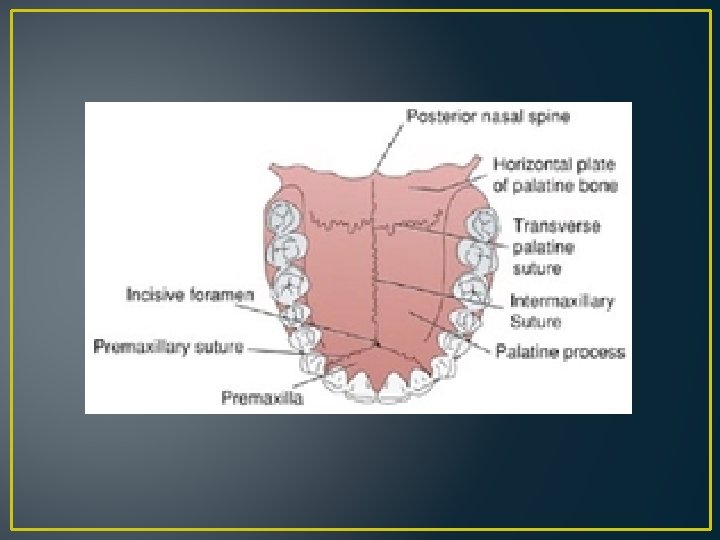
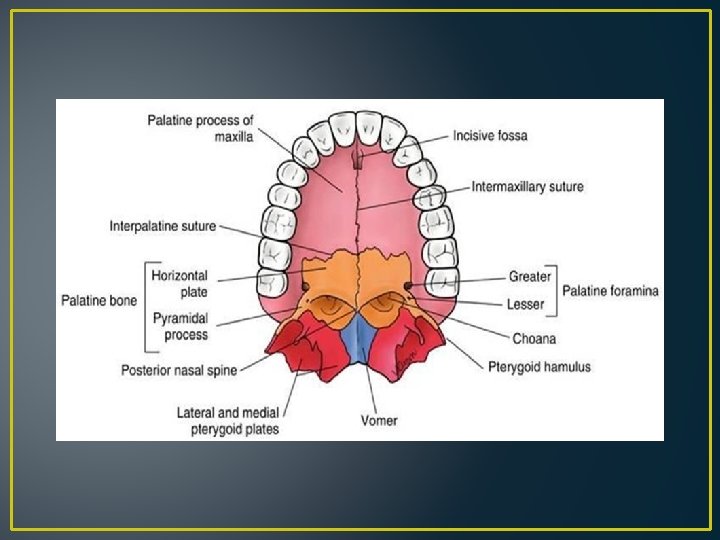
• Alveolar ridge—forms sulcus between hard palate and lip • Hard palate formed by medial projections of the palatine process of the maxillary bone—suture at midline • Palatine process is anterior ¾ of hard palate • Posterior ¼ paired palatine bones
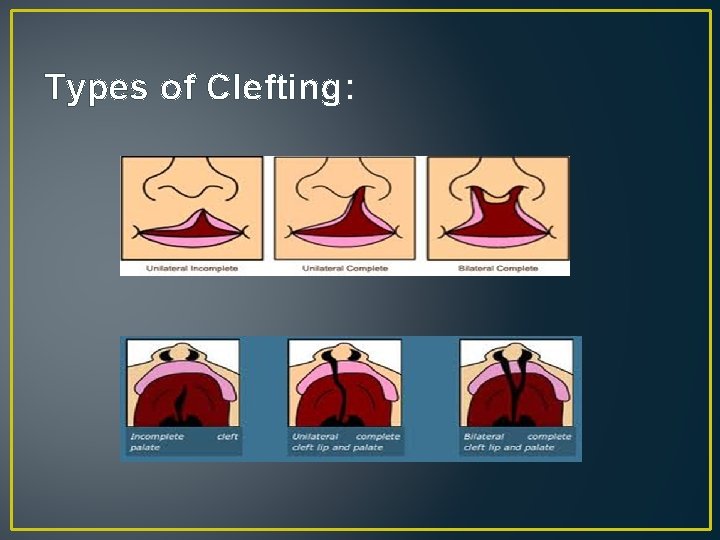
Types of Clefting:
Assessment
Obtain Adequate Sample • Background Information • Important that surgeries are included…they play a role in resonance • Oral Mechanism Exam • A thorough exam may explain resonance issues • Standardized Assessment • For Qualification Reasons • Peripheral Speech Assessment • Connected Speech Sample • Hypernasality may only be noticed during connected speech • Specialized sampling contexts (sensitive to cleft type speech errors) • Handout attached
Oral Mechanism Exam • Note all the things you usually note • • • Tonsils? • Lip scars? • Palate scars? • High arched palate? • Palatal Lift? Malocclusion?
Analyze Speech Sample • • • Rate Overall intelligibility Document phonetic inventory Document speech resonance Document nasal air emission Classify errors
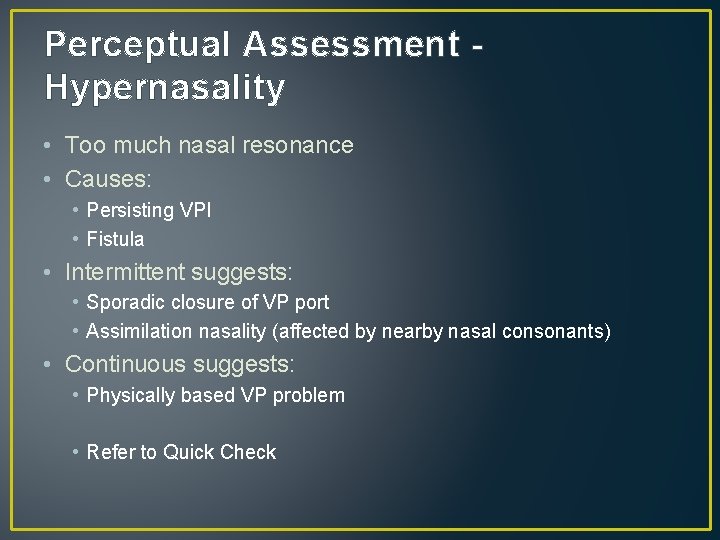
Perceptual Assessment Hypernasality • Too much nasal resonance • Causes: • Persisting VPI • Fistula • Intermittent suggests: • Sporadic closure of VP port • Assimilation nasality (affected by nearby nasal consonants) • Continuous suggests: • Physically based VP problem • Refer to Quick Check
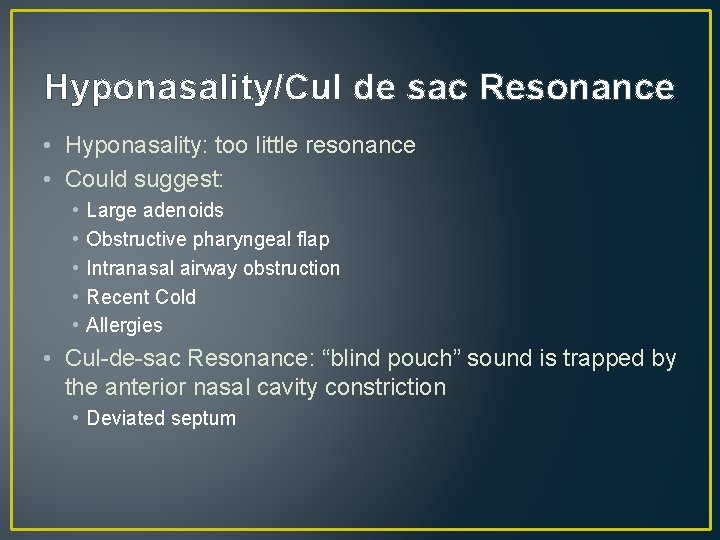
Hyponasality/Cul de sac Resonance • Hyponasality: too little resonance • Could suggest: • • • Large adenoids Obstructive pharyngeal flap Intranasal airway obstruction Recent Cold Allergies • Cul-de-sac Resonance: “blind pouch” sound is trapped by the anterior nasal cavity constriction • Deviated septum
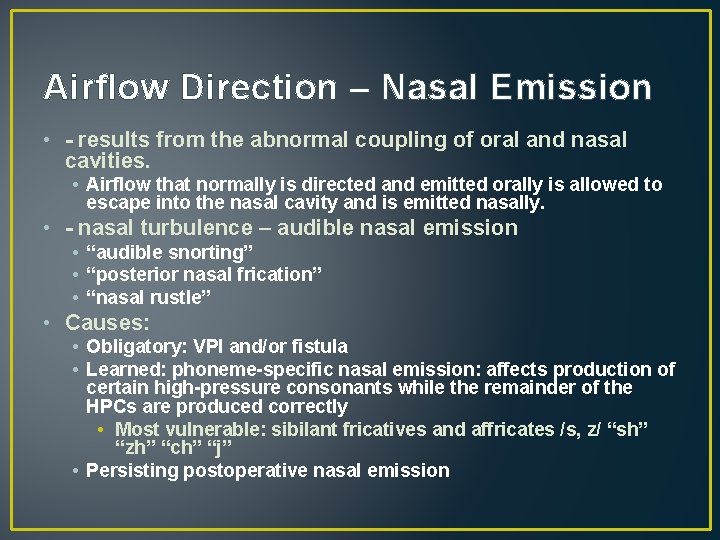
Airflow Direction – Nasal Emission • - results from the abnormal coupling of oral and nasal cavities. • Airflow that normally is directed and emitted orally is allowed to escape into the nasal cavity and is emitted nasally. • - nasal turbulence – audible nasal emission • “audible snorting” • “posterior nasal frication” • “nasal rustle” • Causes: • Obligatory: VPI and/or fistula • Learned: phoneme-specific nasal emission: affects production of certain high-pressure consonants while the remainder of the HPCs are produced correctly • Most vulnerable: sibilant fricatives and affricates /s, z/ “sh” “zh” “ch” “j” • Persisting postoperative nasal emission
Therapy
Collaboration • Get the parents to sign a release allowing you to communicate with their medical team. • “I would like for school clinicians to feel that they are a part of the medical team, and for them to be in regular contact with the team SLP. They are the clinician closest to the child, who knows the child best and is in the child's day to day world. The team SLP is not. The team cannot provide optimal care without collaboration from the school or community SLP. ” • Share your evaluation report and IEP with the medical team.
• For any neurologically normal child born with a cleft, the expectation is for • NORMAL SPEECH
Errors • Obligatory errors: • Errors that are caused by structural or neurogenic problems • Such as • Fistulas • VP insufficiency • These errors require physical management • Learned Errors • Habituated errors that are the result of early mislearning. • They exist and persist in the context of adequate VP closure and required speech remediation. • AKA: • Maladaptive errors • Compensatory misarticulations
Purposes of Early Speech-Language Stimulation Program (Phillips, ) • To develop the child’s confidence in ability to achieve intelligible verbal communication • To ally parental anxiety concerning the child’s development of verbal communication • To encourage development of communication skills to the maximum of the child’s potential --Structural ability to produce consonants influences early lexicon (Willadsen, 2013). • To minimize or prevent development of compensatory articulation and voice patterns • To determine velopharyngeal competence as early as possible
• Encourage parents to respond to child with prolonged vowel sounds or front sounds as oppose to back noises. • No growling • No car noises
• Depending on extent of the cleft, child may selectively avoid the hard palate as a key articulator, preferring to produce sounds that do not require linguapalatal contacts. • Coupling of the nasal and oral cavities will impound intraoral air pressure resulting in distorted productions, avoiding productions of /b/ and /d/ during babbling • Chronic middle ear infections accompanying conductive hearing loss • All these factors can influence the sounds that the baby chooses to produce…therefore resulting in the compensatory techniques we work on correcting.
School Based Therapy • Errors we can work with • Maladaptive compensatory productions • Backed oral productions • Pharyngeal stops, fricatives, affricates • Glottal stops • Nasal air emission • Obligatory errors we cannot correct: • Nasal emission and hypernasality caused by VPI • Nasal air loss caused by fistulas • Adaptive oral misarticulations resulting from structural abnormalities or severe malocclusions
School Based Therapy When To Start: Frequency & Duration • Get these answers: • Daily Basis…that would be awesome…but not • Understand child’s hearing realistic status • Twice weekly • Functional status of VP • 30 minutes sessions mechanism • Preferably 1: 1 • Oral structural hazards to • Supplement with daily speech progress speech homework/home • Plans for ongoing team practice program care
School Based Therapy • Teaching Correct Oral Airflow • • • Blowing bubbles Whistles Blowing against cotton balls Blowing through a straw Nose pinching • **Note: these are not to be used as oral motor exercises, this is strictly to teach the student correct air flow movement.
School Based Therapy Approach • Traditional Articulation Therapy • Isolation • Syllables • CV, VC, CVC, VCV • Words • Initial – medial – final • Phrases • Sentences • Reading Tasks • Lynn Marty-Grames recommends 100% accuracy at each level before progressing. Resource • Eliciting Sounds Techniques and Strategies for Clinicians – 2 nd Edition Wayne A. Secord (2007)
School Based Therapy • Target Sound Selection • Target errors that have the greatest impact on speech understandability and acceptability • This could mean going out of developmental sequence • Stimulability • Visibility • Place of production • Anterior sounds first • Manner • Fricatives will typically be easier than stops
• Children with clefts make a variety of articulation error types • • Not all errors are compensatory errors • • There are four speech sound categories in cleft palate speech, we will talk about these shortly.
• If the child with a cleft needs braces, you can work on articulation, especially [s], until after orthodontics is completed. • Most often, the error is the result of what the tongue is doing, not the position of the teeth. • • Diagnostic therapy should always be attempted. • Certain orthodontic appliances may complicate speech therapy, depending on what you are working on.
VPI
• If the child has velopharyngeal dysfunction, you can’t work on articulation until after surgery. • VPD alters airflow, not articulatory function. • While some children develop maladaptive patterns, not all do.
• What could articulation therapy do? • It may show us that velopharyngeal management is not needed. • It may prepare the child for valid imaging studies. • • It will make the child’s speech more intelligible. • It’s possible to have completely normal articulation and still be hypernasal. • • In some cases, articulation therapy must take place before velopharyngeal imaging. • Refer to a cleft team speech pathologist with a velopharyngeal imaging lab instead!
• Delaying articulation therapy delays speech normalization. • • The better the articulation, the better the intelligibility after VP management • If the velopharynx is dysfunctional, it will be dysfunctional across the phoneme spectrum • If only a certain few sounds come out the nose, and the others don’t…. • • It probably is an articulation problem……your problem! • Mild forms of VPI may only manifest in the complexity of conversation • • Sometimes, the velopharynx can push closed for short utterances, but can’t sustain over time.