
Speech synthesis 1 Speech synthesis What is the
- Slides: 22
Speech synthesis 1
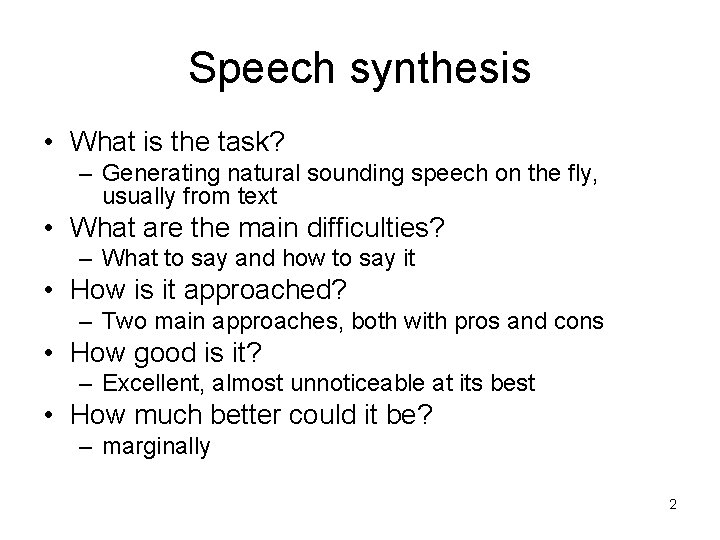
Speech synthesis • What is the task? – Generating natural sounding speech on the fly, usually from text • What are the main difficulties? – What to say and how to say it • How is it approached? – Two main approaches, both with pros and cons • How good is it? – Excellent, almost unnoticeable at its best • How much better could it be? – marginally 2
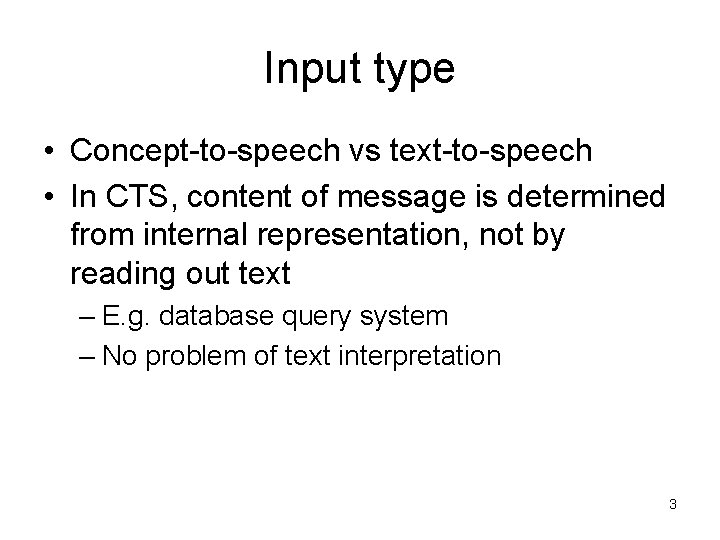
Input type • Concept-to-speech vs text-to-speech • In CTS, content of message is determined from internal representation, not by reading out text – E. g. database query system – No problem of text interpretation 3
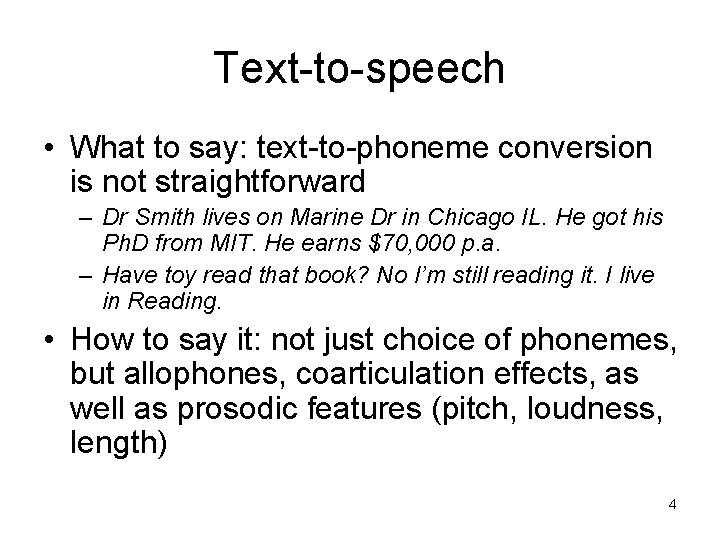
Text-to-speech • What to say: text-to-phoneme conversion is not straightforward – Dr Smith lives on Marine Dr in Chicago IL. He got his Ph. D from MIT. He earns $70, 000 p. a. – Have toy read that book? No I’m still reading it. I live in Reading. • How to say it: not just choice of phonemes, but allophones, coarticulation effects, as well as prosodic features (pitch, loudness, length) 4
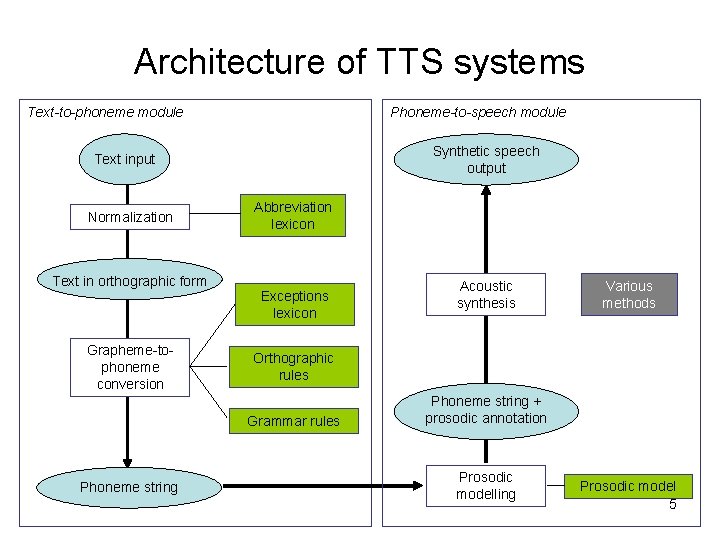
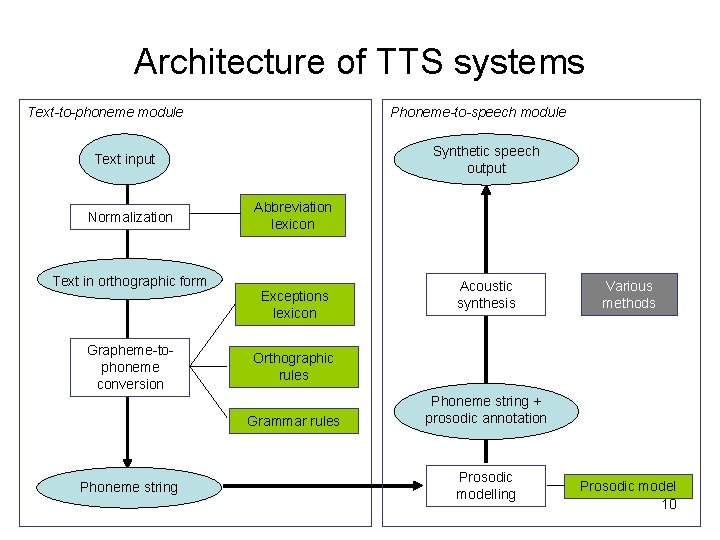
Architecture of TTS systems Text-to-phoneme module Phoneme-to-speech module Synthetic speech output Text input Normalization Text in orthographic form Grapheme-tophoneme conversion Abbreviation lexicon Exceptions lexicon Various methods Orthographic rules Grammar rules Phoneme string Acoustic synthesis Phoneme string + prosodic annotation Prosodic modelling Prosodic model 5
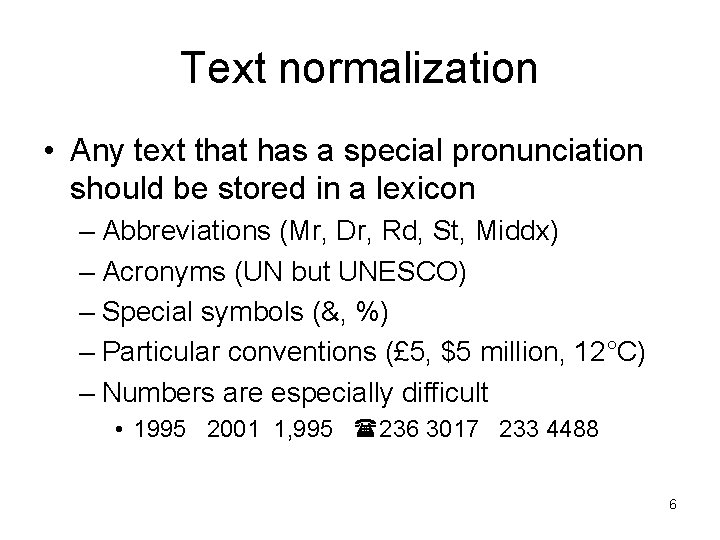
Text normalization • Any text that has a special pronunciation should be stored in a lexicon – Abbreviations (Mr, Dr, Rd, St, Middx) – Acronyms (UN but UNESCO) – Special symbols (&, %) – Particular conventions (£ 5, $5 million, 12°C) – Numbers are especially difficult • 1995 2001 1, 995 236 3017 233 4488 6
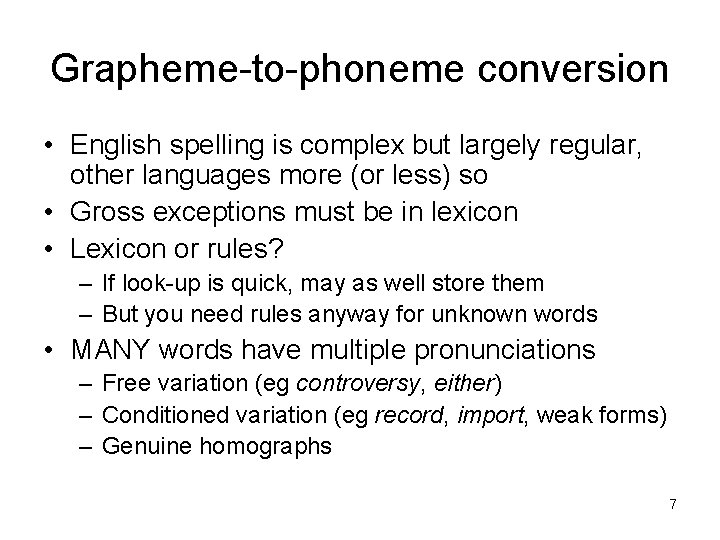
Grapheme-to-phoneme conversion • English spelling is complex but largely regular, other languages more (or less) so • Gross exceptions must be in lexicon • Lexicon or rules? – If look-up is quick, may as well store them – But you need rules anyway for unknown words • MANY words have multiple pronunciations – Free variation (eg controversy, either) – Conditioned variation (eg record, import, weak forms) – Genuine homographs 7
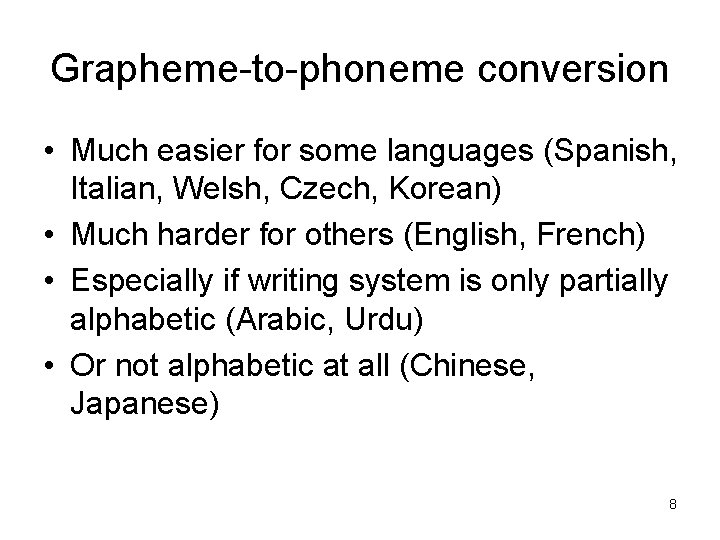
Grapheme-to-phoneme conversion • Much easier for some languages (Spanish, Italian, Welsh, Czech, Korean) • Much harder for others (English, French) • Especially if writing system is only partially alphabetic (Arabic, Urdu) • Or not alphabetic at all (Chinese, Japanese) 8
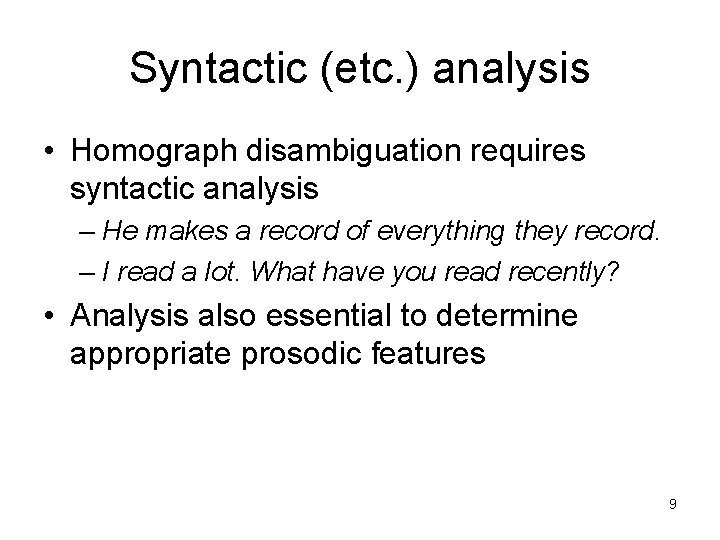
Syntactic (etc. ) analysis • Homograph disambiguation requires syntactic analysis – He makes a record of everything they record. – I read a lot. What have you read recently? • Analysis also essential to determine appropriate prosodic features 9
Architecture of TTS systems Text-to-phoneme module Phoneme-to-speech module Synthetic speech output Text input Normalization Text in orthographic form Grapheme-tophoneme conversion Abbreviation lexicon Exceptions lexicon Various methods Orthographic rules Grammar rules Phoneme string Acoustic synthesis Phoneme string + prosodic annotation Prosodic modelling Prosodic model 10
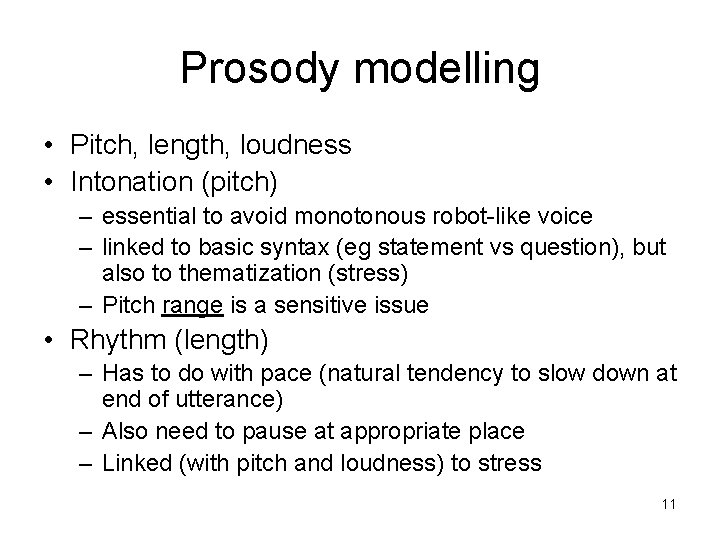
Prosody modelling • Pitch, length, loudness • Intonation (pitch) – essential to avoid monotonous robot-like voice – linked to basic syntax (eg statement vs question), but also to thematization (stress) – Pitch range is a sensitive issue • Rhythm (length) – Has to do with pace (natural tendency to slow down at end of utterance) – Also need to pause at appropriate place – Linked (with pitch and loudness) to stress 11
Acoustic synthesis • Alternative methods: – Articulatory synthesis – Formant synthesis – Concatenative synthesis – Unit selection synthesis 12
Articulatory synthesis • Simulation of physical processes of human articulation • Wolfgang von Kempelen (1734 -1804) and others used bellows, reeds and tubes to construct mechanical speaking machines • Modern versions simulate electronically the effect of articulator positions, vocal tract shape, etc. • Too much like hard work 13
Formant synthesis • Reproduce the relevant characteristics of the acoustic signal • In particular, amplitude and frequency of formants • But also other resonances and noise, eg for nasals, laterals, fricatives etc. • Values of acoustic parameters are derived by rule from phonetic transcription • Result is intelligible, but too “pure” and sounds synthetic 14
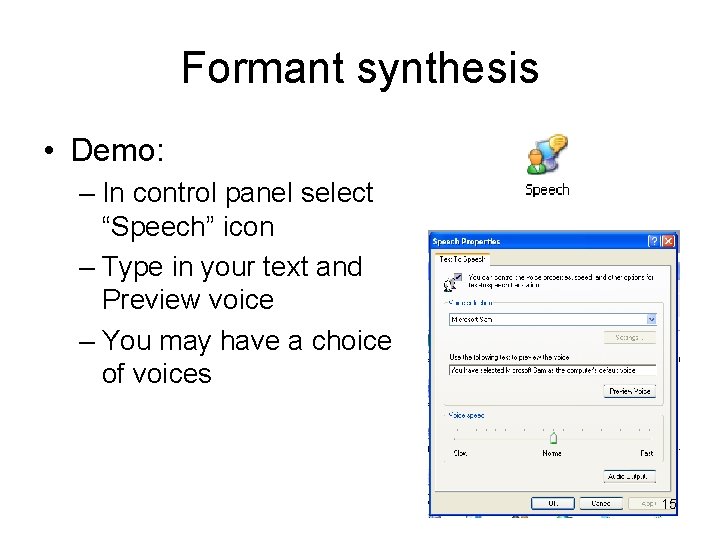
Formant synthesis • Demo: – In control panel select “Speech” icon – Type in your text and Preview voice – You may have a choice of voices 15
Concatenative synthesis • Concatenate segments of pre-recorded natural human speech • Requires database of previously recorded human speech covering all the possible segments to be synthesised • Segment might be phoneme, syllable, word, phrase, or any combination • Or, something else more clever. . . 16
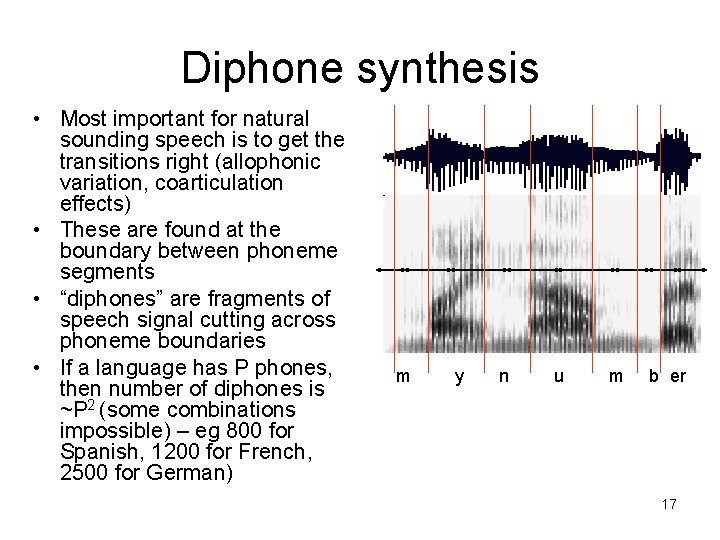
Diphone synthesis • Most important for natural sounding speech is to get the transitions right (allophonic variation, coarticulation effects) • These are found at the boundary between phoneme segments • “diphones” are fragments of speech signal cutting across phoneme boundaries • If a language has P phones, then number of diphones is ~P 2 (some combinations impossible) – eg 800 for Spanish, 1200 for French, 2500 for German) m y n u m b er 17
Diphone synthesis • Most systems use diphones because they are – Manageable in number – Can be automatically extracted from recordings of human speech – Capture most inter-allophonic variants • But they do not capture all coarticulatory effects, so some systems include triphones, as well as fixed phrases and other larger units (= USS) 18
Concatenative synthesis • Input is phonemic representation + prosodic features • Diphone segments can be digitally manipulated for length, pitch and loudness • Segment boundaries need to be smoothed to avoid distortion 19
Unit selection synthesis (USS) • Same idea as concatenative synthesis, but database contains bigger variety of “units” • Multiple examples of phonemes (under different prosodic conditions) are recorded • Selection of appropriate unit therefore becomes more complex, as there are in the database competing candidates for selection 20
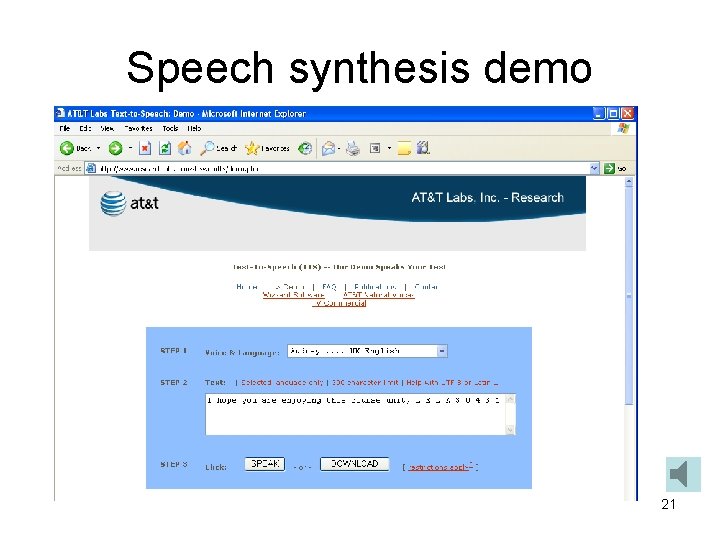
Speech synthesis demo 21
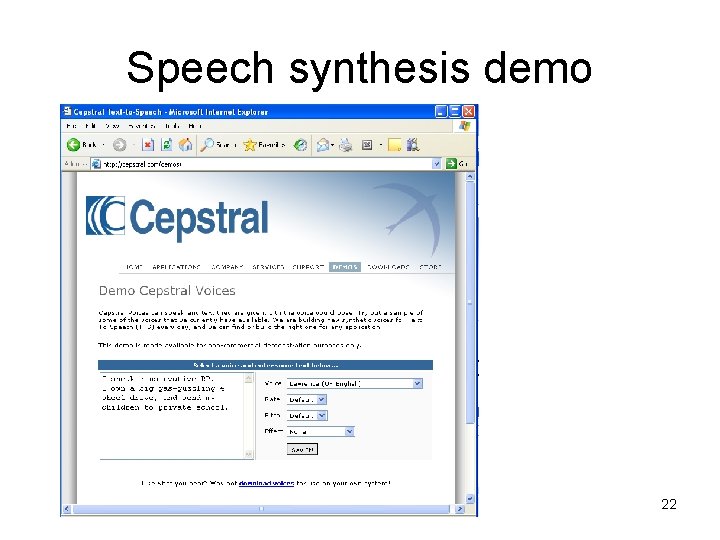
Speech synthesis demo 22