
Speech Processing Berlin Chen Department of Computer Science
Speech Processing Berlin Chen Department of Computer Science & Information Engineering National Taiwan Normal University
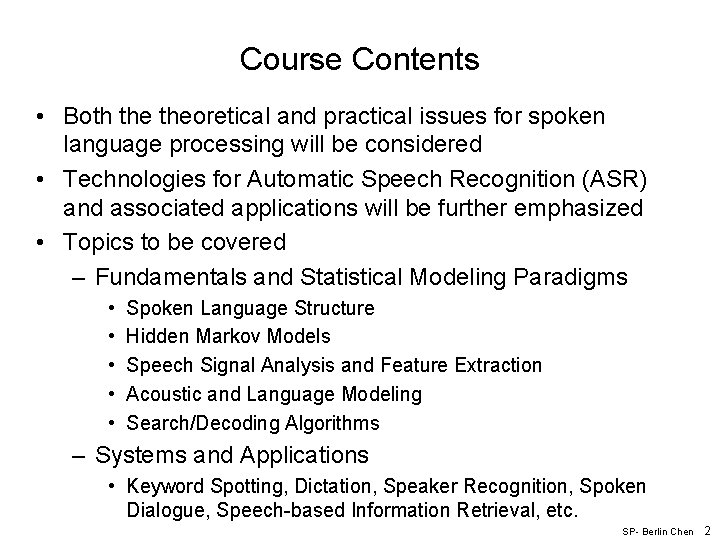
Course Contents • Both theoretical and practical issues for spoken language processing will be considered • Technologies for Automatic Speech Recognition (ASR) and associated applications will be further emphasized • Topics to be covered – Fundamentals and Statistical Modeling Paradigms • • • Spoken Language Structure Hidden Markov Models Speech Signal Analysis and Feature Extraction Acoustic and Language Modeling Search/Decoding Algorithms – Systems and Applications • Keyword Spotting, Dictation, Speaker Recognition, Spoken Dialogue, Speech-based Information Retrieval, etc. SP- Berlin Chen 2

Some Textbooks and References (1/3) • References books – X. Huang, A. Acero, H. Hon. Spoken Language Processing, Prentice Hall, 2001 – L. Rabiner, R. Schafer, Theory and Applications of Digital Speech Processing, Pearson, 2011 – D. Yu and L. Deng, Automatic Speech Recognition: A Deep Learning Approach, Springer, 2015 – Jacob Benesty (ed. ), M. Mohan Sondhi (ed. ), Yiteng Huang (ed. ), Springer Handbook of Speech Processing, Springer, 2007 – M. J. F. Gales and S. J. Young. The Application of Hidden Markov Models in Speech Recognition. Foundations and Trends in Signal Processing, 2008 – C. Manning and H. Schutze. Foundations of Statistical Natural Language Processing. MIT Press, 1999 – J. R. Deller, J. H. L. Hansen, J. G. Proakis. Discrete-Time Processing of Speech Signals. IEEE Press, 2000 – F. Jelinek. Statistical Methods for Speech Recognition. MIT Press, 1999 – L. Rabiner, B. H. Juang. Fundamentals of Speech Recognition. Prentice Hall, 1993 – 王小川教授, 語音訊號處理, 全華圖書 2004 SP- Berlin Chen 3
Some Textbooks and References (2/3) • Reference papers 1. L. Rabiner, “A Tutorial on Hidden Markov Models and Selected Applications in Speech Recognition, ” Proceedings of the IEEE, vol. 77, No. 2, February 1989 2. A. Dempster, N. Laird, and D. Rubin, "Maximum likelihood from incomplete data via the EM algorithm, " J. Royal Star. Soc. , Series B, vol. 39, pp. 1 -38, 1977 3. Jeff A. Bilmes "A Gentle Tutorial of the EM Algorithm and its Application to Parameter Estimation for Gaussian Mixture and Hidden Markov Models, " U. C. Berkeley TR-97 -021 4. J. W. Picone, “Signal modeling techniques in speech recognition, ” proceedings of the IEEE, September 1993, pp. 1215 -1247 5. R. Rosenfeld, ”Two Decades of Statistical Language Modeling: Where Do We Go from Here? , ” Proceedings of IEEE, August, 2000 6. H. Ney, “Progress in Dynamic Programming Search for LVCSR, ” Proceedings of the IEEE, August 2000 7. H. Hermansky, "Should Recognizers Have Ears? ", Speech Communication, 25(1 -3), 1998 SP- Berlin Chen 4
Some Textbooks and References(3/3) 8. Frederick Jelinek, "The Dawn of Statistical ASR and MT, " Computational Linguistics, Vol. 35, No. 4. (1 December 2009), pp. 483 -494 9. L. S. Lee and B. Chen, “Spoken document understanding and organization, ” IEEE Signal Processing Magazine, vol. 22, no. 5, pp. 4260, Sept. 2005 10. M. Gilbert and J. Feng, “Speech and Language Processing over the Web, ” IEEE Signal Processing Magazine 25 (3), May 2008 11. C. Chelba, T. J. Hazen, and M. Saraclar. Retrieval and Browsing of Spoken Content. IEEE Signal Processing Magazine 25 (3), May 2008 12. S. Young et al. , The HTK Book. Version 3. 4: http: //htk. eng. cam. ac. uk 13. J. Schalkwyk et al. , "Google Search by Voice: A case study, " 2010 SP- Berlin Chen 5
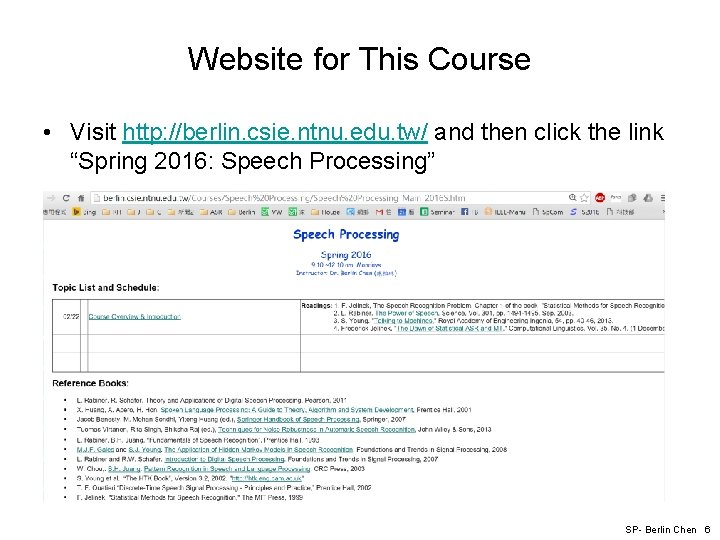
Website for This Course • Visit http: //berlin. csie. ntnu. edu. tw/ and then click the link “Spring 2016: Speech Processing” SP- Berlin Chen 6
Introduction References: 1. B. H. Juang and S. Furui, "Automatic Recognition and Understanding of Spoken Language - A First Step Toward Natural Human-Machine Communication, “ Proceedings of IEEE, August, 2000 2. I. Marsic, A. Medl, and J. Flanagan, “Natural Communication with Informatio Systems, ” Proceedings of IEEE, August, 2000 SP- Berlin Chen 7
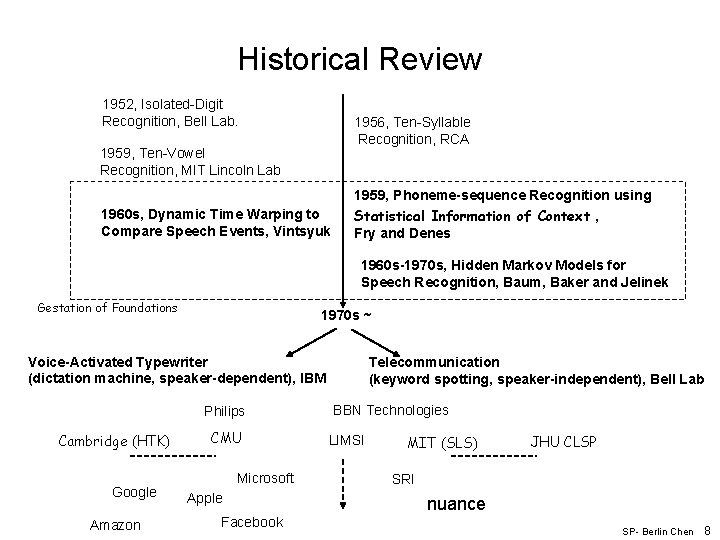
Historical Review 1952, Isolated-Digit Recognition, Bell Lab. 1956, Ten-Syllable Recognition, RCA 1959, Ten-Vowel Recognition, MIT Lincoln Lab 1960 s, Dynamic Time Warping to Compare Speech Events, Vintsyuk 1959, Phoneme-sequence Recognition using Statistical Information of Context , Fry and Denes 1960 s-1970 s, Hidden Markov Models for Speech Recognition, Baum, Baker and Jelinek Gestation of Foundations 1970 s ~ Voice-Activated Typewriter (dictation machine, speaker-dependent), IBM Philips Cambridge (HTK) Google Amazon CMU Microsoft Apple Facebook Telecommunication (keyword spotting, speaker-independent), Bell Lab BBN Technologies LIMSI MIT (SLS) JHU CLSP SRI nuance SP- Berlin Chen 8
Speech Processing vs. Text Processing – Recognition, Analysis and Understanding • Text: analyze and understand text • Speech: recognize speech (i. e. , ASR), and subsequently analyze and understand the recognized text (propagations of ASR errors) – Variability • Text: different synonyms to refer to a specific semantic object or meaning, such as 台灣師範大學, 師大, 教育界龍頭, etc. • Speech: an infinite number of utterances with respect to the same word (e. g. , 台灣師範大學) – Manifested by a wide variety of oral phenomena such as disfluences (hesitations), repetitions, restarts, and corrections – Gender, age, emotional and environmental variations further complicate ASR – No punctuation marks (delimiters) or/and structural information cues exist in speech SP- Berlin Chen 9
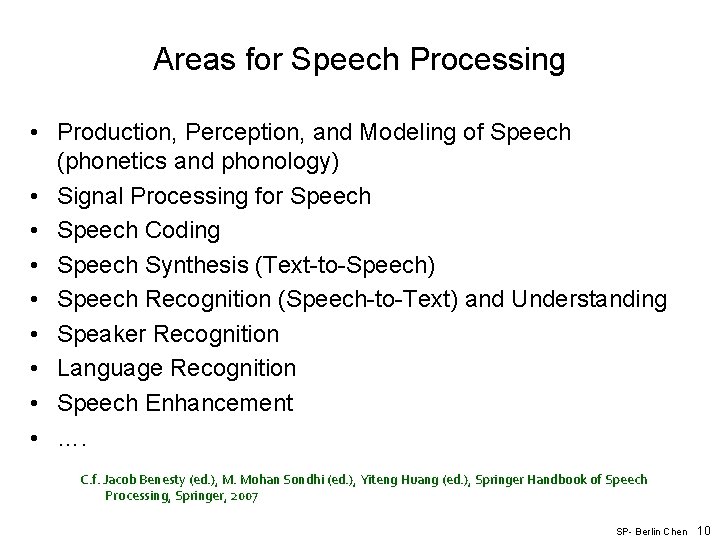
Areas for Speech Processing • Production, Perception, and Modeling of Speech (phonetics and phonology) • Signal Processing for Speech • Speech Coding • Speech Synthesis (Text-to-Speech) • Speech Recognition (Speech-to-Text) and Understanding • Speaker Recognition • Language Recognition • Speech Enhancement • …. C. f. Jacob Benesty (ed. ), M. Mohan Sondhi (ed. ), Yiteng Huang (ed. ), Springer Handbook of Speech Processing, Springer, 2007 SP- Berlin Chen 10

SP- Berlin Chen 11
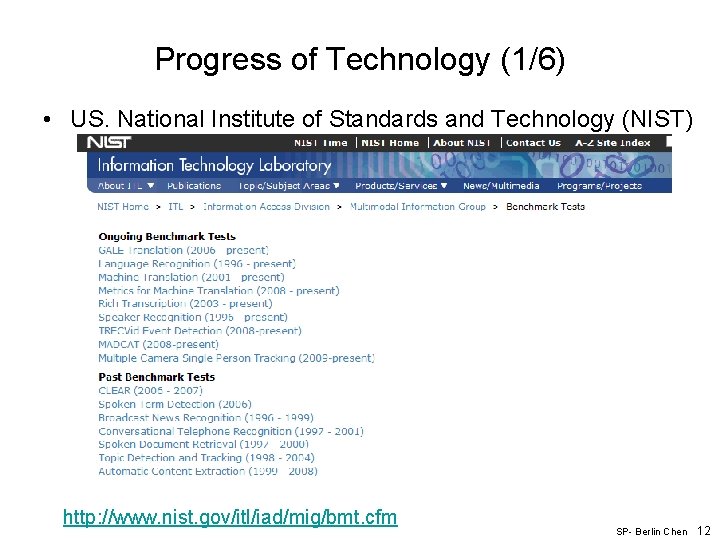
Progress of Technology (1/6) • US. National Institute of Standards and Technology (NIST) http: //www. nist. gov/itl/iad/mig/bmt. cfm SP- Berlin Chen 12
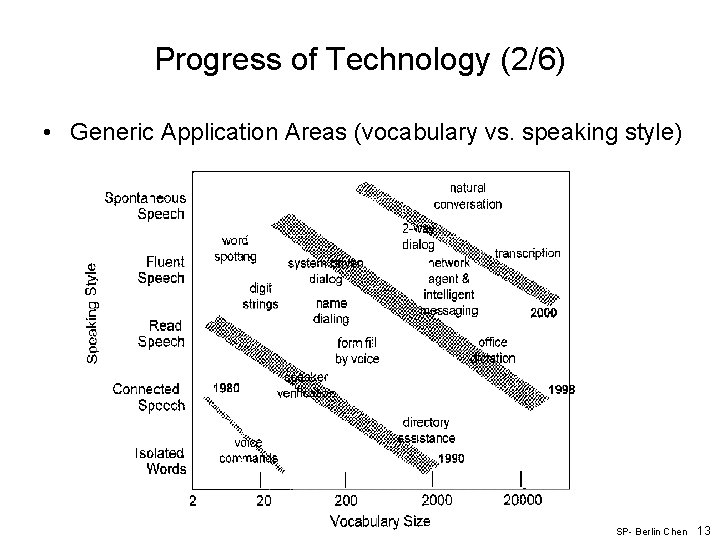
Progress of Technology (2/6) • Generic Application Areas (vocabulary vs. speaking style) SP- Berlin Chen 13
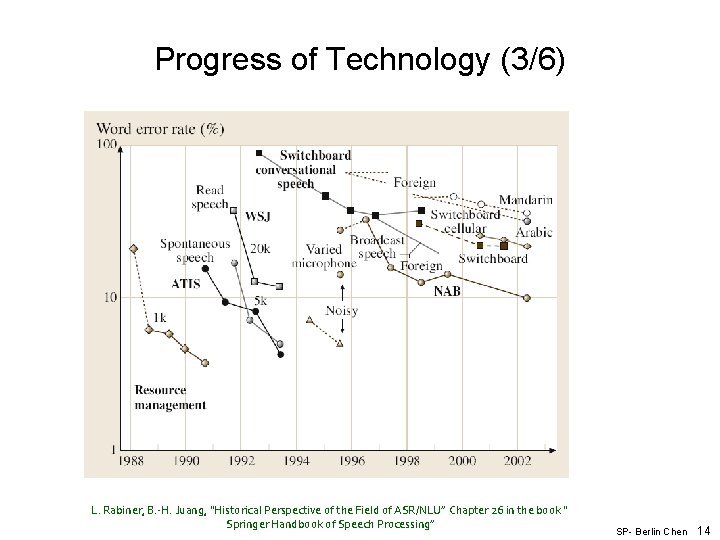
Progress of Technology (3/6) L. Rabiner, B. -H. Juang, “Historical Perspective of the Field of ASR/NLU” Chapter 26 in the book “ Springer Handbook of Speech Processing” SP- Berlin Chen 14
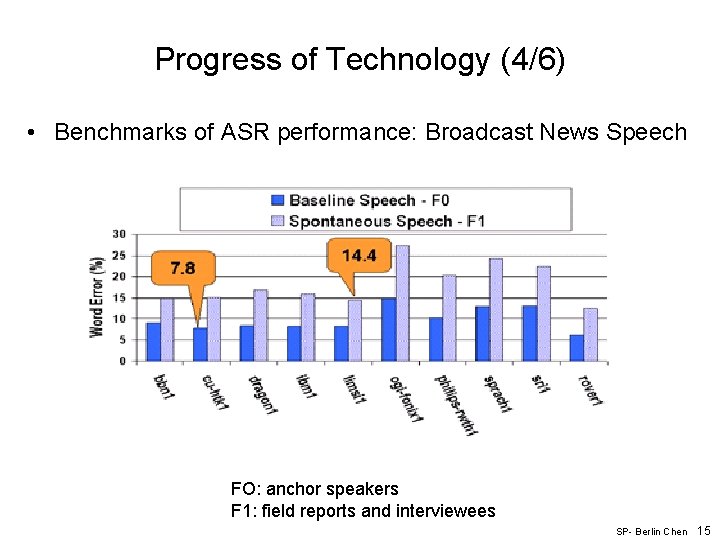
Progress of Technology (4/6) • Benchmarks of ASR performance: Broadcast News Speech FO: anchor speakers F 1: field reports and interviewees SP- Berlin Chen 15
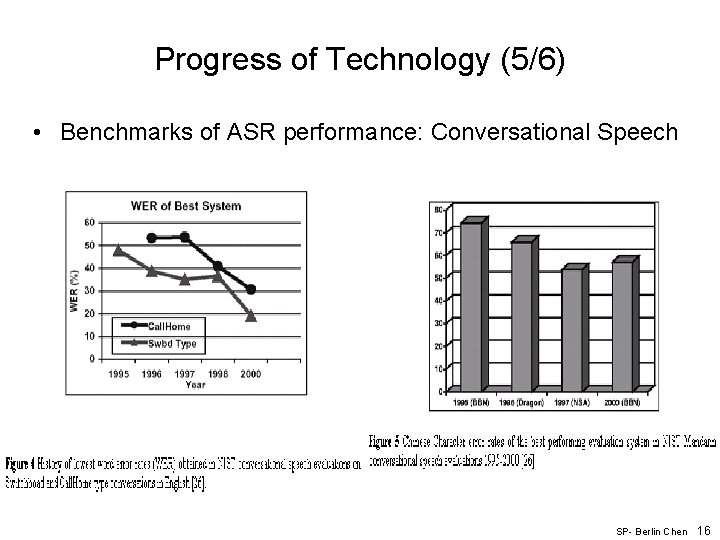
Progress of Technology (5/6) • Benchmarks of ASR performance: Conversational Speech SP- Berlin Chen 16
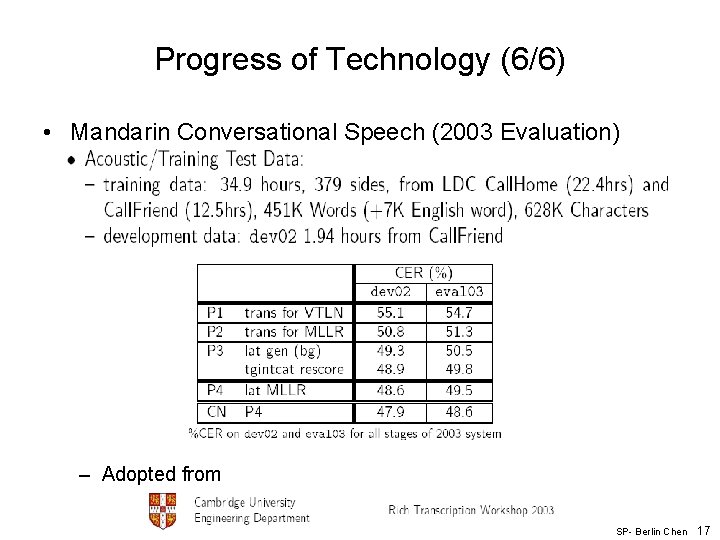
Progress of Technology (6/6) • Mandarin Conversational Speech (2003 Evaluation) – Adopted from SP- Berlin Chen 17
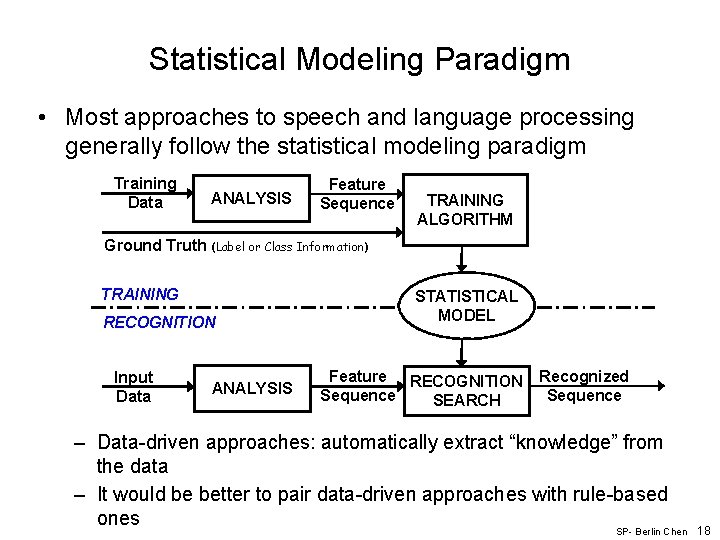
Statistical Modeling Paradigm • Most approaches to speech and language processing generally follow the statistical modeling paradigm Training Data ANALYSIS Feature Sequence TRAINING ALGORITHM Ground Truth (Label or Class Information) TRAINING RECOGNITION Input Data ANALYSIS STATISTICAL MODEL Feature RECOGNITION Sequence SEARCH Recognized Sequence – Data-driven approaches: automatically extract “knowledge” from the data – It would be better to pair data-driven approaches with rule-based ones SP- Berlin Chen 18
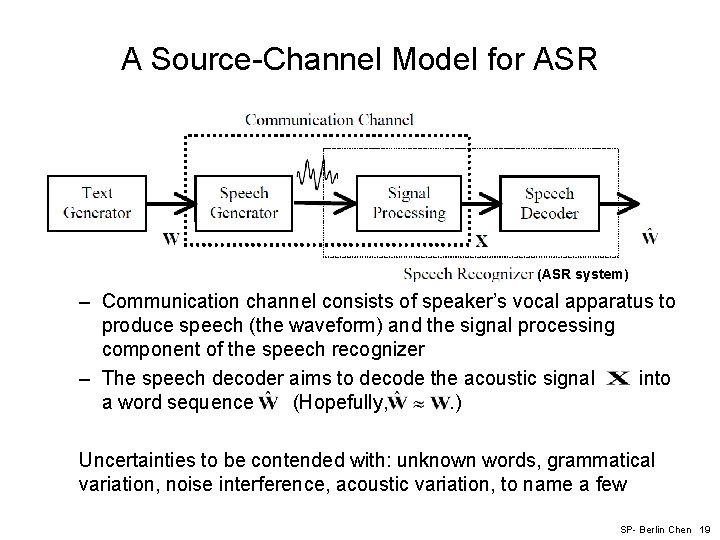
A Source-Channel Model for ASR (ASR system) – Communication channel consists of speaker’s vocal apparatus to produce speech (the waveform) and the signal processing component of the speech recognizer – The speech decoder aims to decode the acoustic signal into a word sequence (Hopefully, . ) Uncertainties to be contended with: unknown words, grammatical variation, noise interference, acoustic variation, to name a few SP- Berlin Chen 19
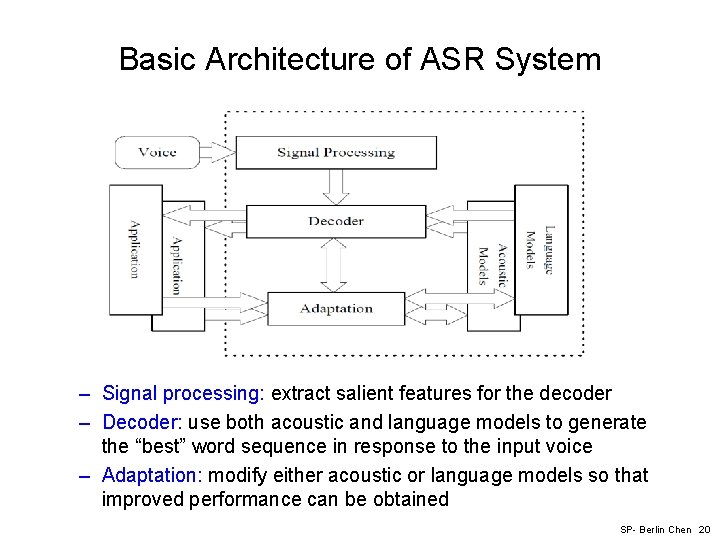
Basic Architecture of ASR System – Signal processing: extract salient features for the decoder – Decoder: use both acoustic and language models to generate the “best” word sequence in response to the input voice – Adaptation: modify either acoustic or language models so that improved performance can be obtained SP- Berlin Chen 20
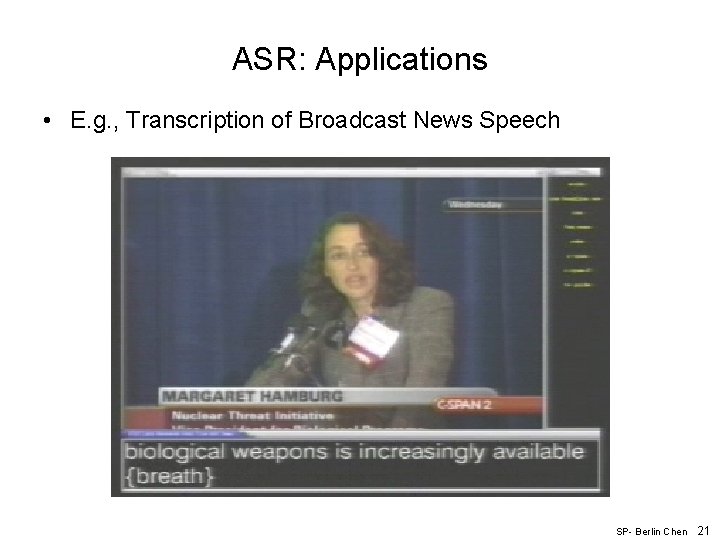
ASR: Applications • E. g. , Transcription of Broadcast News Speech SP- Berlin Chen 21
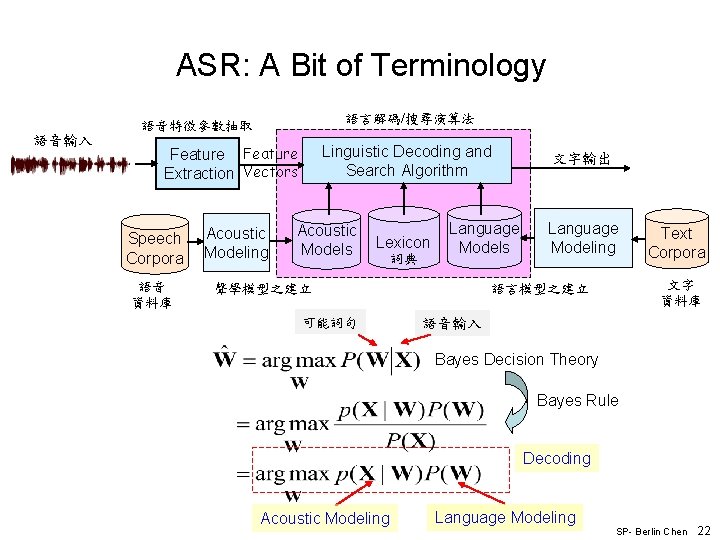
ASR: A Bit of Terminology 語言解碼/搜尋演算法 語音特徵參數抽取 語音輸入 Linguistic Decoding and Search Algorithm Feature Extraction Vectors Speech Corpora 語音 資料庫 Acoustic Modeling Acoustic Models Lexicon 詞典 Language Models 聲學模型之建立 可能詞句 文字輸出 Language Modeling Text Corpora 文字 資料庫 語言模型之建立 語音輸入 Bayes Decision Theory Bayes Rule Decoding Acoustic Modeling Language Modeling SP- Berlin Chen 22
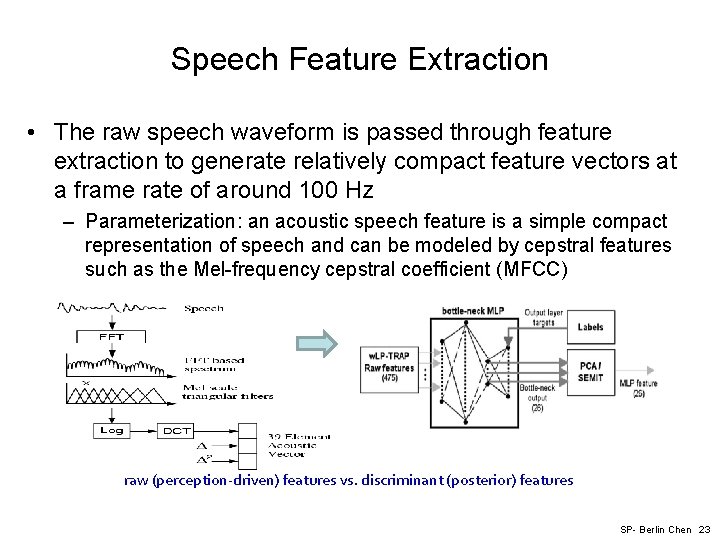
Speech Feature Extraction • The raw speech waveform is passed through feature extraction to generate relatively compact feature vectors at a frame rate of around 100 Hz – Parameterization: an acoustic speech feature is a simple compact representation of speech and can be modeled by cepstral features such as the Mel-frequency cepstral coefficient (MFCC) raw (perception-driven) features vs. discriminant (posterior) features SP- Berlin Chen 23
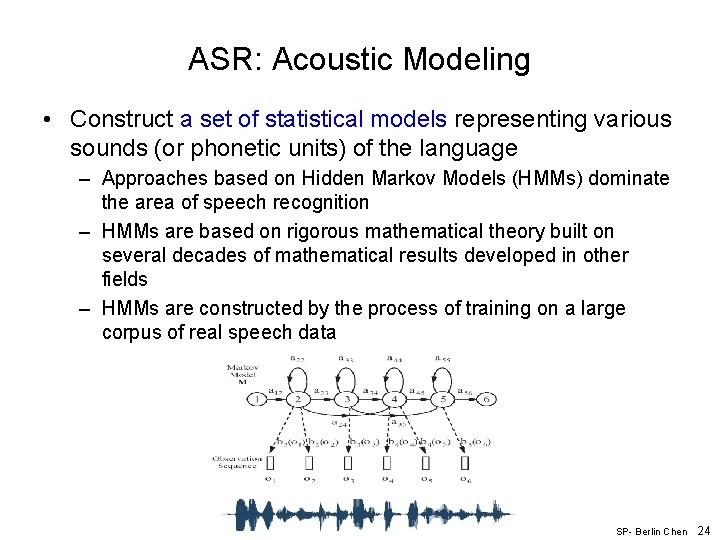
ASR: Acoustic Modeling • Construct a set of statistical models representing various sounds (or phonetic units) of the language – Approaches based on Hidden Markov Models (HMMs) dominate the area of speech recognition – HMMs are based on rigorous mathematical theory built on several decades of mathematical results developed in other fields – HMMs are constructed by the process of training on a large corpus of real speech data SP- Berlin Chen 24
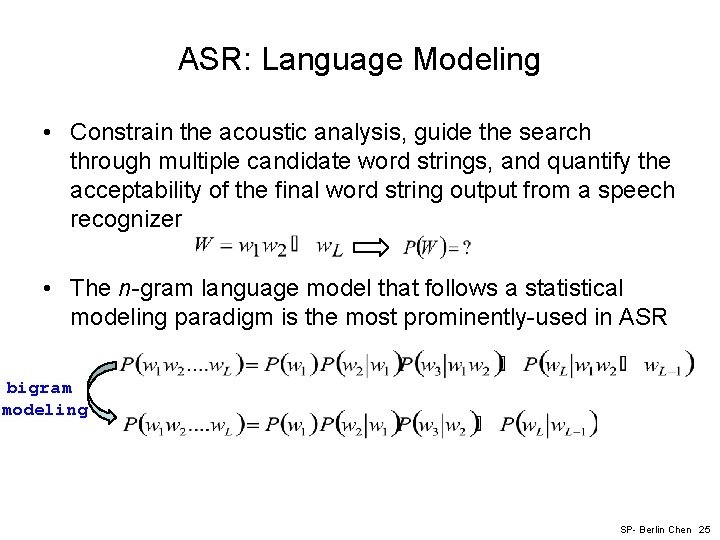
ASR: Language Modeling • Constrain the acoustic analysis, guide the search through multiple candidate word strings, and quantify the acceptability of the final word string output from a speech recognizer • The n-gram language model that follows a statistical modeling paradigm is the most prominently-used in ASR bigram modeling SP- Berlin Chen 25
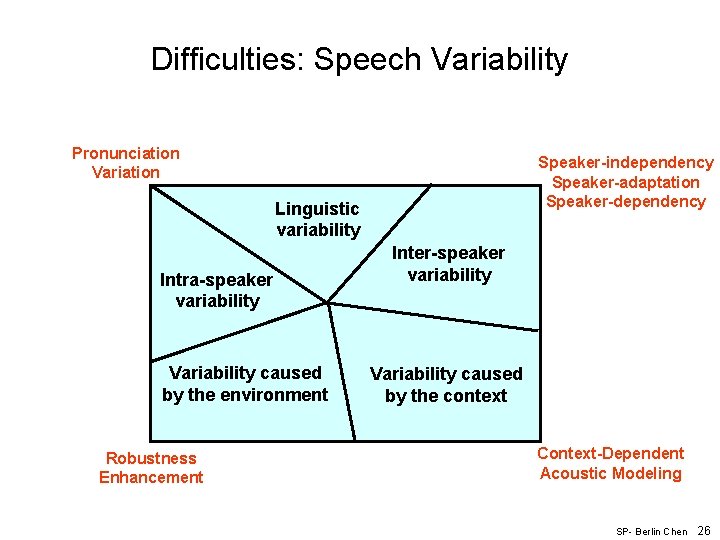
Difficulties: Speech Variability Pronunciation Variation Speaker-independency Speaker-adaptation Speaker-dependency Linguistic variability Intra-speaker variability Variability caused by the environment Robustness Enhancement Inter-speaker variability Variability caused by the context Context-Dependent Acoustic Modeling SP- Berlin Chen 26
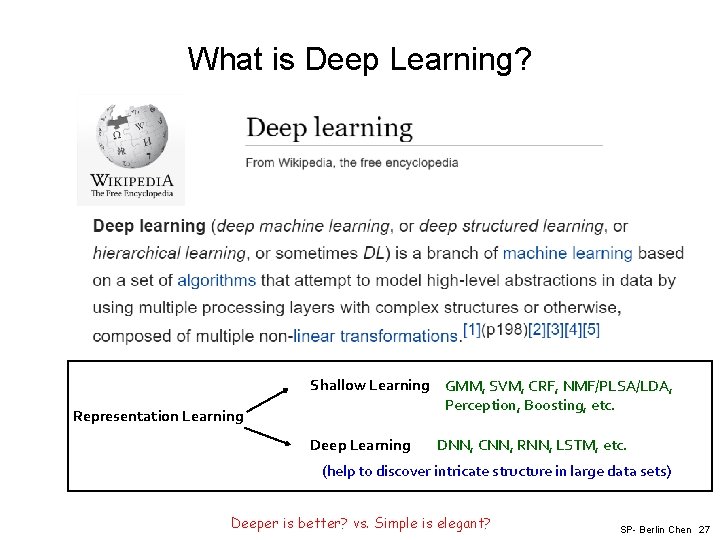
What is Deep Learning? Representation Learning Shallow Learning GMM, SVM, CRF, NMF/PLSA/LDA, Perception, Boosting, etc. Deep Learning DNN, CNN, RNN, LSTM, etc. (help to discover intricate structure in large data sets) Deeper is better? vs. Simple is elegant? SP- Berlin Chen 27
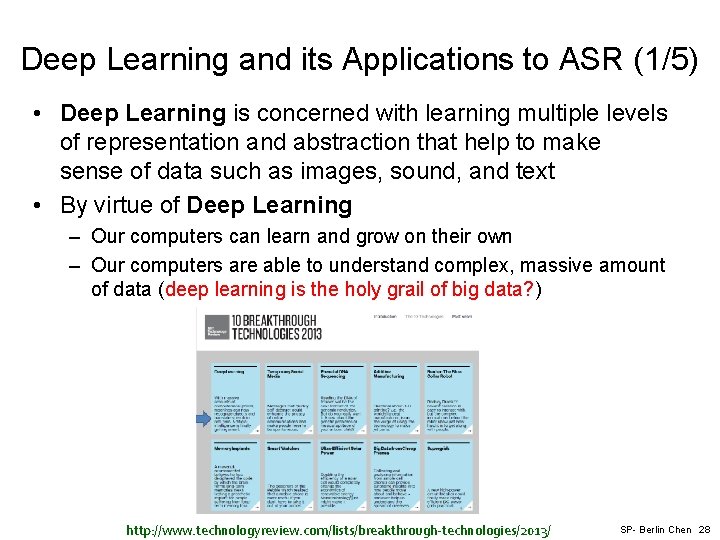
Deep Learning and its Applications to ASR (1/5) • Deep Learning is concerned with learning multiple levels of representation and abstraction that help to make sense of data such as images, sound, and text • By virtue of Deep Learning – Our computers can learn and grow on their own – Our computers are able to understand complex, massive amount of data (deep learning is the holy grail of big data? ) http: //www. technologyreview. com/lists/breakthrough-technologies/2013/ SP- Berlin Chen 28
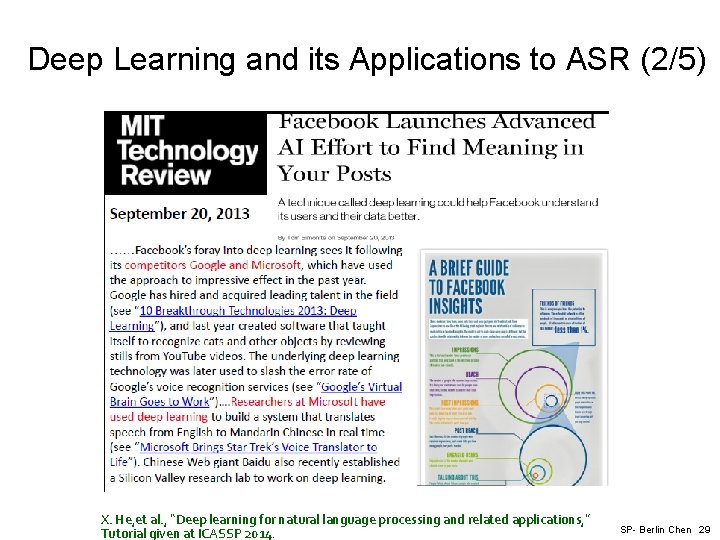
Deep Learning and its Applications to ASR (2/5) X. He, et al. , “Deep learning for natural language processing and related applications, ” Tutorial given at ICASSP 2014. SP- Berlin Chen 29
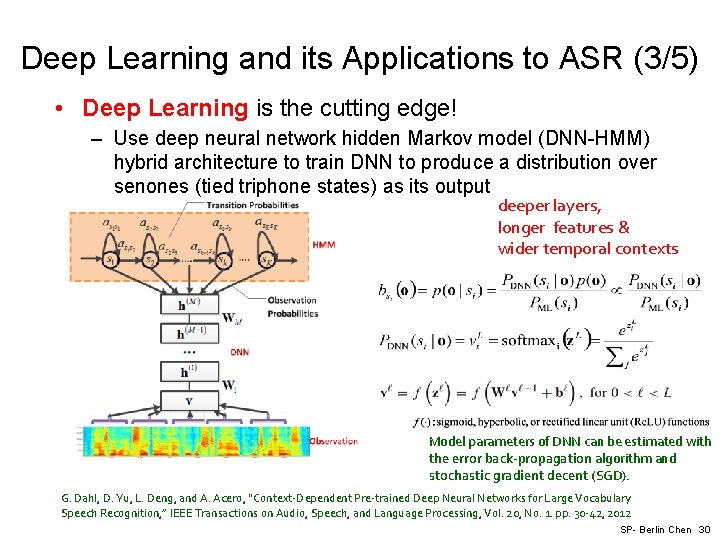
Deep Learning and its Applications to ASR (3/5) • Deep Learning is the cutting edge! – Use deep neural network hidden Markov model (DNN-HMM) hybrid architecture to train DNN to produce a distribution over senones (tied triphone states) as its output deeper layers, longer features & wider temporal contexts Model parameters of DNN can be estimated with the error back-propagation algorithm and stochastic gradient decent (SGD). G. Dahl, D. Yu, L. Deng, and A. Acero, “Context-Dependent Pre-trained Deep Neural Networks for Large Vocabulary Speech Recognition, ” IEEE Transactions on Audio, Speech, and Language Processing, Vol. 20, No. 1. pp. 30 -42, 2012 SP- Berlin Chen 30
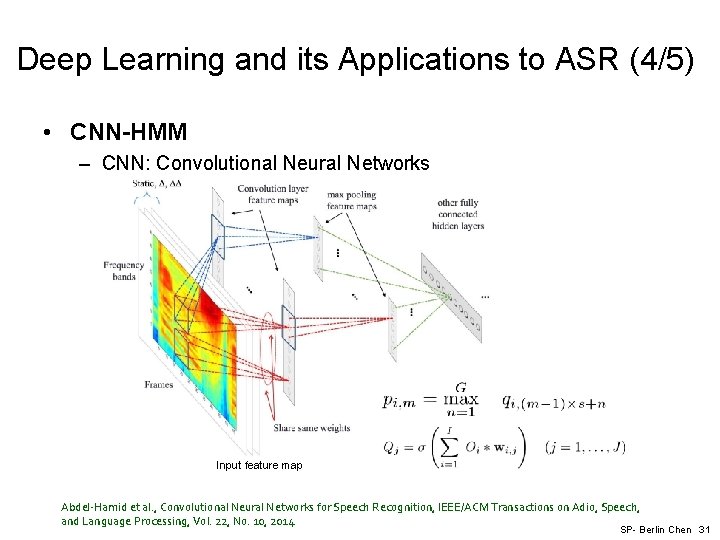
Deep Learning and its Applications to ASR (4/5) • CNN-HMM – CNN: Convolutional Neural Networks Input feature map Abdel-Hamid et al. , Convolutional Neural Networks for Speech Recognition, IEEE/ACM Transactions on Adio, Speech, and Language Processing, Vol. 22, No. 10, 2014 SP- Berlin Chen 31
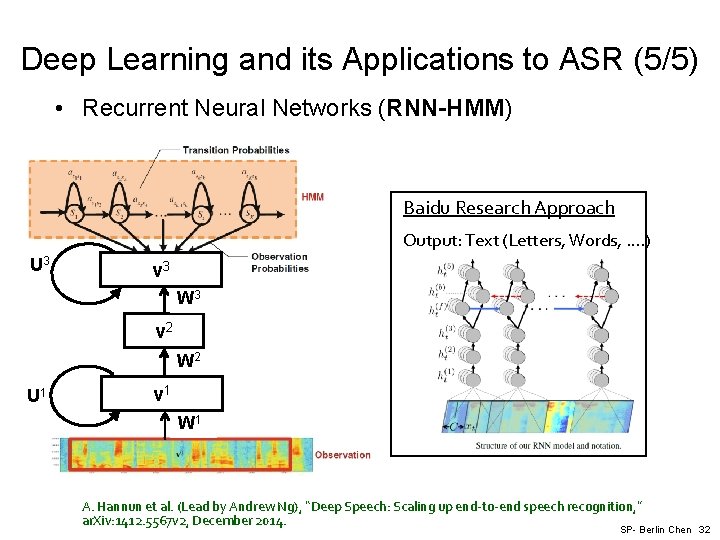
Deep Learning and its Applications to ASR (5/5) • Recurrent Neural Networks (RNN-HMM) Baidu Research Approach Output: Text (Letters, Words, …. ) U 3 v 3 W 3 v 2 W 2 U 1 v 1 W 1 A. Hannun et al. (Lead by Andrew Ng), “Deep Speech: Scaling up end-to-end speech recognition, ” ar. Xiv: 1412. 5567 v 2, December 2014. SP- Berlin Chen 32
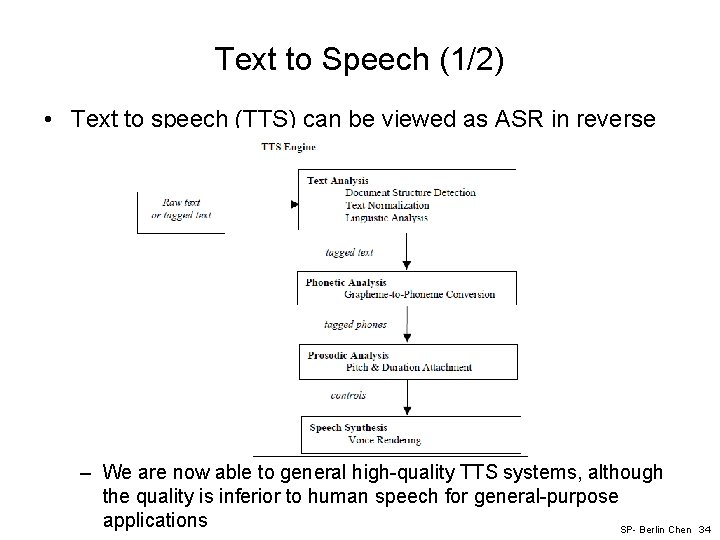
Text to Speech (1/2) • Text to speech (TTS) can be viewed as ASR in reverse – We are now able to general high-quality TTS systems, although the quality is inferior to human speech for general-purpose applications SP- Berlin Chen 34
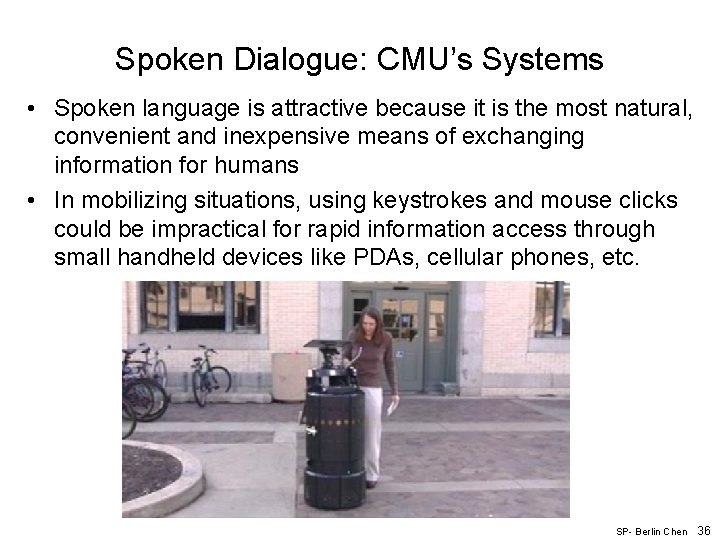
Spoken Dialogue: CMU’s Systems • Spoken language is attractive because it is the most natural, convenient and inexpensive means of exchanging information for humans • In mobilizing situations, using keystrokes and mouse clicks could be impractical for rapid information access through small handheld devices like PDAs, cellular phones, etc. SP- Berlin Chen 36
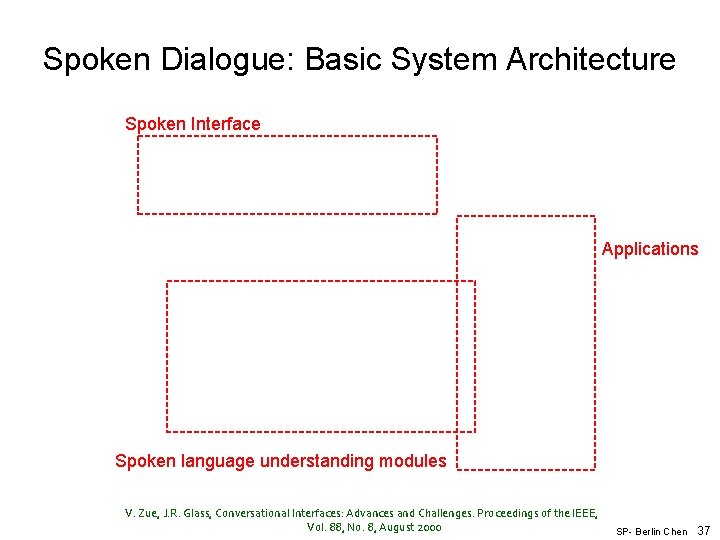
Spoken Dialogue: Basic System Architecture Spoken Interface Applications Spoken language understanding modules V. Zue, J. R. Glass, Conversational Interfaces: Advances and Challenges. Proceedings of the IEEE, Vol. 88, No. 8, August 2000 SP- Berlin Chen 37
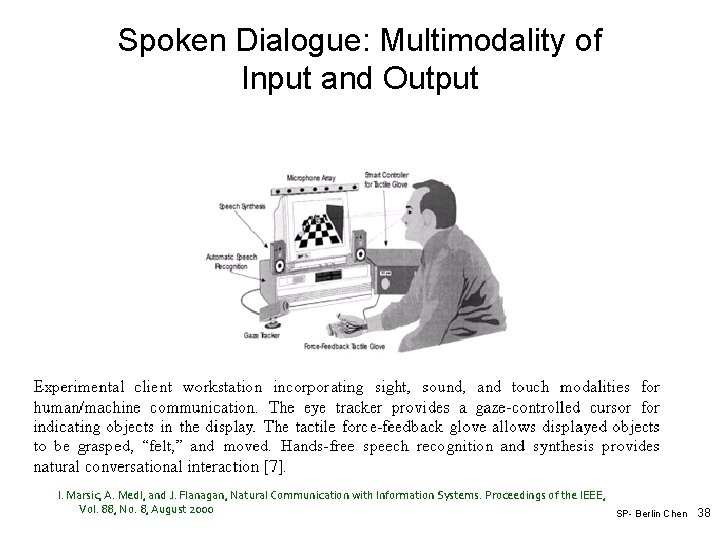
Spoken Dialogue: Multimodality of Input and Output I. Marsic, A. Medl, and J. Flanagan, Natural Communication with Information Systems. Proceedings of the IEEE, Vol. 88, No. 8, August 2000 SP- Berlin Chen 38
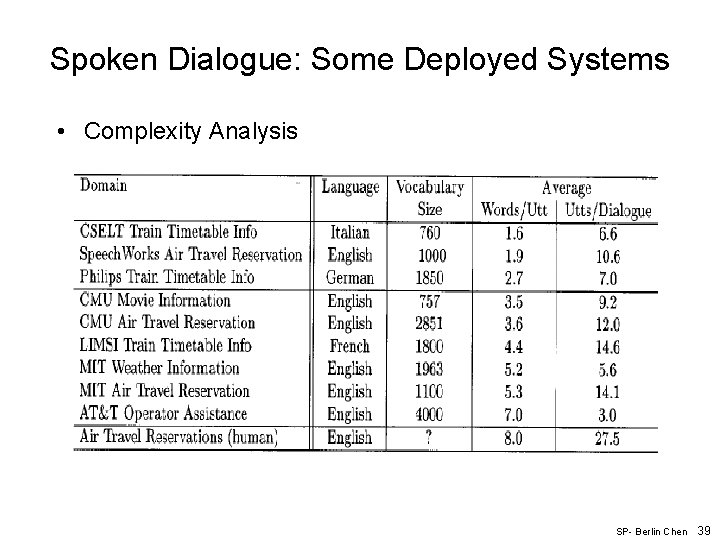
Spoken Dialogue: Some Deployed Systems • Complexity Analysis SP- Berlin Chen 39
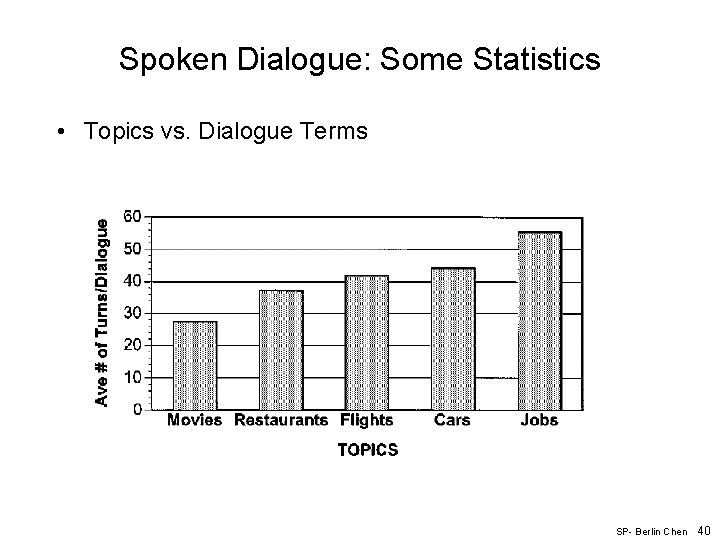
Spoken Dialogue: Some Statistics • Topics vs. Dialogue Terms SP- Berlin Chen 40
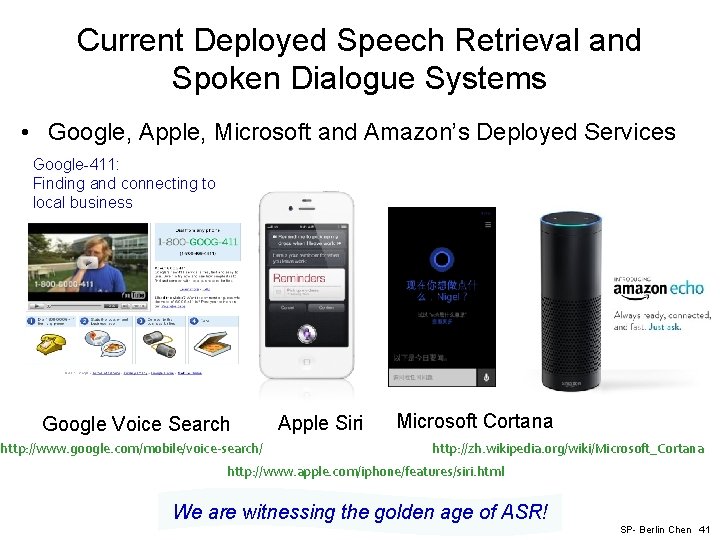
Current Deployed Speech Retrieval and Spoken Dialogue Systems • Google, Apple, Microsoft and Amazon’s Deployed Services Google-411: Finding and connecting to local business Google Voice Search http: //www. google. com/mobile/voice-search/ Apple Siri Microsoft Cortana http: //zh. wikipedia. org/wiki/Microsoft_Cortana http: //www. apple. com/iphone/features/siri. html We are witnessing the golden age of ASR! SP- Berlin Chen 41
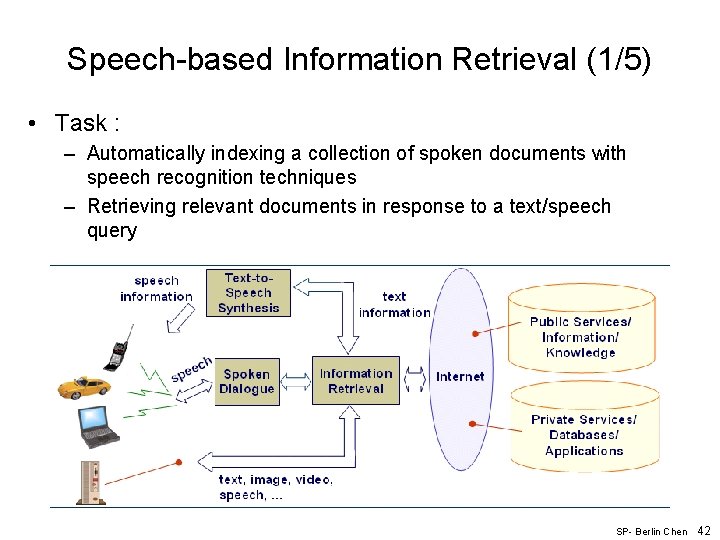
Speech-based Information Retrieval (1/5) • Task : – Automatically indexing a collection of spoken documents with speech recognition techniques – Retrieving relevant documents in response to a text/speech query SP- Berlin Chen 42
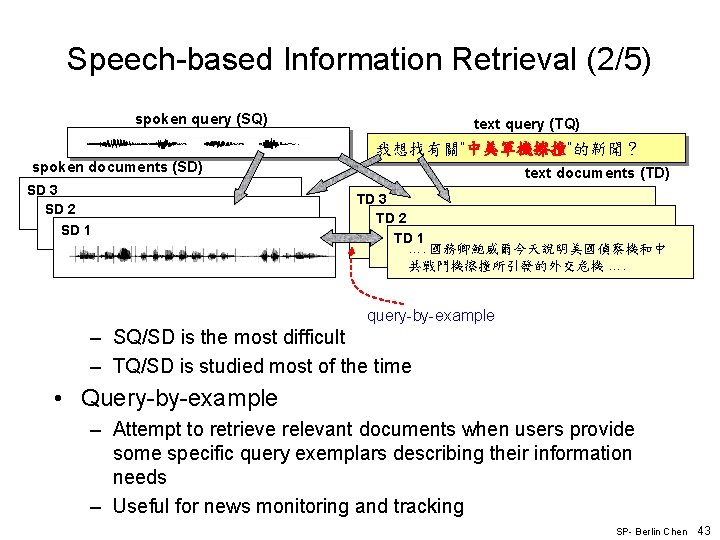
Speech-based Information Retrieval (2/5) spoken query (SQ) text query (TQ) 我想找有關“中美軍機擦撞”的新聞? spoken documents (SD) SD 3 SD 2 SD 1 text documents (TD) TD 3 TD 2 TD 1 …. 國務卿鮑威爾今天說明美國偵察機和中 共戰鬥機擦撞所引發的外交危機 …. query-by-example – SQ/SD is the most difficult – TQ/SD is studied most of the time • Query-by-example – Attempt to retrieve relevant documents when users provide some specific query exemplars describing their information needs – Useful for news monitoring and tracking SP- Berlin Chen 43
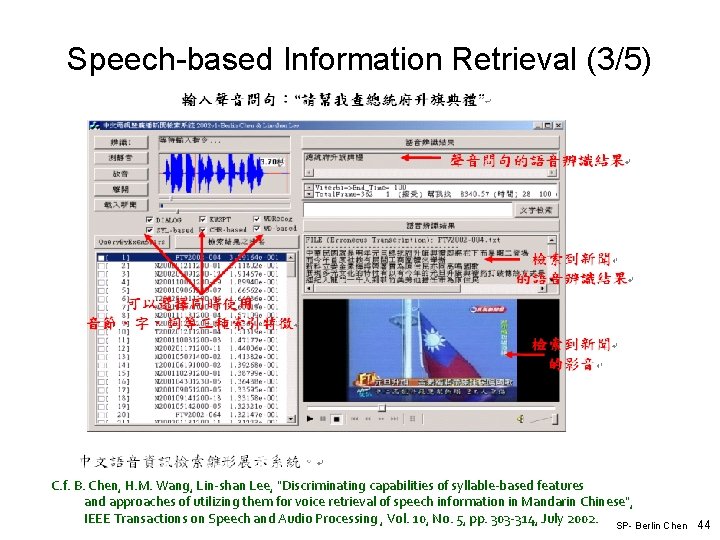
Speech-based Information Retrieval (3/5) C. f. B. Chen, H. M. Wang, Lin-shan Lee, "Discriminating capabilities of syllable-based features and approaches of utilizing them for voice retrieval of speech information in Mandarin Chinese", IEEE Transactions on Speech and Audio Processing , Vol. 10, No. 5, pp. 303 -314, July 2002. SP- Berlin Chen 44
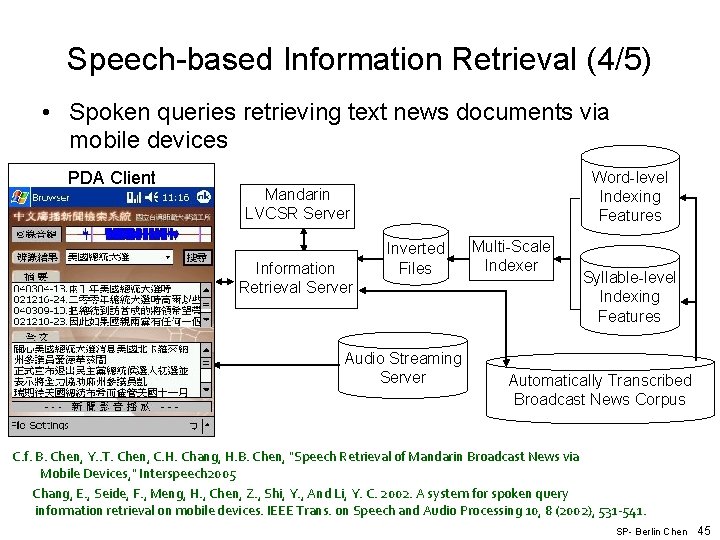
Speech-based Information Retrieval (4/5) • Spoken queries retrieving text news documents via mobile devices PDA Client Word-level Indexing Features Mandarin LVCSR Server Information Retrieval Server Inverted Files Audio Streaming Server Multi-Scale Indexer Syllable-level Indexing Features Automatically Transcribed Broadcast News Corpus C. f. B. Chen, Y. . T. Chen, C. H. Chang, H. B. Chen, "Speech Retrieval of Mandarin Broadcast News via Mobile Devices, " Interspeech 2005 Chang, E. , Seide, F. , Meng, H. , Chen, Z. , Shi, Y. , And Li, Y. C. 2002. A system for spoken query information retrieval on mobile devices. IEEE Trans. on Speech and Audio Processing 10, 8 (2002), 531 -541. SP- Berlin Chen 45
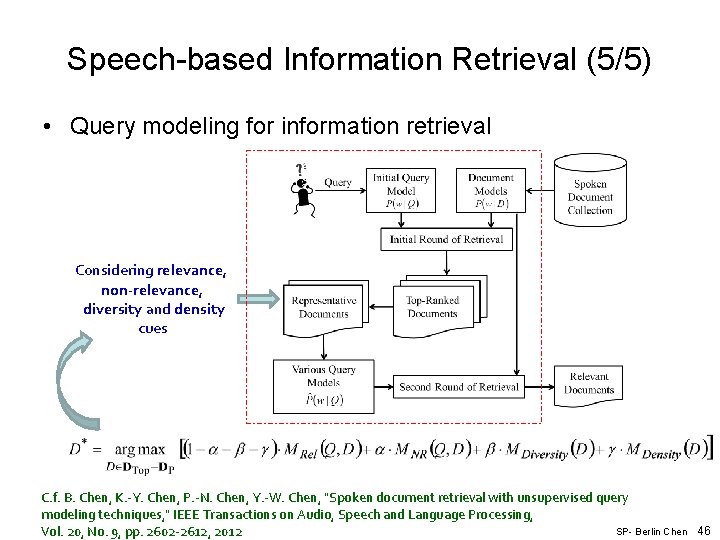
Speech-based Information Retrieval (5/5) • Query modeling for information retrieval Considering relevance, non-relevance, diversity and density cues C. f. B. Chen, K. -Y. Chen, P. -N. Chen, Y. -W. Chen, "Spoken document retrieval with unsupervised query modeling techniques, " IEEE Transactions on Audio, Speech and Language Processing, SP- Berlin Chen 46 Vol. 20, No. 9, pp. 2602 -2612, 2012
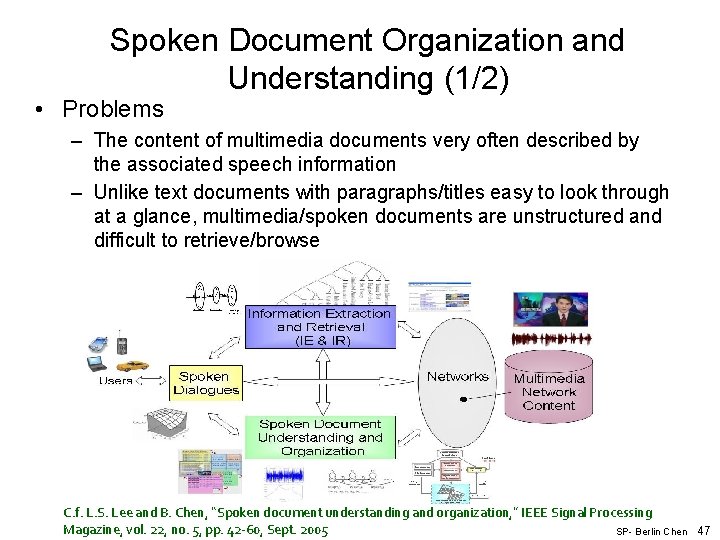
Spoken Document Organization and Understanding (1/2) • Problems – The content of multimedia documents very often described by the associated speech information – Unlike text documents with paragraphs/titles easy to look through at a glance, multimedia/spoken documents are unstructured and difficult to retrieve/browse C. f. L. S. Lee and B. Chen, “Spoken document understanding and organization, ” IEEE Signal Processing Magazine, vol. 22, no. 5, pp. 42 -60, Sept. 2005 SP- Berlin Chen 47
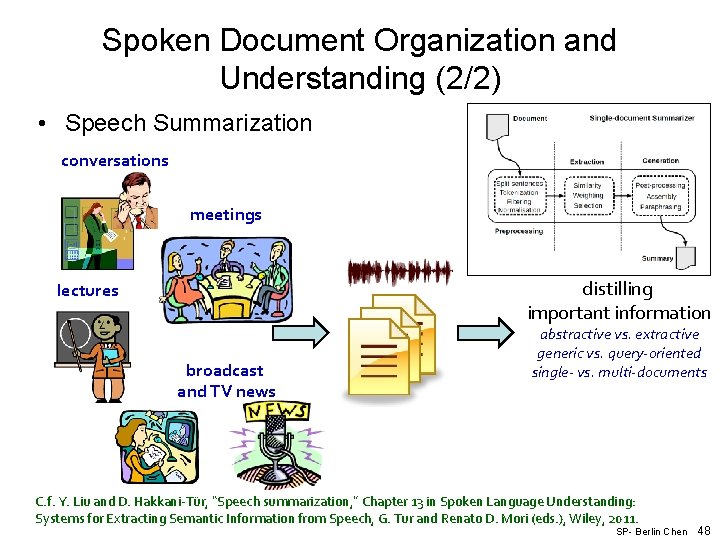
Spoken Document Organization and Understanding (2/2) • Speech Summarization conversations meetings distilling important information lectures broadcast and TV news abstractive vs. extractive generic vs. query-oriented single- vs. multi-documents C. f. Y. Liu and D. Hakkani-Tür, “Speech summarization, ” Chapter 13 in Spoken Language Understanding: Systems for Extracting Semantic Information from Speech, G. Tur and Renato D. Mori (eds. ), Wiley, 2011. SP- Berlin Chen 48
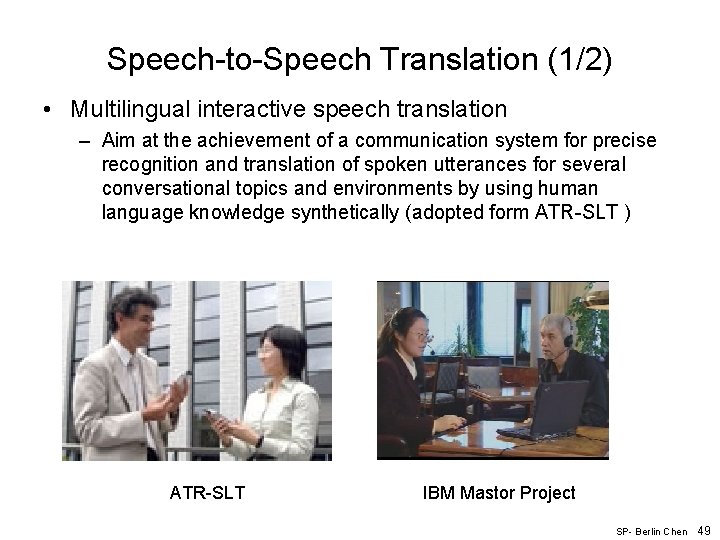
Speech-to-Speech Translation (1/2) • Multilingual interactive speech translation – Aim at the achievement of a communication system for precise recognition and translation of spoken utterances for several conversational topics and environments by using human language knowledge synthetically (adopted form ATR-SLT ) ATR-SLT IBM Mastor Project SP- Berlin Chen 49
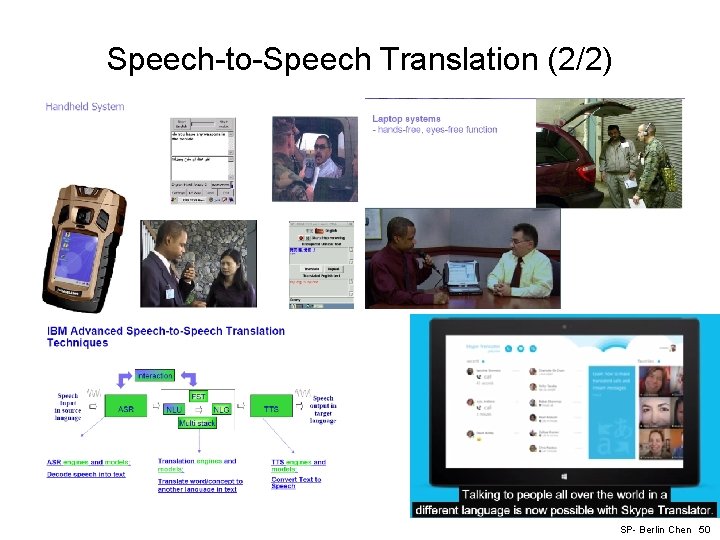
Speech-to-Speech Translation (2/2) SP- Berlin Chen 50
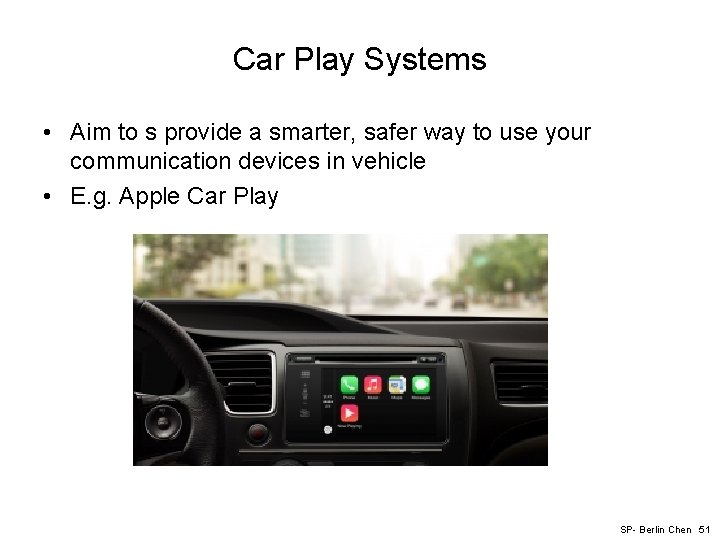
Car Play Systems • Aim to s provide a smarter, safer way to use your communication devices in vehicle • E. g. Apple Car Play SP- Berlin Chen 51
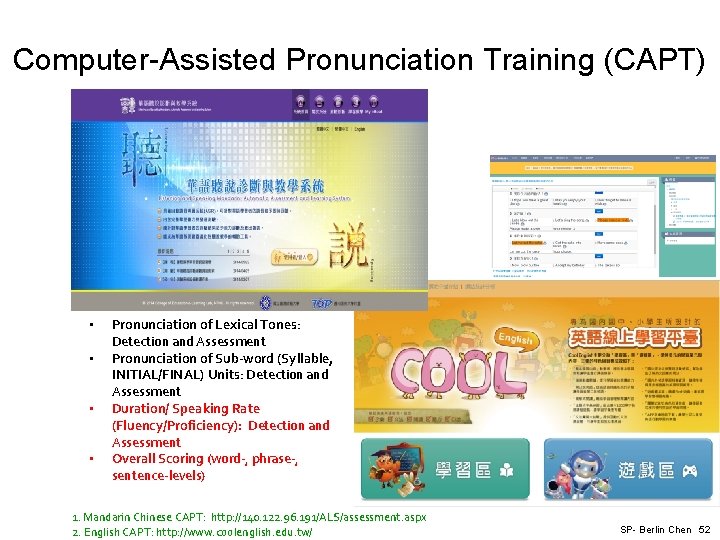
Computer-Assisted Pronunciation Training (CAPT) • • Pronunciation of Lexical Tones: Detection and Assessment Pronunciation of Sub-word (Syllable, INITIAL/FINAL) Units: Detection and Assessment Duration/ Speaking Rate (Fluency/Proficiency): Detection and Assessment Overall Scoring (word-, phrase-, sentence-levels) 1. Mandarin Chinese CAPT: http: //140. 122. 96. 191/ALS/assessment. aspx 2. English CAPT: http: //www. coolenglish. edu. tw/ SP- Berlin Chen 52
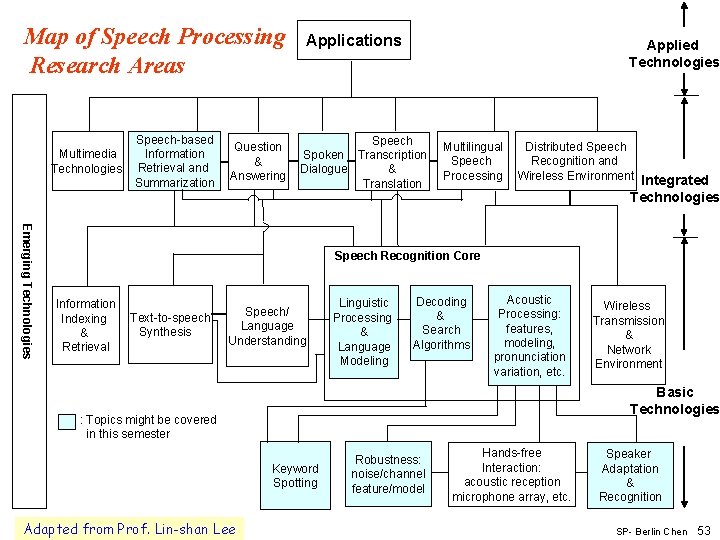
Map of Speech Processing Research Areas Speech-based Information Multimedia Technologies Retrieval and Summarization Question & Answering Applications Applied Technologies Speech Spoken Transcription Dialogue & Translation Multilingual Speech Processing Distributed Speech Recognition and Wireless Environment Integrated Technologies Emerging Technologies Speech Recognition Core Information Indexing & Retrieval Text-to-speech Synthesis Speech/ Language Understanding Linguistic Processing & Language Modeling Decoding & Search Algorithms Acoustic Processing: features, modeling, pronunciation variation, etc. Basic Technologies : Topics might be covered in this semester Keyword Spotting Adapted from Prof. Lin-shan Lee Wireless Transmission & Network Environment Robustness: noise/channel feature/model Hands-free Interaction: acoustic reception microphone array, etc. Speaker Adaptation & Recognition SP- Berlin Chen 53
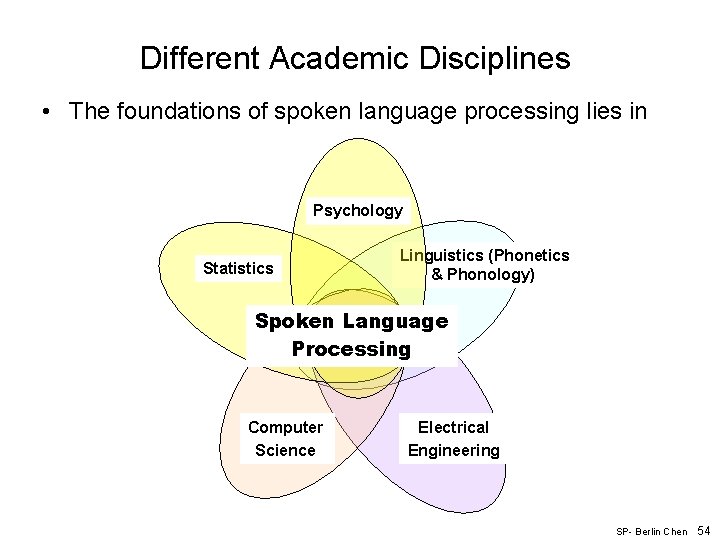
Different Academic Disciplines • The foundations of spoken language processing lies in Psychology Statistics Linguistics (Phonetics & Phonology) Spoken Language Processing Computer Science Electrical Engineering SP- Berlin Chen 54
Speech Processing Toolkit (1/2) • HTK (Hidden Markov Model Tool. Kit) – A toolkit for building Hidden Markov Models (HMMs) – The HMM can be used to model any time series and the core of HTK is similarly general-purpose – In particular, for the acoustic feature extraction, HMMbased acoustic model training and HMM network decoding SP- Berlin Chen 55
Speech Processing Toolkit (2/2) • HTK (Hidden Markov Model Tool. Kit) • Nowadays, Kaldi emerges as a cutting-edge toolkit for developing speech recognition tasks http: //kaldi. sourceforge. net/ SP- Berlin Chen 56
Journals & Conferences • Journals – – – – IEEE Transactions on Audio, Speech and Language Processing Computer Speech & Language Speech Communication Proceedings of the IEEE Signal Processing Magazine ACM Transactions on Speech and Language Processing ACM Transactions on Asian and Low-Resource Language Information Processing … • Conferences – IEEE International Conference on Acoustics, Speech, Signal processing (ICASSP) – Annual Conference of the International Speech Communication Association (Interspeech) – IEEE Workshop on Automatic Speech Recognition and Understanding (ASRU) – IEEE Workshop on Spoken Language Technology (SLT) – International Symposium on Chinese Spoken Language Processing (ISCSLP) – ROCLING Conference on Computational Linguistics and Speech Processing – … SP- Berlin Chen 57
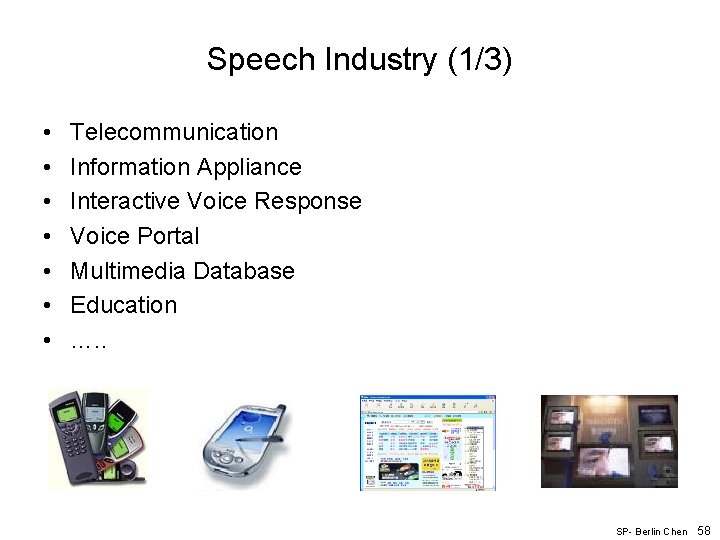
Speech Industry (1/3) • • Telecommunication Information Appliance Interactive Voice Response Voice Portal Multimedia Database Education …. . SP- Berlin Chen 58
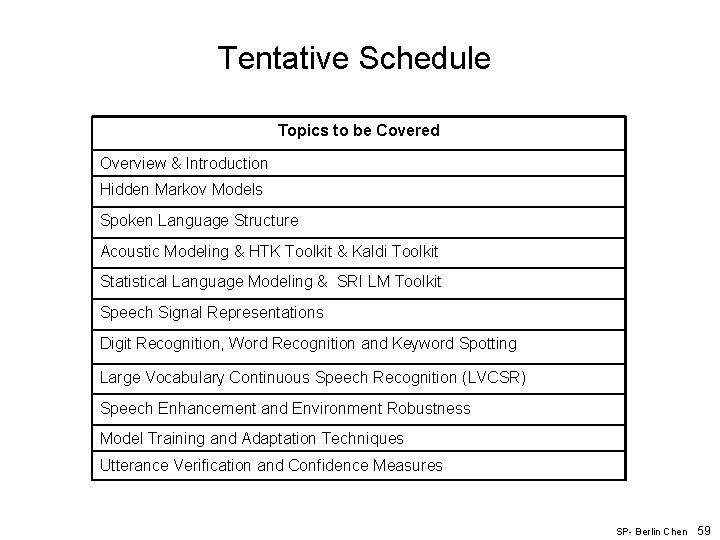
Tentative Schedule Topics to be Covered Overview & Introduction Hidden Markov Models Spoken Language Structure Acoustic Modeling & HTK Toolkit & Kaldi Toolkit Statistical Language Modeling & SRI LM Toolkit Speech Signal Representations Digit Recognition, Word Recognition and Keyword Spotting Large Vocabulary Continuous Speech Recognition (LVCSR) Speech Enhancement and Environment Robustness Model Training and Adaptation Techniques Utterance Verification and Confidence Measures SP- Berlin Chen 59

Good Words • Your attitude determines your altitude. • Stay Hungry; Stay Foolish • Every job is a self-portrait of those who did it. Autograph your work with quality. • …. SP- Berlin Chen 60
- Slides: 60