
SPEECH PREPARATION NOTES PROFESSIONAL COMMUNICATIONS I Know your
- Slides: 22
SPEECH PREPARATION NOTES PROFESSIONAL COMMUNICATIONS
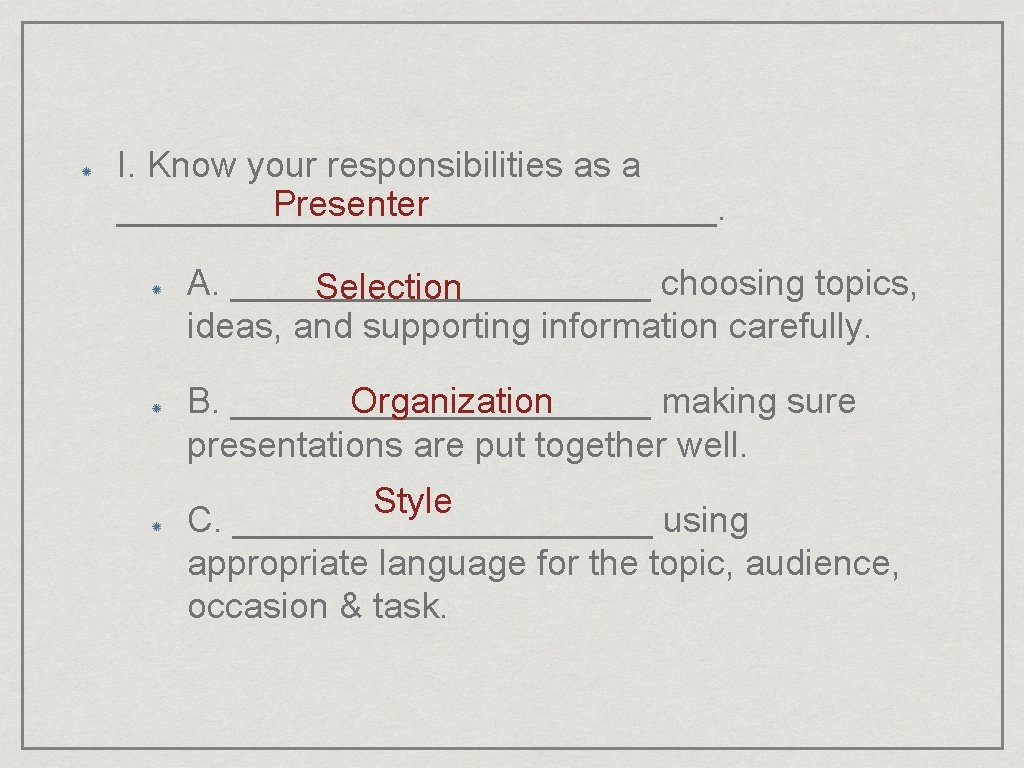
I. Know your responsibilities as a Presenter _______________. A. ___________ choosing topics, Selection ideas, and supporting information carefully. Organization B. ___________ making sure presentations are put together well. Style C. ___________ using appropriate language for the topic, audience, occasion & task.
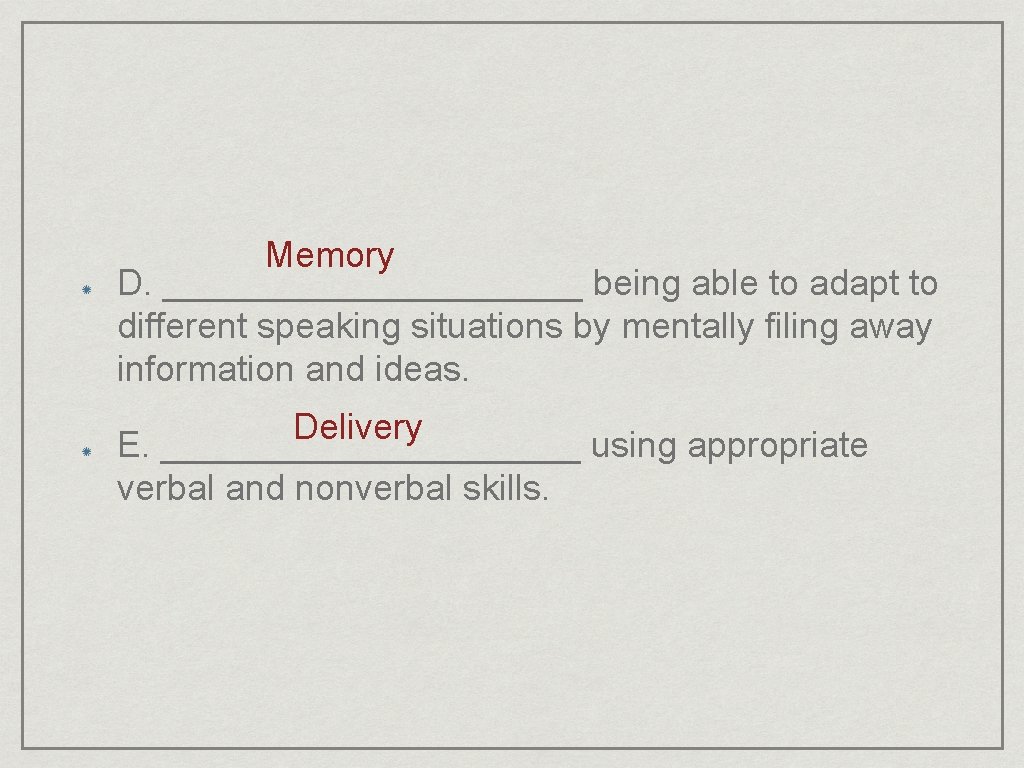
Memory D. ___________ being able to adapt to different speaking situations by mentally filing away information and ideas. Delivery E. ___________ using appropriate verbal and nonverbal skills.
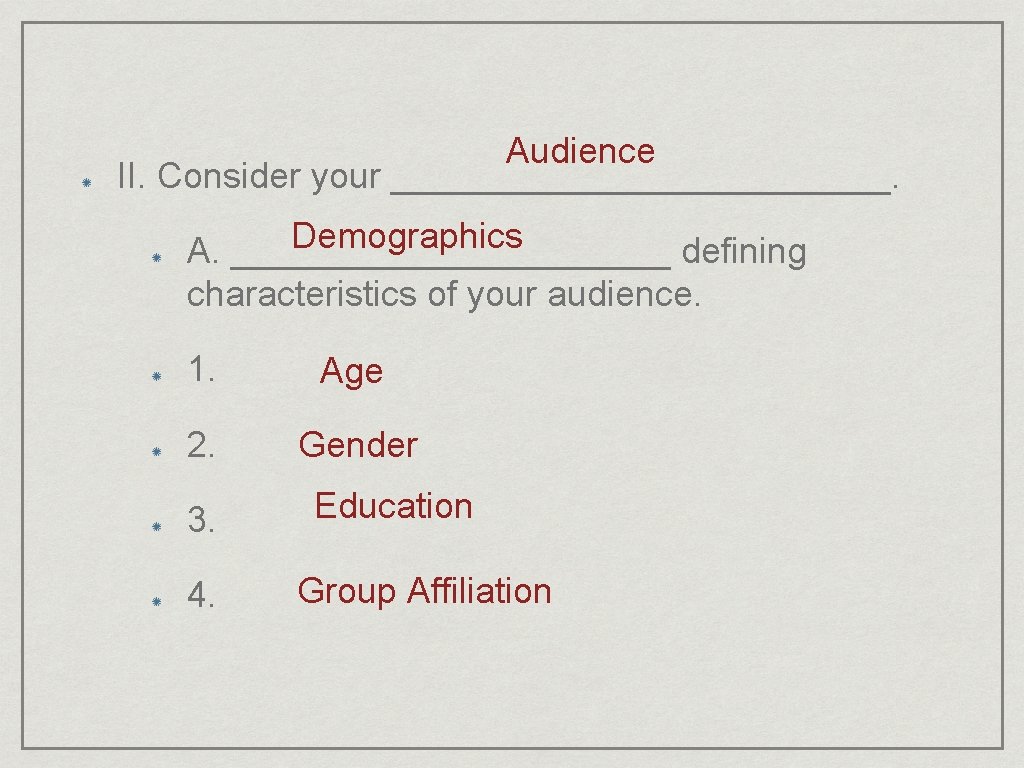
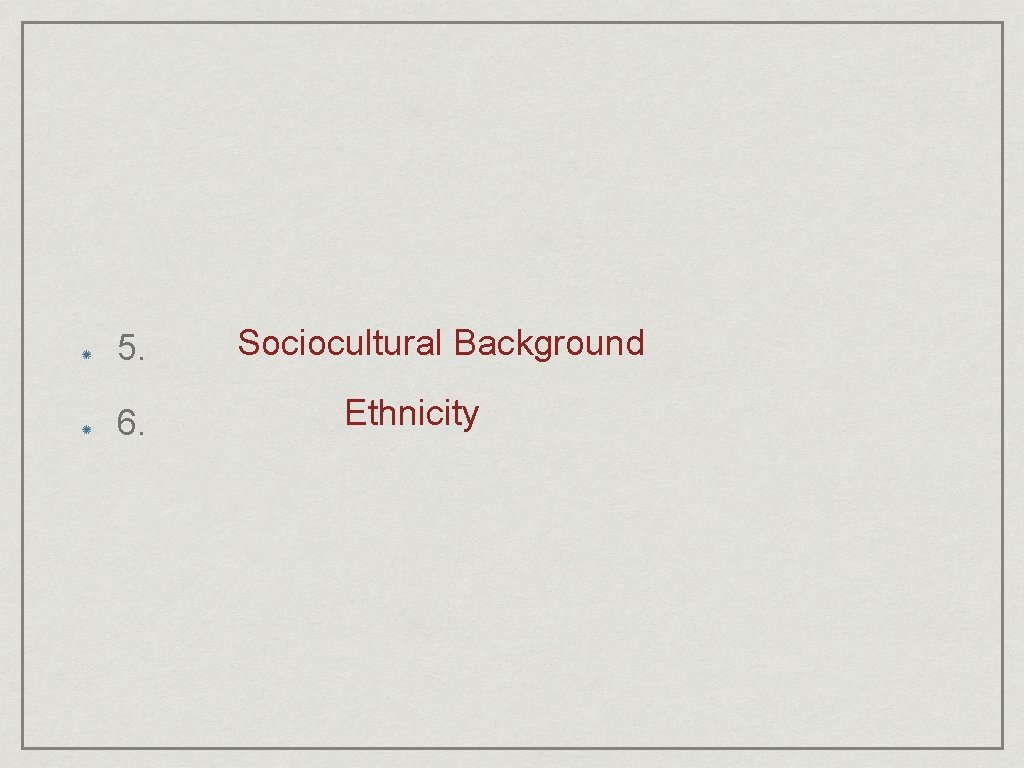
Audience II. Consider your _____________. Demographics A. ___________ defining characteristics of your audience. 1. Age 2. Gender 3. 4. Education Group Affiliation
5. 6. Sociocultural Background Ethnicity
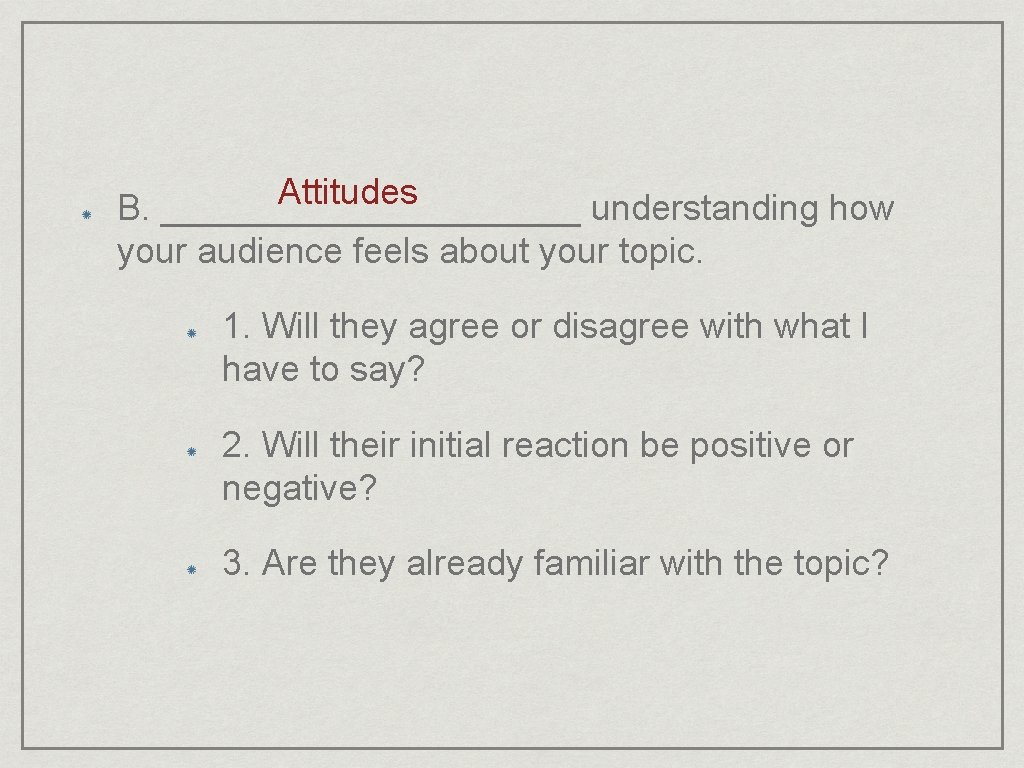
Attitudes B. ___________ understanding how your audience feels about your topic. 1. Will they agree or disagree with what I have to say? 2. Will their initial reaction be positive or negative? 3. Are they already familiar with the topic?
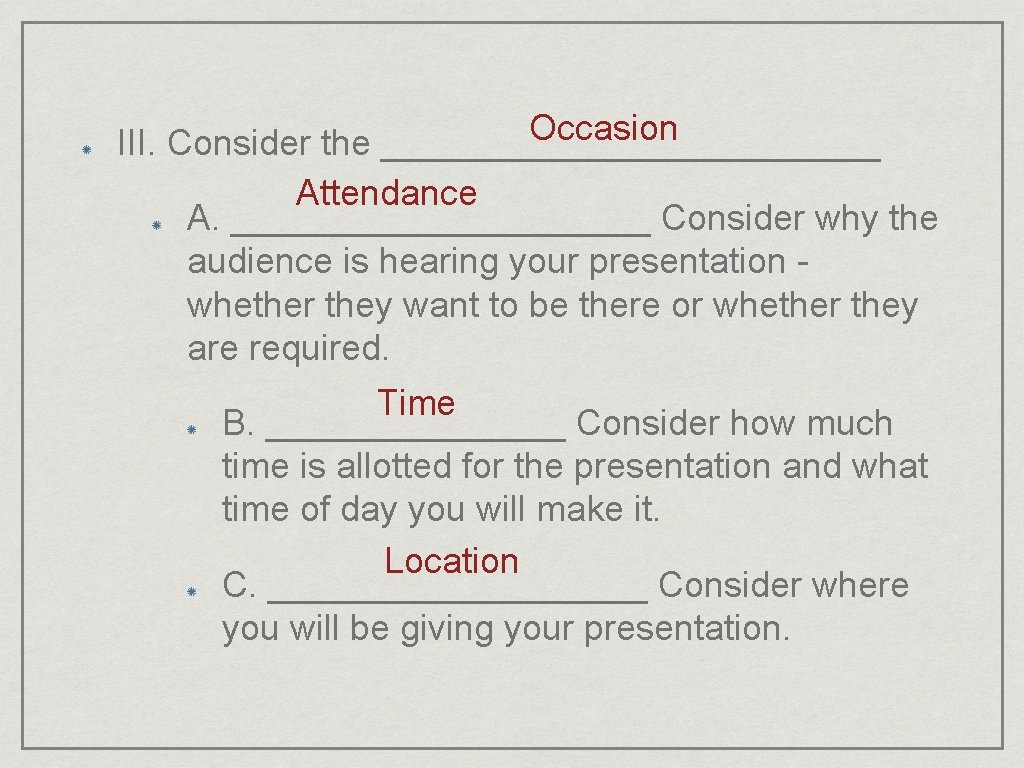
Occasion III. Consider the _____________ Attendance A. ___________ Consider why the audience is hearing your presentation whether they want to be there or whether they are required. Time B. ________ Consider how much time is allotted for the presentation and what time of day you will make it. Location C. __________ Consider where you will be giving your presentation.
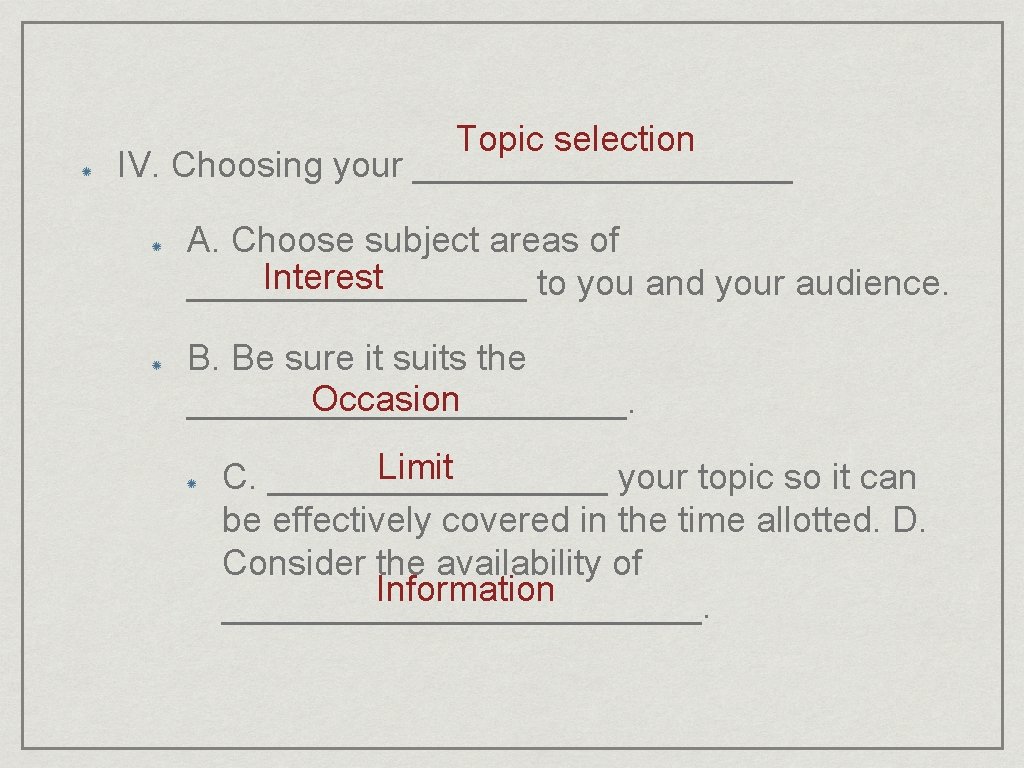
Topic selection IV. Choosing your __________ A. Choose subject areas of Interest _________ to you and your audience. B. Be sure it suits the Occasion ___________. Limit C. _________ your topic so it can be effectively covered in the time allotted. D. Consider the availability of Information ____________.
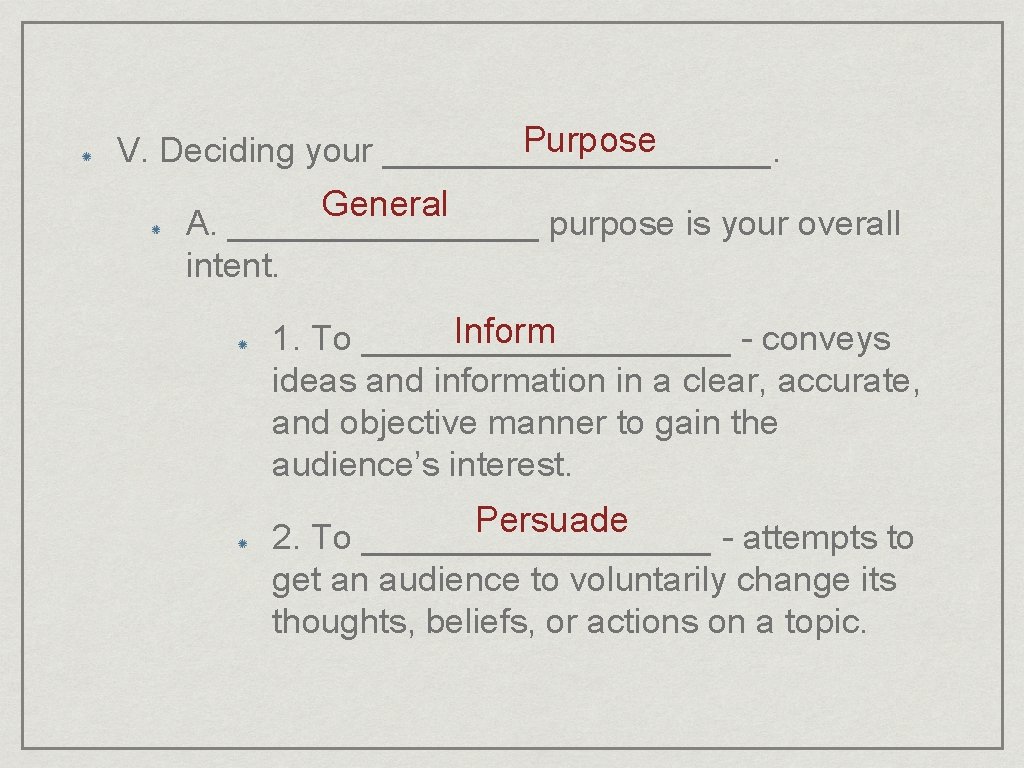
Purpose V. Deciding your __________. General A. ________ purpose is your overall intent. Inform 1. To __________ - conveys ideas and information in a clear, accurate, and objective manner to gain the audience’s interest. Persuade 2. To _________ - attempts to get an audience to voluntarily change its thoughts, beliefs, or actions on a topic.
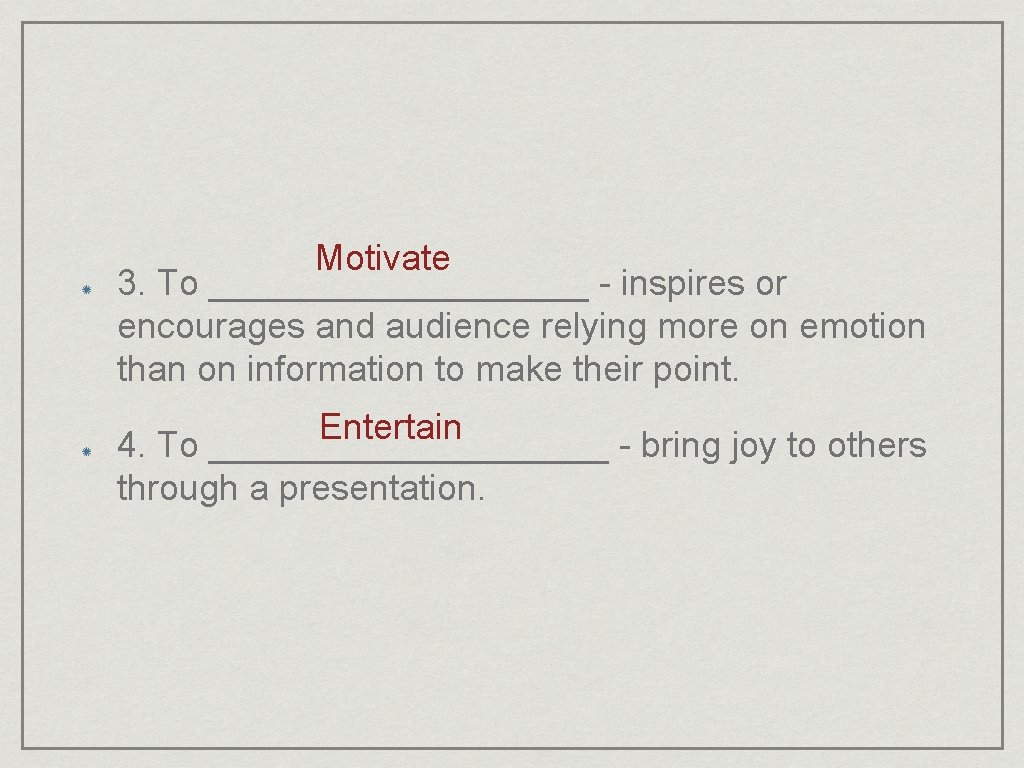
Motivate 3. To __________ - inspires or encourages and audience relying more on emotion than on information to make their point. Entertain 4. To __________ - bring joy to others through a presentation.
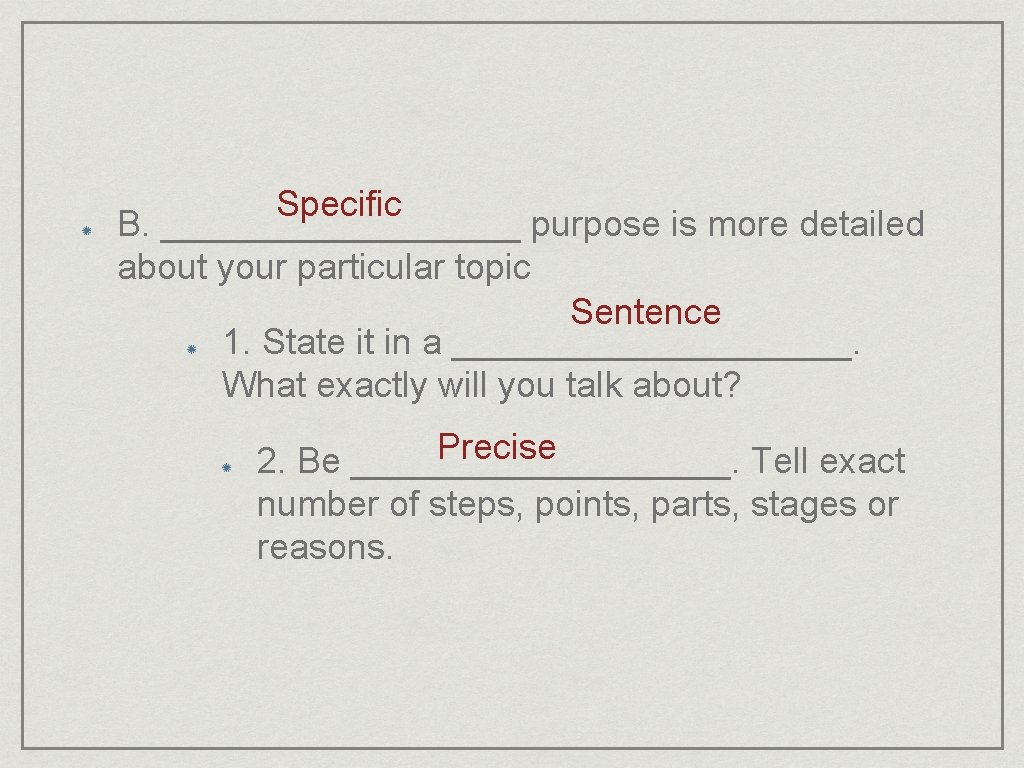
Specific B. _________ purpose is more detailed about your particular topic Sentence 1. State it in a __________. What exactly will you talk about? Precise 2. Be __________. Tell exact number of steps, points, parts, stages or reasons.
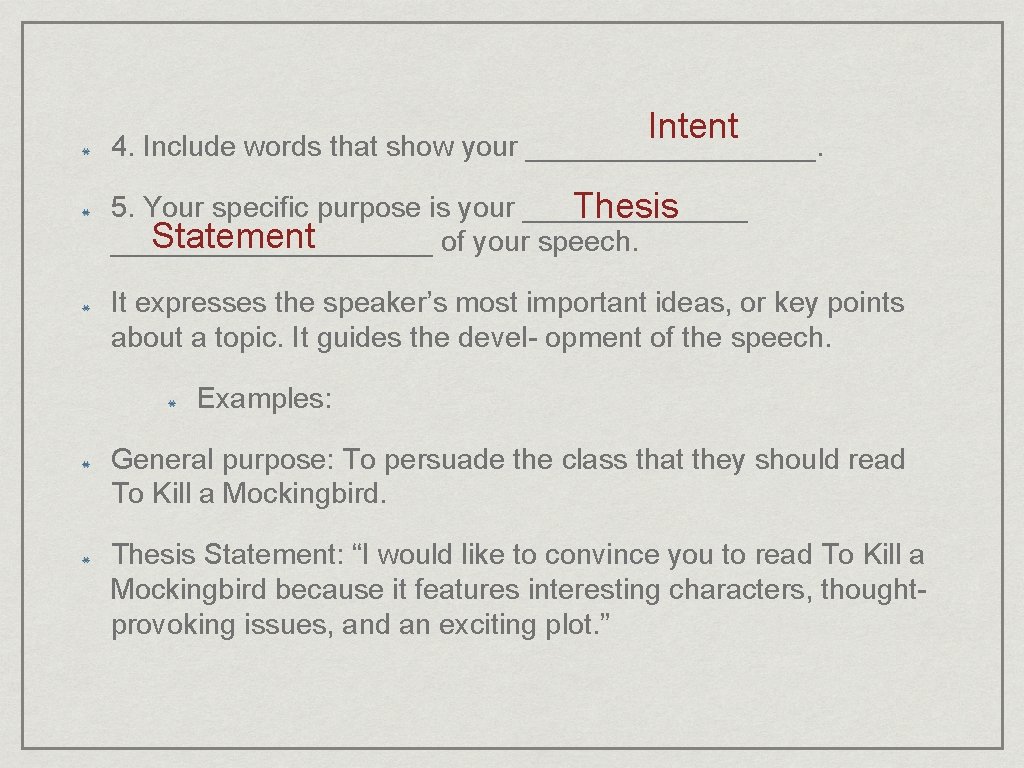
Intent 4. Include words that show your _________. 5. Your specific purpose is your _______ Thesis Statement __________ of your speech. It expresses the speaker’s most important ideas, or key points about a topic. It guides the devel- opment of the speech. Examples: General purpose: To persuade the class that they should read To Kill a Mockingbird. Thesis Statement: “I would like to convince you to read To Kill a Mockingbird because it features interesting characters, thoughtprovoking issues, and an exciting plot. ”
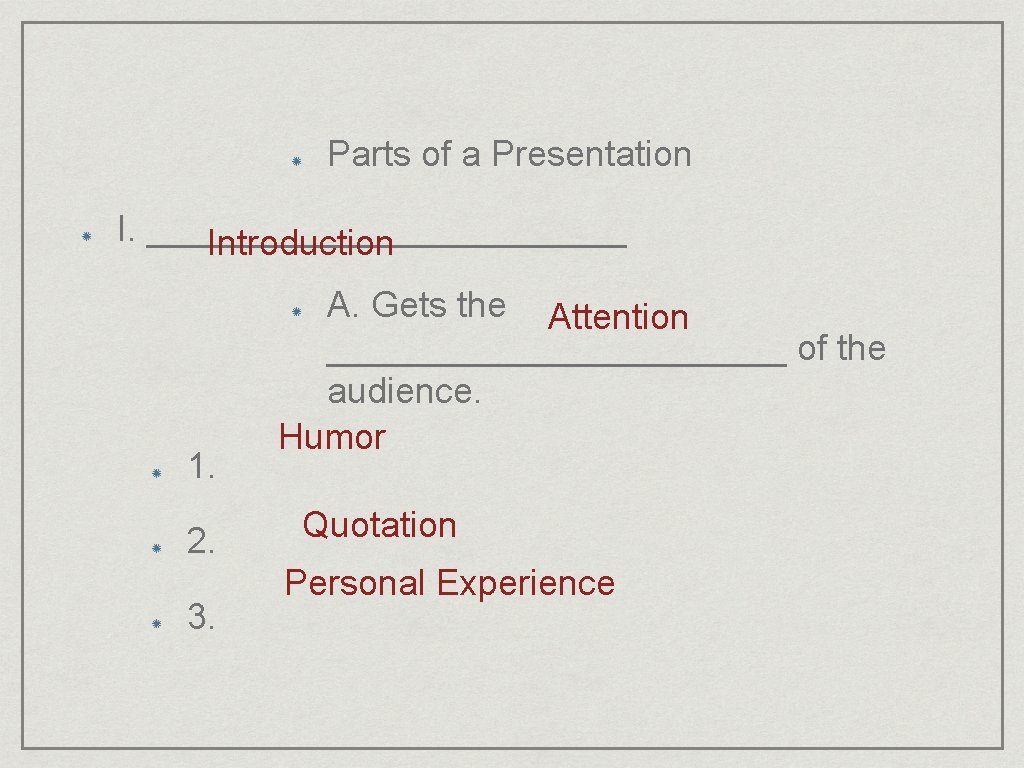
Parts of a Presentation I. ____________ Introduction 1. 2. 3. A. Gets the Attention ____________ of the audience. Humor Quotation Personal Experience
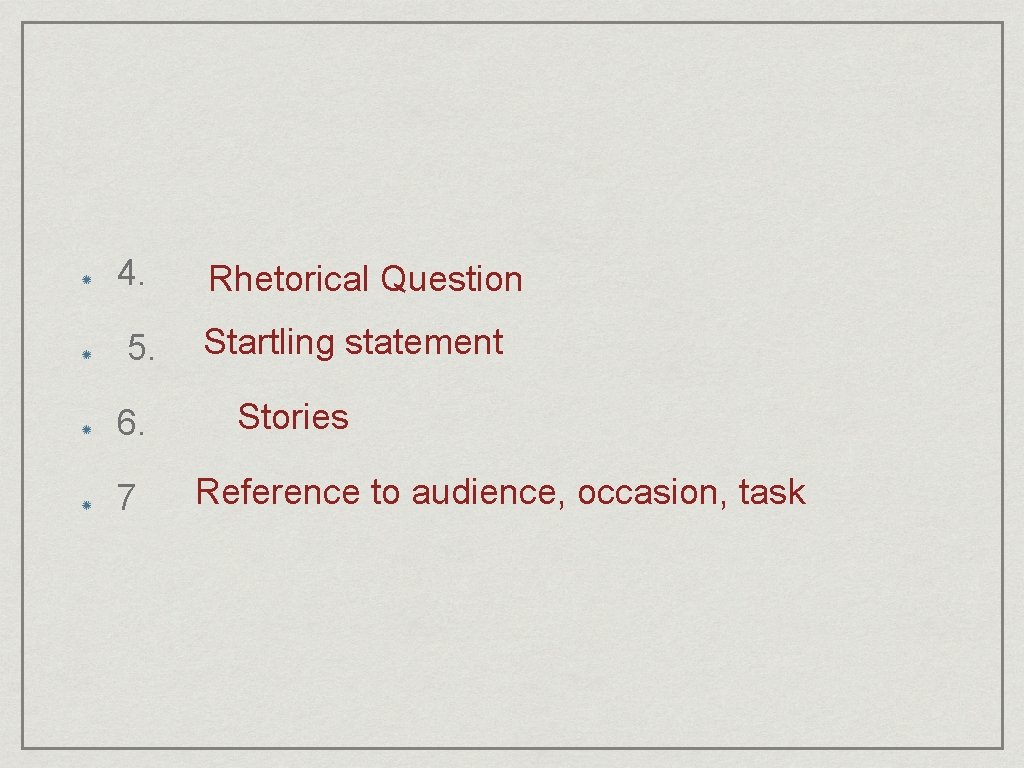
4. Rhetorical Question 5. Startling statement 6. 7 Stories Reference to audience, occasion, task
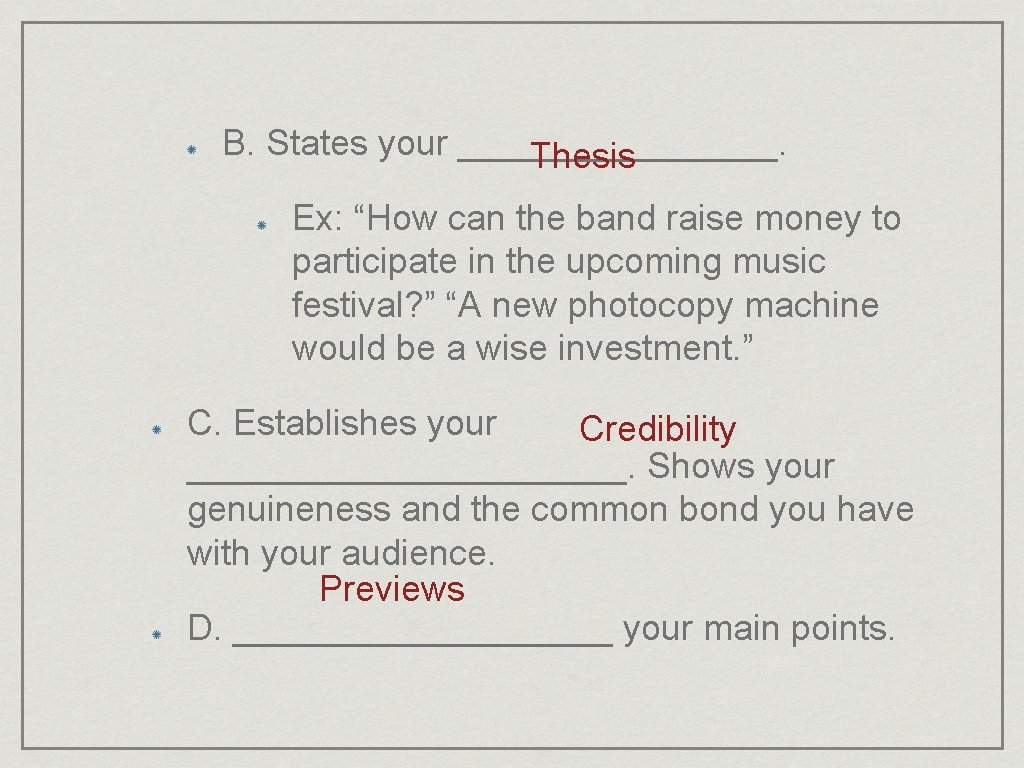
B. States your ________. Thesis Ex: “How can the band raise money to participate in the upcoming music festival? ” “A new photocopy machine would be a wise investment. ” C. Establishes your Credibility ___________. Shows your genuineness and the common bond you have with your audience. Previews D. __________ your main points.
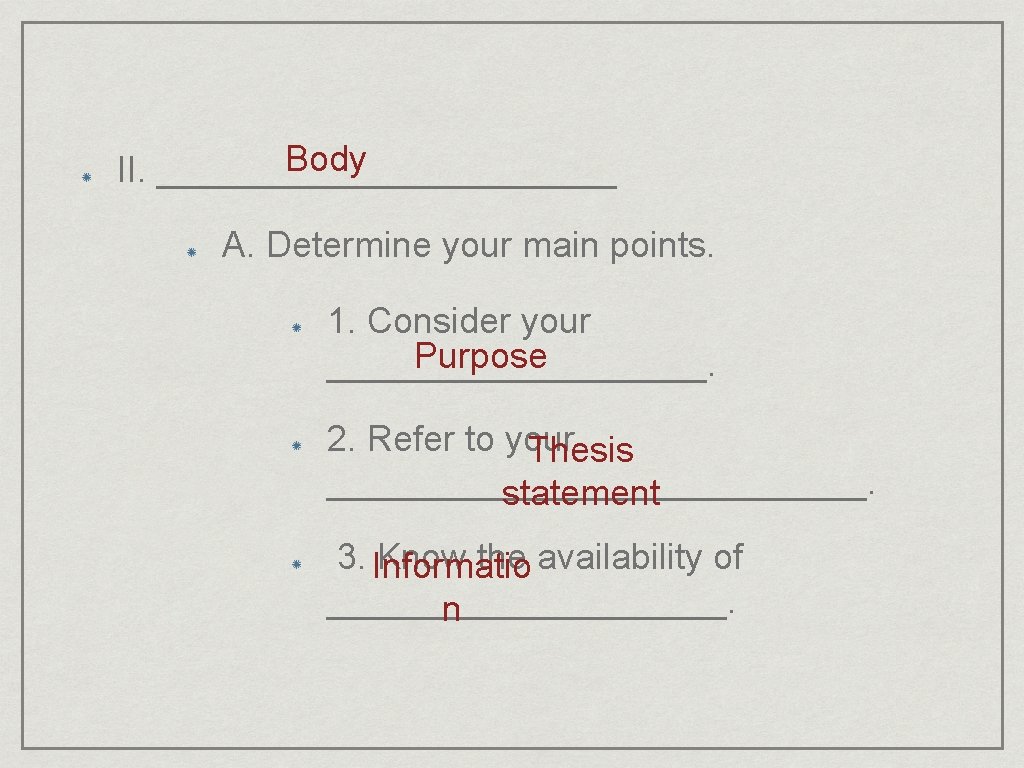
Body II. ____________ A. Determine your main points. 1. Consider your Purpose __________. 2. Refer to your Thesis ______________. statement 3. Informatio Know the availability of __________. n
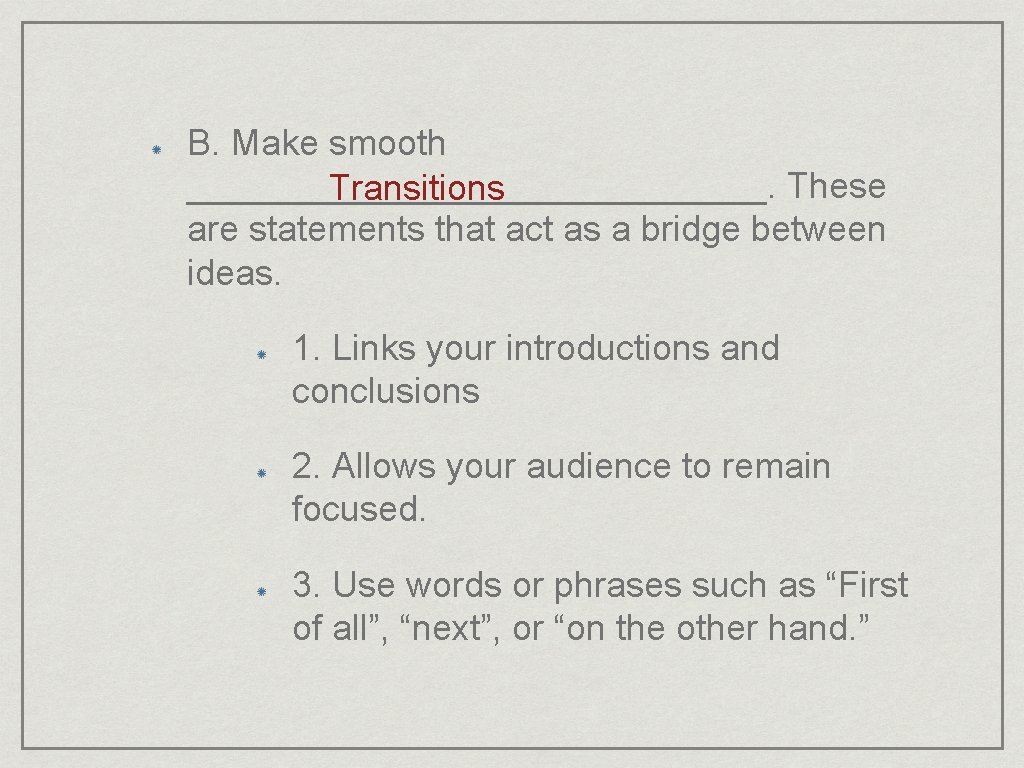
B. Make smooth _______________. These Transitions are statements that act as a bridge between ideas. 1. Links your introductions and conclusions 2. Allows your audience to remain focused. 3. Use words or phrases such as “First of all”, “next”, or “on the other hand. ”
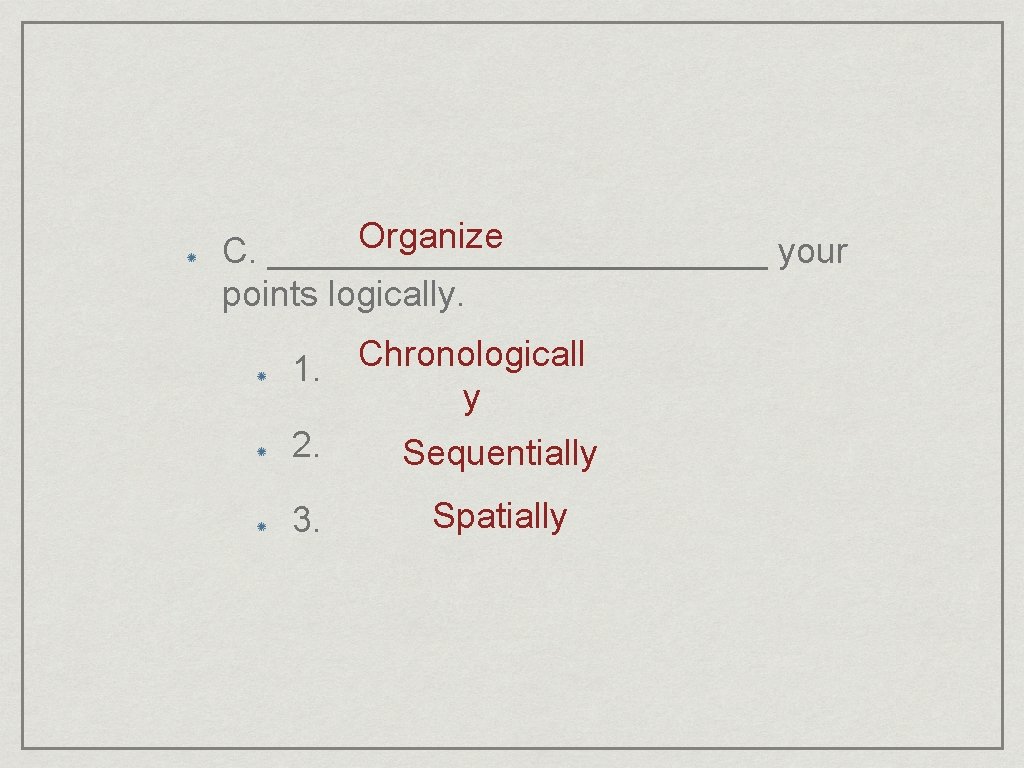
Organize C. _____________ your points logically. Chronologicall 1. y 2. Sequentially 3. Spatially
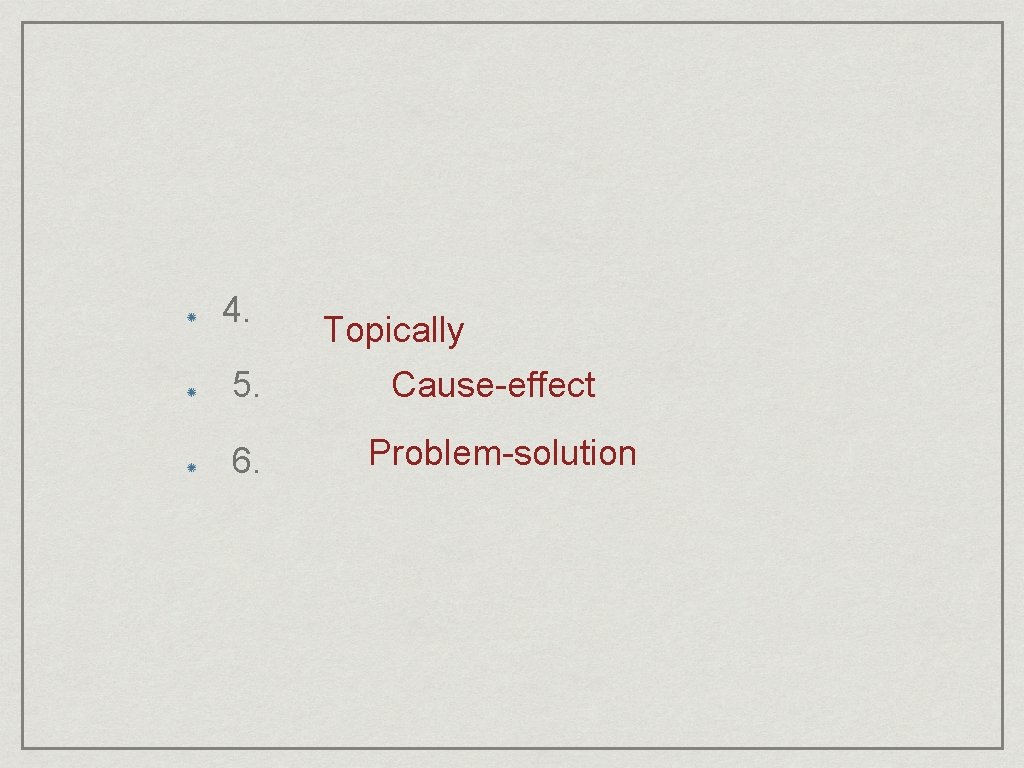
4. Topically 5. Cause-effect 6. Problem-solution
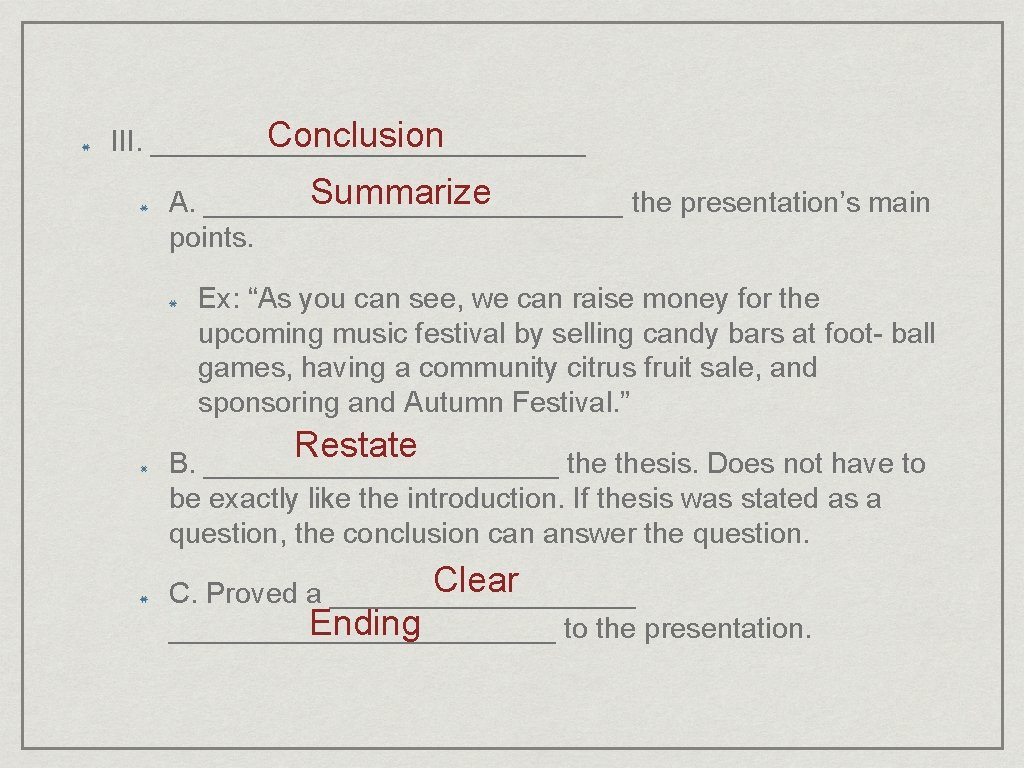
Conclusion III. ______________ Summarize A. _____________ the presentation’s main points. Ex: “As you can see, we can raise money for the upcoming music festival by selling candy bars at foot- ball games, having a community citrus fruit sale, and sponsoring and Autumn Festival. ” Restate B. ___________ thesis. Does not have to be exactly like the introduction. If thesis was stated as a question, the conclusion can answer the question. Clear C. Proved a __________ Ending ____________ to the presentation.
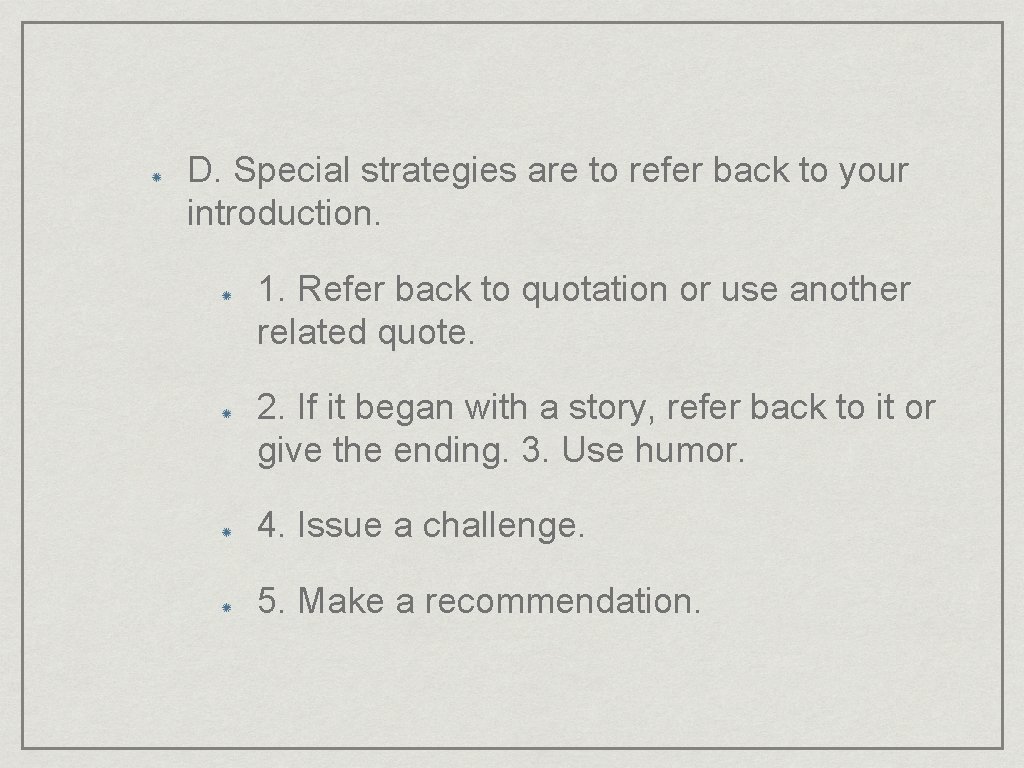
D. Special strategies are to refer back to your introduction. 1. Refer back to quotation or use another related quote. 2. If it began with a story, refer back to it or give the ending. 3. Use humor. 4. Issue a challenge. 5. Make a recommendation.
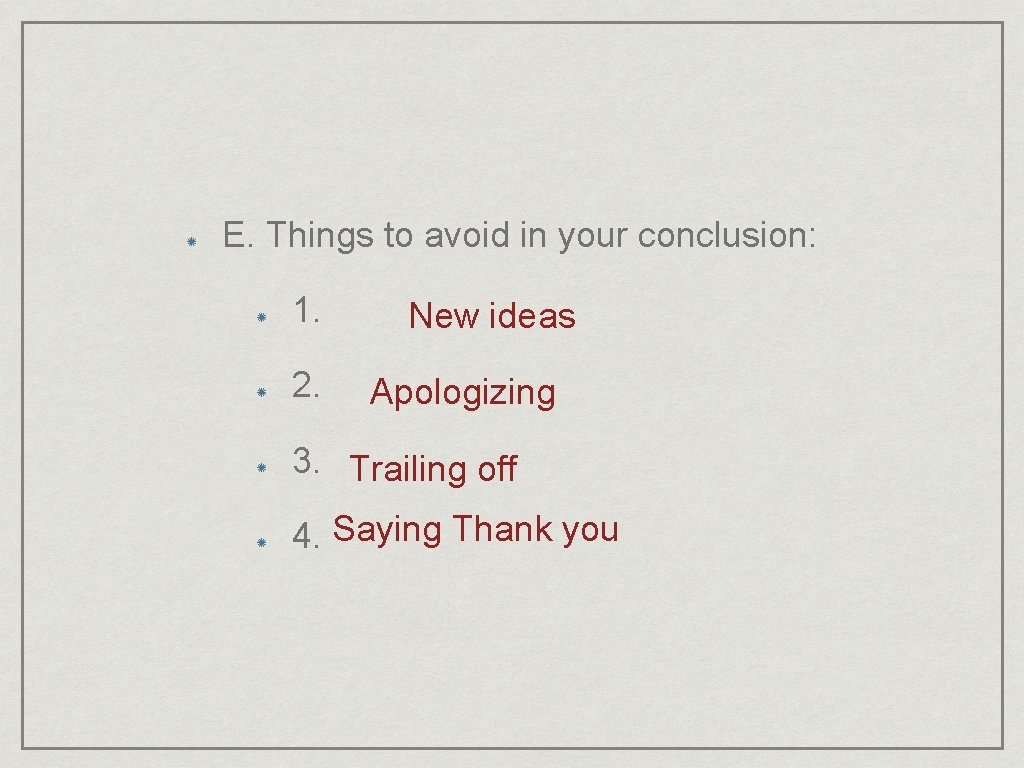
E. Things to avoid in your conclusion: 1. 2. New ideas Apologizing 3. Trailing off 4. Saying Thank you