
SPEECH INTRODUCTIONS The beginning is the most important
SPEECH INTRODUCTIONS “The beginning is the most important part of the work. ” -Plato
Introduction Basics… �The beginning section of your speech �May be as short as a few sentences �No more than 10% of the speech
What is its Purpose? �Grabs the attention of the audience �Gains the goodwill of the audience and establishes your credibility as a speaker �Develops the audience’s interest in the topic of the speech
Attention, Goodwill, Interest: �Attention: find a way to get your inherently distracted audience to FOCUS on YOU! �Goodwill: Audience respect or positive feeling for the speaker as a person; what you say in your opening remarks and the way you say it (tone, inflection, non-verbals) �Interest: Refers to the involvement or concern your audience shows about topic
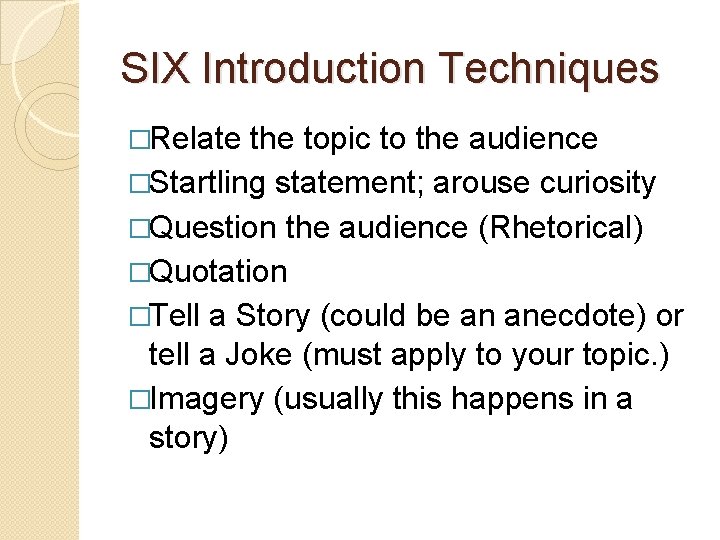
SIX Introduction Techniques �Relate the topic to the audience �Startling statement; arouse curiosity �Question the audience (Rhetorical) �Quotation �Tell a Story (could be an anecdote) or tell a Joke (must apply to your topic. ) �Imagery (usually this happens in a story)
DON’T FORGET �You must clearly state the topic of your speech. �You must prepare your audience for the rest of the speech by establishing and PREVIEWING your topic. �It is possible to state your topic without saying “My topic is…” Listen to this sample introduction. What technique is being used, and what is the topic?
The DO NOT’S of Intro’s… �“Today I want to talk to you about bicycle maintenance. ” �“My speech is about calligraphy—the art of handwriting. ” �“My topic is how to buy a pet. ”
Listen and Guess �Volunteers will read sample introductions. You must guess to see which technique is being used.

What is the Preview Statement? �One sentence in length �Identifies the subtopics from the outline of your speech (A, B, C) �It prepares the audience for what they will hear in the body of your speech �Similar to a thesis statement in a paper
- Slides: 9