
SPEECH AND LANGUAGE THERAPY WORKFORCE PLANNING SESSION East

![Quantifying the specialist contribution (Direct) Direct Clinical Care [d. DCC] o o o o](https://slidetodoc.com/presentation_image_h/cb991938ffed97778c8884197256f47d/image-22.jpg "Quantifying the specialist contribution (Direct) Direct Clinical Care [d. DCC] o o o o")
![NHS productivity: 1995 -2010 [ONS survey] 250 Output index 200 150 Input index 100](https://slidetodoc.com/presentation_image_h/cb991938ffed97778c8884197256f47d/image-25.jpg "NHS productivity: 1995 -2010 [ONS survey] 250 Output index 200 150 Input index 100")
- Slides: 36
SPEECH AND LANGUAGE THERAPY WORKFORCE PLANNING SESSION East Midlands SLT Hub 19 th November 2013
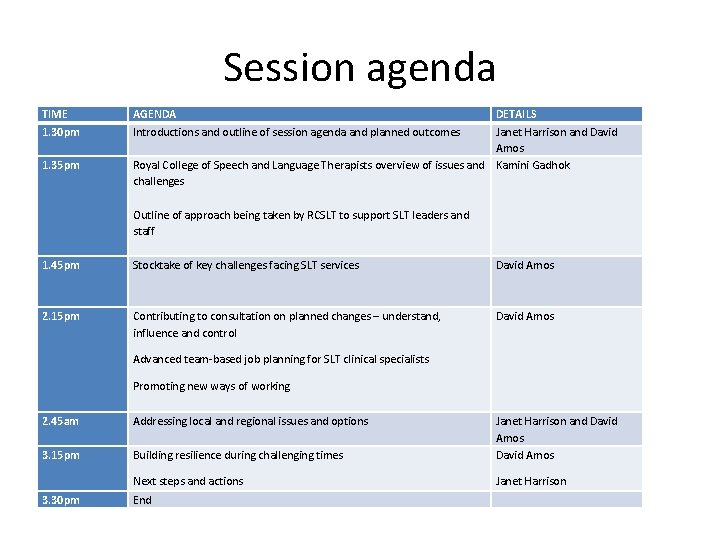
Session agenda TIME 1. 30 pm 1. 35 pm 1. 45 pm 2. 15 pm AGENDA Introductions and outline of session agenda and planned outcomes DETAILS Janet Harrison and David Amos Royal College of Speech and Language Therapists overview of issues and Kamini Gadhok challenges Outline of approach being taken by RCSLT to support SLT leaders and staff Stocktake of key challenges facing SLT services David Amos Contributing to consultation on planned changes – understand, David Amos influence and control Advanced team-based job planning for SLT clinical specialists Promoting new ways of working 2. 45 am Addressing local and regional issues and options 3. 15 pm Building resilience during challenging times Janet Harrison and David Amos Next steps and actions Janet Harrison End 3. 30 pm
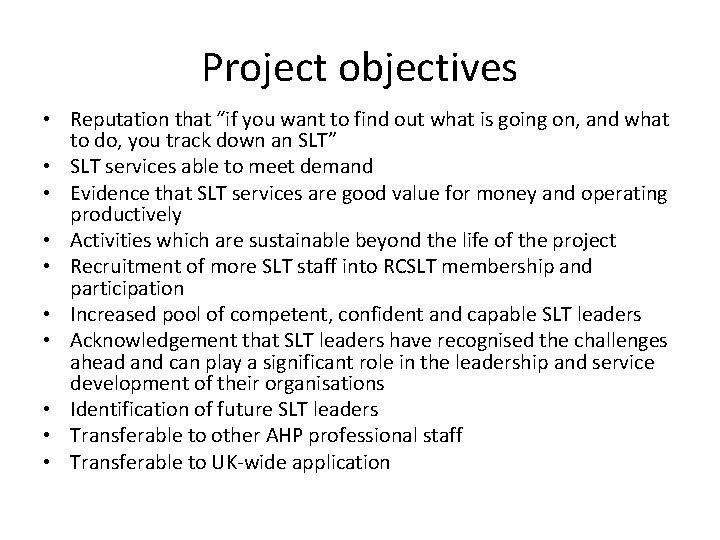
Project objectives • Reputation that “if you want to find out what is going on, and what to do, you track down an SLT” • SLT services able to meet demand • Evidence that SLT services are good value for money and operating productively • Activities which are sustainable beyond the life of the project • Recruitment of more SLT staff into RCSLT membership and participation • Increased pool of competent, confident and capable SLT leaders • Acknowledgement that SLT leaders have recognised the challenges ahead and can play a significant role in the leadership and service development of their organisations • Identification of future SLT leaders • Transferable to other AHP professional staff • Transferable to UK-wide application
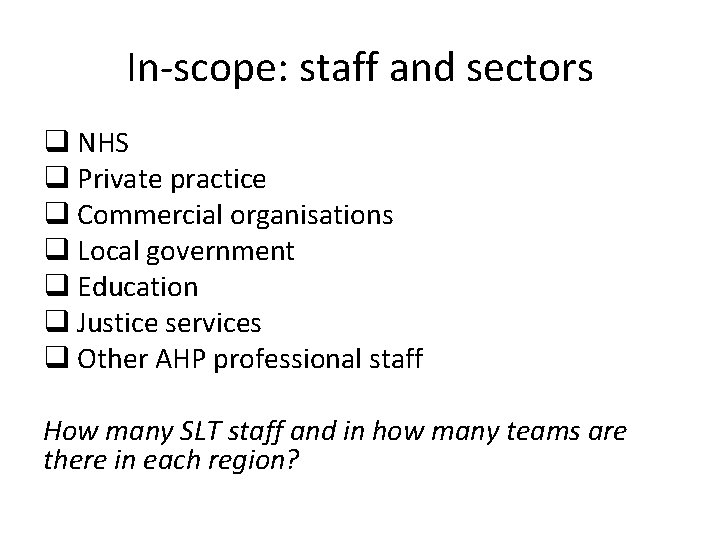
In-scope: staff and sectors q NHS q Private practice q Commercial organisations q Local government q Education q Justice services q Other AHP professional staff How many SLT staff and in how many teams are there in each region?
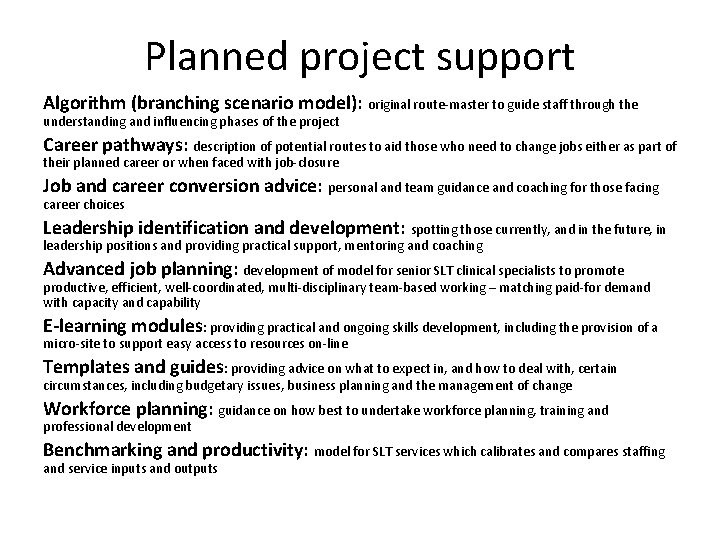
Planned project support Algorithm (branching scenario model): original route-master to guide staff through the understanding and influencing phases of the project Career pathways: description of potential routes to aid those who need to change jobs either as part of their planned career or when faced with job-closure Job and career conversion advice: personal and team guidance and coaching for those facing career choices Leadership identification and development: spotting those currently, and in the future, in leadership positions and providing practical support, mentoring and coaching Advanced job planning: development of model for senior SLT clinical specialists to promote productive, efficient, well-coordinated, multi-disciplinary team-based working – matching paid-for demand with capacity and capability E-learning modules: providing practical and ongoing skills development, including the provision of a micro-site to support easy access to resources on-line Templates and guides: providing advice on what to expect in, and how to deal with, certain circumstances, including budgetary issues, business planning and the management of change Workforce planning: guidance on how best to undertake workforce planning, training and professional development Benchmarking and productivity: model for SLT services which calibrates and compares staffing and service inputs and outputs
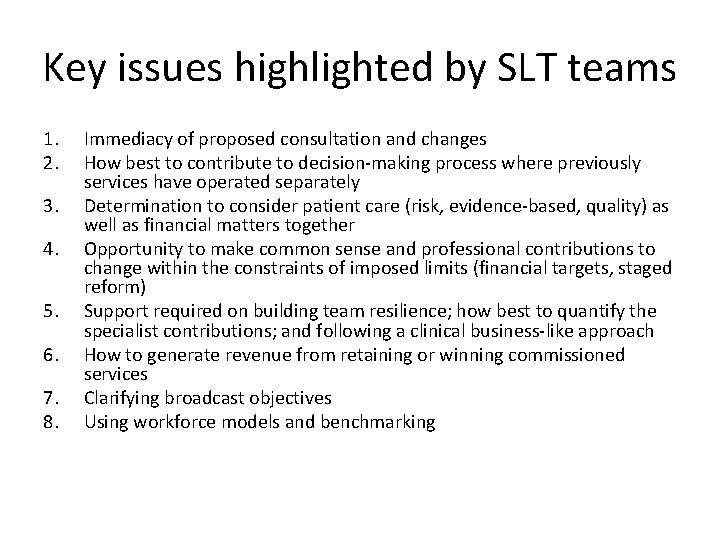
Key issues highlighted by SLT teams 1. 2. 3. 4. 5. 6. 7. 8. Immediacy of proposed consultation and changes How best to contribute to decision-making process where previously services have operated separately Determination to consider patient care (risk, evidence-based, quality) as well as financial matters together Opportunity to make common sense and professional contributions to change within the constraints of imposed limits (financial targets, staged reform) Support required on building team resilience; how best to quantify the specialist contributions; and following a clinical business-like approach How to generate revenue from retaining or winning commissioned services Clarifying broadcast objectives Using workforce models and benchmarking
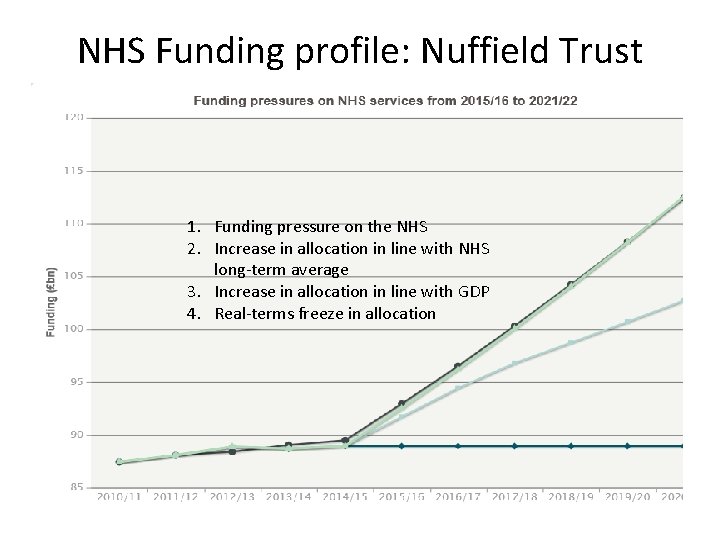
NHS Funding profile: Nuffield Trust 1. Funding pressure on the NHS 2. Increase in allocation in line with NHS long-term average 3. Increase in allocation in line with GDP 4. Real-terms freeze in allocation
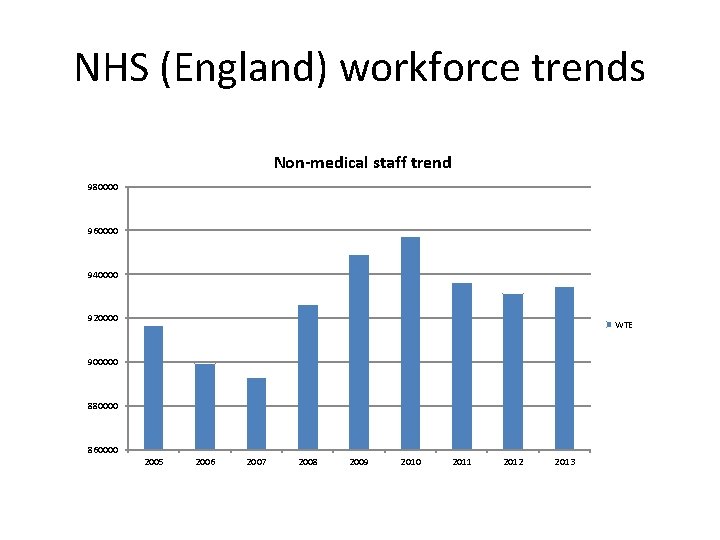
NHS (England) workforce trends Non-medical staff trend 980000 960000 940000 920000 WTE 900000 880000 860000 2005 2006 2007 2008 2009 2010 2011 2012 2013
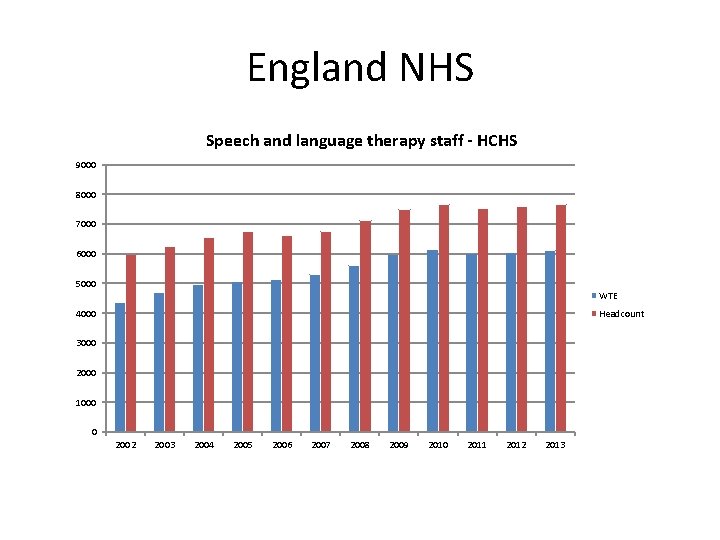
England NHS Speech and language therapy staff - HCHS 9000 8000 7000 6000 5000 WTE 4000 Headcount 3000 2000 1000 0 2002 2003 2004 2005 2006 2007 2008 2009 2010 2011 2012 2013
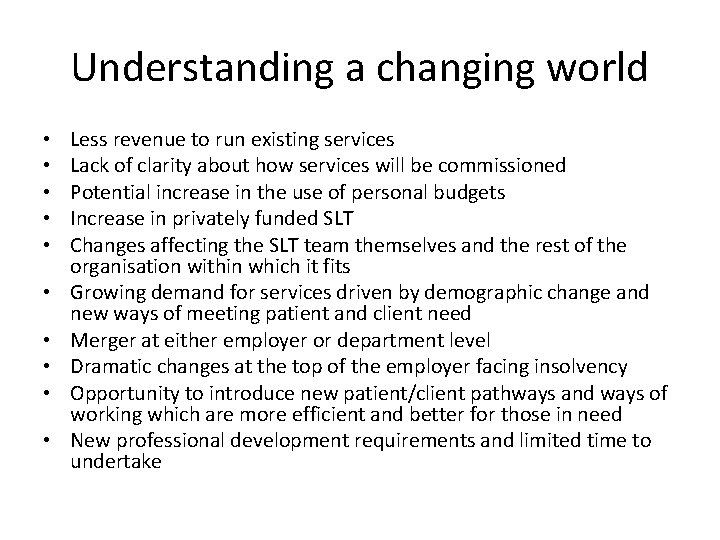
Understanding a changing world • • • Less revenue to run existing services Lack of clarity about how services will be commissioned Potential increase in the use of personal budgets Increase in privately funded SLT Changes affecting the SLT team themselves and the rest of the organisation within which it fits Growing demand for services driven by demographic change and new ways of meeting patient and client need Merger at either employer or department level Dramatic changes at the top of the employer facing insolvency Opportunity to introduce new patient/client pathways and ways of working which are more efficient and better for those in need New professional development requirements and limited time to undertake
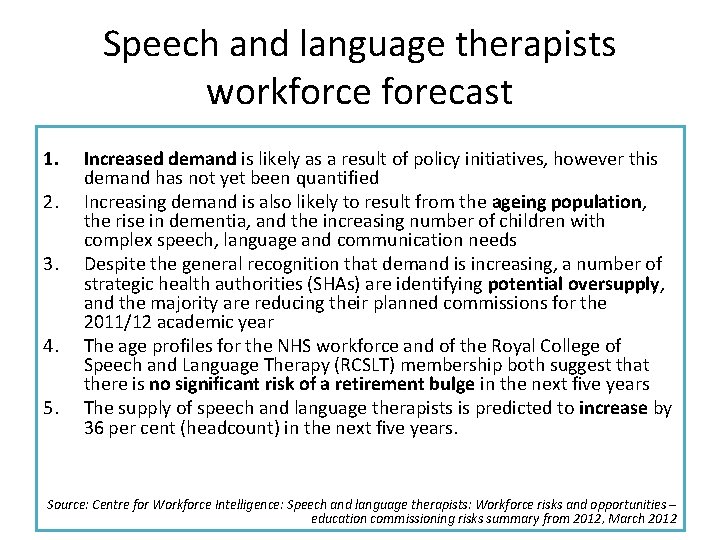
Speech and language therapists workforce forecast 1. 2. 3. 4. 5. Increased demand is likely as a result of policy initiatives, however this demand has not yet been quantified Increasing demand is also likely to result from the ageing population, the rise in dementia, and the increasing number of children with complex speech, language and communication needs Despite the general recognition that demand is increasing, a number of strategic health authorities (SHAs) are identifying potential oversupply, and the majority are reducing their planned commissions for the 2011/12 academic year The age profiles for the NHS workforce and of the Royal College of Speech and Language Therapy (RCSLT) membership both suggest that there is no significant risk of a retirement bulge in the next five years The supply of speech and language therapists is predicted to increase by 36 per cent (headcount) in the next five years. Source: Centre for Workforce Intelligence: Speech and language therapists: Workforce risks and opportunities – education commissioning risks summary from 2012, March 2012
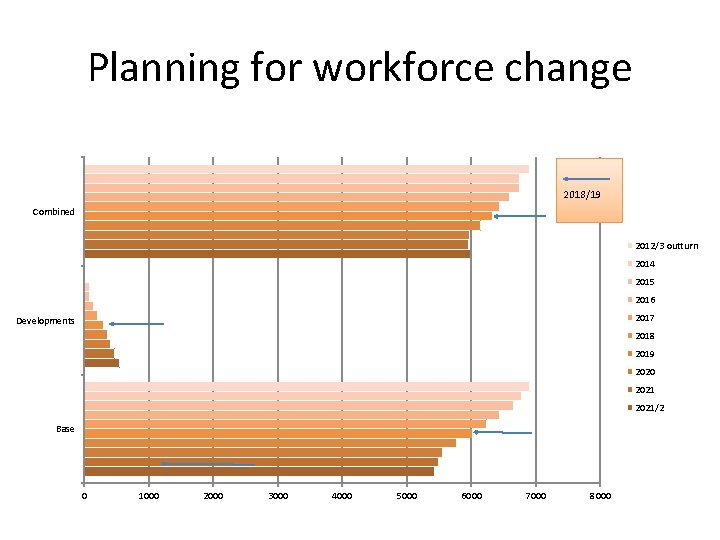
Planning for workforce change 2018/19 Combined 2012/3 outturn 2014 2015 2016 2017 Developments 2018 2019 2020 2021/2 Base 0 1000 2000 3000 4000 5000 6000 7000 8000
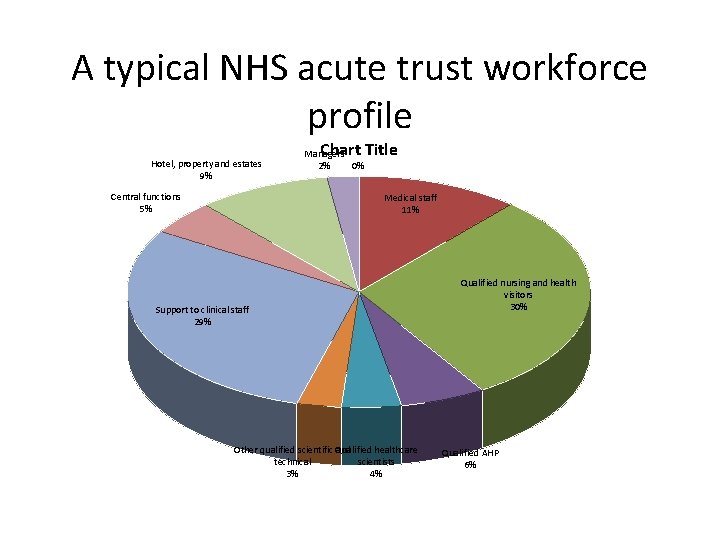
A typical NHS acute trust workforce profile Hotel, property and estates 9% Central functions 5% Chart Title Managers 0% 2% Medical staff 11% Support to clinical staff 29% Other qualified scientific and Qualified healthcare technical scientists 3% 4% Qualified nursing and health visitors 30% Qualified AHP 6%
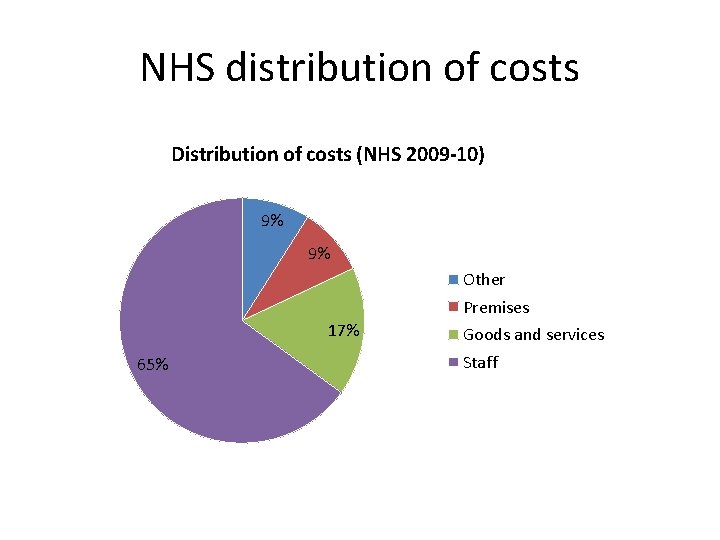
NHS distribution of costs Distribution of costs (NHS 2009 -10) 9% 9% Other Premises 17% 65% Goods and services Staff
What could my organisation be planning? 1. 2. 3. 4. 5. 6. 7. 8. Making a 5 -7% cost improvement each year Merging with another provider organisation Merging the clinical service with another one Placing the SLT service under the leadership of another profession Introducing a service level agreement Undertaking a job evaluation exercise Implementing advanced job planning Being involved in a procurement exercise
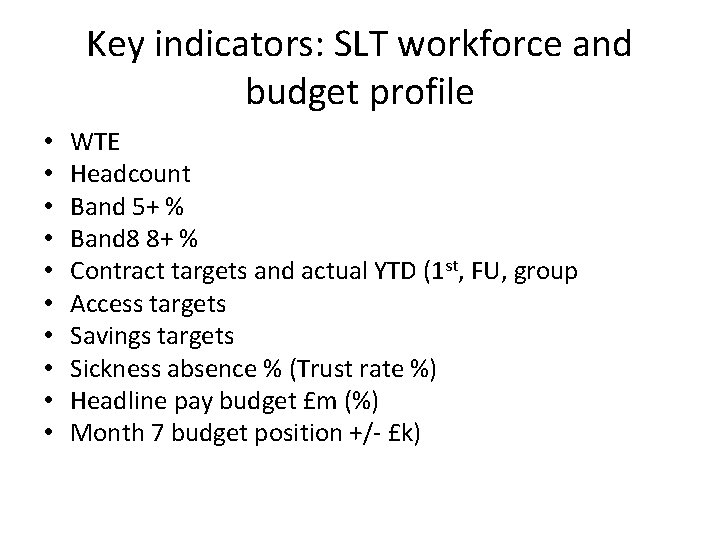
Key indicators: SLT workforce and budget profile • • • WTE Headcount Band 5+ % Band 8 8+ % Contract targets and actual YTD (1 st, FU, group Access targets Savings targets Sickness absence % (Trust rate %) Headline pay budget £m (%) Month 7 budget position +/- £k)
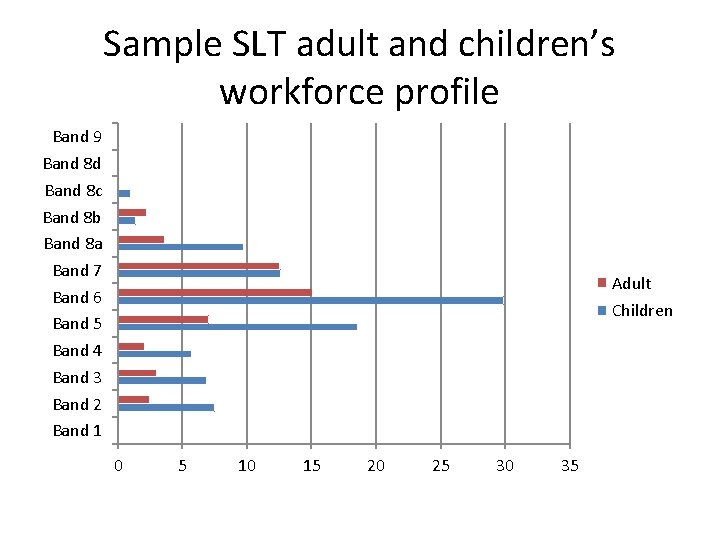
Sample SLT adult and children’s workforce profile Band 9 Band 8 d Band 8 c Band 8 b Band 8 a Band 7 Band 6 Band 5 Band 4 Band 3 Band 2 Band 1 Adult Children 0 5 10 15 20 25 30 35
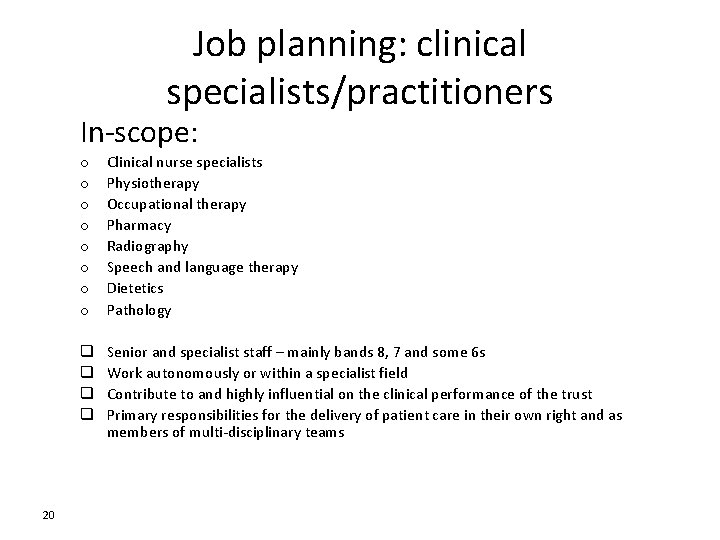
Job planning: clinical specialists/practitioners In-scope: 20 o o o o Clinical nurse specialists Physiotherapy Occupational therapy Pharmacy Radiography Speech and language therapy Dietetics Pathology q q Senior and specialist staff – mainly bands 8, 7 and some 6 s Work autonomously or within a specialist field Contribute to and highly influential on the clinical performance of the trust Primary responsibilities for the delivery of patient care in their own right and as members of multi-disciplinary teams
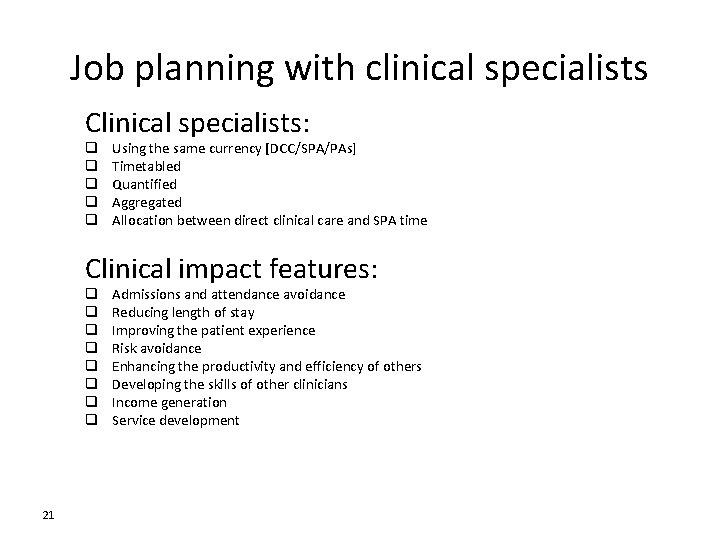
Job planning with clinical specialists Clinical specialists: q q q Using the same currency [DCC/SPA/PAs] Timetabled Quantified Aggregated Allocation between direct clinical care and SPA time Clinical impact features: q q q q 21 Admissions and attendance avoidance Reducing length of stay Improving the patient experience Risk avoidance Enhancing the productivity and efficiency of others Developing the skills of other clinicians Income generation Service development
Quantifying the specialist contribution (Direct) Direct Clinical Care [d. DCC] o o o o (Indirect) Direct Clinical Care [i. DCC] This type of d. DCC is made of: Assessment o Direct delivery of faceto-face therapy programmes o Emergency duties Diagnostic sessions Ward rounds Outpatient services o Other patient treatments This type of i. DCC is made of: Multi-disciplinary team meetings and activities Clinical administration directly related to the d. DCC activities Personalised at patient level training programme to meet needs of delivery of specific patient care plan Supporting Professional Activity (personal) Supporting Professional Activity (others) This type of SPA activity is made up This type of SPA activity is made of: up of: o o o Continuous professional development Audit Clinical governance Statutory and mandatory training Job planning General (non-clinical) administration Appraisal and revalidation Research Divisional/departmental meetings Recruitment Staff management o o o General training, education and formal teaching Specific activity to enhance the efficiency, effectiveness and productivity of other staff Clinical supervision % Number of PAs Gearing:
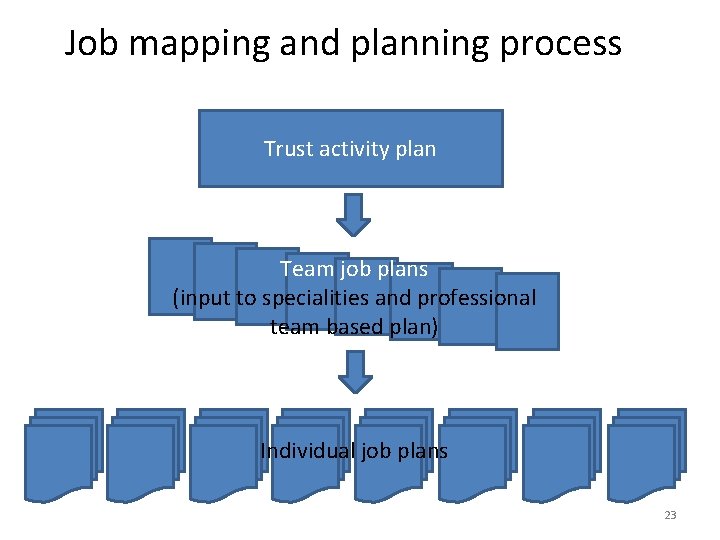
Job mapping and planning process Trust activity plan Team job plans (input to specialities and professional team based plan) Individual job plans 23
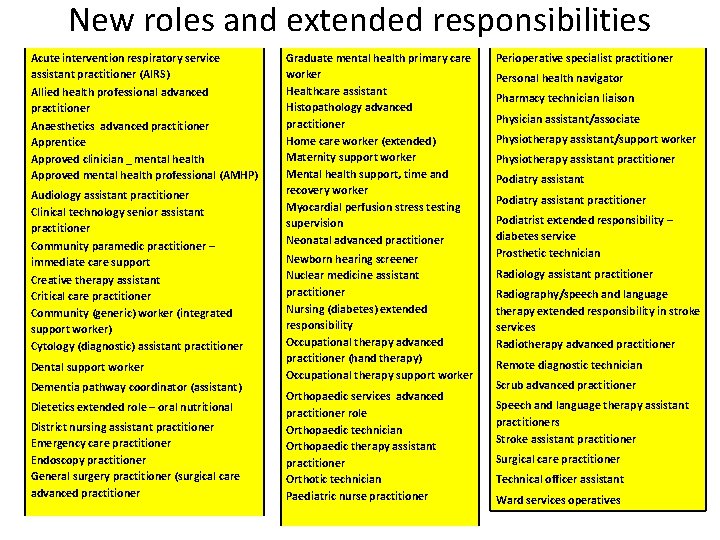
New roles and extended responsibilities Acute intervention respiratory service assistant practitioner (AIRS) Allied health professional advanced practitioner Anaesthetics advanced practitioner Apprentice Approved clinician _ mental health Approved mental health professional (AMHP) Audiology assistant practitioner Clinical technology senior assistant practitioner Community paramedic practitioner – immediate care support Creative therapy assistant Critical care practitioner Community (generic) worker (integrated support worker) Cytology (diagnostic) assistant practitioner Dental support worker Dementia pathway coordinator (assistant) Dietetics extended role – oral nutritional District nursing assistant practitioner Emergency care practitioner Endoscopy practitioner General surgery practitioner (surgical care advanced practitioner Graduate mental health primary care worker Healthcare assistant Histopathology advanced practitioner Home care worker (extended) Maternity support worker Mental health support, time and recovery worker Myocardial perfusion stress testing supervision Neonatal advanced practitioner Newborn hearing screener Nuclear medicine assistant practitioner Nursing (diabetes) extended responsibility Occupational therapy advanced practitioner (hand therapy) Occupational therapy support worker Orthopaedic services advanced practitioner role Orthopaedic technician Orthopaedic therapy assistant practitioner Orthotic technician Paediatric nurse practitioner Perioperative specialist practitioner Personal health navigator Pharmacy technician liaison Physician assistant/associate Physiotherapy assistant/support worker Physiotherapy assistant practitioner Podiatry assistant practitioner Podiatrist extended responsibility – diabetes service Prosthetic technician Radiology assistant practitioner Radiography/speech and language therapy extended responsibility in stroke services Radiotherapy advanced practitioner Remote diagnostic technician Scrub advanced practitioner Speech and language therapy assistant practitioners Stroke assistant practitioner Surgical care practitioner Technical officer assistant Ward services operatives
NHS productivity: 1995 -2010 [ONS survey] 250 Output index 200 150 Input index 100 Productivity index 50 96 19 97 19 98 19 99 20 00 20 01 20 02 20 03 20 04 20 05 20 06 20 07 20 08 20 09 20 10 19 19 95 0
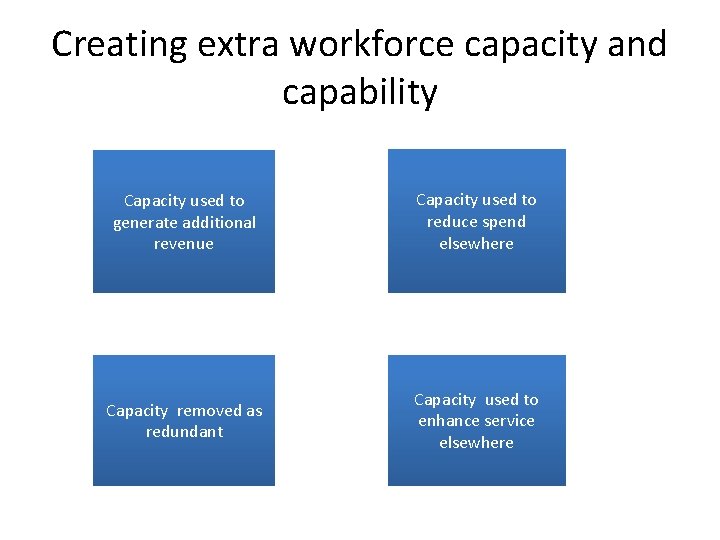
Creating extra workforce capacity and capability Capacity used to generate additional revenue Capacity used to reduce spend elsewhere Capacity removed as redundant Capacity used to enhance service elsewhere
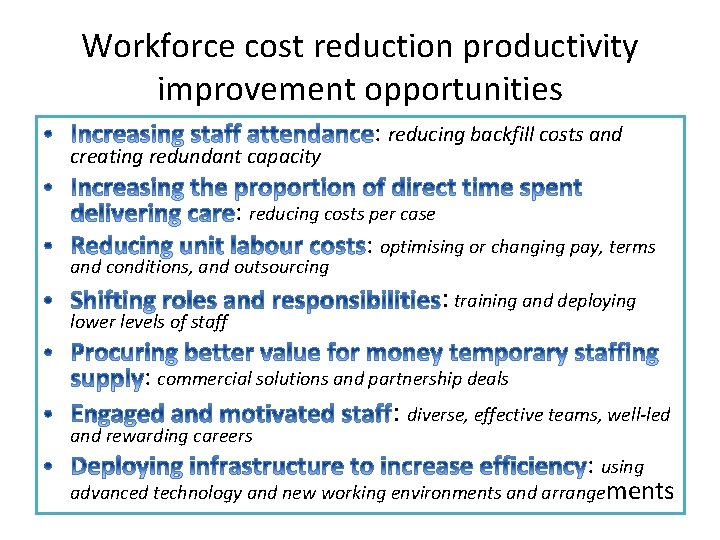
Workforce cost reduction productivity improvement opportunities creating redundant capacity : reducing backfill costs and : reducing costs per case : optimising or changing pay, terms and conditions, and outsourcing lower levels of staff : training and deploying : commercial solutions and partnership deals and rewarding careers : diverse, effective teams, well-led : using advanced technology and new working environments and arrangements
Clinical business language dictionary Acquisition Budgetary management Consultation Co-production Cost avoidance Cost reduction Efficiency Heads of terms Merger Procurement Productivity Privatisation Public-private joint venture Redeployment Service level agreement Tendering
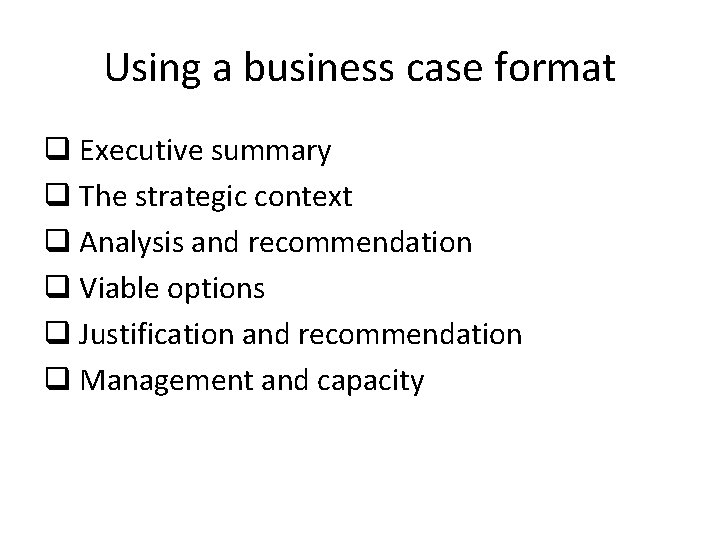
Using a business case format q Executive summary q The strategic context q Analysis and recommendation q Viable options q Justification and recommendation q Management and capacity
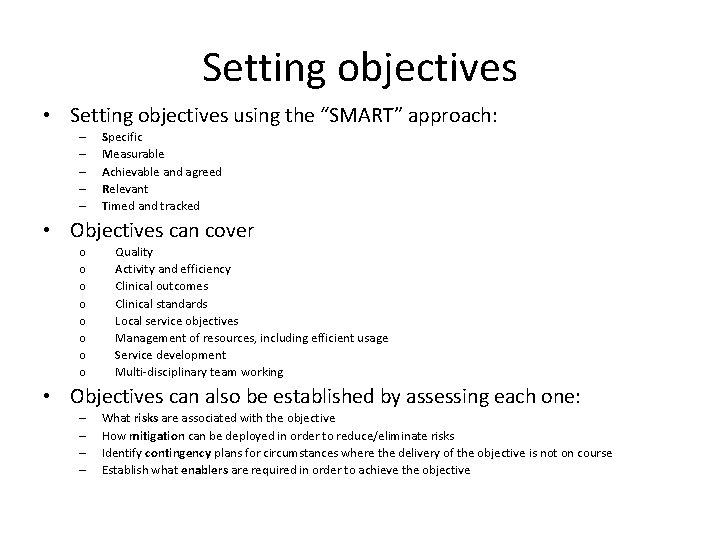
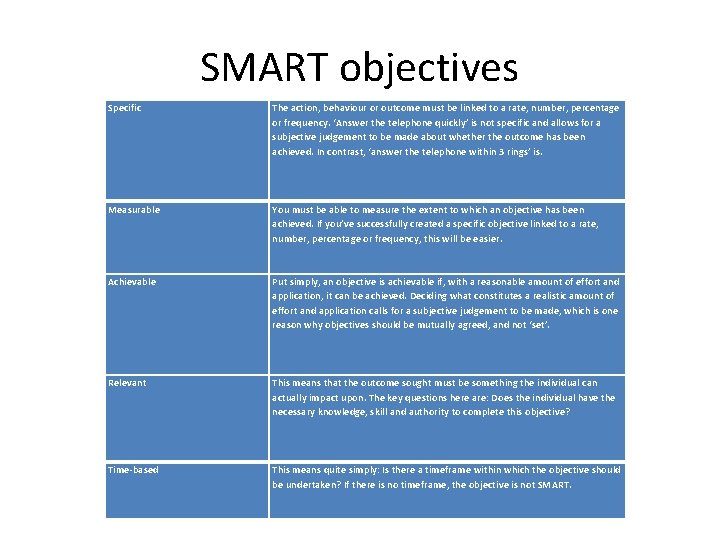
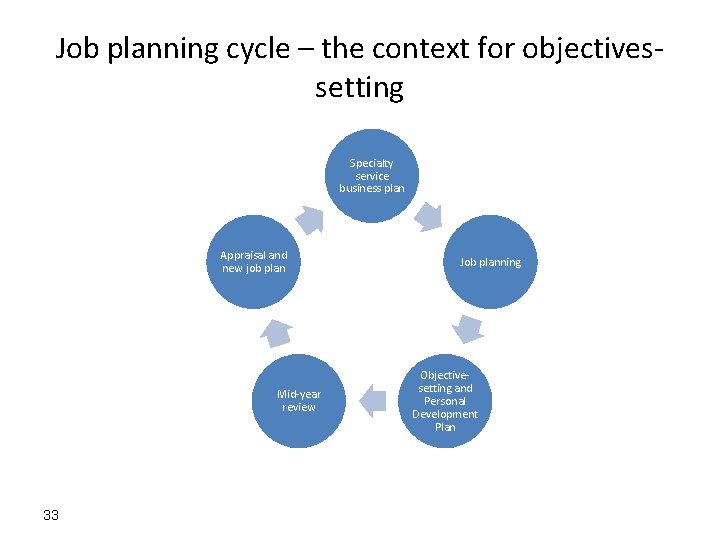
Setting objectives • Setting objectives using the “SMART” approach: – – – Specific Measurable Achievable and agreed Relevant Timed and tracked • Objectives can cover o o o o Quality Activity and efficiency Clinical outcomes Clinical standards Local service objectives Management of resources, including efficient usage Service development Multi-disciplinary team working • Objectives can also be established by assessing each one: – – What risks are associated with the objective How mitigation can be deployed in order to reduce/eliminate risks Identify contingency plans for circumstances where the delivery of the objective is not on course Establish what enablers are required in order to achieve the objective
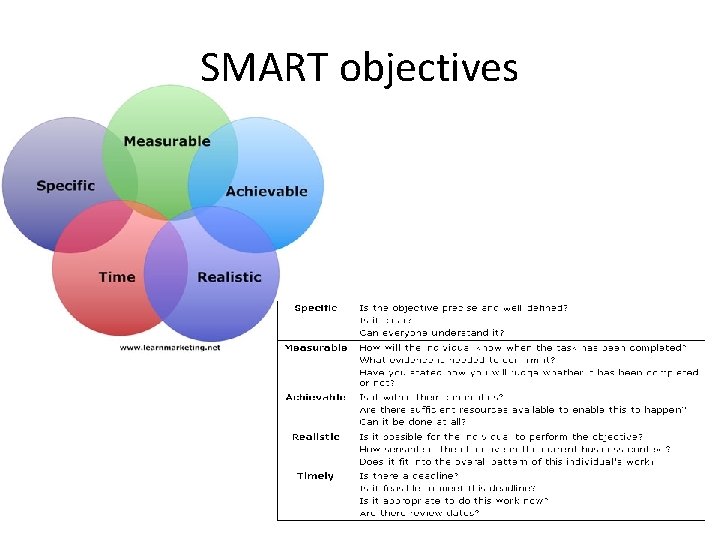
SMART objectives
SMART objectives Specific The action, behaviour or outcome must be linked to a rate, number, percentage or frequency. ‘Answer the telephone quickly’ is not specific and allows for a subjective judgement to be made about whether the outcome has been achieved. In contrast, ‘answer the telephone within 3 rings’ is. Measurable You must be able to measure the extent to which an objective has been achieved. If you’ve successfully created a specific objective linked to a rate, number, percentage or frequency, this will be easier. Achievable Put simply, an objective is achievable if, with a reasonable amount of effort and application, it can be achieved. Deciding what constitutes a realistic amount of effort and application calls for a subjective judgement to be made, which is one reason why objectives should be mutually agreed, and not ‘set’. Relevant This means that the outcome sought must be something the individual can actually impact upon. The key questions here are: Does the individual have the necessary knowledge, skill and authority to complete this objective? Time-based This means quite simply: Is there a timeframe within which the objective should be undertaken? If there is no timeframe, the objective is not SMART.
Job planning cycle – the context for objectivessetting Specialty service business plan Appraisal and new job plan Mid-year review 33 Job planning Objectivesetting and Personal Development Plan
Building resilience during challenging times
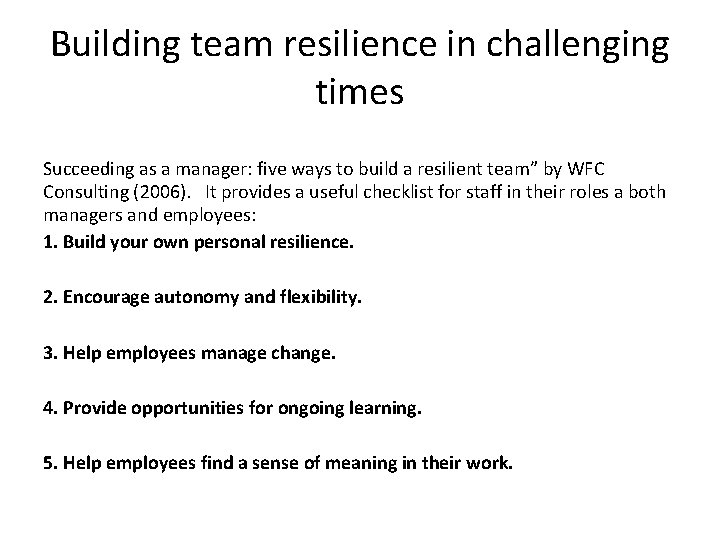
Building team resilience in challenging times Succeeding as a manager: five ways to build a resilient team” by WFC Consulting (2006). It provides a useful checklist for staff in their roles a both managers and employees: 1. Build your own personal resilience. 2. Encourage autonomy and flexibility. 3. Help employees manage change. 4. Provide opportunities for ongoing learning. 5. Help employees find a sense of meaning in their work.
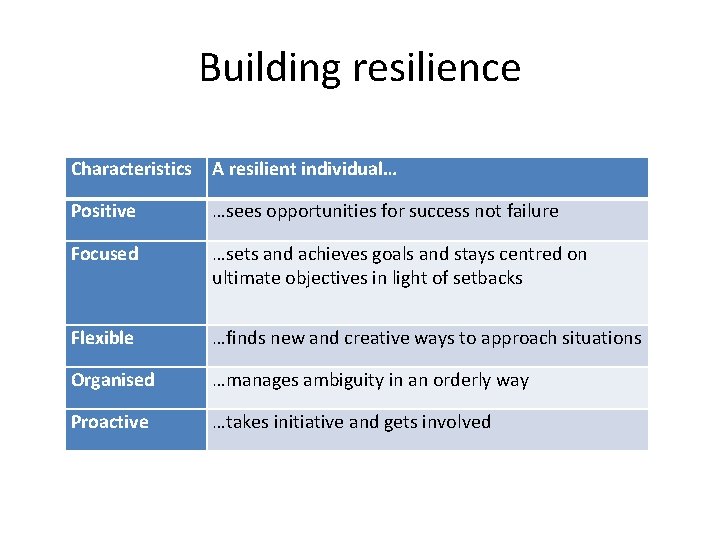
Building resilience Characteristics A resilient individual… Positive …sees opportunities for success not failure Focused …sets and achieves goals and stays centred on ultimate objectives in light of setbacks Flexible …finds new and creative ways to approach situations Organised …manages ambiguity in an orderly way Proactive …takes initiative and gets involved