
Speech and Language Therapy in the Early Years


- Slides: 25
Speech and Language Therapy in the Early Years in Scarborough, Whitby & Ryedale Vicky Wright, Advanced Clinical Specialist SLT York Teaching Hospitals NHS Trust
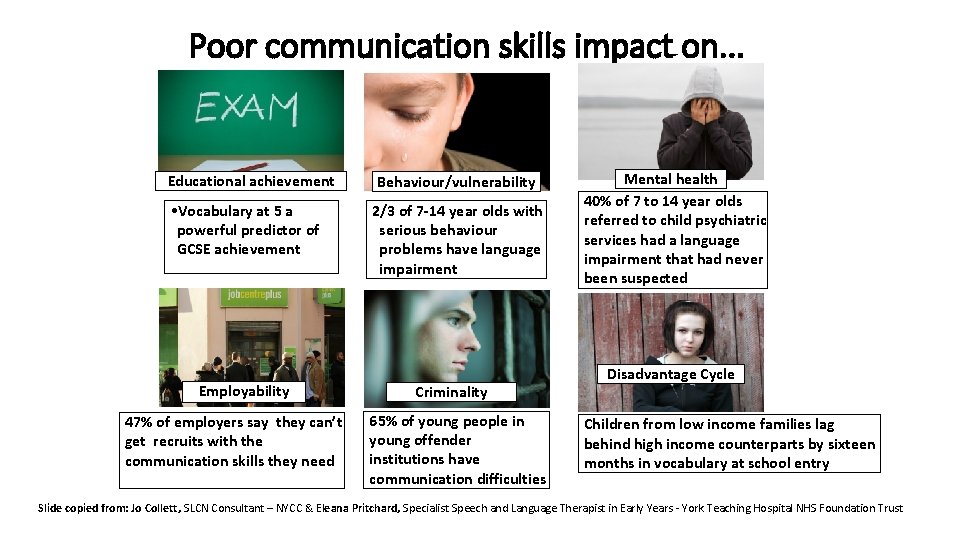
Poor communication skills impact on. . . Educational achievement • Vocabulary at 5 a powerful predictor of GCSE achievement Employability 47% of employers say they can’t get recruits with the communication skills they need Behaviour/vulnerability 2/3 of 7 -14 year olds with serious behaviour problems have language impairment Criminality 65% of young people in young offender institutions have communication difficulties Mental health 40% of 7 to 14 year olds referred to child psychiatric services had a language impairment that had never been suspected Disadvantage Cycle Children from low income families lag behind high income counterparts by sixteen months in vocabulary at school entry Slide copied from: Jo Collett, SLCN Consultant – NYCC & Eleana Pritchard, Specialist Speech and Language Therapist in Early Years - York Teaching Hospital NHS Foundation Trust
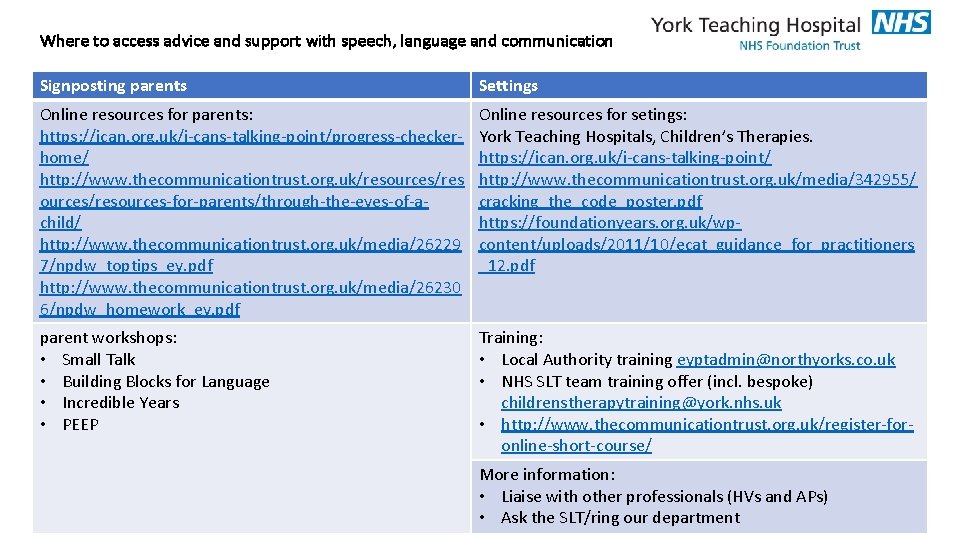
Where to access advice and support with speech, language and communication Signposting parents Settings Online resources for parents: https: //ican. org. uk/i-cans-talking-point/progress-checkerhome/ http: //www. thecommunicationtrust. org. uk/resources/resources-for-parents/through-the-eyes-of-achild/ http: //www. thecommunicationtrust. org. uk/media/26229 7/npdw_toptips_ey. pdf http: //www. thecommunicationtrust. org. uk/media/26230 6/npdw_homework_ey. pdf Online resources for setings: York Teaching Hospitals, Children’s Therapies. https: //ican. org. uk/i-cans-talking-point/ http: //www. thecommunicationtrust. org. uk/media/342955/ cracking_the_code_poster. pdf https: //foundationyears. org. uk/wpcontent/uploads/2011/10/ecat_guidance_for_practitioners _12. pdf parent workshops: • Small Talk • Building Blocks for Language • Incredible Years • PEEP Training: • Local Authority training eyptadmin@northyorks. co. uk • NHS SLT team training offer (incl. bespoke) childrenstherapytraining@york. nhs. uk • http: //www. thecommunicationtrust. org. uk/register-foronline-short-course/ More information: • Liaise with other professionals (HVs and APs) • Ask the SLT/ring our department
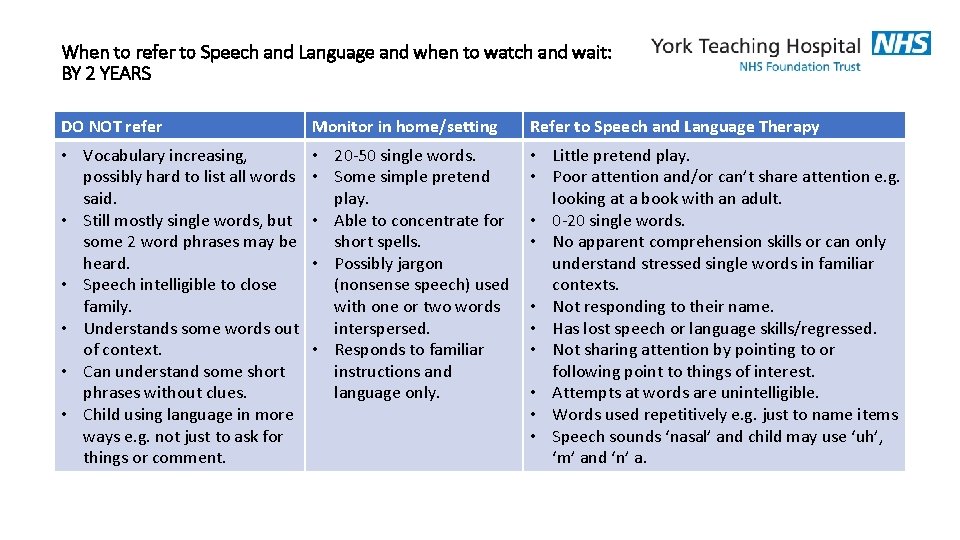
When to refer to Speech and Language and when to watch and wait: BY 2 YEARS DO NOT refer Monitor in home/setting Refer to Speech and Language Therapy • Vocabulary increasing, possibly hard to list all words said. • Still mostly single words, but some 2 word phrases may be heard. • Speech intelligible to close family. • Understands some words out of context. • Can understand some short phrases without clues. • Child using language in more ways e. g. not just to ask for things or comment. • 20 -50 single words. • Some simple pretend play. • Able to concentrate for short spells. • Possibly jargon (nonsense speech) used with one or two words interspersed. • Responds to familiar instructions and language only. • Little pretend play. • Poor attention and/or can’t share attention e. g. looking at a book with an adult. • 0 -20 single words. • No apparent comprehension skills or can only understand stressed single words in familiar contexts. • Not responding to their name. • Has lost speech or language skills/regressed. • Not sharing attention by pointing to or following point to things of interest. • Attempts at words are unintelligible. • Words used repetitively e. g. just to name items • Speech sounds ‘nasal’ and child may use ‘uh’, ‘m’ and ‘n’ a.
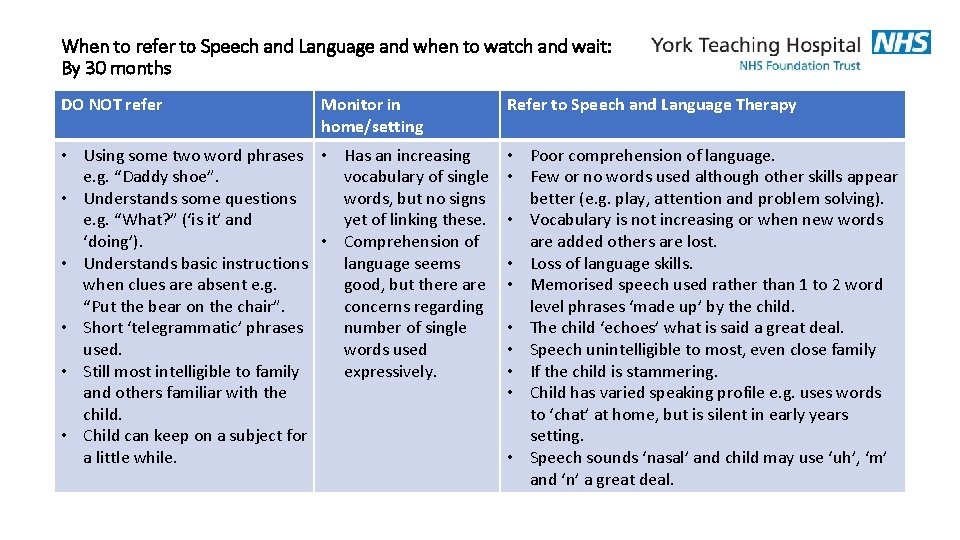
When to refer to Speech and Language and when to watch and wait: By 30 months DO NOT refer Monitor in home/setting • Using some two word phrases • Has an increasing e. g. “Daddy shoe”. vocabulary of single • Understands some questions words, but no signs e. g. “What? ” (‘is it’ and yet of linking these. ‘doing’). • Comprehension of • Understands basic instructions language seems when clues are absent e. g. good, but there are “Put the bear on the chair”. concerns regarding • Short ‘telegrammatic’ phrases number of single used. words used • Still most intelligible to family expressively. and others familiar with the child. • Child can keep on a subject for a little while. Refer to Speech and Language Therapy • Poor comprehension of language. • Few or no words used although other skills appear better (e. g. play, attention and problem solving). • Vocabulary is not increasing or when new words are added others are lost. • Loss of language skills. • Memorised speech used rather than 1 to 2 word level phrases ‘made up’ by the child. • The child ‘echoes’ what is said a great deal. • Speech unintelligible to most, even close family • If the child is stammering. • Child has varied speaking profile e. g. uses words to ‘chat’ at home, but is silent in early years setting. • Speech sounds ‘nasal’ and child may use ‘uh’, ‘m’ and ‘n’ a great deal.
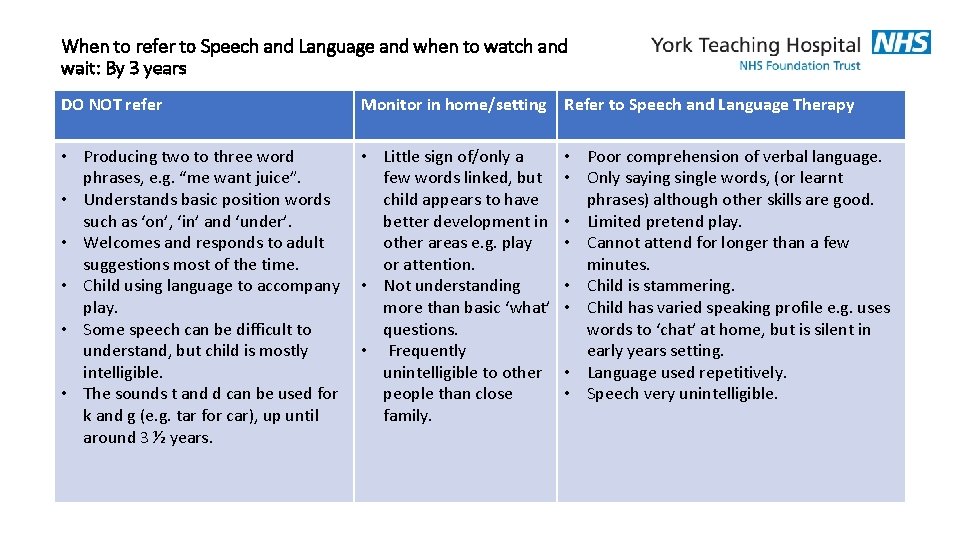
When to refer to Speech and Language and when to watch and wait: By 3 years DO NOT refer Monitor in home/setting Refer to Speech and Language Therapy • Producing two to three word phrases, e. g. “me want juice”. • Understands basic position words such as ‘on’, ‘in’ and ‘under’. • Welcomes and responds to adult suggestions most of the time. • Child using language to accompany play. • Some speech can be difficult to understand, but child is mostly intelligible. • The sounds t and d can be used for k and g (e. g. tar for car), up until around 3 ½ years. • Little sign of/only a few words linked, but child appears to have better development in other areas e. g. play or attention. • Not understanding more than basic ‘what’ questions. • Frequently unintelligible to other people than close family. • Poor comprehension of verbal language. • Only saying single words, (or learnt phrases) although other skills are good. • Limited pretend play. • Cannot attend for longer than a few minutes. • Child is stammering. • Child has varied speaking profile e. g. uses words to ‘chat’ at home, but is silent in early years setting. • Language used repetitively. • Speech very unintelligible.
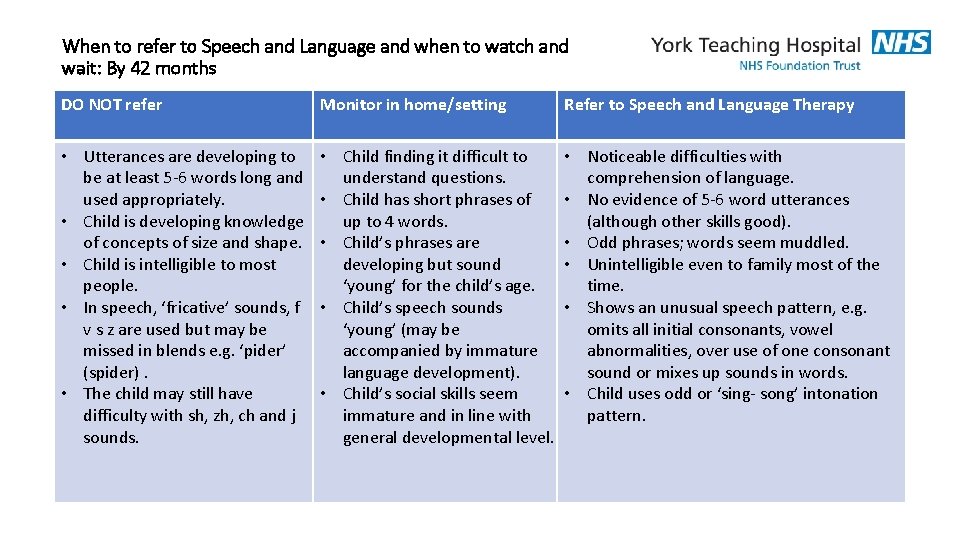
When to refer to Speech and Language and when to watch and wait: By 42 months DO NOT refer Monitor in home/setting Refer to Speech and Language Therapy • Utterances are developing to be at least 5 -6 words long and used appropriately. • Child is developing knowledge of concepts of size and shape. • Child is intelligible to most people. • In speech, ‘fricative’ sounds, f v s z are used but may be missed in blends e. g. ‘pider’ (spider). • The child may still have difficulty with sh, zh, ch and j sounds. • Child finding it difficult to understand questions. • Child has short phrases of up to 4 words. • Child’s phrases are developing but sound ‘young’ for the child’s age. • Child’s speech sounds ‘young’ (may be accompanied by immature language development). • Child’s social skills seem immature and in line with general developmental level. • Noticeable difficulties with comprehension of language. • No evidence of 5 -6 word utterances (although other skills good). • Odd phrases; words seem muddled. • Unintelligible even to family most of the time. • Shows an unusual speech pattern, e. g. omits all initial consonants, vowel abnormalities, over use of one consonant sound or mixes up sounds in words. • Child uses odd or ‘sing- song’ intonation pattern.
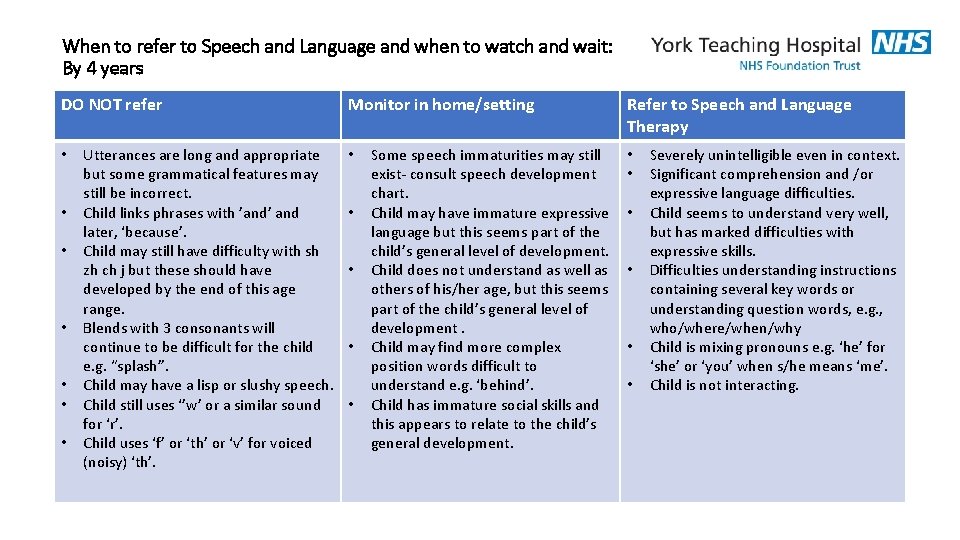
When to refer to Speech and Language and when to watch and wait: By 4 years DO NOT refer • • Utterances are long and appropriate but some grammatical features may still be incorrect. Child links phrases with ’and’ and later, ‘because’. Child may still have difficulty with sh zh ch j but these should have developed by the end of this age range. Blends with 3 consonants will continue to be difficult for the child e. g. “splash”. Child may have a lisp or slushy speech. Child still uses ‘’w’ or a similar sound for ‘r’. Child uses ‘f’ or ‘th’ or ‘v’ for voiced (noisy) ‘th’. Monitor in home/setting • • • Some speech immaturities may still exist- consult speech development chart. Child may have immature expressive language but this seems part of the child’s general level of development. Child does not understand as well as others of his/her age, but this seems part of the child’s general level of development. Child may find more complex position words difficult to understand e. g. ‘behind’. Child has immature social skills and this appears to relate to the child’s general development. Refer to Speech and Language Therapy • • • Severely unintelligible even in context. Significant comprehension and /or expressive language difficulties. Child seems to understand very well, but has marked difficulties with expressive skills. Difficulties understanding instructions containing several key words or understanding question words, e. g. , who/where/when/why Child is mixing pronouns e. g. ‘he’ for ‘she’ or ‘you’ when s/he means ‘me’. Child is not interacting.
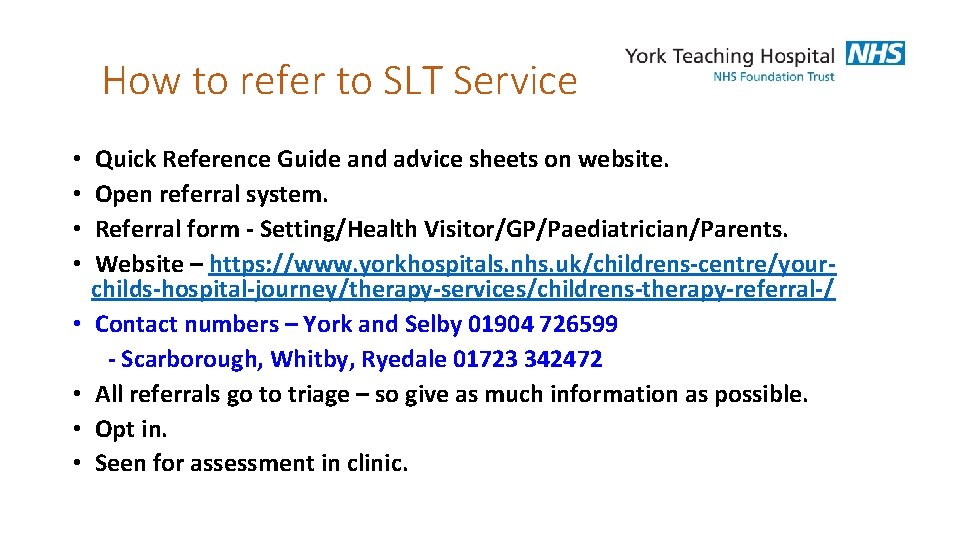
How to refer to SLT Service • • Quick Reference Guide and advice sheets on website. Open referral system. Referral form - Setting/Health Visitor/GP/Paediatrician/Parents. Website – https: //www. yorkhospitals. nhs. uk/childrens-centre/yourchilds-hospital-journey/therapy-services/childrens-therapy-referral-/ Contact numbers – York and Selby 01904 726599 - Scarborough, Whitby, Ryedale 01723 342472 All referrals go to triage – so give as much information as possible. Opt in. Seen for assessment in clinic.
Key information on Children’s Therapies Referral Form • What is the reason for this referral? • Level of concern? • What do you want help with from Children’s Therapies? • How are the difficulties affecting the child’s everyday life at home and at nursery? • Self management strategies/advice already tried and the outcome?
Under 30 months pathway triage guidance: what do we do with referrals to SLT for children under 30 months • Children under 30 months who are referred to SLT with tongue tie, hearing impairment, selective mutism, social communication concerns, complex needs impacting on communication are usually accepted for assessment and asked to opt in. • Referrals for children under 30 months where the concern is limited vocabulary or clarity of speech are usually not accepted for SLT. Research suggests that about 15% of the population are late talkers and of these children, the majority are likely to recover without SLT support. The children who are likely to need support from SLT over and above targeted interventions usually present with: 1. difficulties understanding simple spoken instructions. 2. do not use gestures such as showing, pointing and giving. 3. no spoken words at all at 24 months of age. 4. a family history of speech, language and communication needs. 5. additional developmental delays. 6. differences in their social communication and interaction skills. 7. have been born before 30 weeks of gestation. • Referrals for children under 30 months who present with any of the above 7 risk factors should be accepted for triage/assessment clinic as they have increased risk for persistent language difficulties. • We also accept referrals for children under 30 months with language delays who are Looked After, Refugee, Transient families (military, travellers etc).
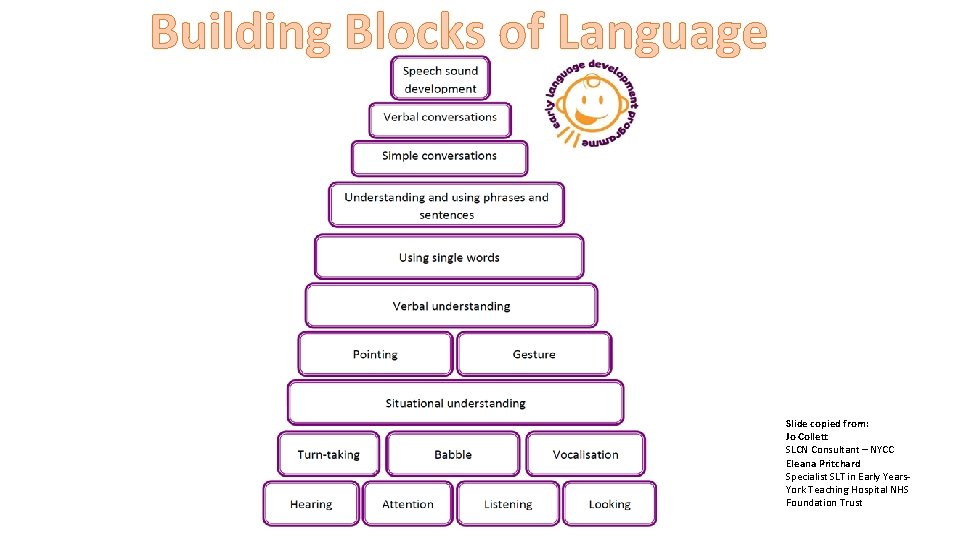
Building Blocks of Language Slide copied from: Jo Collett SLCN Consultant – NYCC Eleana Pritchard Specialist SLT in Early Years. York Teaching Hospital NHS Foundation Trust
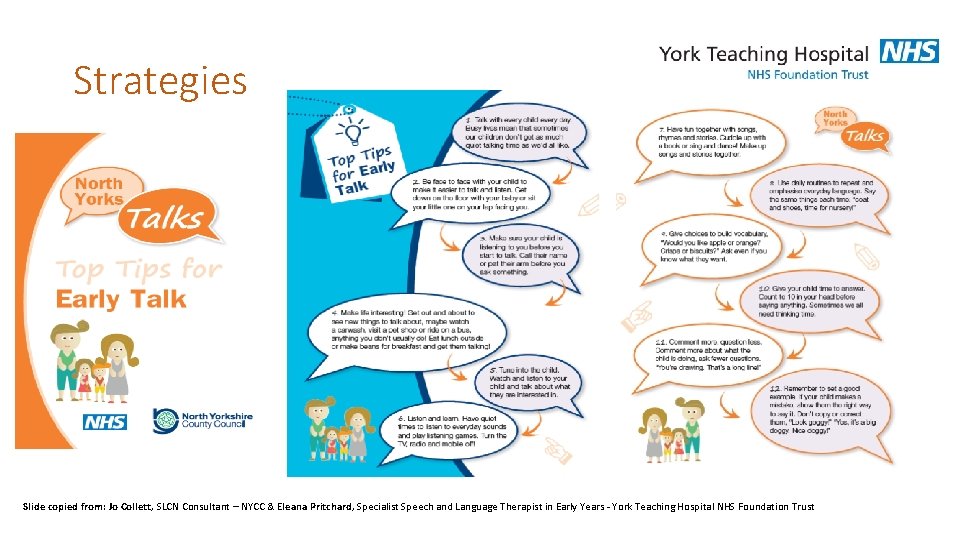
Strategies Slide copied from: Jo Collett, SLCN Consultant – NYCC & Eleana Pritchard, Specialist Speech and Language Therapist in Early Years - York Teaching Hospital NHS Foundation Trust
Supporting understanding of language • Call the child’s name and gain eye gaze first. • Reduce background noise. • Keep sentences short and simple. Break instructions into short chunks. Change the words to help the child understand. • Allow extra time for the child to process language. • Be aware children may appear to understand spoken language but may use situational cues to understand. • Make sure your language is meaningful-talk about the here and now, things within the child’s experiences. • Check for listening and understanding frequently. • Use gesture, like pointing, and Makaton signs. • Use visual cues: demonstrate what you mean, use objects, photos, pictures or symbols.
Using signing to support understanding and communication • Knowing what the child is trying to say helps you to echo back the correct word clearly. Children will increase in confidence to communicate and then drop signing naturally when they are ready. It is important to speak when signing. • In a setting in the initial stages it can be useful to have a sign of the day or week that all staff use. Pick one sign that will be of use to the child e. g. ‘juice’. Use it frequently throughout the day in front of the child whenever you would naturally say the word anyway. • Use your dominant hand as your main signing hand- this helps keep the signs the same. • Always model the correct sign to an individual even if they have their own unique way of signing something. • Use your facial expression to show them what you mean (e. g. tired- make a tired face). • Use a tone of voice that matches the word (e. g. tired- sound tired).
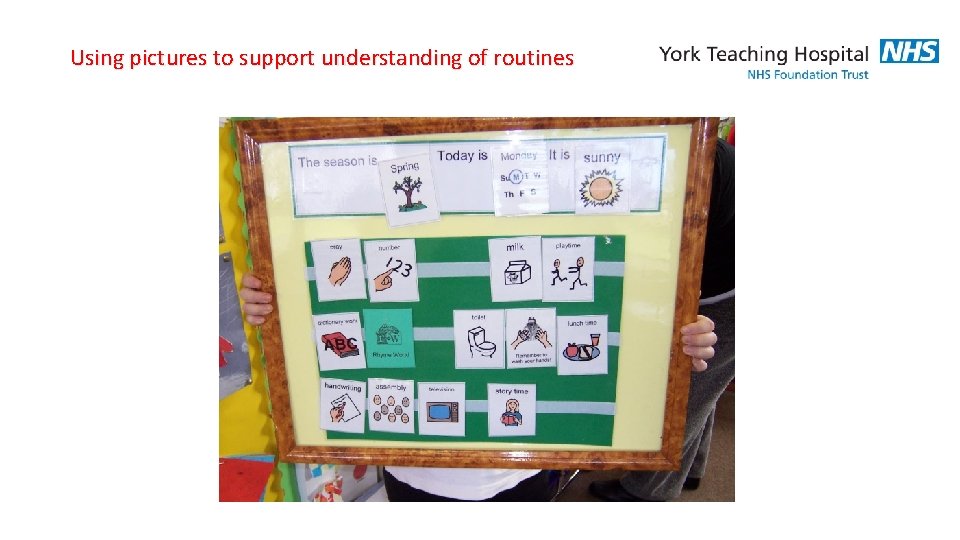
Using pictures to support understanding of routines
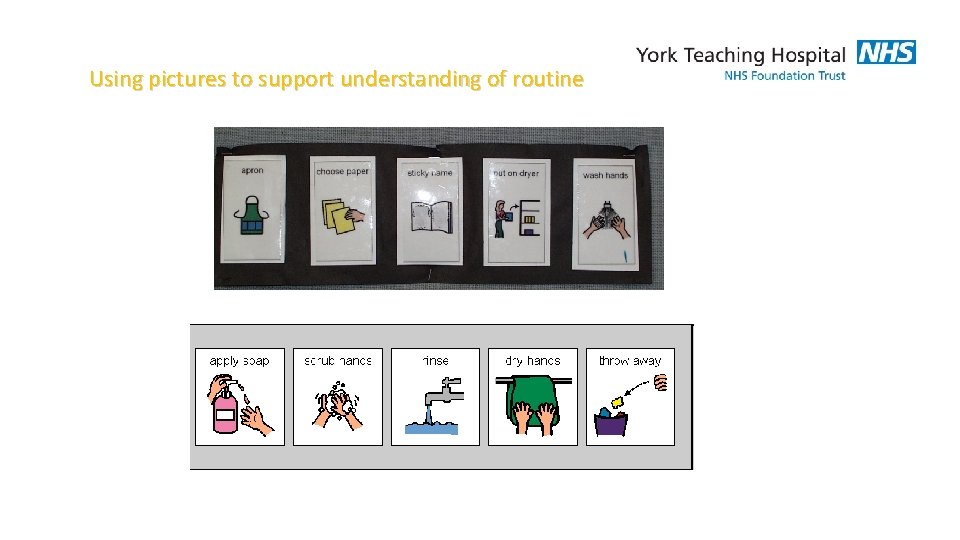
Using pictures to support understanding of routine
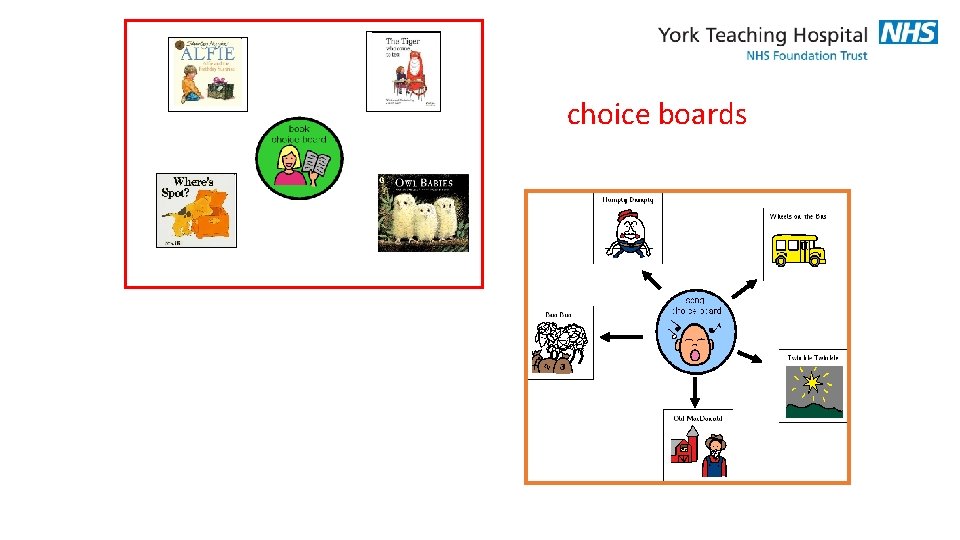
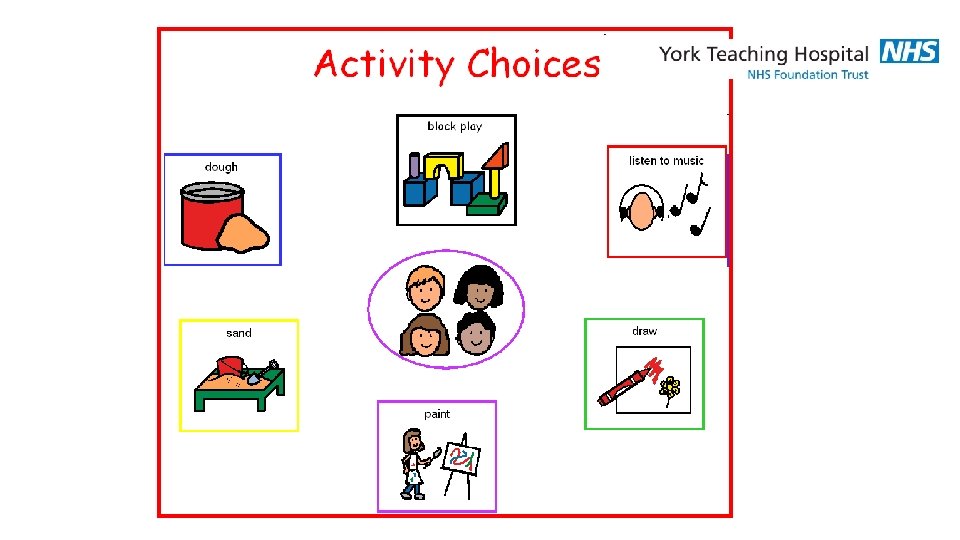
Supporting expressive language skills • Face the child as you talk to them. Get down to their level. • Give them plenty of time to communicate with you, leave pauses to see if s/he makes any sounds or tries any words including copying your words. • Join in with anything they say whether it’s words or sounds, so if the child says “bah” when looking at a ball, say “yes… a ball” • • If your child says something that just sounds like noises and not words when looking at something, make something of it e. g. Child- ”papa” Adult- “mmm…. . apple” • • Don’t tell the child to ‘say’ words. “Say ‘cat’ ” could be changed to you saying, “Look…. . cat”. But then leave it at that; don’t get him/her to repeat the word. • Speak in a lively voice with gestures and facial expression. • Say lots of single words in this way: children need to hear words many times before they attempt saying them. • Model useful words; useful words for young children are: 1. Names for people and things in the child’s environment, 2. Action words like jump sleep wash eat push dance … You say these words as the child is doing these actions e. g. “wash. . wash…” or “splash!” when playing in the water tray. 3. Position words like in, off, out, up, down. 4. Descriptive words relevant to your child’s life e. g. big, wet, dirty, nice… • Offer choices with objects, photos or symbols • Encourage children to communicate with you in any way – gestures, objects, pictures, speaking.
choice boards
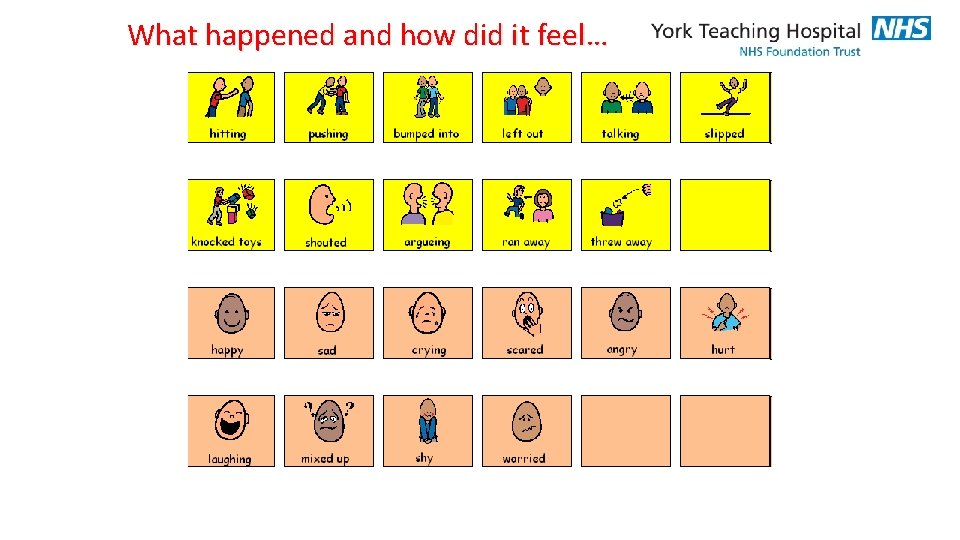
What happened and how did it feel…
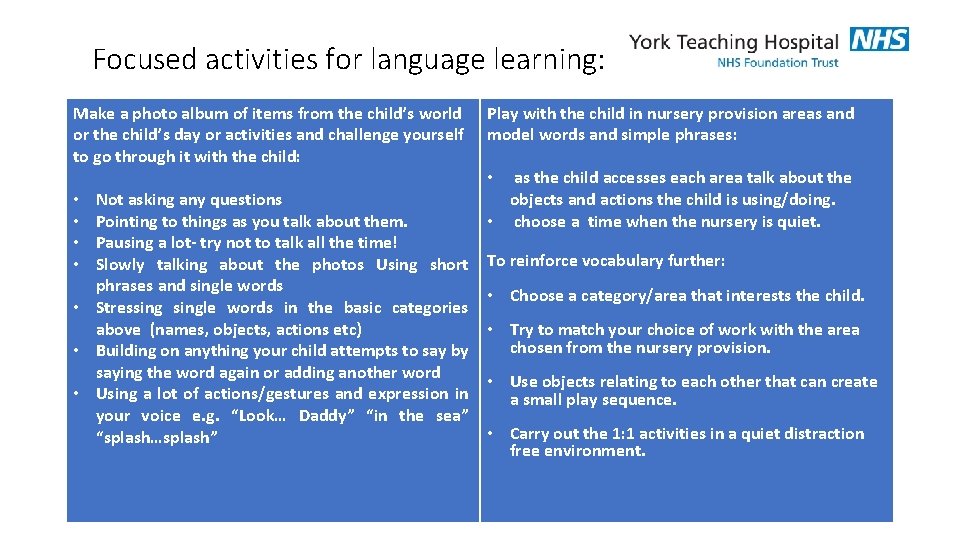
Focused activities for language learning: Make a photo album of items from the child’s world or the child’s day or activities and challenge yourself to go through it with the child: Play with the child in nursery provision areas and model words and simple phrases: as the child accesses each area talk about the objects and actions the child is using/doing. • choose a time when the nursery is quiet. • Not asking any questions Pointing to things as you talk about them. Pausing a lot- try not to talk all the time! Slowly talking about the photos Using short phrases and single words • Stressingle words in the basic categories above (names, objects, actions etc) • Building on anything your child attempts to say by saying the word again or adding another word • Using a lot of actions/gestures and expression in your voice e. g. “Look… Daddy” “in the sea” “splash…splash” • • To reinforce vocabulary further: • Choose a category/area that interests the child. • Try to match your choice of work with the area chosen from the nursery provision. • Use objects relating to each other that can create a small play sequence. • Carry out the 1: 1 activities in a quiet distraction free environment.
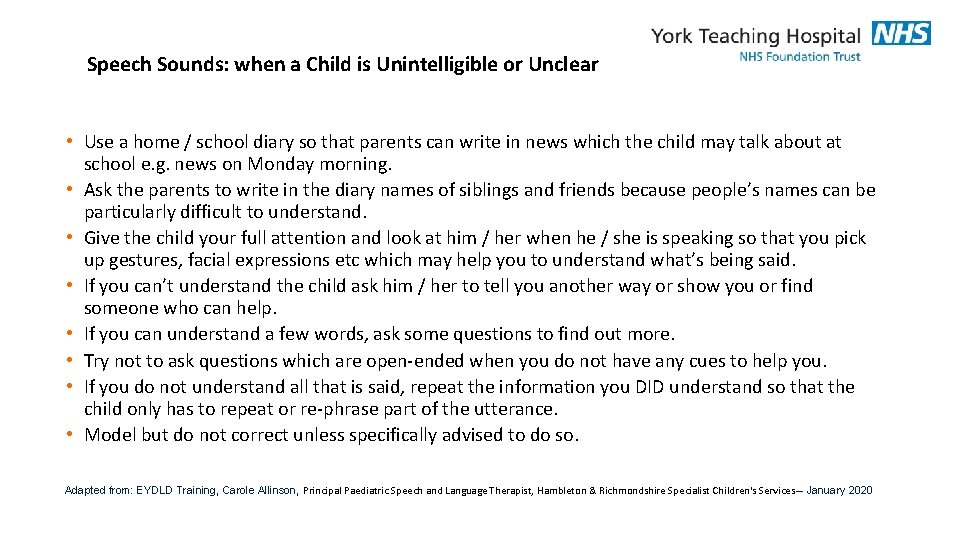
Speech Sounds: when a Child is Unintelligible or Unclear • Use a home / school diary so that parents can write in news which the child may talk about at school e. g. news on Monday morning. • Ask the parents to write in the diary names of siblings and friends because people’s names can be particularly difficult to understand. • Give the child your full attention and look at him / her when he / she is speaking so that you pick up gestures, facial expressions etc which may help you to understand what’s being said. • If you can’t understand the child ask him / her to tell you another way or show you or find someone who can help. • If you can understand a few words, ask some questions to find out more. • Try not to ask questions which are open-ended when you do not have any cues to help you. • If you do not understand all that is said, repeat the information you DID understand so that the child only has to repeat or re-phrase part of the utterance. • Model but do not correct unless specifically advised to do so. Adapted from: EYDLD Training, Carole Allinson, Principal Paediatric Speech and Language Therapist, Hambleton & Richmondshire Specialist Children's Services – January 2020
WEBSITES • www. talkingpoint. org. uk • www. communicationtrust. org. uk • www. rcslt. org • www. literacytrust. org. uk • www. talktoyourbaby. org. uk
Any Questions?