
Speculative Return Address Stack Management Revisited ACM Transactions


- Slides: 23
Speculative Return Address Stack Management Revisited
» ACM Transactions on Architecture and Code Optimization (TACO) ˃ Volume 5 Issue 3, Nov 2008 » Author: ˃ Hans Vandierendonck Ghent University, Gent, Belgium ˃ André Seznec IRISA/INRIA, Cedex, France Paper Intro 2
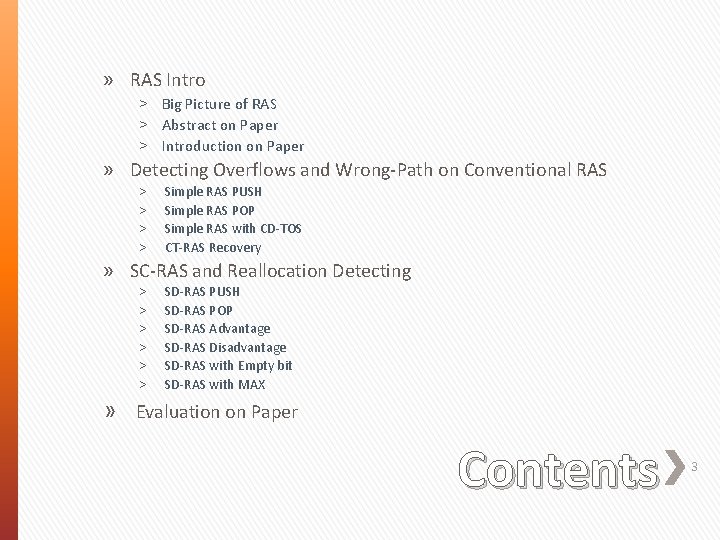
» RAS Intro ˃ Big Picture of RAS ˃ Abstract on Paper ˃ Introduction on Paper » Detecting Overflows and Wrong-Path on Conventional RAS ˃ ˃ Simple RAS PUSH Simple RAS POP Simple RAS with CD-TOS CT-RAS Recovery » SC-RAS and Reallocation Detecting ˃ ˃ ˃ SD-RAS PUSH SD-RAS POP SD-RAS Advantage SD-RAS Disadvantage SD-RAS with Empty bit SD-RAS with MAX » Evaluation on Paper Contents 3
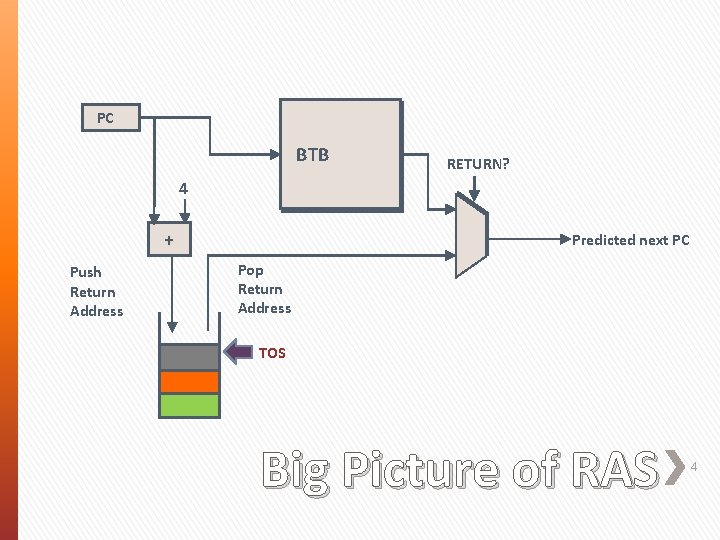
PC BTB RETURN? 4 + Push Return Address Predicted next PC Pop Return Address TOS Big Picture of RAS 4
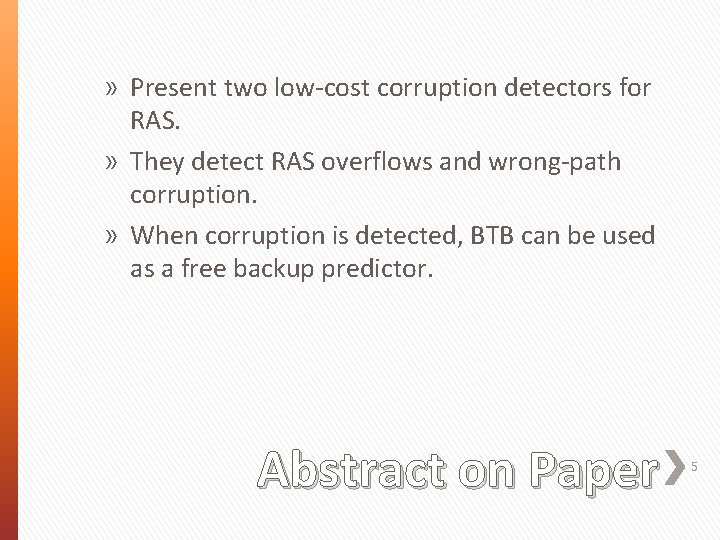
» Present two low-cost corruption detectors for RAS. » They detect RAS overflows and wrong-path corruption. » When corruption is detected, BTB can be used as a free backup predictor. Abstract on Paper 5
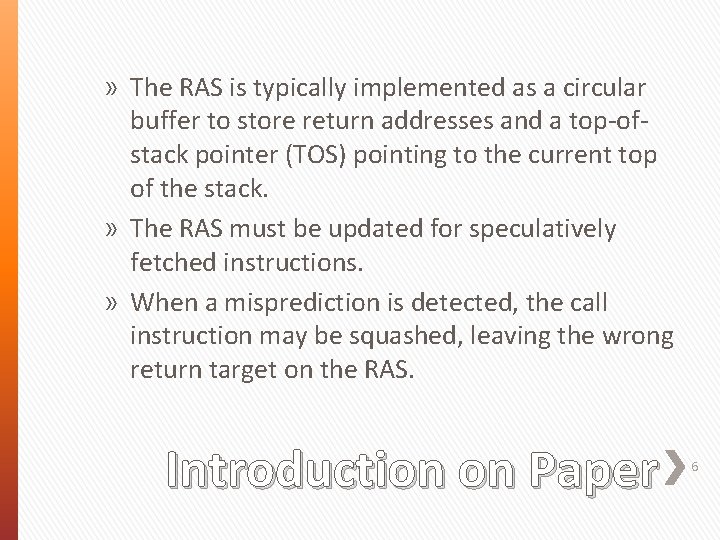
» The RAS is typically implemented as a circular buffer to store return addresses and a top-ofstack pointer (TOS) pointing to the current top of the stack. » The RAS must be updated for speculatively fetched instructions. » When a misprediction is detected, the call instruction may be squashed, leaving the wrong return target on the RAS. Introduction on Paper 6
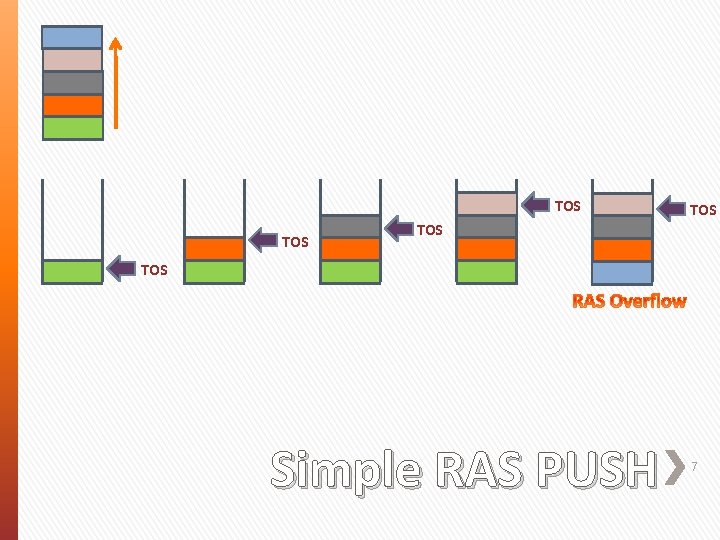
TOS TOS TOS Simple RAS PUSH 7
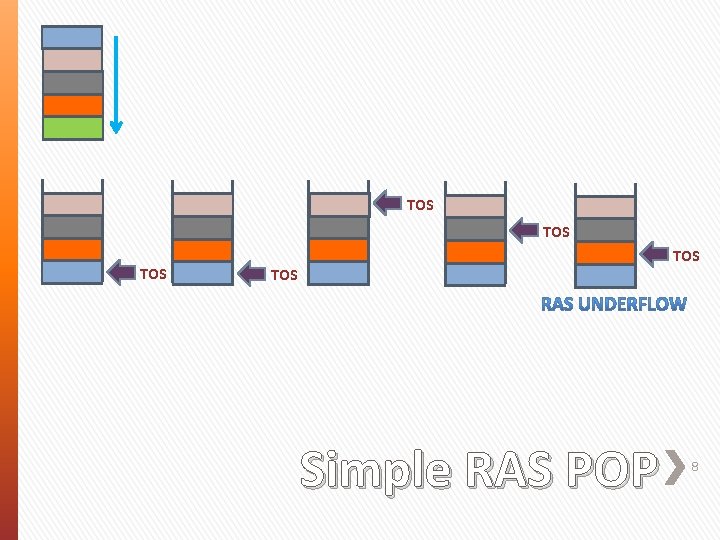
TOS TOS TOS Simple RAS POP 8
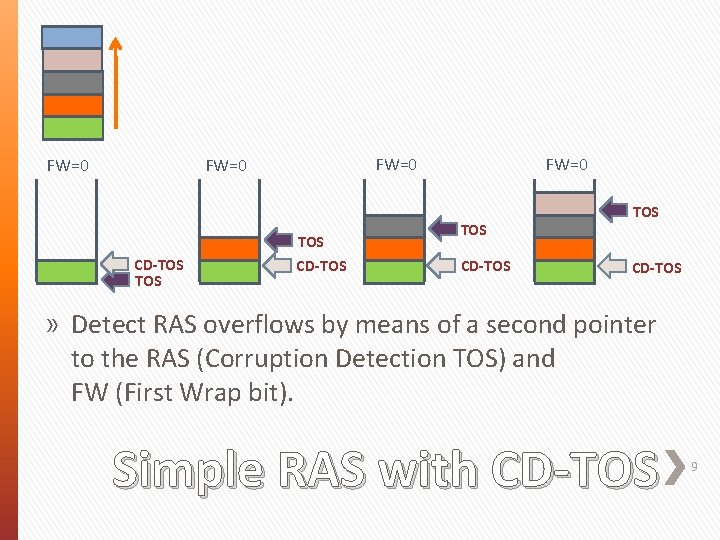
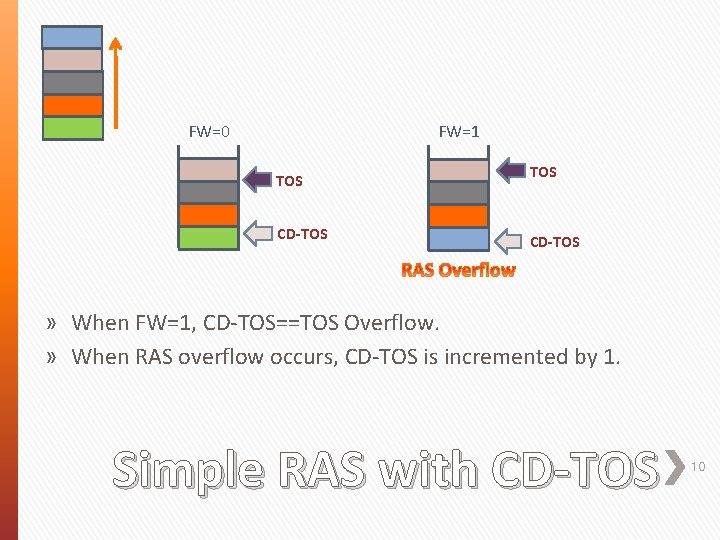
FW=0 TOS CD-TOS » Detect RAS overflows by means of a second pointer to the RAS (Corruption Detection TOS) and FW (First Wrap bit). Simple RAS with CD-TOS 9
FW=0 FW=1 TOS CD-TOS » When FW=1, CD-TOS==TOS Overflow. » When RAS overflow occurs, CD-TOS is incremented by 1. Simple RAS with CD-TOS 10
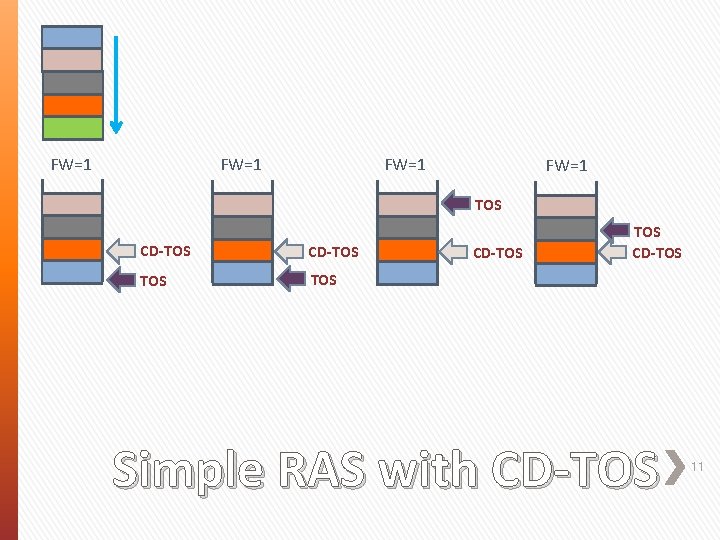
FW=1 TOS CD-TOS Simple RAS with CD-TOS 11
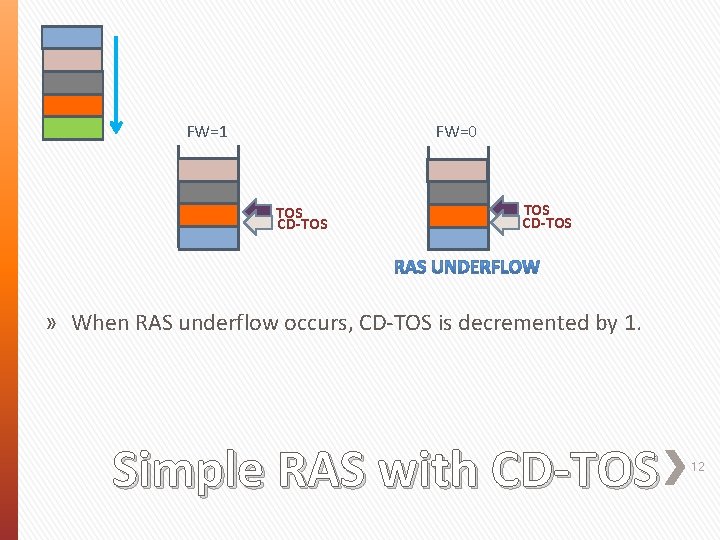
FW=1 FW=0 TOS CD-TOS » When RAS underflow occurs, CD-TOS is decremented by 1. Simple RAS with CD-TOS 12
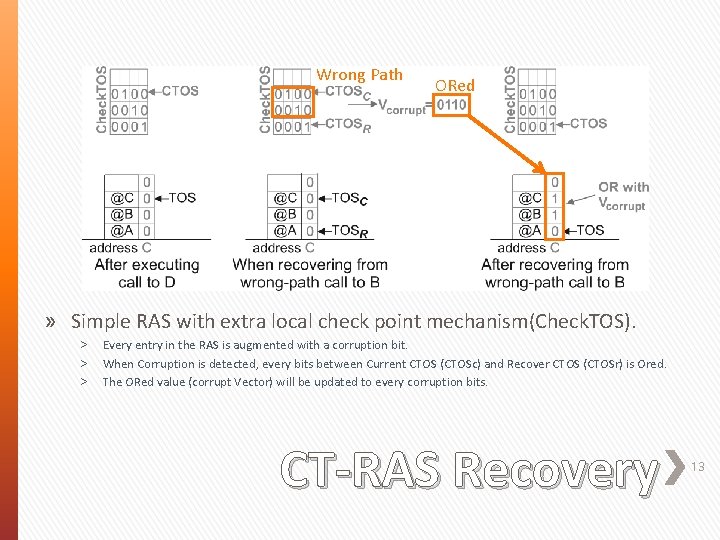
Wrong Path ORed » Simple RAS with extra local check point mechanism(Check. TOS). ˃ ˃ ˃ Every entry in the RAS is augmented with a corruption bit. When Corruption is detected, every bits between Current CTOS (CTOSc) and Recover CTOS (CTOSr) is Ored. The ORed value (corrupt Vector) will be updated to every corruption bits. CT-RAS Recovery 13
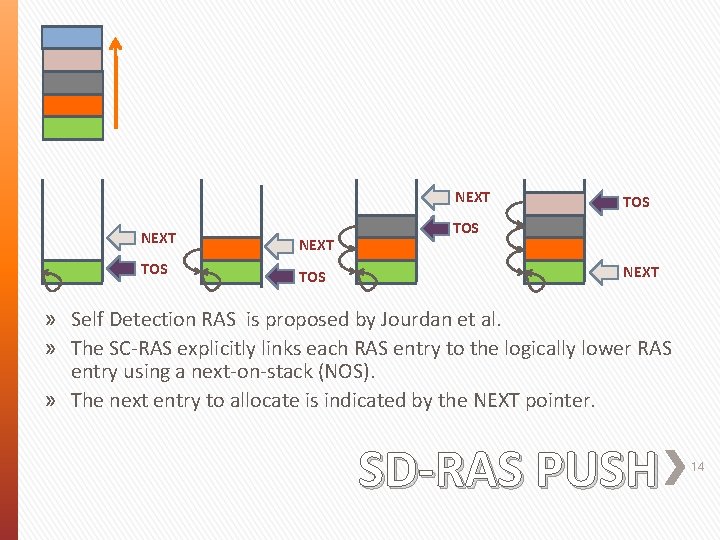
NEXT TOS TOS NEXT » Self Detection RAS is proposed by Jourdan et al. » The SC-RAS explicitly links each RAS entry to the logically lower RAS entry using a next-on-stack (NOS). » The next entry to allocate is indicated by the NEXT pointer. SD-RAS PUSH 14
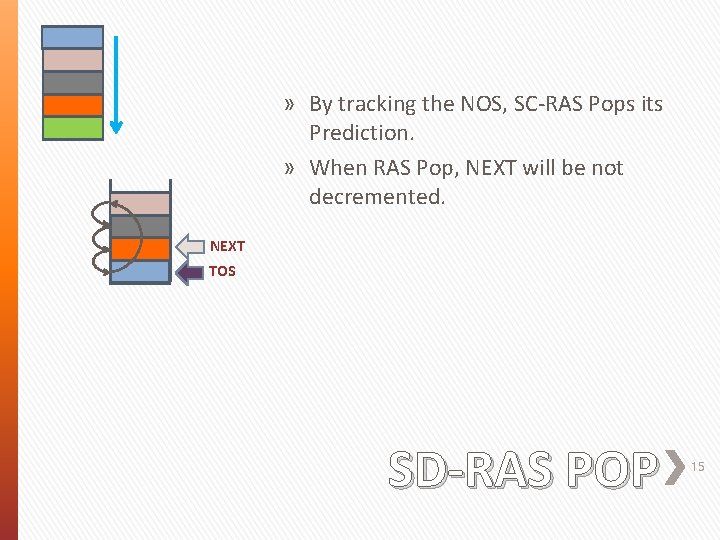
» By tracking the NOS, SC-RAS Pops its Prediction. » When RAS Pop, NEXT will be not decremented. NEXT TOS SD-RAS POP 15
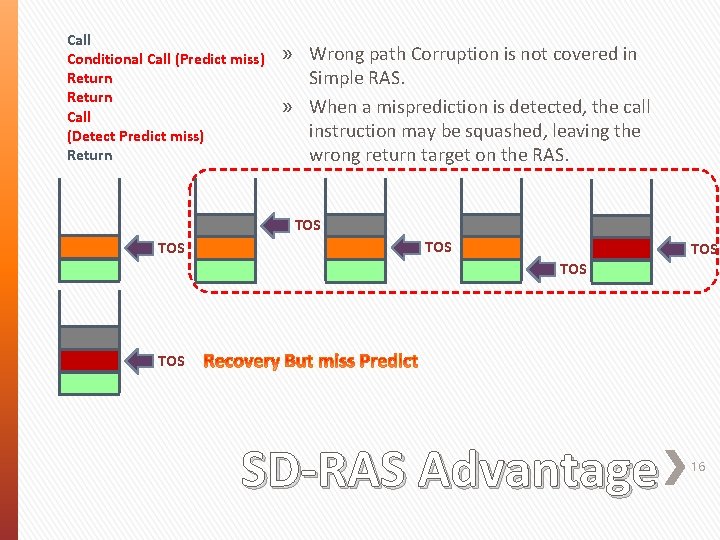
Call Conditional Call (Predict miss) Return Call (Detect Predict miss) Return » Wrong path Corruption is not covered in Simple RAS. » When a misprediction is detected, the call instruction may be squashed, leaving the wrong return target on the RAS. TOS TOS TOS SD-RAS Advantage 16
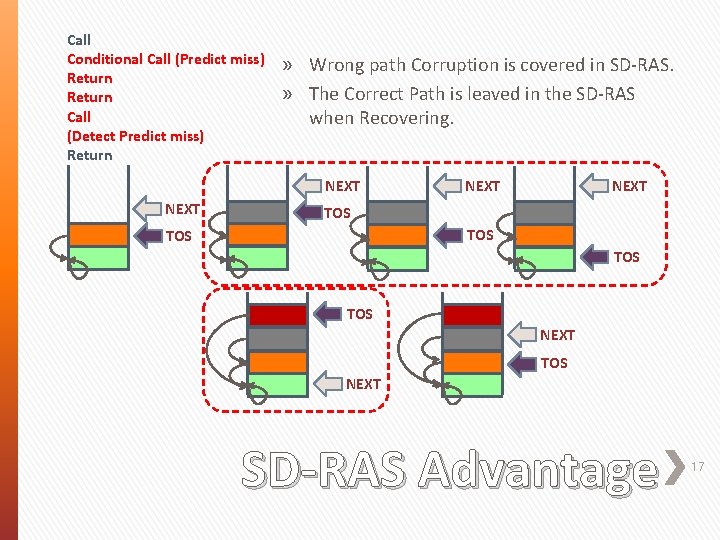
Call Conditional Call (Predict miss) Return Call (Detect Predict miss) Return » Wrong path Corruption is covered in SD-RAS. » The Correct Path is leaved in the SD-RAS when Recovering. NEXT TOS TOS TOS NEXT SD-RAS Advantage 17
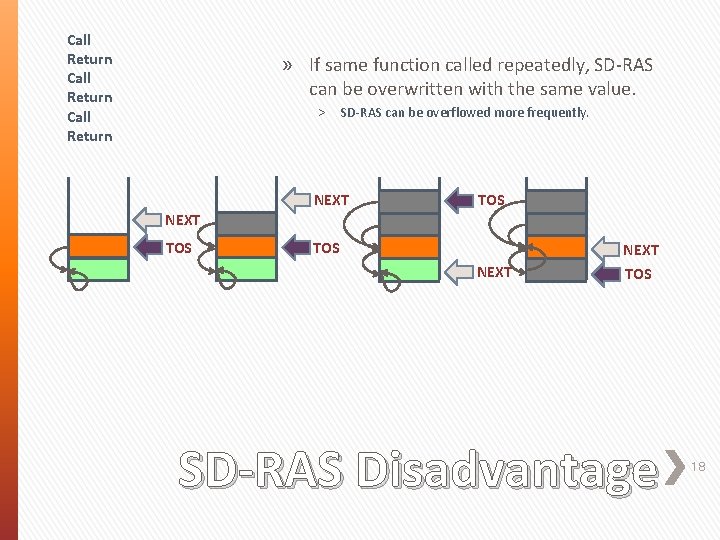
Call Return » If same function called repeatedly, SD-RAS can be overwritten with the same value. ˃ SD-RAS can be overflowed more frequently. NEXT TOS TOS NEXT TOS SD-RAS Disadvantage 18
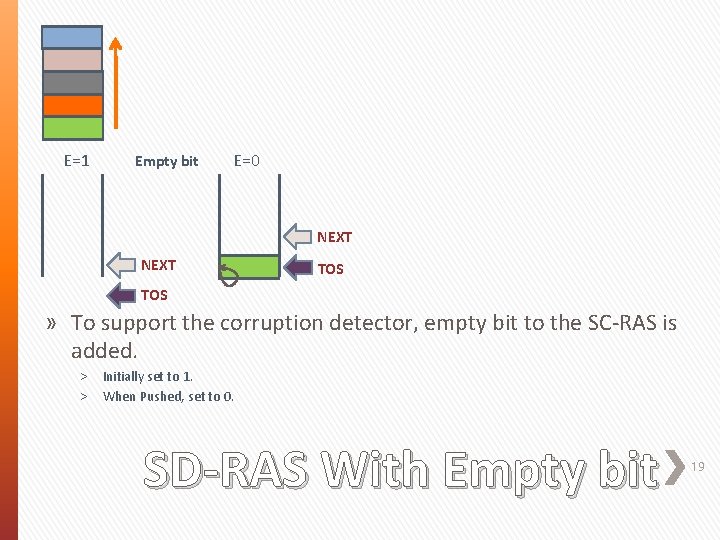
E=1 Empty bit E=0 NEXT TOS » To support the corruption detector, empty bit to the SC-RAS is added. ˃ Initially set to 1. ˃ When Pushed, set to 0. SD-RAS With Empty bit 19
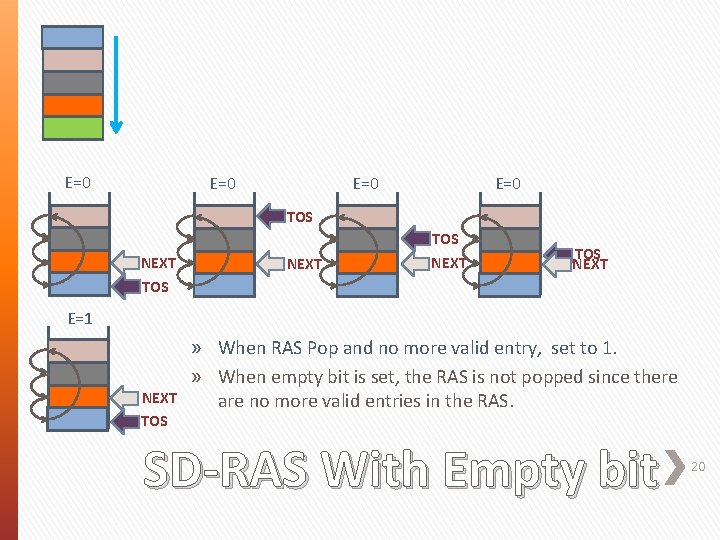
E=0 E=0 TOS NEXT E=1 NEXT TOS » When RAS Pop and no more valid entry, set to 1. » When empty bit is set, the RAS is not popped since there are no more valid entries in the RAS. SD-RAS With Empty bit 20
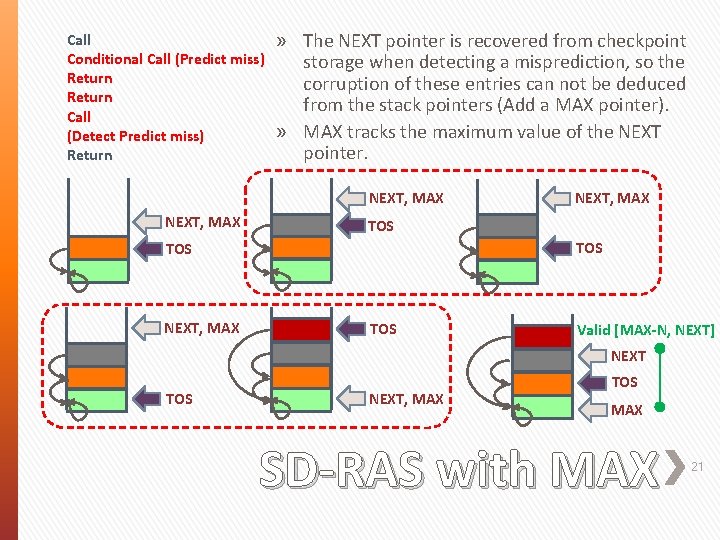
Call Conditional Call (Predict miss) Return Call (Detect Predict miss) Return » The NEXT pointer is recovered from checkpoint storage when detecting a misprediction, so the corruption of these entries can not be deduced from the stack pointers (Add a MAX pointer). » MAX tracks the maximum value of the NEXT pointer. NEXT, MAX TOS TOS NEXT, MAX TOS Valid [MAX-N, NEXT] NEXT TOS NEXT, MAX TOS MAX SD-RAS with MAX 21
» The SC-RAS only suffers from overflow mispredictions. » Simple RAS and CT-RAS are suffer from wrongpath and overflows. » When RAS size is small(4~) CT-RAS is the most effective design. ˃ SC-RAS is not effective because of RAS Overflow. » When RAS size is big (~128) SC-RAS design is the most effective design. ˃ Because of wrong-path recovery, SC-RAS can be powerful. Evaluation on Paper 22
The End 23