
Speculative Execution In Distributed File System and External

Speculative Execution In Distributed File System and External Synchrony Edmund B. Nightingale, Kaushik Veeraraghavan Peter Chen, Jason Flinn Presented by Han Wang Slides based on the SOSP and OSDI presentations
Consistency Availability Partition Tolerance

“ … consistency, availability, and partition tolerance. It is impossible to achieve all three. “ -- Gilbert and Lynn, MIT “So in reality, there are only two types of systems: CP/CA and AP” -- Daniel Abadi, Yale “There is no ‘free lunch’ with distributed data. ” -- Anonymous, HP

CP: Lack Availability CA: Lack Partition Tolerance AP: Lack Consistency

Synchrony Asynchrony
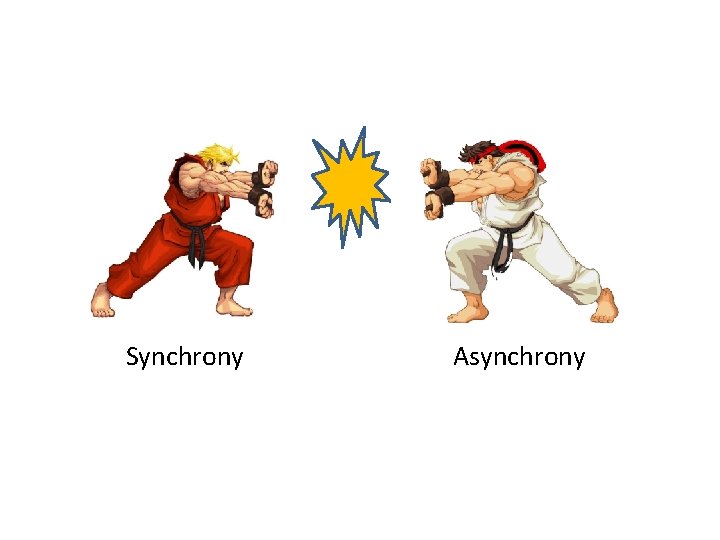
Synchrony Asynchrony
synchronous abstractions: strong reliability guarantees but are slow asynchronous counterparts: relax reliability guarantees reasonable performance
External Synchrony

• provide the reliability and simplicity of a synchronous abstraction • approximate the performance of an asynchronous abstraction.

Rethink the Sync Edmund B. Nightingale, Kaushik Veeraraghavan, Peter M. Chen and Jason Flinn Speculative Execution in a Distributed File System Edmund B. Nightingale, Peter M. Chen, and Jason Flinn
Authors • Edmund B Nightingale – Ph. D from UMich (Jason Flinn) – Microsoft Research – Best Paper Award (OSDI 2006) • Kaushik Veeraraghavan – Ph. D Student in Umich (Jason Flinn) – Best Paper Award (FAST 2010, ASPLOS 2011) • Peter M Chen – Ph. D from Berkeley (David Patterson) – Faculty at UMich • Jason Flinn – Ph. D from CMU (Mahadev Satyanarayanan) – Faculty at Umich
Rethink the Sync Edmund B. Nightingale, Kaushik Veeraraghavan, Peter M. Chen and Jason Flinn Speculative Execution in a Distributed File System Edmund B. Nightingale, Peter M. Chen, and Jason Flinn
Idea Example Design Evaluation

External Synchrony • Question – How to improve both durability and performance for local file system? • Two extremes – Synchronous IO • Easy to use • Guarantee ordering – Asynchronous IO • Fast
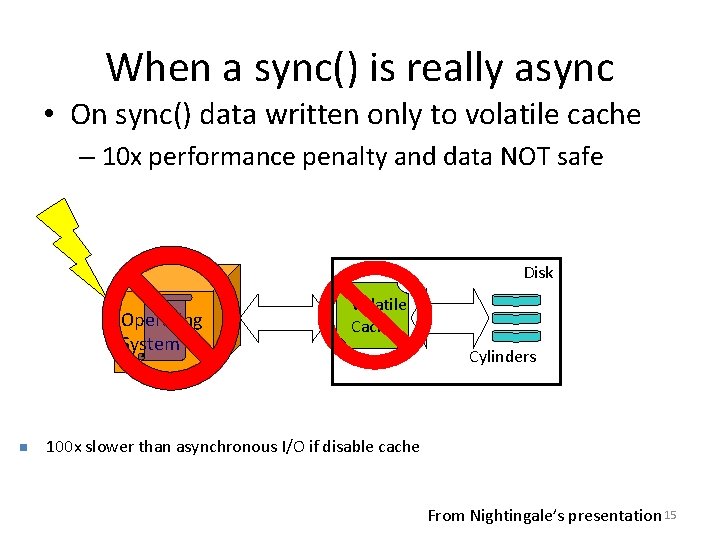
When a sync() is really async • On sync() data written only to volatile cache – 10 x performance penalty and data NOT safe Disk Operating System n Volatile Cache Cylinders 100 x slower than asynchronous I/O if disable cache From Nightingale’s presentation 15

To whom are guarantees provided? • Synchronous I/O definition: – Caller blocked until operation completes App App OS Kernel Disk n Screen Network Guarantee provided to application From Nightingale’s presentation 16
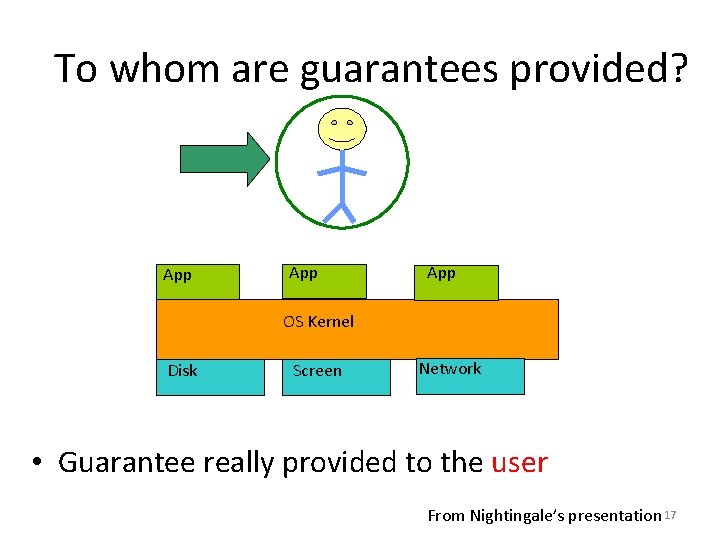
To whom are guarantees provided? App App OS Kernel Disk Screen Network • Guarantee really provided to the user From Nightingale’s presentation 17
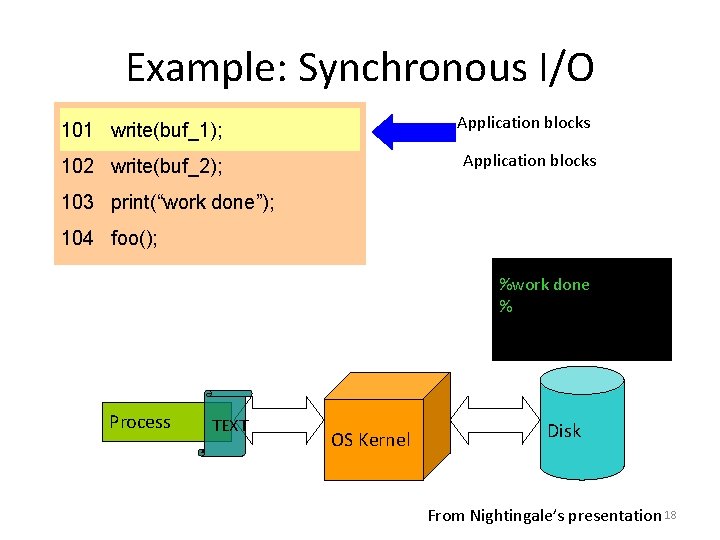
Example: Synchronous I/O Application blocks 101 write(buf_1); Application blocks 102 write(buf_2); 103 print(“work done”); 104 foo(); % %work done % Process TEXT OS Kernel Disk From Nightingale’s presentation 18
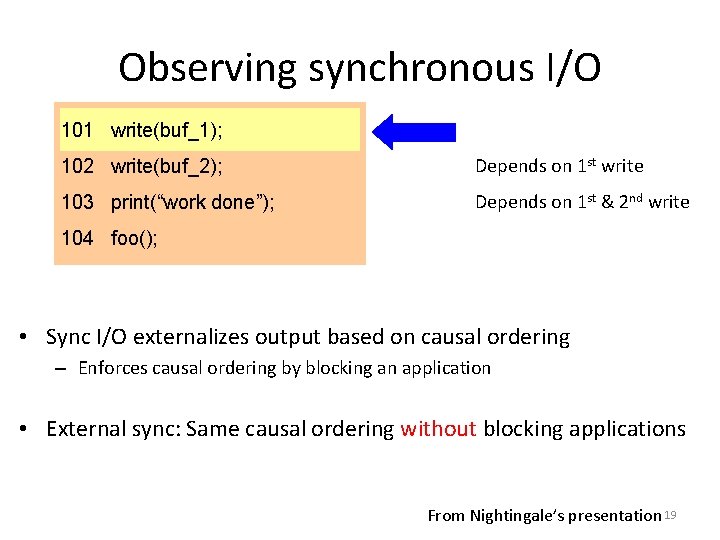
Observing synchronous I/O 101 write(buf_1); 102 write(buf_2); Depends on 1 st write 103 print(“work done”); Depends on 1 st & 2 nd write 104 foo(); • Sync I/O externalizes output based on causal ordering – Enforces causal ordering by blocking an application • External sync: Same causal ordering without blocking applications From Nightingale’s presentation 19
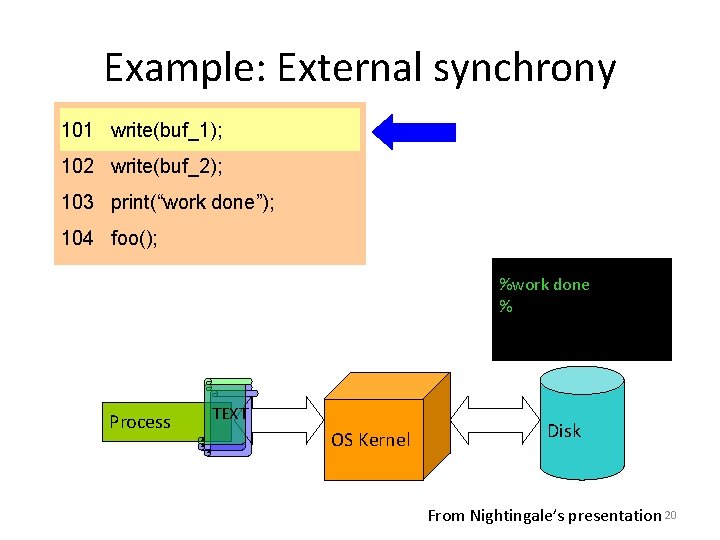
Example: External synchrony 101 write(buf_1); 102 write(buf_2); 103 print(“work done”); 104 foo(); % %work done % Process TEXT OS Kernel Disk From Nightingale’s presentation 20
External Synchrony Design Overview • Synchrony defined by externally observable behavior. – I/O is externally synchronous if output cannot be distinguished from output that could be produced from synchronous I/O. – File system does all the same processing as for synchronous. • Two optimizations made to improve performance. – Group committing is used (commits are atomic). – External output is buffered and processes continue execution. • Output guaranteed to be committed every 5 seconds.
External Synchrony Implementation • Xsyncfs leverages Speculator infrastructure for output buffering and dependency tracking for uncommitted state. • Speculator tracks commit dependencies between processes and uncommitted file system transactions. • ext 3 operates in journaled mode.
Evaluation • Durability • Performance – IO intensive application (Postmark) – Application that synchronize explicitly (My. SQL) – Network intensive, Read-heavy application (SPECweb) – Output-trigger commit on delay
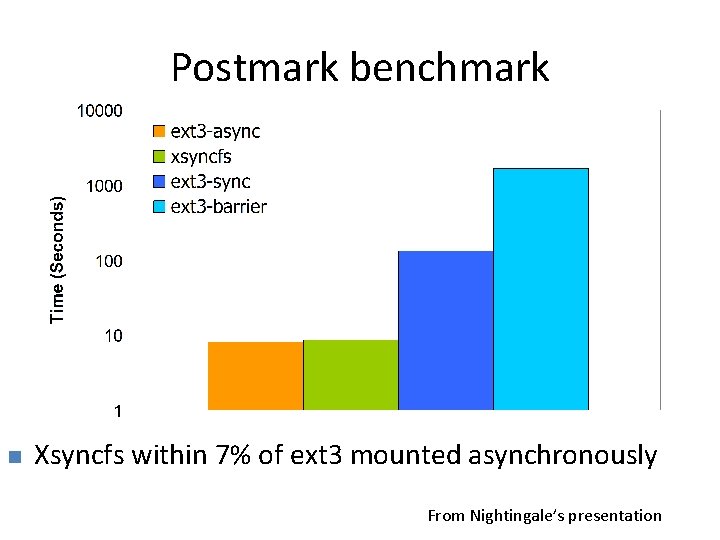
Postmark benchmark n Xsyncfs within 7% of ext 3 mounted asynchronously From Nightingale’s presentation
The My. SQL benchmark n Xsyncfs can group commit from a single client From Nightingale’s presentation
Specweb 99 throughput n Xsyncfs within 8% of ext 3 mounted asynchronously From Nightingale’s presentation

Specweb 99 latency n Request size ext 3 -async xsyncfs 0 -1 KB 0. 064 seconds 0. 097 seconds 1 -10 KB 0. 150 second 0. 180 seconds 10 -100 KB 1. 084 seconds 1. 094 seconds 100 -1000 KB 10. 253 seconds 10. 072 seconds Xsyncfs adds no more than 33 ms of delay From Nightingale’s presentation
Discussions • Is the idea sound? – Nice idea, new idea. • Flaws? – Are the experiments realistic? • What are your take-aways from this paper?
Rethink the Sync Edmund B. Nightingale, Kaushik Veeraraghavan, Peter M. Chen and Jason Flinn Speculative Execution in a Distributed File System Edmund B. Nightingale, Peter M. Chen, and Jason Flinn

Idea Example Design Evaluation
Speculation Execution • Question – How to improve the distributed file system performance? • Characteristics of DFS – Single, coherent namespace • Existing approach – Trade-off consistency for performance

The Idea • Speculative execution – Hide IO latency • Issue multiple IO operations concurrently – Also improve IO throughput • Group commit • For it to succeed – Correct – Efficient – Easy to use
Conditions for Success of Speculations • Results of Speculation is highly predictable – Concurrent updates on cached files are rare • Checkpointing is faster than Remote I/O – 50 us ~ 6 ms (amortizable) v. s. network RTT • Modern computers have spare resources – CPUs are idle for significant portions of time – Extra memory is available for checkpoints
Speculator Interface • Speculator provides a lightweight checkpoint and rollback mechanism • Interface to encapsulate implementation details: – create_speculation – commit_speculation – fail_speculation • Separation of policy and mechanism – Speculator remain ignorant on why clients speculate – DFS do not concern how speculation is done
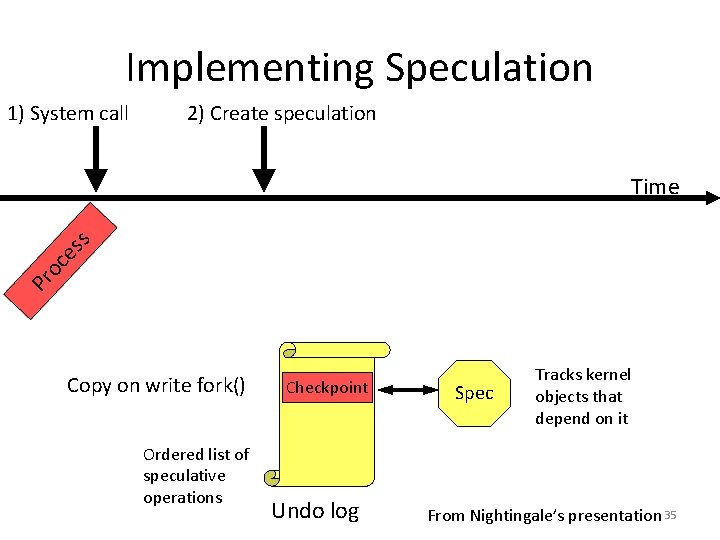
Implementing Speculation 1) System call 2) Create speculation Pr oc es s Time Copy on write fork() Ordered list of speculative operations Checkpoint Undo log Spec Tracks kernel objects that depend on it From Nightingale’s presentation 35
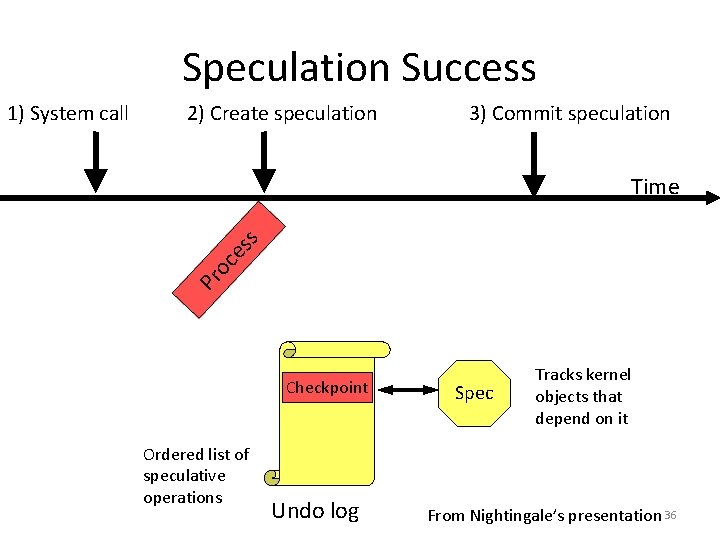
Speculation Success 2) Create speculation 3) Commit speculation oc es s Time Pr 1) System call Checkpoint Ordered list of speculative operations Undo log Spec Tracks kernel objects that depend on it From Nightingale’s presentation 36
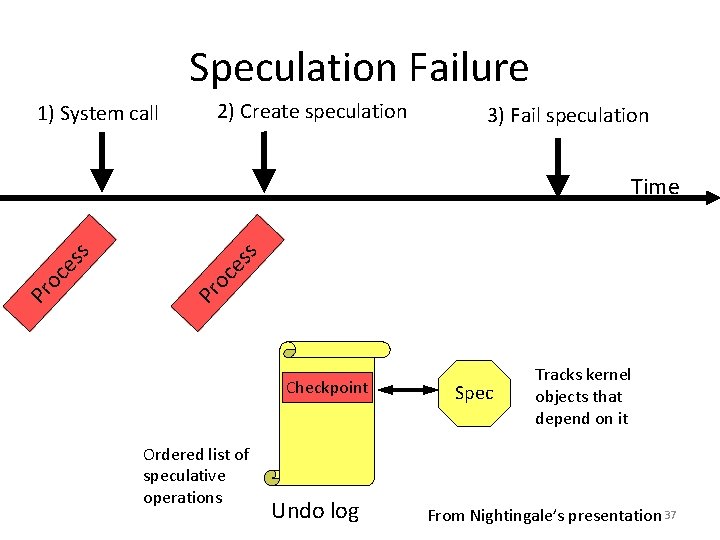
Speculation Failure 1) System call 2) Create speculation 3) Fail speculation s es oc Pr Pr oc es s Time Checkpoint Ordered list of speculative operations Undo log Spec Tracks kernel objects that depend on it From Nightingale’s presentation 37
Ensuring correctness • Two invariants – Speculative state should never be visible to user or any external devices – Process should never view speculative state unless it speculatively depends on the state • Non-speculative process must block or become speculative when viewing speculative states • Three ways to ensure correct executions: – Block – Buffer – Propagate speculations (dependencies)
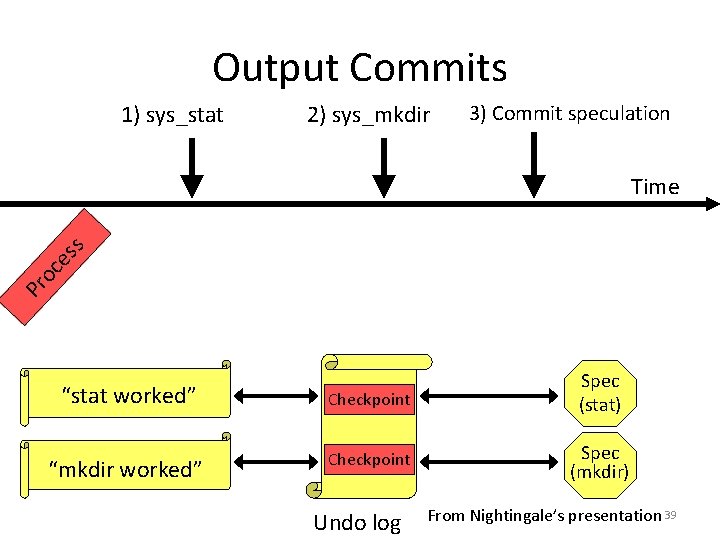
Output Commits 1) sys_stat 2) sys_mkdir 3) Commit speculation Pr oc es s Time “stat worked” Checkpoint Spec (stat) “mkdir worked” Checkpoint Spec (mkdir) Undo log From Nightingale’s presentation 39
Multi-Process Speculation • Processes often cooperate – Example: “make” forks children to compile, link, etc. – Would block if speculation limits to one task • Allow kernel objects to have speculative state – Examples: inodes, signals, pipes, Unix sockets, etc. – Propagate dependencies among objects – Objects rolled back to prior states when specs fail
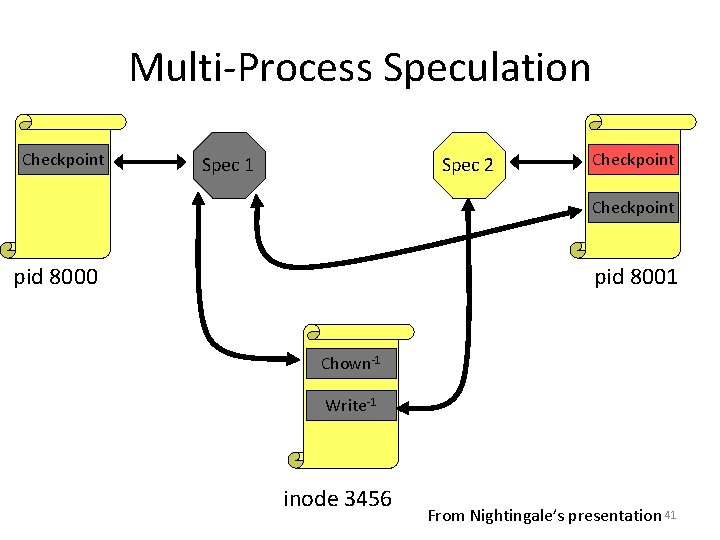
Multi-Process Speculation Checkpoint Spec 1 Spec 2 Checkpoint pid 8000 pid 8001 Chown-1 Write-1 inode 3456 From Nightingale’s presentation 41
Multi-Process Speculation • Supports – Objects in distributed file system – Objects in local memory file system -- RAMFS – Modified Local ext 3 file system – IPCs: • Pipes and fifos, Unix sockets, signals, fork and exits • Does not Support – System V IPC, Futex, shared memory
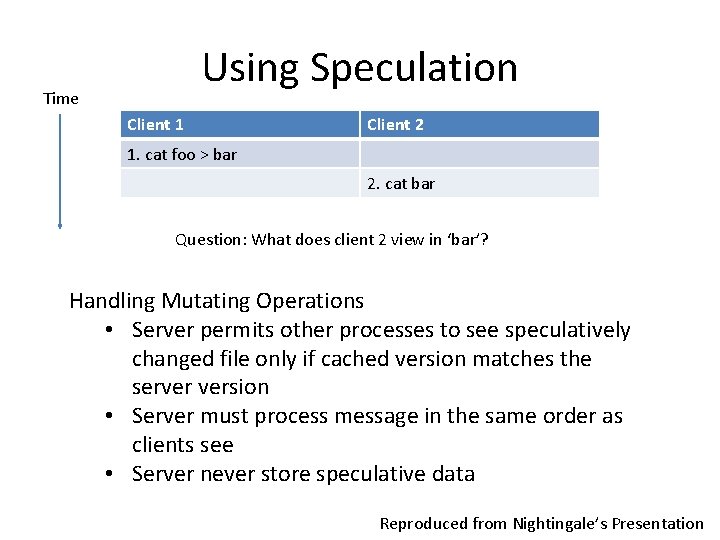
Using Speculation Time Client 1 Client 2 1. cat foo > bar 2. cat bar Question: What does client 2 view in ‘bar’? Handling Mutating Operations • Server permits other processes to see speculatively changed file only if cached version matches the server version • Server must process message in the same order as clients see • Server never store speculative data Reproduced from Nightingale’s Presentation
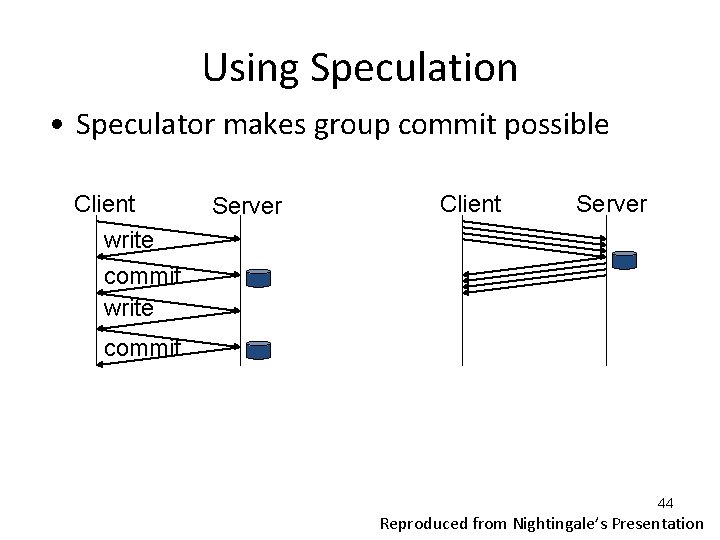
Using Speculation • Speculator makes group commit possible Client write commit write Server Client Server commit 44 Reproduced from Nightingale’s Presentation
Evaluation: Speculative Execution • To answer the following questions – Performance gain from propagating dependencies – Impact on performance when speculation fails – Impact on performance of group commit and sharing state
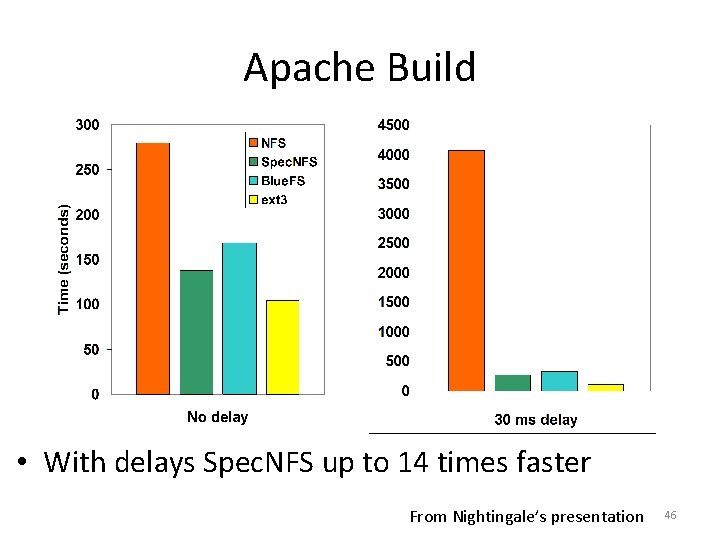
Apache Build • With delays Spec. NFS up to 14 times faster From Nightingale’s presentation 46
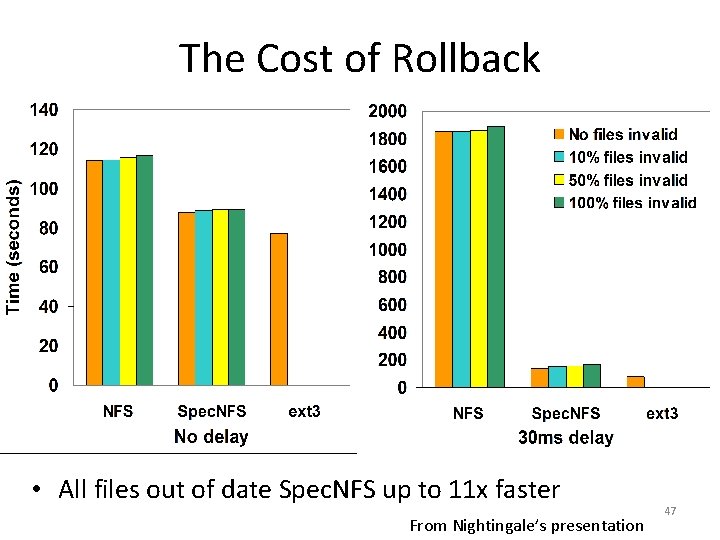
The Cost of Rollback • All files out of date Spec. NFS up to 11 x faster From Nightingale’s presentation 47
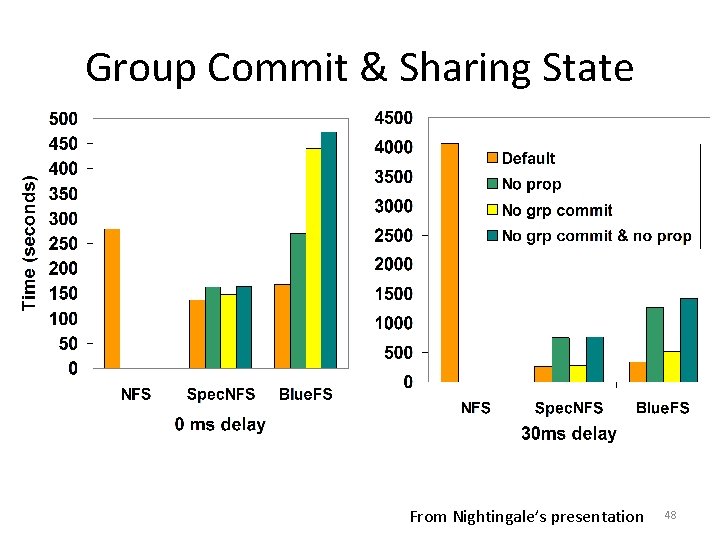
Group Commit & Sharing State From Nightingale’s presentation 48
Discussions • Is speculation in OS the right level of abstraction? – Similar Ideas: • Transaction and Rollback in Relational Database • Transactional Memory • Speculative Execution in OS • What if the conditions for success do not hold? • Portability of code – Code perform worse if OS does not speculate – What about transform source code to perform speculation? • Why isn’t this used nowadays?
Conclusions • Performance need not be sacrified for durability • The transaction and rollback infrastructure in OS is very useful, two good papers! • Ideas are not new, but are generic.

Thanks!
Things they did not do • Mechanism to prevent disk corruption when crash occurs. They used the default journaled mode.
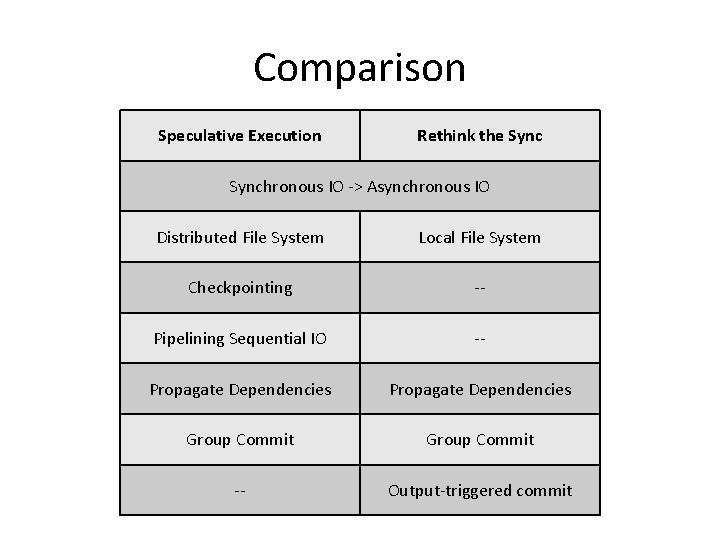
Comparison Speculative Execution Rethink the Synchronous IO -> Asynchronous IO Distributed File System Local File System Checkpointing -- Pipelining Sequential IO -- Propagate Dependencies Group Commit -- Output-triggered commit
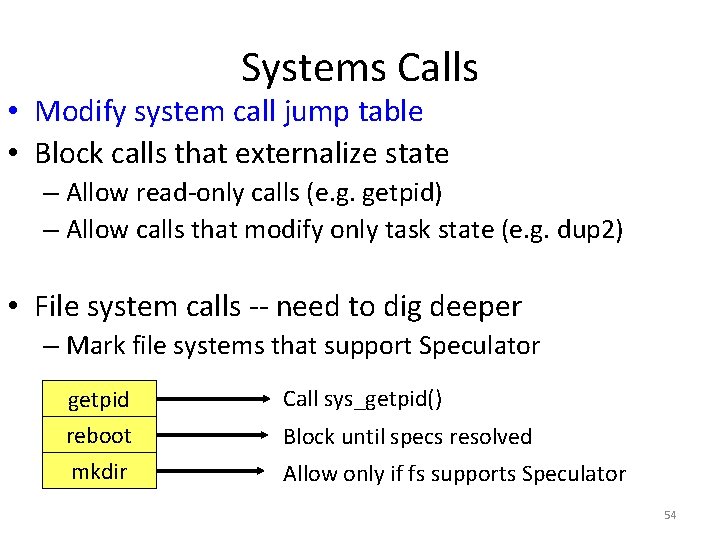
Systems Calls • Modify system call jump table • Block calls that externalize state – Allow read-only calls (e. g. getpid) – Allow calls that modify only task state (e. g. dup 2) • File system calls -- need to dig deeper – Mark file systems that support Speculator getpid reboot mkdir Call sys_getpid() Block until specs resolved Allow only if fs supports Speculator 54
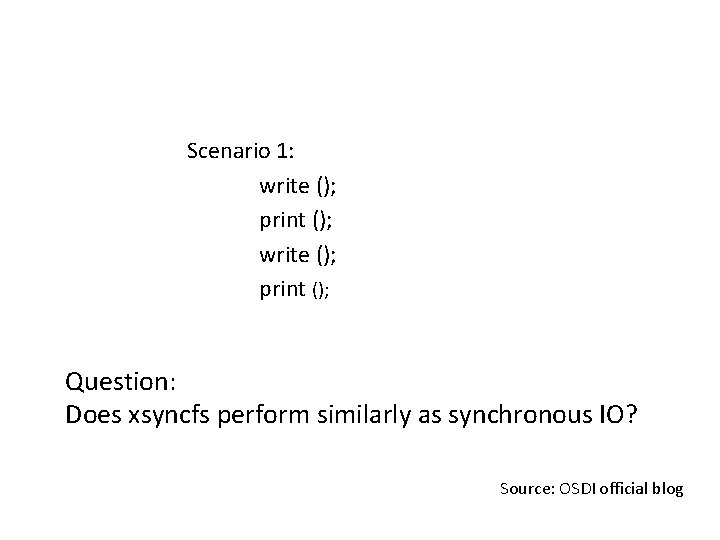
Scenario 1: write (); print (); Question: Does xsyncfs perform similarly as synchronous IO? Source: OSDI official blog
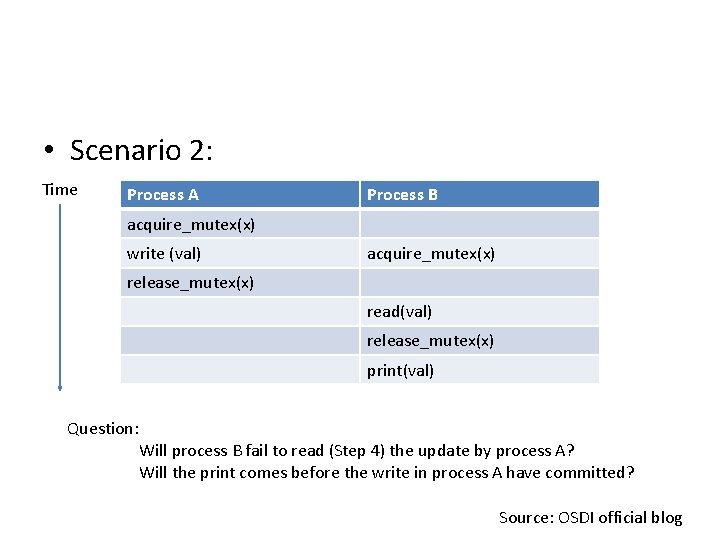
• Scenario 2: Time Process A Process B acquire_mutex(x) write (val) acquire_mutex(x) release_mutex(x) read(val) release_mutex(x) print(val) Question: Will process B fail to read (Step 4) the update by process A? Will the print comes before the write in process A have committed? Source: OSDI official blog
- Slides: 56