
SpectrumEfficient Coherent Optical Zero Padding OFDM for Future
![Coherent Optical OFDM v. Development [Shieh’ 06, Shen’ 11] n n n Based on](https://slidetodoc.com/presentation_image_h/03daf77233480cdc6ab9a49ba12ee046/image-3.jpg "Coherent Optical OFDM v. Development [Shieh’ 06, Shen’ 11] n n n Based on")

- Slides: 19
Spectrum-Efficient Coherent Optical Zero Padding OFDM for Future High -Speed Transport Networks Linglong Dai and Zhaocheng Wang Tsinghua University, Beijing, China
Outline 1 Background 2 Spectrum-Efficient CO-OFDM 3 Simulation Results 4 Conclusions 2
Coherent Optical OFDM v. Development [Shieh’ 06, Shen’ 11] n n n Based on mature OFDM in wireline/wireless industry Practical verification for 100 Gb/s+ optical networks Polarization division multiplexing (PDM) to double throughput v. Key features [Shieh’ 08 , Jansen’ 08] n n Tolerance to optical CD, PMD, PDL Optical channel MIMO Jones matrix 3
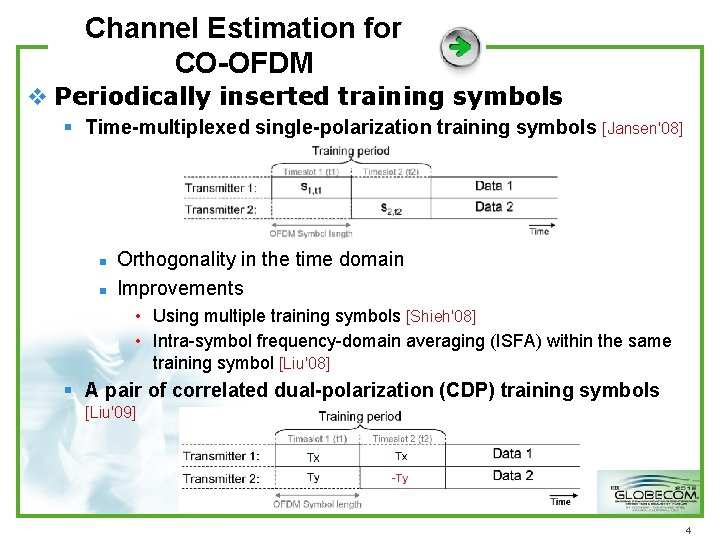
Channel Estimation for CO-OFDM v Periodically inserted training symbols § Time-multiplexed single-polarization training symbols [Jansen'08] n n Orthogonality in the time domain Improvements • Using multiple training symbols [Shieh'08] • Intra-symbol frequency-domain averaging (ISFA) within the same training symbol [Liu'08] § A pair of correlated dual-polarization (CDP) training symbols [Liu'09] 4
Channel Estimation for CO-OFDM v. Problems n All subcarriers used as pilots Reduce the spectral efficiency n Large interval between training symbols (e. g. 20 OFDM symbols [Liu'08] ) Lower the channel tracking capability Utilize optical channel property: • slow time-variation • slow frequency fluctuation 5
Outline 1 Background 2 Spectrum-Efficient CO-OFDM 3 Simulation Results 4 Conclusion 6
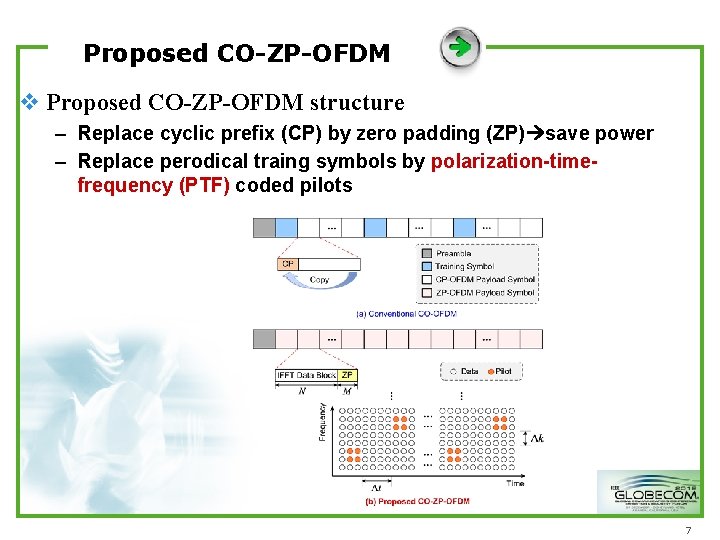
Proposed CO-ZP-OFDM v Proposed CO-ZP-OFDM structure – Replace cyclic prefix (CP) by zero padding (ZP) save power – Replace perodical traing symbols by polarization-timefrequency (PTF) coded pilots 7
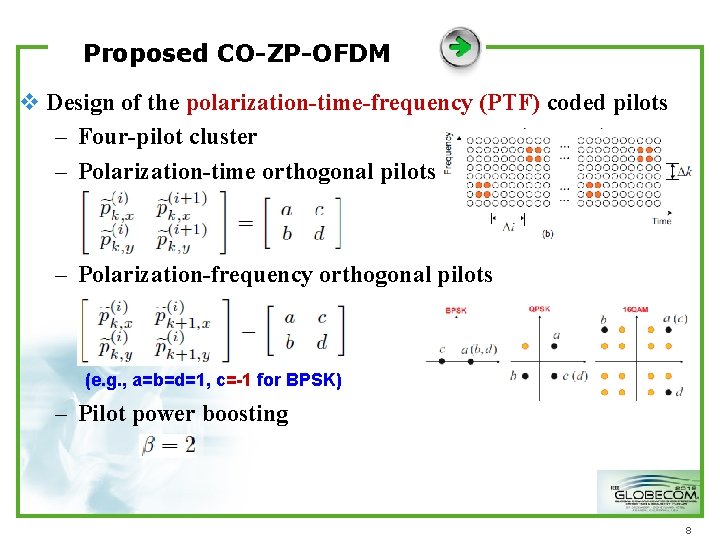
Proposed CO-ZP-OFDM v Design of the polarization-time-frequency (PTF) coded pilots – Four-pilot cluster – Polarization-time orthogonal pilots – Polarization-frequency orthogonal pilots (e. g. , a=b=d=1, c=-1 for BPSK) – Pilot power boosting 8
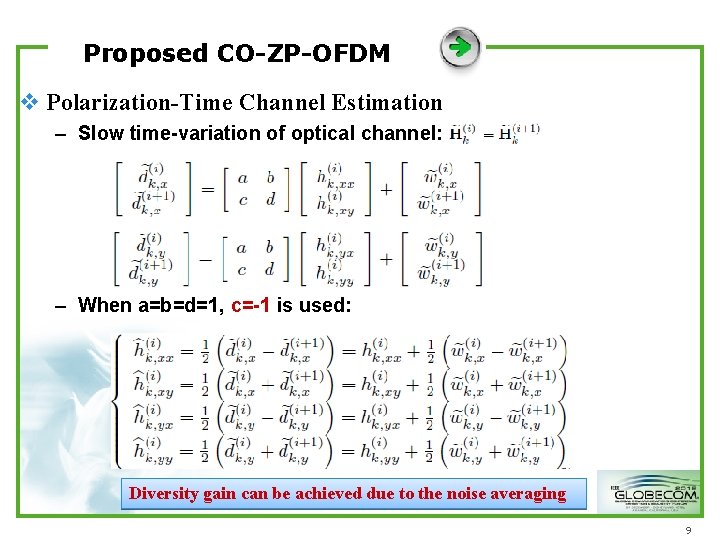
Proposed CO-ZP-OFDM v Polarization-Time Channel Estimation – Slow time-variation of optical channel: – When a=b=d=1, c=-1 is used: Diversity gain can be achieved due to the noise averaging 9
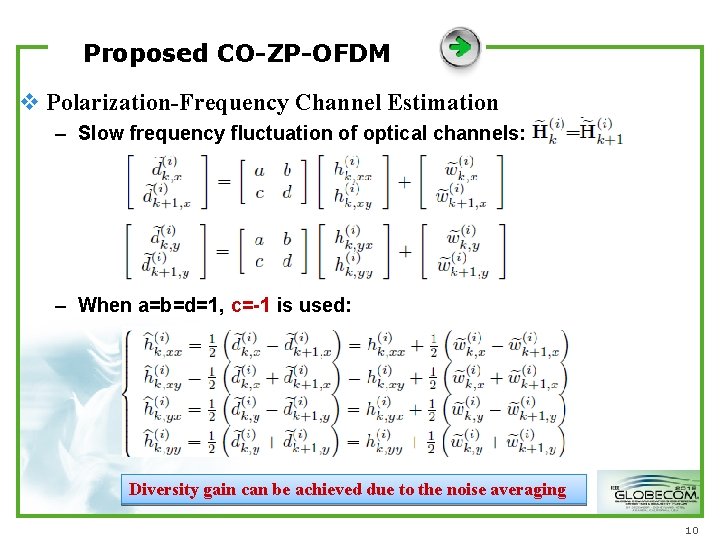
Proposed CO-ZP-OFDM v Polarization-Frequency Channel Estimation – Slow frequency fluctuation of optical channels: – When a=b=d=1, c=-1 is used: Diversity gain can be achieved due to the noise averaging 10
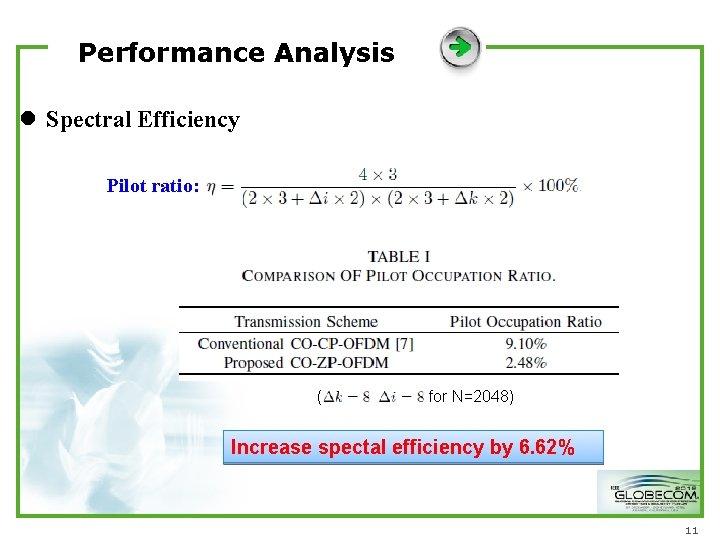
Performance Analysis l Spectral Efficiency Pilot ratio: ( for N=2048) Increase spectal efficiency by 6. 62% 11
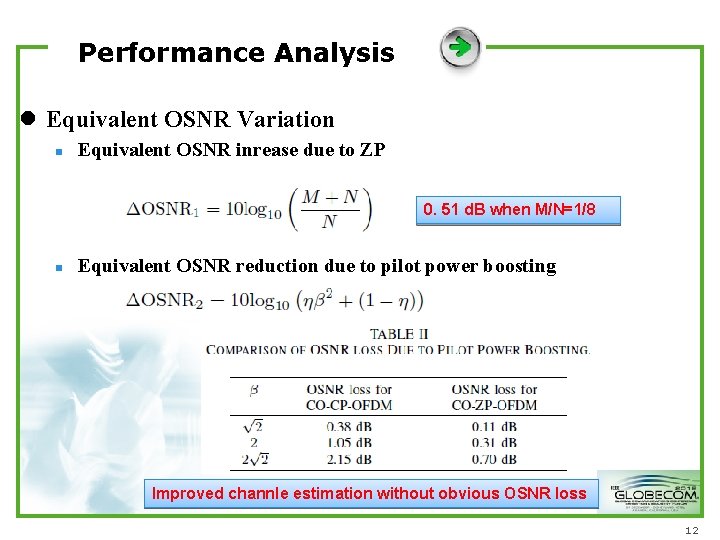
Performance Analysis l Equivalent OSNR Variation n Equivalent OSNR inrease due to ZP 0. 51 d. B when M/N=1/8 n Equivalent OSNR reduction due to pilot power boosting Improved channle estimation without obvious OSNR loss 12
Outline 1 Background 2 Spectrum-Efficient CO-OFDM 3 Simulation Results 4 Conclusion 13
Simulation Setup l Simulation setup • • • Similar to the PMD CO-OFDM system in [Buchali’ 09] IFFT size N=2048, Guard interval length M=256 16 QAM modulation LDPC code Line bandwidth of the optical oscillator is 100 k. Hz Large CD and PMD are imposed 14
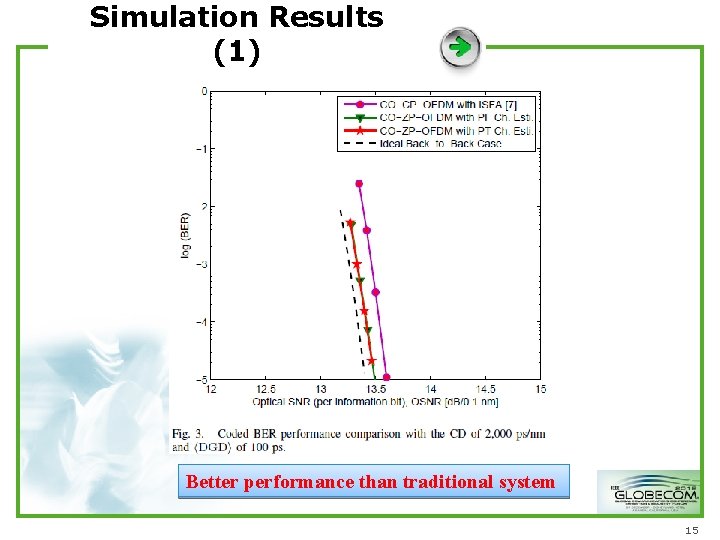
Simulation Results (1) Better performance than traditional system 15
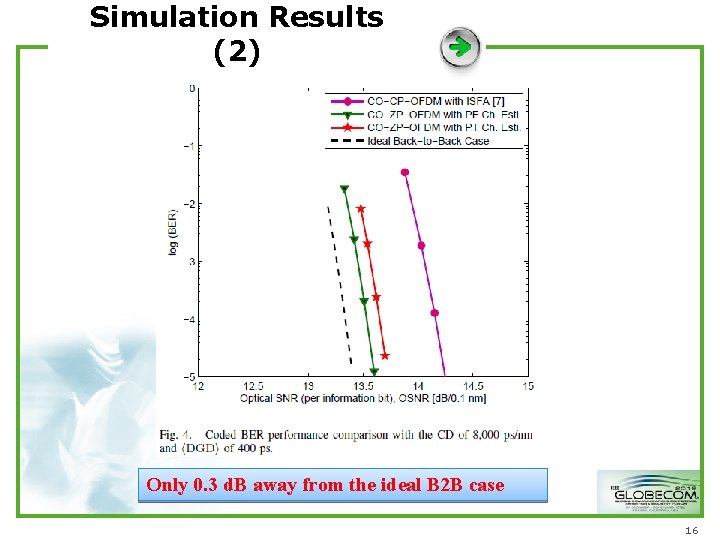
Simulation Results (2) Only 0. 3 d. B away from the ideal B 2 B case 16
Outline 1 Background 2 Spectrum-Efficient CO-OFDM 3 Simulation Results 4 Conclusion 17
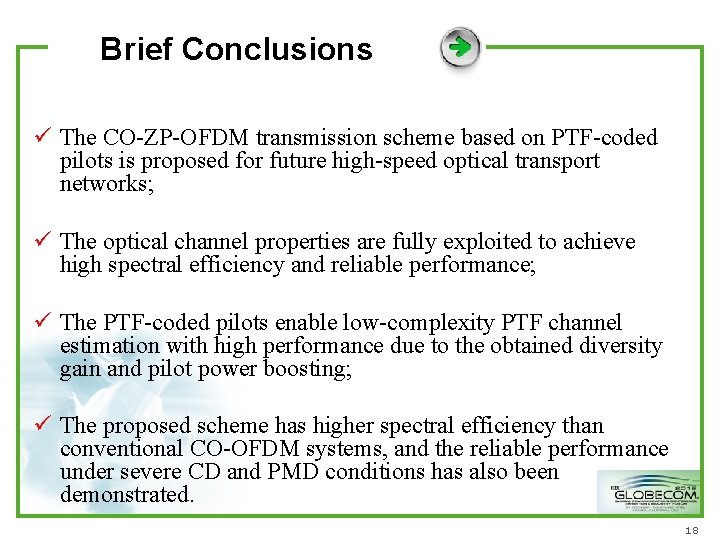
Brief Conclusions ü The CO-ZP-OFDM transmission scheme based on PTF-coded pilots is proposed for future high-speed optical transport networks; ü The optical channel properties are fully exploited to achieve high spectral efficiency and reliable performance; ü The PTF-coded pilots enable low-complexity PTF channel estimation with high performance due to the obtained diversity gain and pilot power boosting; ü The proposed scheme has higher spectral efficiency than conventional CO-OFDM systems, and the reliable performance under severe CD and PMD conditions has also been demonstrated. 18
Thank you !