
Spectrum MRI Towards Diagnosis of MultiRadio Interference in
![References 1. [Golmie ’ 03] N. Golmie, N. Chevrollier, and O. Rebala, “Bluetooth and](https://slidetodoc.com/presentation_image_h2/eb171626cc12cba8f8f03b5dfec28491/image-23.jpg "References 1. [Golmie ’ 03] N. Golmie, N. Chevrollier, and O. Rebala, “Bluetooth and")
- Slides: 23
Spectrum MRI: Towards Diagnosis of Multi-Radio Interference in the Unlicensed Band WINLAB
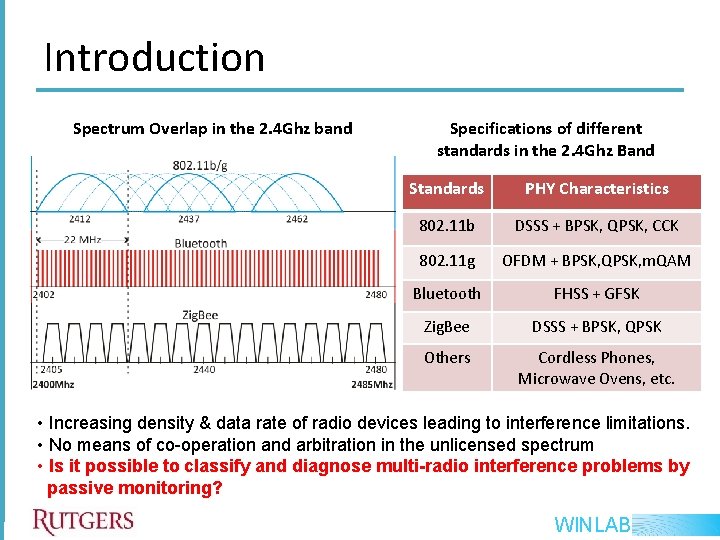
Introduction Spectrum Overlap in the 2. 4 Ghz band Specifications of different standards in the 2. 4 Ghz Band Standards PHY Characteristics 802. 11 b DSSS + BPSK, QPSK, CCK 802. 11 g OFDM + BPSK, QPSK, m. QAM Bluetooth FHSS + GFSK Zig. Bee DSSS + BPSK, QPSK Others Cordless Phones, Microwave Ovens, etc. • Increasing density & data rate of radio devices leading to interference limitations. • No means of co-operation and arbitration in the unlicensed spectrum • Is it possible to classify and diagnose multi-radio interference problems by passive monitoring? WINLAB
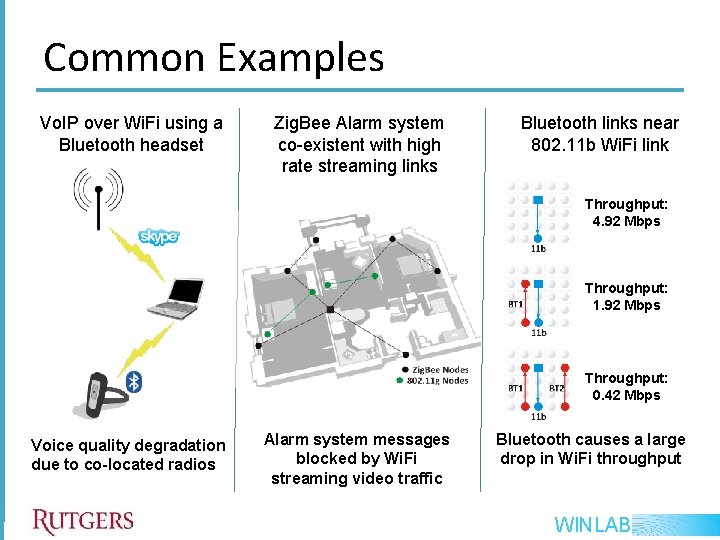
Common Examples Vo. IP over Wi. Fi using a Bluetooth headset Zig. Bee Alarm system co-existent with high rate streaming links Bluetooth links near 802. 11 b Wi. Fi link Throughput: 4. 92 Mbps Throughput: 1. 92 Mbps Throughput: 0. 42 Mbps Voice quality degradation due to co-located radios Alarm system messages blocked by Wi. Fi streaming video traffic Bluetooth causes a large drop in Wi. Fi throughput WINLAB
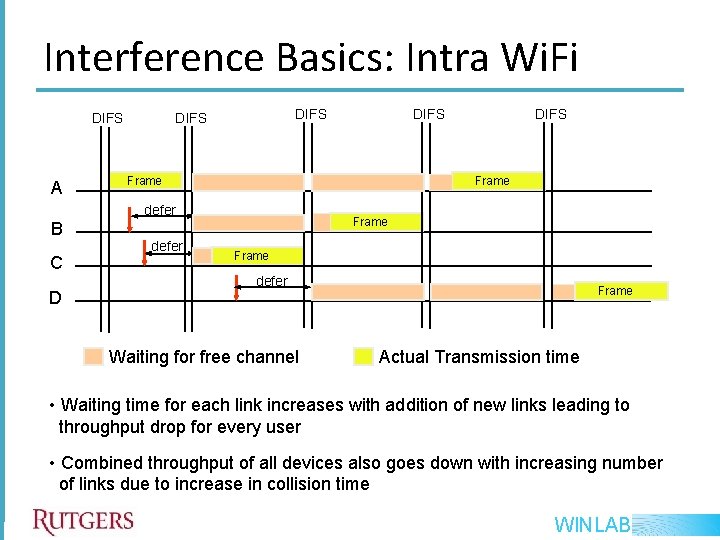
Interference Basics: Intra Wi. Fi A DIFS C D defer DIFS Frame defer B DIFS Frame defer Waiting for free channel Frame Actual Transmission time • Waiting time for each link increases with addition of new links leading to throughput drop for every user • Combined throughput of all devices also goes down with increasing number of links due to increase in collision time WINLAB
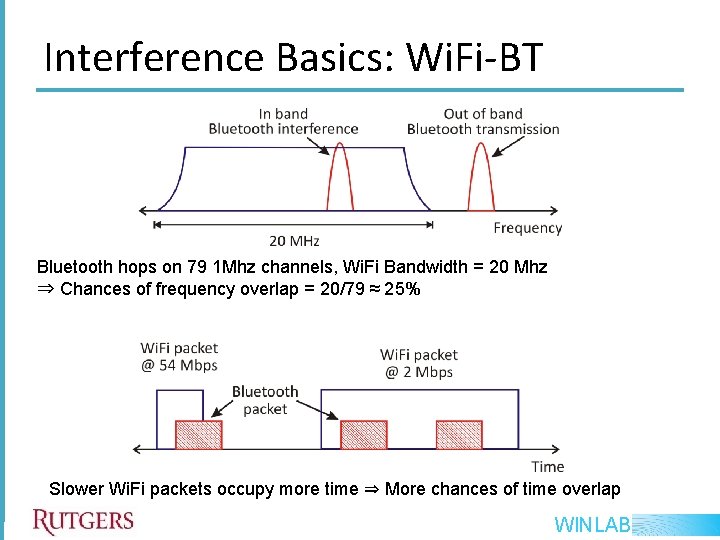
Interference Basics: Wi. Fi-BT Bluetooth hops on 79 1 Mhz channels, Wi. Fi Bandwidth = 20 Mhz ⇒ Chances of frequency overlap = 20/79 ≈ 25% Slower Wi. Fi packets occupy more time ⇒ More chances of time overlap WINLAB
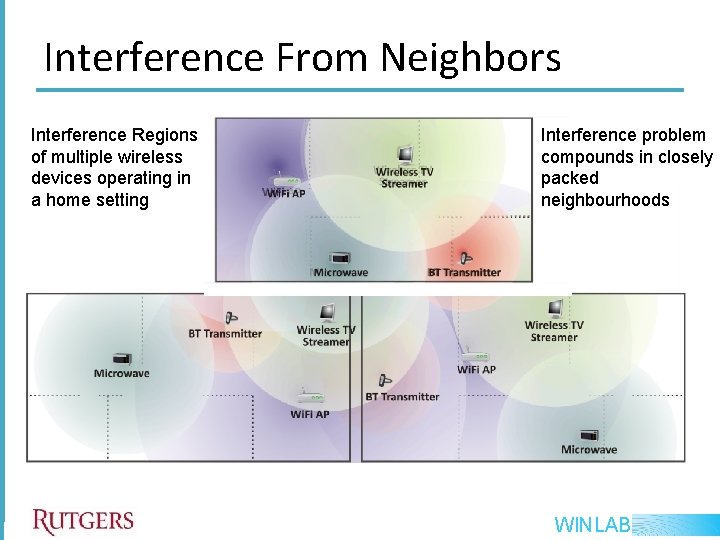
Interference From Neighbors Interference Regions of multiple wireless devices operating in a home setting Interference problem compounds in closely packed neighbourhoods WINLAB
Interference Localization • Ideally we would like to locate sources of interference • But indoor localization is a hard problem in itself – requirement of multiple sensors, training data – physical dimensions needed for accuracy – non-uniform transmit power poses additional problem for localization • We take the approach of logical topology discovery when physical topology is hard to find – system based on user registered devices indexed by their MAC identification WINLAB
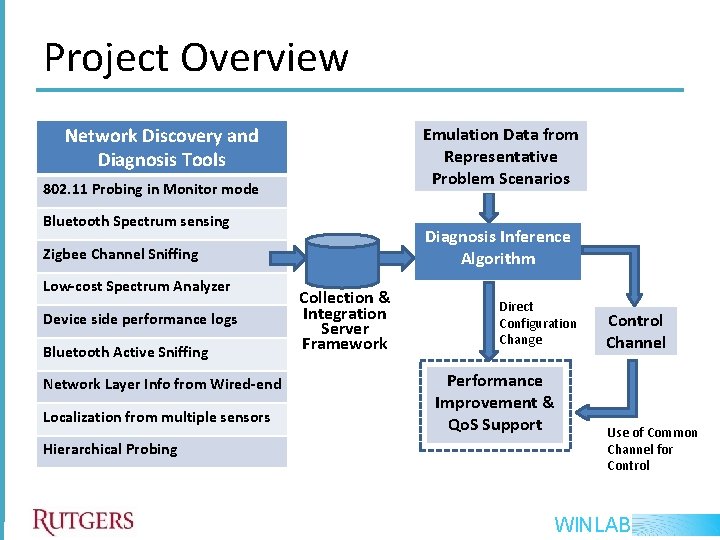
Project Overview Network Discovery and Diagnosis Tools Emulation Data from Representative Problem Scenarios 802. 11 Probing in Monitor mode Bluetooth Spectrum sensing Diagnosis Inference Algorithm Zigbee Channel Sniffing Low-cost Spectrum Analyzer Device side performance logs Bluetooth Active Sniffing Network Layer Info from Wired-end Localization from multiple sensors Hierarchical Probing Collection & Integration Server Framework Direct Configuration Change Performance Improvement & Qo. S Support Control Channel Use of Common Channel for Control WINLAB
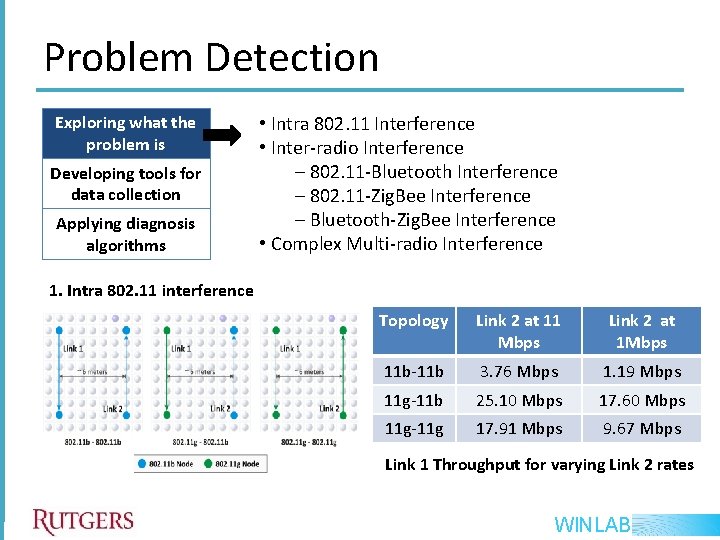
Problem Detection Exploring what the problem is Developing tools for data collection Applying diagnosis algorithms • Intra 802. 11 Interference • Inter-radio Interference – 802. 11 -Bluetooth Interference – 802. 11 -Zig. Bee Interference – Bluetooth-Zig. Bee Interference • Complex Multi-radio Interference 1. Intra 802. 11 interference Topology Link 2 at 11 Mbps Link 2 at 1 Mbps 11 b-11 b 3. 76 Mbps 1. 19 Mbps 11 g-11 b 25. 10 Mbps 17. 60 Mbps 11 g-11 g 17. 91 Mbps 9. 67 Mbps Link 1 Throughput for varying Link 2 rates WINLAB
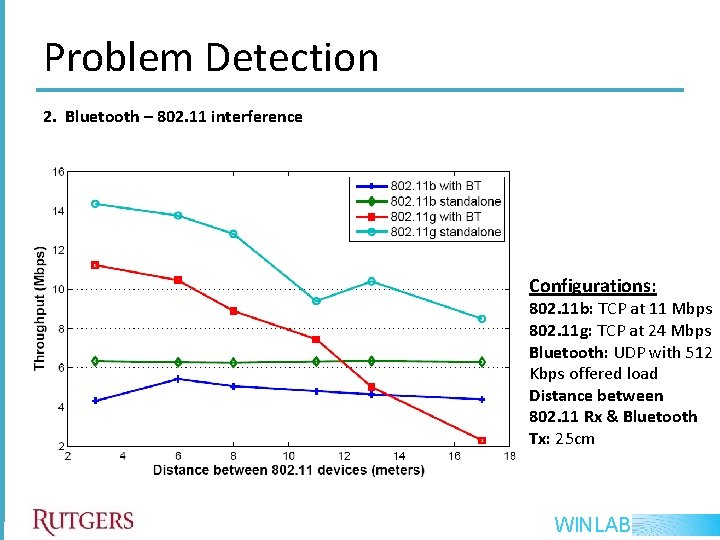
Problem Detection 2. Bluetooth – 802. 11 interference Configurations: 802. 11 b: TCP at 11 Mbps 802. 11 g: TCP at 24 Mbps Bluetooth: UDP with 512 Kbps offered load Distance between 802. 11 Rx & Bluetooth Tx: 25 cm WINLAB
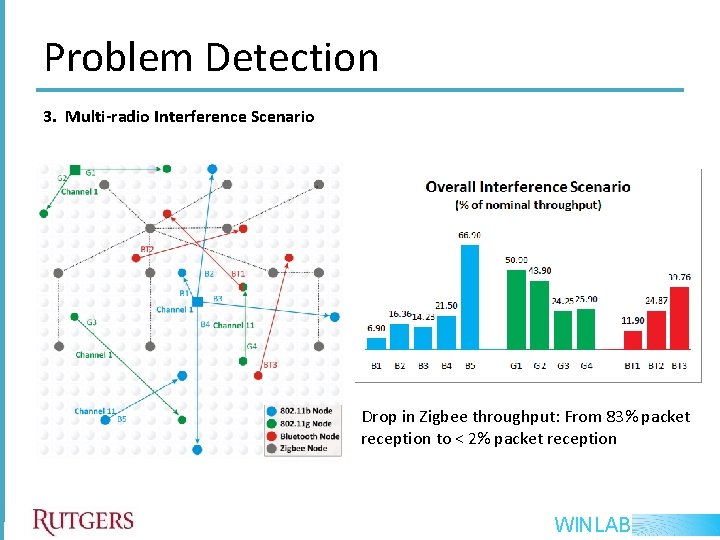
Problem Detection 3. Multi-radio Interference Scenario Drop in Zigbee throughput: From 83% packet reception to < 2% packet reception WINLAB
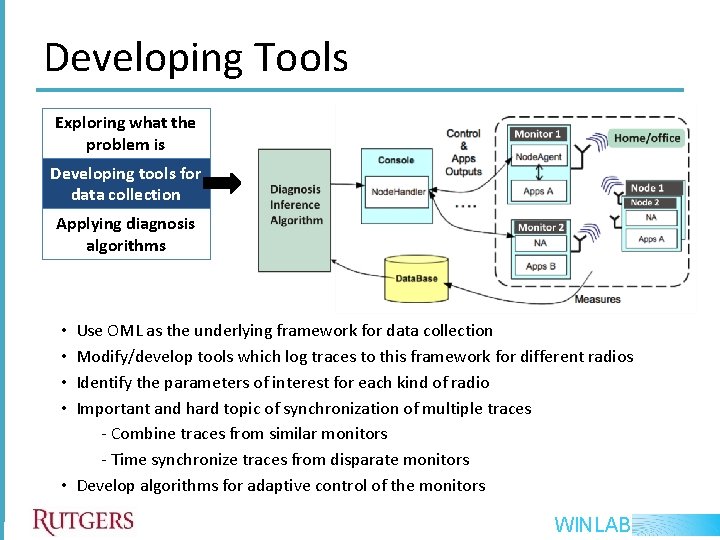
Developing Tools Exploring what the problem is Developing tools for data collection Applying diagnosis algorithms Use OML as the underlying framework for data collection Modify/develop tools which log traces to this framework for different radios Identify the parameters of interest for each kind of radio Important and hard topic of synchronization of multiple traces - Combine traces from similar monitors - Time synchronize traces from disparate monitors • Develop algorithms for adaptive control of the monitors • • WINLAB
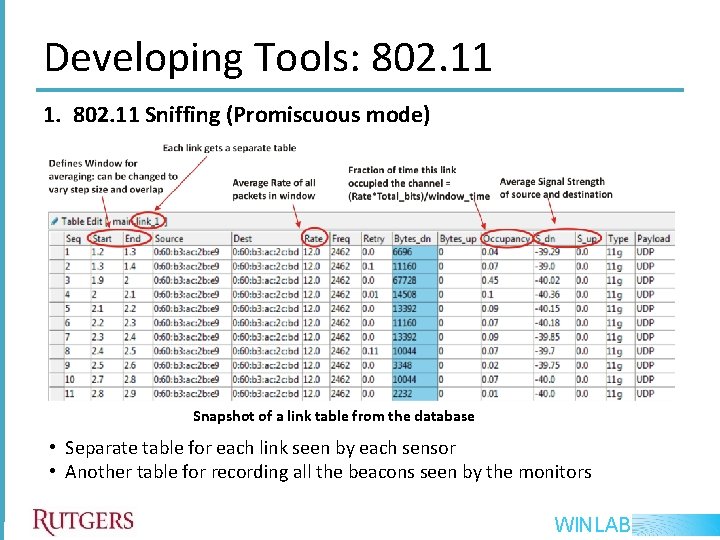
Developing Tools: 802. 11 1. 802. 11 Sniffing (Promiscuous mode) Snapshot of a link table from the database • Separate table for each link seen by each sensor • Another table for recording all the beacons seen by the monitors WINLAB
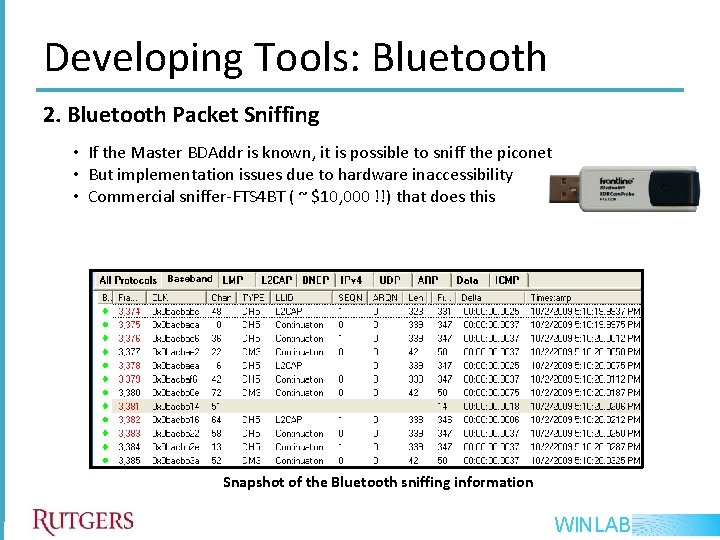
Developing Tools: Bluetooth 2. Bluetooth Packet Sniffing • If the Master BDAddr is known, it is possible to sniff the piconet • But implementation issues due to hardware inaccessibility • Commercial sniffer-FTS 4 BT ( ~ $10, 000 !!) that does this Snapshot of the Bluetooth sniffing information WINLAB
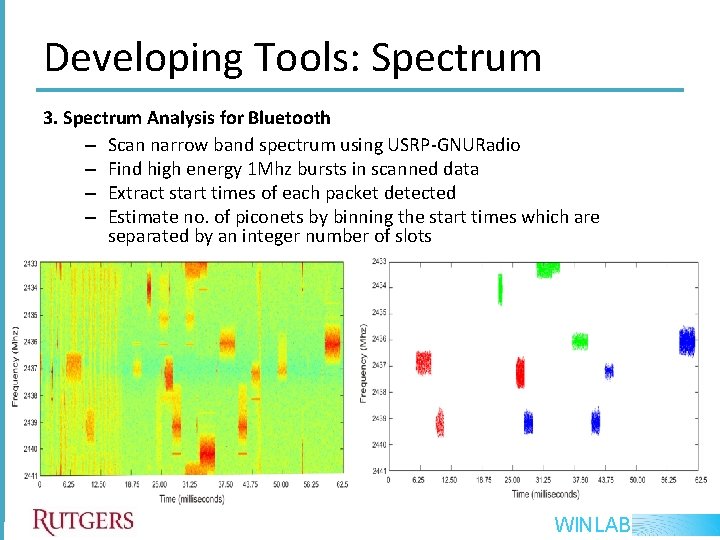
Developing Tools: Spectrum 3. Spectrum Analysis for Bluetooth – Scan narrow band spectrum using USRP-GNURadio – Find high energy 1 Mhz bursts in scanned data – Extract start times of each packet detected – Estimate no. of piconets by binning the start times which are separated by an integer number of slots WINLAB
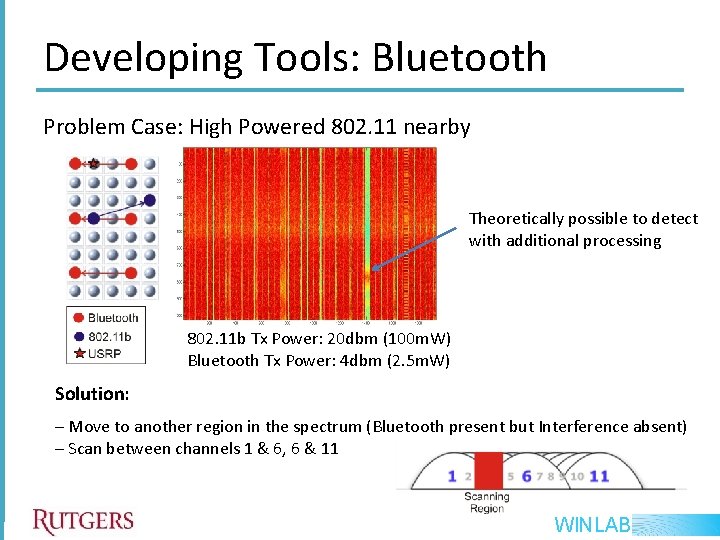
Developing Tools: Bluetooth Problem Case: High Powered 802. 11 nearby Theoretically possible to detect with additional processing 802. 11 b Tx Power: 20 dbm (100 m. W) Bluetooth Tx Power: 4 dbm (2. 5 m. W) Solution: – Move to another region in the spectrum (Bluetooth present but Interference absent) – Scan between channels 1 & 6, 6 & 11 WINLAB
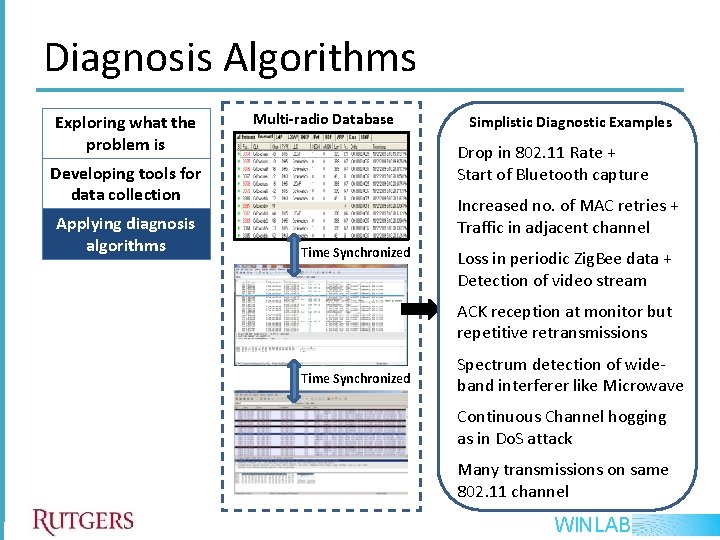
Diagnosis Algorithms Exploring what the problem is Multi-radio Database Drop in 802. 11 Rate + Start of Bluetooth capture Developing tools for data collection Applying diagnosis algorithms Simplistic Diagnostic Examples Increased no. of MAC retries + Traffic in adjacent channel Time Synchronized Loss in periodic Zig. Bee data + Detection of video stream ACK reception at monitor but repetitive retransmissions Time Synchronized Spectrum detection of wideband interferer like Microwave Continuous Channel hogging as in Do. S attack Many transmissions on same 802. 11 channel WINLAB
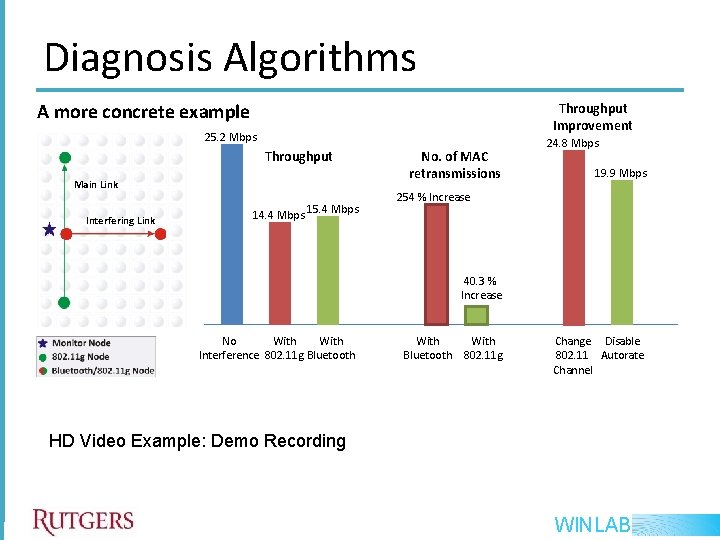
Diagnosis Algorithms A more concrete example Throughput Improvement 25. 2 Mbps Throughput Main Link Interfering Link 14. 4 Mbps 15. 4 Mbps No. of MAC retransmissions 24. 8 Mbps 19. 9 Mbps 254 % Increase 40. 3 % Increase No With Interference 802. 11 g Bluetooth With Bluetooth 802. 11 g Change Disable 802. 11 Autorate Channel HD Video Example: Demo Recording WINLAB
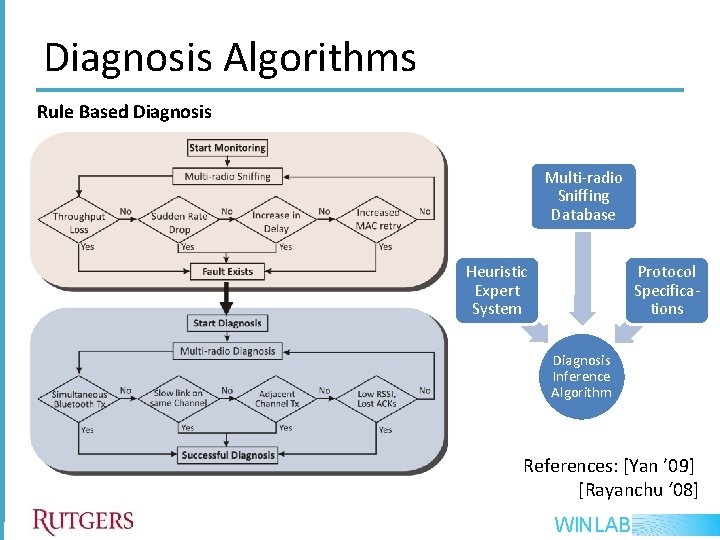
Diagnosis Algorithms Rule Based Diagnosis Multi-radio Sniffing Database Heuristic Expert System Protocol Specifications Diagnosis Inference Algorithm References: [Yan ’ 09] [Rayanchu ‘ 08] WINLAB
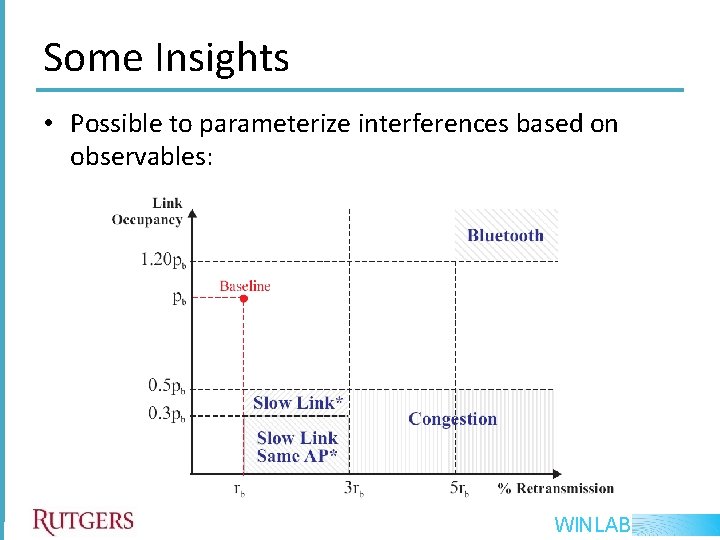
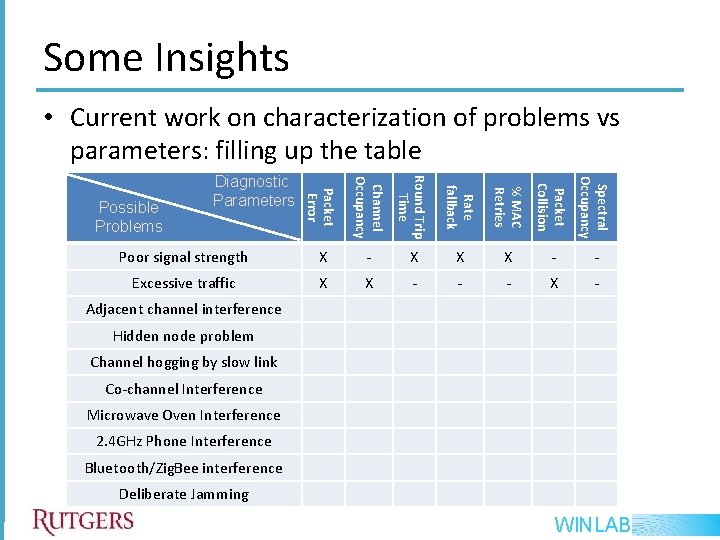
Some Insights • Possible to parameterize interferences based on observables: WINLAB
Some Insights • Current work on characterization of problems vs parameters: filling up the table Packet Error Channel Occupancy Round Trip Time Rate fallback % MAC Retries Packet Collision Spectral Occupancy Diagnostic Parameters Poor signal strength X - X X X - - Excessive traffic X X - - - X - Possible Problems Adjacent channel interference Hidden node problem Channel hogging by slow link Co-channel Interference Microwave Oven Interference 2. 4 GHz Phone Interference Bluetooth/Zig. Bee interference Deliberate Jamming WINLAB
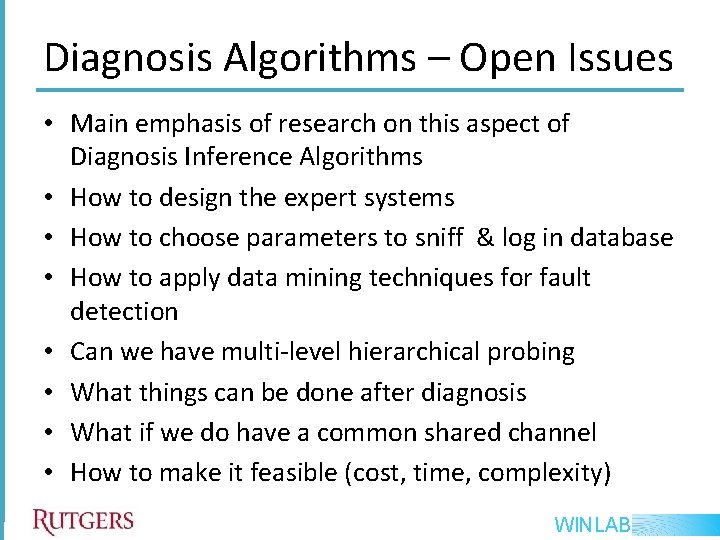
Diagnosis Algorithms – Open Issues • Main emphasis of research on this aspect of Diagnosis Inference Algorithms • How to design the expert systems • How to choose parameters to sniff & log in database • How to apply data mining techniques for fault detection • Can we have multi-level hierarchical probing • What things can be done after diagnosis • What if we do have a common shared channel • How to make it feasible (cost, time, complexity) WINLAB
References 1. [Golmie ’ 03] N. Golmie, N. Chevrollier, and O. Rebala, “Bluetooth and wlan coexistence: Challenges and solutions, ” IEEE Wireless Communications Magazine, vol. 10, pp. 22– 29, 2003. 2. [Shin ’ 07] S. Y. Shin, H. S. Park, S. Choi, and W. H. Kwon, “Packet error rate analysis of zigbee under wlan and bluetooth interferences, ” IEEE Trans on Wireless Commun, vol. 6, no. 8, 2007. 3. [Jing ‘ 08] X. Jing, et al. , “Distributed coordination schemes for multi-radio co-existence in dense spectrum environments: An experimental study on the orbit testbed, ” in Proc. of Dy. SPAN 2008, 3 rd IEEE Symposium on New Frontiers in Dynamic Spectrum Access Networks, Oct. 2008. 4. [Gummadi ‘ 07] R. Gummadi, D. Wetherall, B. Greenstein, and S. Seshan, “Understanding and mitigating the impact of rf interference on 802. 11 networks, ” in Proc. of Sigcomm 07, 2007. 5. [Bellardo ’ 03] J. Bellardo and S. Savage, “ 802. 11 Denial-of-Service Attacks: Real Vulnerabilities and Practical Solutions, ” Proc. 11 th Usenix Security Symp. , Usenix Assoc. , 2003. 6. [Stranne ‘ 06] A. Stranne, O. Edfors, and B. -A. Molin, “Energy-based interference analysis of heterogeneous packet radio networks. ” IEEE Trans on Commun. , vol. 54, no. 4, 2006. 7. [Cheng ’ 07] Y. -C. Cheng, et al. , “Automating cross-layer diagnosis of enterprise wireless networks, ” in Proc. of Sigcomm 07. ACM Press, , pp. 25– 36. , 2007. 8. [Sheth ‘ 06] A. Sheth, et al. , “Mojo: a distributed physical layer anomaly detection system for 802. 11 wlans, ” in Proc. of Mobi. Sys ’ 06, 2006. 9. [Yan ’ 09] B. Yan and G. Chen, “Model-based Fault Diagnosis for IEEE 802. 11 Wireless LANs, ” in Proc. of Mobi. Quitous ‘ 09, Toronto, Canada, July 2009. 10. [Rayanchu ‘ 08] S. Rayanchu, et al. , “Diagnosing Wireless Packet Losses in 802. 11: Separating Collision from Weak Signal”, in Proc. of IEEE Infocom ‘ 08, 2008. WINLAB