
Spectrum Management with Technical Flexibility Paul Kolodzy Ph
Spectrum Management with Technical Flexibility Paul Kolodzy, Ph. D Spectrum Management 2008 20 May 2008
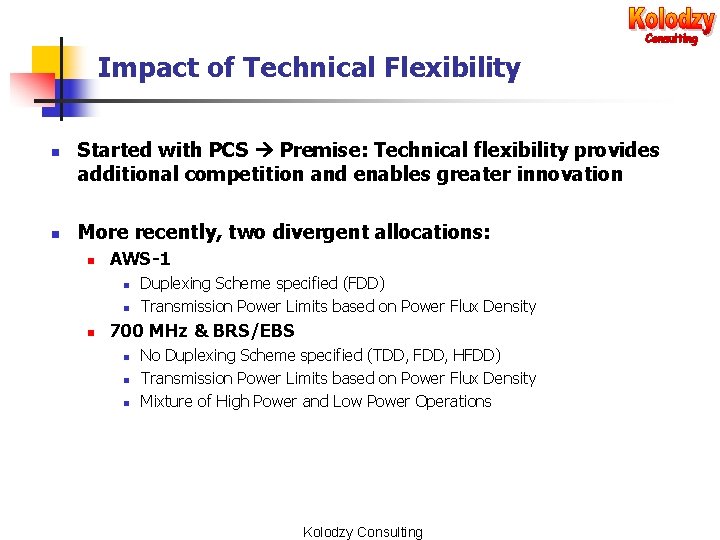
Impact of Technical Flexibility n n Started with PCS Premise: Technical flexibility provides additional competition and enables greater innovation More recently, two divergent allocations: n AWS-1 n n n Duplexing Scheme specified (FDD) Transmission Power Limits based on Power Flux Density 700 MHz & BRS/EBS n n n No Duplexing Scheme specified (TDD, FDD, HFDD) Transmission Power Limits based on Power Flux Density Mixture of High Power and Low Power Operations Kolodzy Consulting
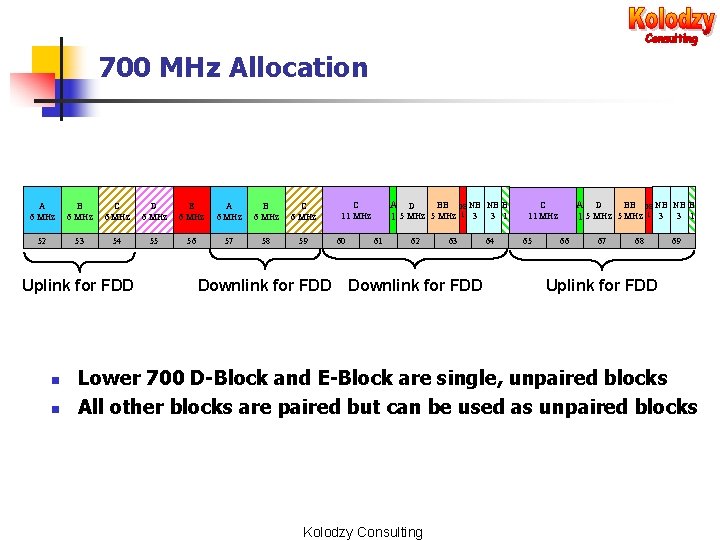
700 MHz Allocation A 6 MHz B 6 MHz C 6 MHz D 6 MHz E 6 MHz A 6 MHz B 6 MHz C 6 MHz 52 53 54 55 56 57 58 59 Uplink for FDD n n Downlink for FDD A D BB GB NB NB B 1 5 MHz 1 3 3 1 C 11 MHz 60 61 62 63 Downlink for FDD 64 A D BB GB NB NB B 1 5 MHz 1 3 3 1 C 11 MHz 65 66 67 68 69 Uplink for FDD Lower 700 D-Block and E-Block are single, unpaired blocks All other blocks are paired but can be used as unpaired blocks Kolodzy Consulting
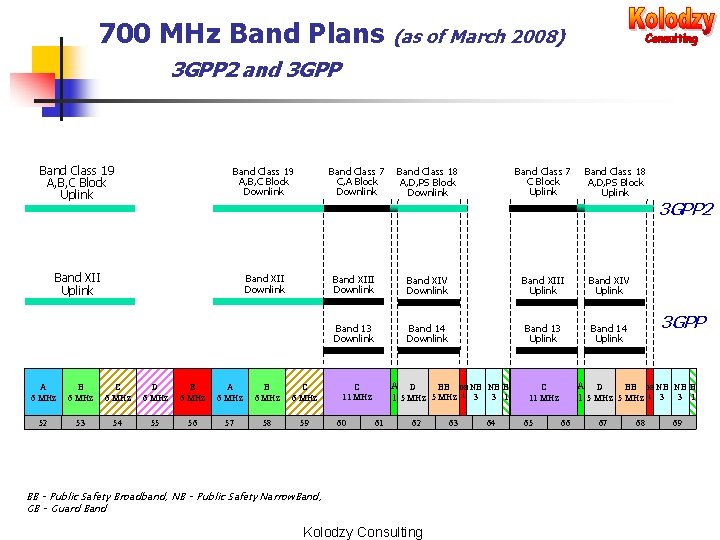
700 MHz Band Plans (as of March 2008) 3 GPP 2 and 3 GPP Band Class 19 A, B, C Block Uplink Band Class 19 A, B, C Block Downlink Band XII Uplink Band XII Downlink Band Class 7 C, A Block Downlink Band Class 7 C Block Uplink Band Class 18 A, D, PS Block Downlink Band Class 18 A, D, PS Block Uplink 3 GPP 2 A 6 MHz B 6 MHz C 6 MHz D 6 MHz E 6 MHz A 6 MHz B 6 MHz C 6 MHz 52 53 54 55 56 57 58 59 Band XIII Downlink Band XIV Downlink Band XIII Uplink Band XIV Uplink Band 13 Downlink Band 14 Downlink Band 13 Uplink Band 14 Uplink A D BB GB NB NB B 1 5 MHz 1 3 3 1 C 11 MHz 60 61 62 BB – Public Safety Broadband, NB – Public Safety Narrow. Band, GB – Guard Band Kolodzy Consulting 63 64 A D BB GB NB NB B 1 5 MHz 1 3 3 1 C 11 MHz 65 3 GPP 66 67 68 69
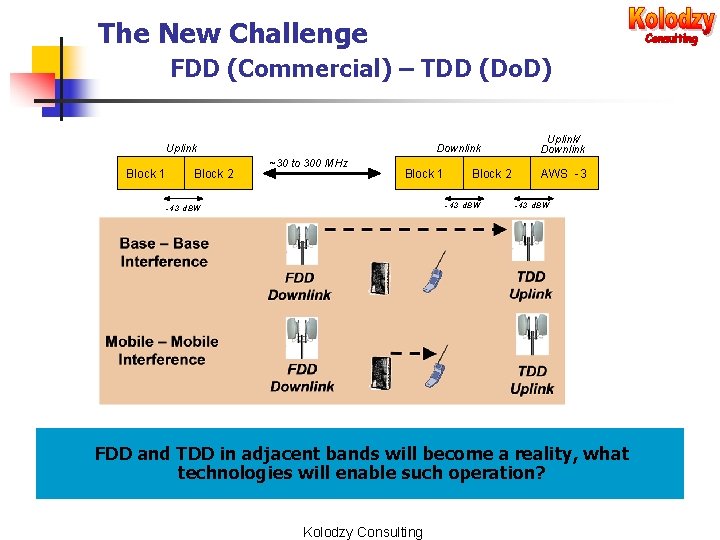
The New Challenge FDD (Commercial) – TDD (Do. D) Uplink Block 1 Block 2 Downlink ~30 to 300 MHz Block 1 Block 2 -43 d. BW Uplink/ Downlink AWS -3 -43 d. BW FDD and TDD in adjacent bands will become a reality, what technologies will enable such operation? Kolodzy Consulting
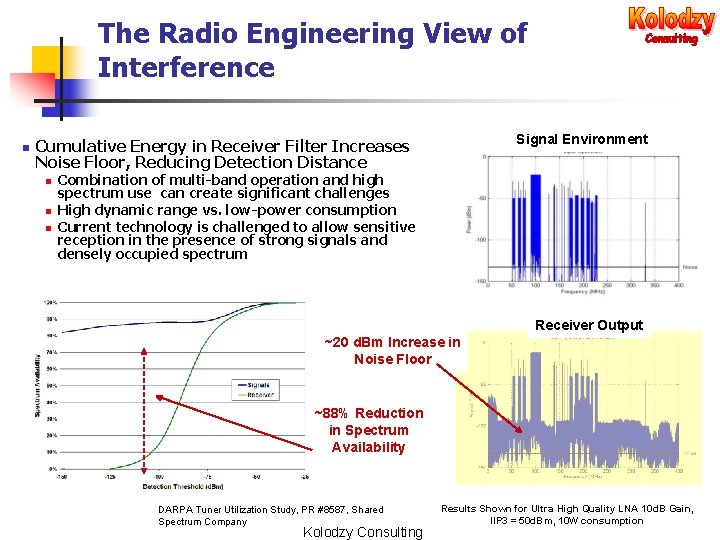
The Radio Engineering View of Interference n Signal Environment Cumulative Energy in Receiver Filter Increases Noise Floor, Reducing Detection Distance n n n Combination of multi-band operation and high spectrum use can create significant challenges High dynamic range vs. low-power consumption Current technology is challenged to allow sensitive reception in the presence of strong signals and densely occupied spectrum Receiver Output ~20 d. Bm Increase in Noise Floor ~88% Reduction in Spectrum Availability DARPA Tuner Utilization Study, PR #8587, Shared Spectrum Company Kolodzy Consulting Results Shown for Ultra High Quality LNA 10 d. B Gain, IIP 3 = 50 d. Bm, 10 W consumption
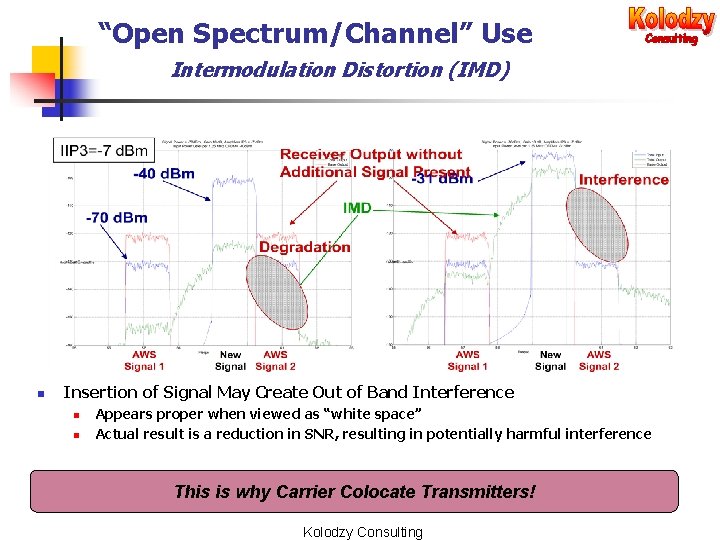
“Open Spectrum/Channel” Use Intermodulation Distortion (IMD) n Insertion of Signal May Create Out of Band Interference n n Appears proper when viewed as “white space” Actual result is a reduction in SNR, resulting in potentially harmful interference This is why Carrier Colocate Transmitters! Kolodzy Consulting
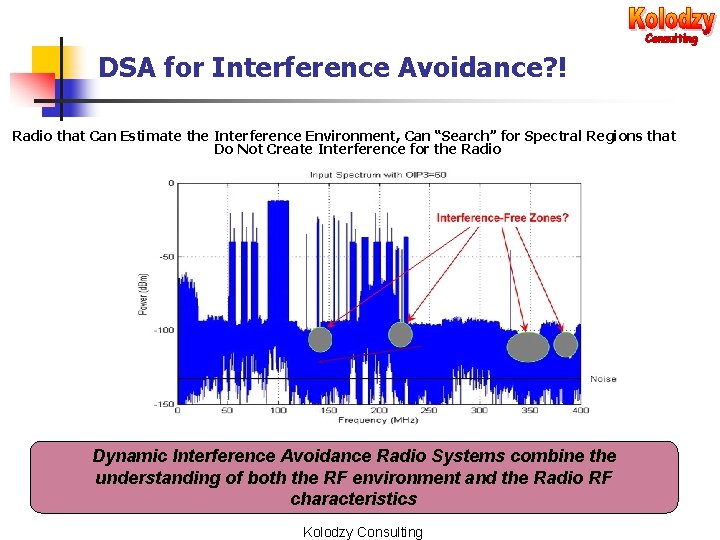
DSA for Interference Avoidance? ! Radio that Can Estimate the Interference Environment, Can “Search” for Spectral Regions that Do Not Create Interference for the Radio Dynamic Interference Avoidance Radio Systems combine the understanding of both the RF environment and the Radio RF characteristics Kolodzy Consulting
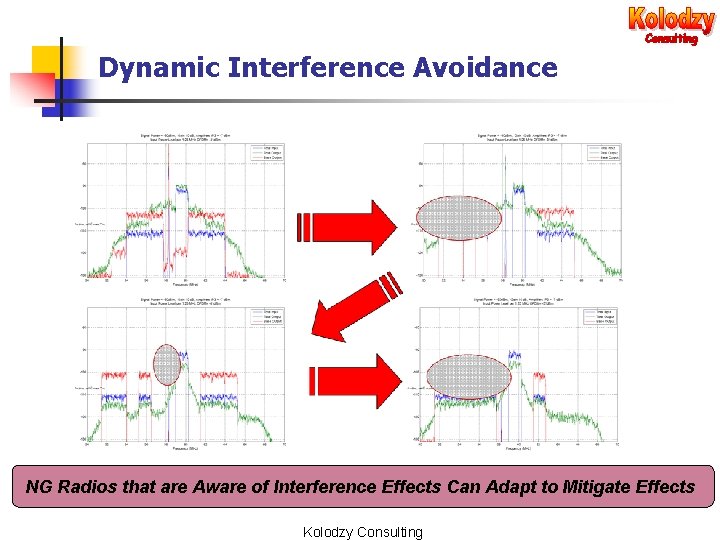
Dynamic Interference Avoidance NG Radios that are Aware of Interference Effects Can Adapt to Mitigate Effects Kolodzy Consulting
New Directions / New Tools n Static, Worst-case Analysis vs Statistical Analysis n n n Spectral and Spatial Filtering Improvement n n n Monte-Carlo Techniques Propagation Models, Component Models Antenna Pattern Shaping for Gain and Interference Avoidance Advanced Filters and Adaptive Modulation Dynamics Become Increasing Important n n n Spectral Sharing for Capacity Spectral Sharing for Interference Avoidance Network Optimization via Radio Operations Kolodzy Consulting
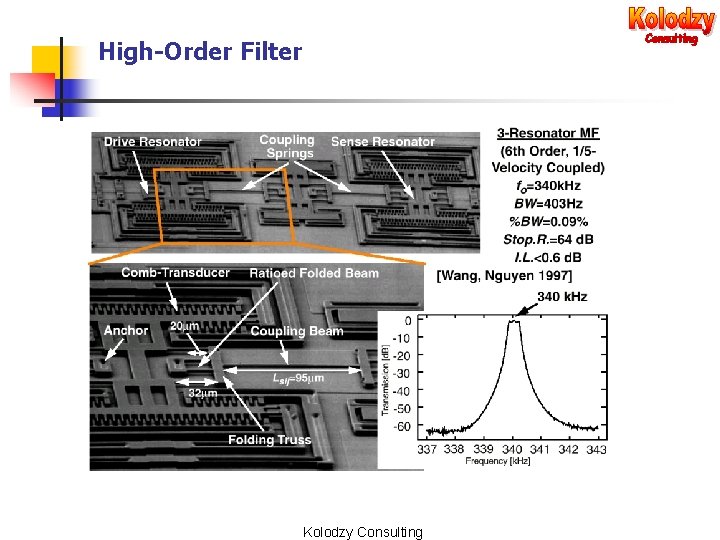
High-Order Filter Kolodzy Consulting
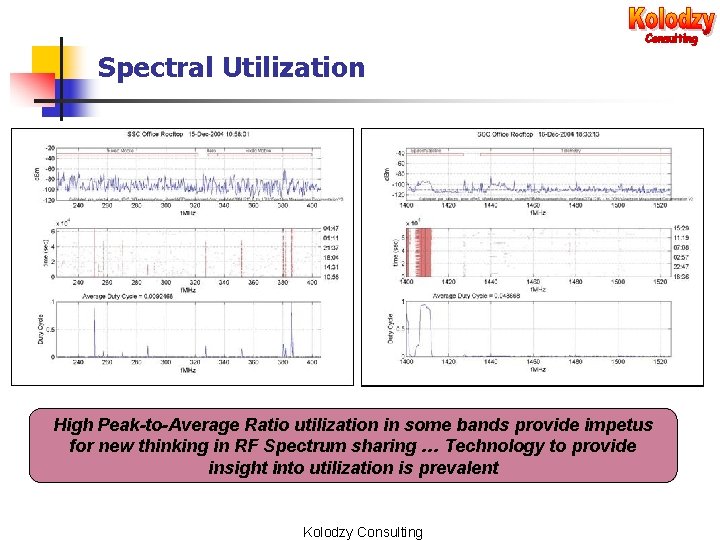
Spectral Utilization High Peak-to-Average Ratio utilization in some bands provide impetus for new thinking in RF Spectrum sharing … Technology to provide insight into utilization is prevalent Kolodzy Consulting
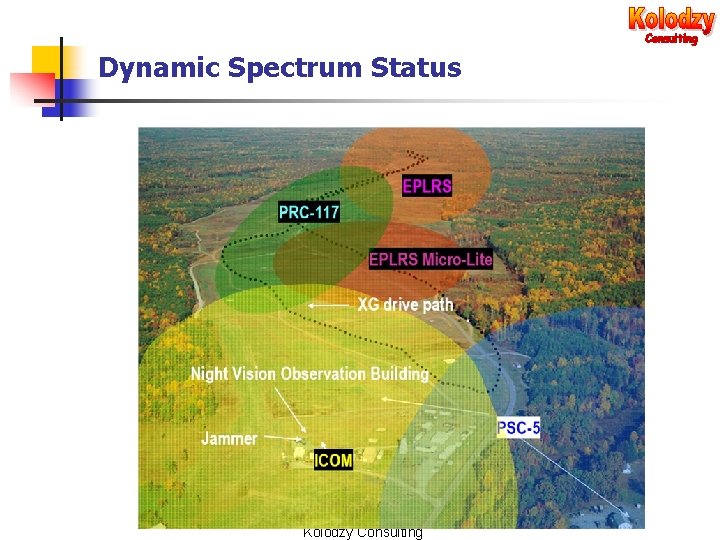
Dynamic Spectrum Status Kolodzy Consulting
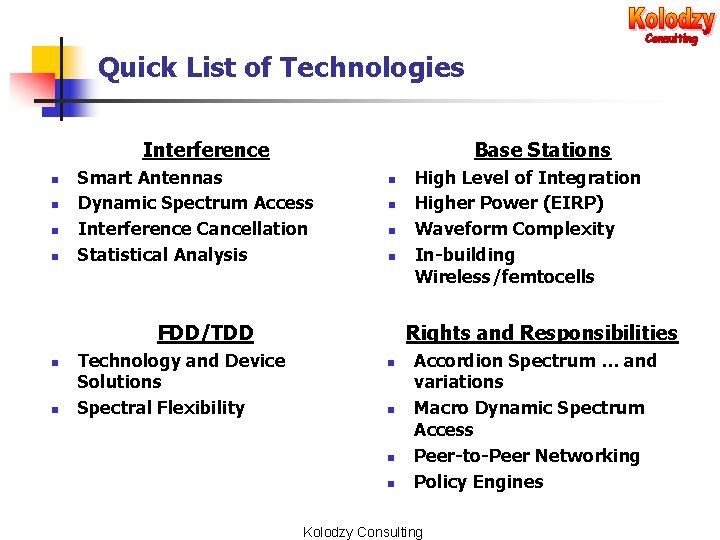
Quick List of Technologies Interference n n Base Stations Smart Antennas Dynamic Spectrum Access Interference Cancellation Statistical Analysis n n FDD/TDD n n Technology and Device Solutions Spectral Flexibility High Level of Integration Higher Power (EIRP) Waveform Complexity In-building Wireless/femtocells Rights and Responsibilities n n Accordion Spectrum … and variations Macro Dynamic Spectrum Access Peer-to-Peer Networking Policy Engines Kolodzy Consulting
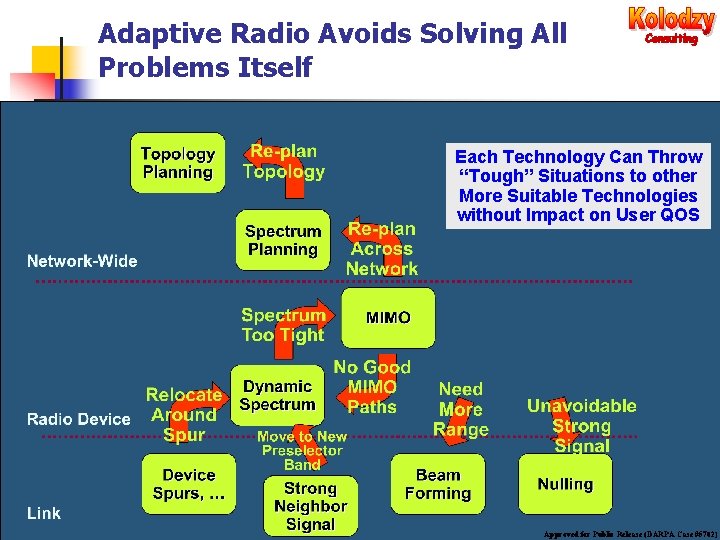
Adaptive Radio Avoids Solving All Problems Itself Each Technology Can Throw “Tough” Situations to other More Suitable Technologies without Impact on User QOS Kolodzy Consulting Approved for Public Release (DARPA Case #5702)
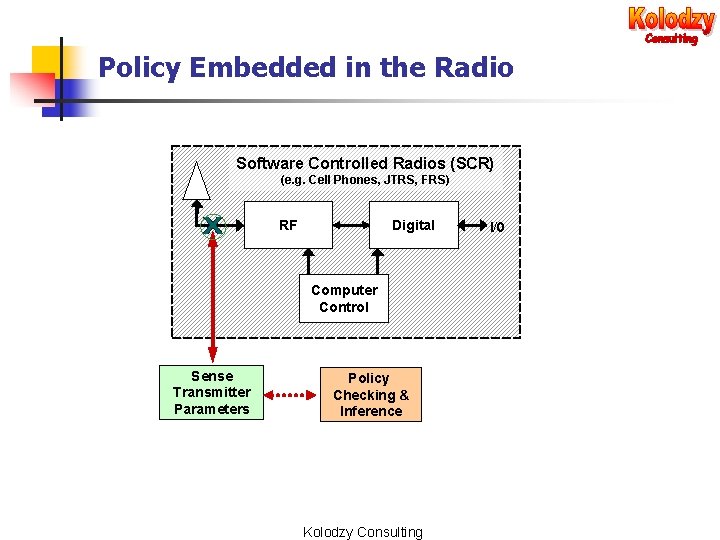
Policy Embedded in the Radio Software Controlled Radios (SCR) (e. g. Cell Phones, JTRS, FRS) RF Digital Computer Control Sense Transmitter Parameters Policy Checking & Inference Kolodzy Consulting I/0
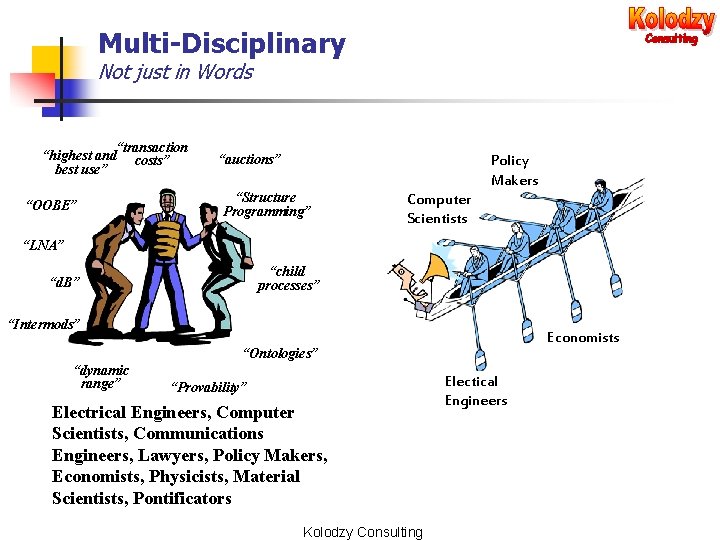
Multi-Disciplinary Not just in Words “transaction “highest and costs” best use” “OOBE” “auctions” Policy Makers “Structure Programming” Computer Scientists “LNA” “child processes” “d. B” “Intermods” Economists “Ontologies” “dynamic range” “Provability” Electrical Engineers, Computer Scientists, Communications Engineers, Lawyers, Policy Makers, Economists, Physicists, Material Scientists, Pontificators Kolodzy Consulting Electical Engineers
Kolodzy Consulting
- Slides: 18