
Spectroscopy The Interaction between Radiation and Matter presented
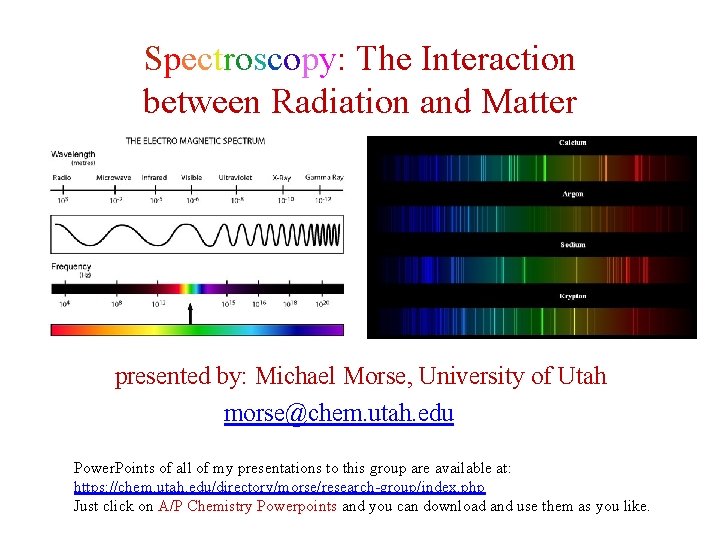
Spectroscopy: The Interaction between Radiation and Matter presented by: Michael Morse, University of Utah morse@chem. utah. edu Power. Points of all of my presentations to this group are available at: https: //chem. utah. edu/directory/morse/research-group/index. php Just click on A/P Chemistry Powerpoints and you can download and use them as you like.
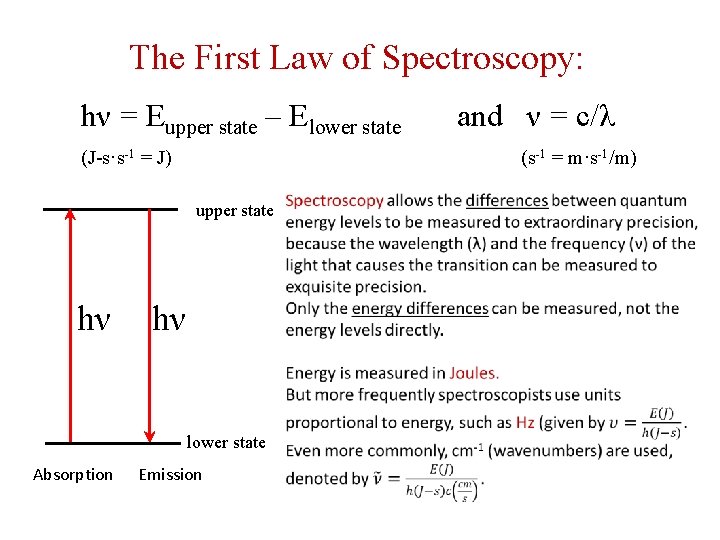
The First Law of Spectroscopy: hν = Eupper state – Elower state (J-s·s-1 = J) (s-1 = m·s-1/m) upper state hν and ν = c/λ hν lower state Absorption Emission
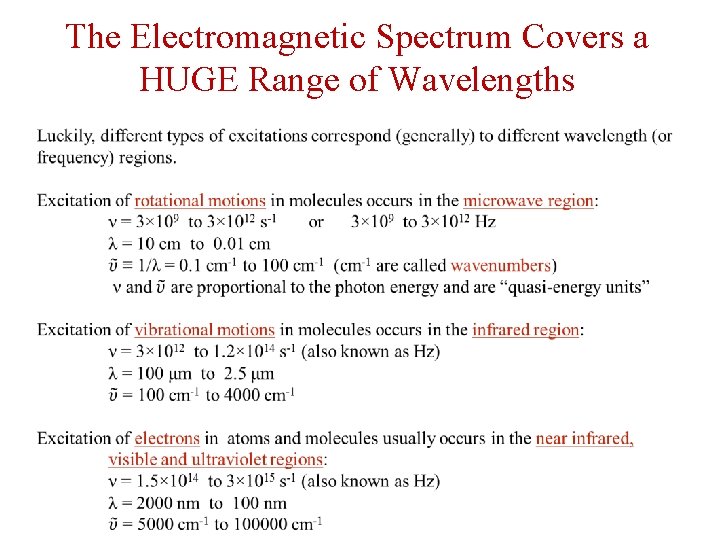
The Electromagnetic Spectrum Covers a HUGE Range of Wavelengths
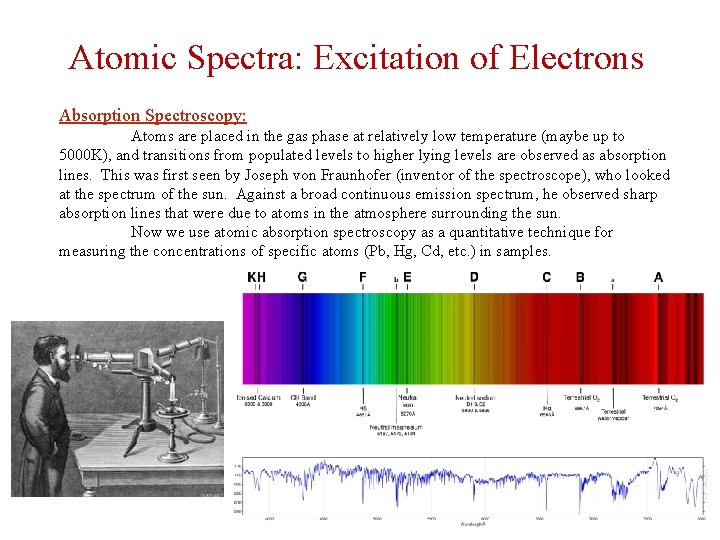
Atomic Spectra: Excitation of Electrons Absorption Spectroscopy: Atoms are placed in the gas phase at relatively low temperature (maybe up to 5000 K), and transitions from populated levels to higher lying levels are observed as absorption lines. This was first seen by Joseph von Fraunhofer (inventor of the spectroscope), who looked at the spectrum of the sun. Against a broad continuous emission spectrum, he observed sharp absorption lines that were due to atoms in the atmosphere surrounding the sun. Now we use atomic absorption spectroscopy as a quantitative technique for measuring the concentrations of specific atoms (Pb, Hg, Cd, etc. ) in samples.
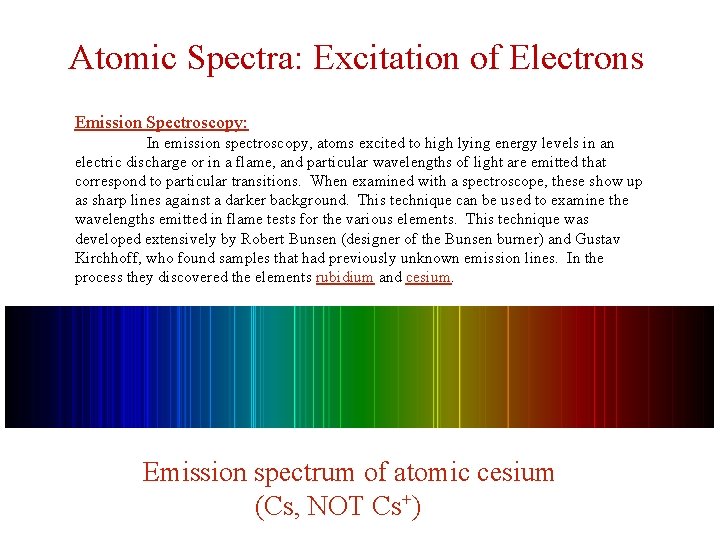
Atomic Spectra: Excitation of Electrons Emission Spectroscopy: In emission spectroscopy, atoms excited to high lying energy levels in an electric discharge or in a flame, and particular wavelengths of light are emitted that correspond to particular transitions. When examined with a spectroscope, these show up as sharp lines against a darker background. This technique can be used to examine the wavelengths emitted in flame tests for the various elements. This technique was developed extensively by Robert Bunsen (designer of the Bunsen burner) and Gustav Kirchhoff, who found samples that had previously unknown emission lines. In the process they discovered the elements rubidium and cesium. Emission spectrum of atomic cesium (Cs, NOT Cs+)

What can we learn from an atomic spectrum? Example: Aluminum atoms have a 1 s 2 2 p 6 3 s 2 3 p 1 configuration, where the spectrum is completely due to excitations of the 3 p electron to higher lying ns or nd orbitals (excitations to other orbitals, like the np or nf orbitals, are forbidden):
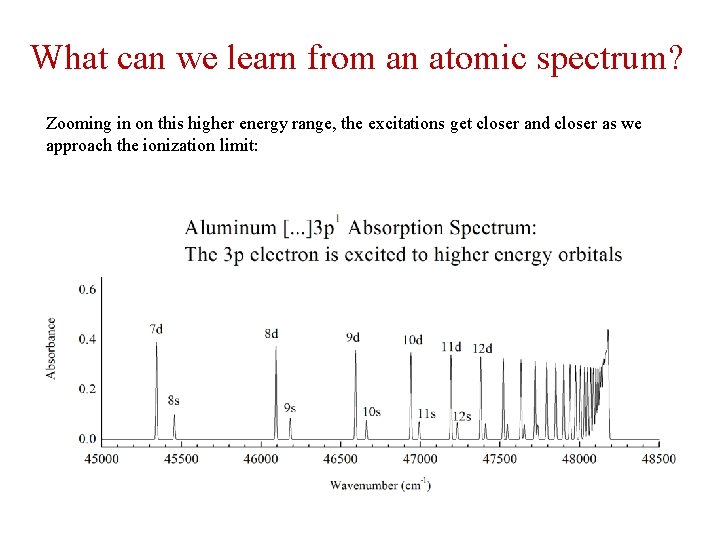
What can we learn from an atomic spectrum? Zooming in on this higher energy range, the excitations get closer and closer as we approach the ionization limit:
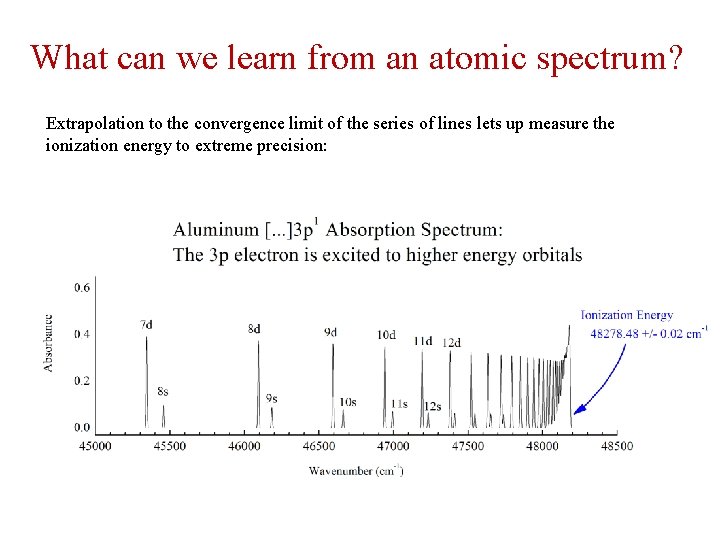
What can we learn from an atomic spectrum? Extrapolation to the convergence limit of the series of lines lets up measure the ionization energy to extreme precision:
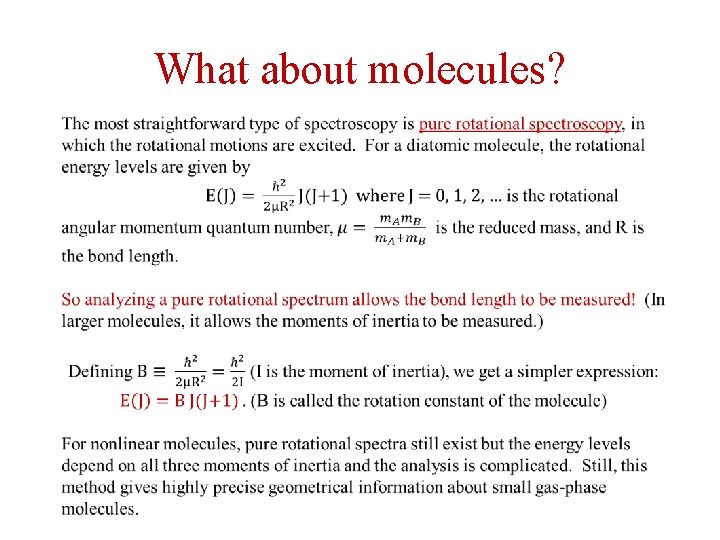
What about molecules?
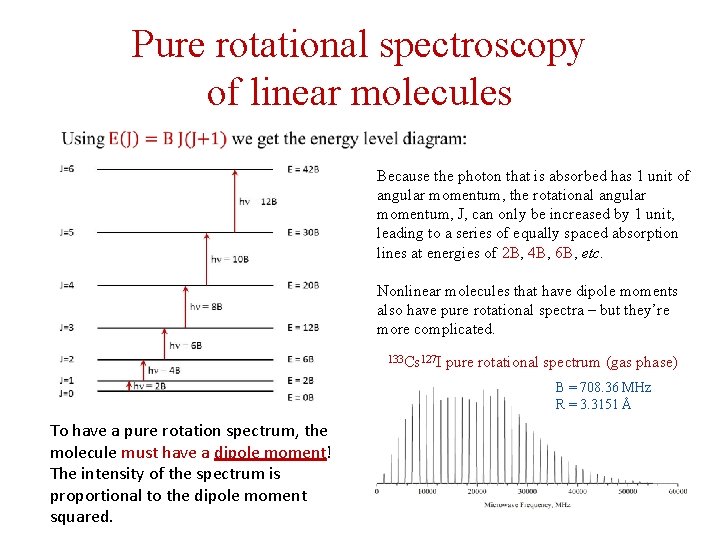
Pure rotational spectroscopy of linear molecules Because the photon that is absorbed has 1 unit of angular momentum, the rotational angular momentum, J, can only be increased by 1 unit, leading to a series of equally spaced absorption lines at energies of 2 B, 4 B, 6 B, etc. Nonlinear molecules that have dipole moments also have pure rotational spectra – but they’re more complicated. 133 Cs 127 I pure rotational spectrum (gas phase) B = 708. 36 MHz R = 3. 3151 Å To have a pure rotation spectrum, the molecule must have a dipole moment! The intensity of the spectrum is proportional to the dipole moment squared.

Pure rotational spectroscopy and astronomy How do we actually know anything about the composition of stars and outer space? One way: Radio Astronomy Rotating molecules in deep space emit radiation when they drop from one rotational state to another. This is in the radio or microwave portion of the spectrum, and can be detected using radio telescopes. Most known interstellar molecules have been detected by this method. Examples: H-C≡C-C≡C-C≡N H-C≡C-C≡C-C≡C-C≡C-C≡N Fe. O, Na. I, Si. C, Si. N, Si. O, Si. S, Ti. O 2 Many more

Where do you use rotational excitations in your everyday life?
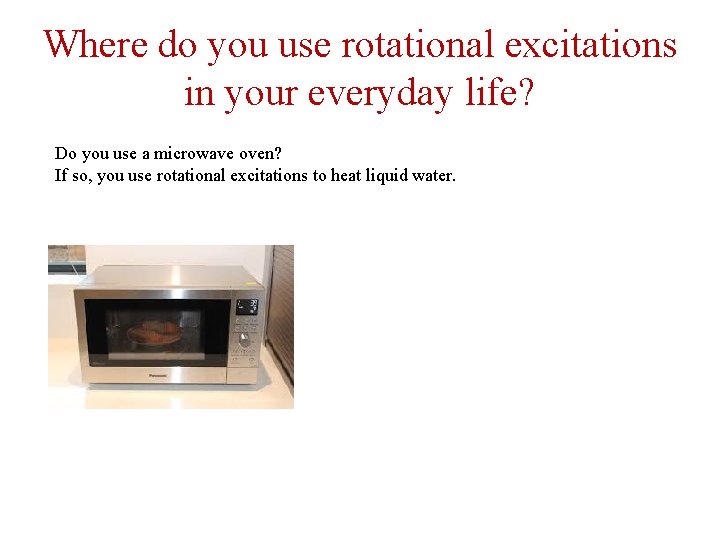
Where do you use rotational excitations in your everyday life? Do you use a microwave oven? If so, you use rotational excitations to heat liquid water.
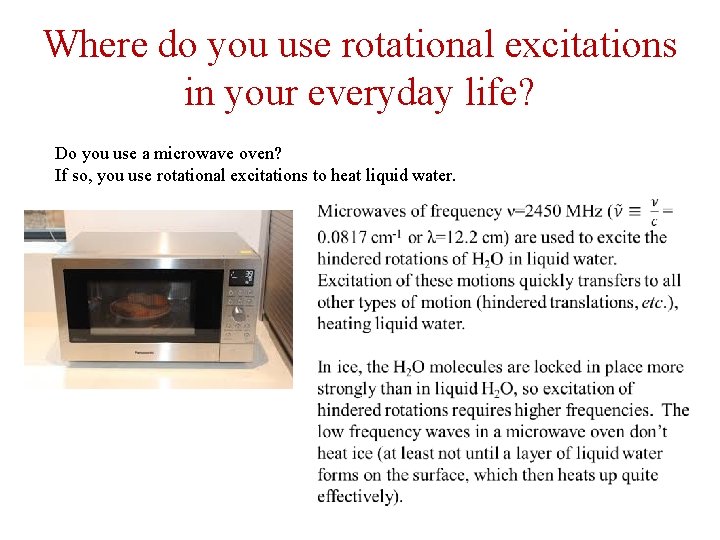
Where do you use rotational excitations in your everyday life? Do you use a microwave oven? If so, you use rotational excitations to heat liquid water.
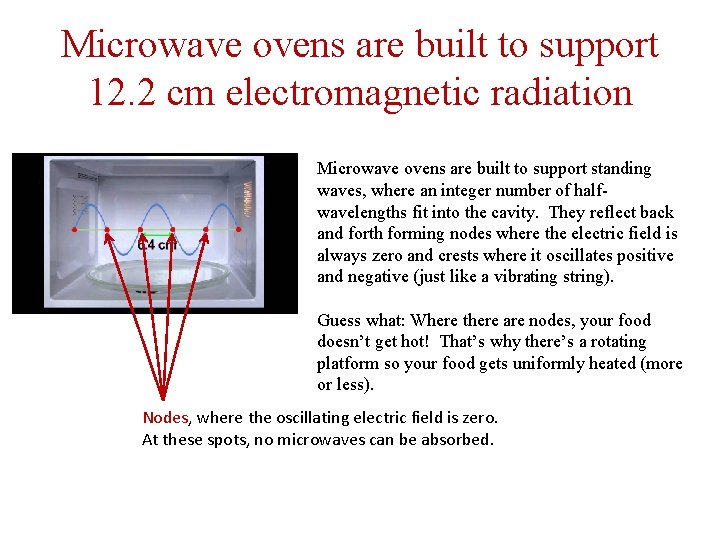
Microwave ovens are built to support 12. 2 cm electromagnetic radiation Microwave ovens are built to support standing waves, where an integer number of halfwavelengths fit into the cavity. They reflect back and forth forming nodes where the electric field is always zero and crests where it oscillates positive and negative (just like a vibrating string). Guess what: Where there are nodes, your food doesn’t get hot! That’s why there’s a rotating platform so your food gets uniformly heated (more or less). Nodes, where the oscillating electric field is zero. At these spots, no microwaves can be absorbed.
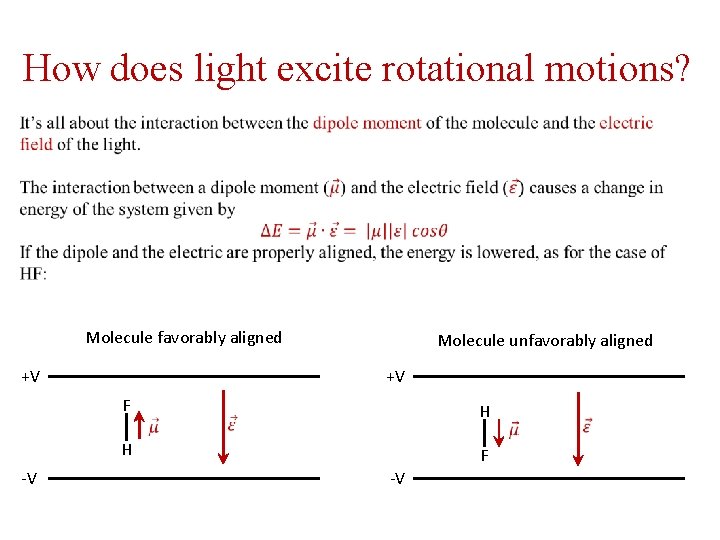
How does light excite rotational motions? Molecule favorably aligned +V Molecule unfavorably aligned +V F H H -V F -V
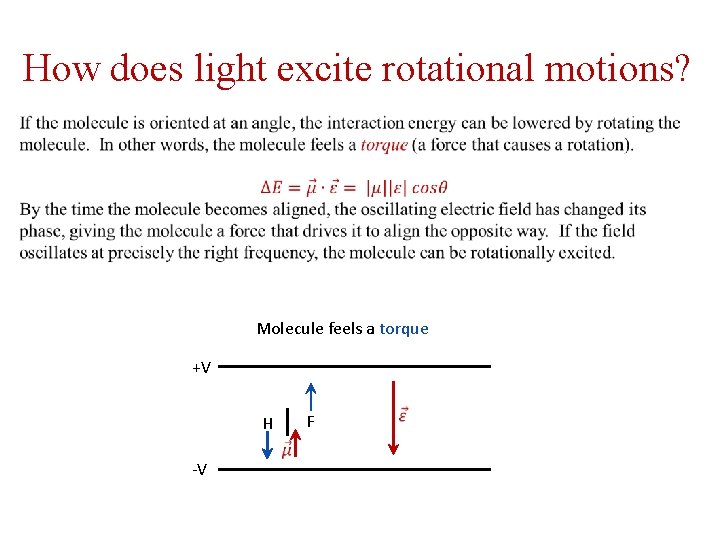
How does light excite rotational motions? Molecule feels a torque +V F H -V
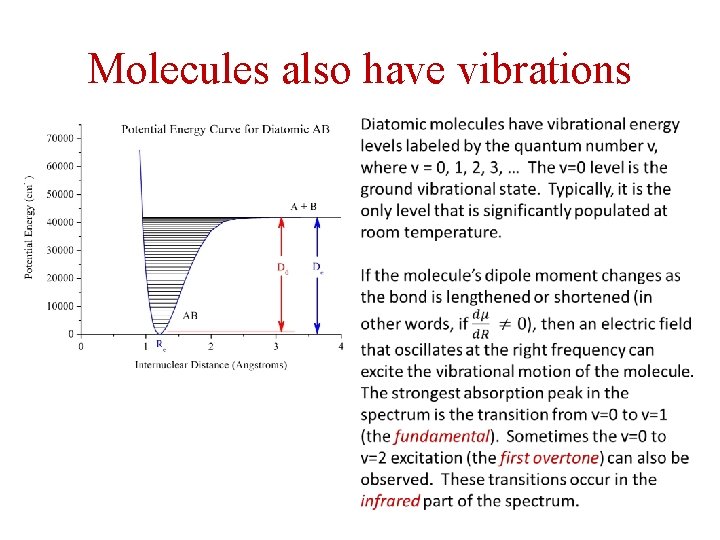
Molecules also have vibrations
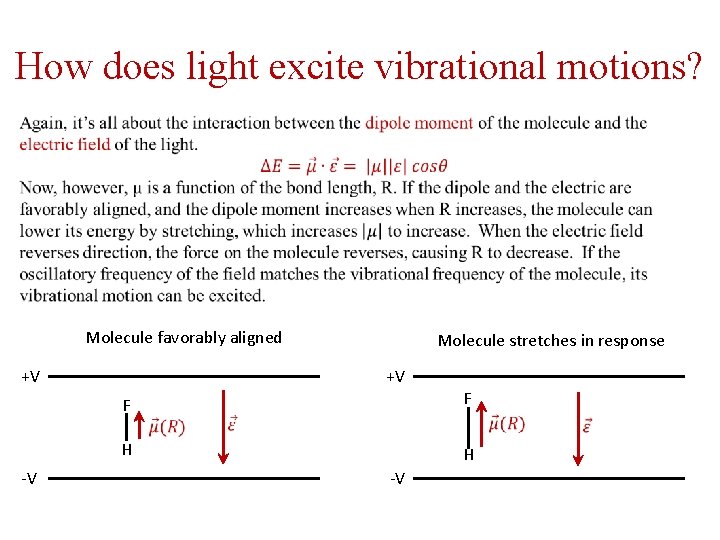
How does light excite vibrational motions? Molecule favorably aligned +V Molecule stretches in response +V F H -V F H -V
Some molecules can’t absorb IR light at all
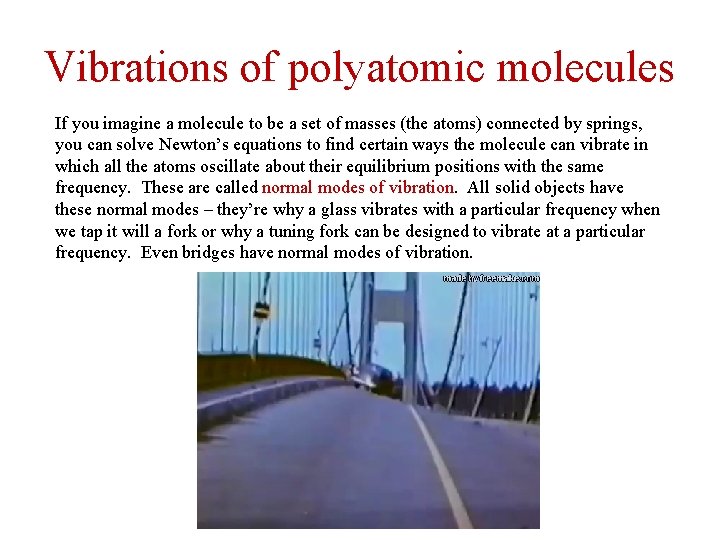
Vibrations of polyatomic molecules If you imagine a molecule to be a set of masses (the atoms) connected by springs, you can solve Newton’s equations to find certain ways the molecule can vibrate in which all the atoms oscillate about their equilibrium positions with the same frequency. These are called normal modes of vibration. All solid objects have these normal modes – they’re why a glass vibrates with a particular frequency when we tap it will a fork or why a tuning fork can be designed to vibrate at a particular frequency. Even bridges have normal modes of vibration.
Polyatomic molecules have many normal modes A useful way to think about a polyatomic molecule with N atoms is this: To specify the location of all N atoms, you need 3 N coordinates: (x 1, y 1, z 1) for atom 1, (x 2, y 2, z 2) for atom 2, etc. These 3 N coordinates can be recombined to give (X, Y, Z) for the location of the center of mass and then 3 N-3 other coordinates are needed to specify the locations of the atoms. Motion along the (X, Y, Z) coordinates gives translation of the molecule in space. If the molecule is linear, 2 angles are needed (θ, φ) to specify the position of the molecular axis. Motion in these coordinates is molecular rotation. That leaves 3 N-5 coordinates to describe the position of the atoms relative to the rotating coordinate system. Movement along these coordinates gives the vibrations of the molecule. If the molecule is nonlinear, 3 angles are needed to specify the orientation of the molecule in space (3 rotational degrees of freedom). This leaves 3 N-6 vibrations. Overall, linear molecules have 3 N-5 different vibrational motions (normal modes); Nonlinear molecules have 3 N-6 different vibrational motions (normal modes). CO 2 has 4 normal modes H-C≡C-H has 7 normal modes C 6 H 6 has 30 normal modes
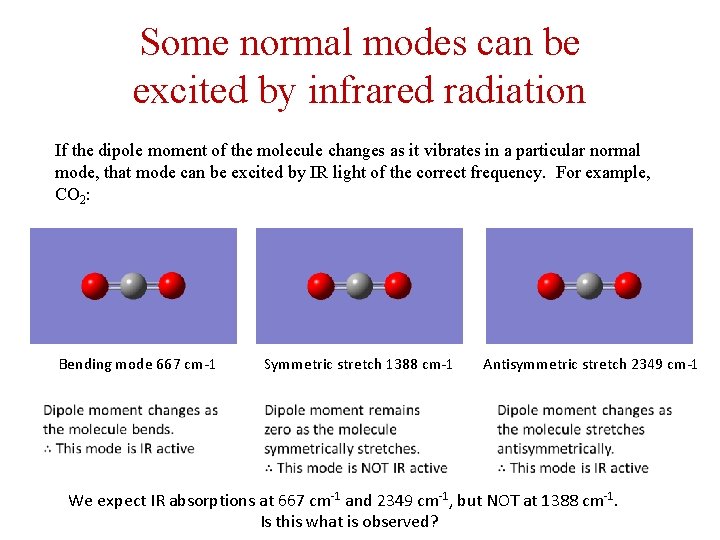
Some normal modes can be excited by infrared radiation If the dipole moment of the molecule changes as it vibrates in a particular normal mode, that mode can be excited by IR light of the correct frequency. For example, CO 2: Bending mode 667 cm-1 Symmetric stretch 1388 cm-1 Antisymmetric stretch 2349 cm-1 We expect IR absorptions at 667 cm-1 and 2349 cm-1, but NOT at 1388 cm-1. Is this what is observed?
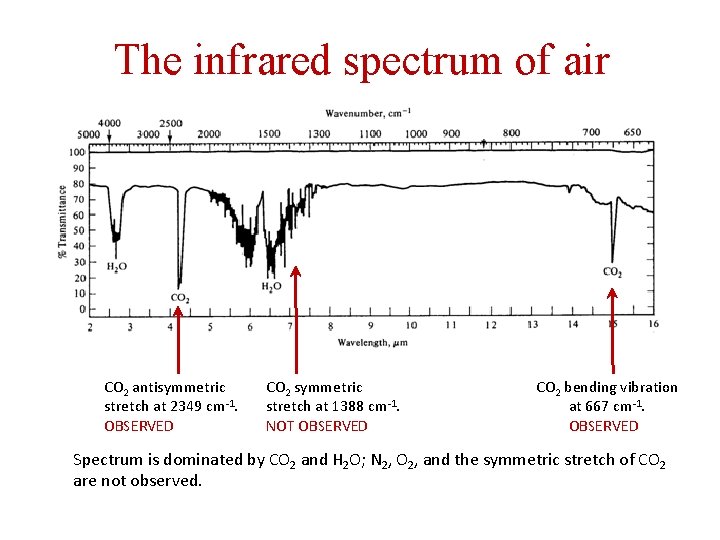
The infrared spectrum of air CO 2 antisymmetric stretch at 2349 cm-1. OBSERVED CO 2 symmetric stretch at 1388 cm-1. NOT OBSERVED CO 2 bending vibration at 667 cm-1. OBSERVED Spectrum is dominated by CO 2 and H 2 O; N 2, O 2, and the symmetric stretch of CO 2 are not observed.
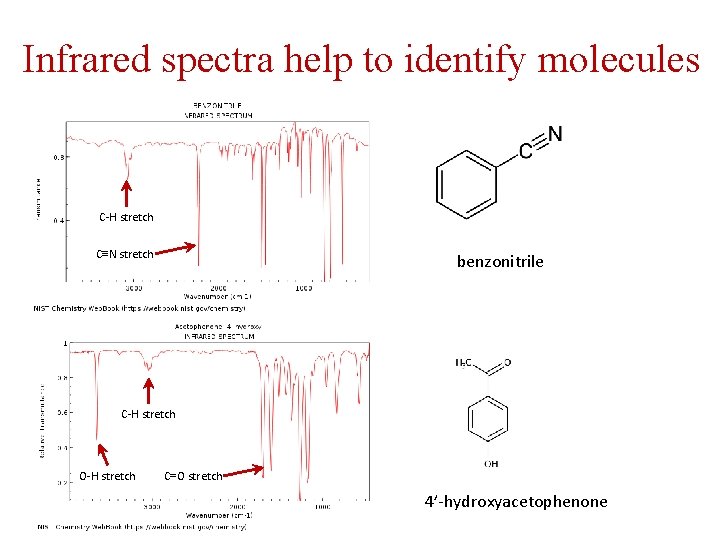
Infrared spectra help to identify molecules C-H stretch C≡N stretch benzonitrile C-H stretch O-H stretch C=O stretch 4’-hydroxyacetophenone
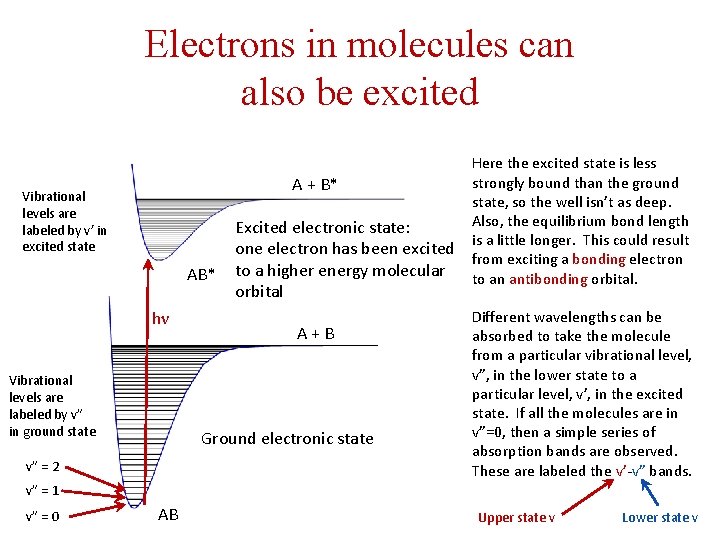
Electrons in molecules can also be excited Vibrational levels are labeled by v’ in excited state AB* hν Vibrational levels are labeled by v” in ground state Here the excited state is less strongly bound than the ground A + B* state, so the well isn’t as deep. Also, the equilibrium bond length Excited electronic state: one electron has been excited is a little longer. This could result from exciting a bonding electron to a higher energy molecular to an antibonding orbital A + B Ground electronic state v” = 2 Different wavelengths can be absorbed to take the molecule from a particular vibrational level, v”, in the lower state to a particular level, v’, in the excited state. If all the molecules are in v”=0, then a simple series of absorption bands are observed. These are labeled the v’-v” bands. v” = 1 v” = 0 AB Upper state v Lower state v
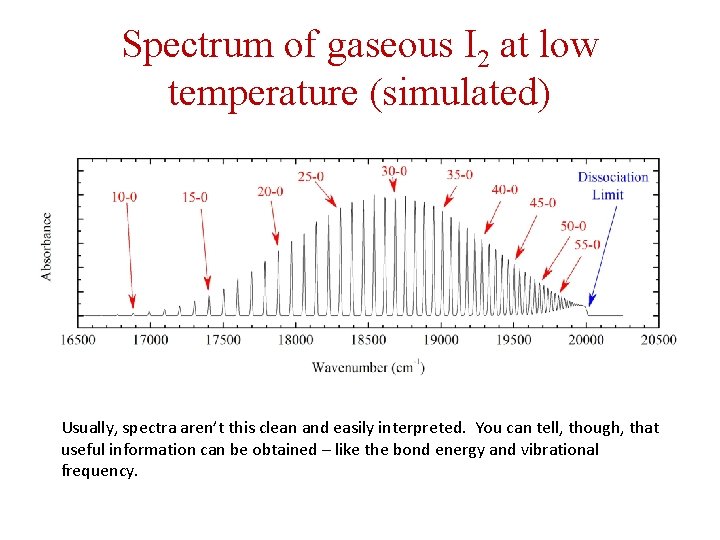
Spectrum of gaseous I 2 at low temperature (simulated) Usually, spectra aren’t this clean and easily interpreted. You can tell, though, that useful information can be obtained – like the bond energy and vibrational frequency.
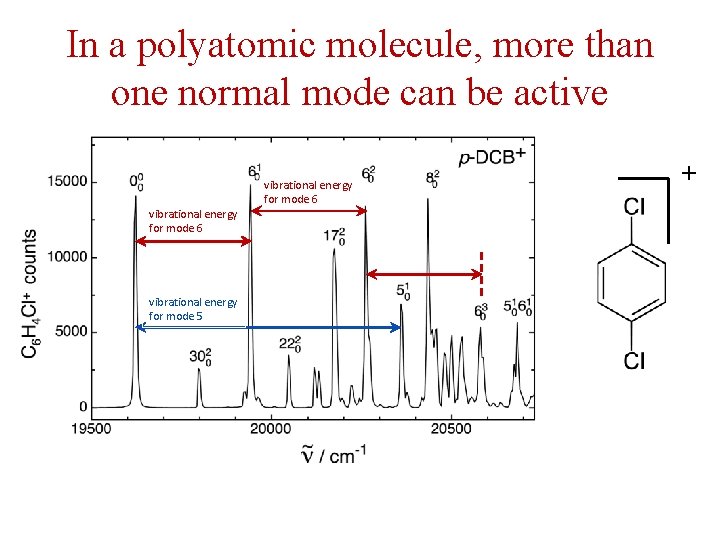
In a polyatomic molecule, more than one normal mode can be active vibrational energy for mode 6 vibrational energy for mode 5 vibrational energy for mode 6 +
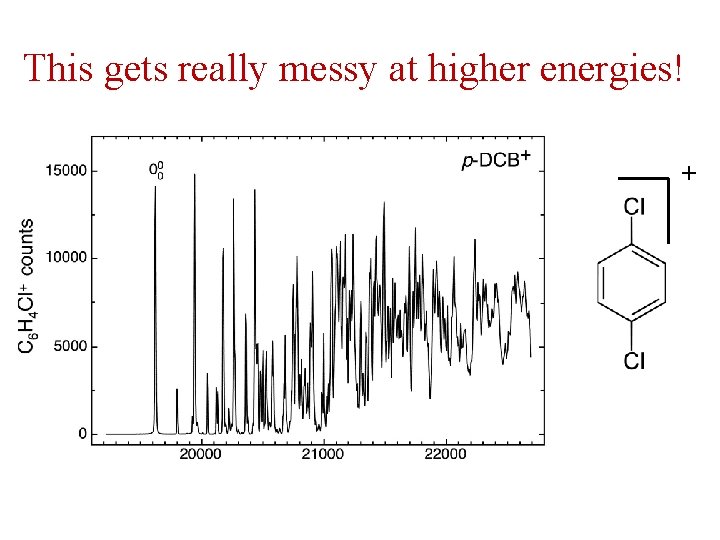
This gets really messy at higher energies! +
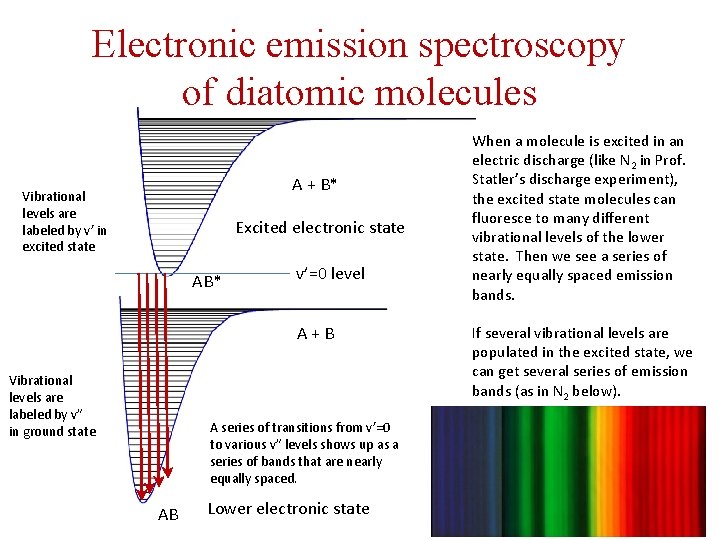
Electronic emission spectroscopy of diatomic molecules A + B* Vibrational levels are labeled by v’ in excited state Excited electronic state AB* v’=0 level A + B Vibrational levels are labeled by v” in ground state A series of transitions from v’=0 to various v” levels shows up as a series of bands that are nearly equally spaced. AB Lower electronic state When a molecule is excited in an electric discharge (like N 2 in Prof. Statler’s discharge experiment), the excited state molecules can fluoresce to many different vibrational levels of the lower state. Then we see a series of nearly equally spaced emission bands. If several vibrational levels are populated in the excited state, we can get several series of emission bands (as in N 2 below).
Thanks for listening! Anytime you’d like to ask me a question: morse@chem. utah. edu This and all previous presentations can be found at my website: https: //chem. utah. edu/directory/morse/research-group/ap_chemistry_powerpoints. php
- Slides: 31