
Spectroscopy Results from Belle Soo Kyung Choi Gyeongsang
Spectroscopy Results from Belle Soo. Kyung Choi Gyeongsang National University Spectroscopy session : Heavy Quarks & Leptons 2010 Oct 11 Laboratori Nazionali di Frascati
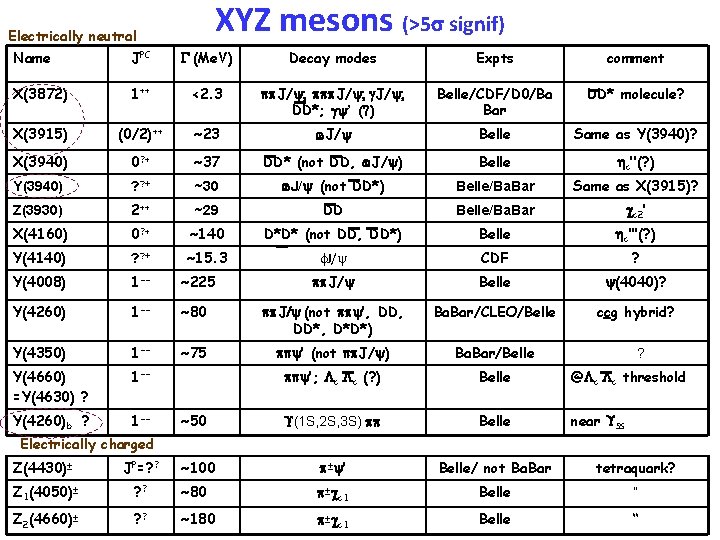
XYZ mesons (>5 s signif) Electrically neutral Name JPC G (Me. V) Decay modes Expts comment X(3872) 1++ <2. 3 pp. J/y; ppp. J/y; g. J/y; DD*; gy’ (? ) Belle/CDF/D 0/Ba Bar DD* molecule? X(3915) (0/2)++ ~23 w. J/y Belle Same as Y(3940)? X(3940) 0? + ~37 DD* (not DD, w. J/y) Belle hc’’(? ) Y(3940) ? ? + ~30 w. J/y (not DD*) Belle/Ba. Bar Same as X(3915)? Z(3930) 2++ ~29 DD Belle/Ba. Bar cc 2’ X(4160) 0? + ~140 D*D* (not DD, DD*) Belle hc’’’(? ) Y(4140) ? ? + ~15. 3 J/ CDF ? Y(4008) 1 -- ~225 pp. J/y Belle y(4040)? Y(4260) 1 -- ~80 pp. J/y (not ppy’, DD*, D*D*) Ba. Bar/CLEO/Belle ccg hybrid? Y(4350) 1 -- ~75 ppy’ (not pp. J/y) Ba. Bar/Belle Y(4660) =Y(4630) ? 1 -- ppy’; Lc Lc (? ) Belle @Lc Lc threshold Y(4260)b ? 1 -- (1 S, 2 S, 3 S) pp Belle near 5 S ~100 p±y’ Belle/ not Ba. Bar tetraquark? ~50 ? Electrically charged Z(4430)± JP=? ? Z 1(4050)± ? ? ~80 p±cc 1 Belle “ Z 2(4660)± ? ? ~180 p±cc 1 Belle “
The X(3872)

The X(3872) in B K p+p-J/y discovered by Belle (140/fb) y’ p+p-J/y X(3872) p+p-J/y M(pp. J/y) – M(J/y) S. K. Choi , S. L. Olsen et al PRL 91, 262001 seen in 4 experiments
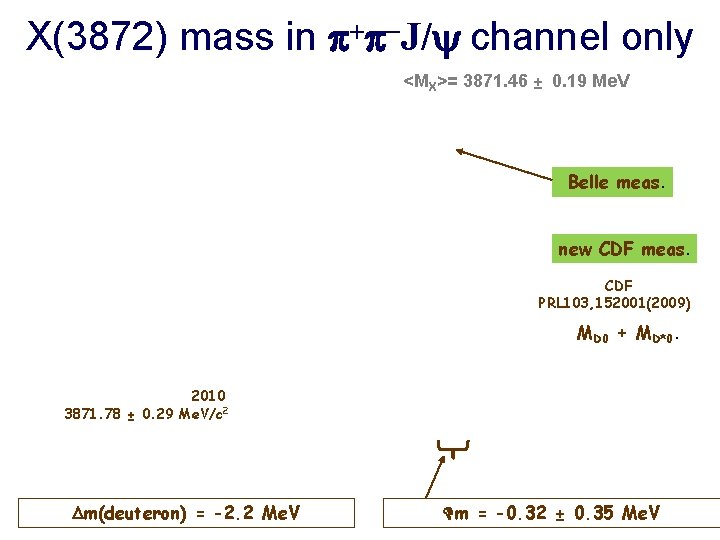
X(3872) mass in p+p-J/y channel only <MX>= 3871. 46 ± 0. 19 Me. V Belle meas. new CDF meas. CDF PRL 103, 152001(2009) MD 0 + MD*0. 2010 3871. 78 ± 0. 29 Me. V/c 2 Dm(deuteron) = -2. 2 Me. V m = -0. 32 ± 0. 35 Me. V
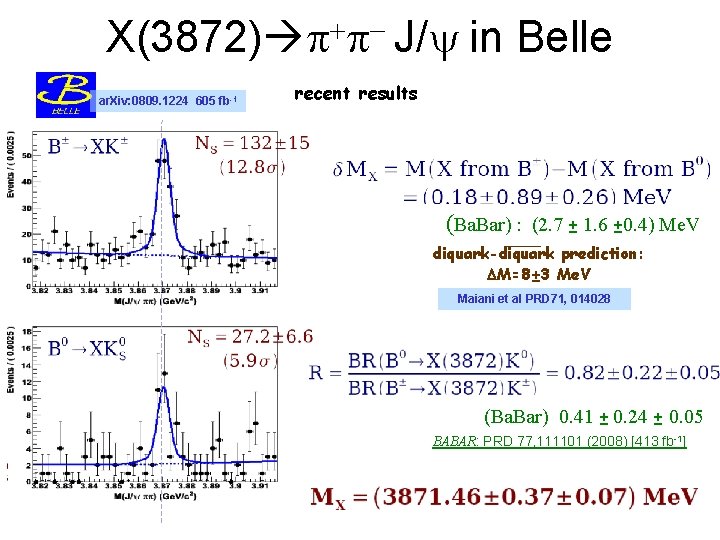
+ X(3872) p p J/ ar. Xiv: 0809. 1224 605 fb-1 in Belle recent results (Ba. Bar) : (2. 7 ± 1. 6 ± 0. 4) Me. V diquark-diquark prediction: DM=8± 3 Me. V Maiani et al PRD 71, 014028 (Ba. Bar) 0. 41 ± 0. 24 ± 0. 05 BABAR: PRD 77, 111101 (2008) [413 fb-1]
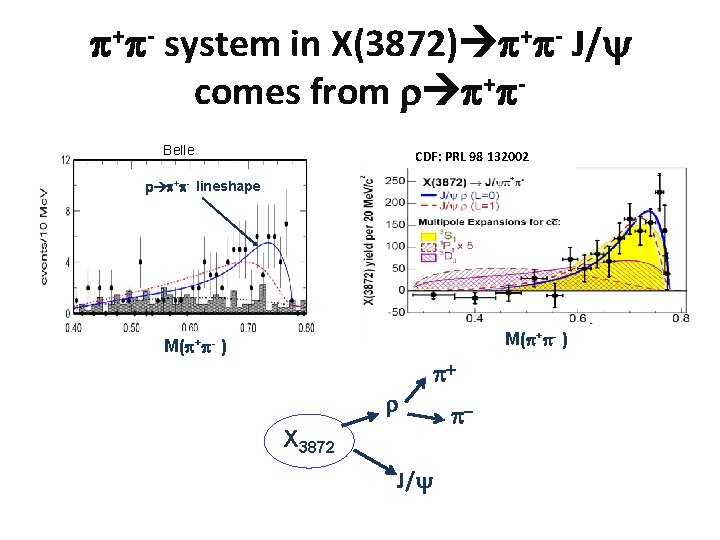
p+p- system in X(3872) p+p- J/y comes from r p+p. Belle CDF: PRL 98 132002 r p+p- lineshape M(p+p- ) ) p+ r X 3872 J/y p-

JPC of the X(3872) Angular distributions for B KX(3872) Kr. J/y Partial Wave basis: 775 Me. V X(3872) r J/y is right at threshold neglect higher partial waves 3872 Me. V 3097 Me. V 1++: L: S: 2 -+: S-Wave 1 D-wave 1, 2 L: S: P-Wave 1, 2 F-wave 1, 2 Only 1 amplitude: BLS=B 01 2 amplitudes: BLS=B 11 & B 12 1 free parameter: 3 free parameters normalization complex
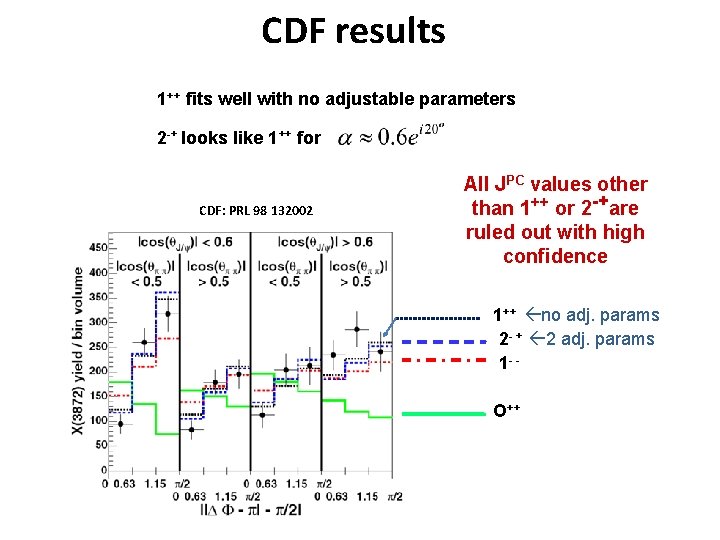
CDF results 1++ fits well with no adjustable parameters 2 -+ looks like 1++ for CDF: PRL 98 132002 All JPC values other than 1++ or 2 -+are ruled out with high confidence 1++ no adj. params 2 - + 2 adj. params 1 - O++
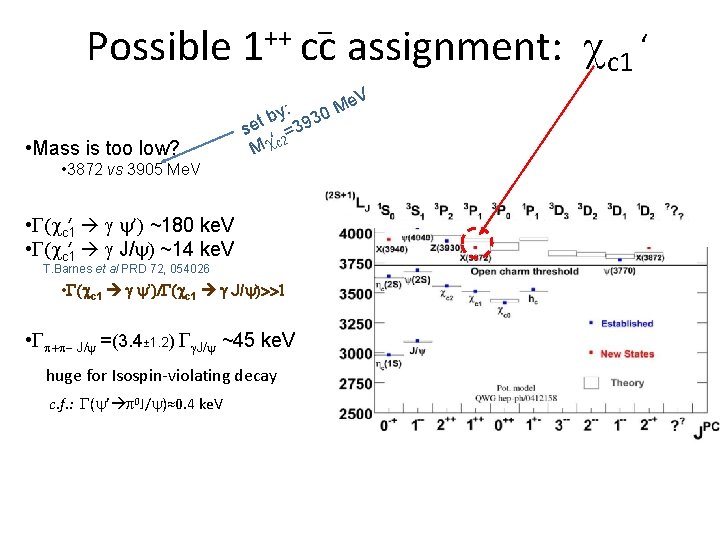
_ Possible 1++ cc assignment: cc 1 ‘ V • Mass is too low? e M : y b 30 set =39 ‘ 2 Mc c • 3872 vs 3905 Me. V • G(cc 1‘ g ’) ~180 ke. V • G(cc 1‘ g J/ ) ~14 ke. V T. Barnes et al PRD 72, 054026 • G(cc 1 g y’)/G(cc 1 g J/y)>>1 • Gp+p- J/ =(3. 4± 1. 2) Gg. J/ ~45 ke. V huge for Isospin-violating decay c. f. : G( ’ p 0 J/ )≈0. 4 ke. V
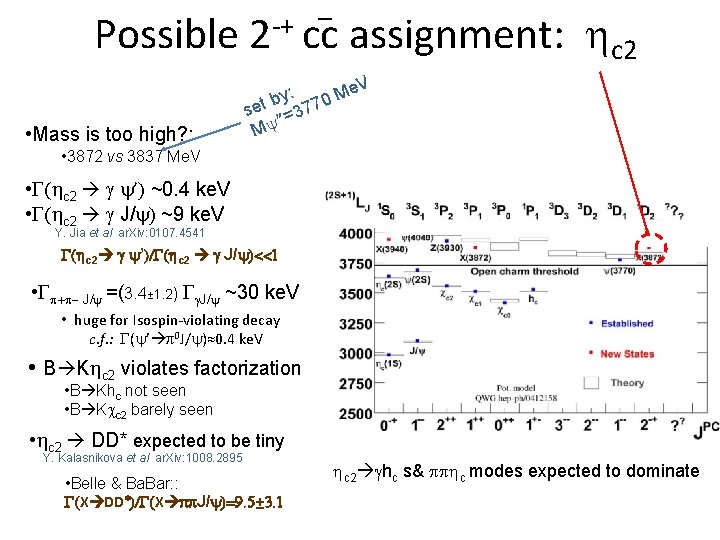
_ Possible 2 -+ cc assignment: hc 2 V • Mass is too high? : e : M y b 0 set ”=377 M • 3872 vs 3837 Me. V • G(hc 2 g ’) ~0. 4 ke. V • G(hc 2 g J/ ) ~9 ke. V Y. Jia et al ar. Xiv: 0107. 4541 G(hc 2 g y’)/G(hc 2 g J/y)<<1 • Gp+p- J/ =(3. 4± 1. 2) Gg. J/ ~30 ke. V • huge for Isospin-violating decay c. f. : G( ’ p 0 J/ )≈0. 4 ke. V • B Khc 2 violates factorization • B Khc not seen • B Kcc 2 barely seen • hc 2 DD* expected to be tiny Y. Kalasnikova et al ar. Xiv: 1008. 2895 • Belle & Ba. Bar: : G(X DD*)/G(X pp. J/y)=9. 5± 3. 1 hc 2 ghc s& pphc modes expected to dominate
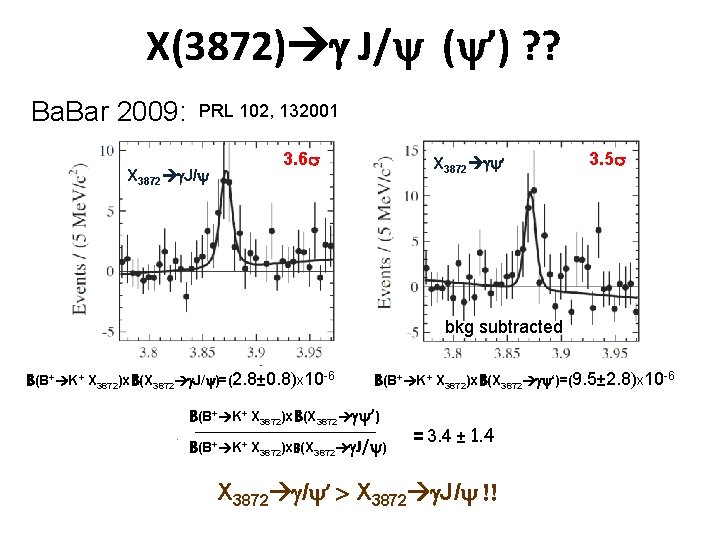
X(3872) g J/y (y’) ? ? Ba. Bar 2009: PRL 102, 132001 X 3872 g. J/y 3. 6 s X 3872 gy’ 3. 5 s bkg subtracted B(B+ K+ X 3872)x. B(X 3872 g. J/y)=(2. 8± 0. 8)x 10 -6 B(B+ K+ X 3872)x. B(X 3872 gy‘)=(9. 5± 2. 8)x 10 -6 B(B+ K+ X 3872)x. B(X 3872 gy’) B(B+ K+ X 3872)x. B(X 3872 g. J/y) = 3. 4 ± 1. 4 X 3872 g/y’ > X 3872 g. J/y !!
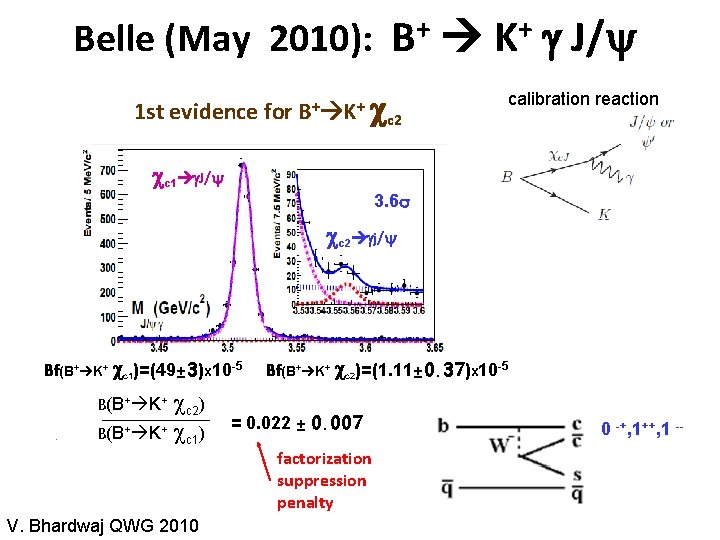
Belle (May 2010): B+ K+ g J/y 1 st evidence for B+ K+ cc 2 calibration reaction cc 1 g. J/y 3. 6 s cc 2 gj/y Bf(B+ K+ cc 1)=(49± 3)x 10 -5 B(B+ K+ cc 2) B(B+ K+ cc 1) Bf(B+ K+ cc 2)=(1. 11± 0. 37)x 10 -5 = 0. 022 ± 0. 007 factorization suppression penalty V. Bhardwaj QWG 2010 0 -+, 1++, 1 --
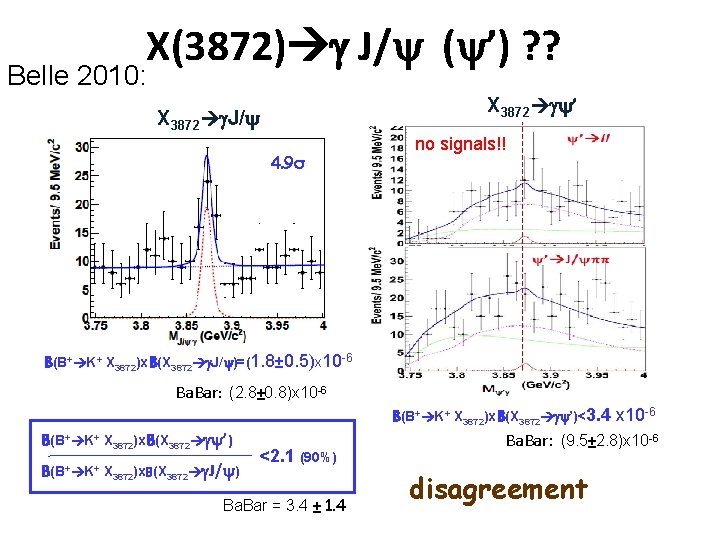
X(3872) g J/y (y’) ? ? Belle 2010: X 3872 gy’ X 3872 g. J/y 4. 9 s no signals!! B(B+ K+ X 3872)x. B(X 3872 g. J/y)=(1. 8± 0. 5)x 10 -6 Ba. Bar: (2. 8± 0. 8)x 10 -6 B(B+ K+ X 3872)x. B(X 3872 gy’) B (B+ K+ X 3872)x. B(X 3872 g. J/y) <2. 1 (90%) Ba. Bar = 3. 4 ± 1. 4 B(B+ K+ X 3872)x. B(X 3872 gy’)<3. 4 x 10 -6 Ba. Bar: (9. 5± 2. 8)x 10 -6 disagreement
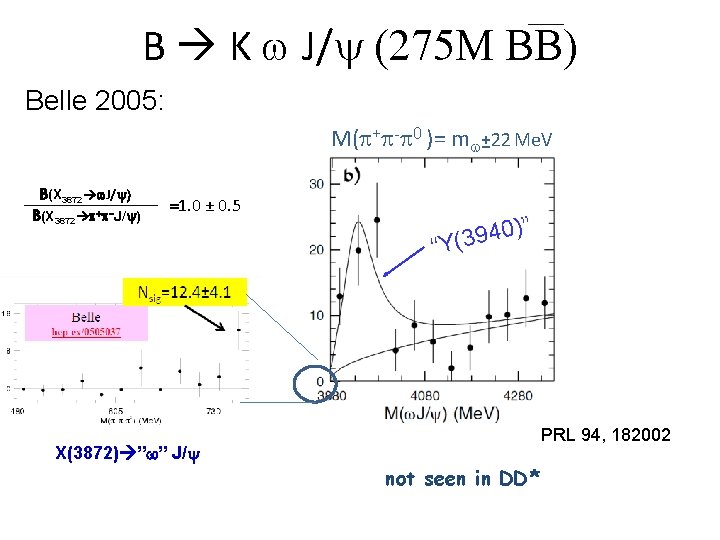
B K w J/ (275 M BB) Belle 2005: M(p+p-p 0 )= mw± 22 Me. V B(X 3872 w. J/y) B(X 3872 p+p-J/y) =1. 0 ± 0. 5 X(3872) ”w” J/y )” 0 4 9 3 ( “Y PRL 94, 182002 not seen in DD*
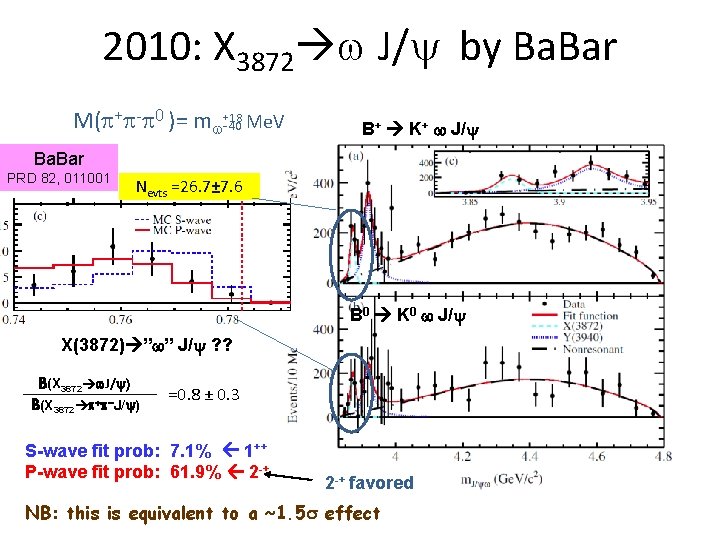
2010: X 3872 w J/ by Ba. Bar M(p+p-p 0 )= mw+18 -40 Me. V B+ K+ w J/y Ba. Bar PRD 82, 011001 Nevts =26. 7± 7. 6 B 0 K 0 w J/y X(3872) ”w” J/y ? ? B(X 3872 w. J/y) B(X 3872 p+p-J/y) =0. 8 ± 0. 3 S-wave fit prob: 7. 1% 1++ P-wave fit prob: 61. 9% 2 -+ favored NB: this is equivalent to a ~1. 5 s effect
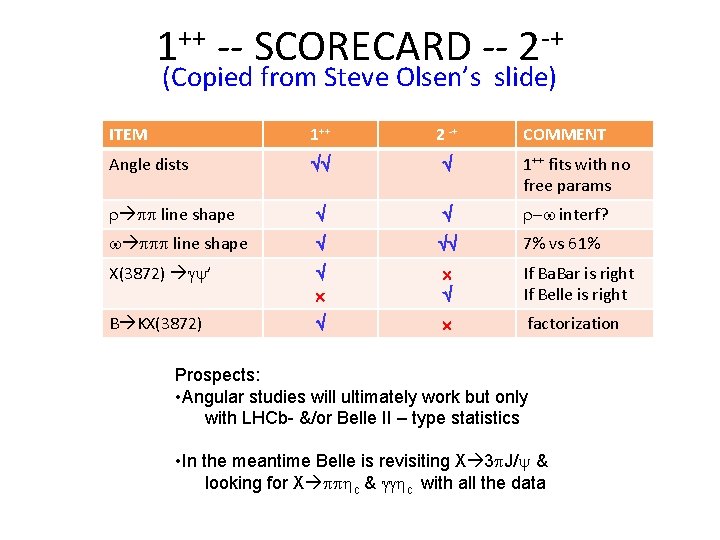
++ -+ 1 -- SCORECARD -- 2 (Copied from Steve Olsen’s slide) ITEM 1++ 2 -+ COMMENT Angle dists 1++ fits with no free params r pp line shape r-w interf? w ppp line shape 7% vs 61% X(3872) g ’ If Ba. Bar is right If Belle is right B KX(3872) factorization Prospects: • Angular studies will ultimately work but only with LHCb- &/or Belle II – type statistics • In the meantime Belle is revisiting X 3 p. J/ & looking for X pphc & gghc with all the data
The X(3915) The Y(3940)
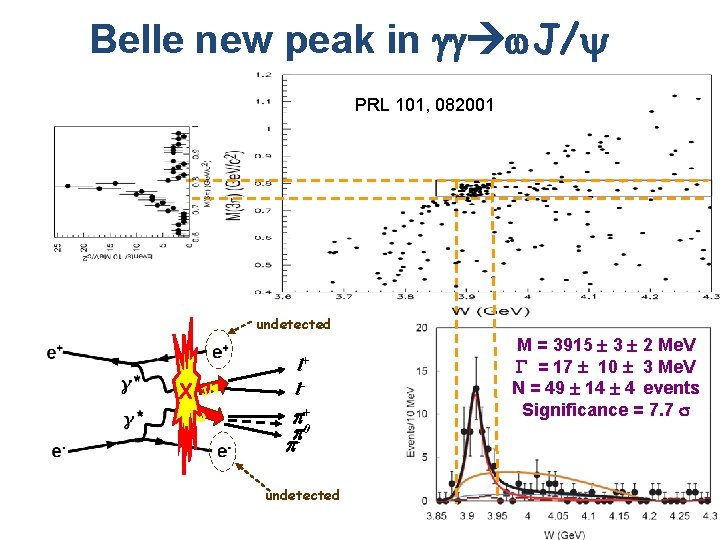
Belle new peak in gg w. J/y PRL 101, 082001 undetected X J/y w l+ l- p 0+ p pundetected M = 3915 3 2 Me. V G = 17 10 3 Me. V N = 49 14 4 events Significance = 7. 7 s
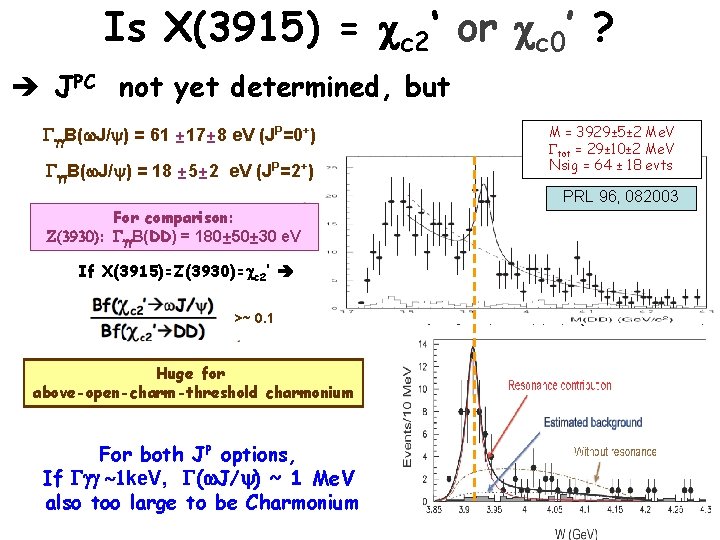
Is X(3915) = cc 2‘ or cc 0’ ? JPC not yet determined, but Ggg. B(w. J/y) = 61 ± 17± 8 e. V (JP=0+) Ggg. B(w. J/y) = 18 ± 5± 2 e. V (JP=2+) For comparison: Z(3930): Ggg. B(DD) = 180± 50± 30 e. V If X(3915)=Z(3930)=cc 2’ >~ 0. 1 Huge for above-open-charm-threshold charmonium For both JP options, If Ggg ~1 ke. V, G(w. J/y) ~ 1 Me. V also too large to be Charmonium M = 3929± 5± 2 Me. V Gtot = 29± 10± 2 Me. V Nsig = 64 ± 18 evts PRL 96, 082003
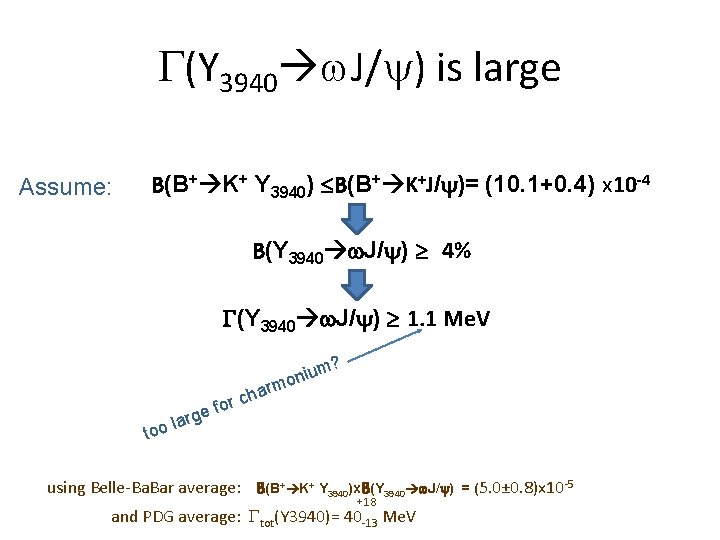
G(Y 3940 w. J/ ) is large Assume: B(B+ K+ Y 3940) B(B+ K+J/y)= (10. 1+0. 4) x 10 -4 B(Y 3940 w. J/y) 4% G(Y 3940 w. J/y) 1. 1 Me. V too e larg f ium n o m ? r ha c r o using Belle-Ba. Bar average: B(B+ K+ Y 3940)x. B(Y 3940 w. J/y) +18 and PDG average: Gtot(Y 3940)= 40 -13 Me. V = (5. 0± 0. 8)x 10 -5

Is there a b-sector counterpart to the Y(4260)?
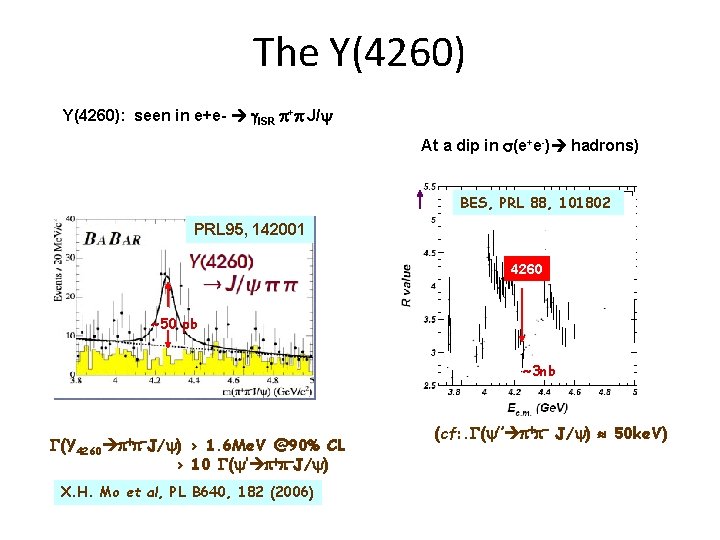
The Y(4260): seen in e+e- g. ISR p+p-J/y At a dip in s(e+e-) hadrons) BES, PRL 88, 101802 PRL 95, 142001 4260 ~50 pb ~3 nb G(Y 4260 p+p-J/y) > 1. 6 Me. V @90% CL > 10 G(y’ p+p-J/y) X. H. Mo et al, PL B 640, 182 (2006) (cf: . G(y” p+p- J/y) 50 ke. V)
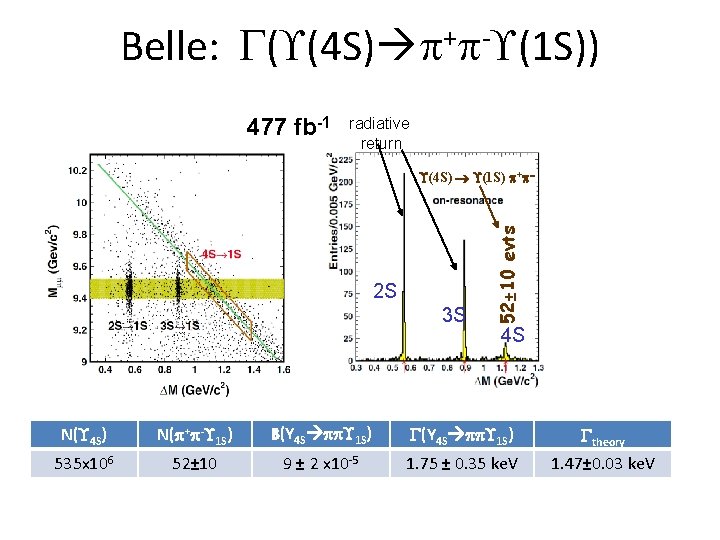
Belle: G( (4 S) p+p- (1 S)) 477 fb-1 radiative return 2 S 3 S 52± 10 evts (4 S) (1 S) p+p- 4 S N( 4 S) N(p+p- 1 S) B(Y 4 S pp 1 S) Gtheory 535 x 106 52± 10 9 ± 2 x 10 -5 1. 75 ± 0. 35 ke. V 1. 47± 0. 03 ke. V

325± 20 evts! Belle: G( 5 S p+p- 1 S) 1/20 th the data: 477 fb-1 23. 6 fb-1 1/5 th the cross-section But >6 times as many events K. F. Chen et al (Belle) PRL 100, 112001 (2008)
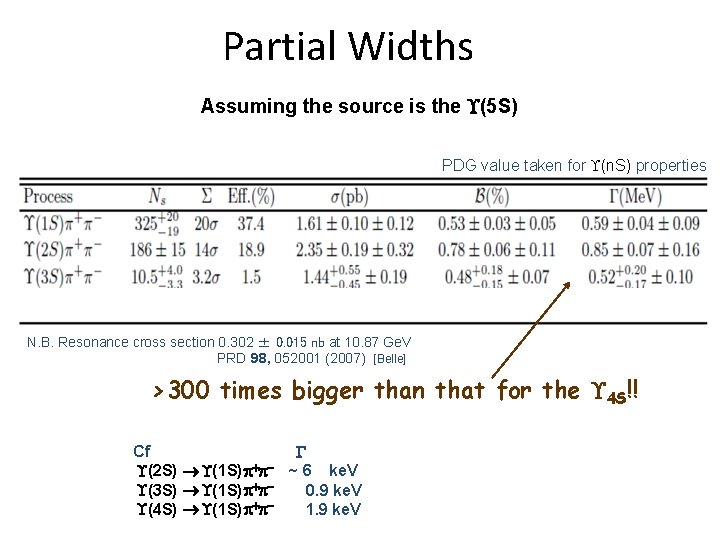
Partial Widths Assuming the source is the (5 S) PDG value taken for (n. S) properties N. B. Resonance cross section 0. 302 ± 0. 015 nb at 10. 87 Ge. V PRD 98, 052001 (2007) [Belle] >300 times bigger than that for the 4 S!! Cf G + (2 S) (1 S) p p ~ 6 ke. V (3 S) (1 S) p+p 0. 9 ke. V (4 S) (1 S) p+p 1. 9 ke. V
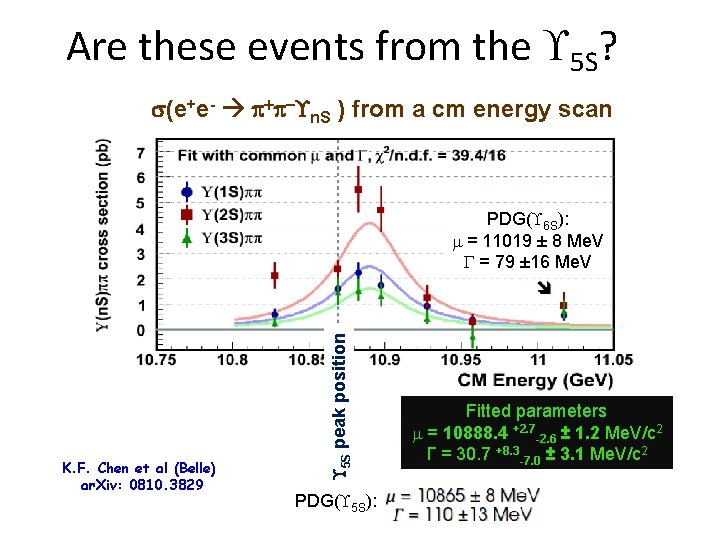
Are these events from the 5 S? s(e+e- p+p- n. S ) from a cm energy scan K. F. Chen et al (Belle) ar. Xiv: 0810. 3829 5 S peak position PDG( 6 S): m = 11019 ± 8 Me. V G = 79 ± 16 Me. V PDG( 5 S): Fitted parameters m = 10888. 4 +2. 7 -2. 6 ± 1. 2 Me. V/c 2 Γ = 30. 7 +8. 3 -7. 0 ± 3. 1 Me. V/c 2
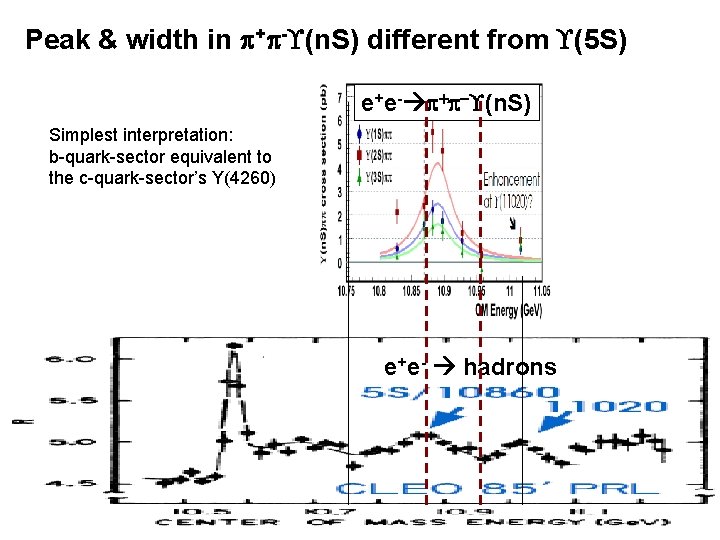
Peak & width in p+p- (n. S) different from (5 S) e+e- p+p- (n. S) Simplest interpretation: b-quark-sector equivalent to the c-quark-sector’s Y(4260) e+e- hadrons
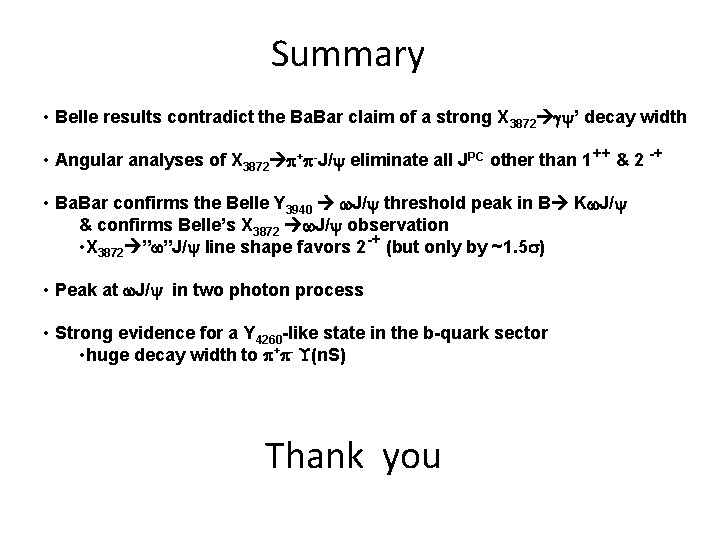
Summary • Belle results contradict the Ba. Bar claim of a strong X 3872 gy’ decay width • Angular analyses of X 3872 p+p-J/y eliminate all JPC other than 1++ & 2 -+ • Ba. Bar confirms the Belle Y 3940 w. J/y threshold peak in B Kw. J/y & confirms Belle’s X 3872 w. J/y observation • X 3872 ”w”J/y line shape favors 2 -+ (but only by ~1. 5 s) • Peak at w. J/y in two photon process • Strong evidence for a Y 4260 -like state in the b-quark sector • huge decay width to p+p- (n. S) Thank you

Backup
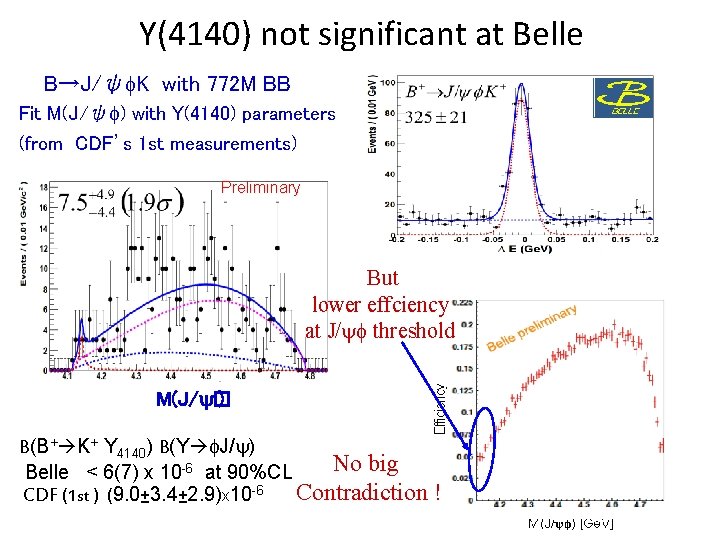
Y(4140) not significant at Belle B→J/ψ K with 772 M BB Fit M(J/ψ ) with Y(4140) parameters (from CDF’s 1 st measurements) Preliminary But lower effciency at J/ threshold M(J/y� ) B(B+ K+ Y 4140) B(Y J/ ) No big Belle < 6(7) x 10 -6 at 90%CL Contradiction CDF (1 st ) (9. 0± 3. 4± 2. 9)x 10 -6 !
Charged resonancelike states Z+(4430) Z 1+(4050) & Z 2+ (4250) p+cc 1
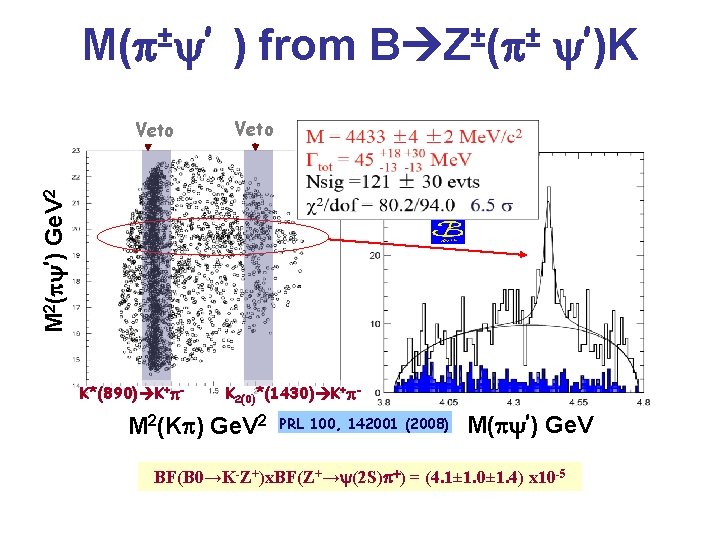
± M(p y’ Veto y’)K -13 M 2(py’) Ge. V 2 Veto ) from ± ± B Z (p K*(890) K+p- K 2(0)*(1430) K+p- M 2(Kp) Ge. V 2 PRL 100, 142001 (2008) M(py’) Ge. V BF(B 0→K-Z+)x. BF(Z+→y(2 S)p+) = (4. 1± 1. 0± 1. 4) x 10 -5
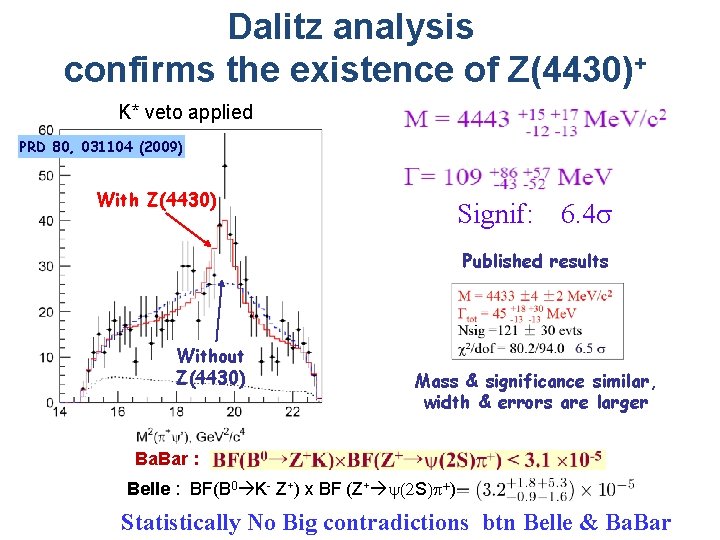
Dalitz analysis confirms the existence of Z(4430)+ K* veto applied PRD 80, 031104 (2009) With Z(4430) Signif: 6. 4 s Published results Without Z(4430) Mass & significance similar, width & errors are larger Ba. Bar : Belle : BF(B 0 K- Z+) x BF (Z+ (2 S)p+) Statistically No Big contradictions btn Belle & Ba. Bar
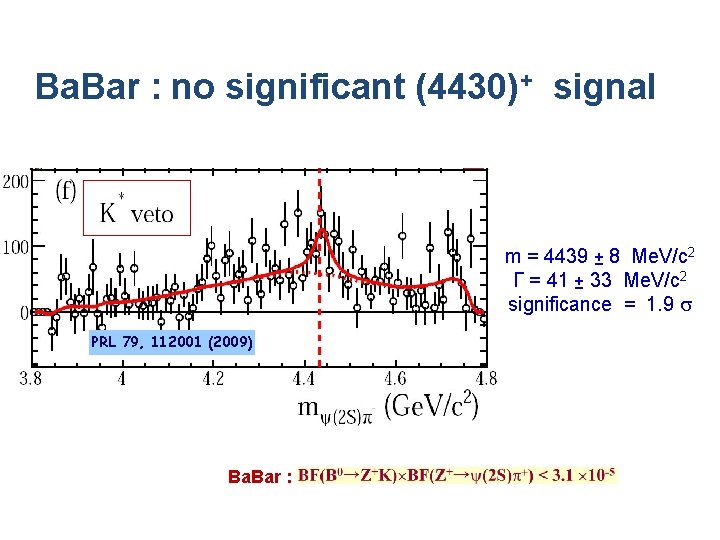
Ba. Bar : no significant (4430)+ signal m = 4439 ± 8 Me. V/c 2 Γ = 41 ± 33 Me. V/c 2 significance = 1. 9 s PRL 79, 112001 (2009) Ba. Bar :
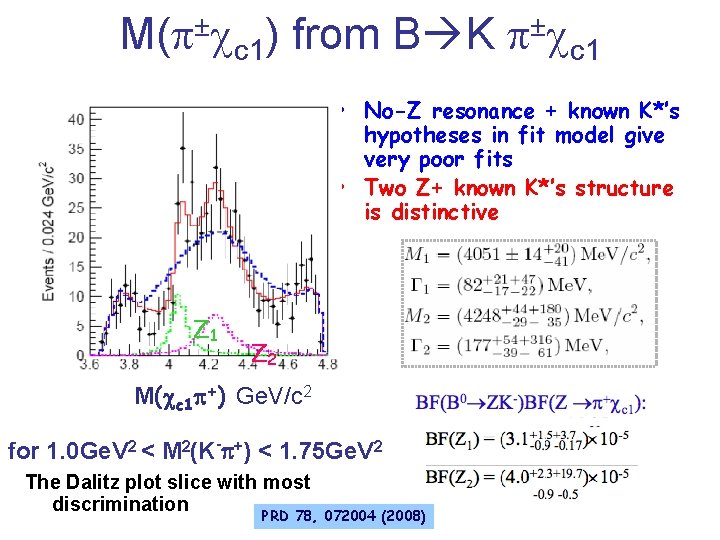
M(p±cc 1) from B K p±cc 1 • No-Z resonance + known K*’s hypotheses in fit model give very poor fits • Two Z+ known K*’s structure is distinctive Z 1 Z 2 M(cc 1 p+) Ge. V/c 2 for 1. 0 Ge. V 2 < M 2(K-p+) < 1. 75 Ge. V 2 The Dalitz plot slice with most discrimination PRD 78, 072004 (2008)
- Slides: 36