
SPECTROSCOPY OVERVIEW This cycle is directed to ASTRONOMERS


- Slides: 94
SPECTROSCOPY OVERVIEW This cycle is directed to ASTRONOMERS Develops through a logical path which goes from conception to construction and operations of the instrument The Science Case: High Resolution Spectroscopy of (cool) stars Basic tools for specifications and verification One example of similar design and different implementations: UVES, FEROS, HARPS Successful Program: VLT instrumentation Aspects of Optical design (B. Delabre) L. Pasquini July 2002
SPECTROSCOPY Science Cases Science cases: Why do we want to have a new instrument ? Which science to address? Which Outstanding problems to solve ? How ? Which Telescope ? Which fraction of the time is available ? Related questions: Which community will serve ? What is already available to them ? What is the state of art ? The competition ? The alternatives? Some Practical Aspects: Feasibility, Financial, Timescale L. Pasquini July 2002
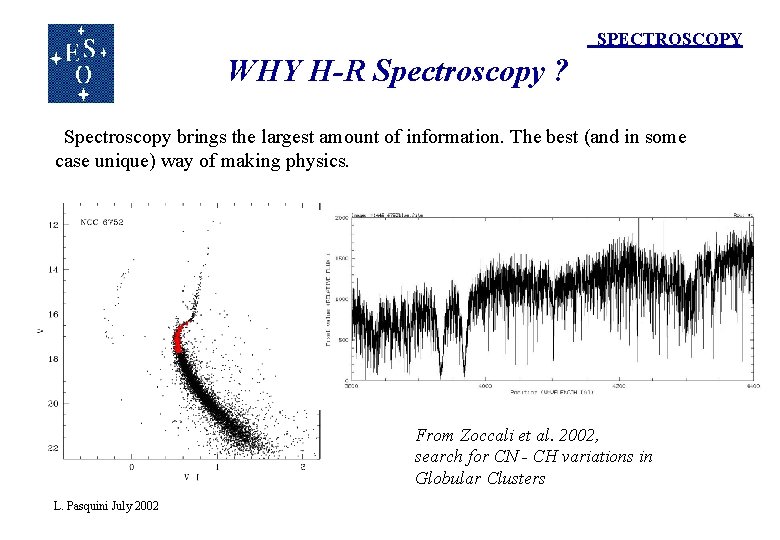
SPECTROSCOPY WHY H-R Spectroscopy ? Spectroscopy brings the largest amount of information. The best (and in some case unique) way of making physics. From Zoccali et al. 2002, search for CN - CH variations in Globular Clusters L. Pasquini July 2002
SPECTROSCOPY Cool Stars: Some Topics Detailed Chemical Abundance: Distance Scale , Stellar Populations, Star Formation History, Chemical Evolution, Age of the Galaxy Primordial Nucleosynthesis: Li, Be abundance Stellar Interior: Diffusion, Mixing, oscillations. . Accurate Radial velocities : Dynamics of complex systems, Binaries, Exo. Planets, short and long term variations Rotation & magnetic fields: Activity, Dynamo, Solar-stellar connection, Angular Momentum evolution. . . L. Pasquini July 2002
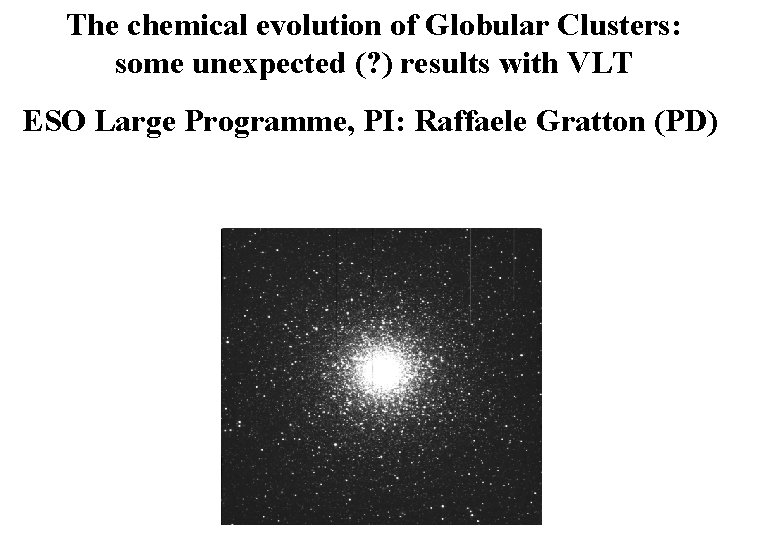
The chemical evolution of Globular Clusters: some unexpected (? ) results with VLT ESO Large Programme, PI: Raffaele Gratton (PD)
Content - Distances to globular clusters and impact on ages: short and long distance scales - Star-to-star chemical inhomogeneities: the Na-O anticorrelation - Lithium abundances - ESO Large Program 165 -L 0263
Distances to globular clusters and impact on ages: short and long distance scales
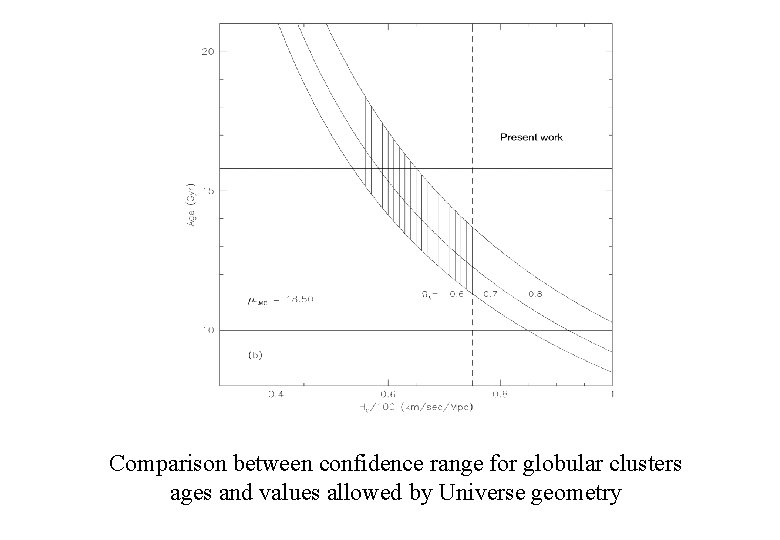
Comparison between confidence range for globular clusters ages and values allowed by Universe geometry
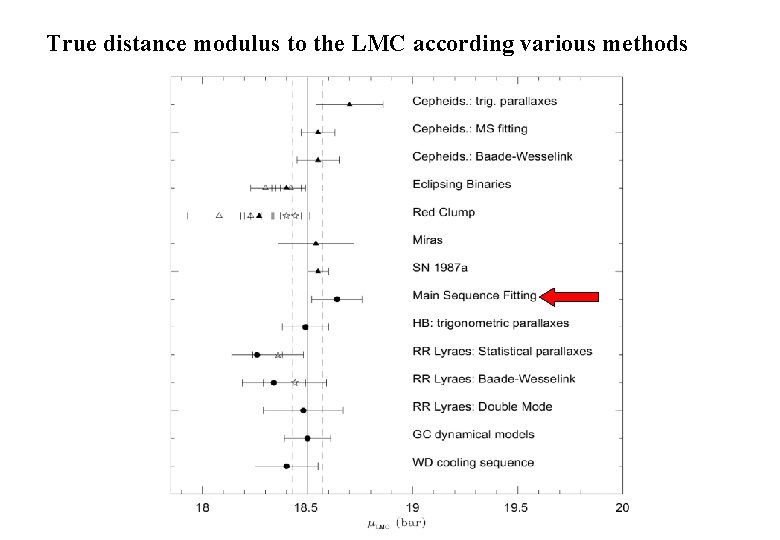
True distance modulus to the LMC according various methods
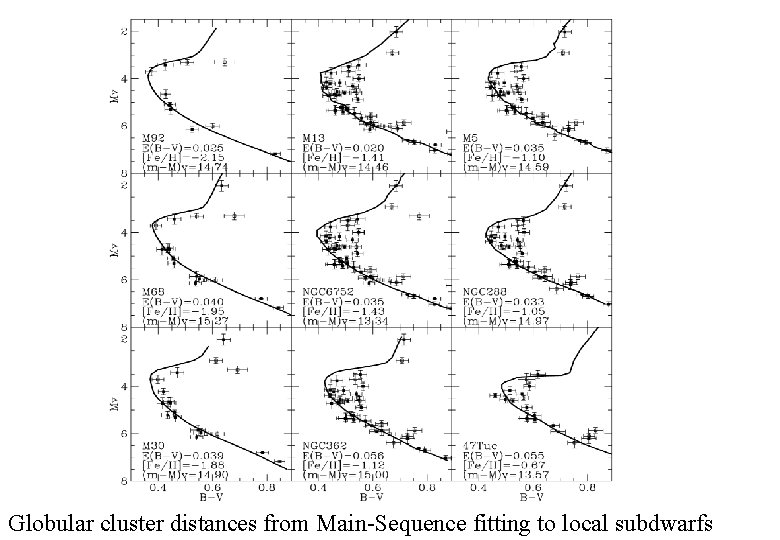
Globular cluster distances from Main-Sequence fitting to local subdwarfs
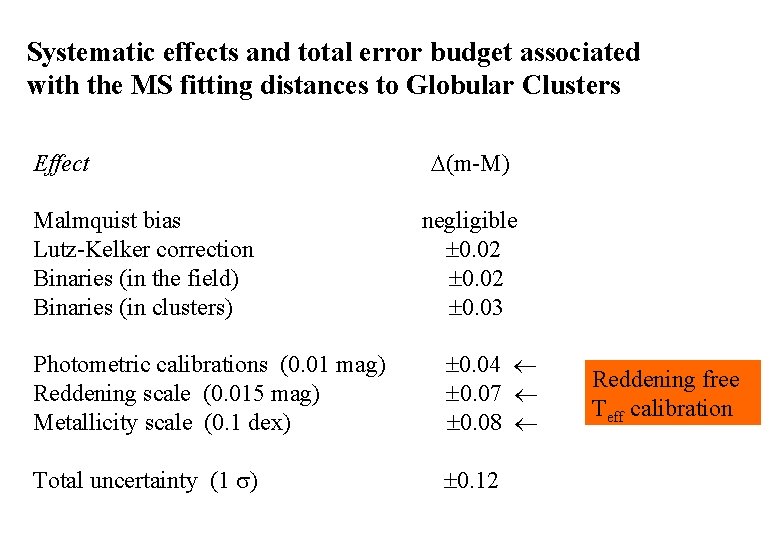
Systematic effects and total error budget associated with the MS fitting distances to Globular Clusters Effect Malmquist bias Lutz-Kelker correction Binaries (in the field) Binaries (in clusters) (m-M) negligible 0. 02 0. 03 Photometric calibrations (0. 01 mag) Reddening scale (0. 015 mag) Metallicity scale (0. 1 dex) 0. 04 0. 07 0. 08 Total uncertainty (1 ) 0. 12 Reddening free Teff calibration
Star-to-star chemical inhomogeneities: the Na-O anticorrelation
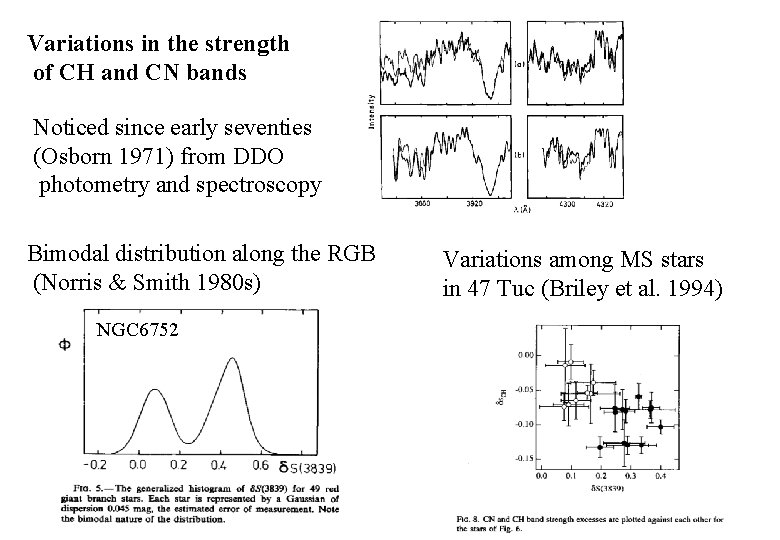
Variations in the strength of CH and CN bands Noticed since early seventies (Osborn 1971) from DDO photometry and spectroscopy Bimodal distribution along the RGB (Norris & Smith 1980 s) NGC 6752 Variations among MS stars in 47 Tuc (Briley et al. 1994)
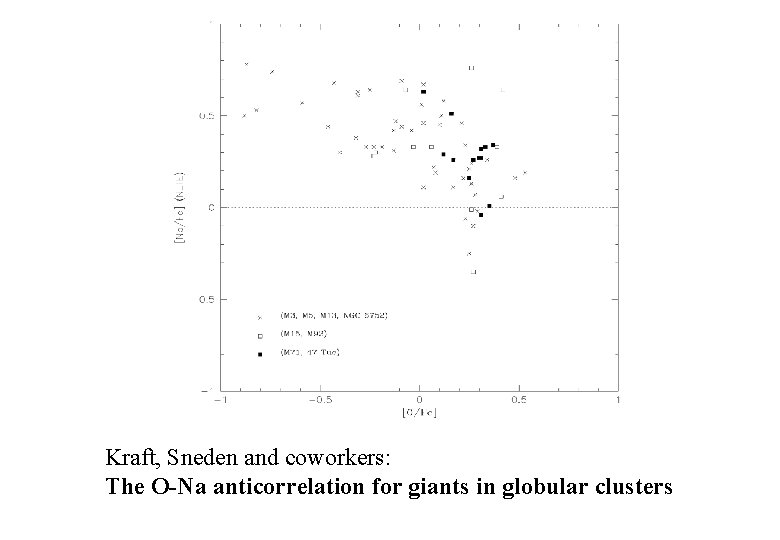
Kraft, Sneden and coworkers: The O-Na anticorrelation for giants in globular clusters
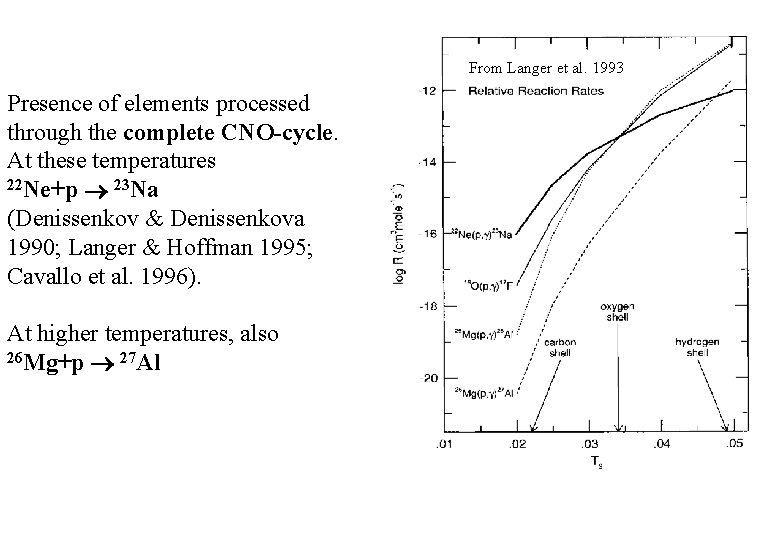
From Langer et al. 1993 Presence of elements processed through the complete CNO-cycle. At these temperatures 22 Ne+p 23 Na (Denissenkov & Denissenkova 1990; Langer & Hoffman 1995; Cavallo et al. 1996). At higher temperatures, also 26 Mg+p 27 Al
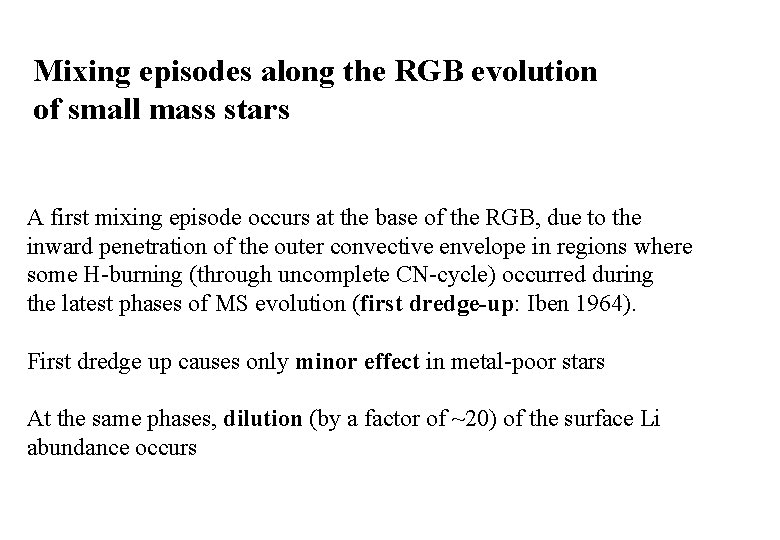
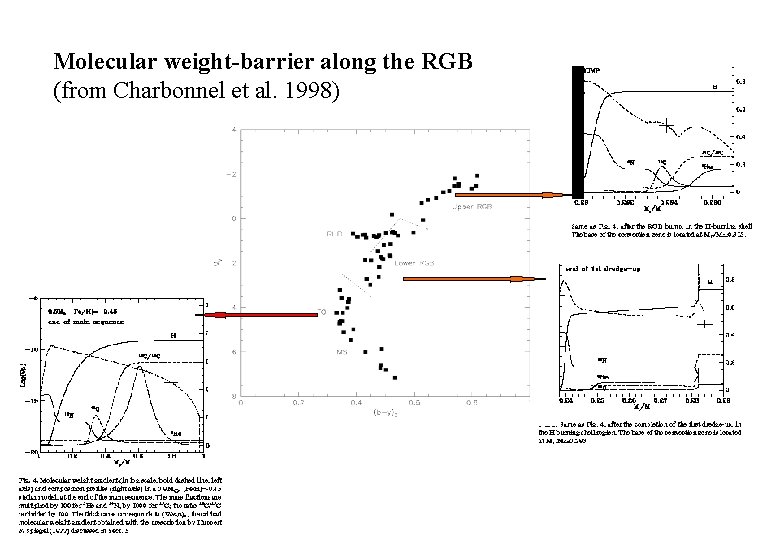
Mixing episodes along the RGB evolution of small mass stars A first mixing episode occurs at the base of the RGB, due to the inward penetration of the outer convective envelope in regions where some H-burning (through uncomplete CN-cycle) occurred during the latest phases of MS evolution (first dredge-up: Iben 1964). First dredge up causes only minor effect in metal-poor stars At the same phases, dilution (by a factor of ~20) of the surface Li abundance occurs
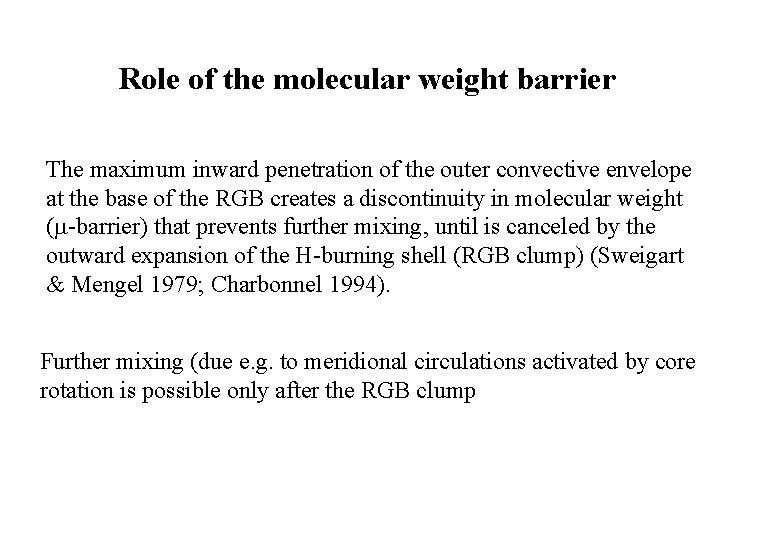
Role of the molecular weight barrier The maximum inward penetration of the outer convective envelope at the base of the RGB creates a discontinuity in molecular weight ( -barrier) that prevents further mixing, until is canceled by the outward expansion of the H-burning shell (RGB clump) (Sweigart & Mengel 1979; Charbonnel 1994). Further mixing (due e. g. to meridional circulations activated by core rotation is possible only after the RGB clump
Molecular weight-barrier along the RGB (from Charbonnel et al. 1998)
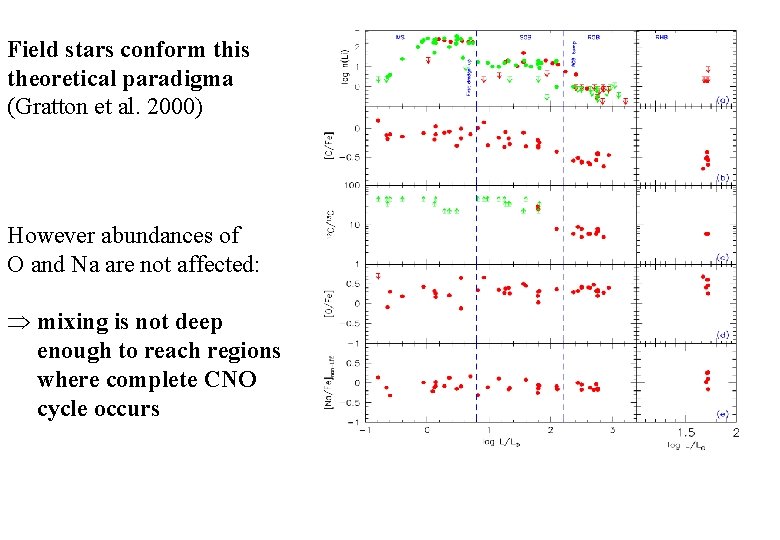
Field stars conform this theoretical paradigma (Gratton et al. 2000) However abundances of O and Na are not affected: mixing is not deep enough to reach regions where complete CNO cycle occurs
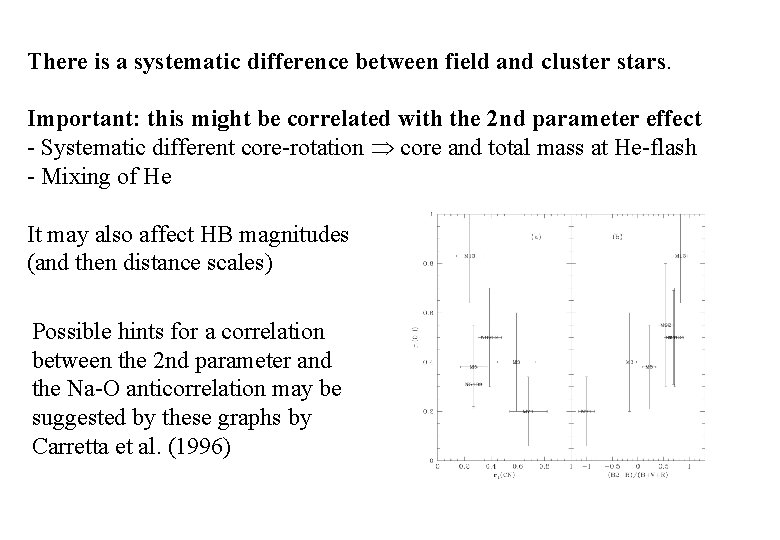
There is a systematic difference between field and cluster stars. Important: this might be correlated with the 2 nd parameter effect - Systematic different core-rotation core and total mass at He-flash - Mixing of He It may also affect HB magnitudes (and then distance scales) Possible hints for a correlation between the 2 nd parameter and the Na-O anticorrelation may be suggested by these graphs by Carretta et al. (1996)
What is going on in cluster stars? There are mainly two scenarios: - Deep mixing episodes: may only occur along the RGB, after the clump (temperature is not large enough in TO-stars) - Accretion: should be present independent of the evolutionary phase (the material comes from now extincted TP AGB stars, undergoing hot bottom burning). Accretion might occur: . on protostars (Cottrell & Da Costa). on already formed stars (D’Antona, Gratton & Chieffi) Not distinguishable from observations of bright giants Observations of stars fainter than the clump
Lithium abundances
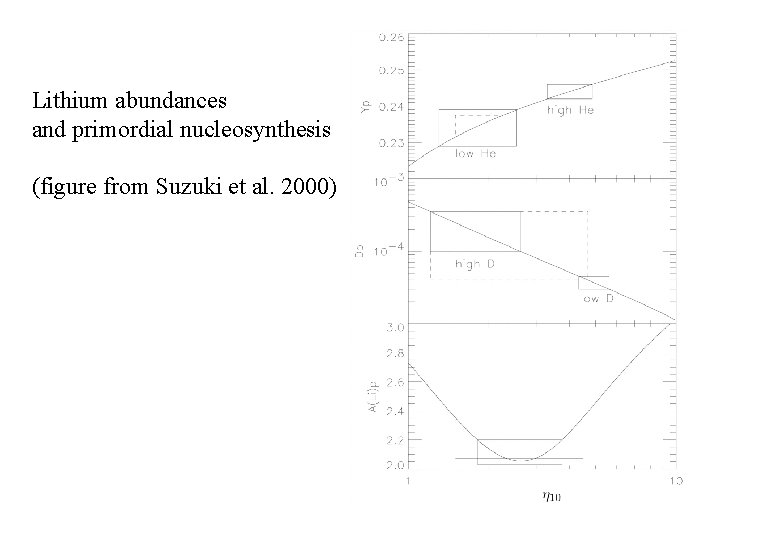
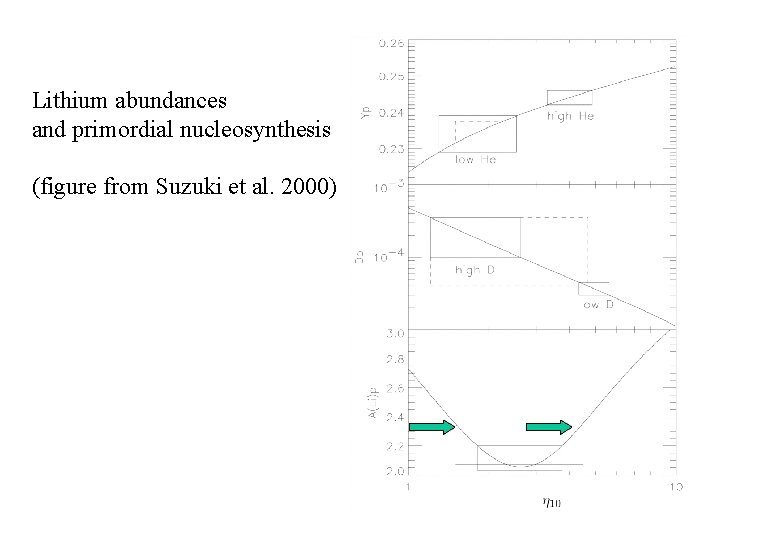
Lithium abundances and primordial nucleosynthesis (figure from Suzuki et al. 2000)
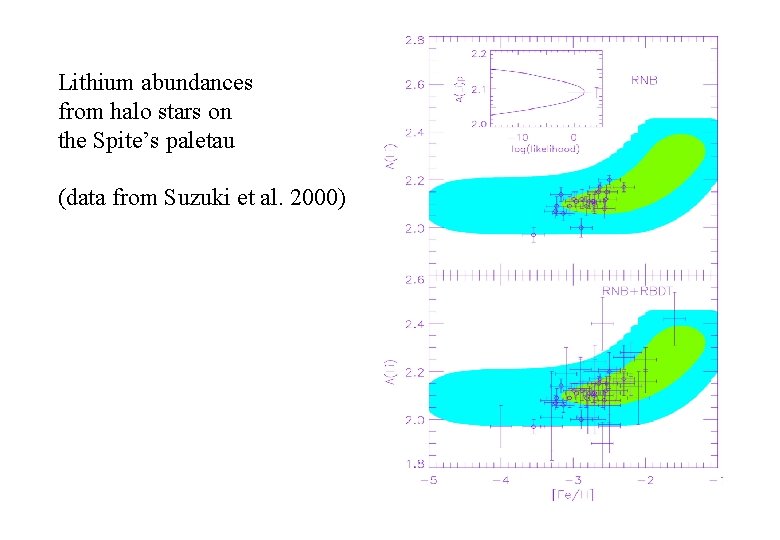
Lithium abundances from halo stars on the Spite’s paletau (data from Suzuki et al. 2000)
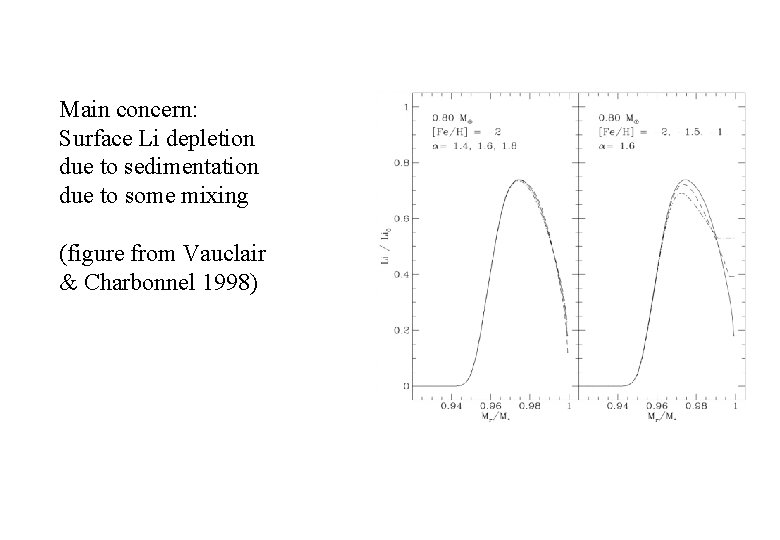
Main concern: Surface Li depletion due to sedimentation due to some mixing (figure from Vauclair & Charbonnel 1998)
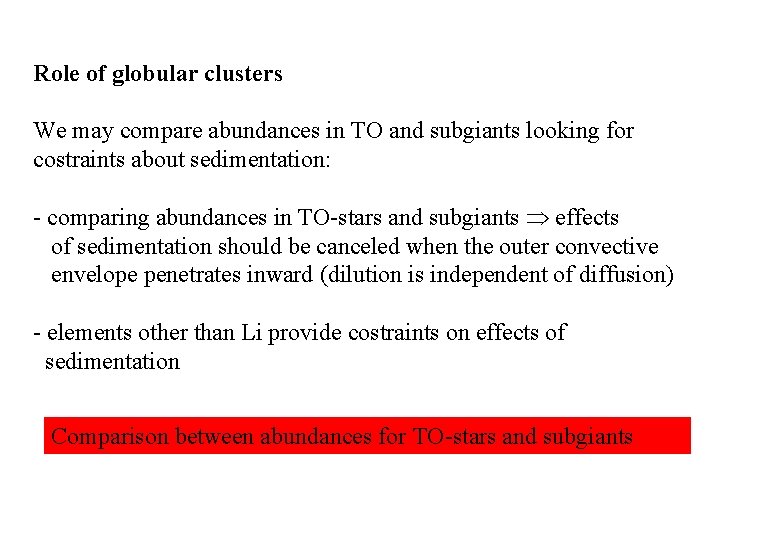
Role of globular clusters We may compare abundances in TO and subgiants looking for costraints about sedimentation: - comparing abundances in TO-stars and subgiants effects of sedimentation should be canceled when the outer convective envelope penetrates inward (dilution is independent of diffusion) - elements other than Li provide costraints on effects of sedimentation Comparison between abundances for TO-stars and subgiants
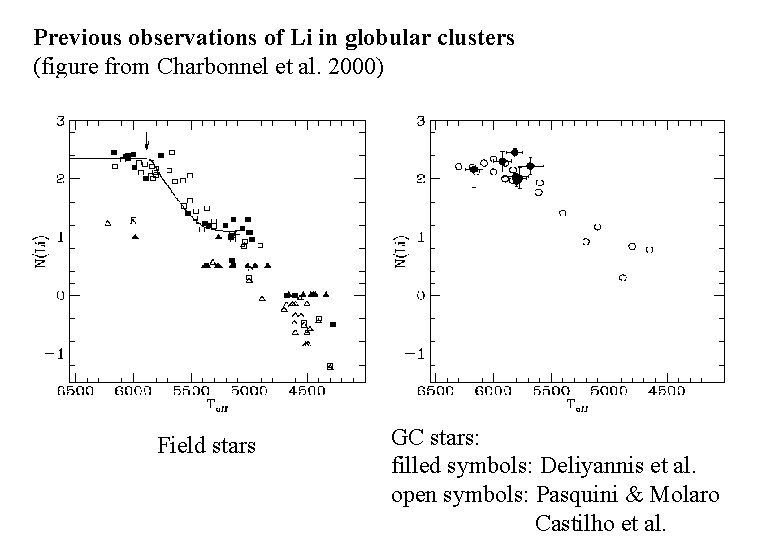
Previous observations of Li in globular clusters (figure from Charbonnel et al. 2000) Field stars GC stars: filled symbols: Deliyannis et al. open symbols: Pasquini & Molaro Castilho et al.
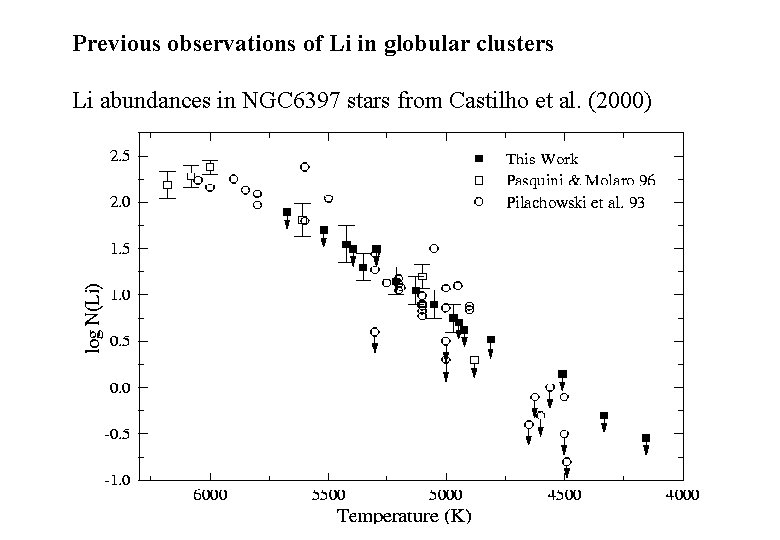
Previous observations of Li in globular clusters Li abundances in NGC 6397 stars from Castilho et al. (2000)
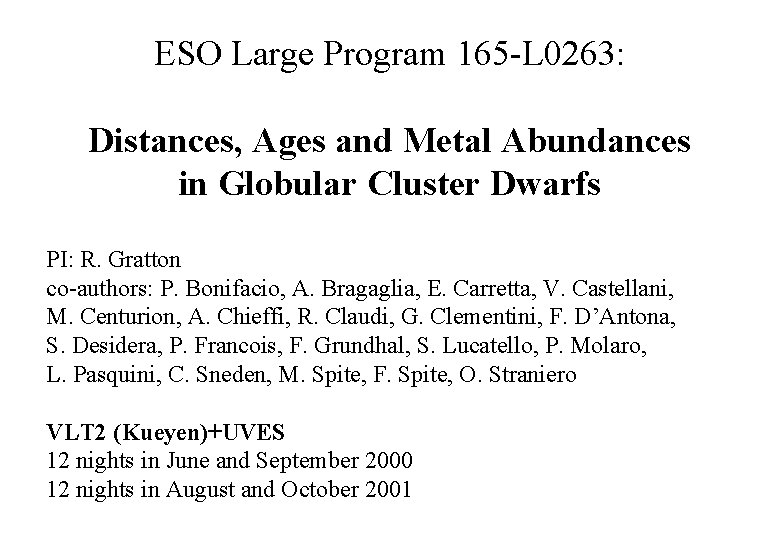
ESO Large Program 165 -L 0263: Distances, Ages and Metal Abundances in Globular Cluster Dwarfs PI: R. Gratton co-authors: P. Bonifacio, A. Bragaglia, E. Carretta, V. Castellani, M. Centurion, A. Chieffi, R. Claudi, G. Clementini, F. D’Antona, S. Desidera, P. Francois, F. Grundhal, S. Lucatello, P. Molaro, L. Pasquini, C. Sneden, M. Spite, F. Spite, O. Straniero VLT 2 (Kueyen)+UVES 12 nights in June and September 2000 12 nights in August and October 2001
OBSERVATIONS
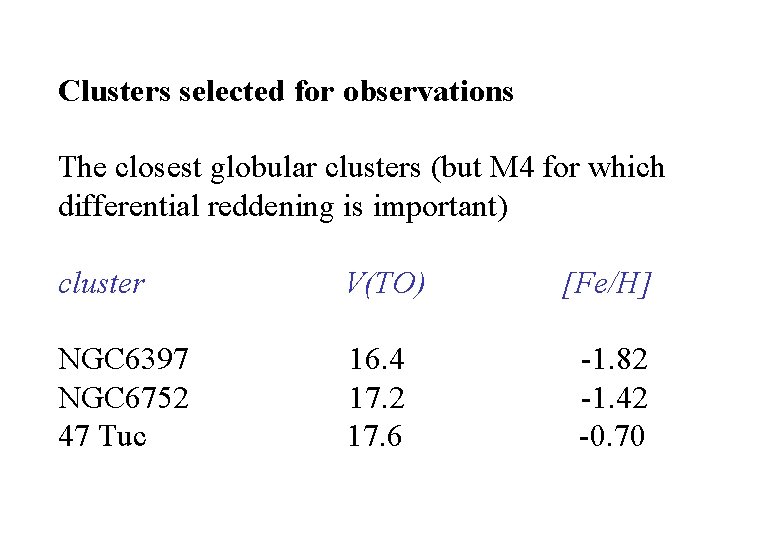
Clusters selected for observations The closest globular clusters (but M 4 for which differential reddening is important) cluster V(TO) [Fe/H] NGC 6397 NGC 6752 47 Tuc 16. 4 17. 2 17. 6 -1. 82 -1. 42 -0. 70
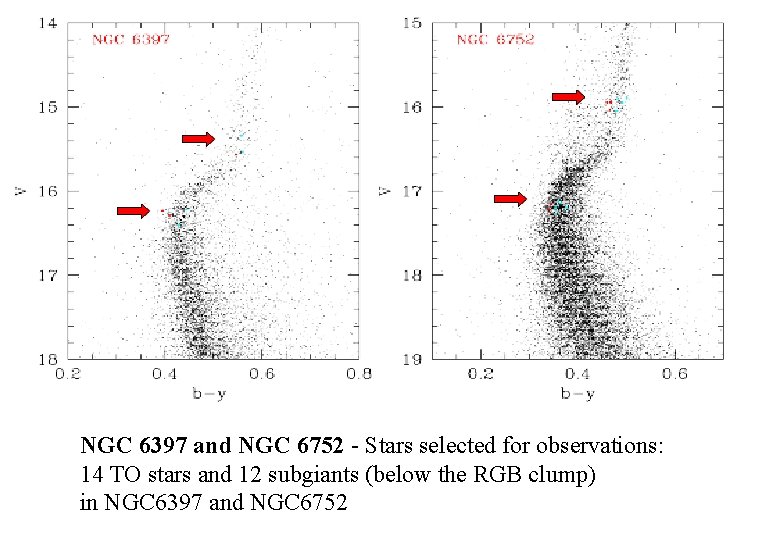
NGC 6397 and NGC 6752 - Stars selected for observations: 14 TO stars and 12 subgiants (below the RGB clump) in NGC 6397 and NGC 6752
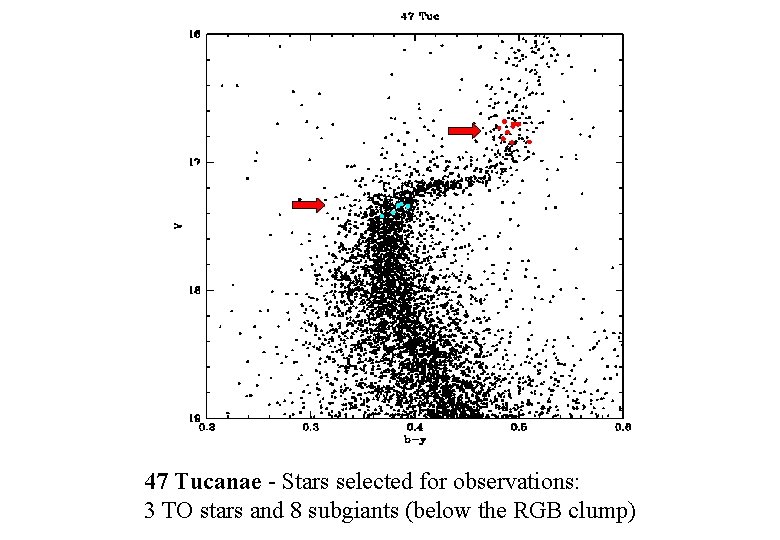
47 Tucanae - Stars selected for observations: 3 TO stars and 8 subgiants (below the RGB clump)
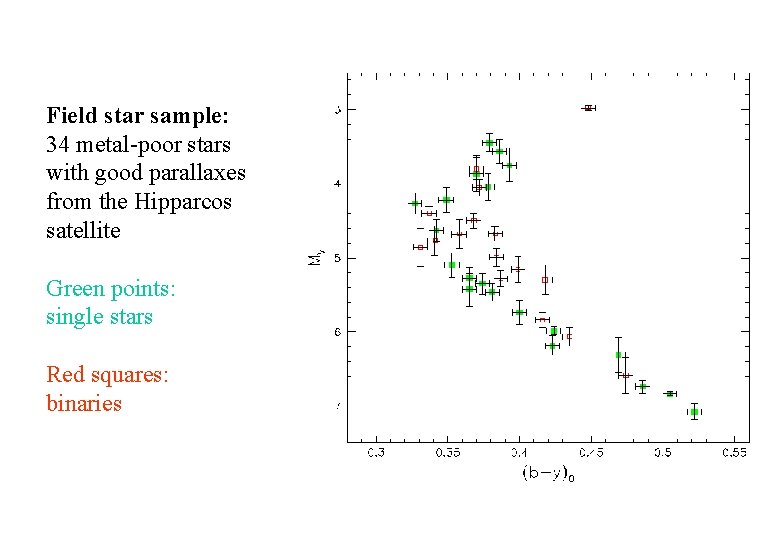
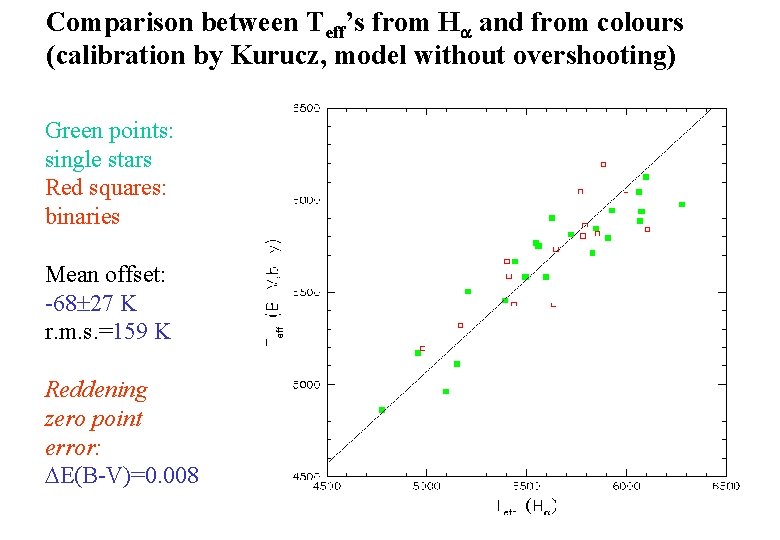
Field star sample: 34 metal-poor stars with good parallaxes from the Hipparcos satellite Green points: single stars Red squares: binaries
ANALYSIS
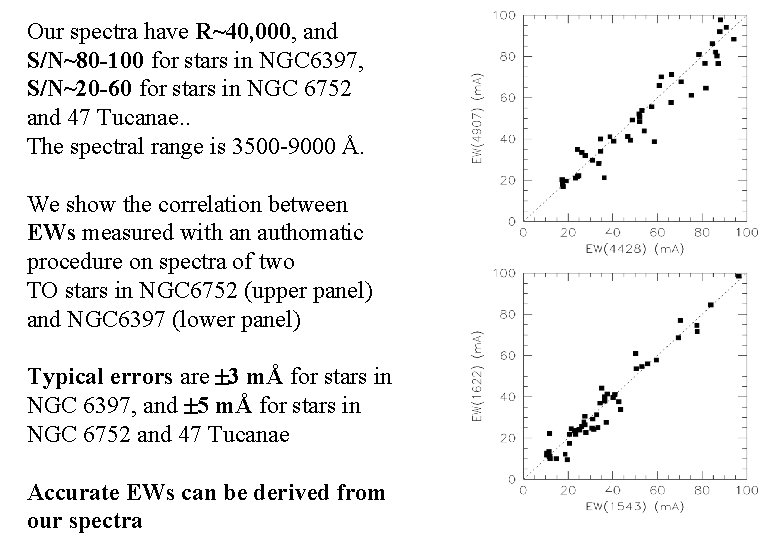
Our spectra have R~40, 000, and S/N~80 -100 for stars in NGC 6397, S/N~20 -60 for stars in NGC 6752 and 47 Tucanae. . The spectral range is 3500 -9000 Å. We show the correlation between EWs measured with an authomatic procedure on spectra of two TO stars in NGC 6752 (upper panel) and NGC 6397 (lower panel) Typical errors are 3 mÅ for stars in NGC 6397, and 5 mÅ for stars in NGC 6752 and 47 Tucanae Accurate EWs can be derived from our spectra
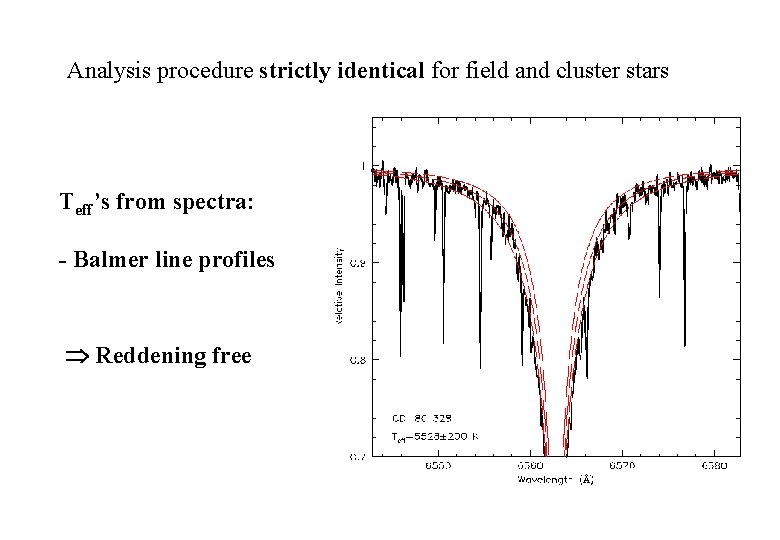
Analysis procedure strictly identical for field and cluster stars Teff’s from spectra: - Balmer line profiles Reddening free
Comparison between Teff’s from H and from colours (calibration by Kurucz, model without overshooting) Green points: single stars Red squares: binaries Mean offset: -68 27 K r. m. s. =159 K Reddening zero point error: E(B-V)=0. 008
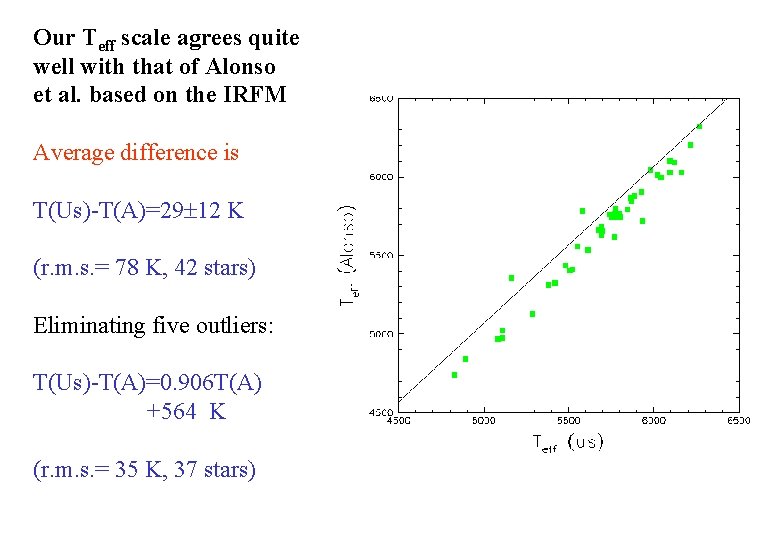
Our Teff scale agrees quite well with that of Alonso et al. based on the IRFM Average difference is T(Us)-T(A)=29 12 K (r. m. s. = 78 K, 42 stars) Eliminating five outliers: T(Us)-T(A)=0. 906 T(A) +564 K (r. m. s. = 35 K, 37 stars)
Results • Impact of microscopic diffusion on models of low mass stars • The O-Na anticorrelation among globular cluster TO-stars • Lithium abundances in TO-stars and subgiants of globular clusters • Distances and Ages of Globular Clusters • Comparison between abundances in GC and field stars • Rotation of TO-stars in globular clusters
Impact of microscopic diffusion on models of low mass stars
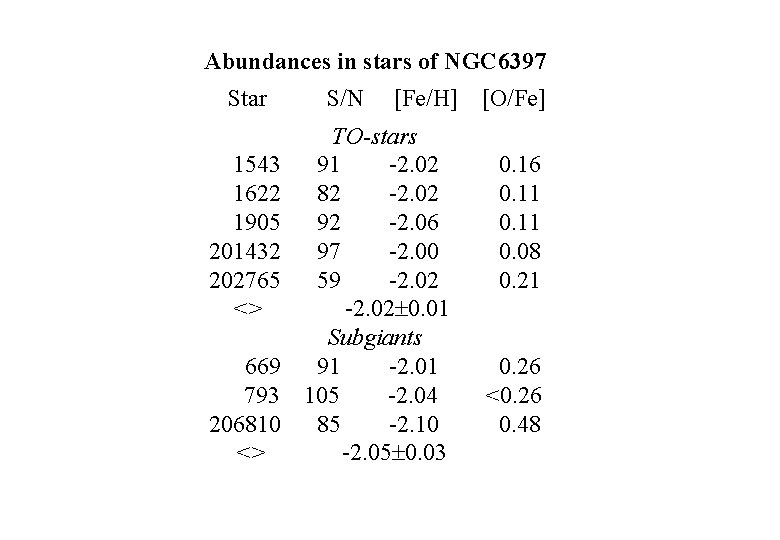
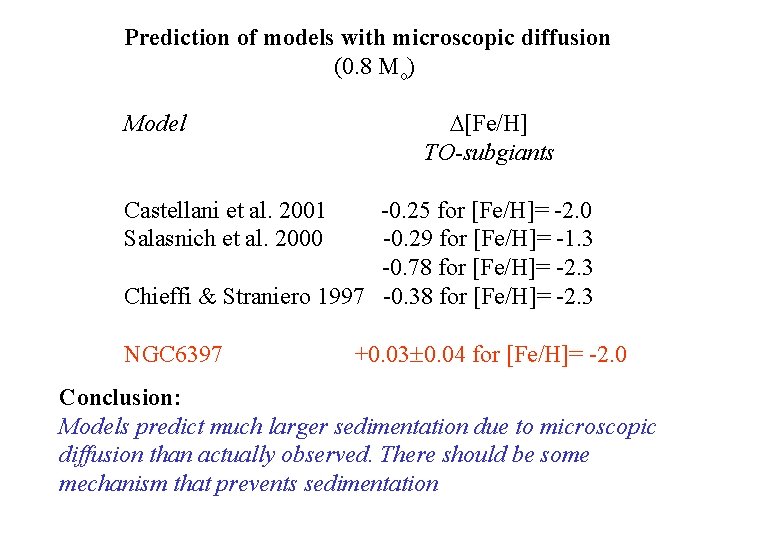
Impact of microscopic diffusion on models of low mass stars Microscopic diffusion is a basic physical mechanism, that should be included in stellar models It causes sedimentation of heavy elements, mainly He; in low mass (M~0. 8 M 0), metal-poor ([Fe/H] -2) stars near the TO, also O and Fe are expected to be depleted significantly The net effects of sedimentation are: - ages are reduced by about 10% - Li abundances may be significantly reduced with respect to the original value Our observations of TO and subgiants in NGC 6397 (M~0. 8 M 0, [Fe/H]=-2. 0) allow to costrain sedimentation effects
Abundances in stars of NGC 6397 Star 1543 1622 1905 201432 202765 <> 669 793 206810 <> S/N [Fe/H] TO-stars 91 -2. 02 82 -2. 02 92 -2. 06 97 -2. 00 59 -2. 02 0. 01 Subgiants 91 -2. 01 105 -2. 04 85 -2. 10 -2. 05 0. 03 [O/Fe] 0. 16 0. 11 0. 08 0. 21 0. 26 <0. 26 0. 48
Prediction of models with microscopic diffusion (0. 8 Mo) Model [Fe/H] TO-subgiants Castellani et al. 2001 Salasnich et al. 2000 -0. 25 for [Fe/H]= -2. 0 -0. 29 for [Fe/H]= -1. 3 -0. 78 for [Fe/H]= -2. 3 Chieffi & Straniero 1997 -0. 38 for [Fe/H]= -2. 3 NGC 6397 +0. 03 0. 04 for [Fe/H]= -2. 0 Conclusion: Models predict much larger sedimentation due to microscopic diffusion than actually observed. There should be some mechanism that prevents sedimentation
The O-Na anticorrelation among globular cluster stars
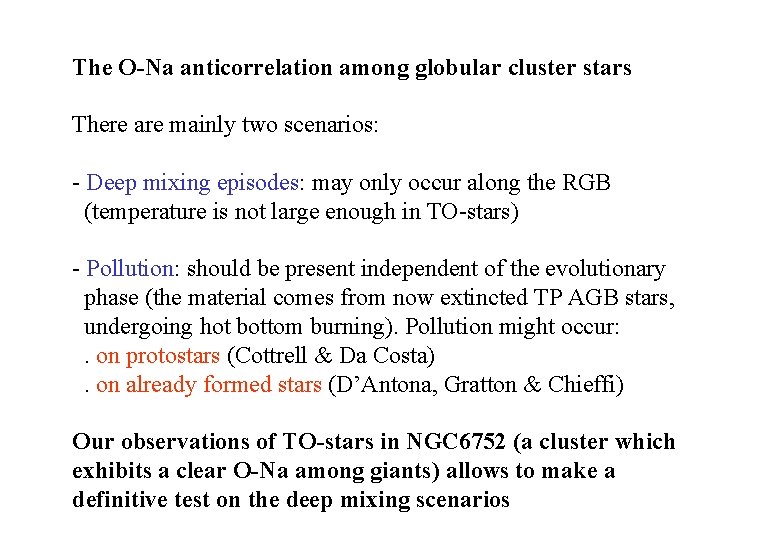
The O-Na anticorrelation among globular cluster stars There are mainly two scenarios: - Deep mixing episodes: may only occur along the RGB (temperature is not large enough in TO-stars) - Pollution: should be present independent of the evolutionary phase (the material comes from now extincted TP AGB stars, undergoing hot bottom burning). Pollution might occur: . on protostars (Cottrell & Da Costa). on already formed stars (D’Antona, Gratton & Chieffi) Our observations of TO-stars in NGC 6752 (a cluster which exhibits a clear O-Na among giants) allows to make a definitive test on the deep mixing scenarios
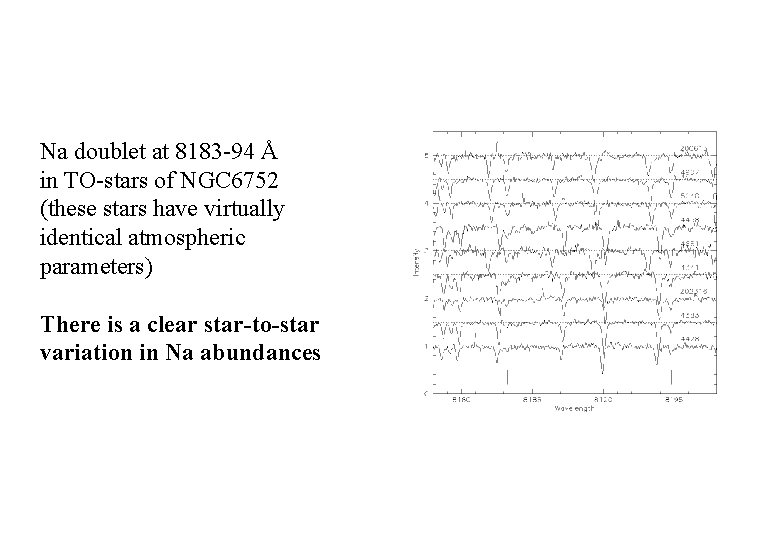
Na doublet at 8183 -94 Å in TO-stars of NGC 6752 (these stars have virtually identical atmospheric parameters) There is a clear star-to-star variation in Na abundances
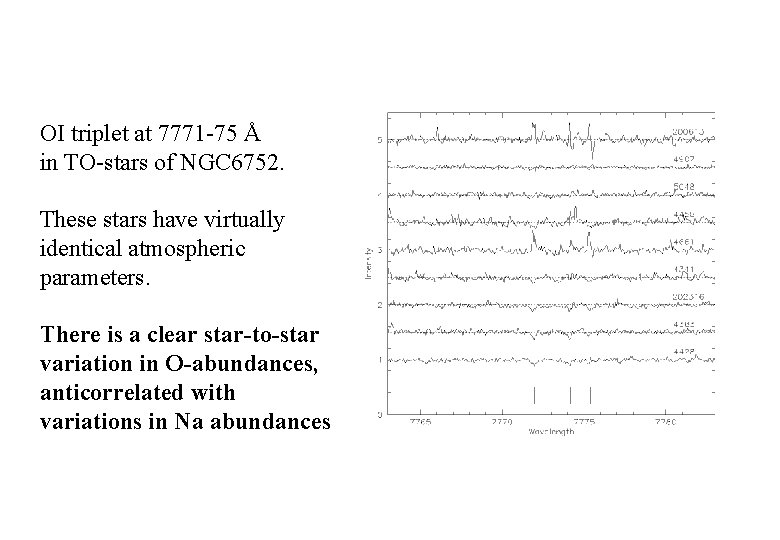
OI triplet at 7771 -75 Å in TO-stars of NGC 6752. These stars have virtually identical atmospheric parameters. There is a clear star-to-star variation in O-abundances, anticorrelated with variations in Na abundances
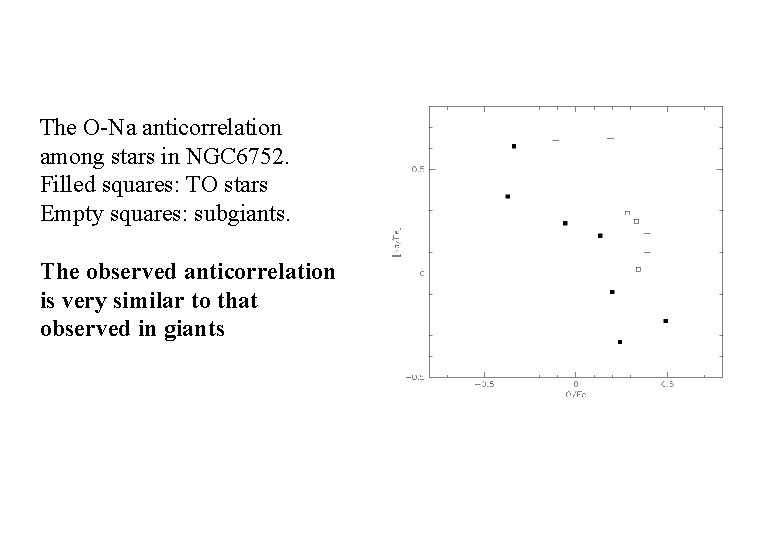
The O-Na anticorrelation among stars in NGC 6752. Filled squares: TO stars Empty squares: subgiants. The observed anticorrelation is very similar to that observed in giants
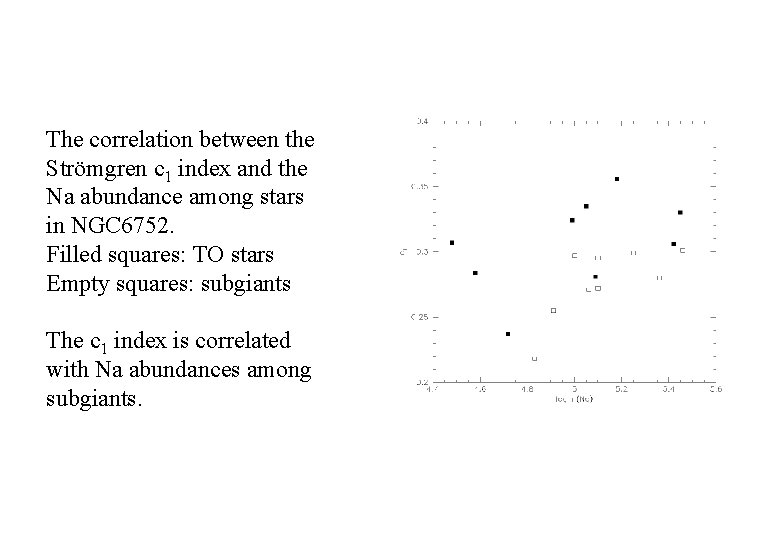
The correlation between the Strömgren c 1 index and the Na abundance among stars in NGC 6752. Filled squares: TO stars Empty squares: subgiants The c 1 index is correlated with Na abundances among subgiants.
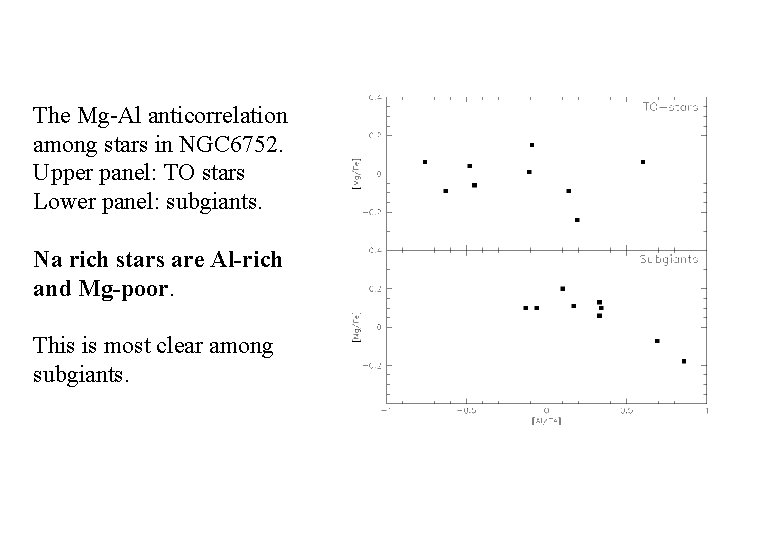
The Mg-Al anticorrelation among stars in NGC 6752. Upper panel: TO stars Lower panel: subgiants. Na rich stars are Al-rich and Mg-poor. This is most clear among subgiants.
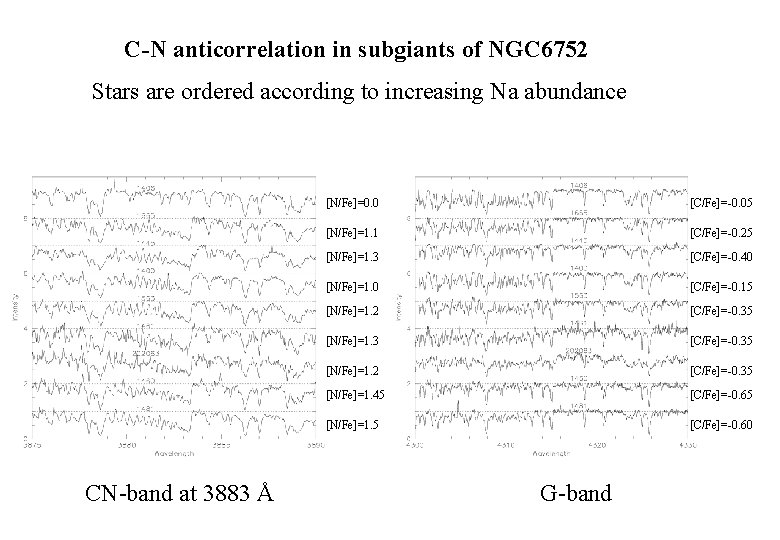
C-N anticorrelation in subgiants of NGC 6752 Stars are ordered according to increasing Na abundance CN-band at 3883 Å [N/Fe]=0. 0 [C/Fe]=-0. 05 [N/Fe]=1. 1 [C/Fe]=-0. 25 [N/Fe]=1. 3 [C/Fe]=-0. 40 [N/Fe]=1. 0 [C/Fe]=-0. 15 [N/Fe]=1. 2 [C/Fe]=-0. 35 [N/Fe]=1. 3 [C/Fe]=-0. 35 [N/Fe]=1. 2 [C/Fe]=-0. 35 [N/Fe]=1. 45 [C/Fe]=-0. 65 [N/Fe]=1. 5 [C/Fe]=-0. 60 G-band
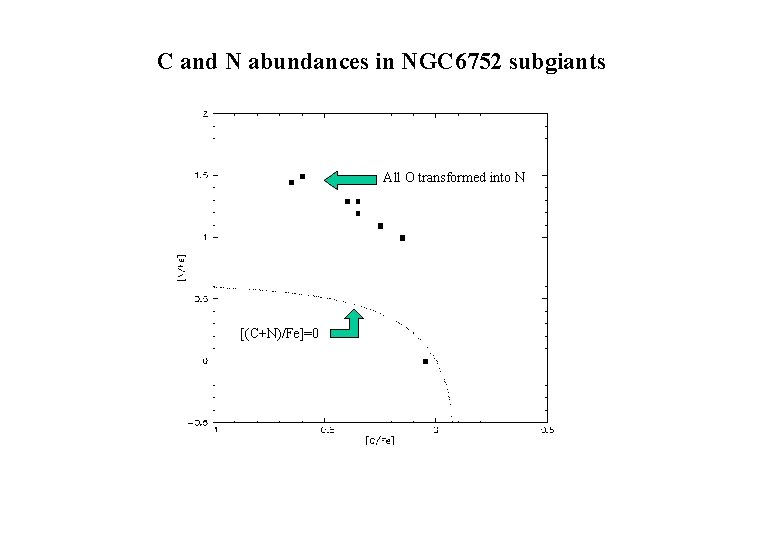
C and N abundances in NGC 6752 subgiants All O transformed into N [(C+N)/Fe]=0
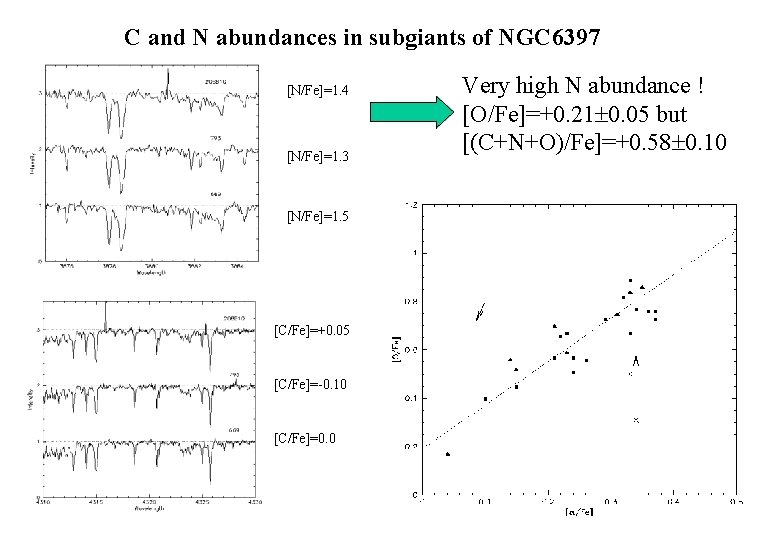
C and N abundances in subgiants of NGC 6397 [N/Fe]=1. 4 [N/Fe]=1. 3 [N/Fe]=1. 5 [C/Fe]=+0. 05 [C/Fe]=-0. 10 [C/Fe]=0. 0 Very high N abundance ! [O/Fe]=+0. 21 0. 05 but [(C+N+O)/Fe]=+0. 58 0. 10
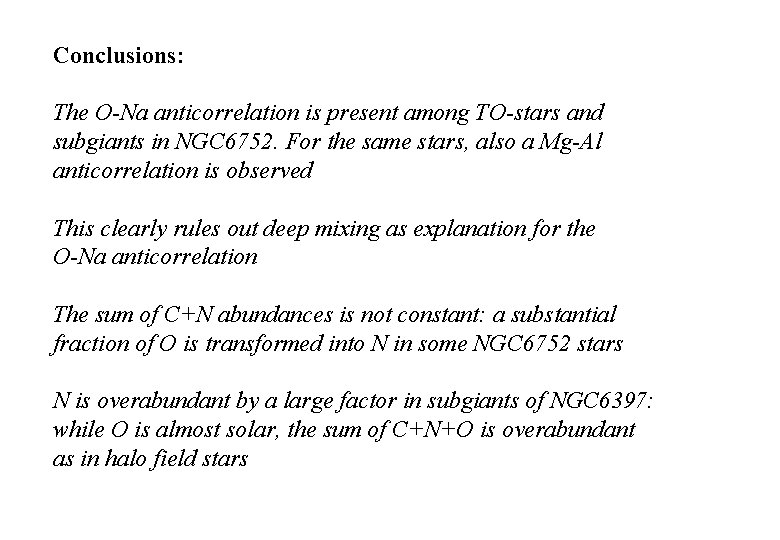
Conclusions: The O-Na anticorrelation is present among TO-stars and subgiants in NGC 6752. For the same stars, also a Mg-Al anticorrelation is observed This clearly rules out deep mixing as explanation for the O-Na anticorrelation The sum of C+N abundances is not constant: a substantial fraction of O is transformed into N in some NGC 6752 stars N is overabundant by a large factor in subgiants of NGC 6397: while O is almost solar, the sum of C+N+O is overabundant as in halo field stars
Lithium abundances in TO-stars and subgiants of globular clusters
NGC 6397
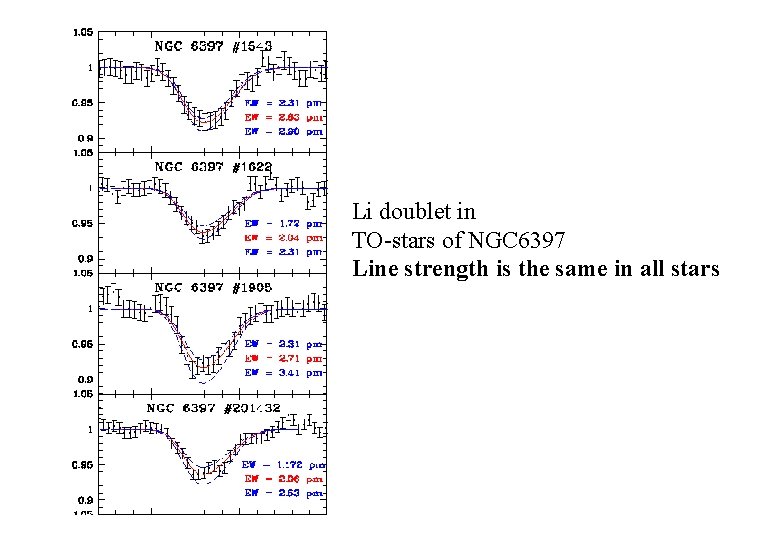
Li doublet in TO-stars of NGC 6397 Line strength is the same in all stars
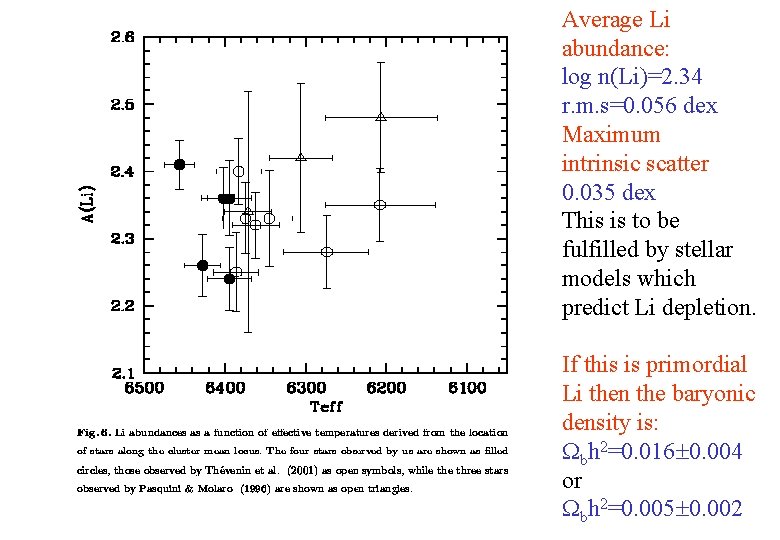
Average Li abundance: log n(Li)=2. 34 r. m. s=0. 056 dex Maximum intrinsic scatter 0. 035 dex This is to be fulfilled by stellar models which predict Li depletion. If this is primordial Li then the baryonic density is: bh 2=0. 016 0. 004 or bh 2=0. 005 0. 002
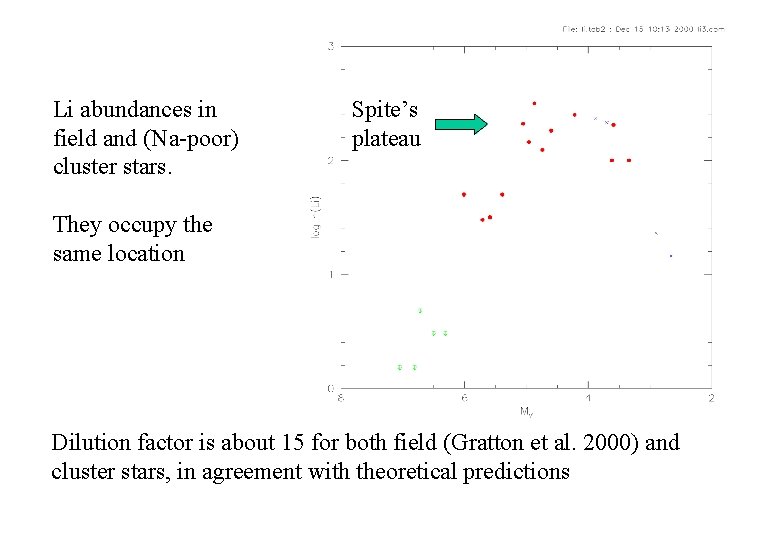
Li abundances in field and (Na-poor) cluster stars. Spite’s plateau They occupy the same location Dilution factor is about 15 for both field (Gratton et al. 2000) and cluster stars, in agreement with theoretical predictions
Lithium abundances and primordial nucleosynthesis (figure from Suzuki et al. 2000)
NGC 6752
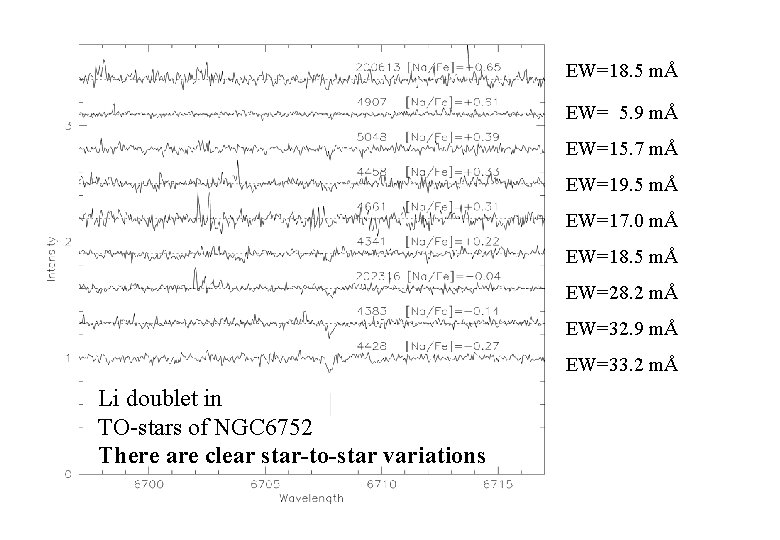
EW=18. 5 mÅ EW= 5. 9 mÅ EW=15. 7 mÅ EW=19. 5 mÅ EW=17. 0 mÅ EW=18. 5 mÅ EW=28. 2 mÅ EW=32. 9 mÅ EW=33. 2 mÅ Li doublet in TO-stars of NGC 6752 There are clear star-to-star variations
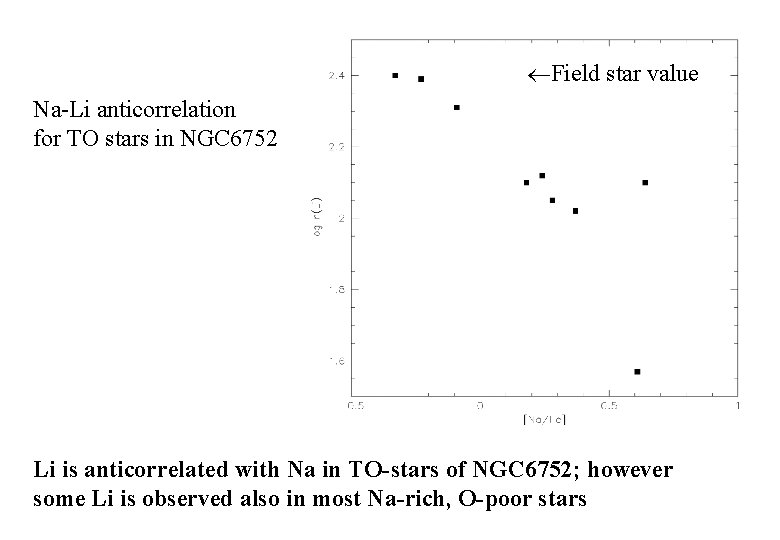
Field star value Na-Li anticorrelation for TO stars in NGC 6752 Li is anticorrelated with Na in TO-stars of NGC 6752; however some Li is observed also in most Na-rich, O-poor stars
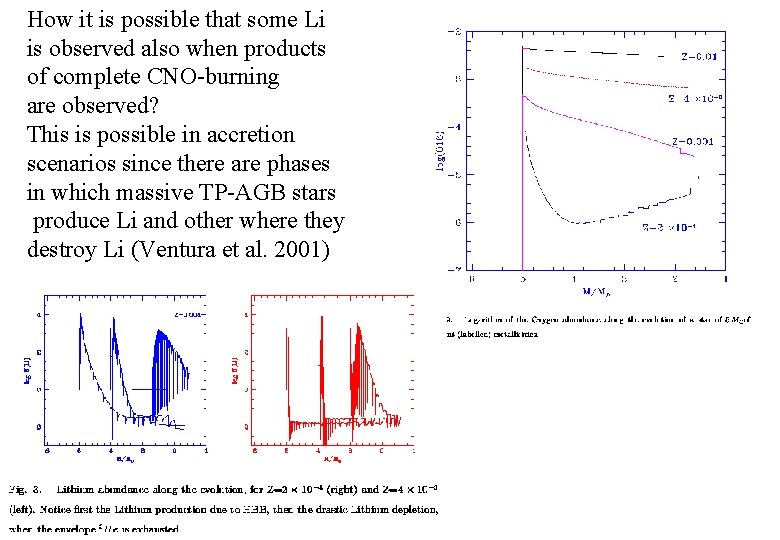
How it is possible that some Li is observed also when products of complete CNO-burning are observed? This is possible in accretion scenarios since there are phases in which massive TP-AGB stars produce Li and other where they destroy Li (Ventura et al. 2001)
Conclusions: Stars at the TO of NGC 6397, and O-rich TO-stars in NGC 6752 have Li abundances very close to those of stars on the Spite’s plateau Na-rich, O-poor TO-stars in NGC 6752 have Li abundances lower than that of stars on the Spite’s plateau, but some Li is still observed The observed dilution factor for subgiants is similar to that predict by current models
Distances and Ages of Globular Clusters
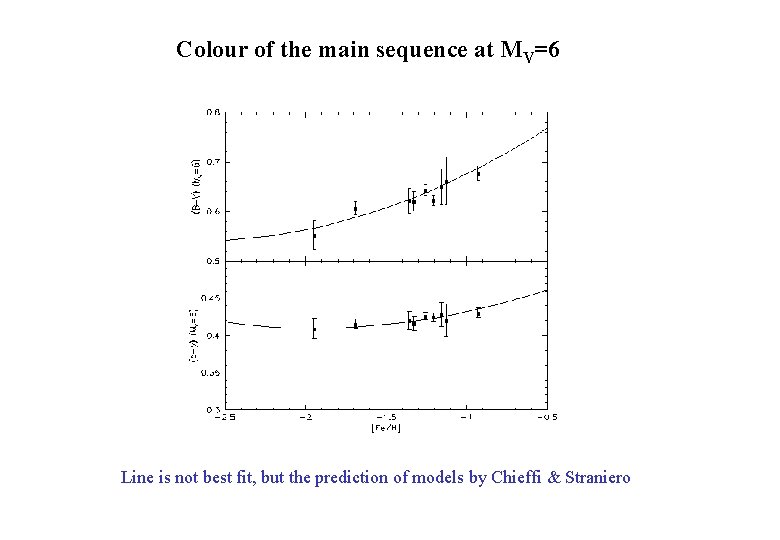
Colour of the main sequence at MV=6 Line is not best fit, but the prediction of models by Chieffi & Straniero
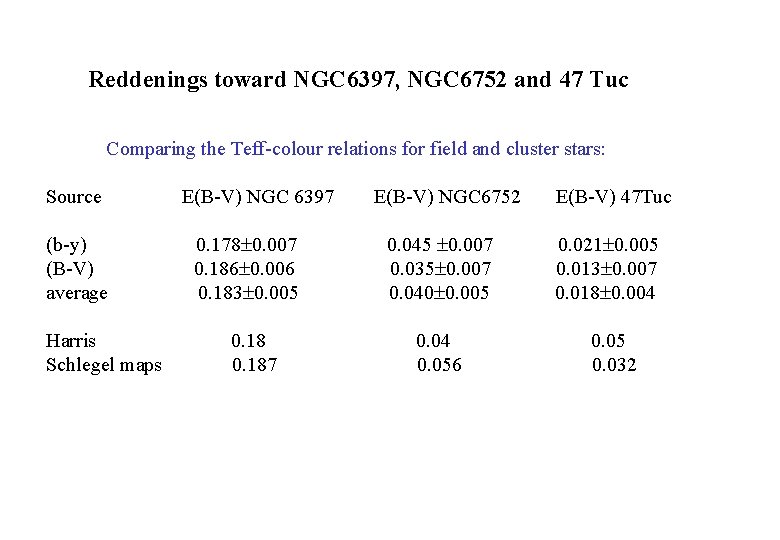
Reddenings toward NGC 6397, NGC 6752 and 47 Tuc Comparing the Teff-colour relations for field and cluster stars: Source (b-y) (B-V) average Harris Schlegel maps E(B-V) NGC 6397 0. 178 0. 007 0. 186 0. 006 0. 183 0. 005 0. 187 E(B-V) NGC 6752 0. 045 0. 007 0. 035 0. 007 0. 040 0. 005 0. 04 0. 056 E(B-V) 47 Tuc 0. 021 0. 005 0. 013 0. 007 0. 018 0. 004 0. 05 0. 032
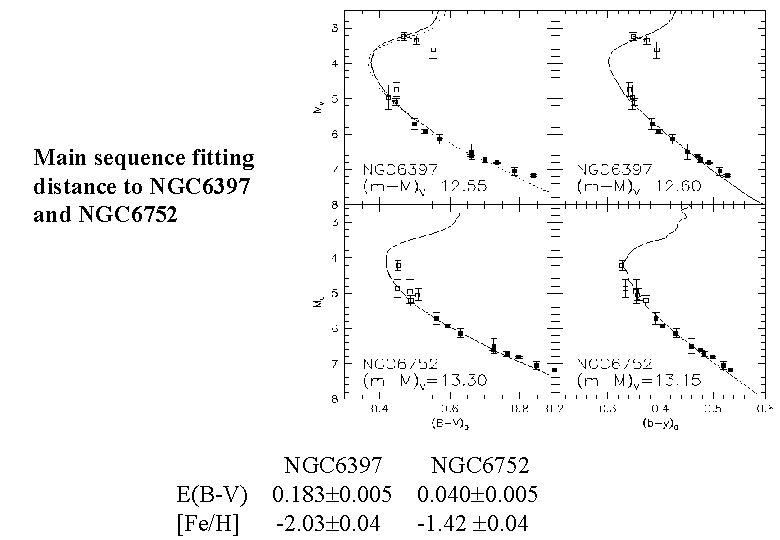
Main sequence fitting distance to NGC 6397 and NGC 6752 E(B-V) [Fe/H] NGC 6397 0. 183 0. 005 -2. 03 0. 04 NGC 6752 0. 040 0. 005 -1. 42 0. 04
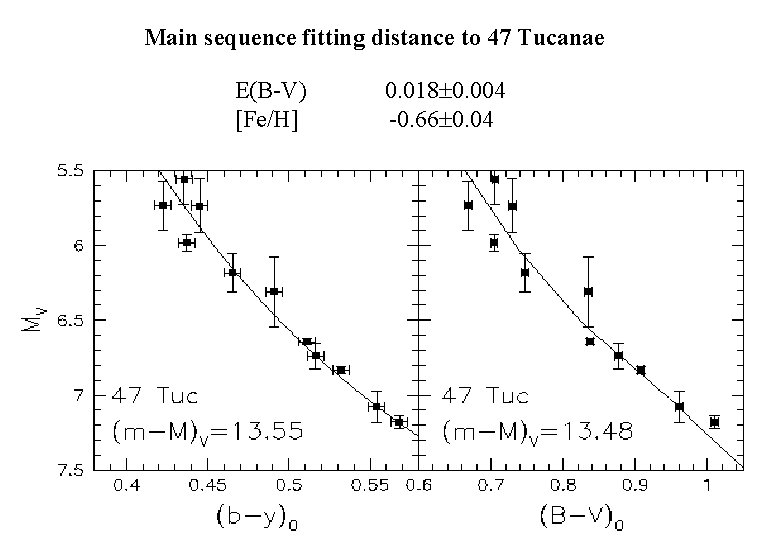
Main sequence fitting distance to 47 Tucanae E(B-V) [Fe/H] 0. 018 0. 004 -0. 66 0. 04
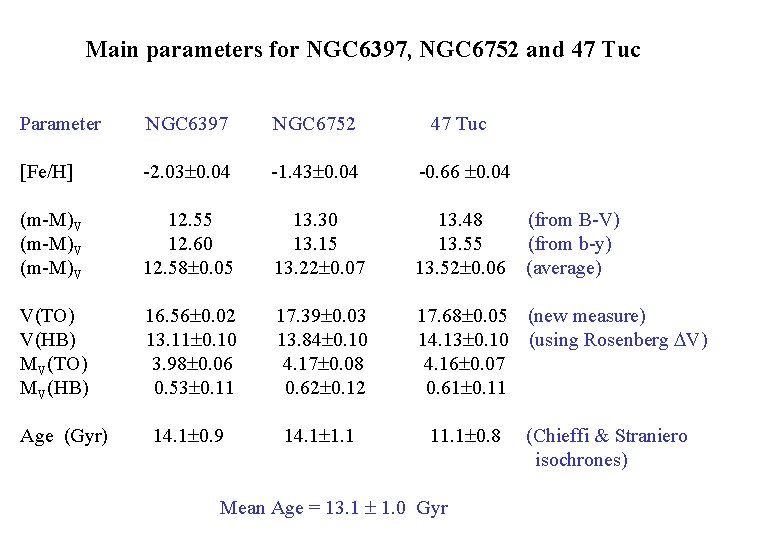
Main parameters for NGC 6397, NGC 6752 and 47 Tuc Parameter NGC 6397 NGC 6752 [Fe/H] -2. 03 0. 04 -1. 43 0. 04 -0. 66 0. 04 (m-M)V 12. 55 12. 60 12. 58 0. 05 13. 30 13. 15 13. 22 0. 07 13. 48 13. 55 13. 52 0. 06 V(TO) V(HB) MV(TO) MV(HB) 16. 56 0. 02 13. 11 0. 10 3. 98 0. 06 0. 53 0. 11 17. 39 0. 03 13. 84 0. 10 4. 17 0. 08 0. 62 0. 12 17. 68 0. 05 (new measure) 14. 13 0. 10 (using Rosenberg V) 4. 16 0. 07 0. 61 0. 11 14. 1 0. 9 14. 1 1. 1 Age (Gyr) 47 Tuc 11. 1 0. 8 Mean Age = 13. 1 1. 0 Gyr (from B-V) (from b-y) (average) (Chieffi & Straniero isochrones)
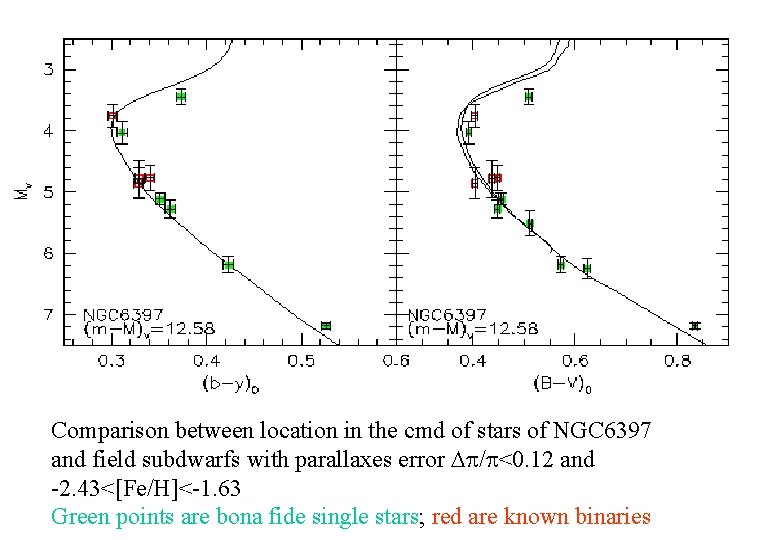
Comparison between location in the cmd of stars of NGC 6397 and field subdwarfs with parallaxes error / <0. 12 and -2. 43<[Fe/H]<-1. 63 Green points are bona fide single stars; red are known binaries
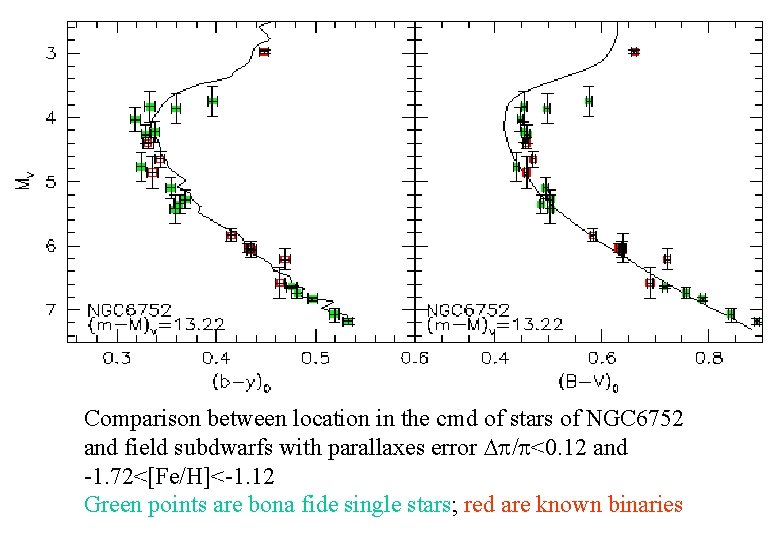
Comparison between location in the cmd of stars of NGC 6752 and field subdwarfs with parallaxes error / <0. 12 and -1. 72<[Fe/H]<-1. 12 Green points are bona fide single stars; red are known binaries
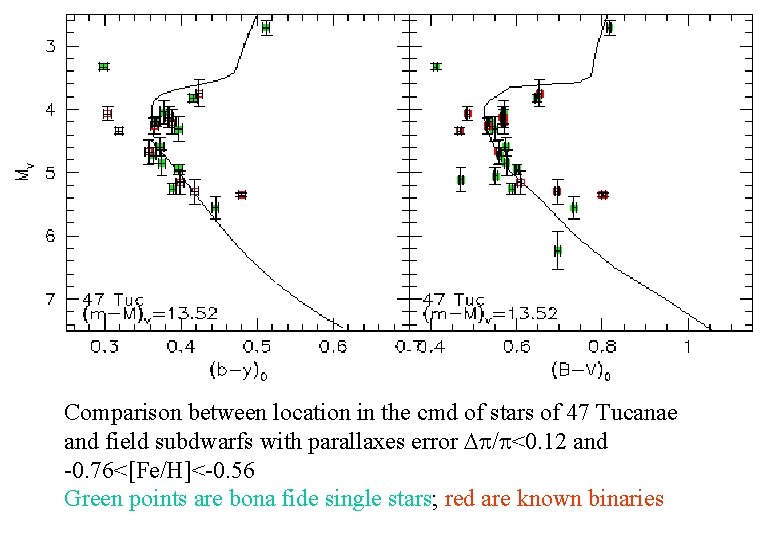
Comparison between location in the cmd of stars of 47 Tucanae and field subdwarfs with parallaxes error / <0. 12 and -0. 76<[Fe/H]<-0. 56 Green points are bona fide single stars; red are known binaries
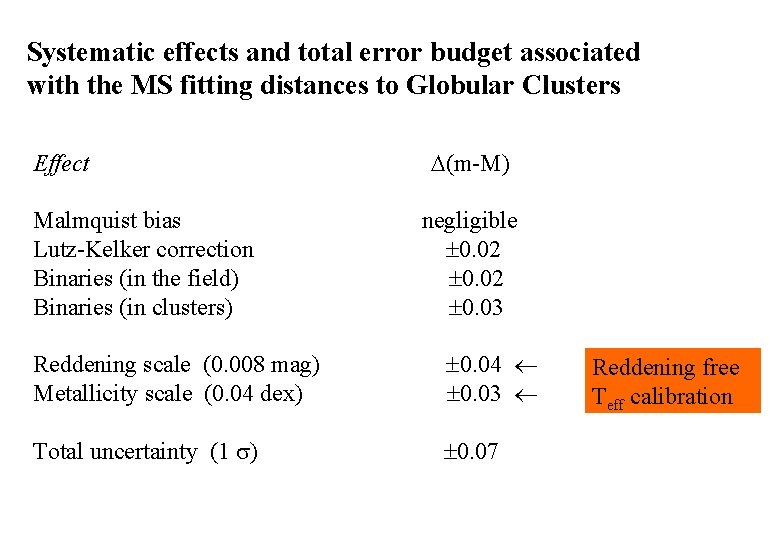
Systematic effects and total error budget associated with the MS fitting distances to Globular Clusters Effect Malmquist bias Lutz-Kelker correction Binaries (in the field) Binaries (in clusters) (m-M) negligible 0. 02 0. 03 Reddening scale (0. 008 mag) Metallicity scale (0. 04 dex) 0. 04 0. 03 Total uncertainty (1 ) 0. 07 Reddening free Teff calibration
Rotation of TO-stars in globular clusters
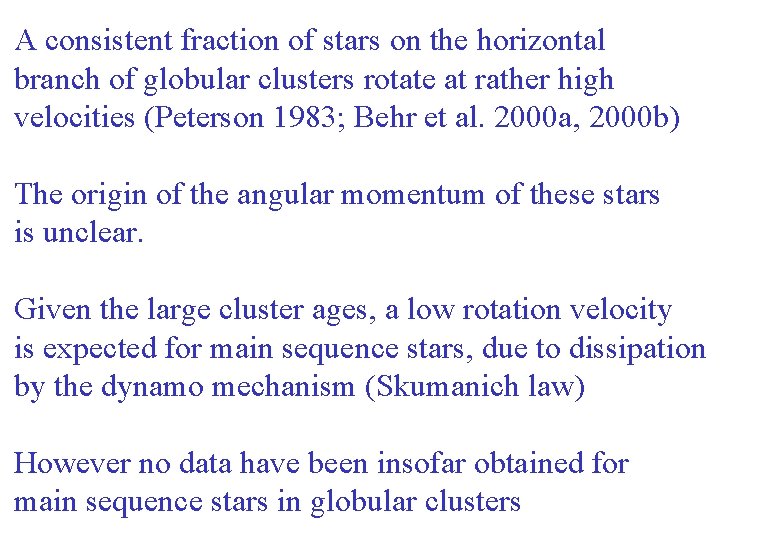
A consistent fraction of stars on the horizontal branch of globular clusters rotate at rather high velocities (Peterson 1983; Behr et al. 2000 a, 2000 b) The origin of the angular momentum of these stars is unclear. Given the large cluster ages, a low rotation velocity is expected for main sequence stars, due to dissipation by the dynamo mechanism (Skumanich law) However no data have been insofar obtained for main sequence stars in globular clusters
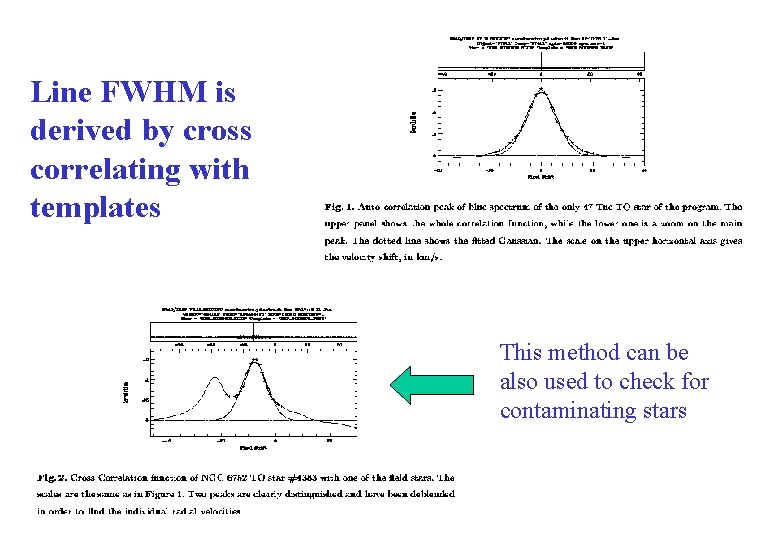
Line FWHM is derived by cross correlating with templates This method can be also used to check for contaminating stars
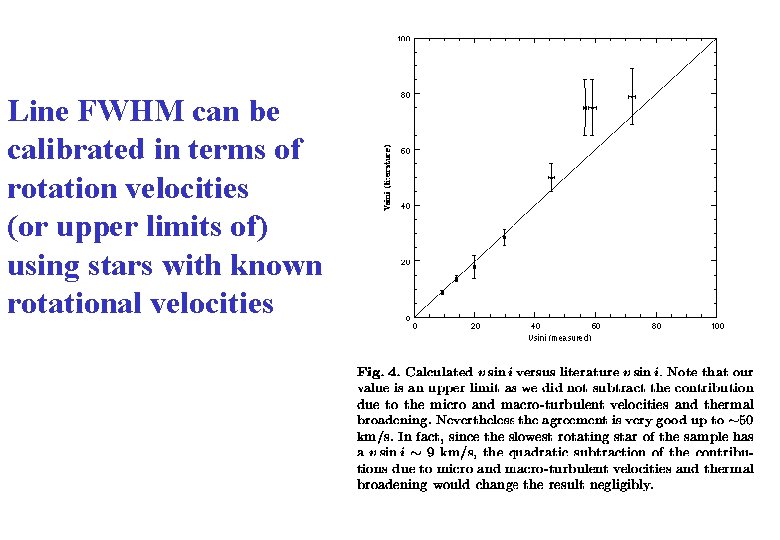
Line FWHM can be calibrated in terms of rotation velocities (or upper limits of) using stars with known rotational velocities
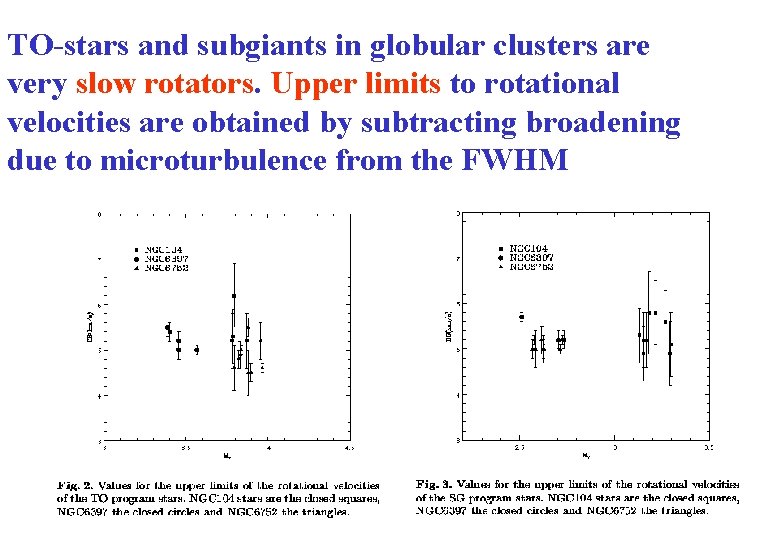
TO-stars and subgiants in globular clusters are very slow rotators. Upper limits to rotational velocities are obtained by subtracting broadening due to microturbulence from the FWHM
If stars rotate, scatter is expected depending on random orientation of the rotational axis Very stringent upper limits to rotation can be obtained by comparing the observed scatter with that expected from random axis orientation The limit is: v sin i 1. 7 km/s The limit on rotation is v 2 km/s
SUMMARY
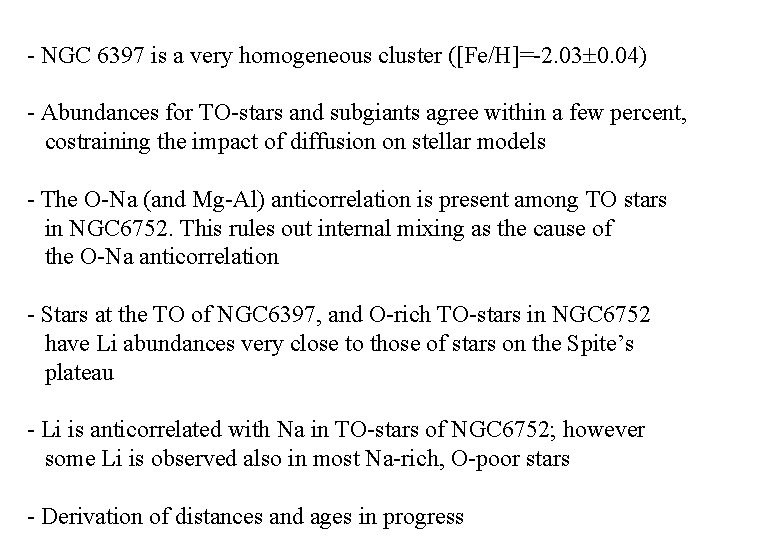
- NGC 6397 is a very homogeneous cluster ([Fe/H]=-2. 03 0. 04) - Abundances for TO-stars and subgiants agree within a few percent, costraining the impact of diffusion on stellar models - The O-Na (and Mg-Al) anticorrelation is present among TO stars in NGC 6752. This rules out internal mixing as the cause of the O-Na anticorrelation - Stars at the TO of NGC 6397, and O-rich TO-stars in NGC 6752 have Li abundances very close to those of stars on the Spite’s plateau - Li is anticorrelated with Na in TO-stars of NGC 6752; however some Li is observed also in most Na-rich, O-poor stars - Derivation of distances and ages in progress
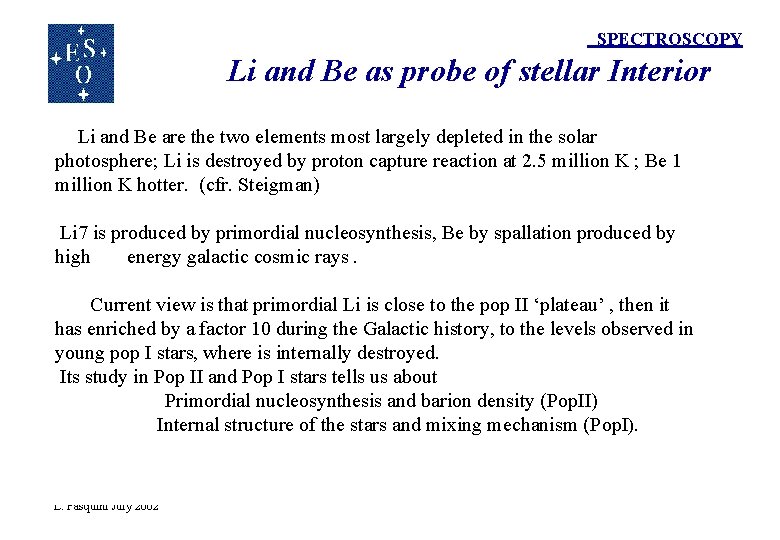
SPECTROSCOPY Li and Be as probe of stellar Interior Li and Be are the two elements most largely depleted in the solar photosphere; Li is destroyed by proton capture reaction at 2. 5 million K ; Be 1 million K hotter. (cfr. Steigman) Li 7 is produced by primordial nucleosynthesis, Be by spallation produced by high energy galactic cosmic rays. Current view is that primordial Li is close to the pop II ‘plateau’ , then it has enriched by a factor 10 during the Galactic history, to the levels observed in young pop I stars, where is internally destroyed. Its study in Pop II and Pop I stars tells us about Primordial nucleosynthesis and barion density (Pop. II) Internal structure of the stars and mixing mechanism (Pop. I). L. Pasquini July 2002
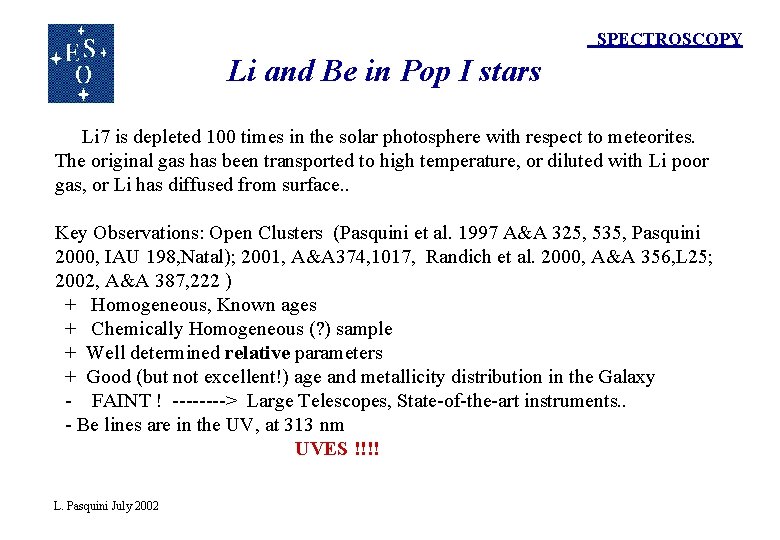
SPECTROSCOPY Li and Be in Pop I stars Li 7 is depleted 100 times in the solar photosphere with respect to meteorites. The original gas has been transported to high temperature, or diluted with Li poor gas, or Li has diffused from surface. . Key Observations: Open Clusters (Pasquini et al. 1997 A&A 325, 535, Pasquini 2000, IAU 198, Natal); 2001, A&A 374, 1017, Randich et al. 2000, A&A 356, L 25; 2002, A&A 387, 222 ) + Homogeneous, Known ages + Chemically Homogeneous (? ) sample + Well determined relative parameters + Good (but not excellent!) age and metallicity distribution in the Galaxy - FAINT ! ----> Large Telescopes, State-of-the-art instruments. . - Be lines are in the UV, at 313 nm UVES !!!! L. Pasquini July 2002
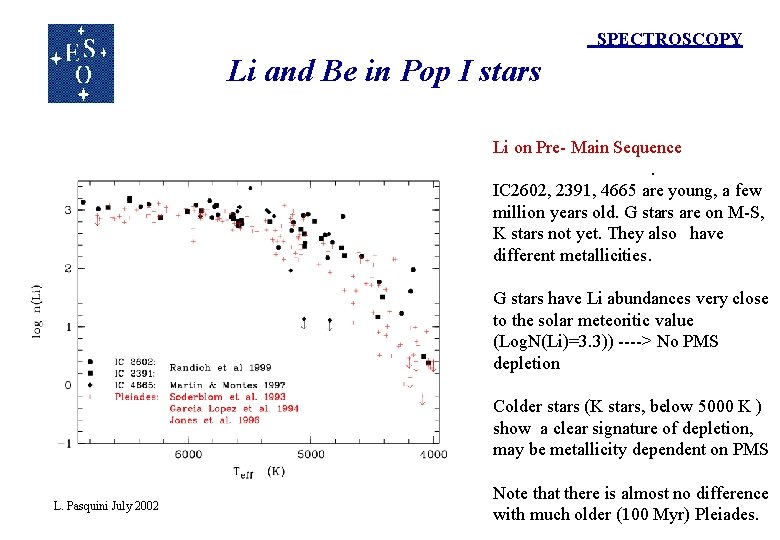
SPECTROSCOPY Li and Be in Pop I stars Li on Pre- Main Sequence. IC 2602, 2391, 4665 are young, a few million years old. G stars are on M-S, K stars not yet. They also have different metallicities. G stars have Li abundances very close to the solar meteoritic value (Log. N(Li)=3. 3)) ----> No PMS depletion Colder stars (K stars, below 5000 K ) show a clear signature of depletion, may be metallicity dependent on PMS L. Pasquini July 2002 Note that there is almost no difference with much older (100 Myr) Pleiades.
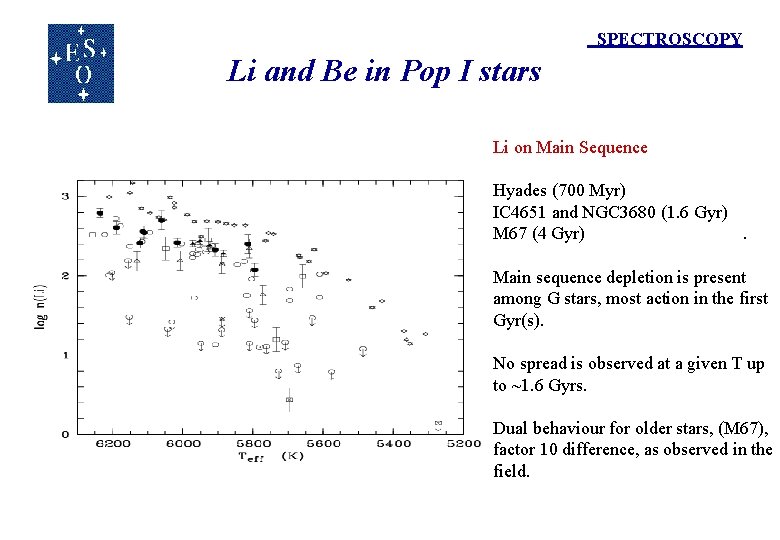
SPECTROSCOPY Li and Be in Pop I stars Li on Main Sequence Hyades (700 Myr) IC 4651 and NGC 3680 (1. 6 Gyr) M 67 (4 Gyr). Main sequence depletion is present among G stars, most action in the first Gyr(s). No spread is observed at a given T up to ~1. 6 Gyrs. Dual behaviour for older stars, (M 67), factor 10 difference, as observed in the field. L. Pasquini July 2002
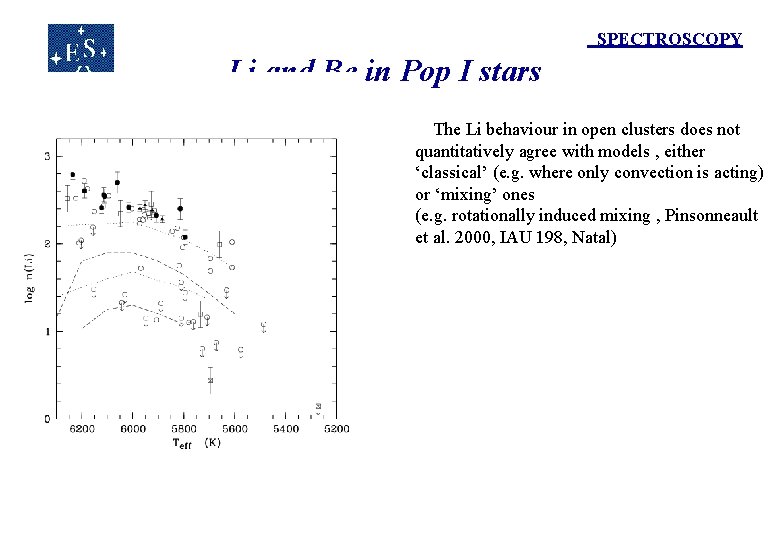
SPECTROSCOPY Li and Be in Pop I stars The Li behaviour in open clusters does not quantitatively agree with models , either ‘classical’ (e. g. where only convection is acting) or ‘mixing’ ones (e. g. rotationally induced mixing , Pinsonneault et al. 2000, IAU 198, Natal) L. Pasquini July 2002
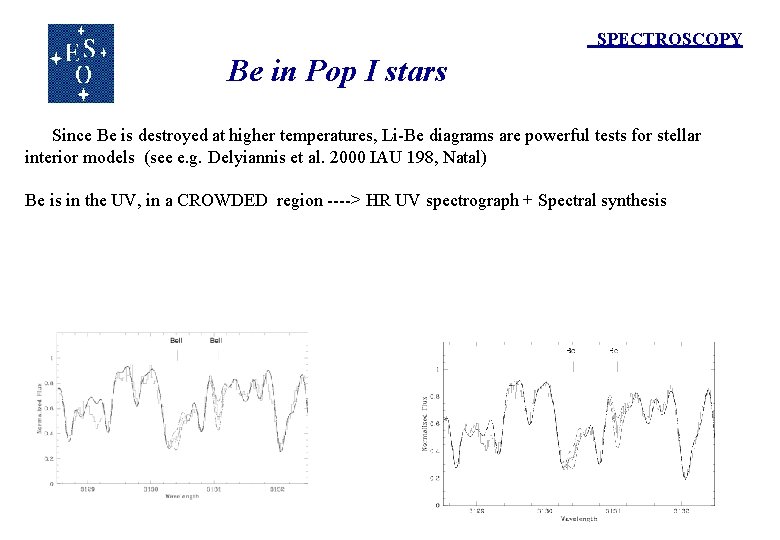
SPECTROSCOPY Be in Pop I stars Since Be is destroyed at higher temperatures, Li-Be diagrams are powerful tests for stellar interior models (see e. g. Delyiannis et al. 2000 IAU 198, Natal) Be is in the UV, in a CROWDED region ----> HR UV spectrograph + Spectral synthesis L. Pasquini July 2002
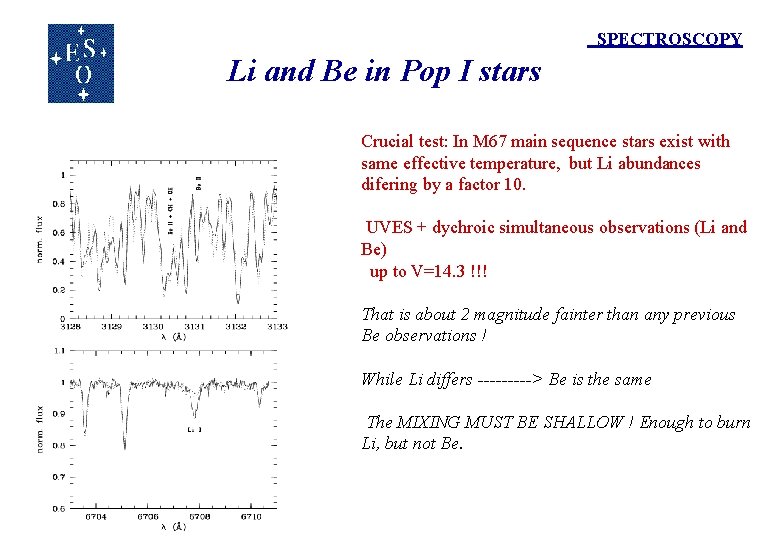
SPECTROSCOPY Li and Be in Pop I stars Crucial test: In M 67 main sequence stars exist with same effective temperature, but Li abundances difering by a factor 10. UVES + dychroic simultaneous observations (Li and Be) up to V=14. 3 !!! That is about 2 magnitude fainter than any previous Be observations ! While Li differs -----> Be is the same The MIXING MUST BE SHALLOW ! Enough to burn Li, but not Be. L. Pasquini July 2002
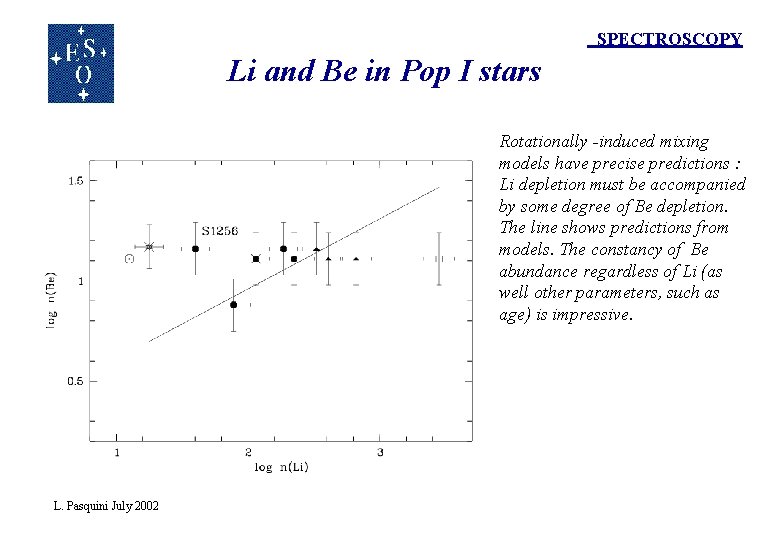
SPECTROSCOPY Li and Be in Pop I stars Rotationally -induced mixing models have precise predictions : Li depletion must be accompanied by some degree of Be depletion. The line shows predictions from models. The constancy of Be abundance regardless of Li (as well other parameters, such as age) is impressive. L. Pasquini July 2002
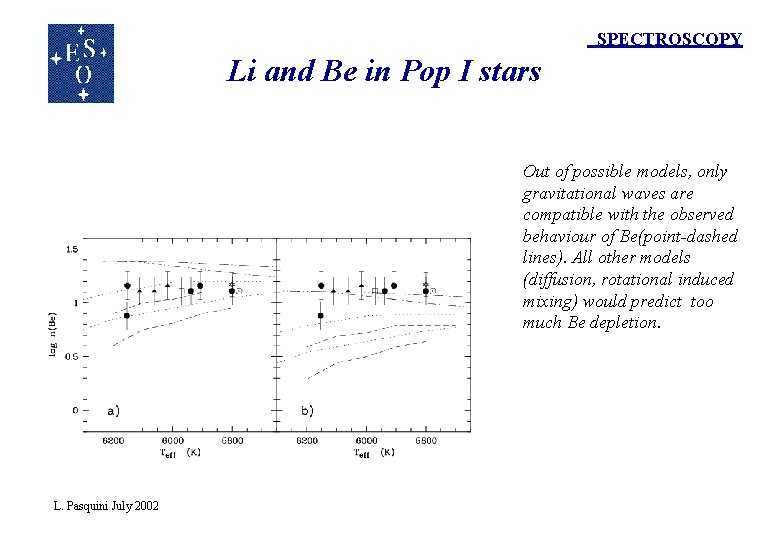
SPECTROSCOPY Li and Be in Pop I stars Out of possible models, only gravitational waves are compatible with the observed behaviour of Be(point-dashed lines). All other models (diffusion, rotational induced mixing) would predict too much Be depletion. L. Pasquini July 2002
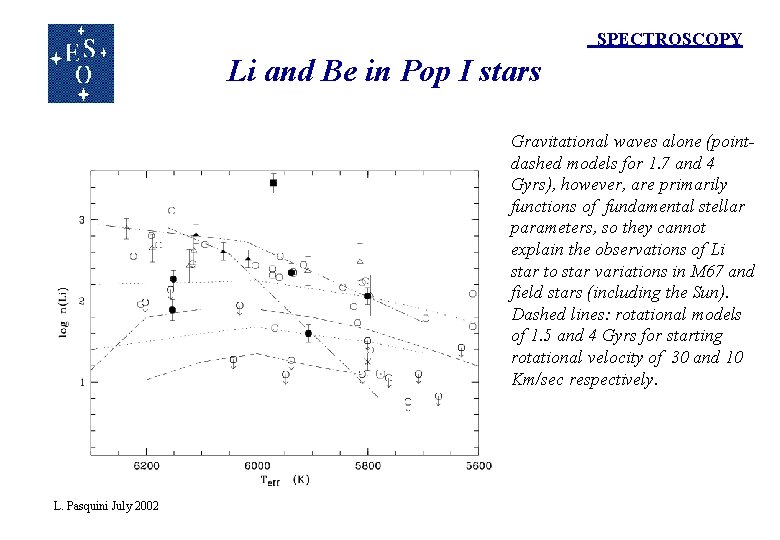
SPECTROSCOPY Li and Be in Pop I stars Gravitational waves alone (pointdashed models for 1. 7 and 4 Gyrs), however, are primarily functions of fundamental stellar parameters, so they cannot explain the observations of Li star to star variations in M 67 and field stars (including the Sun). Dashed lines: rotational models of 1. 5 and 4 Gyrs for starting rotational velocity of 30 and 10 Km/sec respectively. L. Pasquini July 2002