
Spectroscopy of extrasolar planets atmosphere Alain Lecavelier des

- Slides: 31
Spectroscopy of extrasolar planets atmosphere Alain Lecavelier des Etangs Institut d’Astrophysique de Paris VLST Workshop STSc. I Feb. 26 -27, 2004
Alfred Vidal-Madjar Jean-Michel Désert Roger Ferlet Guillaume Hébrard (IAP, Paris) Alain Lecavelier des Etangs Institut d’Astrophysique de Paris VLST Workshop STSc. I Feb. 26 -27, 2004
Spectroscopy of extrasolar planets atmosphere • Future is difficult to predict • In 1994, “When will the first extrasolar planet detected ? ” answers: 2000, 2010… • 1 year ago: detection of OI: “not within the current capabilities” • Prediction: Future is impossible to predict VLST Workshop STSc. I Feb. 26 -27, 2004
Spectroscopy of extrasolar planets atmosphere • What has been done (HST): (description of the present) 4 UV detections of the bottom and upper atmosphere of HD 209458 b in space, in the UV-optical wavelength range. • With a VLST: (extrapolation to the future from the present) – Large sample of extrasolar planets – Detailed view of planets around nearby stars – Toward Earth and Ocean-like planets VLST Workshop STSc. I Feb. 26 -27, 2004
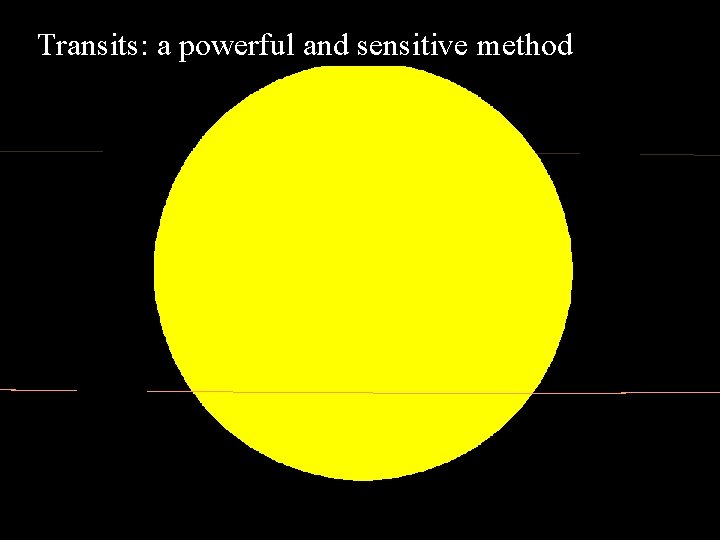
Transits: a powerful and sensitive method VLST Workshop STSc. I Feb. 26 -27, 2004
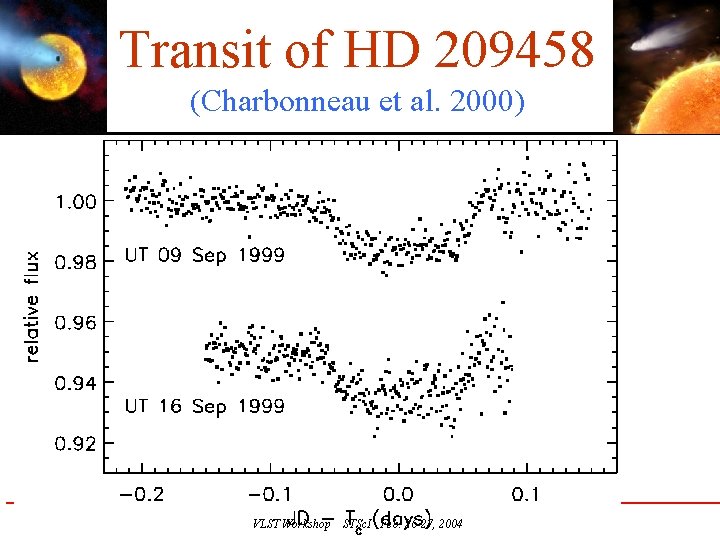
Transit of HD 209458 (Charbonneau et al. 2000) VLST Workshop STSc. I Feb. 26 -27, 2004
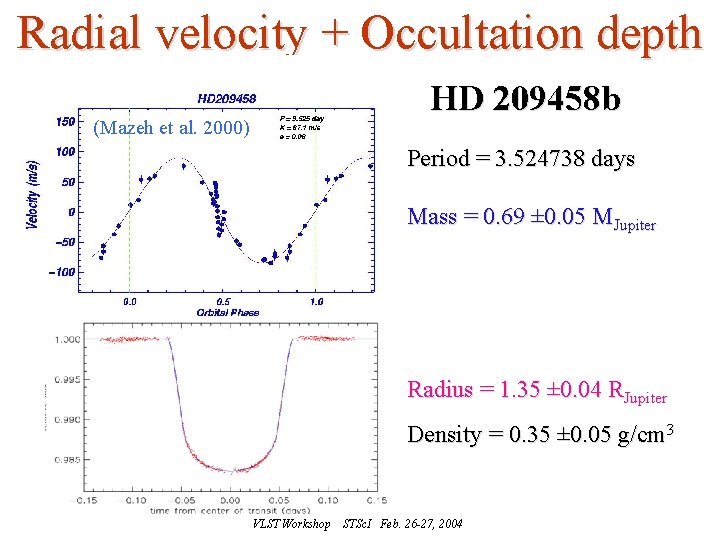
Radial velocity + Occultation depth (Mazeh et al. 2000) HD 209458 b Period = 3. 524738 days Mass = 0. 69 ± 0. 05 MJupiter Radius = 1. 35 ± 0. 04 RJupiter Density = 0. 35 ± 0. 05 g/cm 3 VLST Workshop STSc. I Feb. 26 -27, 2004
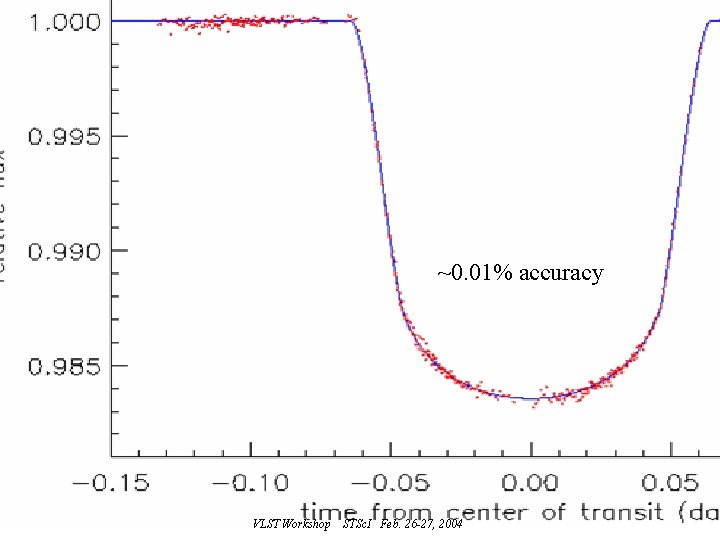
~0. 01% accuracy VLST Workshop STSc. I Feb. 26 -27, 2004
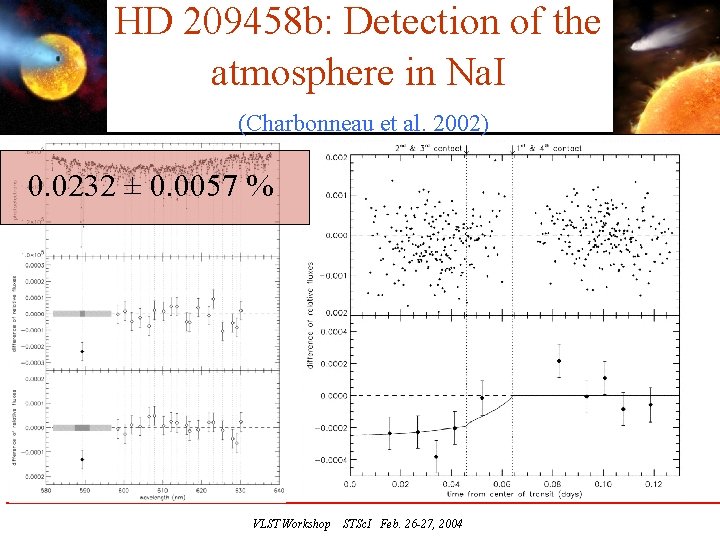
HD 209458 b: Detection of the atmosphere in Na. I (Charbonneau et al. 2002) 0. 0232 ± 0. 0057 % VLST Workshop STSc. I Feb. 26 -27, 2004
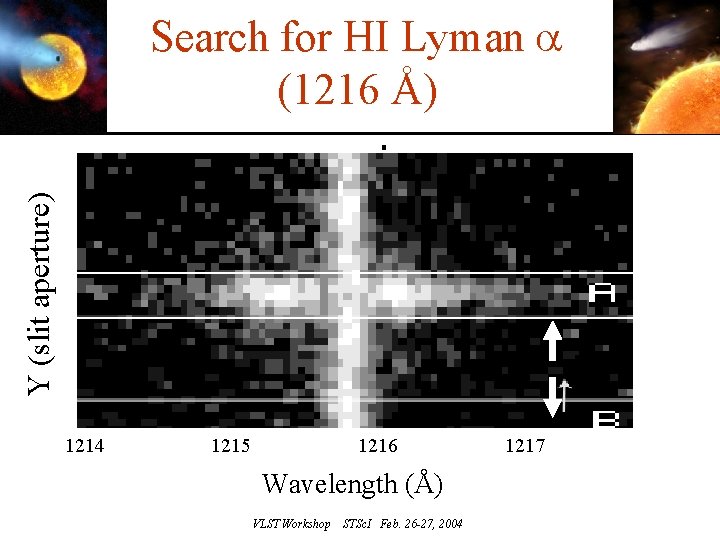
Y (slit aperture) Search for HI Lyman a (1216 Å) 1214 1215 1216 Wavelength (Å) VLST Workshop STSc. I Feb. 26 -27, 2004 1217
VLST Workshop STSc. I Feb. 26 -27, 2004
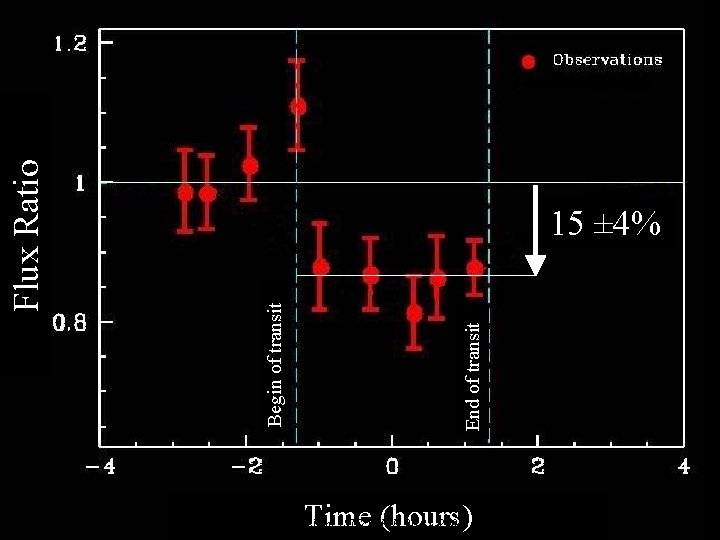
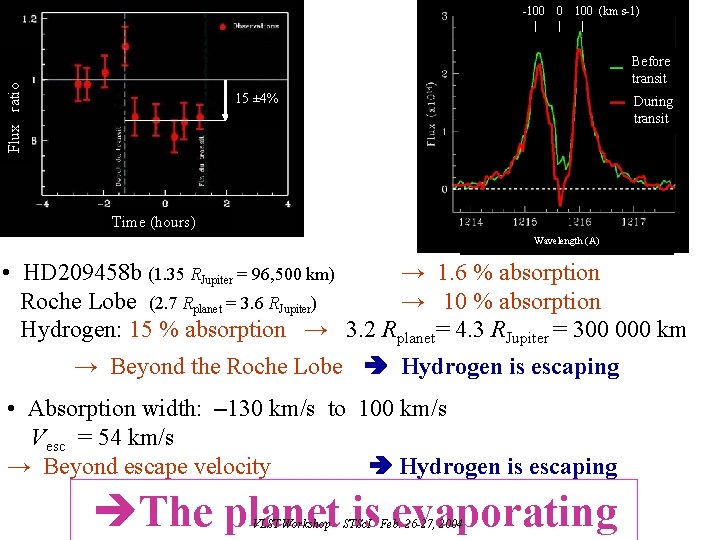
End of transit Begin of transit Flux Ratio 15 ± 4% Time (hours) VLST Workshop STSc. I Feb. 26 -27, 2004
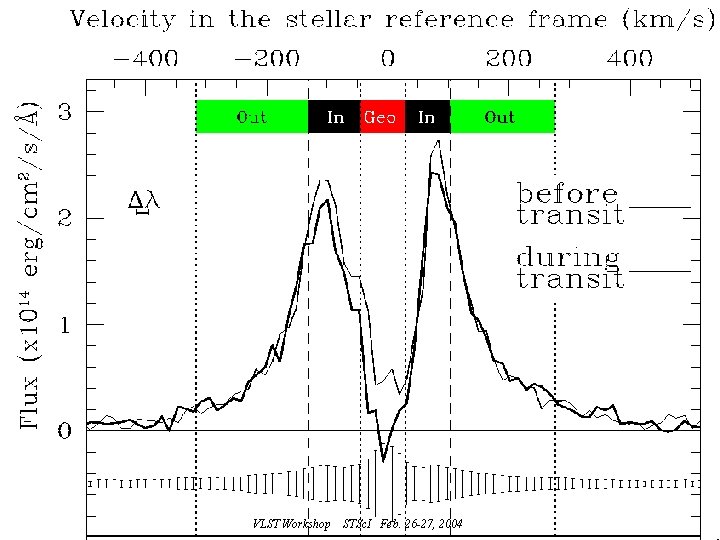
-100 | 100 (km s-1) | Flux ratio Before transit 15 ± 4% During transit Time (hours) Wavelength (A) • HD 209458 b (1. 35 RJupiter = 96, 500 km) → 1. 6 % absorption Roche Lobe (2. 7 Rplanet = 3. 6 RJupiter) → 10 % absorption Hydrogen: 15 % absorption → 3. 2 Rplanet= 4. 3 RJupiter = 300 000 km → Beyond the Roche Lobe Hydrogen is escaping • Absorption width: – 130 km/s to 100 km/s Vesc = 54 km/s → Beyond escape velocity Hydrogen is escaping The planet is evaporating VLST Workshop STSc. I Feb. 26 -27, 2004
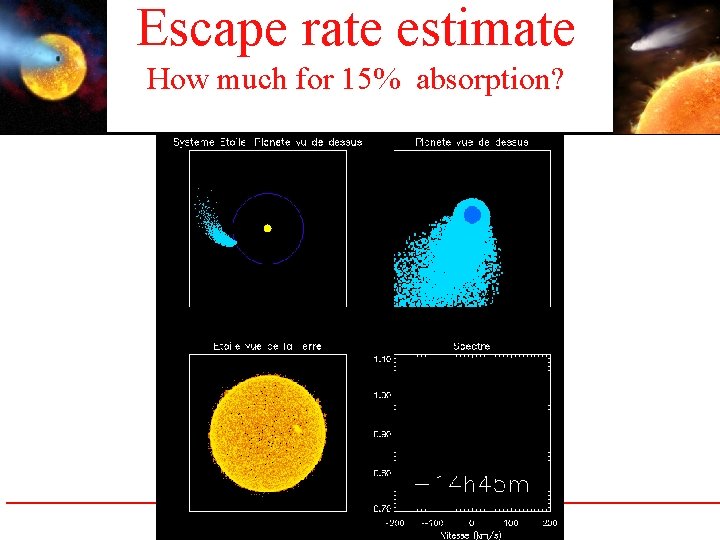
Escape rate estimate How much for 15% absorption? VLST Workshop STSc. I Feb. 26 -27, 2004
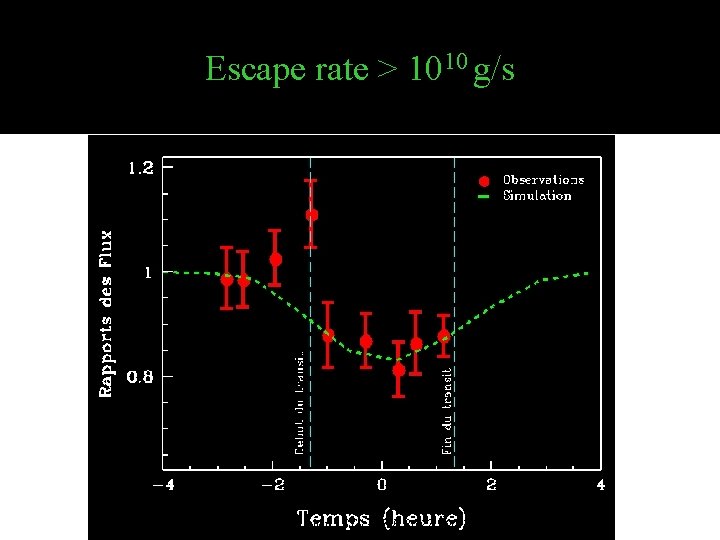
Escape rate > 1010 g/s VLST Workshop STSc. I Feb. 26 -27, 2004
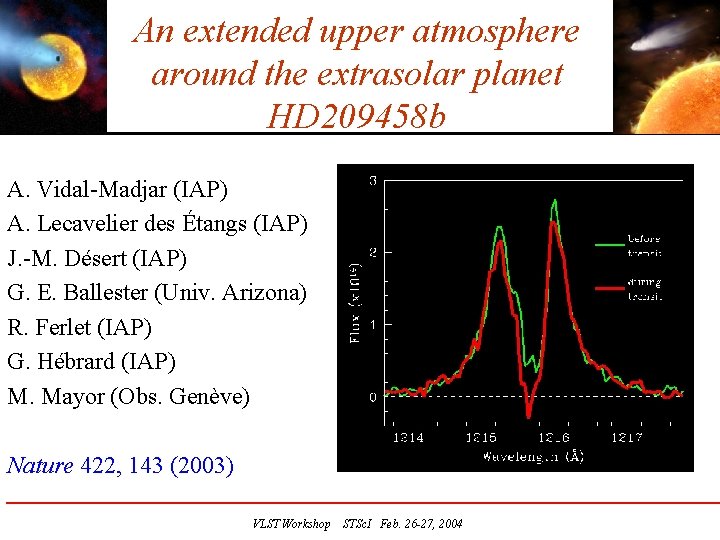
An extended upper atmosphere around the extrasolar planet HD 209458 b A. Vidal-Madjar (IAP) A. Lecavelier des Étangs (IAP) J. -M. Désert (IAP) G. E. Ballester (Univ. Arizona) R. Ferlet (IAP) G. Hébrard (IAP) M. Mayor (Obs. Genève) Nature 422, 143 (2003) VLST Workshop STSc. I Feb. 26 -27, 2004
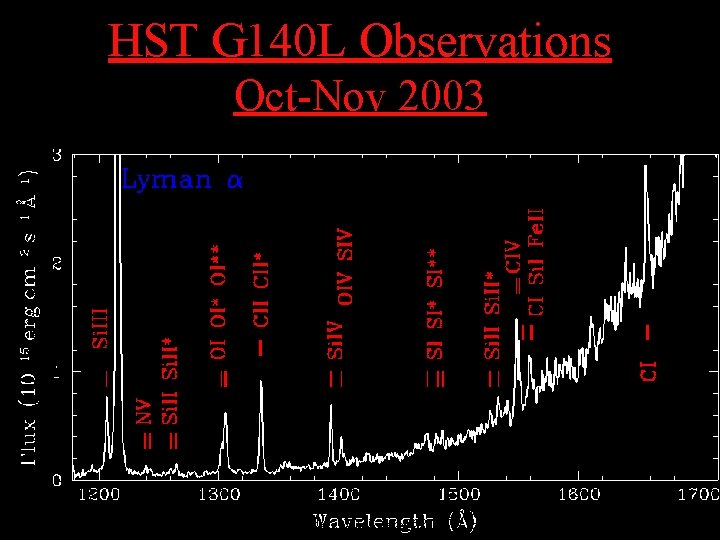
HST G 140 L Observations Oct-Nov 2003 • Fig 1 VLST Workshop STSc. I Feb. 26 -27, 2004
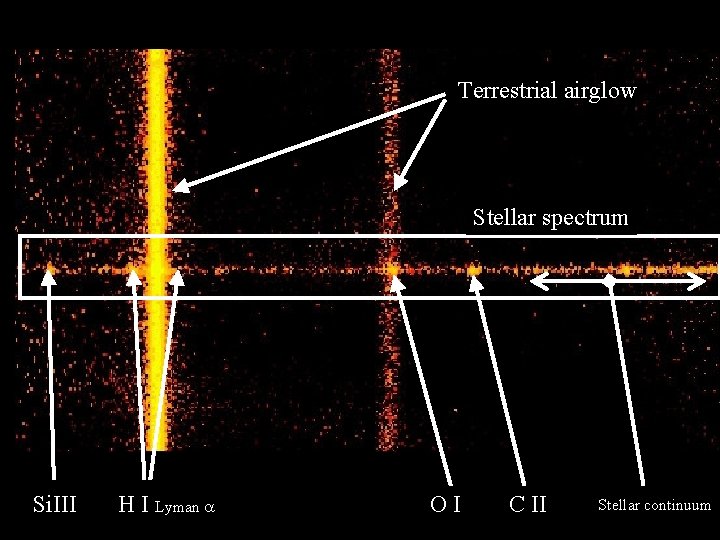
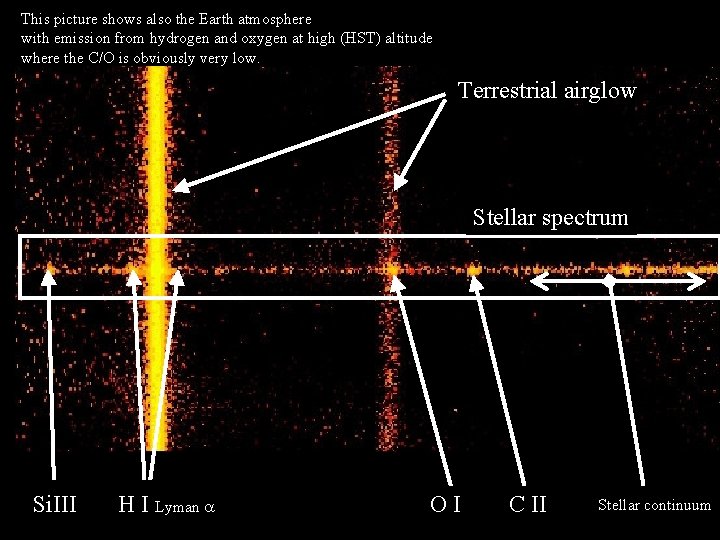
Terrestrial airglow Stellar spectrum Si. III H I Lyman a OI VLST Workshop STSc. I Feb. 26 -27, 2004 C II Stellar continuum
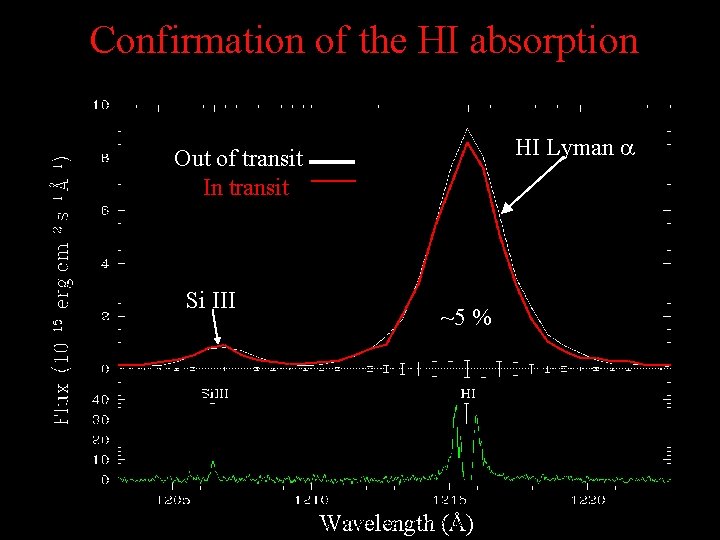
Confirmation of the HI absorption • Fig 2 a HI Lyman a Out of transit In transit Si III ~5 % Wavelength (Å) VLST Workshop STSc. I Feb. 26 -27, 2004
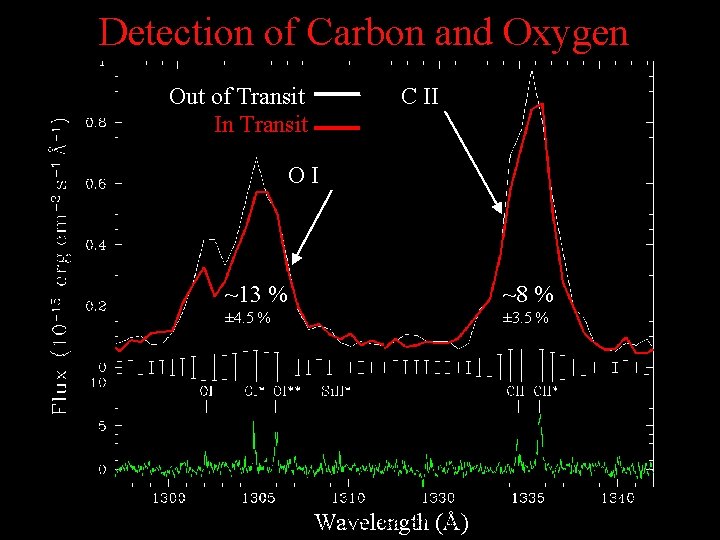
Detection of Carbon and Oxygen Out of Transit In Transit C II OI Vidal-Madjar et al. 2004 (astro-ph/0401457) ~13 % ~8 % ± 4. 5 % ± 3. 5 % Wavelength (Å) VLST Workshop STSc. I Feb. 26 -27, 2004
Consequence Vidal-Madjar et al. (2004 astro-ph/0401457) • Oxygen and carbon are also present in the upper atmosphere of HD 209458 b • They are carried out by the hydrogen flow: HYDRODYNAMICAL ESCAPE ( « BLOW-OFF » ) VLST Workshop STSc. I Feb. 26 -27, 2004
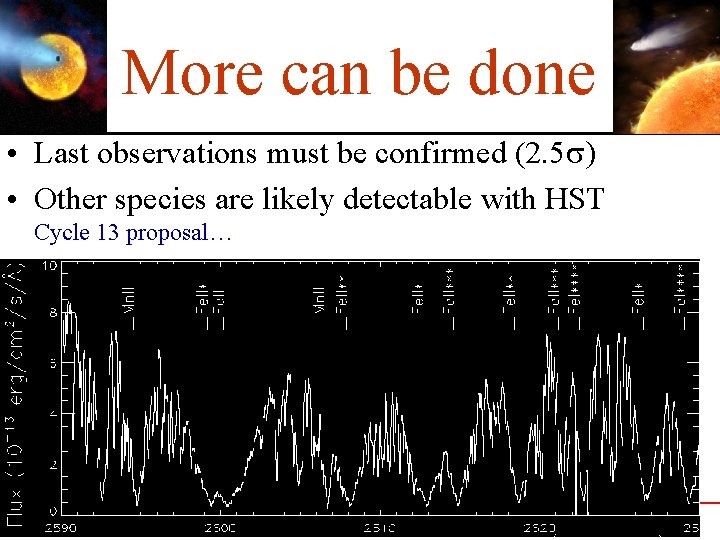
More can be done • Last observations must be confirmed (2. 5 s) • Other species are likely detectable with HST Cycle 13 proposal… VLST Workshop STSc. I Feb. 26 -27, 2004
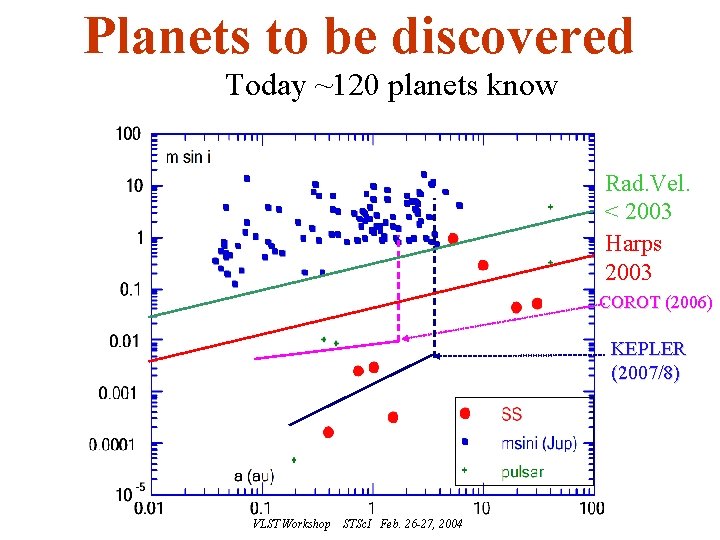
Planets to be discovered Today ~120 planets know Rad. Vel. 10 m/s <(present) 2003 1 m/s Harps (2003 HARPS) 2003 COROT (2006) KEPLER (2007/8) VLST Workshop STSc. I Feb. 26 -27, 2004
A large number of targets for the VLST • ≥ 7% planet / star • 15% « Hot Jupiter » / planet 1% « Hot Jupiter » / star • 10% transiting planet / « Hot Jupiter » 0. 1% transit / star • 10, 000 G stars (V≤ 8) 10 « Hot Jupiter » transits on stars V≤ 8 • 85, 000 G stars (V≤ 10) 85 transits on V≤ 10 • 300, 000 G stars (V≤ 12) 300 transits on V≤ 12 VLST Workshop STSc. I Feb. 26 -27, 2004
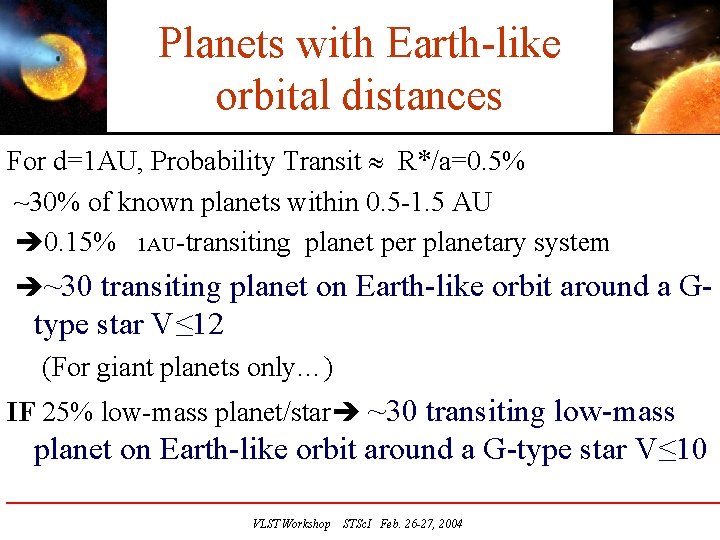
Planets with Earth-like orbital distances For d=1 AU, Probability Transit R*/a=0. 5% ~30% of known planets within 0. 5 -1. 5 AU 0. 15% 1 AU-transiting planet per planetary system ~30 transiting planet on Earth-like orbit around a G- type star V≤ 12 (For giant planets only…) IF 25% low-mass planet/star ~30 transiting low-mass planet on Earth-like orbit around a G-type star V≤ 10 VLST Workshop STSc. I Feb. 26 -27, 2004
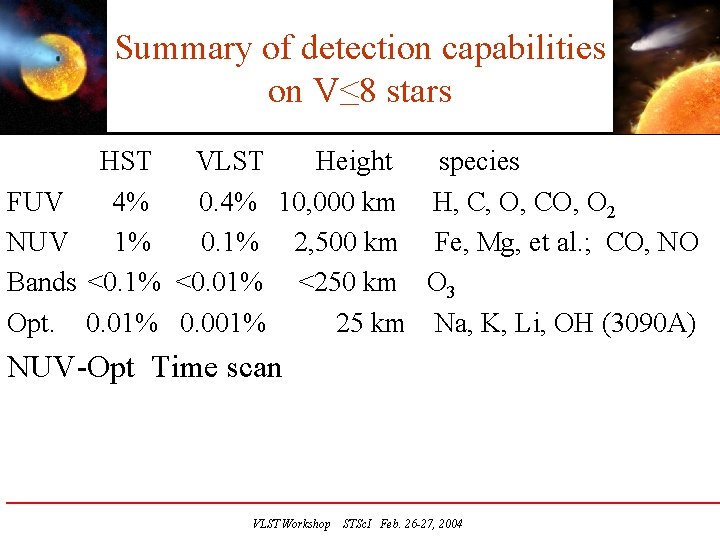
Summary of detection capabilities on V≤ 8 stars HST VLST Height species FUV 4% 0. 4% 10, 000 km H, C, O, CO, O 2 NUV 1% 0. 1% 2, 500 km Fe, Mg, et al. ; CO, NO Bands <0. 1% <0. 01% <250 km O 3 Opt. 0. 01% 0. 001% 25 km Na, K, Li, OH (3090 A) NUV-Opt Time scan VLST Workshop STSc. I Feb. 26 -27, 2004
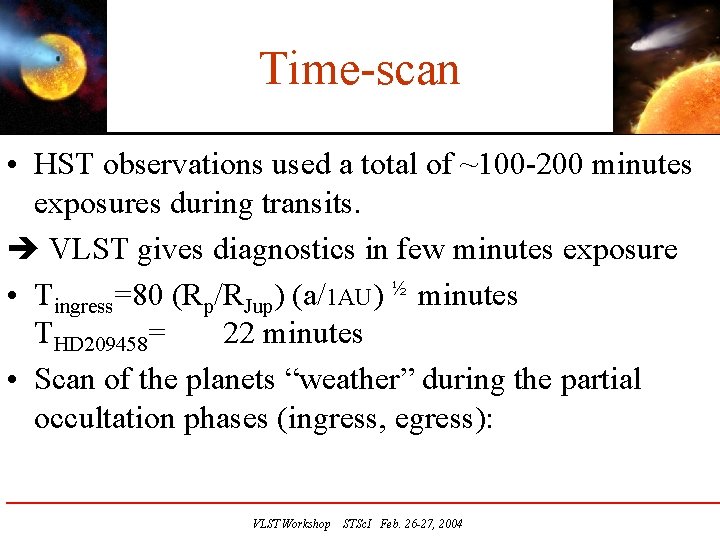
Time-scan • HST observations used a total of ~100 -200 minutes exposures during transits. VLST gives diagnostics in few minutes exposure • Tingress=80 (Rp/RJup) (a/1 AU) ½ minutes THD 209458= 22 minutes • Scan of the planets “weather” during the partial occultation phases (ingress, egress): VLST Workshop STSc. I Feb. 26 -27, 2004
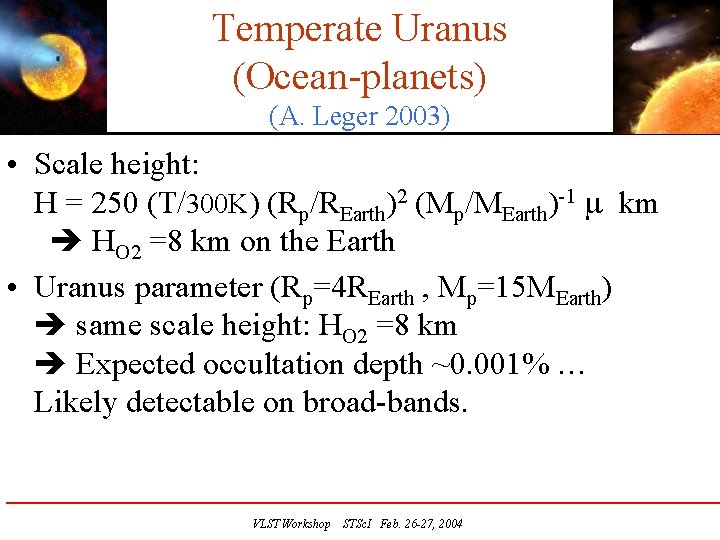
Temperate Uranus (Ocean-planets) (A. Leger 2003) • Scale height: H = 250 (T/300 K) (Rp/REarth)2 (Mp/MEarth)-1 m km HO 2 =8 km on the Earth • Uranus parameter (Rp=4 REarth , Mp=15 MEarth) same scale height: HO 2 =8 km Expected occultation depth ~0. 001% … Likely detectable on broad-bands. VLST Workshop STSc. I Feb. 26 -27, 2004
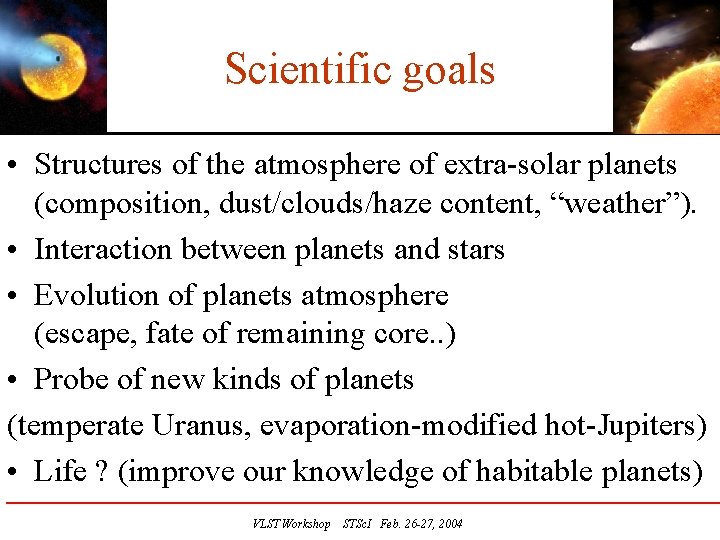
Scientific goals • Structures of the atmosphere of extra-solar planets (composition, dust/clouds/haze content, “weather”). • Interaction between planets and stars • Evolution of planets atmosphere (escape, fate of remaining core. . ) • Probe of new kinds of planets (temperate Uranus, evaporation-modified hot-Jupiters) • Life ? (improve our knowledge of habitable planets) VLST Workshop STSc. I Feb. 26 -27, 2004
This picture shows also the Earth atmosphere with emission from hydrogen and oxygen at high (HST) altitude where the C/O is obviously very low. Terrestrial airglow Stellar spectrum Si. III H I Lyman a OI VLST Workshop STSc. I Feb. 26 -27, 2004 C II Stellar continuum
• END VLST Workshop STSc. I Feb. 26 -27, 2004