
SPECTROSCOPY AND ITS APPLICATIONS DR ANIL KUMAR ASSOCIATE


- Slides: 18
SPECTROSCOPY AND ITS APPLICATIONS DR. ANIL KUMAR ASSOCIATE PROFESSOR OF CHEMISTRY HARISH CHANDRA P G COLLEGE, VARANASI
Spectrocopy: ØIt is a tool for elucidation of structure of chemical compounds. Ø There are so many types of spectroscopy such as ØUV-Visible spectroscopy Ø IR spectroscopy ØRaman spectroscopy ØNMR spectroscopy Ø Rotational or Microwave spectroscopy Ø ESR spectroscopy Ø Photo acoustic spectroscopy Ø Auger spectroscopy
UV and Visible spectroscopy
IR SPECTROSCOPY
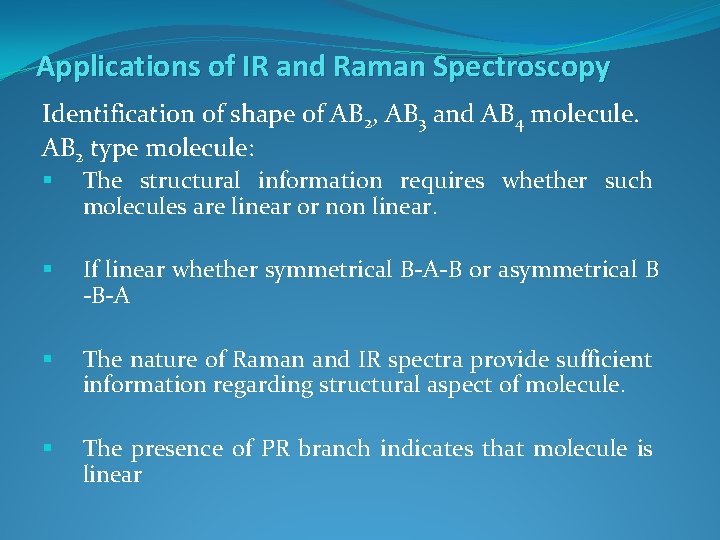
Applications of IR and Raman Spectroscopy Identification of shape of AB 2, AB 3 and AB 4 molecule. AB 2 type molecule: § The structural information requires whether such molecules are linear or non linear. § If linear whether symmetrical B-A-B or asymmetrical B -B-A § The nature of Raman and IR spectra provide sufficient information regarding structural aspect of molecule. § The presence of PR branch indicates that molecule is linear
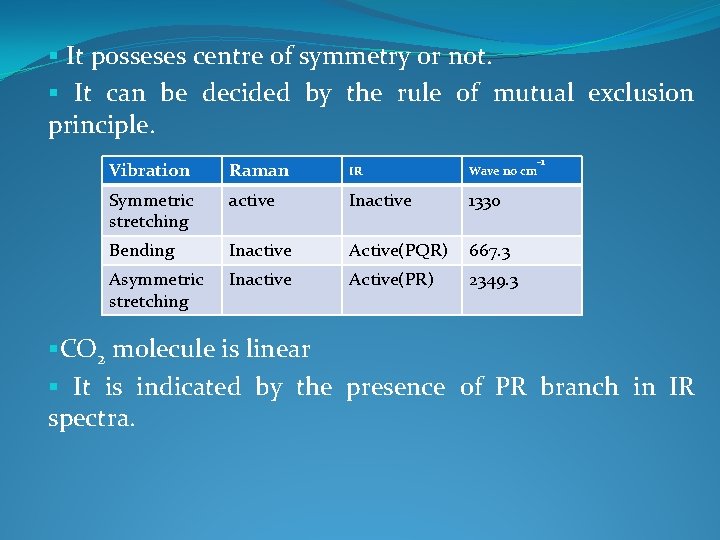
§ It posseses centre of symmetry or not. § It can be decided by the rule of mutual exclusion principle. Vibration Raman IR Wave no cm Symmetric stretching active Inactive 1330 Bending Inactive Active(PQR) 667. 3 Asymmetric stretching Inactive Active(PR) 2349. 3 -1 §CO 2 molecule is linear § It is indicated by the presence of PR branch in IR spectra.
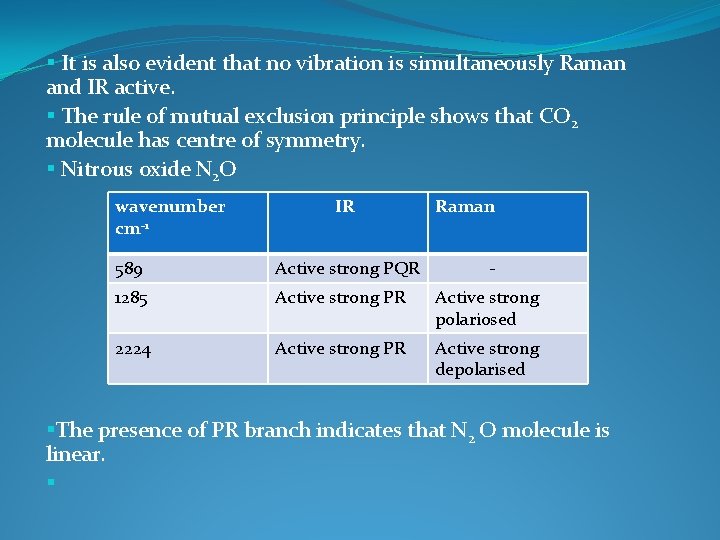
§ It is also evident that no vibration is simultaneously Raman and IR active. § The rule of mutual exclusion principle shows that CO 2 molecule has centre of symmetry. § Nitrous oxide N 2 O wavenumber cm-1 IR Raman 589 Active strong PQR - 1285 Active strong PR Active strong polariosed 2224 Active strong PR Active strong depolarised §The presence of PR branch indicates that N 2 O molecule is linear. §
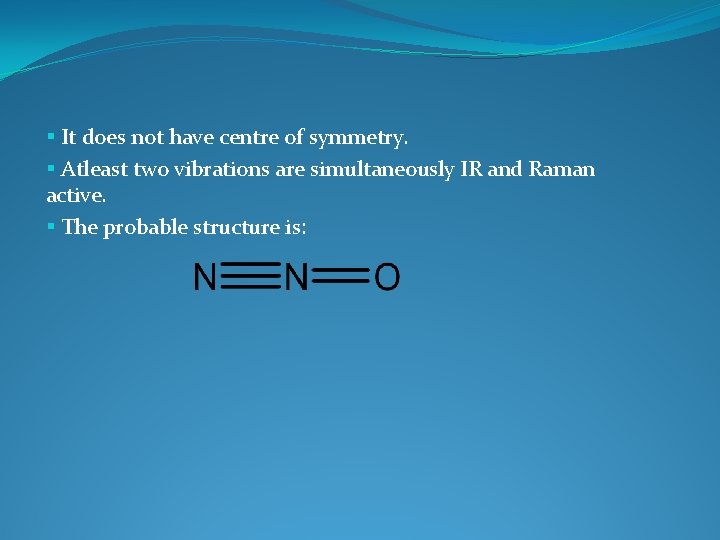
§ It does not have centre of symmetry. § Atleast two vibrations are simultaneously IR and Raman active. § The probable structure is:
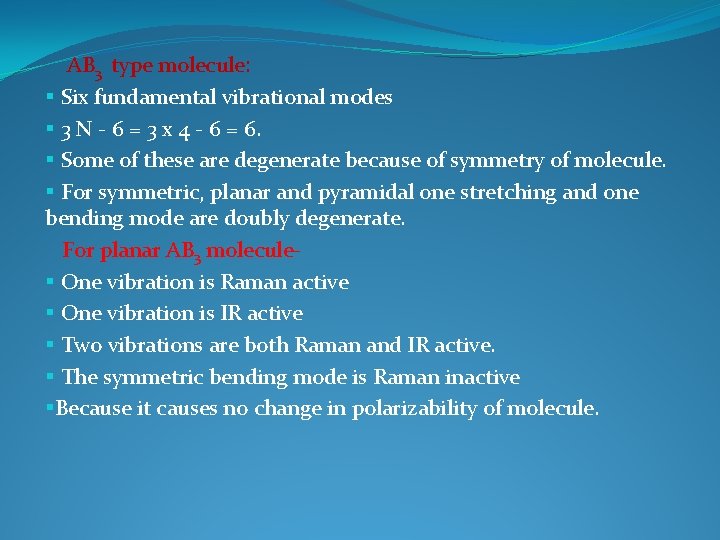
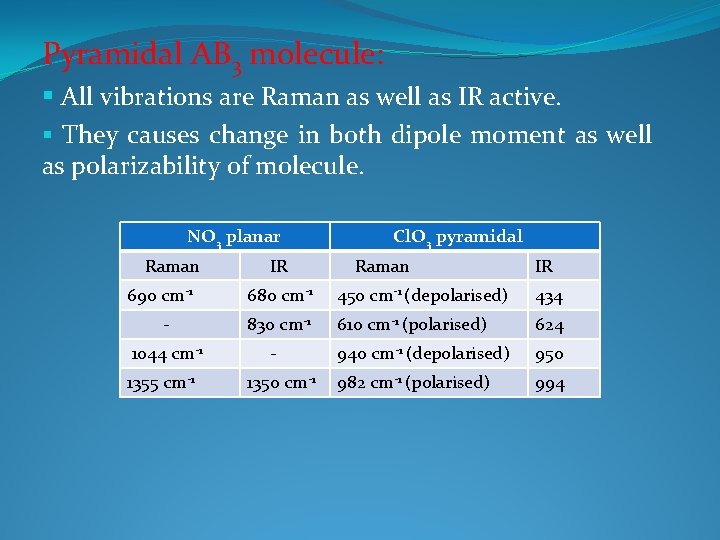
AB 3 type molecule: § Six fundamental vibrational modes § 3 N - 6 = 3 x 4 - 6 = 6. § Some of these are degenerate because of symmetry of molecule. § For symmetric, planar and pyramidal one stretching and one bending mode are doubly degenerate. For planar AB 3 molecule§ One vibration is Raman active § One vibration is IR active § Two vibrations are both Raman and IR active. § The symmetric bending mode is Raman inactive §Because it causes no change in polarizability of molecule.
Pyramidal AB 3 molecule: § All vibrations are Raman as well as IR active. § They causes change in both dipole moment as well as polarizability of molecule. NO 3 planar Raman 690 cm-1 1044 cm-1 1355 cm-1 IR Cl. O 3 pyramidal Raman IR 680 cm-1 450 cm-1 (depolarised) 434 830 cm-1 610 cm-1 (polarised) 624 940 cm-1 (depolarised) 950 982 cm-1 (polarised) 994 1350 cm-1
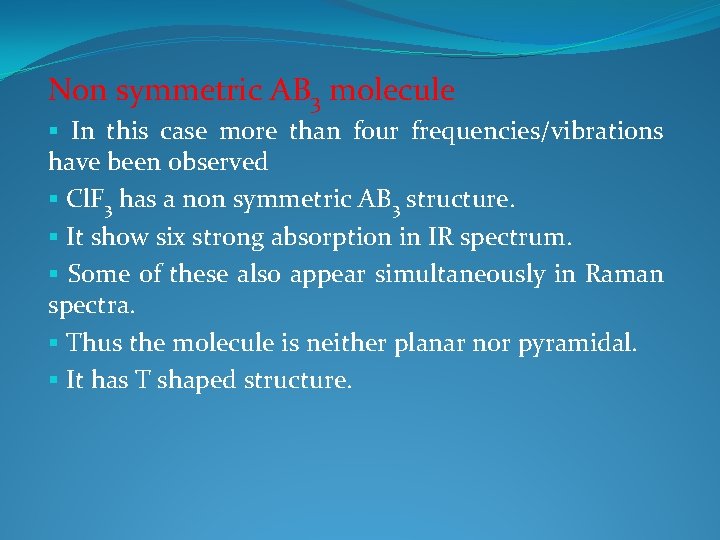
Non symmetric AB 3 molecule § In this case more than four frequencies/vibrations have been observed § Cl. F 3 has a non symmetric AB 3 structure. § It show six strong absorption in IR spectrum. § Some of these also appear simultaneously in Raman spectra. § Thus the molecule is neither planar nor pyramidal. § It has T shaped structure.
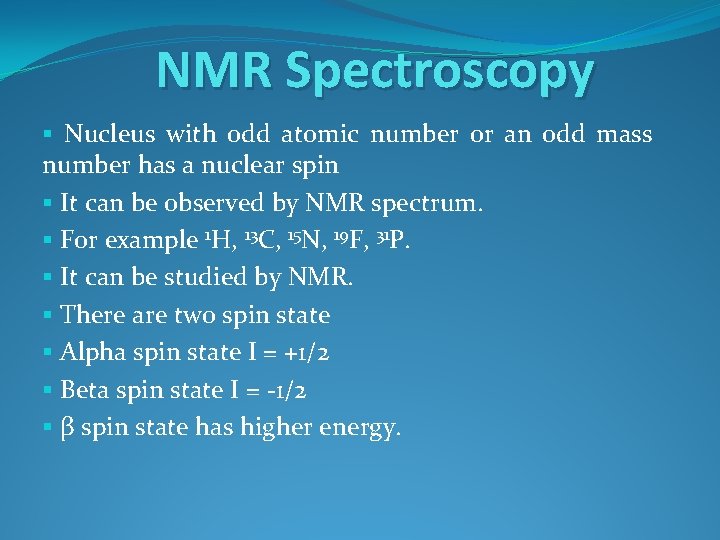
NMR Spectroscopy § Nucleus with odd atomic number or an odd mass number has a nuclear spin § It can be observed by NMR spectrum. § For example 1 H, 13 C, 15 N, 19 F, 31 P. § It can be studied by NMR. § There are two spin state § Alpha spin state I = +1/2 § Beta spin state I = -1/2 § β spin state has higher energy.