
Spectrophotometry ICP Maintenance and Operating conditions Introduction To
- Slides: 17
Spectrophotometry ICP Maintenance and Operating conditions
Introduction • To make sure that in ICP maintains consistent, accurate results, daily maintenance and cleaning is needed. • If maintenance is not performed, it can seriously affect the sensitivity of the instrument.
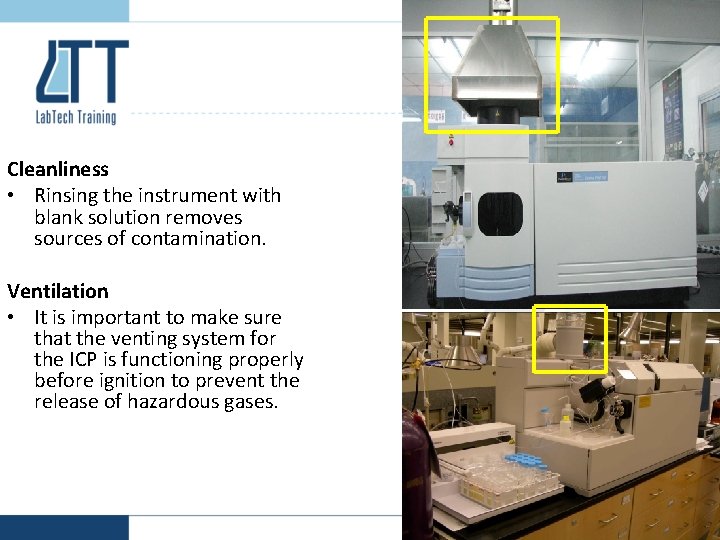
Cleanliness • Rinsing the instrument with blank solution removes sources of contamination. Ventilation • It is important to make sure that the venting system for the ICP is functioning properly before ignition to prevent the release of hazardous gases.
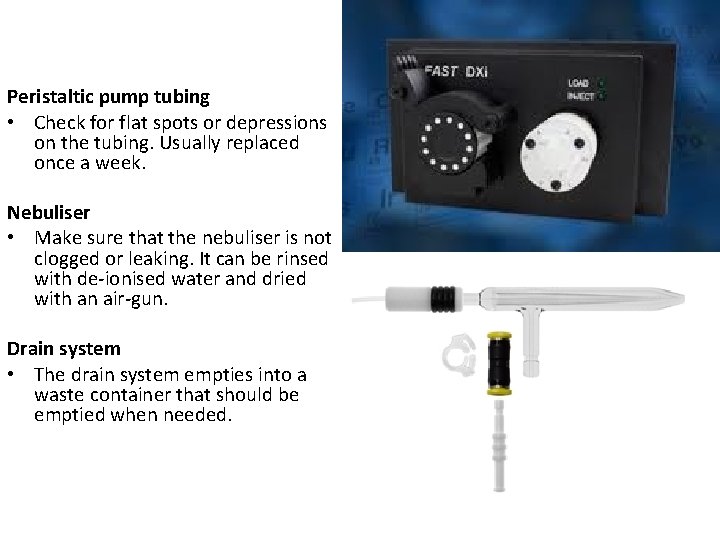
Peristaltic pump tubing • Check for flat spots or depressions on the tubing. Usually replaced once a week. Nebuliser • Make sure that the nebuliser is not clogged or leaking. It can be rinsed with de-ionised water and dried with an air-gun. Drain system • The drain system empties into a waste container that should be emptied when needed.
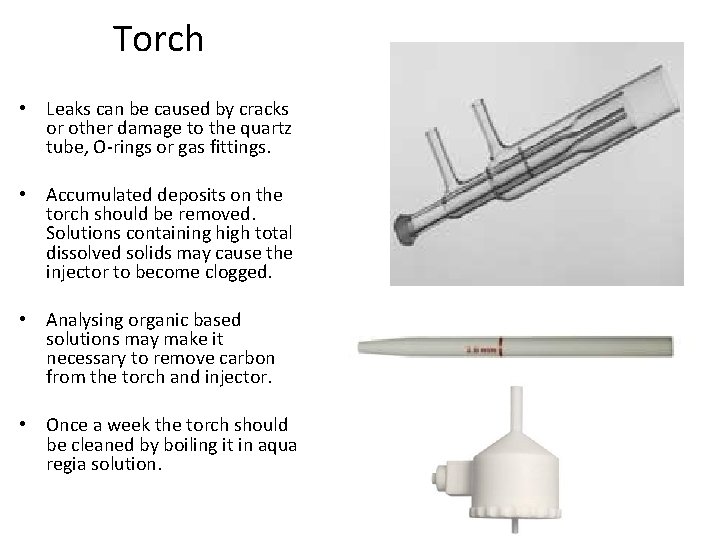
Torch • Leaks can be caused by cracks or other damage to the quartz tube, O-rings or gas fittings. • Accumulated deposits on the torch should be removed. Solutions containing high total dissolved solids may cause the injector to become clogged. • Analysing organic based solutions may make it necessary to remove carbon from the torch and injector. • Once a week the torch should be cleaned by boiling it in aqua regia solution.
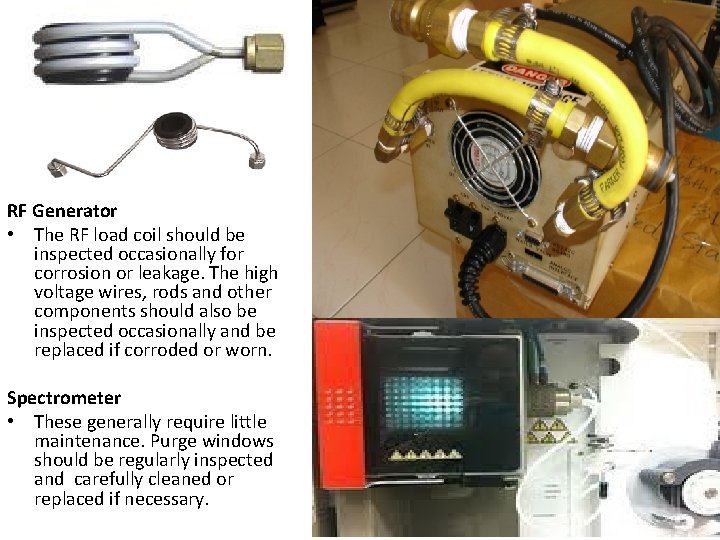
RF Generator • The RF load coil should be inspected occasionally for corrosion or leakage. The high voltage wires, rods and other components should also be inspected occasionally and be replaced if corroded or worn. Spectrometer • These generally require little maintenance. Purge windows should be regularly inspected and carefully cleaned or replaced if necessary.
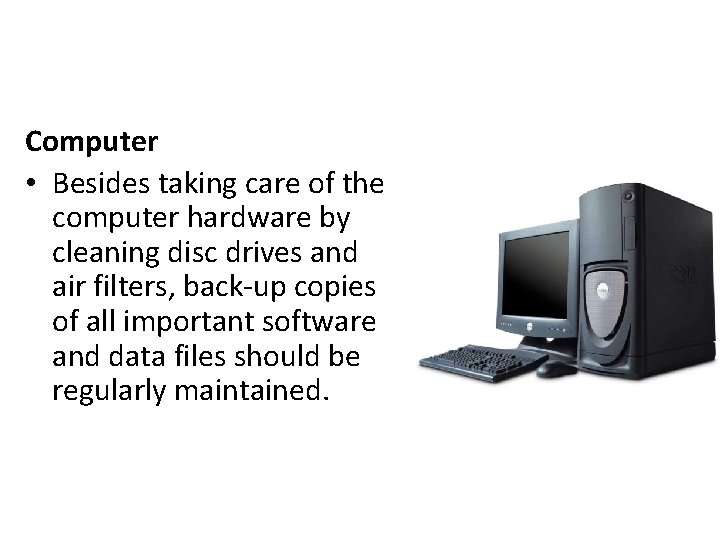
Computer • Besides taking care of the computer hardware by cleaning disc drives and air filters, back-up copies of all important software and data files should be regularly maintained.
Visual Bullet Test • This is a simple test which can be performed on a daily basis. • A solution of 1000 ppm of an element which produces a well-defined bullet in the centre of the ICP discharge is aspirated. • The presence of the bullet indicates that the aerosol is reaching the plasma while the vertical position of the bullet is an indicator of the gas flow and the RF settings being used.
Signal intensity • The number of emission counts for a given concentration of an element is often used as a quick diagnostic. • It is usually more useful for a trend analysis than as an absolute performance indicator since the emission counts may vary from day to day.
Precision • The short term precision for 5 -10 measurements of a strong emission line is often used to indicate the noise associated with sample introduction. – The precision is usually expressed as either %CV or %RSD.
Detection limits • Detection limits are often used as the ultimate test of instrument performance as they combine measurement of sensitivity with measurement of noise. • They are not good diagnostic indicators because, if they are not within expected ranges, there could be a number of causes.
Atom/ion ratio • Many ICP users employ this ratio of emission intensity as a diagnostic indicator of the relative excitation conditions in the plasma. Wavelength/peak alignment • All dispersive instruments operating between 200 -900 nm are subject to some degree of instrument drift. It is therefore important that the spectrometer is calibrated correctly for wavelength before an analysis.
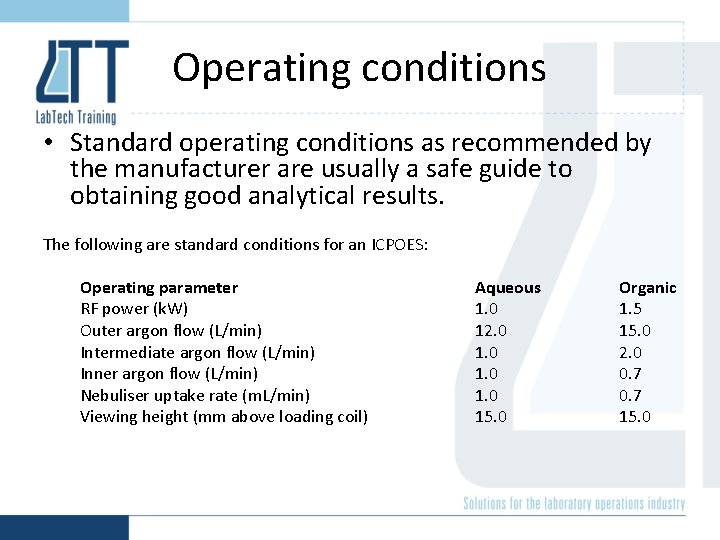
Operating conditions • Standard operating conditions as recommended by the manufacturer are usually a safe guide to obtaining good analytical results. The following are standard conditions for an ICPOES: Operating parameter RF power (k. W) Outer argon flow (L/min) Intermediate argon flow (L/min) Inner argon flow (L/min) Nebuliser uptake rate (m. L/min) Viewing height (mm above loading coil) Aqueous 1. 0 12. 0 15. 0 Organic 1. 5 15. 0 2. 0 0. 7 15. 0
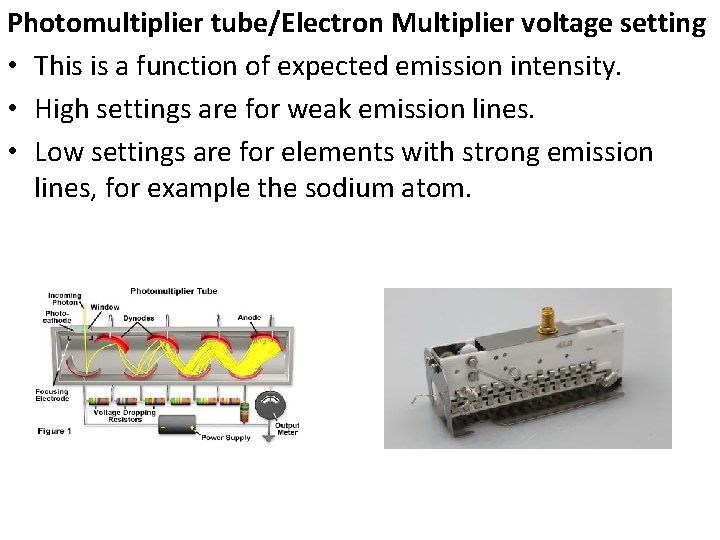
Photomultiplier tube/Electron Multiplier voltage setting • This is a function of expected emission intensity. • High settings are for weak emission lines. • Low settings are for elements with strong emission lines, for example the sodium atom.
Residence time • The inner argon gas flow is another critical parameter because it largely determines the residence time for the sample. • The longer the residence time of the analyte in the plasma, the more time there is for atomisation, excitation and ionisation. • For an element which emits strong ionic lines and which has a large ionisation energy, a long residence time is required.
RF power • Increasing the power increases the temperature of the plasma which may be needed for the excitation/ionisation of a particular element. Viewing Height • This determines whether excited state atoms or ions are being observed and their intensities measured.
Calibration • Calibration involves the use of a single multi-element standard and a blank. • This is sufficient to obtain linear calibration curves for the elements of interest over five orders of magnitude above the detection limits. • For low precision, calibrations from previous analyses that are stored in the computer can be used.