
Spectrophotometry Coupled Assay Many compounds of biological importance
Spectrophotometry
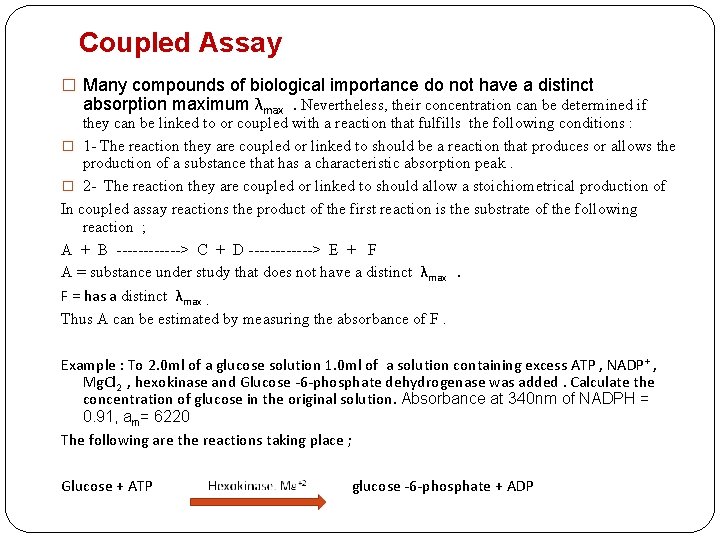
Coupled Assay � Many compounds of biological importance do not have a distinct absorption maximum λmax. Nevertheless, their concentration can be determined if they can be linked to or coupled with a reaction that fulfills the following conditions : � 1 - The reaction they are coupled or linked to should be a reaction that produces or allows the production of a substance that has a characteristic absorption peak. � 2 - The reaction they are coupled or linked to should allow a stoichiometrical production of In coupled assay reactions the product of the first reaction is the substrate of the following reaction ; A + B ------> C + D ------> E + F A = substance under study that does not have a distinct λmax. F = has a distinct λmax. Thus A can be estimated by measuring the absorbance of F. Example : To 2. 0 ml of a glucose solution 1. 0 ml of a solution containing excess ATP , NADP + , Mg. Cl 2 , hexokinase and Glucose -6 -phosphate dehydrogenase was added. Calculate the concentration of glucose in the original solution. Absorbance at 340 nm of NADPH = 0. 91, am= 6220 The following are the reactions taking place ; Glucose + ATP glucose -6 -phosphate + ADP

Coupled Assay Glucose -6 -phosphate + NADP+ phosphogluconate + 6 - NADPH+ H+ Glucose has no absorbtion at 340 nm , but NADPH does , and from reaction 1 mole of glucose produces 1 mole of NADPH , thus each mole of NADPH produced originates from 1 mole of glucose in the original solution. Absorbance at 340 nm is the absorbance of NADPH = 0. 91 A = am x C x 1 = 0. 91 = 6220 x C x 1 C NADPH = 0. 91 / 6220 = 1. 46 x 10 -4 M. Thus there is 1. 46 x 10 -4 M of glucose present in the test solution. The glucose concentration in the original solution = 1. 46 x 10 -4 x 3/2 = 2. 2 x 10 -4 M
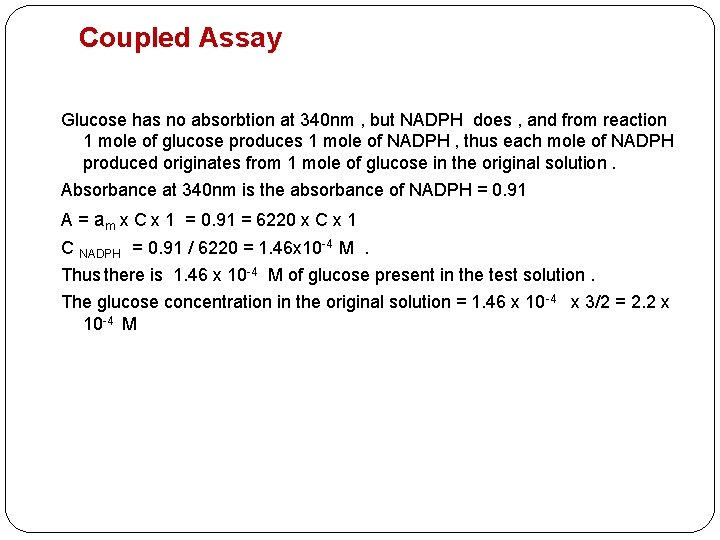
Coupled Assay Glucose has no absorbtion at 340 nm , but NADPH does , and from reaction 1 mole of glucose produces 1 mole of NADPH , thus each mole of NADPH produced originates from 1 mole of glucose in the original solution. Absorbance at 340 nm is the absorbance of NADPH = 0. 91 A = am x C x 1 = 0. 91 = 6220 x C x 1 C NADPH = 0. 91 / 6220 = 1. 46 x 10 -4 M. Thus there is 1. 46 x 10 -4 M of glucose present in the test solution. The glucose concentration in the original solution = 1. 46 x 10 -4 x 3/2 = 2. 2 x 10 -4 M
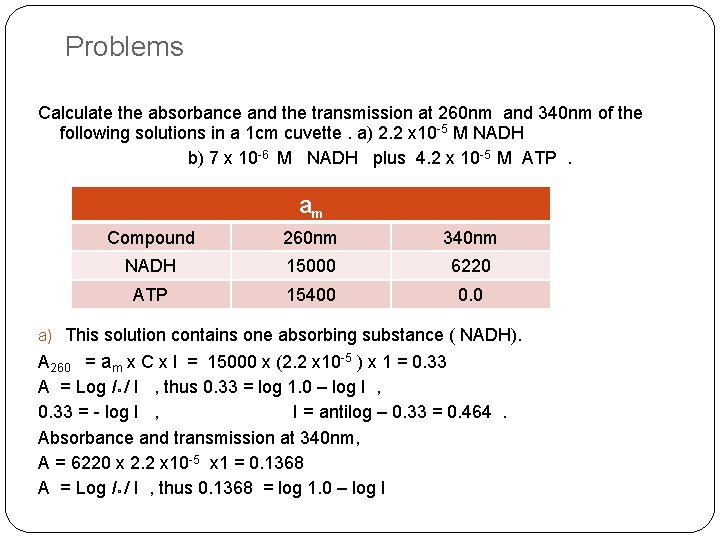
Problems Calculate the absorbance and the transmission at 260 nm and 340 nm of the following solutions in a 1 cm cuvette. a) 2. 2 x 10 -5 M NADH b) 7 x 10 -6 M NADH plus 4. 2 x 10 -5 M ATP. am Compound 260 nm 340 nm NADH 15000 6220 ATP 15400 0. 0 a) This solution contains one absorbing substance ( NADH). A 260 = am x C x l = 15000 x (2. 2 x 10 -5 ) x 1 = 0. 33 A = Log I° / I , thus 0. 33 = log 1. 0 – log I , 0. 33 = - log I , I = antilog – 0. 33 = 0. 464. Absorbance and transmission at 340 nm, A = 6220 x 2. 2 x 10 -5 x 1 = 0. 1368 A = Log I° / I , thus 0. 1368 = log 1. 0 – log I
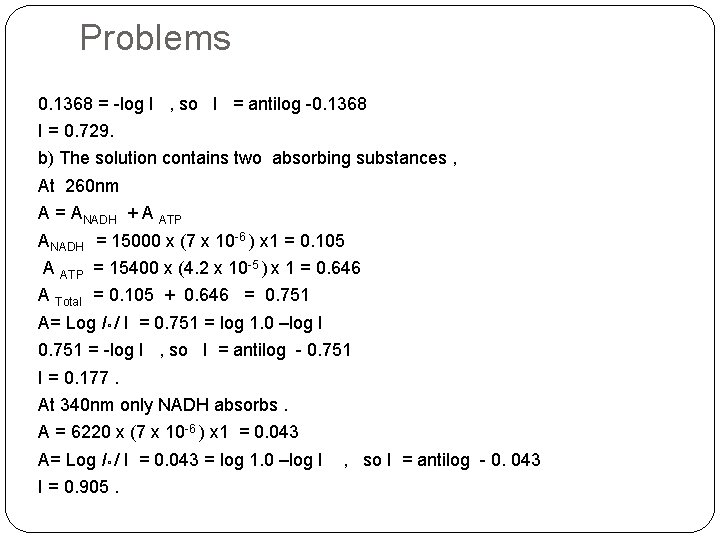
Problems 0. 1368 = -log I , so I = antilog -0. 1368 I = 0. 729. b) The solution contains two absorbing substances , At 260 nm A = ANADH + A ATP ANADH = 15000 x (7 x 10 -6 ) x 1 = 0. 105 A ATP = 15400 x (4. 2 x 10 -5 ) x 1 = 0. 646 A Total = 0. 105 + 0. 646 = 0. 751 A= Log I° / I = 0. 751 = log 1. 0 –log I 0. 751 = -log I , so I = antilog - 0. 751 I = 0. 177. At 340 nm only NADH absorbs. A = 6220 x (7 x 10 -6 ) x 1 = 0. 043 A= Log I° / I = 0. 043 = log 1. 0 –log I I = 0. 905. , so I = antilog - 0. 043

Problems Calculate the concentration of ATP and NADPH in solutions with absorbance's , a) 0. 15 at 340 nm and 0. 9 at 260 nm. b) Zero at 340 nm and 0. 750 at 260 nm. c)0. 22 at 340 nm and 0. 531 at 260 nm. am Compound 260 nm 340 nm NADPH 15000 6220 ATP 15400 0. 0 Since this solution contains two absorbing substances , thus we will start with absorbance at 340 nm since only NADPH absorbs. A 340 nm = A NADPH only. A = am x C x l = 6220 x C x 1 C = 0. 15 / 6220 = 2. 4 x 10 -5 M
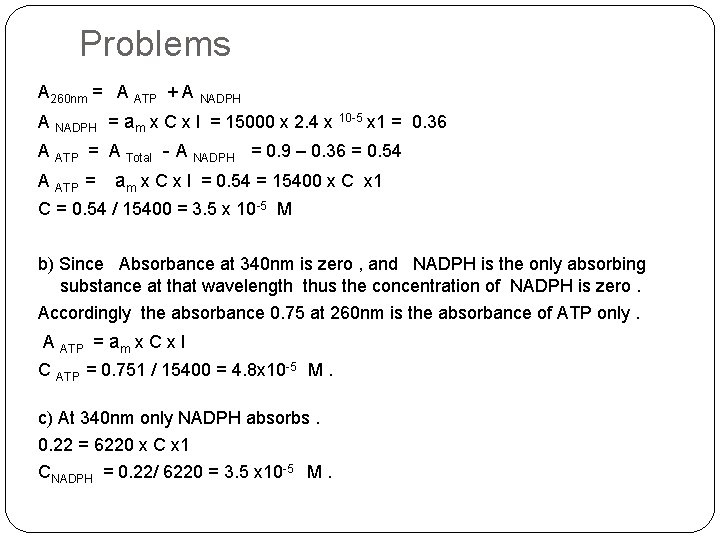
Problems A 260 nm = A ATP + A NADPH = am x C x l = 15000 x 2. 4 x 10 -5 x 1 = 0. 36 A ATP = A Total - A NADPH = 0. 9 – 0. 36 = 0. 54 A ATP = am x C x l = 0. 54 = 15400 x C x 1 C = 0. 54 / 15400 = 3. 5 x 10 -5 M b) Since Absorbance at 340 nm is zero , and NADPH is the only absorbing substance at that wavelength thus the concentration of NADPH is zero. Accordingly the absorbance 0. 75 at 260 nm is the absorbance of ATP only. A ATP = am x C x l C ATP = 0. 751 / 15400 = 4. 8 x 10 -5 M. c) At 340 nm only NADPH absorbs. 0. 22 = 6220 x C x 1 CNADPH = 0. 22/ 6220 = 3. 5 x 10 -5 M.
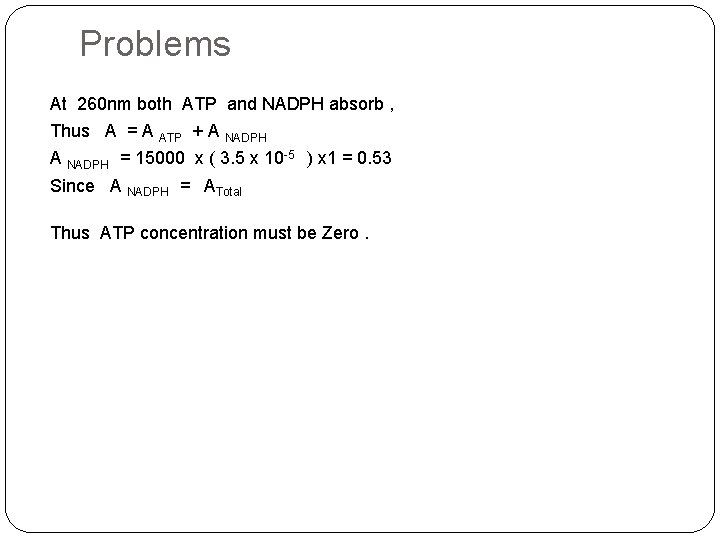
Problems At 260 nm both ATP and NADPH absorb , Thus A = A ATP + A NADPH = 15000 x ( 3. 5 x 10 -5 ) x 1 = 0. 53 Since A NADPH = ATotal Thus ATP concentration must be Zero.
- Slides: 9