
Spectrophotometry Colour and Turbidity v Aim w To
Spectrophotometry, Colour and Turbidity v Aim w To distinguish between colour and turbidity. w To know the principles behind the analytical instruments that measure these parameters (Beer-Lamberts Law). w To understand the relevance of these measurements to Environmental Engineering. v Reference Sawyer C. N. , Mc. Carty P. L. , Parkin G. F. Chemistry for Environmental Engineering Outline Importance of Colour Importance of Turbidity Colour Measurement of Turbidity Spectrophotometry
Colour in Water v What is the cause w True Colour (Dissolved Material) – p. H linked w Apparent Colour (Suspended Material) v Importance w Aesthetic w THM’s w Industrial Effluent
Colour Measurement v By Eye w Nessler Tubes w Standard Solution (Potassium chloroplatinate) v Visual Comparison Devices w Nessleriser v By Spectrophotometer w Light absorbing character v Express Results in units Hazen w True Colour, Apparent Colour
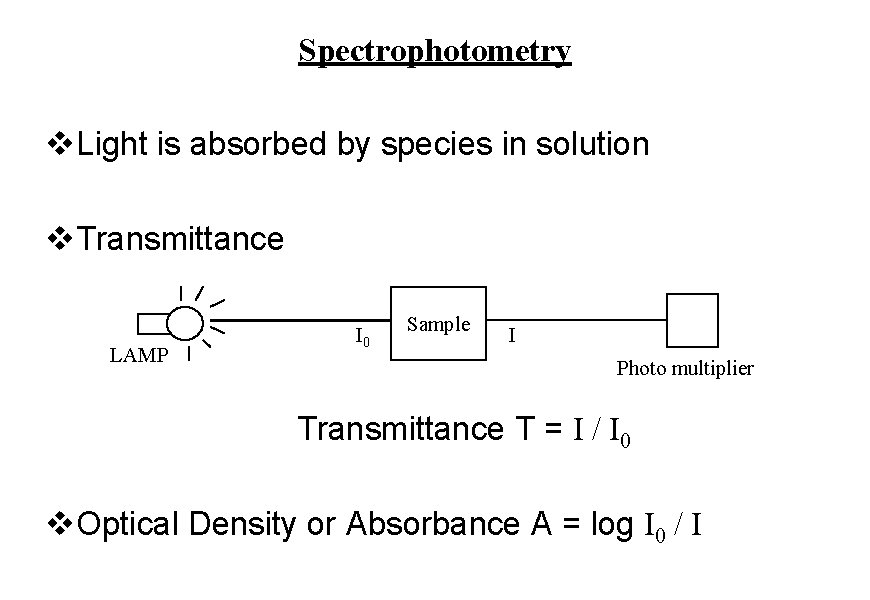
Spectrophotometry v Light is absorbed by species in solution v Transmittance LAMP I 0 Sample I Photo multiplier Transmittance T = I / I 0 v Optical Density or Absorbance A = log I 0 / I
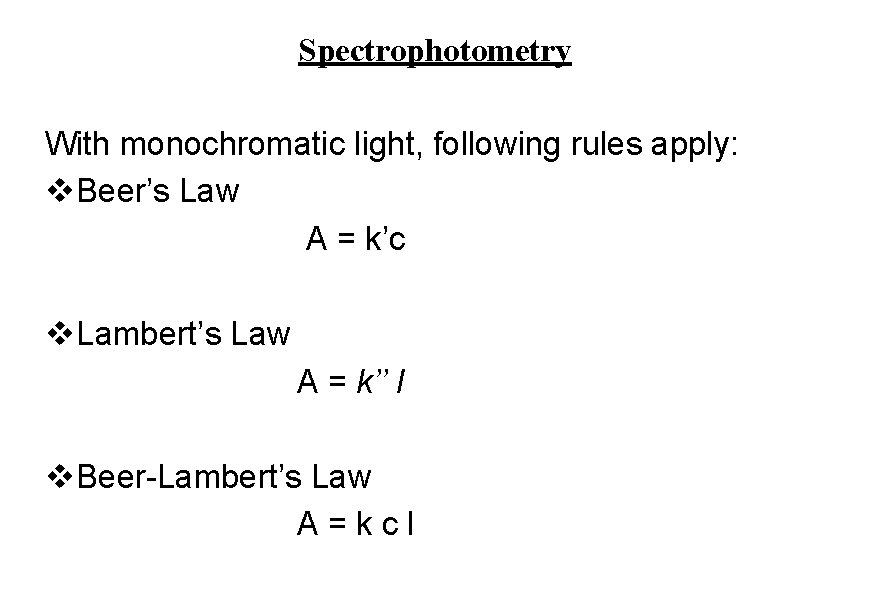
Spectrophotometry With monochromatic light, following rules apply: v Beer’s Law A = k’c v Lambert’s Law A = k’’ l v Beer-Lambert’s Law A=kcl

Spectrophotometry v Colorimeter w Filter produces a specific wavelength of light LAMP I 0 Sample I Photo multiplier Filter v Spectrophotometer w Prism produces a very specific wavelength of light LAMP I 0 Prism Sample I Photo multiplier
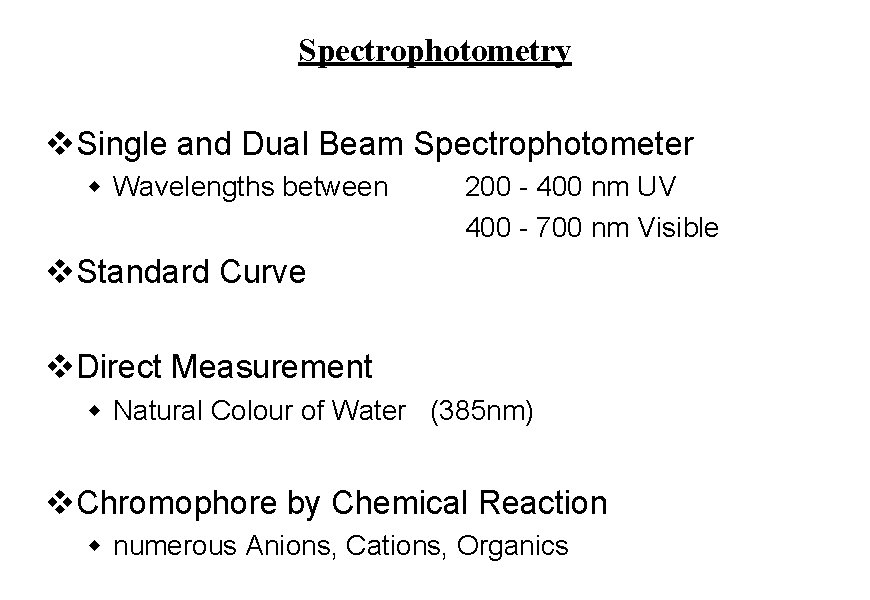
Spectrophotometry v Single and Dual Beam Spectrophotometer w Wavelengths between 200 - 400 nm UV 400 - 700 nm Visible v Standard Curve v Direct Measurement w Natural Colour of Water (385 nm) v Chromophore by Chemical Reaction w numerous Anions, Cations, Organics
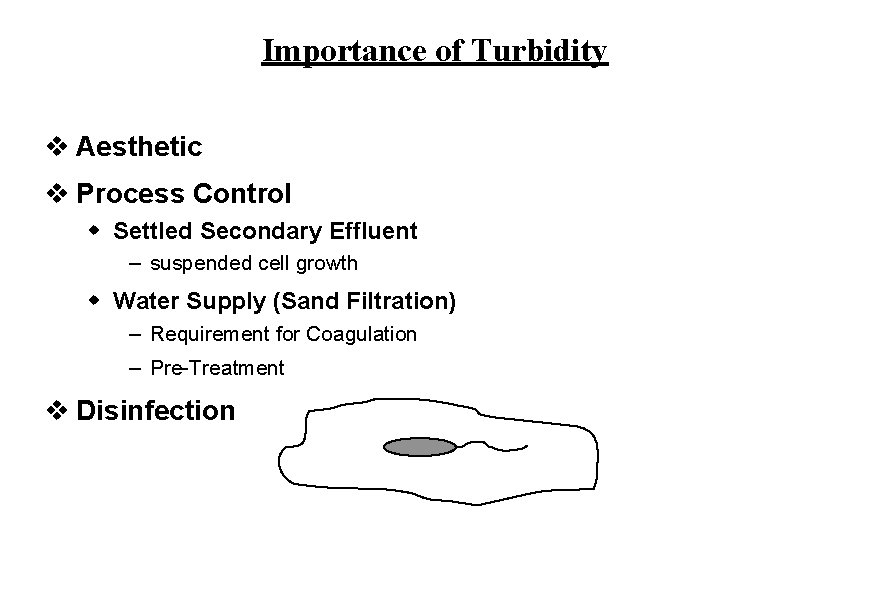
Importance of Turbidity v Aesthetic v Process Control w Settled Secondary Effluent – suspended cell growth w Water Supply (Sand Filtration) – Requirement for Coagulation – Pre-Treatment v Disinfection
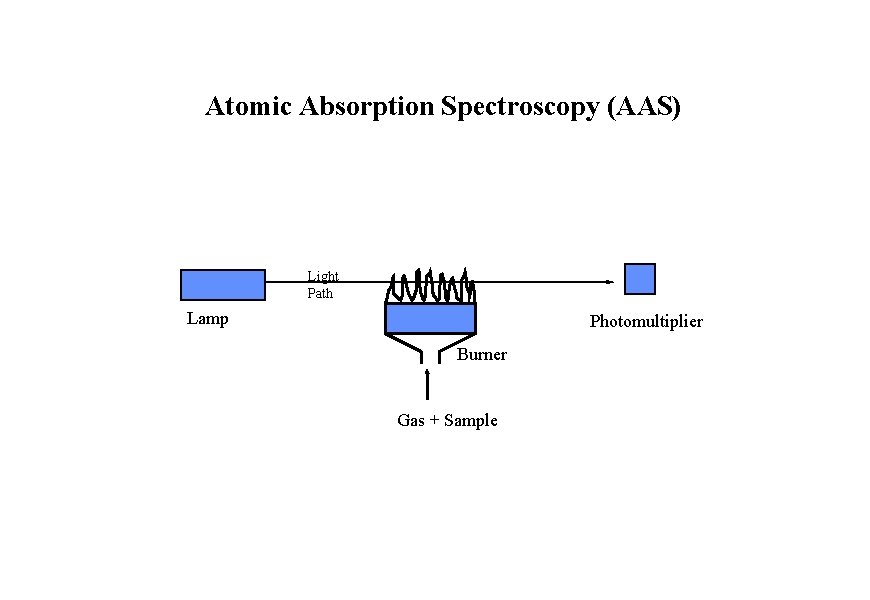
Atomic Absorption Spectroscopy (AAS) Light Path Lamp Photomultiplier Burner Gas + Sample
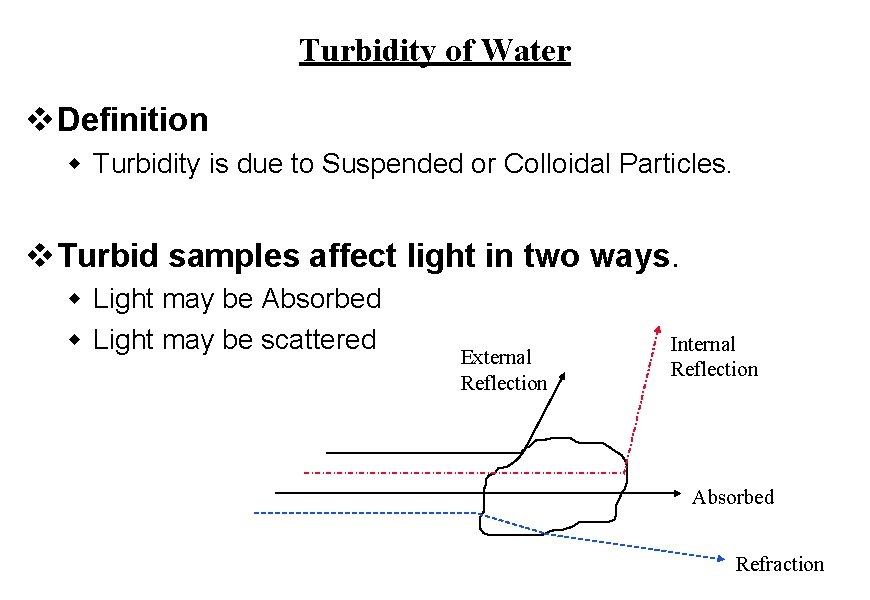
Turbidity of Water v Definition w Turbidity is due to Suspended or Colloidal Particles. v Turbid samples affect light in two ways. w Light may be Absorbed w Light may be scattered External Reflection Internal Reflection Absorbed Refraction
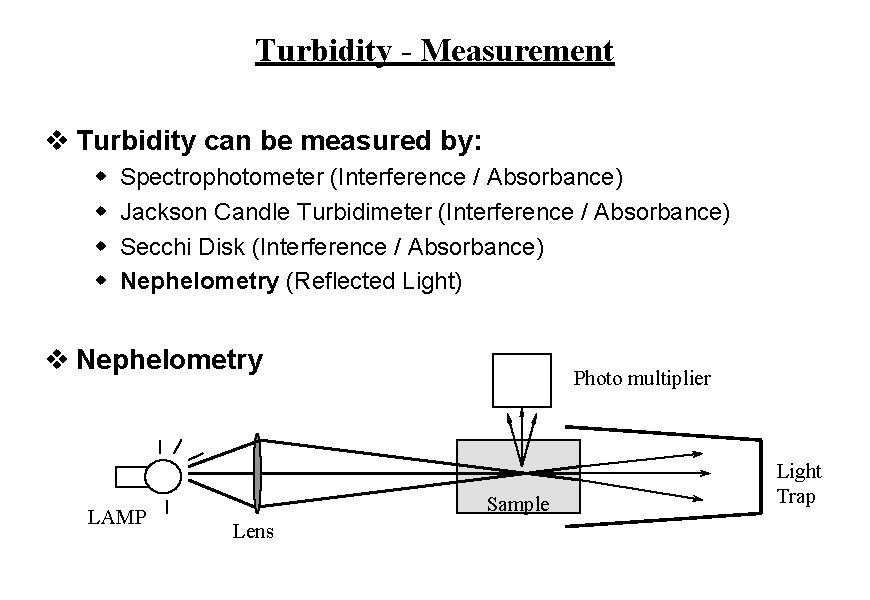
Turbidity - Measurement v Turbidity can be measured by: w w Spectrophotometer (Interference / Absorbance) Jackson Candle Turbidimeter (Interference / Absorbance) Secchi Disk (Interference / Absorbance) Nephelometry (Reflected Light) v Nephelometry LAMP Photo multiplier Sample Lens Light Trap
Turbidity - Measurement v Units of Turbidity w Nephelometric Turbidity Units (NTU) w Calibrate with: Si. O 2 Suspension (1 mg/l) Standard Formazin Suspensions Bead Suspensions in a Gel v Precautions w Sample Dilution w Air Bubbles, Condensation, Stray Light w Large Suspended Particles
Spectrophotometry, Colour and Turbidity v Summary w Definition and Origins of Colour, Its Measurement, and its Significance in EE. w Definition and Origins of Turbidity, Its Measurement, and its Significance in EE. w The general application of Spectrophotometry in water analysis.
- Slides: 13