
Spectral Snow Profiler Probe Basic Operation The probe
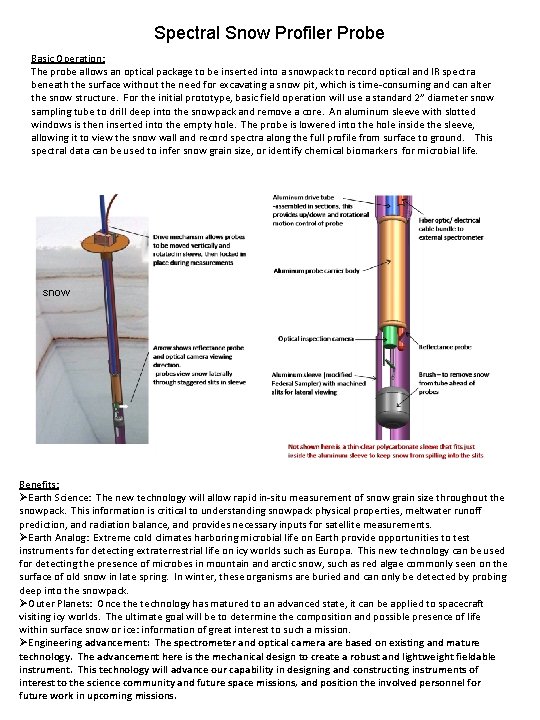
Spectral Snow Profiler Probe Basic Operation: The probe allows an optical package to be inserted into a snowpack to record optical and IR spectra beneath the surface without the need for excavating a snow pit, which is time-consuming and can alter the snow structure. For the initial prototype, basic field operation will use a standard 2” diameter snow sampling tube to drill deep into the snowpack and remove a core. An aluminum sleeve with slotted windows is then inserted into the empty hole. The probe is lowered into the hole inside the sleeve, allowing it to view the snow wall and record spectra along the full profile from surface to ground. This spectral data can be used to infer snow grain size, or identify chemical biomarkers for microbial life. snow Benefits: ØEarth Science: The new technology will allow rapid in-situ measurement of snow grain size throughout the snowpack. This information is critical to understanding snowpack physical properties, meltwater runoff prediction, and radiation balance, and provides necessary inputs for satellite measurements. ØEarth Analog: Extreme cold climates harboring microbial life on Earth provide opportunities to test instruments for detecting extraterrestrial life on icy worlds such as Europa. This new technology can be used for detecting the presence of microbes in mountain and arctic snow, such as red algae commonly seen on the surface of old snow in late spring. In winter, these organisms are buried and can only be detected by probing deep into the snowpack. ØOuter Planets: Once the technology has matured to an advanced state, it can be applied to spacecraft visiting icy worlds. The ultimate goal will be to determine the composition and possible presence of life within surface snow or ice: information of great interest to such a mission. ØEngineering advancement: The spectrometer and optical camera are based on existing and mature technology. The advancement here is the mechanical design to create a robust and lightweight fieldable instrument. This technology will advance our capability in designing and constructing instruments of interest to the science community and future space missions, and position the involved personnel for future work in upcoming missions.
- Slides: 1