
Spectra White Light Light from many colors mixes

- Slides: 8
Spectra
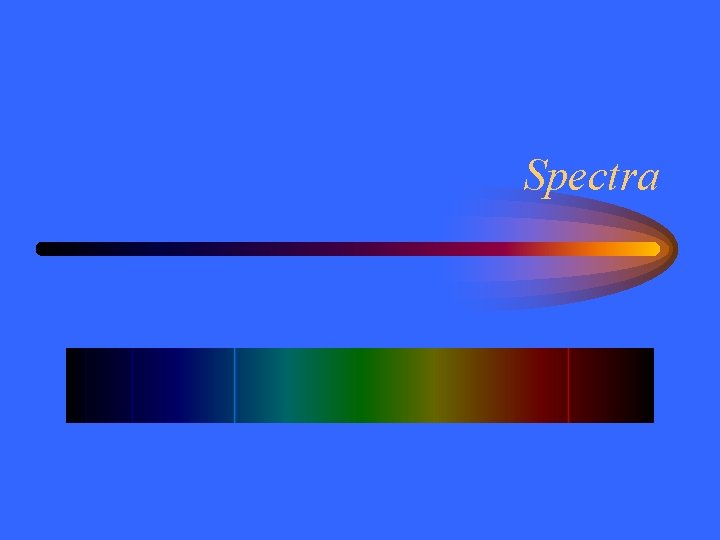
White Light • Light from many colors mixes to form white light. • Different colors have different wavelengths. • Shorter wavelengths bend more through a prism. • A diffraction grating combines many edges and acts like a prism.
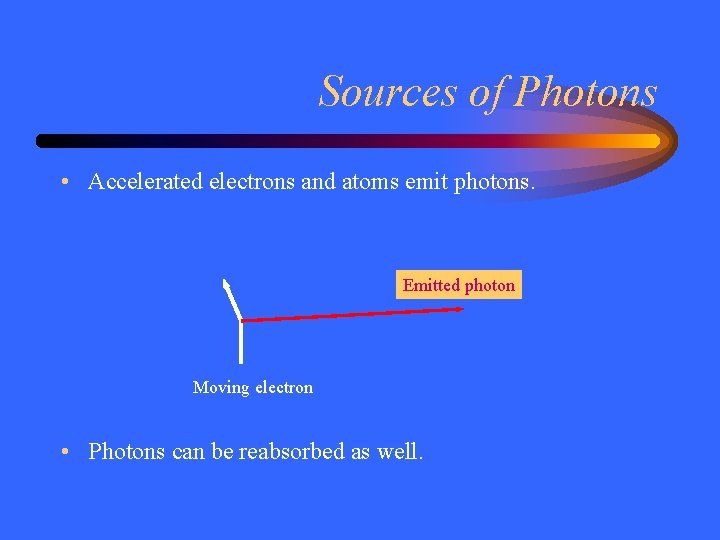
Sources of Photons • Accelerated electrons and atoms emit photons. Emitted photon Moving electron • Photons can be reabsorbed as well.
Temperature • Higher temperature means more energy. • Temperature is measured in kelvin (K). • Absolute zero: • Room temperature: • Temperature of the Sun: 0 K = -273 ºC = -459 ºF. 300 K 20 ºC = 68 ºF. 5800 K 6100 ºC 11, 000 ºF • At high temperatures kelvin and centigrade are about the same.
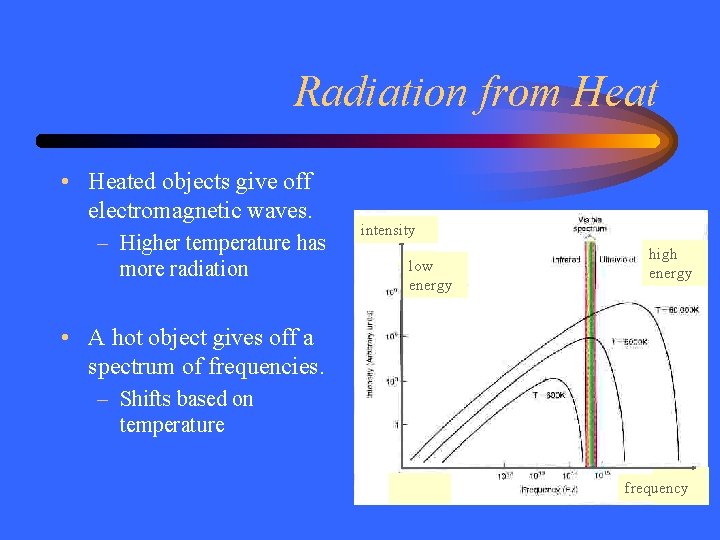
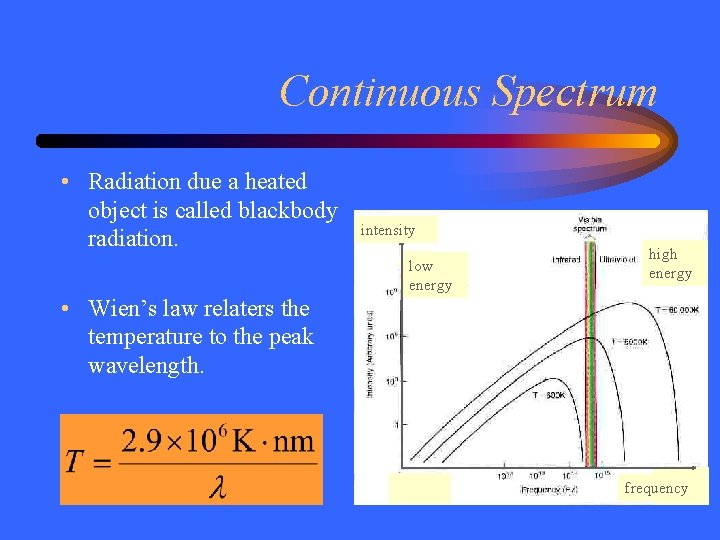
Radiation from Heat • Heated objects give off electromagnetic waves. – Higher temperature has more radiation intensity low energy high energy • A hot object gives off a spectrum of frequencies. – Shifts based on temperature frequency
Continuous Spectrum • Radiation due a heated object is called blackbody radiation. • Wien’s law relaters the temperature to the peak wavelength. intensity low energy high energy frequency
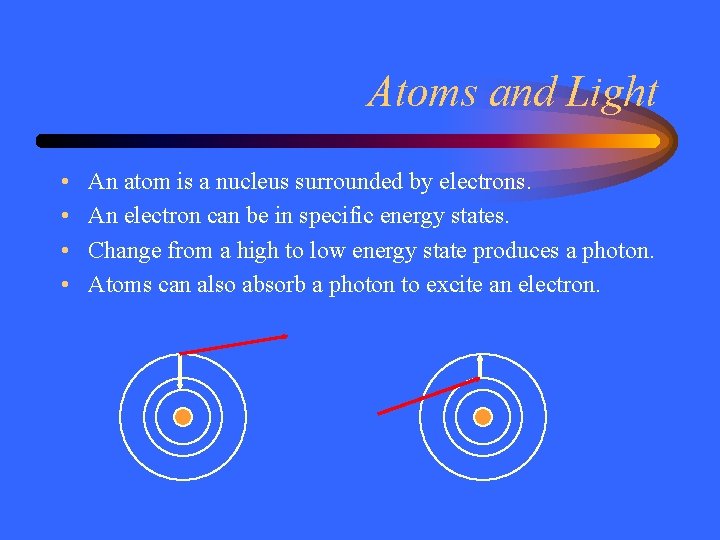
Atoms and Light • • An atom is a nucleus surrounded by electrons. An electron can be in specific energy states. Change from a high to low energy state produces a photon. Atoms can also absorb a photon to excite an electron.
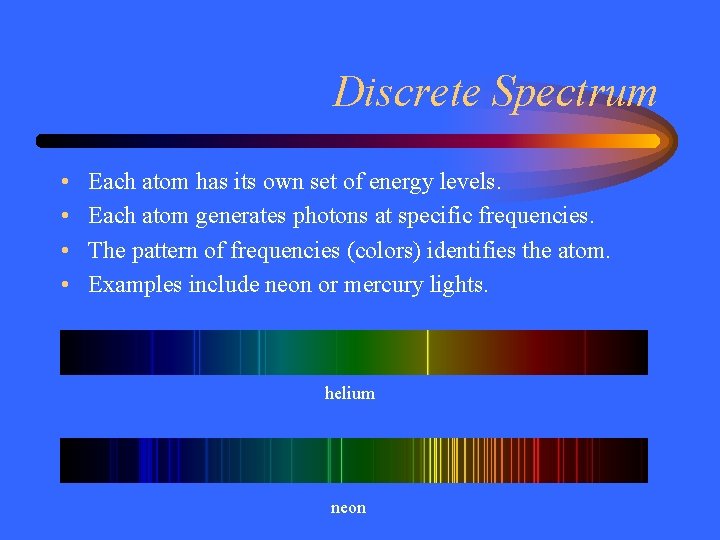
Discrete Spectrum • • Each atom has its own set of energy levels. Each atom generates photons at specific frequencies. The pattern of frequencies (colors) identifies the atom. Examples include neon or mercury lights. helium neon