
Spectra How are spectra formed What are the
- Slides: 28
Spectra How are spectra formed? What are the 3 different types of spectra? What can spectra tell us?
spec·trum ˈspektrəm/ noun � 1. a band of colors, as seen in a rainbow, produced by separation of the components of light by their different degrees of refraction according to wavelength. the entire range of wavelengths of electromagnetic radiation. an image or distribution of components of any electromagnetic radiation arranged in a progressive series according to wavelength. an image or distribution of components of sound, particles, etc. , arranged according to such characteristics as frequency, charge, and energy. � 2. used to classify something, or suggest that it can be classified, in terms of its position on a scale between two extreme or opposite points.
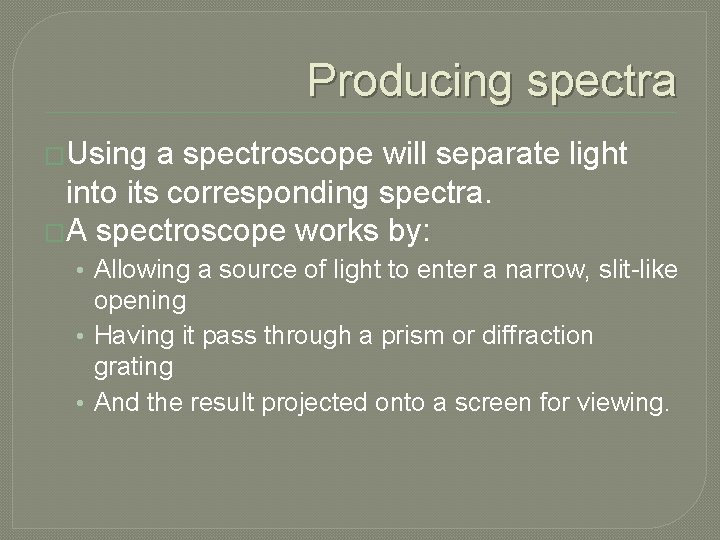
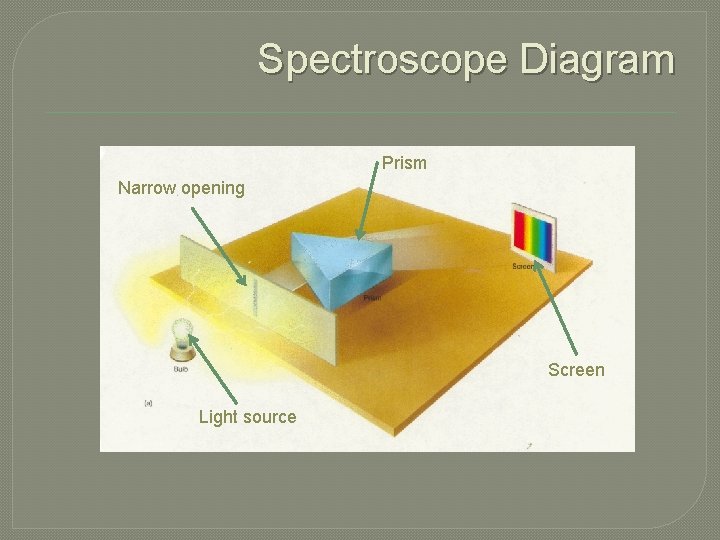
Producing spectra �Using a spectroscope will separate light into its corresponding spectra. �A spectroscope works by: • Allowing a source of light to enter a narrow, slit-like opening • Having it pass through a prism or diffraction grating • And the result projected onto a screen for viewing.
Spectroscope Diagram Prism Narrow opening Screen Light source
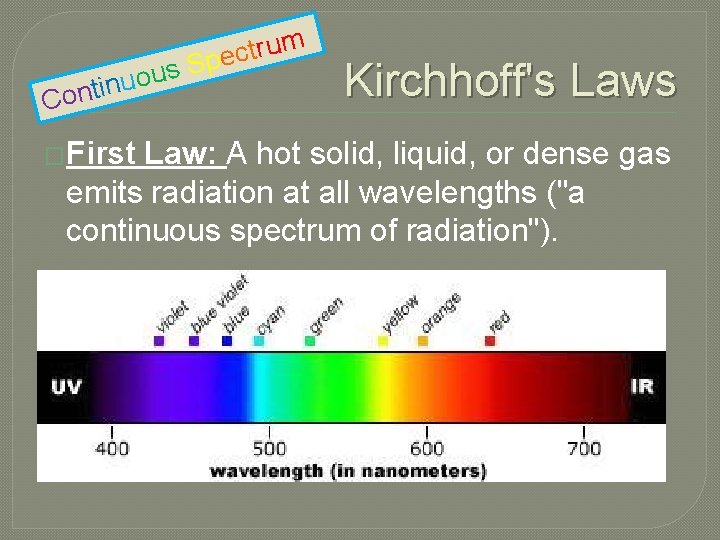
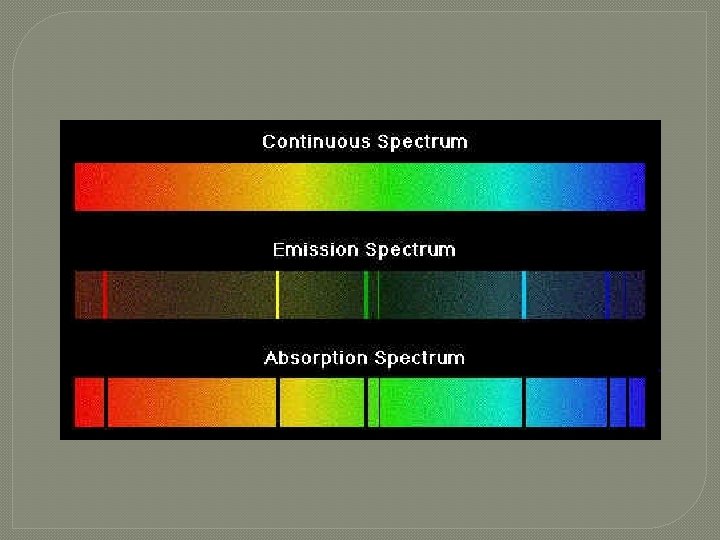
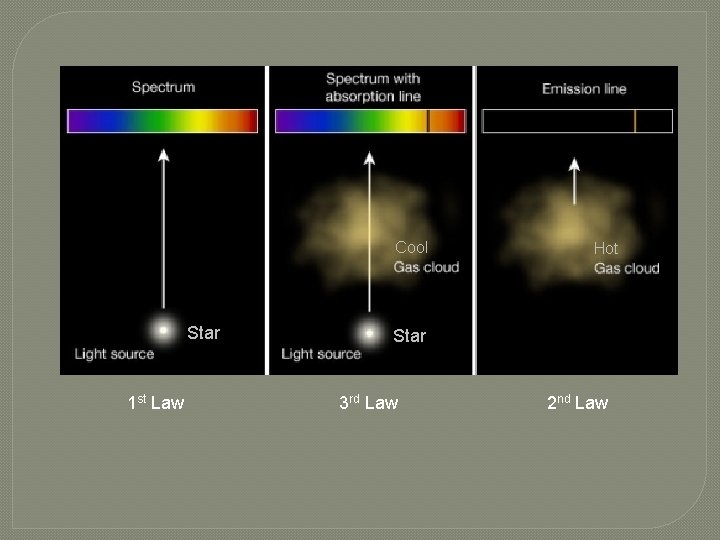
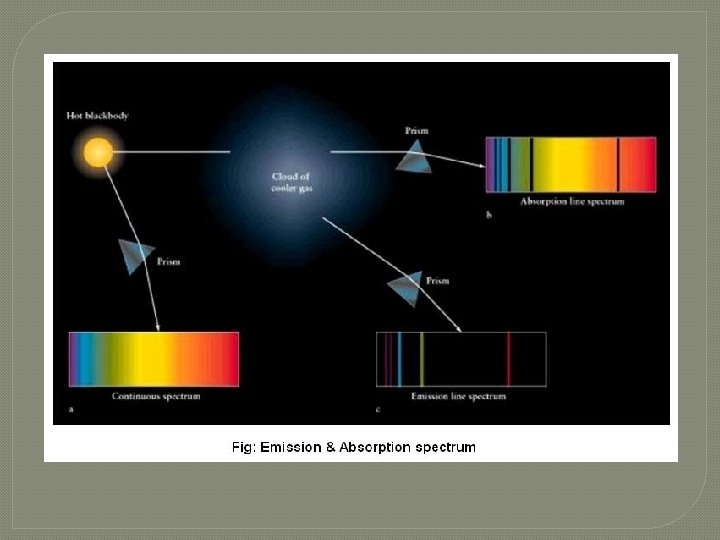
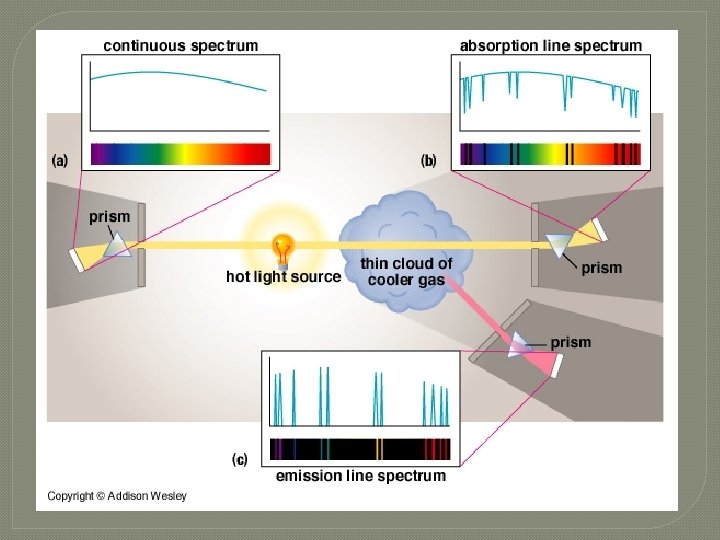
s ou u n i t on C �First m u r t c Spe Kirchhoff's Law: A hot solid, liquid, or dense gas emits radiation at all wavelengths ("a continuous spectrum of radiation").
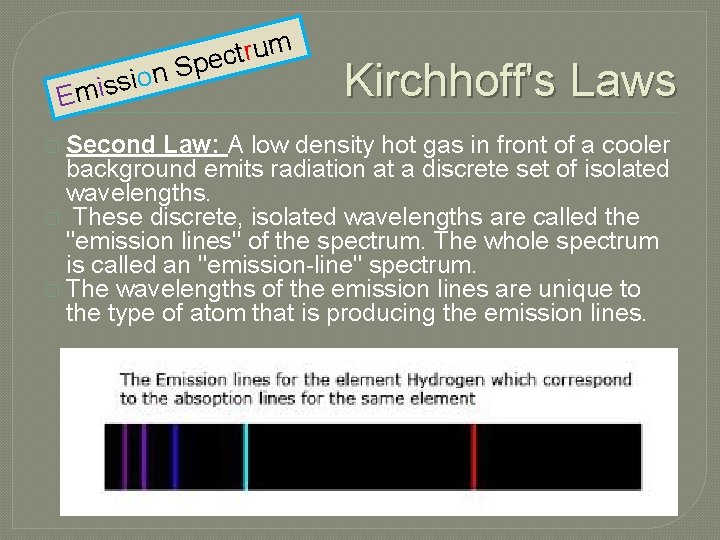
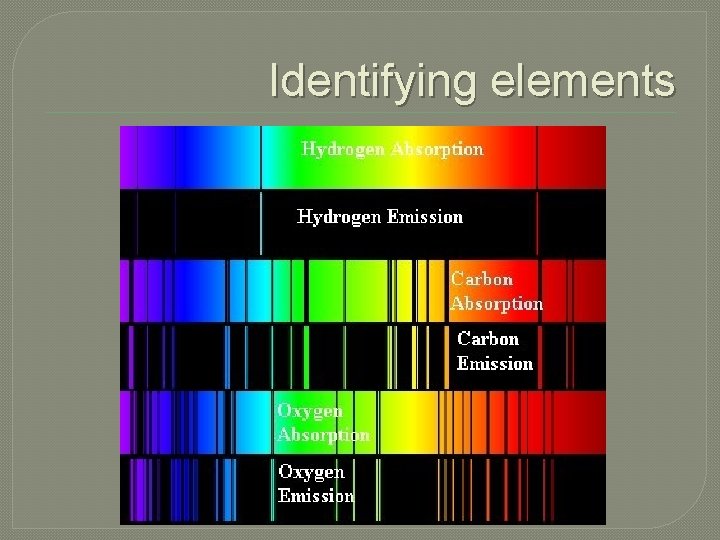
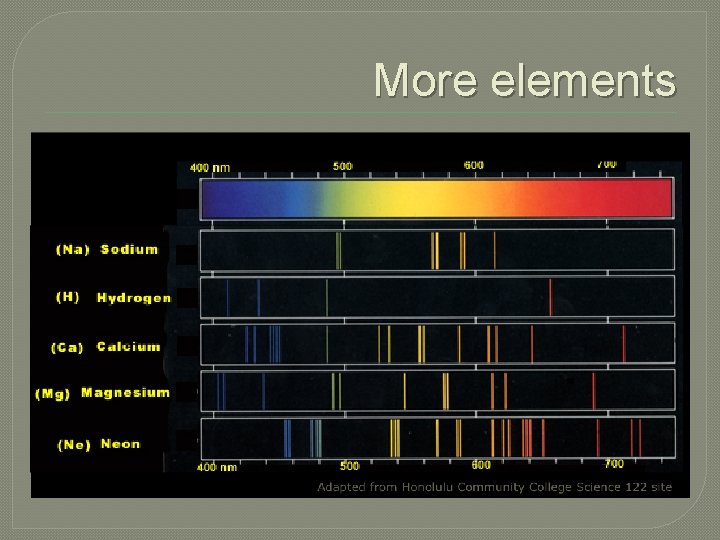
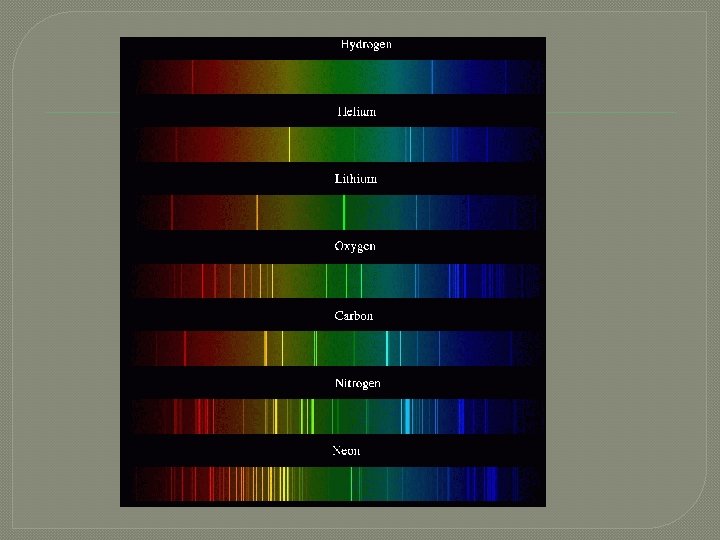
n o i s s E mi � Second m u r t c Spe Kirchhoff's Law: A low density hot gas in front of a cooler background emits radiation at a discrete set of isolated wavelengths. � These discrete, isolated wavelengths are called the "emission lines" of the spectrum. The whole spectrum is called an "emission-line" spectrum. � The wavelengths of the emission lines are unique to the type of atom that is producing the emission lines.
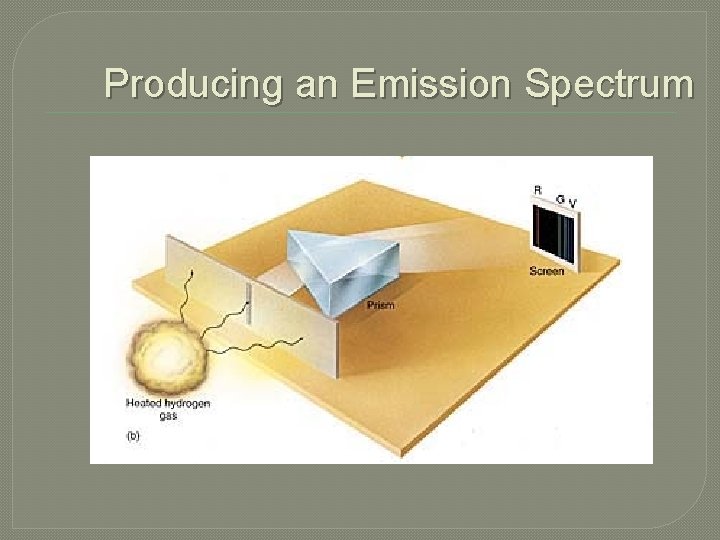
Producing an Emission Spectrum
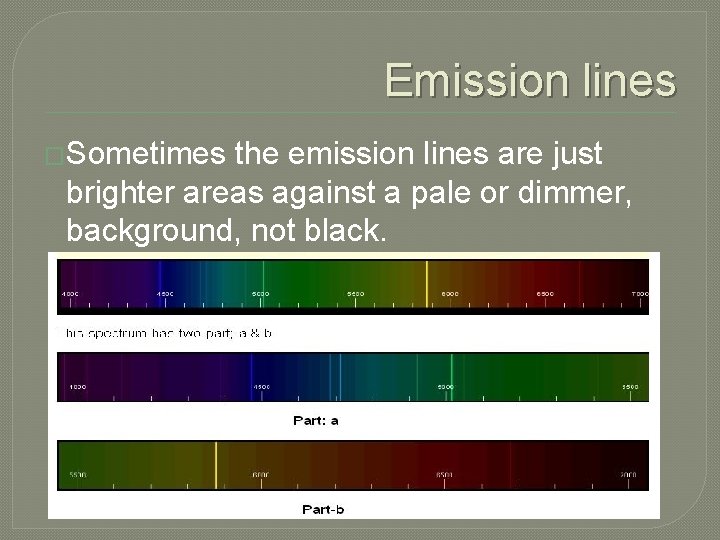
Emission lines �Sometimes the emission lines are just brighter areas against a pale or dimmer, background, not black.
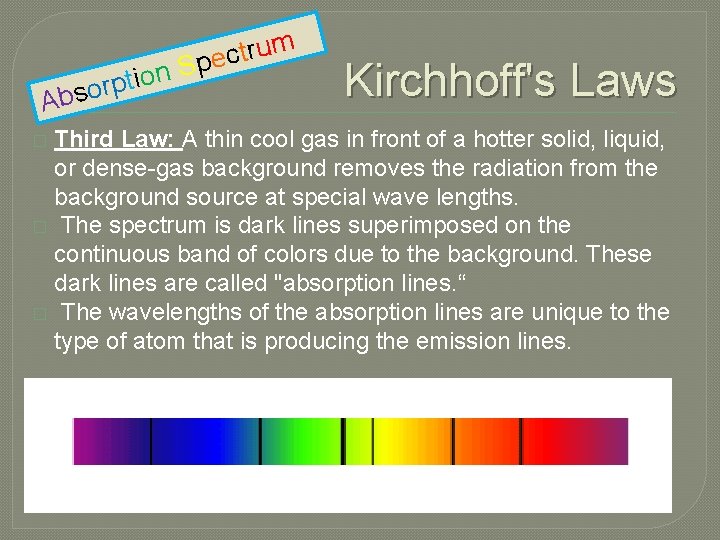
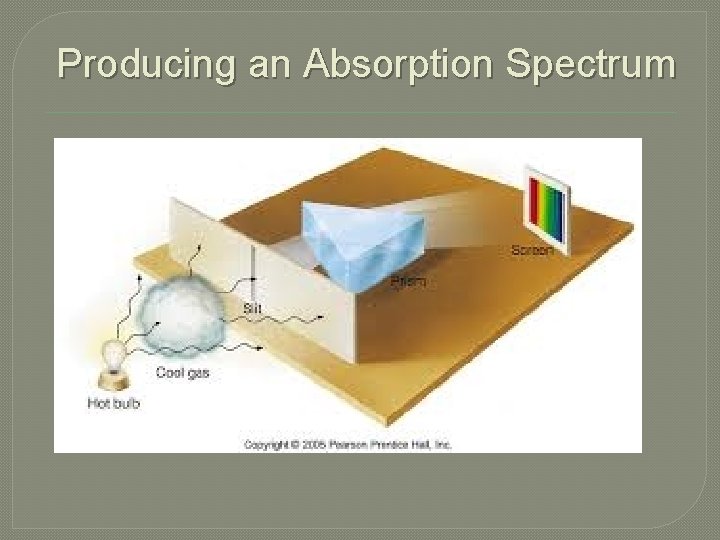
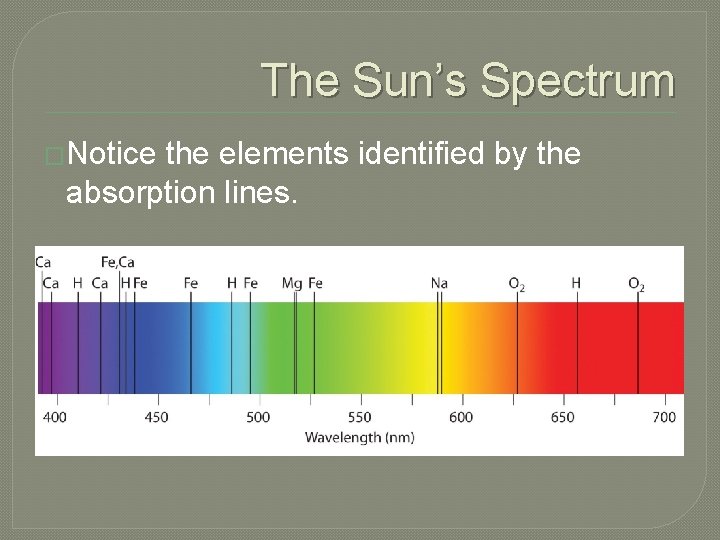
n o i t p r Abso m u r t c S pe Kirchhoff's Laws Third Law: A thin cool gas in front of a hotter solid, liquid, or dense-gas background removes the radiation from the background source at special wave lengths. � The spectrum is dark lines superimposed on the continuous band of colors due to the background. These dark lines are called "absorption lines. “ � The wavelengths of the absorption lines are unique to the type of atom that is producing the emission lines. �
Producing an Absorption Spectrum
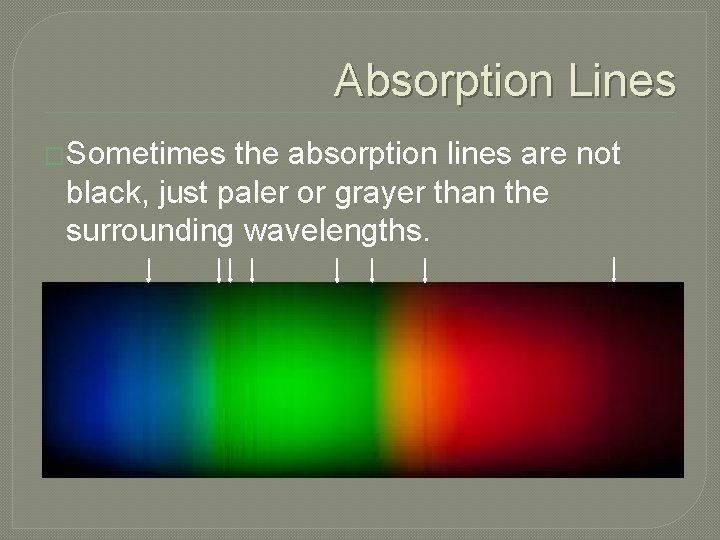
Absorption Lines �Sometimes the absorption lines are not black, just paler or grayer than the surrounding wavelengths.
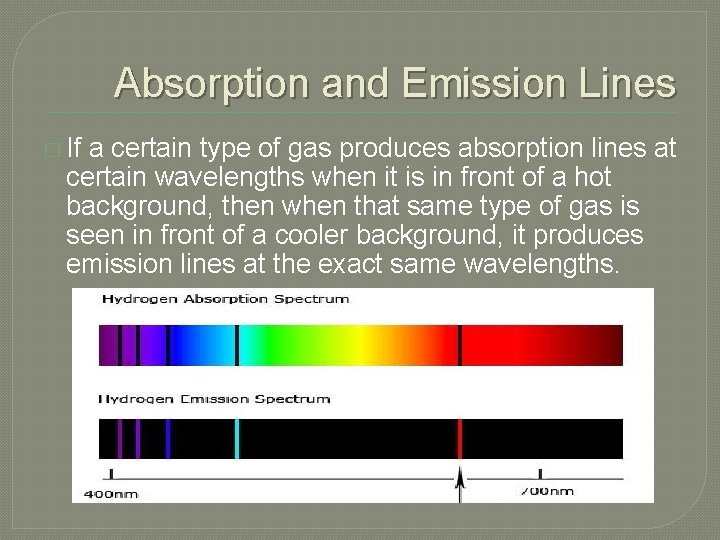
Absorption and Emission Lines � If a certain type of gas produces absorption lines at certain wavelengths when it is in front of a hot background, then when that same type of gas is seen in front of a cooler background, it produces emission lines at the exact same wavelengths.
Cool Star 1 st Law Hot Star 3 rd Law 2 nd Law
Identifying elements
More elements
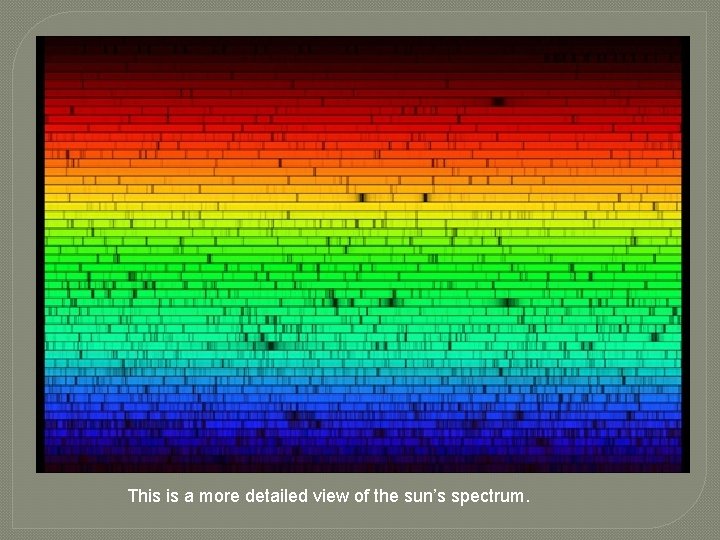
The Sun’s Spectrum �Notice the elements identified by the absorption lines.
This is a more detailed view of the sun’s spectrum.
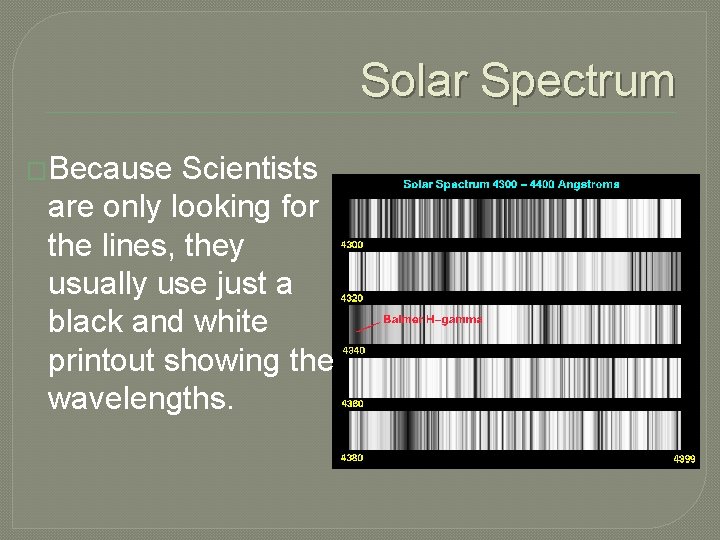
Solar Spectrum �Because Scientists are only looking for the lines, they usually use just a black and white printout showing the wavelengths.
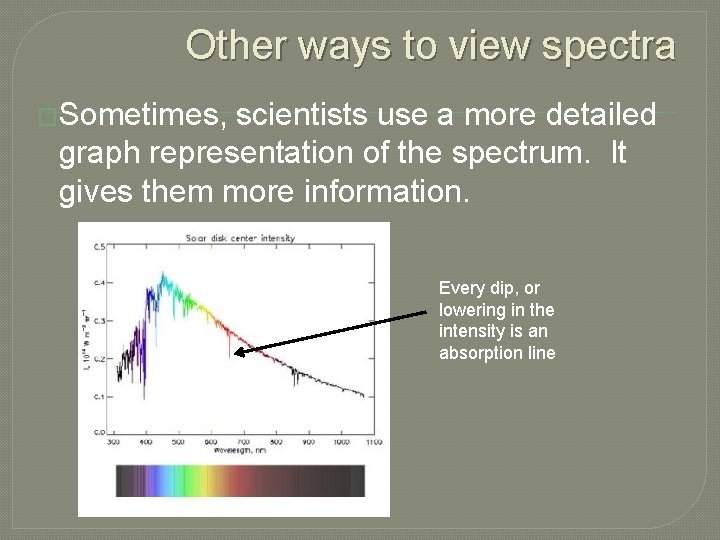
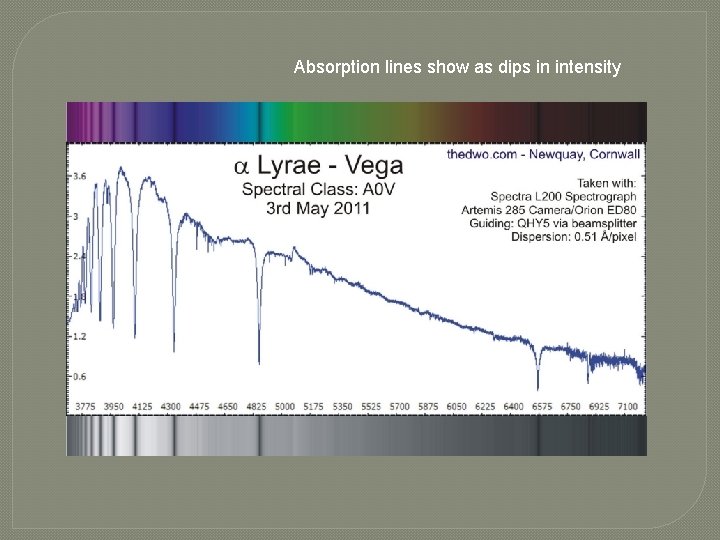
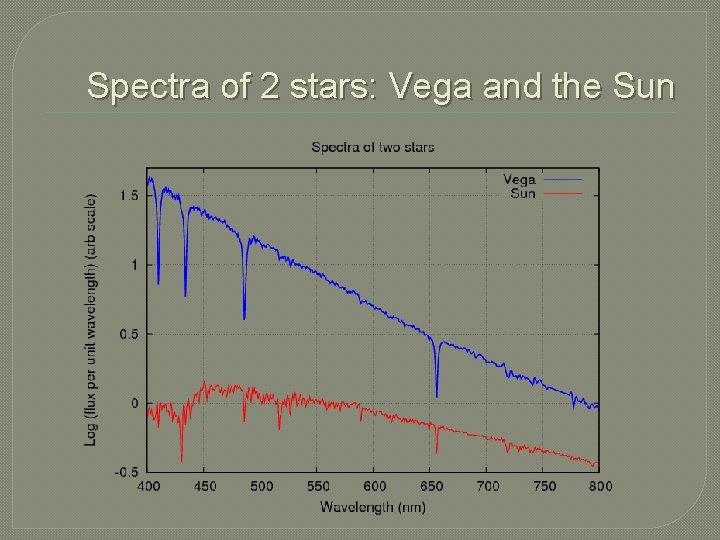
Other ways to view spectra �Sometimes, scientists use a more detailed graph representation of the spectrum. It gives them more information. Every dip, or lowering in the intensity is an absorption line
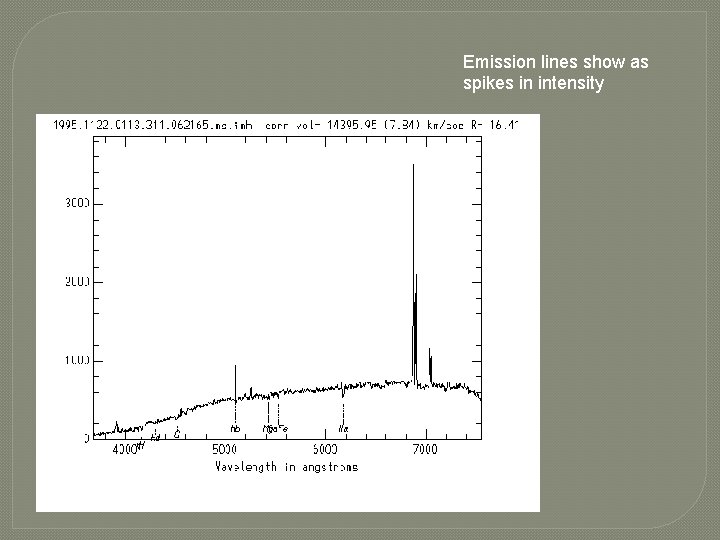
Emission lines show as spikes in intensity
Absorption lines show as dips in intensity
Spectra of 2 stars: Vega and the Sun
Conclusion �What are Kirchhoff’s 3 laws? �What are the 3 different types of spectra? �What is the difference in how they are formed? �What is a spectroscope? �What information can spectral lines tell us?