
SPECT imaging with semiconductor detectors Andy Boston ajbostonliv
SPECT imaging with semiconductor detectors Andy Boston ajboston@liv. ac. uk

Outline of presentation • What is SPECT? • What detector technology can we consider? • The Pro. SPECTus project & links to fundamental research • The future prospects
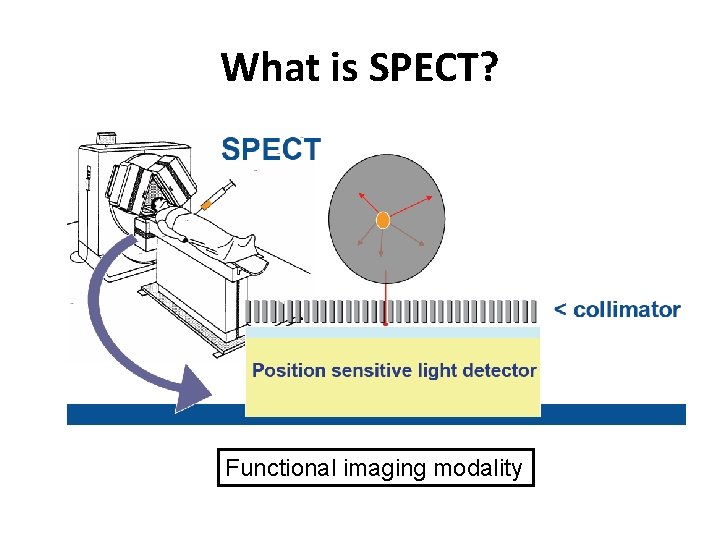
What is SPECT? Functional imaging modality
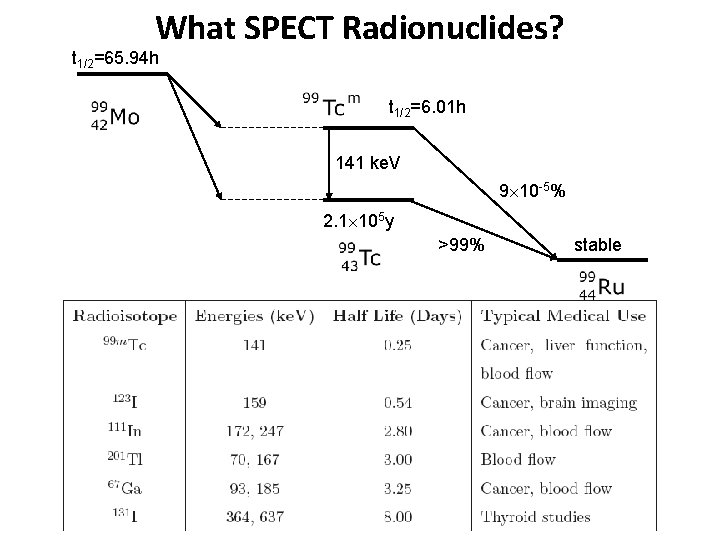
What SPECT Radionuclides? t 1/2=65. 94 h t 1/2=6. 01 h 141 ke. V 9 10 -5% 2. 1 105 y >99% stable
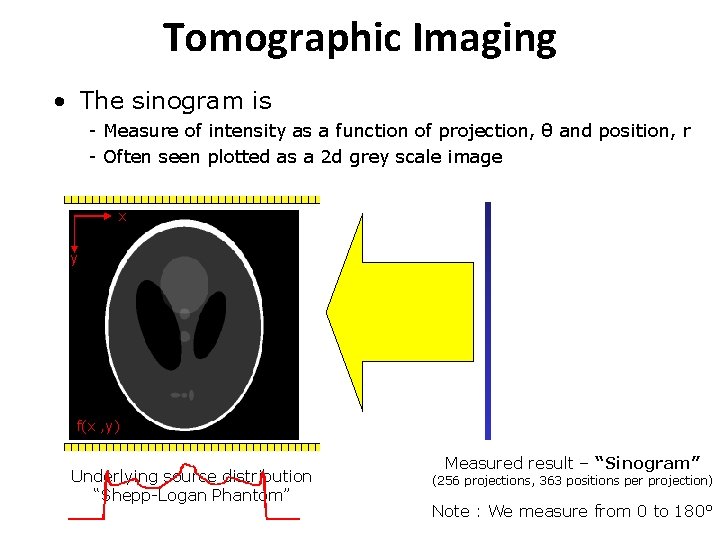
Tomographic Imaging • The sinogram is what we aim to measure - Measure of intensity as a function of projection, θ and position, r - Often seen plotted as a 2 d grey scale image θ x y f(x , y) Underlying source distribution “Shepp-Logan Phantom” r p(r , θ) Measured result – “Sinogram” (256 projections, 363 positions per projection) Note : We measure from 0 to 180°

SPECT : Problems/Opportunities Technical • Collimator Limits Spatial Resolution & Efficiency • Collimator is heavy and bulky • Energy of radioisotope limited to low energy • Na. I: Tl Dominant for >40 Years. . . • MRI Existing PMTs will not easily operate • Would like to be able to image a larger fraction of events. Common radionuclides: 99 m. Tc, 123 I, 131 I
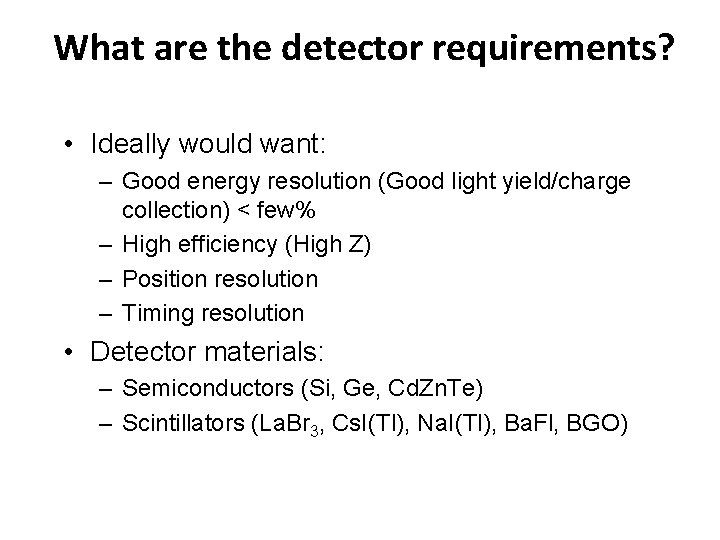
What are the detector requirements? • Ideally would want: – Good energy resolution (Good light yield/charge collection) < few% – High efficiency (High Z) – Position resolution – Timing resolution • Detector materials: – Semiconductors (Si, Ge, Cd. Zn. Te) – Scintillators (La. Br 3, Cs. I(Tl), Na. I(Tl), Ba. Fl, BGO)
Pro. SPECTus Next generation Single Photon Emission Computed Tomography Nuclear Physics Group, Dept of Physics, University of Liverpool, Nuclear Physics & Technology Groups, STFC Daresbury Laboratory, MARIARC & Royal Liverpool University NHS Trust
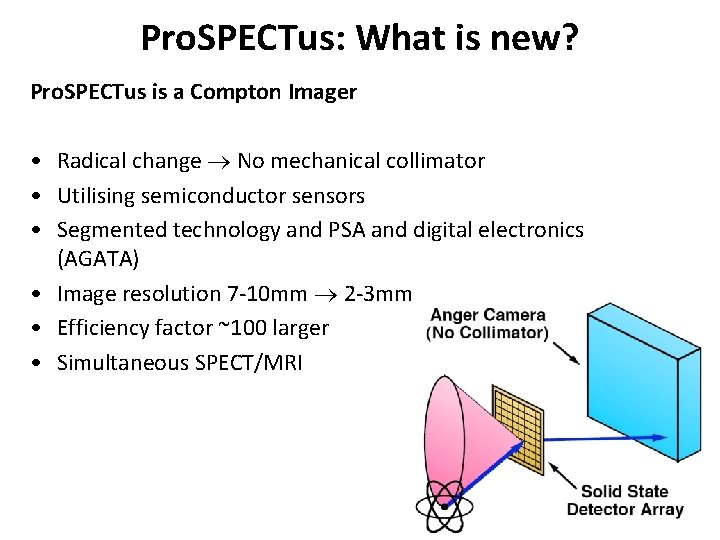
Pro. SPECTus: What is new? Pro. SPECTus is a Compton Imager • Radical change No mechanical collimator • Utilising semiconductor sensors • Segmented technology and PSA and digital electronics (AGATA) • Image resolution 7 -10 mm 2 -3 mm • Efficiency factor ~100 larger • Simultaneous SPECT/MRI

What’s new? Conventional SPECT Compton camera Source E 0 • Gamma rays detected by a gamma camera • Inefficient detection method • Incompatible with MRI • Gamma rays detected by a Compton camera • Positions and energies of interactions used to locate the source Factors that limit the performance of a Compton Imager: Energy resolution, Detector position resolution, Doppler Broadening
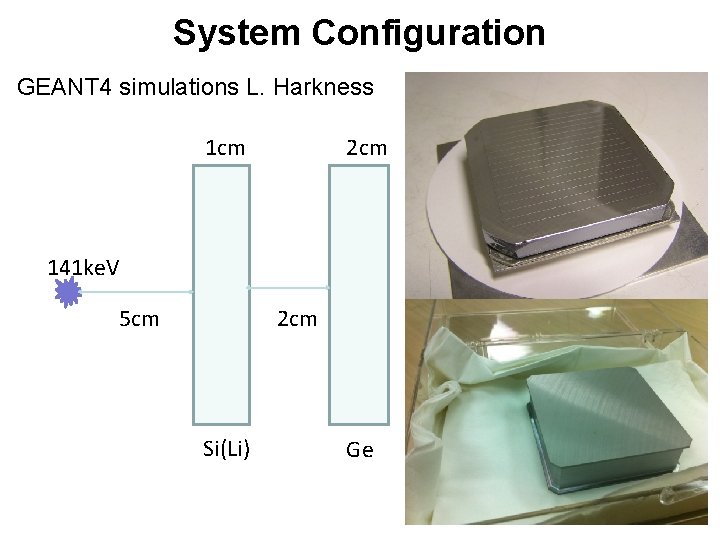
System Configuration GEANT 4 simulations L. Harkness 1 cm 2 cm • Total Coincident ~3. 49% • SPECT ~ 0. 025% (typical value) • Factor of ~140 141 ke. V 5 cm 2 cm Si(Li) Ge Event Type % Single / Single 2. 23 Single / Multiple 0. 33 Multiple / Single 0. 61 Multiple / Multiple 0. 04 Not absorbed 0. 28
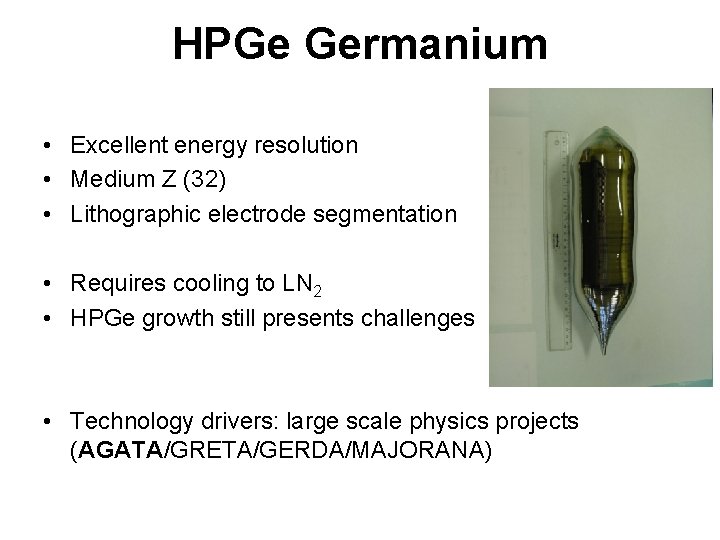
HPGe Germanium • Excellent energy resolution • Medium Z (32) • Lithographic electrode segmentation • Requires cooling to LN 2 • HPGe growth still presents challenges • Technology drivers: large scale physics projects (AGATA/GRETA/GERDA/MAJORANA)
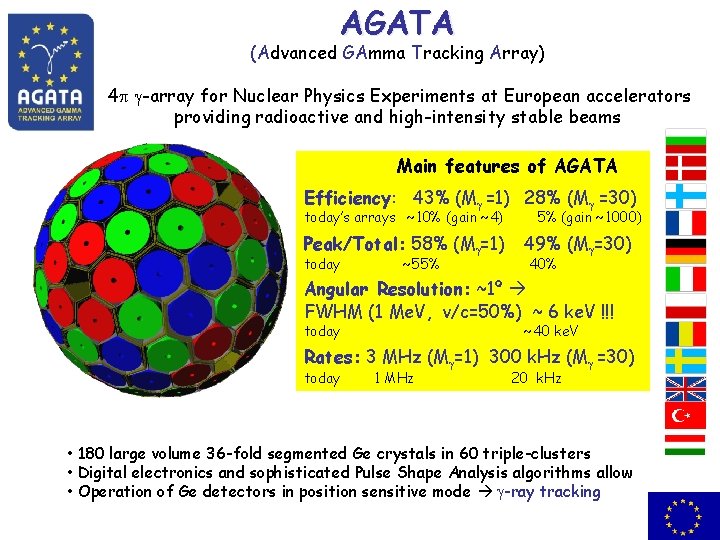
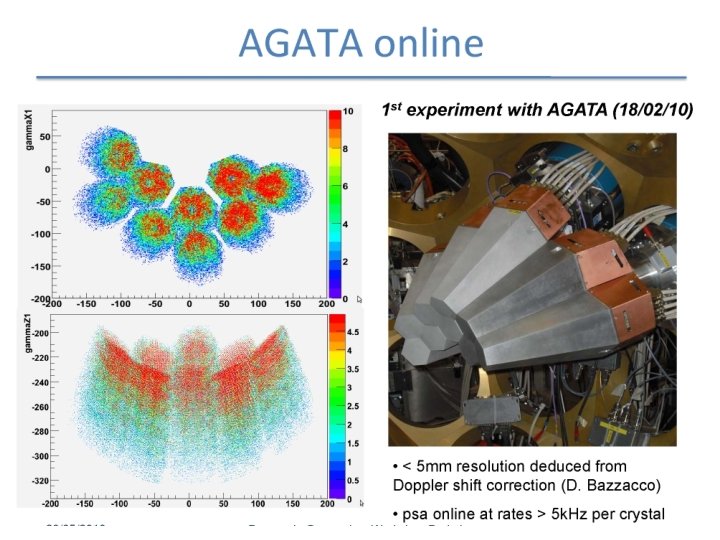
AGATA (Advanced GAmma Tracking Array) 4 -array for Nuclear Physics Experiments at European accelerators providing radioactive and high-intensity stable beams Main features of AGATA Efficiency: 43% (M =1) 28% (M =30) today’s arrays ~10% (gain ~4) Peak/Total: 58% (M =1) today ~55% 5% (gain ~1000) 49% (M =30) 40% Angular Resolution: ~1º FWHM (1 Me. V, v/c=50%) ~ 6 ke. V !!! today ~40 ke. V Rates: 3 MHz (M =1) 300 k. Hz (M =30) today 1 MHz 20 k. Hz • 180 large volume 36 -fold segmented Ge crystals in 60 triple-clusters • Digital electronics and sophisticated Pulse Shape Analysis algorithms allow • Operation of Ge detectors in position sensitive mode -ray tracking
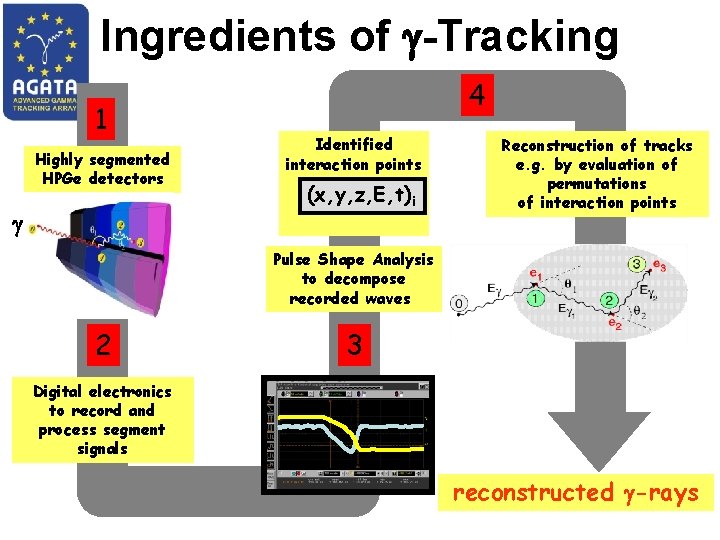
Ingredients of g-Tracking 1 Highly segmented HPGe detectors · · g · · 2 4 Identified interaction points (x, y, z, E, t)i Reconstruction of tracks e. g. by evaluation of permutations of interaction points Pulse Shape Analysis to decompose recorded waves 3 Digital electronics to record and process segment signals reconstructed g-rays
Pro. SPECTus Next generation Single Photon Emission Computed Tomography Nuclear Physics Group, Dept of Physics, University of Liverpool, Nuclear Physics & Technology Groups, STFC Daresbury Laboratory, MARIARC & Royal Liverpool University NHS Trust
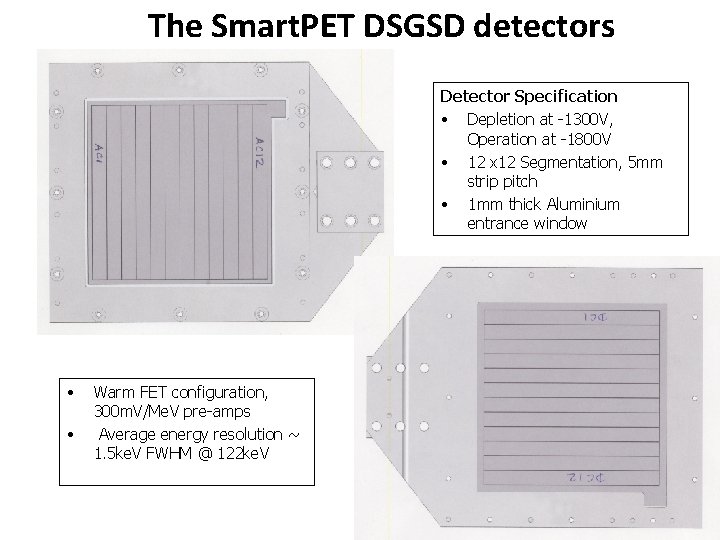
The Smart. PET DSGSD detectors Detector Specification • Depletion at -1300 V, Operation at -1800 V • 12 x 12 Segmentation, 5 mm strip pitch • 1 mm thick Aluminium entrance window • • Warm FET configuration, 300 m. V/Me. V pre-amps Average energy resolution ~ 1. 5 ke. V FWHM @ 122 ke. V
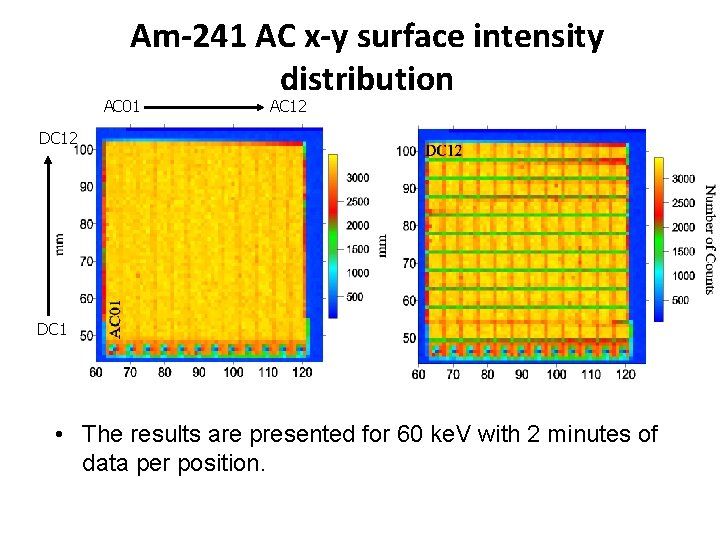
Am-241 AC x-y surface intensity distribution AC 01 AC 12 DC 1 • The results are presented for 60 ke. V with 2 minutes of data per position.
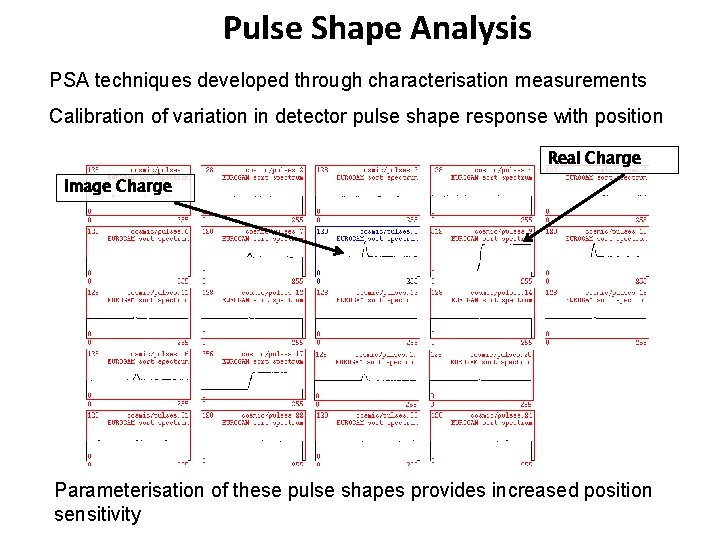
Pulse Shape Analysis PSA techniques developed through characterisation measurements Calibration of variation in detector pulse shape response with position Real Charge Image Charge Parameterisation of these pulse shapes provides increased position sensitivity
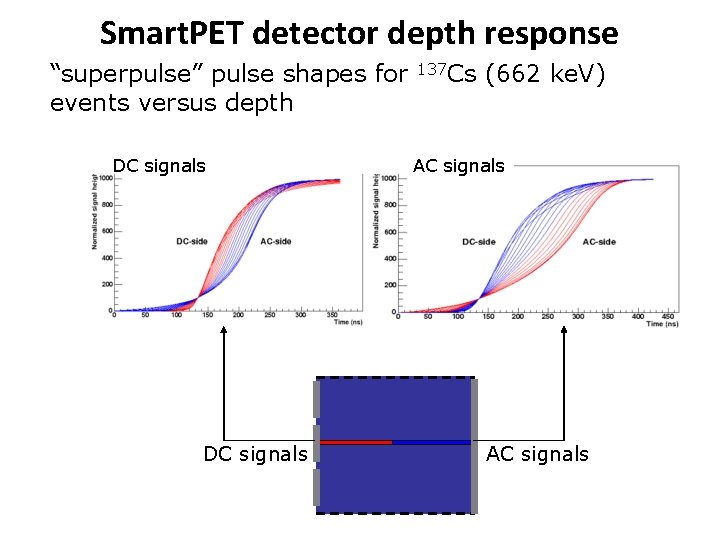
Smart. PET detector depth response “superpulse” pulse shapes for events versus depth DC signals 137 Cs (662 ke. V) AC signals
Image Reconstruction • Sensors have excellent energy & position information. • Uniformity of sensor response • Optimise existing: – Analytical – Iterative – Stochastic • Requirement for GPU acceleration
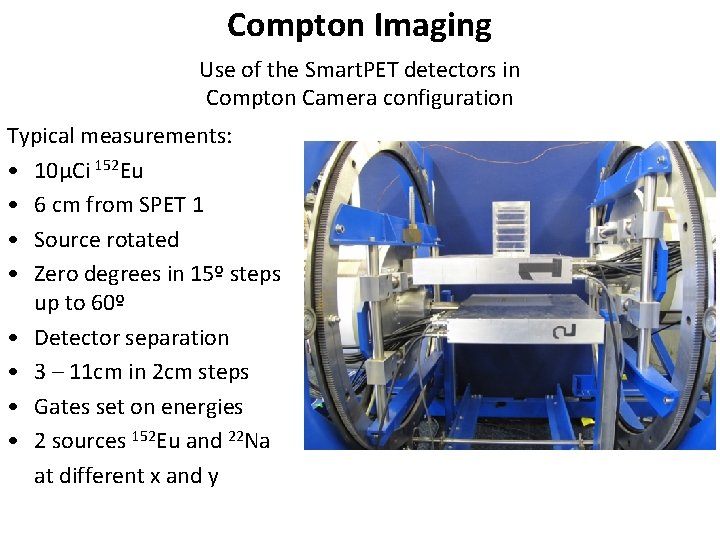
Compton Imaging Use of the Smart. PET detectors in Compton Camera configuration Typical measurements: • 10μCi 152 Eu • 6 cm from SPET 1 • Source rotated • Zero degrees in 15º steps up to 60º • Detector separation • 3 – 11 cm in 2 cm steps • Gates set on energies • 2 sources 152 Eu and 22 Na at different x and y
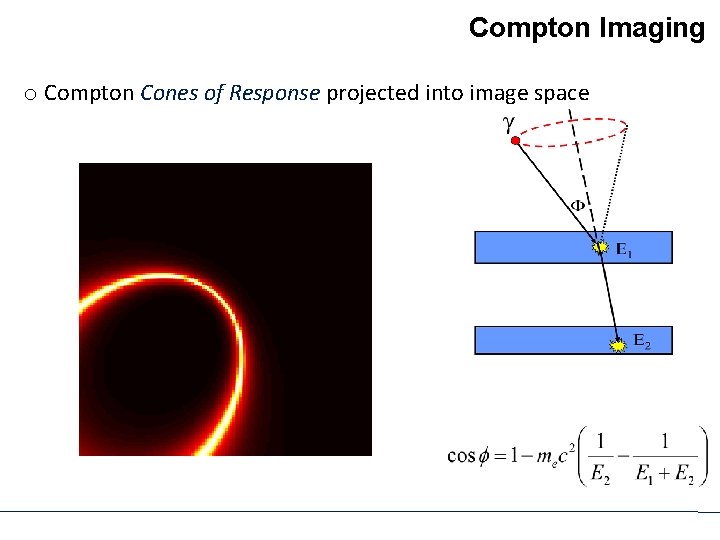
Compton Imaging o Compton Cones of Response projected into image space
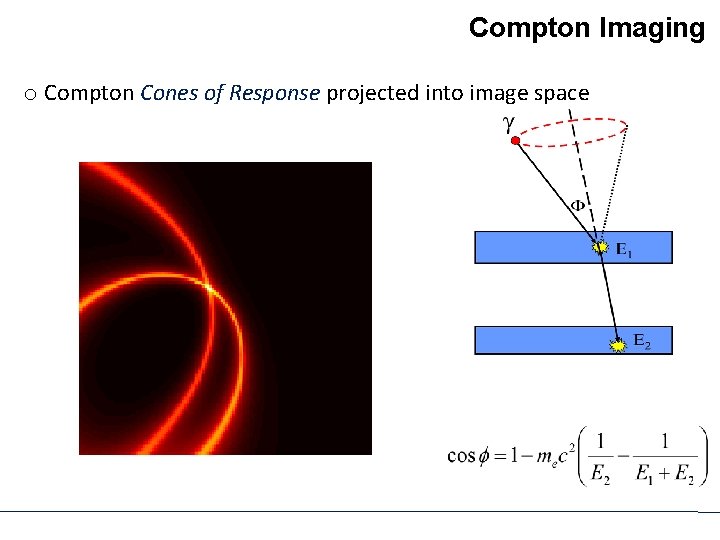
Compton Imaging o Compton Cones of Response projected into image space
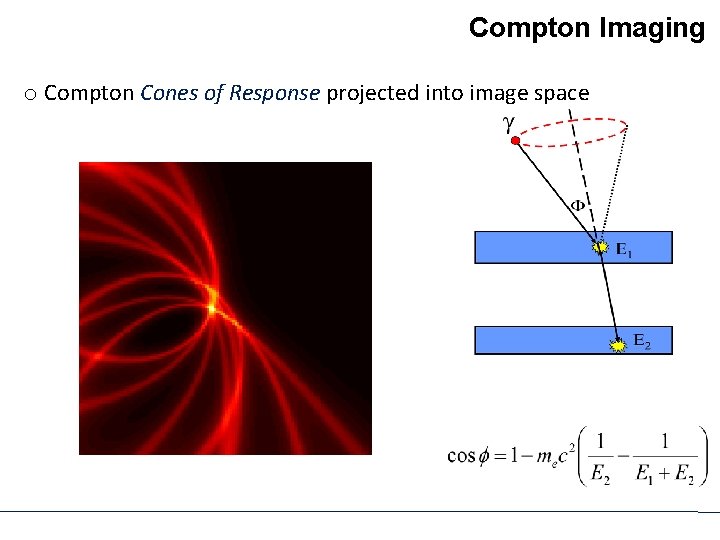
Compton Imaging o Compton Cones of Response projected into image space
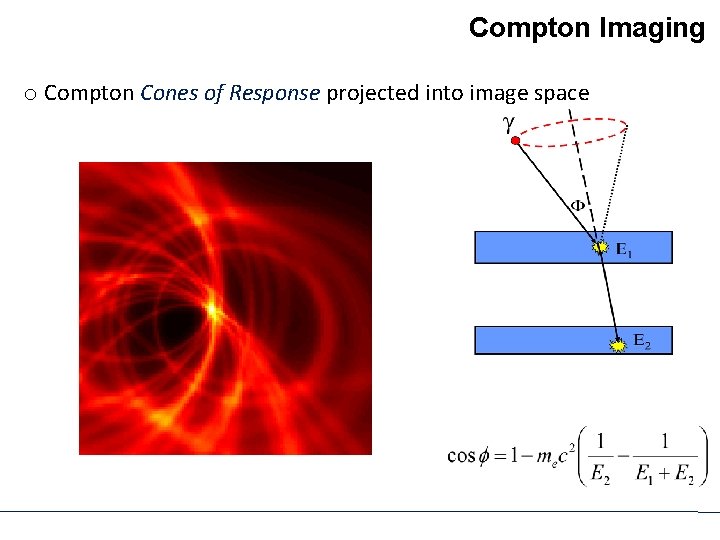
Compton Imaging o Compton Cones of Response projected into image space
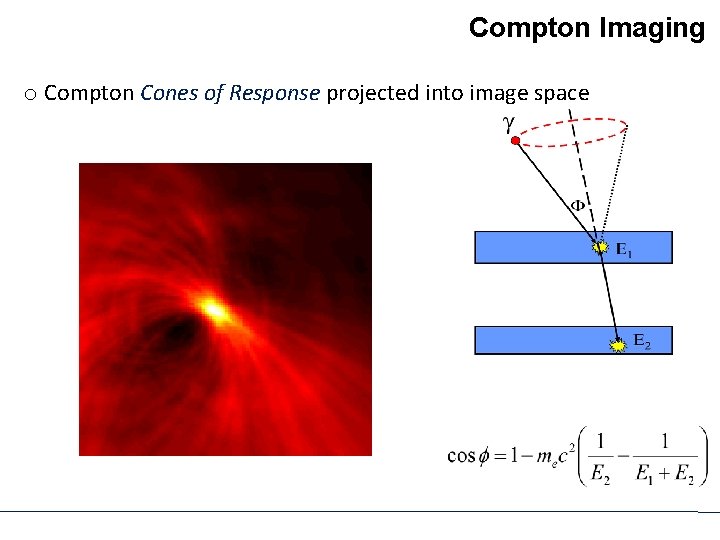
Compton Imaging o Compton Cones of Response projected into image space
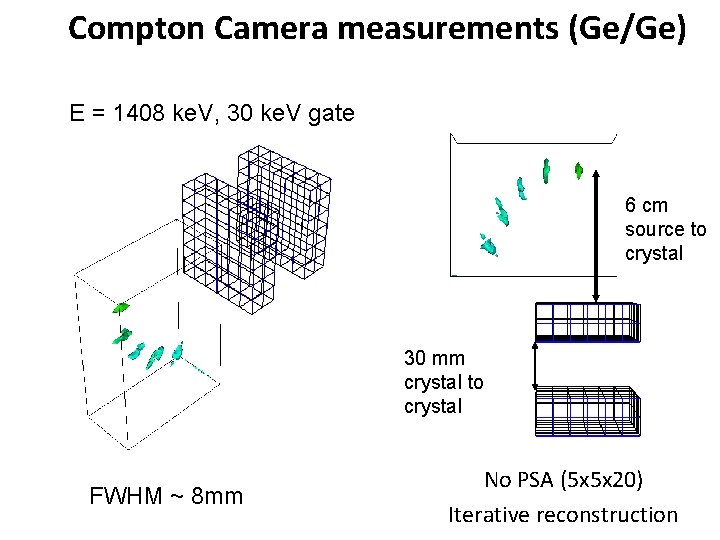
Compton Camera measurements (Ge/Ge) E = 1408 ke. V, 30 ke. V gate 6 cm source to crystal 30 mm crystal to crystal FWHM ~ 8 mm No PSA (5 x 5 x 20) Iterative reconstruction
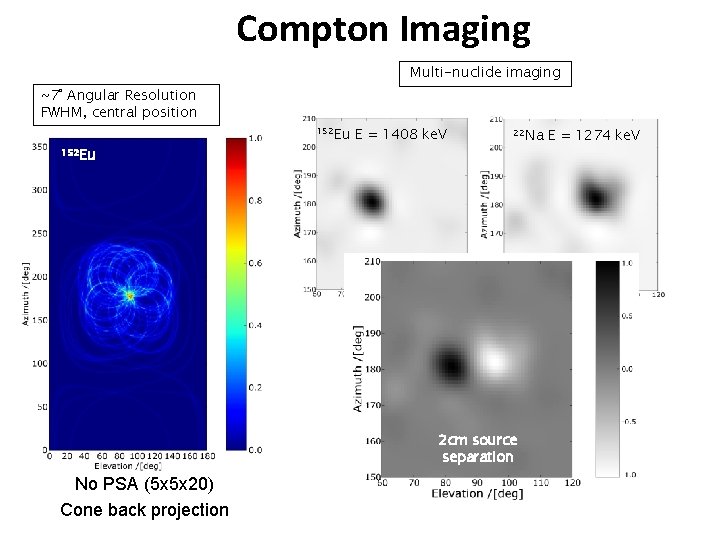
Compton Imaging Multi-nuclide imaging ~7º Angular Resolution FWHM, central position 152 Eu E = 1408 ke. V 22 Na 2 cm source separation No PSA (5 x 5 x 20) Cone back projection E = 1274 ke. V
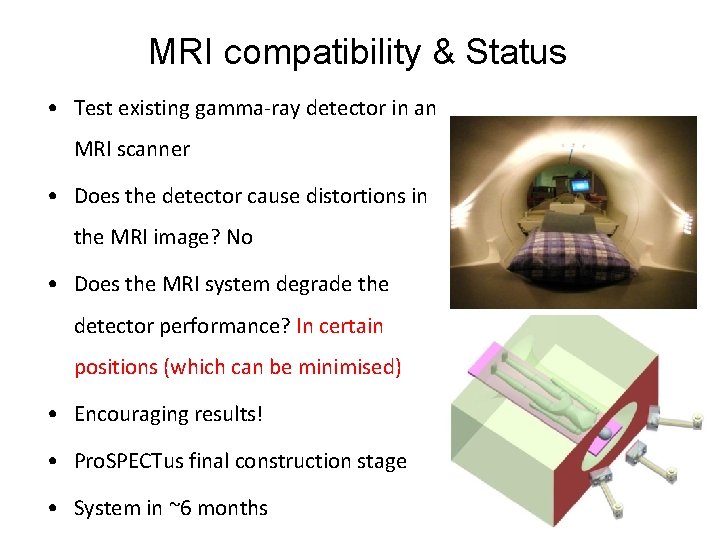
MRI compatibility & Status • Test existing gamma-ray detector in an MRI scanner • Does the detector cause distortions in the MRI image? No • Does the MRI system degrade the detector performance? In certain positions (which can be minimised) • Encouraging results! • Pro. SPECTus final construction stage • System in ~6 months
What are the next steps? • Immediate priorities • We (almost) have an integrated Compton Gamma camera optimised for <500 ke. V • Demonstrate sensitivity with phantoms • Commence trials including clinical evaluation • For the future: • Consider electron tracking Si scatterer • Possible use of large CZT analyser (requires large wafer material with 1 cm thickness)
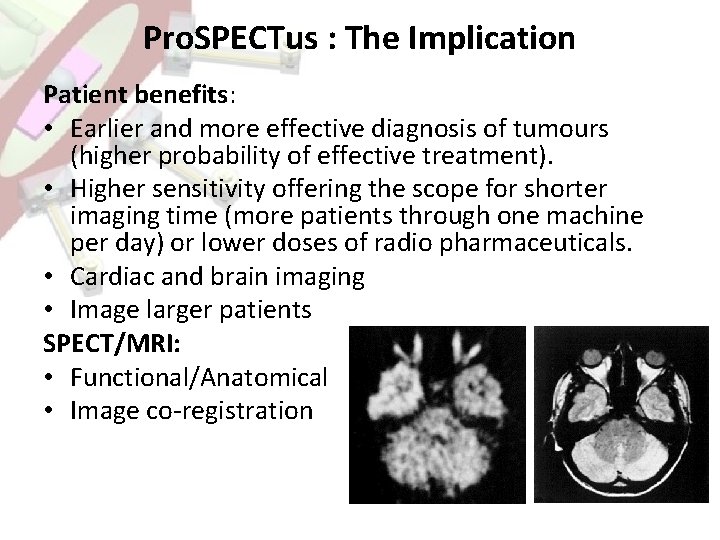
Pro. SPECTus : The Implication Patient benefits: • Earlier and more effective diagnosis of tumours (higher probability of effective treatment). • Higher sensitivity offering the scope for shorter imaging time (more patients through one machine per day) or lower doses of radio pharmaceuticals. • Cardiac and brain imaging • Image larger patients SPECT/MRI: • Functional/Anatomical • Image co-registration
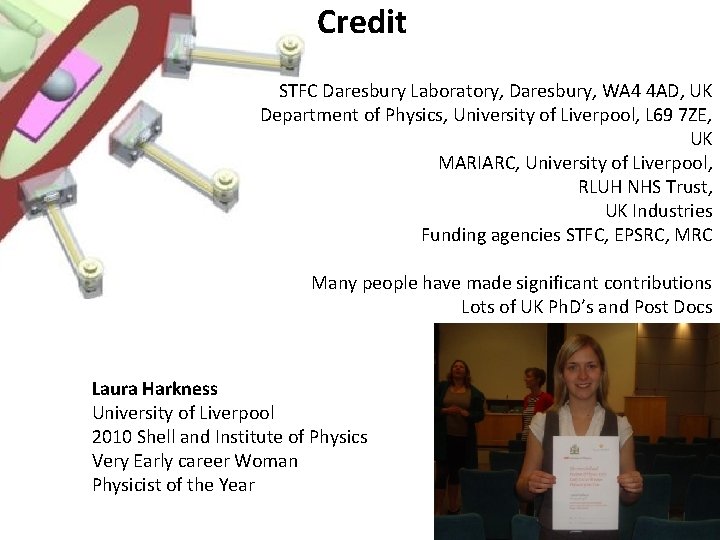
Credit STFC Daresbury Laboratory, Daresbury, WA 4 4 AD, UK Department of Physics, University of Liverpool, L 69 7 ZE, UK MARIARC, University of Liverpool, RLUH NHS Trust, UK Industries Funding agencies STFC, EPSRC, MRC Many people have made significant contributions Lots of UK Ph. D’s and Post Docs Laura Harkness University of Liverpool 2010 Shell and Institute of Physics Very Early career Woman Physicist of the Year
- Slides: 34