
Specifying ScratchDig of an Optical Surface MIL0 13830


- Slides: 14
Specifying Scratch/Dig of an Optical Surface MIL-0 -13830 Jason Kuhn 12/12/12
The Scratch/Dig Numbers � Two numbers are always specified i. e. 60 -40 � The first number specifies the maximum width of scratches on the surface in tenths of a micron. � The second number defines the average maximum diameter of a dig in hundredths of a millimeter.
Scratches �A scratch is defined as any marking or tearing in the surface. A scratch is much longer than it is wide. � Typical width is 1 -8 microns #80 Max width equals 8 microns #60 Max width equals 6 microns #40 Max width equals 4 microns #20 Max width equals 2 microns #10 Max width equals 1 micron #5 Max width equals 1/2 micron
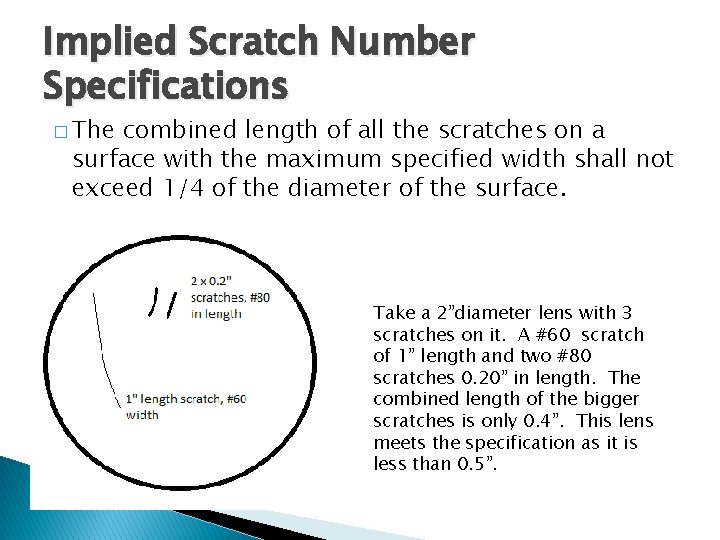
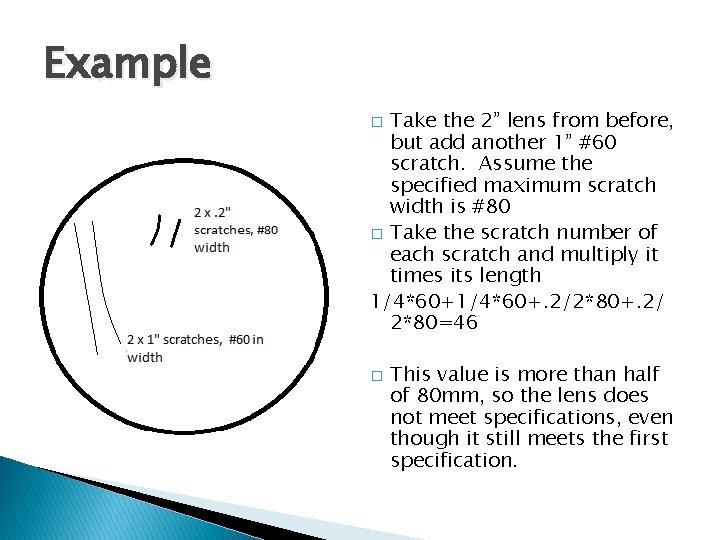
Implied Scratch Number Specifications � The combined length of all the scratches on a surface with the maximum specified width shall not exceed 1/4 of the diameter of the surface. Take a 2”diameter lens with 3 scratches on it. A #60 scratch of 1” length and two #80 scratches 0. 20” in length. The combined length of the bigger scratches is only 0. 4”. This lens meets the specification as it is less than 0. 5”.
Implied Scratch Number Specifications � An element with multiple scratches of various widths: Each scratch width number is multiplied times the ratio of their length to the diameter of the element. The sum of these values shall not exceed the maximum specified scratch number.
Example Take the 2” lens from before, but add another 1” #60 scratch. Assume the specified maximum scratch width is #80 � Take the scratch number of each scratch and multiply it times its length 1/4*60+. 2/2*80+. 2/ 2*80=46 � � This value is more than half of 80 mm, so the lens does not meet specifications, even though it still meets the first specification.
Implied Scratch Number Specifications � Areas of surface whose maximum specified scratch width is #20 or better shall have no 1/4” diameter area with more than 4 scratches (#10 or larger) � Surface area outside of the defined clear aperture is expected to meet 80 -50 unless otherwise specified. � Coating scratches must also comply with surface specifications even if the scratch is not deep enough to affect the actual glass surface.
Digs �A dig is any pit-like hole in the surface. They are usually round in shape. The dig specification defines the maximum allowable diameter of any dig in the surface. In the case of irregular shaped digs, the average diameter of shape is used � Typical Dig size is 0. 05 mm-0. 5 mm
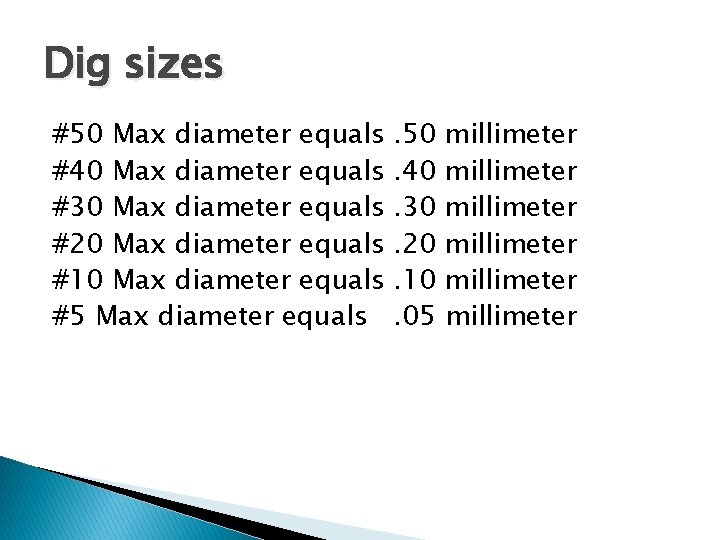
Dig sizes #50 Max diameter equals #40 Max diameter equals #30 Max diameter equals #20 Max diameter equals #10 Max diameter equals #5 Max diameter equals . 50. 40. 30. 20. 10. 05 millimeter millimeter
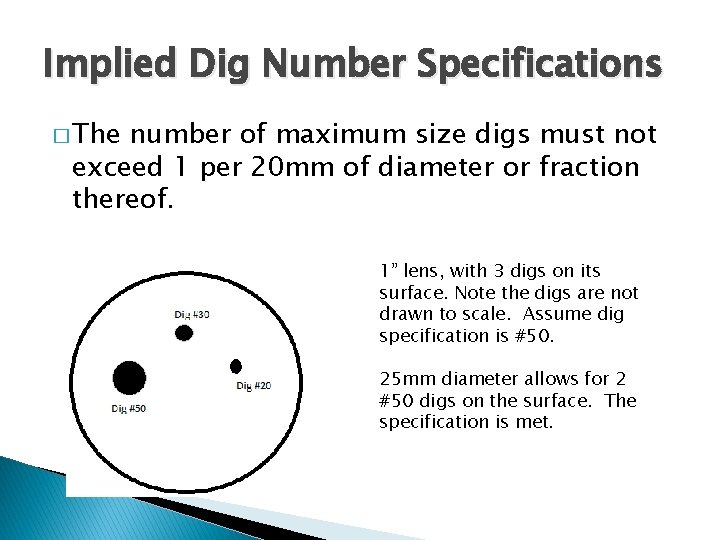
Implied Dig Number Specifications � The number of maximum size digs must not exceed 1 per 20 mm of diameter or fraction thereof. 1” lens, with 3 digs on its surface. Note the digs are not drawn to scale. Assume dig specification is #50. 25 mm diameter allows for 2 #50 digs on the surface. The specification is met.
Implied Dig Number Specifications � The sum of all the digs larger than 2. 5 microns shall not exceed twice the number of the dig specification. Same 1” lens, with 3 digs on its surface. Note the digs are not drawn to scale. Assume dig specification is #50. The sum of the dig numbers across the surface is 100. This just barely meets specification as 2 x the dig specification is 100. Any other digs on the surface larger than 2. 5 microns would make this surface not meet specifications.
Implied Dig Number Specifications � All surfaces with dig specifications of #10 or smaller must have 1 mm separation (edge) between each dig. � A bubbles and inclusions should be considered as an equivalent size dig, � There should only be 1 maximum size bubble per 20 mm of light, or fraction thereof.
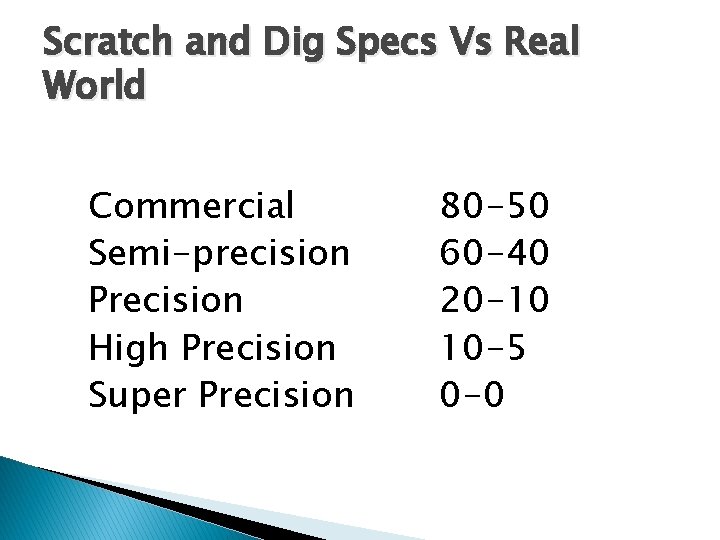
Scratch and Dig Specs Vs Real World Commercial Semi-precision Precision High Precision Super Precision 80 -50 60 -40 20 -10 10 -5 0 -0
Cost Vs Scratch/Dig �I found two nearly identical broadband metallic mirrors from Newport varying only in optical surface quality. Both mirrors are 1” Zerodur Aluminum mirrors with a wavelength range from 450 -700 nm. � Model 10 Z 40 ER. 1 Scratch Dig: 10 -2 � Price: $129. 00 � Model 10 Z 20 ER. 1 Scratch Dig: 15 -5 � Price: $110. 00