
Specifications and Supplier Development in the UK Electrical
- Slides: 40
Specifications and Supplier Development in the UK Electrical Transmission and Distribution Equipment Industry Tom Mc. Govern and Chris Hicks University of Newcastle upon Tyne IGLS 04/1 Dr Tom Mc. Govern and Dr Chris Hicks
Definition of a Specification • “ a written description of a product that is generated beforehand to guide the development of the product” (Smith and Reinertsen, 1991, p 81). • “forum for dialogue” (Nellore and Söderquist). Dr Tom Mc. Govern and Dr Chris Hicks IGLS 04/2
Purpose of a Specification • To state the requirements concerning the performance and technical attributes of a product. • To give guidance on the process of making and using a product. Source: BS 7373, 1998 Dr Tom Mc. Govern and Dr Chris Hicks IGLS 04/3
Performance or Functional Specification • “specifies requirements in terms of features, characteristics, process conditions, limits and exclusions defining the performance of the product” Source: BS 7373, 1998, p 1 IGLS 04/4 Dr Tom Mc. Govern and Dr Chris Hicks
Product or Technical Specification • “ document that prescribes the requirements that the product needs to fulfil in order to conform to the performance specification”. Source: BS 7373, 1998, p 1. IGLS 04/5 Dr Tom Mc. Govern and Dr Chris Hicks
Specification of Processes • Broad and general. • Dependent on internal and external standards (BS, NGTS, IEC, ISO). IGLS 04/6 Dr Tom Mc. Govern and Dr Chris Hicks
Previous Research • • High volume automotive industry Black box engineering. Models of the specification process. Little research conducted in to the low volume, capital goods sector. IGLS 04/7 Dr Tom Mc. Govern and Dr Chris Hicks
Purpose of this Paper • Application of specifications in the UK electrical transmission and distribution equipment industry. • Case studies of National Grid Company and one of its strategic suppliers. IGLS 04/8 Dr Tom Mc. Govern and Dr Chris Hicks
Electricity Industry • In 2001, the electricity industry accounted for 13% of all industrial investment in the UK and contributed 1. 2 % to GDP (DTI, 2003). • Highly capital intensive, with total assets of £ 135 billion, or 4% of the total capital stock of UK industry (DTI, 2000). IGLS 04/9 Dr Tom Mc. Govern and Dr Chris Hicks
Research Methodology • In-depth case studies. • Explore the type of specifications issued by NGC. • NGC’s supplier development initiative. • SSADM to explore internal processes at Supplier. Co and its external communications with customers and suppliers. IGLS 04/10 Dr Tom Mc. Govern and Dr Chris Hicks
Research Methodology (cont. ) • Understand the processes and issues related to specifications. • Investigate how the business processes interacted in response to invitations to tender. • Identify how Supplier. Co put together tenders. IGLS 04/11 Dr Tom Mc. Govern and Dr Chris Hicks
Privatisation of Electricity Supply Industry • 1989 Electricity Act provided the framework for the privatisation of the electricity industry (CEGB) in the UK • Fossil fuel power stations transferred to four generating companies: Power. Gen and National Power in England Wales, and Scottish Power and Hydro-electric in Scotland IGLS 04/12 Dr Tom Mc. Govern and Dr Chris Hicks
Privatisation (cont. ) • Nuclear stations transferred to Nuclear Electric. • NGC took responsibility for operating high voltage transmission grid in England Wales (400, 000 and 275, 000 volts). • Twelve Regional Electricity Companies took responsibility for supply and distribution. IGLS 04/13 Dr Tom Mc. Govern and Dr Chris Hicks
National Grid Company (NGC) • Operates and maintains the 4, 500 -mile transmission grid. • Operates the electricity connectors between England Scotland. • Operates the cross-Channel transmission link to France. • Responsible for maintaining the physical assets and ensuring the long-term IGLS 04/14 reliability of the grid. Dr Tom Mc. Govern and Dr Chris Hicks
NGC (cont. ) • Monopoly position as a system operator. • Regulated by OFGEM. • Under the New Electricity Trading Arrangements (NETA), NGC is to guarantee the quality and reliability of electricity across the network and to balance aggregate supply and demand. IGLS 04/15 Dr Tom Mc. Govern and Dr Chris Hicks
National Grid Technical Specifications (NGTS) • NGC is cost driven. • Substantial technical expertise. • Substantial body of explicit and implicit knowledge. • High age profile of engineers at NGC and its suppliers. • Detailed technical specifications for critical new components. IGLS 04/16 Dr Tom Mc. Govern and Dr Chris Hicks
NGTS (cont. ) • NGTS documents are available on the web to approved suppliers. • Specifications are orientated towards a single integrated grid to give stability of supply. • Specification defines the product requirements to meet performance standard specified by the Regulator (99. 4% availability of supply). IGLS 04/17 Dr Tom Mc. Govern and Dr Chris Hicks
NGTS (cont. ) • Type Registration system for plant and equipment to ensure compliance with NGC technical standards and specifications. • All equipment has to be pre-approved by NGC. • NGC controls design solutions. • NGC seeks well-proven solutions and very high reliability NOT innovation. IGLS 04/18 Dr Tom Mc. Govern and Dr Chris Hicks
NGTS (cont. ) • Tender documents are framed in terms of functional or ‘application’ specifications. These are underpinned by the NGTS framework. IGLS 04/19 Dr Tom Mc. Govern and Dr Chris Hicks
Supplier Development • First tier suppliers of transmission and distribution equipment are assessed as part of the tender evaluation process. • Suppliers are assessed on tender price, tender compliance, capability and performance. IGLS 04/20 Dr Tom Mc. Govern and Dr Chris Hicks
Supplier Development (cont. ) • The capabilities of suppliers are assessed on ten criteria: management systems; contract management; safety, health and environmental; scheme development; tenders; design management; programme management; supplier management; site management; commissioning and postproject support. IGLS 04/21 Dr Tom Mc. Govern and Dr Chris Hicks
Supplier Development (cont. ) • Suppliers are assessed on a scale of 1 to 10 in each of the ten categories: 1 is inadequate, 3 is poor, 7 is good and 10 is excellent. • Suppliers are shown their individual performance on the basis of the assessment criteria plus a comparison with other suppliers. IGLS 04/22 Dr Tom Mc. Govern and Dr Chris Hicks
Supplier Development (cont. ) • NGC works with suppliers to develop a programme and action plan to improve their capabilities. • Supplier performance during each contract is assessed on the basis of project delivery, site delivery and commercial criteria. • NGC has a considerable amount of data for tender evaluation. IGLS 04/23 Dr Tom Mc. Govern and Dr Chris Hicks
Supplier Development (cont. ) • Supplier development strategy guarantees quality assurance and helps suppliers to improve their capabilities and performance IGLS 04/24 Dr Tom Mc. Govern and Dr Chris Hicks
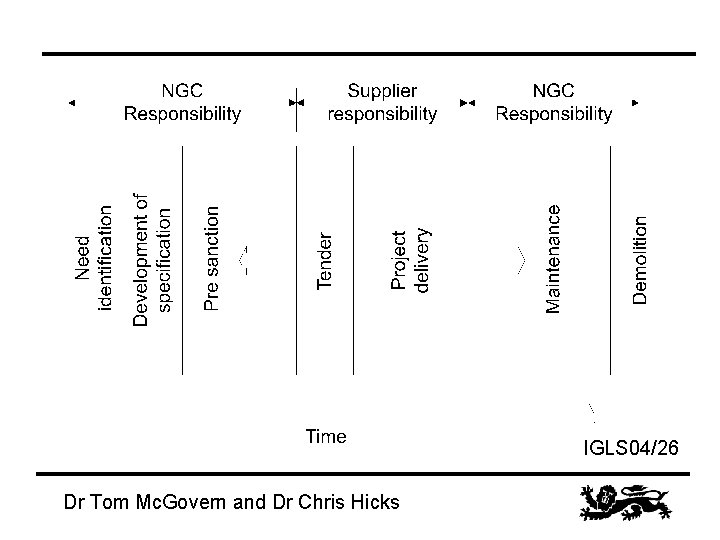
Supply Chain Management • Collaborative as opposed to partnership relationships. • Shift from a product development strategy to supply chain management. • NGC is seeking integrated solutions that encompass product development, construction, tendering, project delivery, maintenance and demolition. IGLS 04/25 Dr Tom Mc. Govern and Dr Chris Hicks
IGLS 04/26 Dr Tom Mc. Govern and Dr Chris Hicks
Supply Chain Management • From January 2004, NGC will not approve components. • Lower-tier suppliers must link in with a first -tier solution provider. • Principal contractor is responsible for ensuring that the product meets NGC standards. • Creation of ‘super clusters’. IGLS 04/27 Dr Tom Mc. Govern and Dr Chris Hicks
Supplier. Co • Produces a wide range of equipment including air-insulated and gas-insulated switchgear. • Restructured into SBUs: Projects, Protection, Automation and Control (A&C). • Tenders come to A&C via Projects. • Projects undertakes the risk management. IGLS 04/28 Dr Tom Mc. Govern and Dr Chris Hicks
Restructuring • Shift from a functional to a customerfocused structure. • Senior engineers operate across the main functions of the business. • Senior engineers are responsible for planning and controlling the project. • Senior engineer liaises directly with the customer. IGLS 04/29 Dr Tom Mc. Govern and Dr Chris Hicks
Tendering • An issue of accuracy with site drawings provided by NGC. • Each clause has to be checked to ensure compliance with NGTS, BS, ISO or IEC standards. • Some specifications are onerous and sometimes over specified resulting in higher costs for the testing of products. IGLS 04/30 Dr Tom Mc. Govern and Dr Chris Hicks
Tendering (cont. ) • NGC system stifles creativity and innovation and increase costs. • Issuing of standard documents to trusted contractors would allow the supplier to indicate non-compliance in particular areas of the tender. • Would prefer to offer alternative products (noncompliant) with improved technology. IGLS 04/31 Dr Tom Mc. Govern and Dr Chris Hicks
Tendering (cont. ) • Supplier. Co always bids compliant. • When seeking quotations or ordering equipment, the relevant sections of the specification are passed to the suppliers. • Primary role of tendering is to develop tenders that achieve the correct price, quality and delivery date to meet customers’ requirements. IGLS 04/32 Dr Tom Mc. Govern and Dr Chris Hicks
Tendering (cont. ) • Takes 7 to 10 days to prepare a tender and involves two to three people working on it part-time. • The work content is generally 80 -100 hours. • 20% tendering success rate. IGLS 04/33 Dr Tom Mc. Govern and Dr Chris Hicks
Benefits of NGC System • NGC management of specifications and supplier development initiative give the Company control of product development and fulfilment processes throughout the supply chain. • Supplier development strategy makes purchasing decisions transparent to suppliers and the Regulator. IGLS 04/34 Dr Tom Mc. Govern and Dr Chris Hicks
Benefits of NGC System (cont) • Engineering competence of NGC is recognised throughout its supply chain and also internationally. • Ensures the adoption of appropriate quality standards throughout the supply chain. • Specifications need to reflect the changing nature of the industry. IGLS 04/35 Dr Tom Mc. Govern and Dr Chris Hicks
Benefits of NGC System (cont. ) • Specifications should take into account the type and amount of information given to or obtained from suppliers. • Few first-tier suppliers and mutual dependence between NGC and its suppliers. • NGC has a large investment in embedded knowledge. IGLS 04/36 Dr Tom Mc. Govern and Dr Chris Hicks
Benefits of NGC System (cont. ) • Design of distribution products is not driven by competition. • Emphasis on reliability and cost reduction to satisfy the Regulator and satisfy shareholders. • Specifications are static, therefore the focus is on supplier development. IGLS 04/37 Dr Tom Mc. Govern and Dr Chris Hicks
Conclusions • Detailed technical specifications reduce the design choices available to suppliers, which may constrain innovation and increase costs. • NGC is adopting functional specifications, but they will be embedded within a comprehensive framework of detailed technical specifications. IGLS 04/38 Dr Tom Mc. Govern and Dr Chris Hicks
Conclusions (cont. ) • Integration of knowledge is NGC’s core competence. • NGC seeks to develop its technical expertise rather than capture it from suppliers. • Supplier development programme controls costs and encourages suppliers to maintain and develop their capabilities. IGLS 04/39 Dr Tom Mc. Govern and Dr Chris Hicks
Conclusions (cont. ) • The programme promotes competition between suppliers. • Specifications influence the power balance between customers and suppliers. • Specifications have a large influence on performance, capital and operating costs. • Specifications are a strategic issue. IGLS 04/40 Dr Tom Mc. Govern and Dr Chris Hicks