
Specifications and methodologies of instrument performance monitoring systems

![[Parameter Definition Example] NEd. T NE△T specification and monitoring for microwave sounders(2015, NWP SAF)](https://slidetodoc.com/presentation_image_h2/e596819b88dec14826578432f9a18030/image-19.jpg "[Parameter Definition Example] NEd. T NE△T specification and monitoring for microwave sounders(2015, NWP SAF)")
![EUMETSAT [MSG 1/2/3/4] 1) Orbit state: Epoch, X(Y/Z)-position, SRP coefficient, Semi-Major Axis, Eccentricity Inclination,](https://slidetodoc.com/presentation_image_h2/e596819b88dec14826578432f9a18030/image-22.jpg "EUMETSAT [MSG 1/2/3/4] 1) Orbit state: Epoch, X(Y/Z)-position, SRP coefficient, Semi-Major Axis, Eccentricity Inclination,")
- Slides: 23
Specifications and methodologies of instrument performance monitoring systems Information for performance monitoring “specification and requirements” Dohyeong Kim (KMA), CMA, EUMETSAT, ISRO, JMA and NOAA 2019 GRWG/GDWG Annual Meeting, 4 -8 March 2019, Frascati, Italia 1
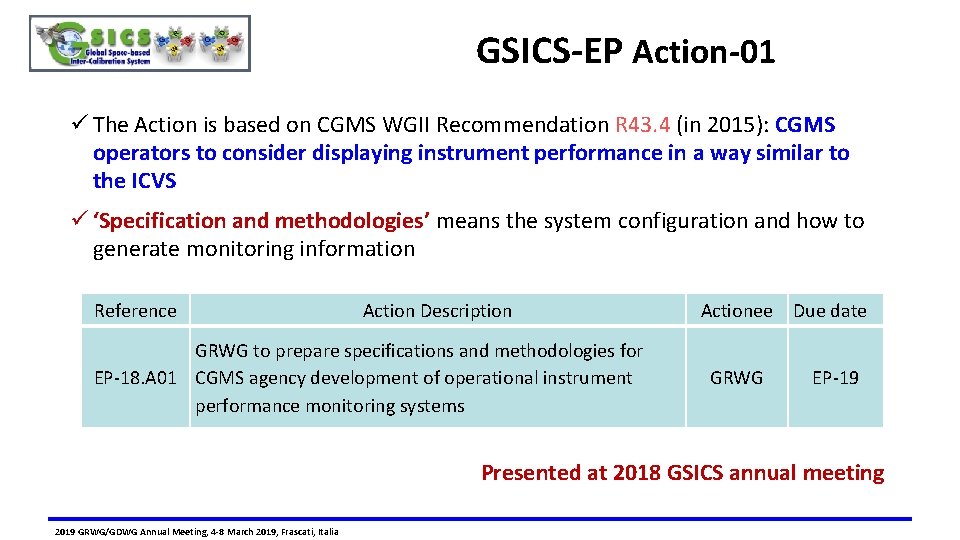
GSICS-EP Action-01 ü The Action is based on CGMS WGII Recommendation R 43. 4 (in 2015): CGMS operators to consider displaying instrument performance in a way similar to the ICVS ü ‘Specification and methodologies’ means the system configuration and how to generate monitoring information Reference Action Description GRWG to prepare specifications and methodologies for EP-18. A 01 CGMS agency development of operational instrument performance monitoring systems Actionee Due date GRWG EP-19 Presented at 2018 GSICS annual meeting 2019 GRWG/GDWG Annual Meeting, 4 -8 March 2019, Frascati, Italia
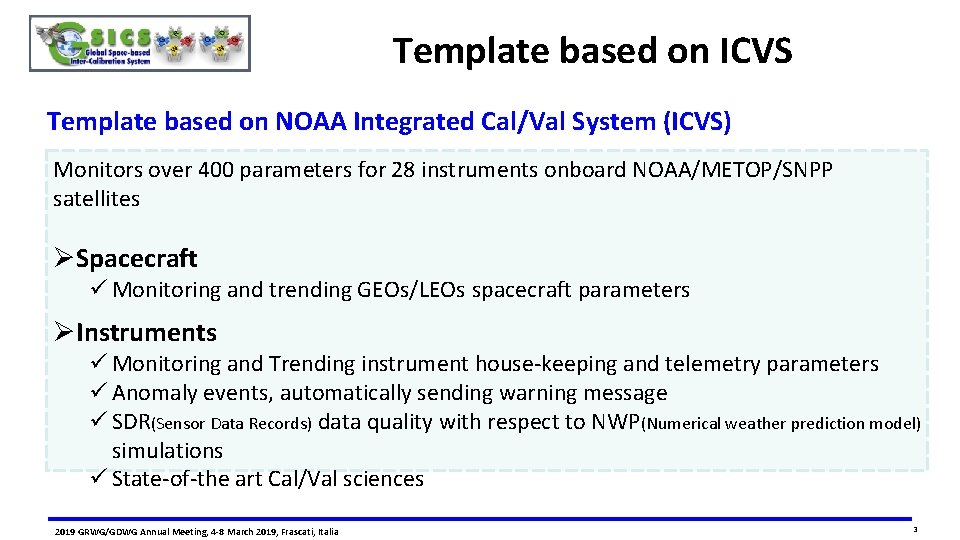
Template based on ICVS Template based on NOAA Integrated Cal/Val System (ICVS) Monitors over 400 parameters for 28 instruments onboard NOAA/METOP/SNPP satellites ØSpacecraft ü Monitoring and trending GEOs/LEOs spacecraft parameters ØInstruments ü Monitoring and Trending instrument house-keeping and telemetry parameters ü Anomaly events, automatically sending warning message ü SDR(Sensor Data Records) data quality with respect to NWP(Numerical weather prediction model) simulations ü State-of-the art Cal/Val sciences 2019 GRWG/GDWG Annual Meeting, 4 -8 March 2019, Frascati, Italia 3
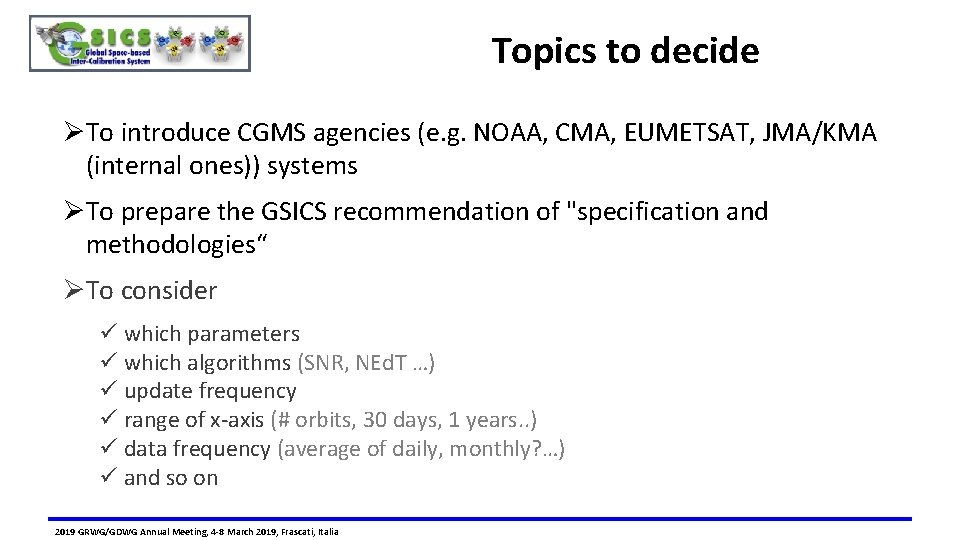
Topics to decide ØTo introduce CGMS agencies (e. g. NOAA, CMA, EUMETSAT, JMA/KMA (internal ones)) systems ØTo prepare the GSICS recommendation of "specification and methodologies“ ØTo consider ü which parameters ü which algorithms (SNR, NEd. T …) ü update frequency ü range of x-axis (# orbits, 30 days, 1 years. . ) ü data frequency (average of daily, monthly? …) ü and so on 2019 GRWG/GDWG Annual Meeting, 4 -8 March 2019, Frascati, Italia
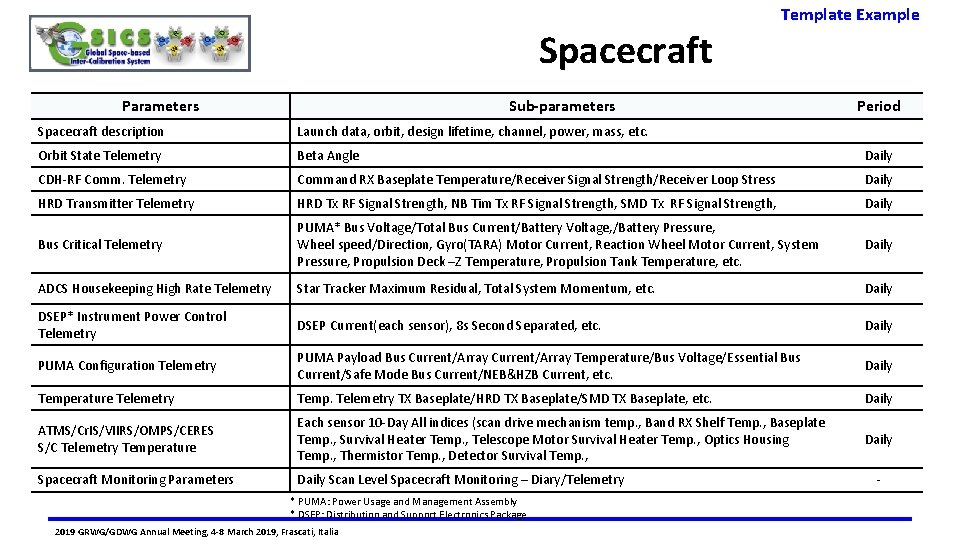
Spacecraft Parameters Template Example Sub-parameters Period Spacecraft description Launch data, orbit, design lifetime, channel, power, mass, etc. Orbit State Telemetry Beta Angle Daily CDH-RF Comm. Telemetry Command RX Baseplate Temperature/Receiver Signal Strength/Receiver Loop Stress Daily HRD Transmitter Telemetry HRD Tx RF Signal Strength, NB Tim Tx RF Signal Strength, SMD Tx RF Signal Strength, Daily Bus Critical Telemetry PUMA* Bus Voltage/Total Bus Current/Battery Voltage, /Battery Pressure, Wheel speed/Direction, Gyro(TARA) Motor Current, Reaction Wheel Motor Current, System Pressure, Propulsion Deck –Z Temperature, Propulsion Tank Temperature, etc. Daily ADCS Housekeeping High Rate Telemetry Star Tracker Maximum Residual, Total System Momentum, etc. Daily DSEP* Instrument Power Control Telemetry DSEP Current(each sensor), 8 s Second Separated, etc. Daily PUMA Configuration Telemetry PUMA Payload Bus Current/Array Temperature/Bus Voltage/Essential Bus Current/Safe Mode Bus Current/NEB&HZB Current, etc. Daily Temperature Telemetry Temp. Telemetry TX Baseplate/HRD TX Baseplate/SMD TX Baseplate, etc. Daily ATMS/Cr. IS/VIIRS/OMPS/CERES S/C Telemetry Temperature Each sensor 10 -Day All indices (scan drive mechanism temp. , Band RX Shelf Temp. , Baseplate Temp. , Survival Heater Temp. , Telescope Motor Survival Heater Temp. , Optics Housing Temp. , Thermistor Temp. , Detector Survival Temp. , Daily Spacecraft Monitoring Parameters Daily Scan Level Spacecraft Monitoring – Diary/Telemetry * PUMA: Power Usage and Management Assembly * DSEP: Distribution and Support Electronics Package 2019 GRWG/GDWG Annual Meeting, 4 -8 March 2019, Frascati, Italia -
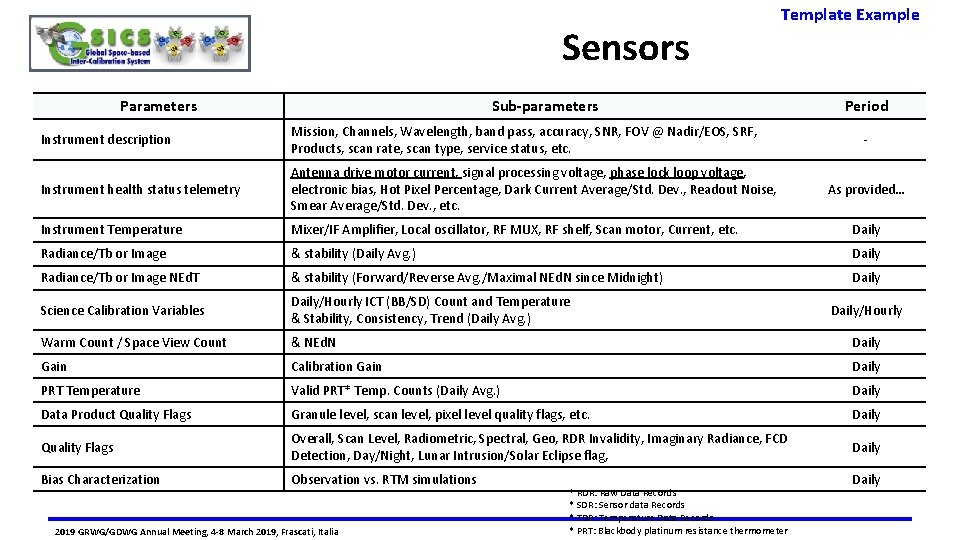
Sensors Parameters Template Example Sub-parameters Period Instrument description Mission, Channels, Wavelength, band pass, accuracy, SNR, FOV @ Nadir/EOS, SRF, Products, scan rate, scan type, service status, etc. Instrument health status telemetry Antenna drive motor current, signal processing voltage, phase lock loop voltage, electronic bias, Hot Pixel Percentage, Dark Current Average/Std. Dev. , Readout Noise, Smear Average/Std. Dev. , etc. Instrument Temperature Mixer/IF Amplifier, Local oscillator, RF MUX, RF shelf, Scan motor, Current, etc. Daily Radiance/Tb or Image & stability (Daily Avg. ) Daily Radiance/Tb or Image NEd. T & stability (Forward/Reverse Avg. /Maximal NEd. N since Midnight) Daily Science Calibration Variables Daily/Hourly ICT (BB/SD) Count and Temperature & Stability, Consistency, Trend (Daily Avg. ) Warm Count / Space View Count & NEd. N Daily Gain Calibration Gain Daily PRT Temperature Valid PRT* Temp. Counts (Daily Avg. ) Daily Data Product Quality Flags Granule level, scan level, pixel level quality flags, etc. Daily Quality Flags Overall, Scan Level, Radiometric, Spectral, Geo, RDR Invalidity, Imaginary Radiance, FCD Detection, Day/Night, Lunar Intrusion/Solar Eclipse flag, Daily Bias Characterization Observation vs. RTM simulations Daily 2019 GRWG/GDWG Annual Meeting, 4 -8 March 2019, Frascati, Italia * RDR: Raw Data Records * SDR: Sensor data Records * TDR: Temperature Data Records * PRT: Blackbody platinum resistance thermometer As provided… Daily/Hourly
Parameters that are not regarded as intersection portion among the instruments ATMS Cr. IS FSR VIIRS OMPS Receiver Shelf PRTs RDR Housekeeping Variables RDR Impulse Noise Count SDR Granule version Dark Look-up Table Main Motor Position Inteferogram Quality SDR Fringe Count SDR RSB H Factor RDR 2 -Wire PRT Temperature OMA Structure Temp. (Hrly. Avg. ), Stage Cooler Temp. (Hrly. Avg. ), Beam Splitter/Scan Baffle/Telescope Temp. (Hrly Avg. ), Servo Error daily or Avg. etc ES ZPD Fringe Count SDR RSB F Factor (ICVS vs. Oper) SDR Table Version and ID RDR Telemetry Health and Status (Scan drive, , , ) Allan NEDN ICT Real Orbital Avg. ES ZPD Amplitude SDR RSB F Factor (Oper vs. RSB Auto Cal) Linearity Calibration Reference LED TDR Data Quality Flag Allan NEDN ICT Imaginary Orbital Avg. Moving Window Size SDR RSB F Factor (ICVS vs. RSB Auto Cal) Solar Degradation TDR Operational Mode Flag Allan NEDN DS Real Orbital Avg. Moving Window Spectral Stability SDR RSB ICVS Det F Factor Nadir System Operational State TDR Daily Global O-B Bias (ECMWF) Allan NEDN DS Imaginary Orbital Avg. ES Spectral Radiance/BT SDR RSB Lunar Band Ratio Nadir System Table Version and ID TDR Monthly Global O-B Bias(GPSRO) Gain Orbit Avg. Calibration (Daily Avg. Normalized NEDN, 8 s Avg. Normalized NEDN) SDR TEB F Factor Nadir System Temperature/Voltage/Currents SDR DNB Trend Suite Software Version Control/Operational State/Temperature/Voltages/Curr ents TDR Inter-sensor Bias (SNO) Offset Orbit avg. RDR Dwell Telemetry Mapped Variables SDR Circuit Card Assembly Temperature GEO Quality Flag (QF 1) Quality Flag Scan Level/Overall/Radiometric/Spectral/Geo/RDR/Bit Trim/Imaginary Radiance/FCE Detection/FCE Correction/Day and Night/Impulse Noise Count/Fringe Count/ES ZPD Amplitude SDR Scan Cavity Baffle Temperature GEO Misc Moving Window Size SDR TEB O-B (ECMWF) Scan Drive Status Moving Window Spectral Stability GEO QF Status ES Spectral Radiance/BT RDR Scan Sync Loss Calibration: (Daily Avg. Normalized NEDN, 8 s Avg. Normalized NEDN) * Presently unavailable 2019 GRWG/GDWG Annual Meeting, Processing 4 -8 Marchlog 2019, Frascati, Italia * VIIRS Radiometric Calibration - H-factor: Solar Diffuser degradation factor Mgll
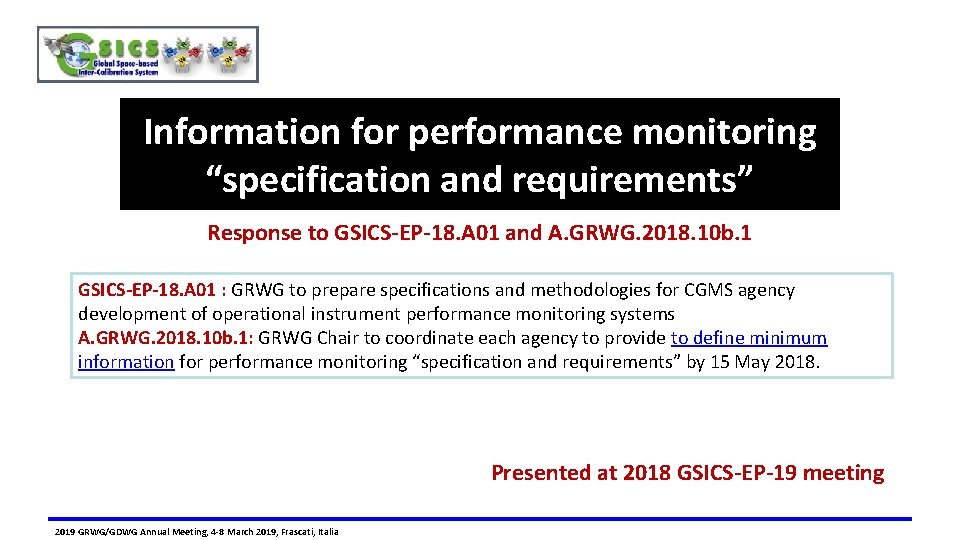
Information for performance monitoring “specification and requirements” Response to GSICS-EP-18. A 01 and A. GRWG. 2018. 10 b. 1 GSICS-EP-18. A 01 : GRWG to prepare specifications and methodologies for CGMS agency development of operational instrument performance monitoring systems A. GRWG. 2018. 10 b. 1: GRWG Chair to coordinate each agency to provide to define minimum information for performance monitoring “specification and requirements” by 15 May 2018. Presented at 2018 GSICS-EP-19 meeting 2019 GRWG/GDWG Annual Meeting, 4 -8 March 2019, Frascati, Italia
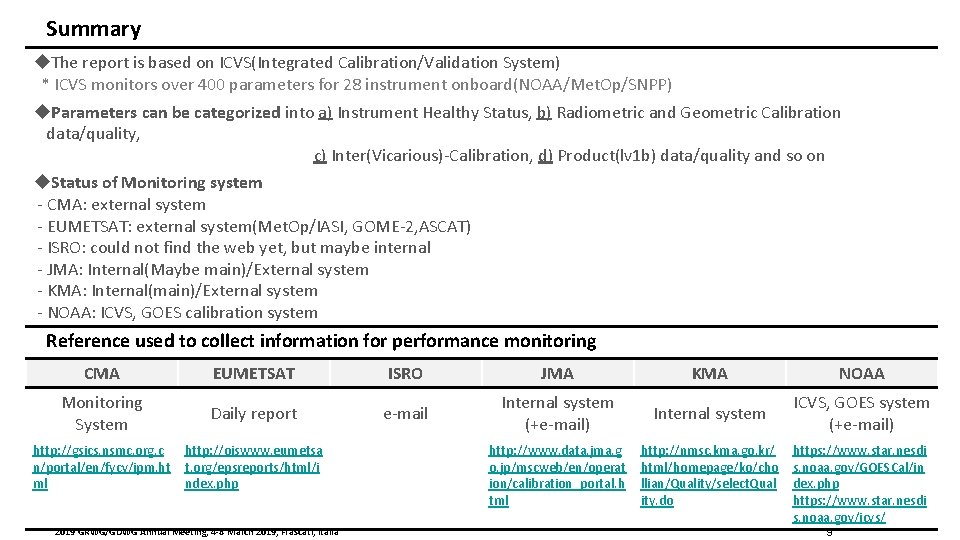
Summary u. The report is based on ICVS(Integrated Calibration/Validation System) * ICVS monitors over 400 parameters for 28 instrument onboard(NOAA/Met. Op/SNPP) u. Parameters can be categorized into a) Instrument Healthy Status, b) Radiometric and Geometric Calibration data/quality, c) Inter(Vicarious)-Calibration, d) Product(lv 1 b) data/quality and so on u. Status of Monitoring system - CMA: external system - EUMETSAT: external system(Met. Op/IASI, GOME-2, ASCAT) - ISRO: could not find the web yet, but maybe internal - JMA: Internal(Maybe main)/External system - KMA: Internal(main)/External system - NOAA: ICVS, GOES calibration system Reference used to collect information for performance monitoring CMA EUMETSAT ISRO JMA KMA NOAA Monitoring System Daily report e-mail Internal system (+e-mail) Internal system ICVS, GOES system (+e-mail) http: //gsics. nsmc. org. c n/portal/en/fycv/ipm. ht ml http: //oiswww. eumetsa t. org/epsreports/html/i ndex. php http: //www. data. jma. g o. jp/mscweb/en/operat ion/calibration_portal. h tml http: //nmsc. kma. go. kr/ html/homepage/ko/cho llian/Quality/select. Qual ity. do 2019 GRWG/GDWG Annual Meeting, 4 -8 March 2019, Frascati, Italia https: //www. star. nesdi s. noaa. gov/GOESCal/in dex. php https: //www. star. nesdi s. noaa. gov/icvs/ 9
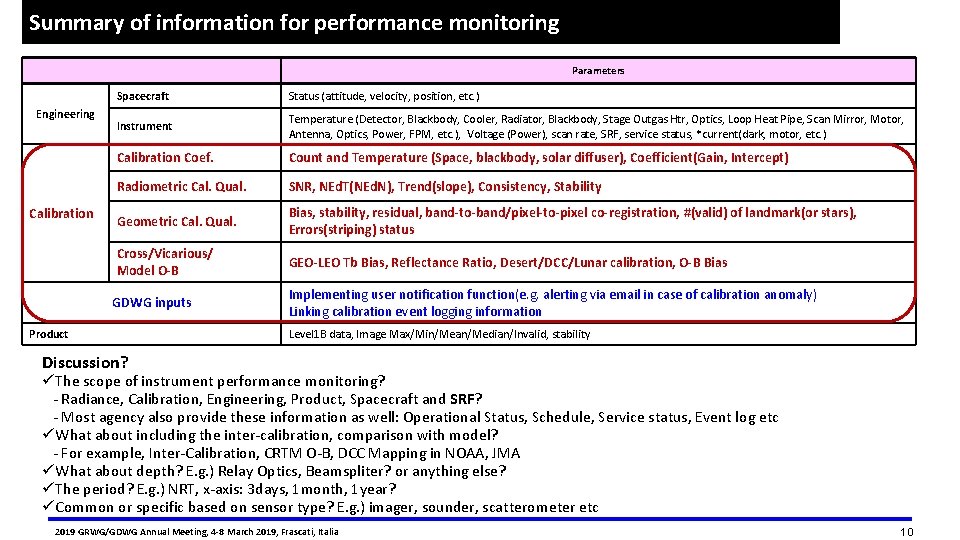
Summary of information for performance monitoring Parameters Engineering Calibration Spacecraft Status (attitude, velocity, position, etc. ) Instrument Temperature (Detector, Blackbody, Cooler, Radiator, Blackbody, Stage Outgas Htr, Optics, Loop Heat Pipe, Scan Mirror, Motor, Antenna, Optics, Power, FPM, etc. ), Voltage (Power), scan rate, SRF, service status, *current(dark, motor, etc. ) Calibration Coef. Count and Temperature (Space, blackbody, solar diffuser), Coefficient(Gain, Intercept) Radiometric Cal. Qual. SNR, NEd. T(NEd. N), Trend(slope), Consistency, Stability Geometric Cal. Qual. Bias, stability, residual, band-to-band/pixel-to-pixel co-registration, #(valid) of landmark(or stars), Errors(striping) status Cross/Vicarious/ Model O-B GEO-LEO Tb Bias, Reflectance Ratio, Desert/DCC/Lunar calibration, O-B Bias GDWG inputs Product Implementing user notification function(e. g. alerting via email in case of calibration anomaly) Linking calibration event logging information Level 1 B data, Image Max/Min/Mean/Median/Invalid, stability Discussion? ü The scope of instrument performance monitoring? - Radiance, Calibration, Engineering, Product, Spacecraft and SRF? - Most agency also provide these information as well: Operational Status, Schedule, Service status, Event log etc ü What about including the inter-calibration, comparison with model? - For example, Inter-Calibration, CRTM O-B, DCC Mapping in NOAA, JMA ü What about depth? E. g. ) Relay Optics, Beamspliter? or anything else? ü The period? E. g. ) NRT, x-axis: 3 days, 1 month, 1 year? ü Common or specific based on sensor type? E. g. ) imager, sounder, scatterometer etc 2019 GRWG/GDWG Annual Meeting, 4 -8 March 2019, Frascati, Italia 10
Backup slides 2019 GRWG/GDWG Annual Meeting, 4 -8 March 2019, Frascati, Italia
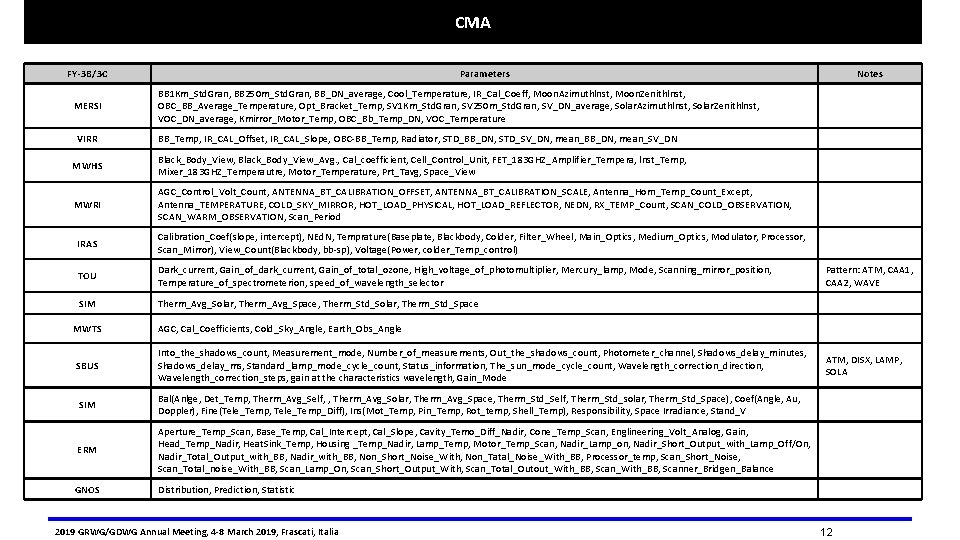
CMA FY-3 B/3 C MERSI VIRR Parameters Notes BB 1 Km_Std. Gran, BB 250 m_Std. Gran, BB_DN_average, Cool_Temperature, IR_Cal_Coeff, Moon. Azimuthlnst, Moon. Zenithlnst, OBC_BB_Average_Temperature, Opt_Bracket_Temp, SV 1 Km_Std. Gran, SV 250 m_Std. Gran, SV_DN_average, Solar. Azimuthlnst, Solar. Zenithlnst, VOC_DN_average, Kmirror_Motor_Temp, OBC_Bb_Temp_DN, VOC_Temperature BB_Temp, IR_CAL_Offset, IR_CAL_Slope, OBC-BB_Temp, Radiator, STD_BB_DN, STD_SV_DN, mean_BB_DN, mean_SV_DN MWHS Black_Body_View, Black_Body_View_Avg. , Cal_coefficient, Cell_Control_Unit, FET_183 GHZ_Amplifier_Tempera, lnst_Temp, Mixer_183 GHZ_Temperautre, Motor_Temperature, Prt_Tavg, Space_View MWRI AGC_Control_Volt_Count, ANTENNA_BT_CALIBRATION_OFFSET, ANTENNA_BT_CALIBRATION_SCALE, Antenna_Horn_Temp_Count_Except, Antenna_TEMPERATURE, COLD_SKY_MIRROR, HOT_LOAD_PHYSICAL, HOT_LOAD_REFLECTOR, NEDN, RX_TEMP_Count, SCAN_COLD_OBSERVATION, SCAN_WARM_OBSERVATION, Scan_Period IRAS Calibration_Coef(slope, intercept), NEd. N, Temprature(Baseplate, Blackbody, Colder, Filter_Wheel, Main_Optics, Medium_Optics, Modulator, Processor, Scan_Mirror), View_Count(Blackbody, bb-sp), Voltage(Power, colder_Temp_control) TOU Dark_current, Gain_of_dark_current, Gain_of_total_ozone, High_voltage_of_photomultiplier, Mercury_lamp, Mode, Scanning_mirror_position, Temperature_of_spectrometerion, speed_of_wavelength_selector SIM Therm_Avg_Solar, Therm_Avg_Space, Therm_Std_Solar, Therm_Std_Space MWTS AGC, Cal_Coefficients, Cold_Sky_Angle, Earth_Obs_Angle SBUS Into_the_shadows_count, Measurement_mode, Number_of_measurements, Out_the_shadows_count, Photometer_channel, Shadows_delay_minutes, Shadows_delay_ms, Standard_lamp_mode_cycle_count, Status_information, The_sun_mode_cycle_count, Wavelength_correction_direction, Wavelength_correction_steps, gain at the characteristics wavelength, Gain_Mode SIM Bal(Anlge, Det_Temp, Therm_Avg_Self, , Therm_Avg_Solar, Therm_Avg_Space, Therm_Std_Self, Therm_Std_solar, Therm_Std_Space), Coef(Angle, Au, Doppler), Fine(Tele_Temp, Tele_Temp_Diff), Ins(Mot_Temp, Pin_Temp, Rot_temp, Shell_Temp), Responsibility, Space Irradiance, Stand_V ERM Aperture_Temp_Scan, Base_Temp, Cal_Intercept, Cal_Slope, Cavity_Temo_Diff_Nadir, Cone_Temp_Scan, Englineering_Volt_Analog, Gain, Head_Temp_Nadir, Heat. Sink_Temp, Housing _Temp_Nadir, Lamp_Temp, Motor_Temp_Scan, Nadir_Lamp_on, Nadir_Short_Output_with_Lamp_Off/On, Nadir_Total_Output_with_BB, Nadir_with_BB, Non_Short_Noise_With, Non_Tatal_Noise_With_BB, Processor_temp, Scan_Short_Noise, Scan_Total_noise_With_BB, Scan_Lamp_On, Scan_Short_Output_With, Scan_Total_Outout_With_BB, Scanner_Bridgen_Balance GNOS Distribution, Prediction, Statistic 2019 GRWG/GDWG Annual Meeting, 4 -8 March 2019, Frascati, Italia Pattern: ATM, CAA 1, CAA 2, WAVE ATM, DISX, LAMP, SOLA 12
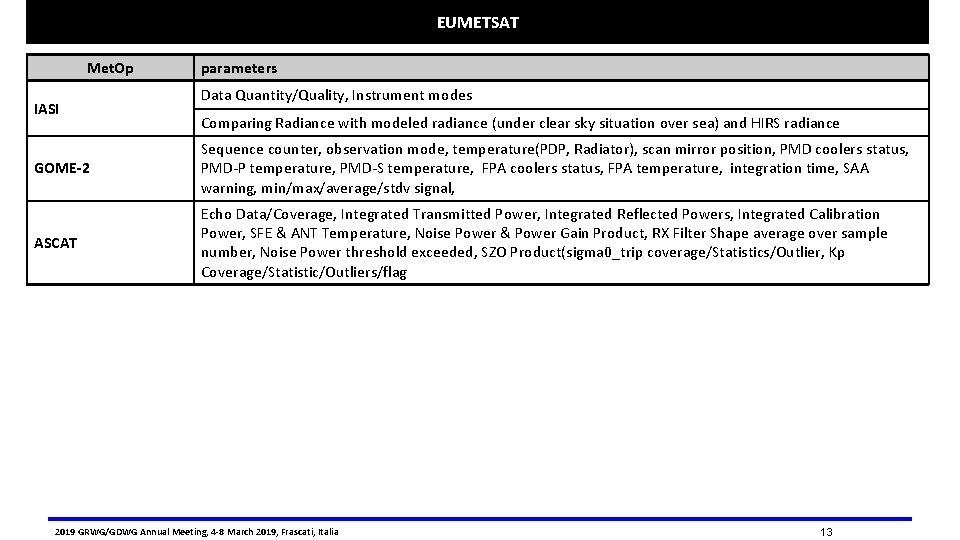
EUMETSAT Met. Op IASI parameters Data Quantity/Quality, Instrument modes Comparing Radiance with modeled radiance (under clear sky situation over sea) and HIRS radiance GOME-2 Sequence counter, observation mode, temperature(PDP, Radiator), scan mirror position, PMD coolers status, PMD-P temperature, PMD-S temperature, FPA coolers status, FPA temperature, integration time, SAA warning, min/max/average/stdv signal, ASCAT Echo Data/Coverage, Integrated Transmitted Power, Integrated Reflected Powers, Integrated Calibration Power, SFE & ANT Temperature, Noise Power & Power Gain Product, RX Filter Shape average over sample number, Noise Power threshold exceeded, SZO Product(sigma 0_trip coverage/Statistics/Outlier, Kp Coverage/Statistic/Outliers/flag 2019 GRWG/GDWG Annual Meeting, 4 -8 March 2019, Frascati, Italia 13
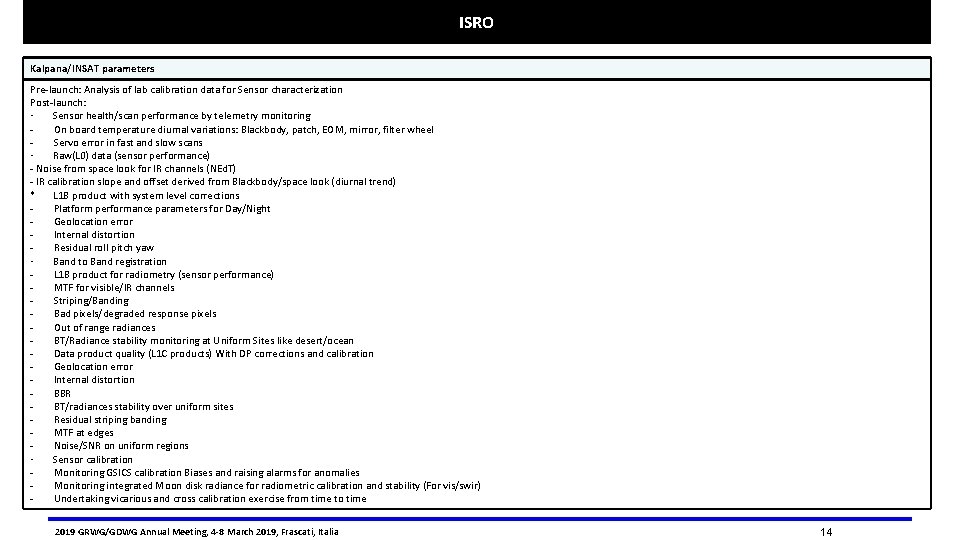
ISRO Kalpana/INSAT parameters Pre-launch: Analysis of lab calibration data for Sensor characterization Post-launch: · Sensor health/scan performance by telemetry monitoring On board temperature diurnal variations: Blackbody, patch, EOM, mirror, filter wheel Servo error in fast and slow scans · Raw(L 0) data (sensor performance) - Noise from space look for IR channels (NEd. T) - IR calibration slope and offset derived from Blackbody/space look (diurnal trend) * L 1 B product with system level corrections Platform performance parameters for Day/Night Geolocation error Internal distortion Residual roll pitch yaw · Band to Band registration L 1 B product for radiometry (sensor performance) MTF for visible/IR channels Striping/Banding Bad pixels/degraded response pixels Out of range radiances BT/Radiance stability monitoring at Uniform Sites like desert/ocean Data product quality (L 1 C products) With DP corrections and calibration Geolocation error Internal distortion BBR BT/radiances stability over uniform sites Residual striping banding MTF at edges Noise/SNR on uniform regions · Sensor calibration Monitoring GSICS calibration Biases and raising alarms for anomalies Monitoring integrated Moon disk radiance for radiometric calibration and stability (For vis/swir) Undertaking vicarious and cross calibration exercise from time to time 2019 GRWG/GDWG Annual Meeting, 4 -8 March 2019, Frascati, Italia 14
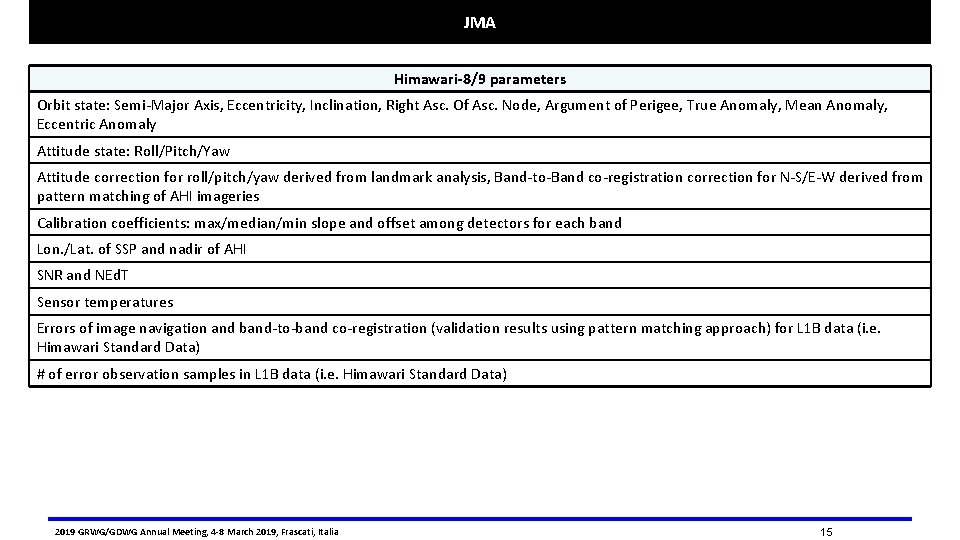
JMA Himawari-8/9 parameters Orbit state: Semi-Major Axis, Eccentricity, Inclination, Right Asc. Of Asc. Node, Argument of Perigee, True Anomaly, Mean Anomaly, Eccentric Anomaly Attitude state: Roll/Pitch/Yaw Attitude correction for roll/pitch/yaw derived from landmark analysis, Band-to-Band co-registration correction for N-S/E-W derived from pattern matching of AHI imageries Calibration coefficients: max/median/min slope and offset among detectors for each band Lon. /Lat. of SSP and nadir of AHI SNR and NEd. T Sensor temperatures Errors of image navigation and band-to-band co-registration (validation results using pattern matching approach) for L 1 B data (i. e. Himawari Standard Data) # of error observation samples in L 1 B data (i. e. Himawari Standard Data) 2019 GRWG/GDWG Annual Meeting, 4 -8 March 2019, Frascati, Italia 15
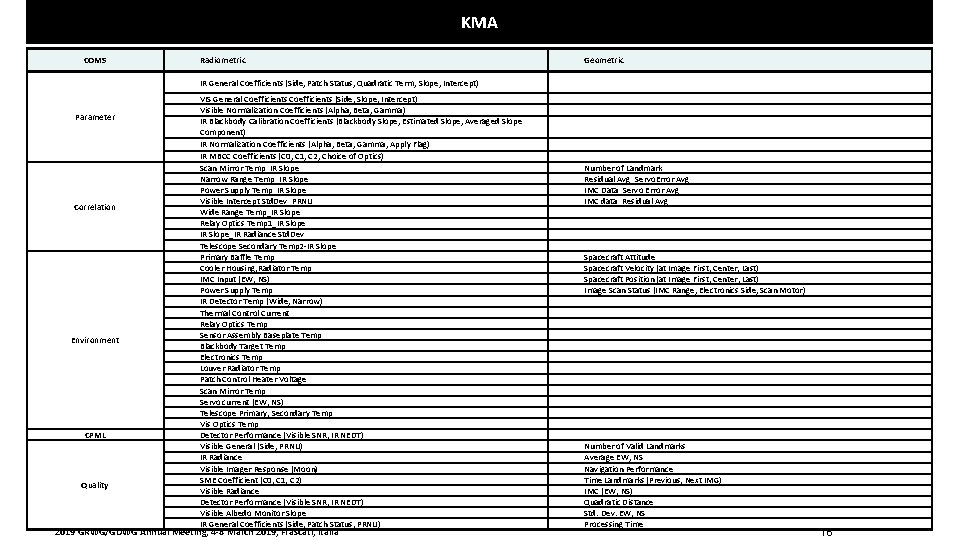
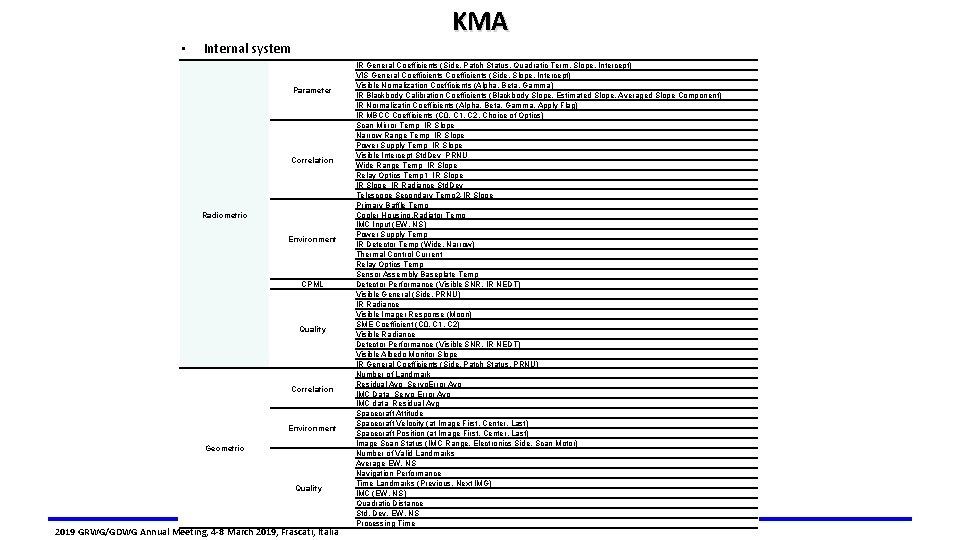
KMA COMS Radiometric Geometric IR General Coefficients (Side, Patch Status, Quadratic Term, Slope, Intercept) Parameter Correlation Environment CPML Quality VIS General Coefficients (Side, Slope, Intercept) Visible Normalization Coefficients (Alpha, Beta, Gamma) IR Blackbody Calibration Coefficients (Blackbody Slope, Estimated Slope, Averaged Slope Component) IR Normalization Coefficients (Alpha, Beta, Gamma, Apply Flag) IR MBCC Coefficients (C 0, C 1, C 2, Choice of Optics) Scan Mirror Temp_IR Slope Narrow Range Temp_IR Slope Power Supply Temp_IR Slope Visible Intercept Std. Dev_PRNU Wide Range Temp_IR Slope Relay Optics Temp 1_IR Slope_IR Radiance Std. Dev Telescope Secondary Temp 2 -IR Slope Primary Baffle Temp Cooler Housing, Radiator Temp IMC Input (EW, NS) Power Supply Temp IR Detector Temp (Wide, Narrow) Thermal Control Current Relay Optics Temp Sensor Assembly Baseplate Temp Blackbody Target Temp Electronics Temp Louver Radiator Temp Patch Control Heater Voltage Scan Mirror Temp Servo current (EW, NS) Telescope Primary, Secondary Temp Vis Optics Temp Detector Performance (Visible SNR, IR NEDT) Visible General (Side, PRNU) IR Radiance Visible Imager Response (Moon) SME Coefficient (C 0, C 1, C 2) Visible Radiance Detector Performance (Visible SNR, IR NEDT) Visible Albedo Monitor Slope IR General Coefficients (Side, Patch Status, PRNU) 2019 GRWG/GDWG Annual Meeting, 4 -8 March 2019, Frascati, Italia Number of Landmark Residual Avg_Servo. Error Avg IMC Data_Servo Error Avg IMC data_Residual Avg Spacecraft Attitude Spacecraft Velocity (at Image First, Center, Last) Spacecraft Position (at Image First, Center, Last) Image Scan Status (IMC Range, Electronics Side, Scan Motor) Number of Valid Landmarks Average EW, NS Navigation Performance Time Landmarks (Previous, Next IMG) IMC (EW, NS) Quadratic Distance Std. Dev. EW, NS Processing Time 16
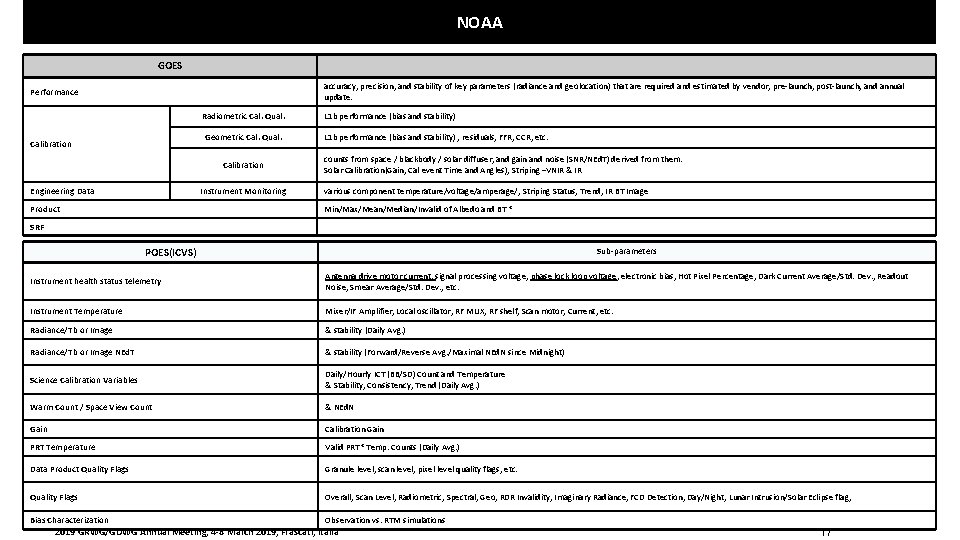
NOAA GOES accuracy, precision, and stability of key parameters (radiance and geolocation) that are required and estimated by vendor, pre-launch, post-launch, and annual update. Performance Radiometric Cal. Qual. Geometric Cal. Qual. Calibration Engineering Data Instrument Monitoring Product L 1 b performance (bias and stability) , residuals, FFR, CCR, etc. counts from space / blackbody / solar diffuser, and gain and noise (SNR/NEd. T) derived from them. Solar Calibration(Gain, Cal event Time and Angles), Striping –VNIR & IR various component temperature/voltage/amperage/, Striping Status, Trend, IR BT Image Min/Max/Mean/Median/Invalid of Albedo and BT * SRF POES(ICVS) Sub-parameters Instrument health status telemetry Antenna drive motor current, signal processing voltage, phase lock loop voltage, electronic bias, Hot Pixel Percentage, Dark Current Average/Std. Dev. , Readout Noise, Smear Average/Std. Dev. , etc. Instrument Temperature Mixer/IF Amplifier, Local oscillator, RF MUX, RF shelf, Scan motor, Current, etc. Radiance/Tb or Image & stability (Daily Avg. ) Radiance/Tb or Image NEd. T & stability (Forward/Reverse Avg. /Maximal NEd. N since Midnight) Science Calibration Variables Daily/Hourly ICT (BB/SD) Count and Temperature & Stability, Consistency, Trend (Daily Avg. ) Warm Count / Space View Count & NEd. N Gain Calibration Gain PRT Temperature Valid PRT* Temp. Counts (Daily Avg. ) Data Product Quality Flags Granule level, scan level, pixel level quality flags, etc. Quality Flags Overall, Scan Level, Radiometric, Spectral, Geo, RDR Invalidity, Imaginary Radiance, FCD Detection, Day/Night, Lunar Intrusion/Solar Eclipse flag, Bias Characterization Observation vs. RTM simulations 2019 GRWG/GDWG Annual Meeting, 4 -8 March 2019, Frascati, Italia 17
Thank you 2019 GRWG/GDWG Annual Meeting, 4 -8 March 2019, Frascati, Italia 18
[Parameter Definition Example] NEd. T NE△T specification and monitoring for microwave sounders(2015, NWP SAF) includes 6 different methods: 1)NOAA/ATMS, 2)Met Office, 3)EUMETSAT, 4)NOAA STAR, 5)MWS, 6)Allan Deviation methods EUMETSAT NOAA STAR ICVS ~2015~ Reference: NEd. T specification and monitoring for microwave sounders, 2015, NWP SAF 2019 GRWG/GDWG Annual Meeting, 4 -8 March 2019, Frascati, Italia Reference: 2015 STAR ICVS Instrument Performance Review ATMS/AMSU/MHS Anomaly Report, Ninghai Sun, NOAA/NESDIS/STAR • EUMETSAT: standard deviation based NEd. T • NOAA : Allan deviation method since 2015
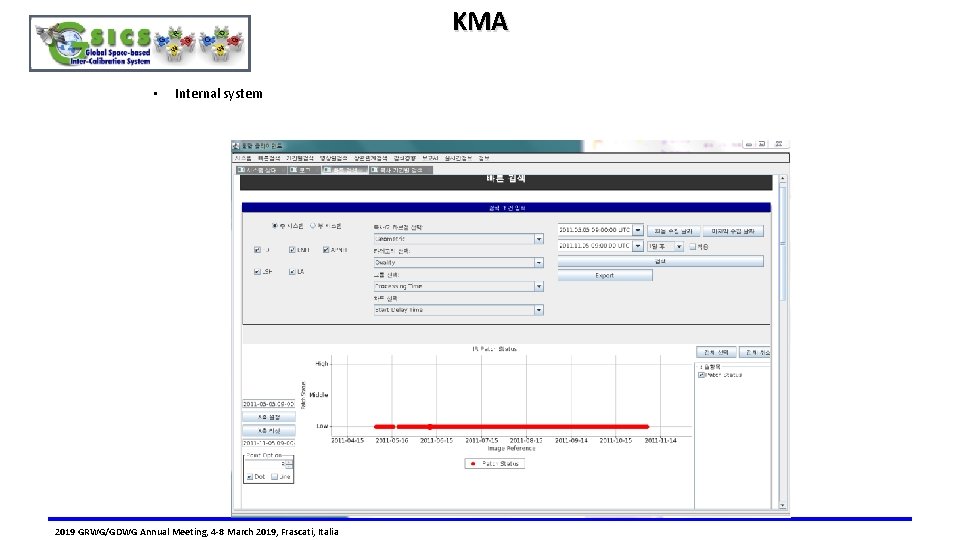
KMA • Internal system 2019 GRWG/GDWG Annual Meeting, 4 -8 March 2019, Frascati, Italia
KMA • Internal system Parameter Correlation Radiometric Environment CPML Quality Correlation Environment Geometric Quality 2019 GRWG/GDWG Annual Meeting, 4 -8 March 2019, Frascati, Italia IR General Coefficients (Side, Patch Status, Quadratic Term, Slope, Intercept) VIS General Coefficients (Side, Slope, Intercept) Visible Nomalization Coefficients (Alpha, Beta, Gamma) IR Blackbody Calibration Coefficients (Blackbody Slope, Estimated Slope, Averaged Slope Component) IR Normalizatin Coefficients (Alpha, Beta, Gamma, Apply Flag) IR MBCC Coefficients (C 0, C 1, C 2, Choice of Optics) Scan Mirror Temp_IR Slope Narrow Range Temp_IR Slope Power Supply Temp_IR Slope Visible Intercept Std. Dev_PRNU Wide Range Temp_IR Slope Relay Optics Temp 1_IR Slope_IR Radiance Std. Dev Telescope Secondary Temp 2 -IR Slope Primary Baffle Temp Cooler Housing, Radiator Temp IMC Input (EW, NS) Power Supply Temp IR Detector Temp (Wide, Narrow) Thermal Control Current Relay Optics Temp Sensor Assembly Baseplate Temp Detector Performance (Visible SNR, IR NEDT) Visible General (Side, PRNU) IR Radiance Visible Imager Response (Moon) SME Coefficient (C 0, C 1, C 2) Visible Radiance Detector Performance (Visible SNR, IR NEDT) Visible Albedo Monitor Slope IR General Coefficients (Side, Patch Status, PRNU) Number of Landmark Residual Avg_Servo. Error Avg IMC Data_Servo Error Avg IMC data_Residual Avg Spacecraft Attitude Spacecraft Velocity (at Image First, Center, Last) Spacecraft Position (at Image First, Center, Last) Image Scan Status (IMC Range, Electronics Side, Scan Motor) Number of Valid Landmarks Average EW, NS Navigation Performance Time Landmarks (Previous, Next IMG) IMC (EW, NS) Quadratic Distance Std. Dev. EW, NS Processing Time
EUMETSAT [MSG 1/2/3/4] 1) Orbit state: Epoch, X(Y/Z)-position, SRP coefficient, Semi-Major Axis, Eccentricity Inclination, Right Asc. Of Asc. Node, Argument of Perigee, True Anomaly, Longitude at epoch, Mean Longitude; The orbital parameters for all operational Meteosat spacecraft are distributed via a dedicated mailing list in the form of weekly email 2) Attitude state: Epoch, Spin Axis Right Asc. , Spin Axis Declination, Spin Axis X(Y/Z) 3) Physical state: Epoch, Spin Rate, Total Mass, Fuel Mass, Oxidizer Mass [Products] - OSSI provides users with a near real-time view of the status of the operational service provided by EUMETSAT. [Calibration] - MSG/MFG Calibration - Inter-calibration: Monitored instrument, reference instrument, status, GSICS product, documentation 1) Instrument Specification 2) Instrument Events (database of calibration related events) 3) Instrument Monitoring (database or documents with information on the instrument state) 4) Data Outgases (graphs with information on instrument outage dates) 5) Relevant Documents 2019 GRWG/GDWG Annual Meeting, 4 -8 March 2019, Frascati, Italia
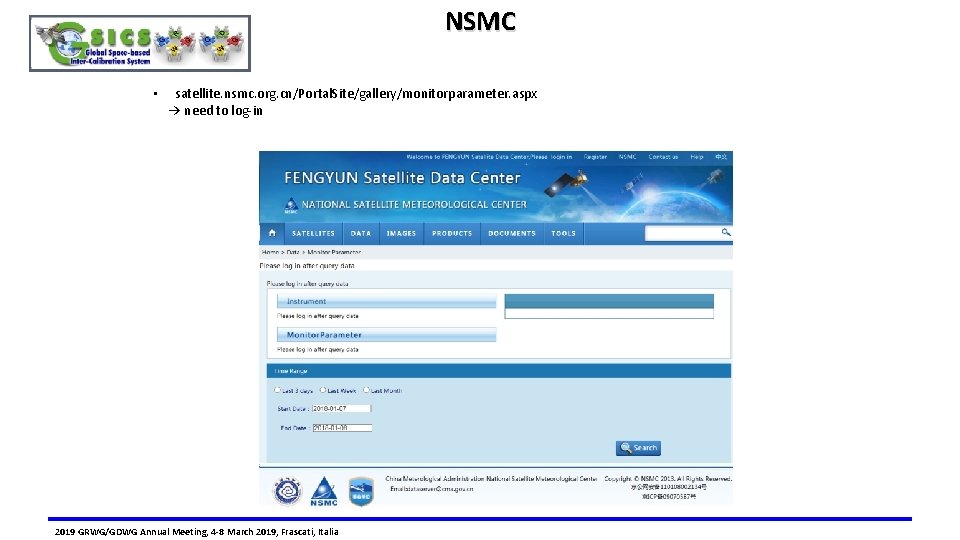
NSMC • satellite. nsmc. org. cn/Portal. Site/gallery/monitorparameter. aspx → need to log-in 2019 GRWG/GDWG Annual Meeting, 4 -8 March 2019, Frascati, Italia